A.C. Galbraith 1877-1963
Alexander Cameron Galbraith was born in Paisley, Ontario, Canada on March 9, 1877. By 1891 he appears in Lisgar, Manitoba, a small town south of Winnipeg near the North Dakota border, where his family was farming. In 1906 at age 17, Alex is living in Winnipeg with his parents and five younger siblings. Three years later he marries Emilie Elizabeth Whittmauer in Winnipeg. Their first two children—Mabel and Howard—are born there: Alex is listed as a builder in the Canadian census of 1911. By 1914, the young family has moved west to Edmonton where daughter Marjorie is born and Alex is listed as a contractor for the railroad. About this time he incorporates a dredging company, which goes bankrupt.
Meanwhile Alex was making periodic visits to Oregon, and the family decides to move to the St. Johns area. In September 1919 they are in Portland and he is one of five incorporators to establish the George E. Englehart Realty Company. That October, Alex appears as a selling agent for homes in Portland and farm properties in eastern Oregon. In 1920, he and Emilie and their three children are living in a home he built, now a parking lot, at the corner of North Oberlin and Monteith.
An economic boom following the end of World War 1 fueled speculation in Portland real estate and significant growth in homebuilding, with Portland setting records for building permits issued on the West Coast. Alex sees this economic opportunity and incorporates as A.C. Galbraith Housebuilding Company—still maintaining business ties with Englehart—with Alex as president and offices at 209 S. Jersey in St. Johns, a storefront just north of today’s St. Johns Cinema. The company launches into construction of small, simple bungalows throughout St. Johns and begins to gain a reputation for their work, which continues to expand.
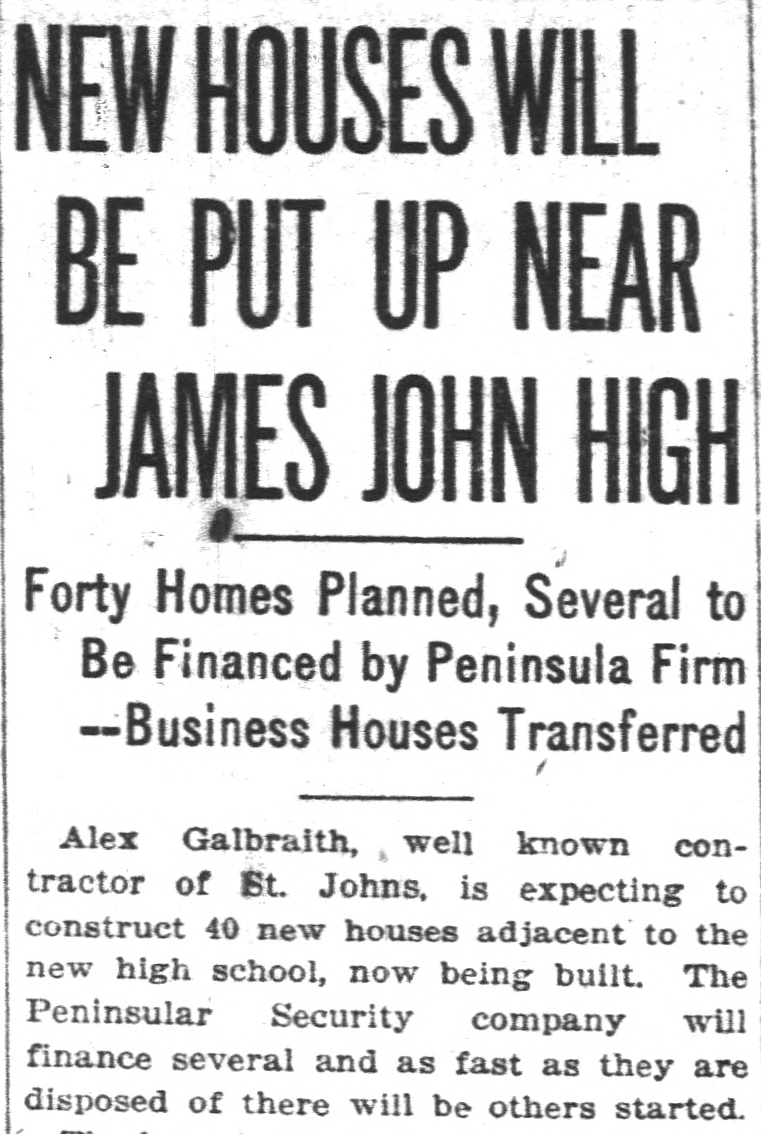
From the Oregon Journal, February 5, 1922
Many of these houses, on the north side of the 6900 and 7000 block of N. Central Avenue, were later demolished for expansion of Roosevelt High School.
In the midst of his busy building career, Alex and Emilie both became naturalized citizens. Vouching for them as upstanding citizens was business colleague George E. Englehart. The Galbraiths became citizens on September 18, 1924.
A review of the building styles built by Galbraith suggests he utilized two types of simple bungalow designs, both involved one-story, center-entry, covered front porch bungalows that were favored early in Portland’s real estate market expansion. In the first years of his building career, Galbraith built a simple one-story bungalow with two windows and door facing the street, sometimes with the gable end forward and other times with the gable parallel to the street. He also built several small Craftsman style bungalows with front porch columns, brackets and prominent wide fascia.
In late 1922 and 1923, Galbraith shifted to a jerkinhead or clipped-gable roof style. The jerkinhead design combines a gable roof and a hipped roof, resulting in a truncated pitched surface above the partial gable end of the roof. Like this:
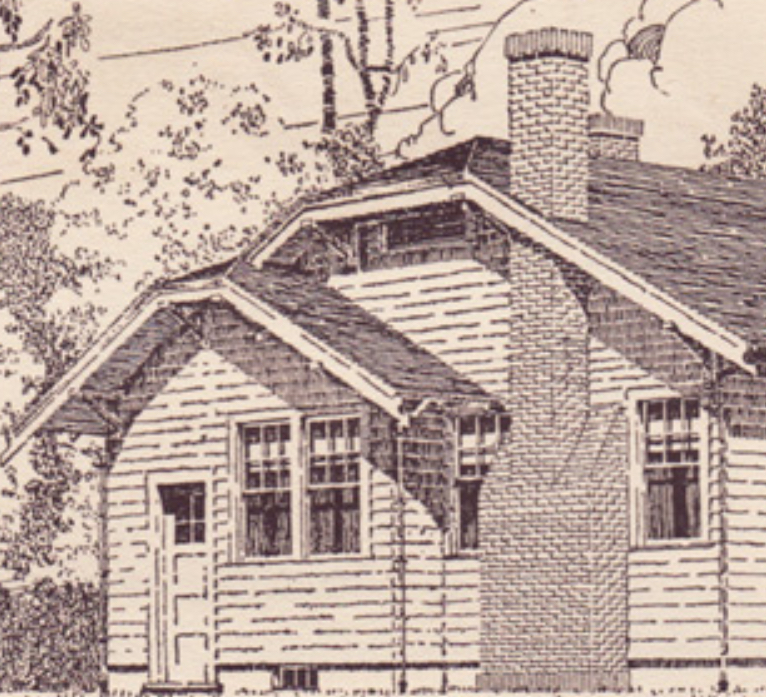
Detail of a jerkindhead-style clipped gable, from Telegram Plan Book Design 421.
It’s likely Galbraith was working from a standard plan set, like so many builders of the time. Here’s one from Portland-based Universal Plan Service that bears a striking resemblance with bungalows he built from 1922-1926.
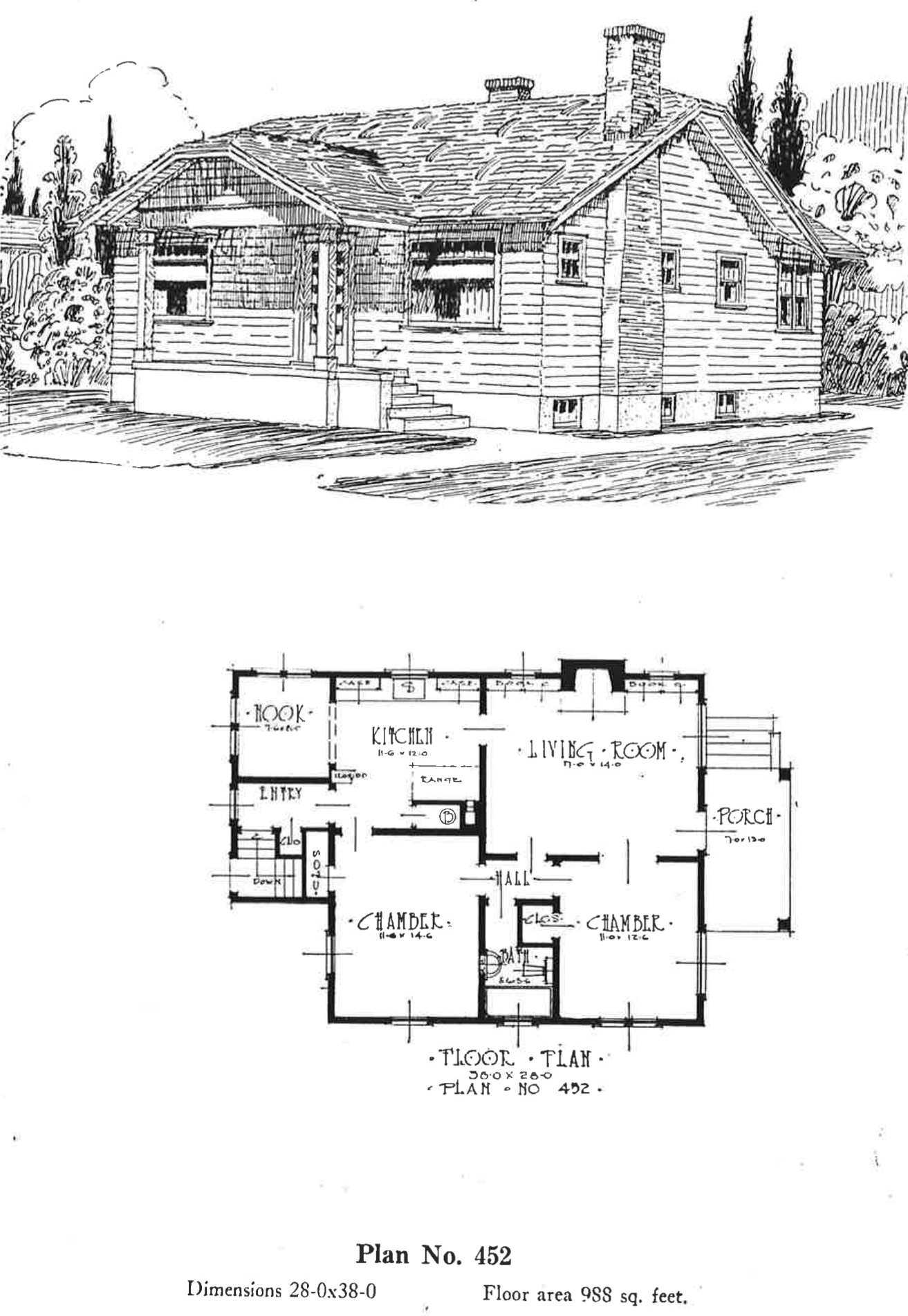
A review of Galbraith building permits and newspaper references to homes he built, shows that most of the permits were taken out by Emilie, and the newspaper references report that Mrs. A.C. Galbraith is planning to build a particular house. This was not unusual: often a builder’s wife was also the business manager involved with the paperwork side of home building.
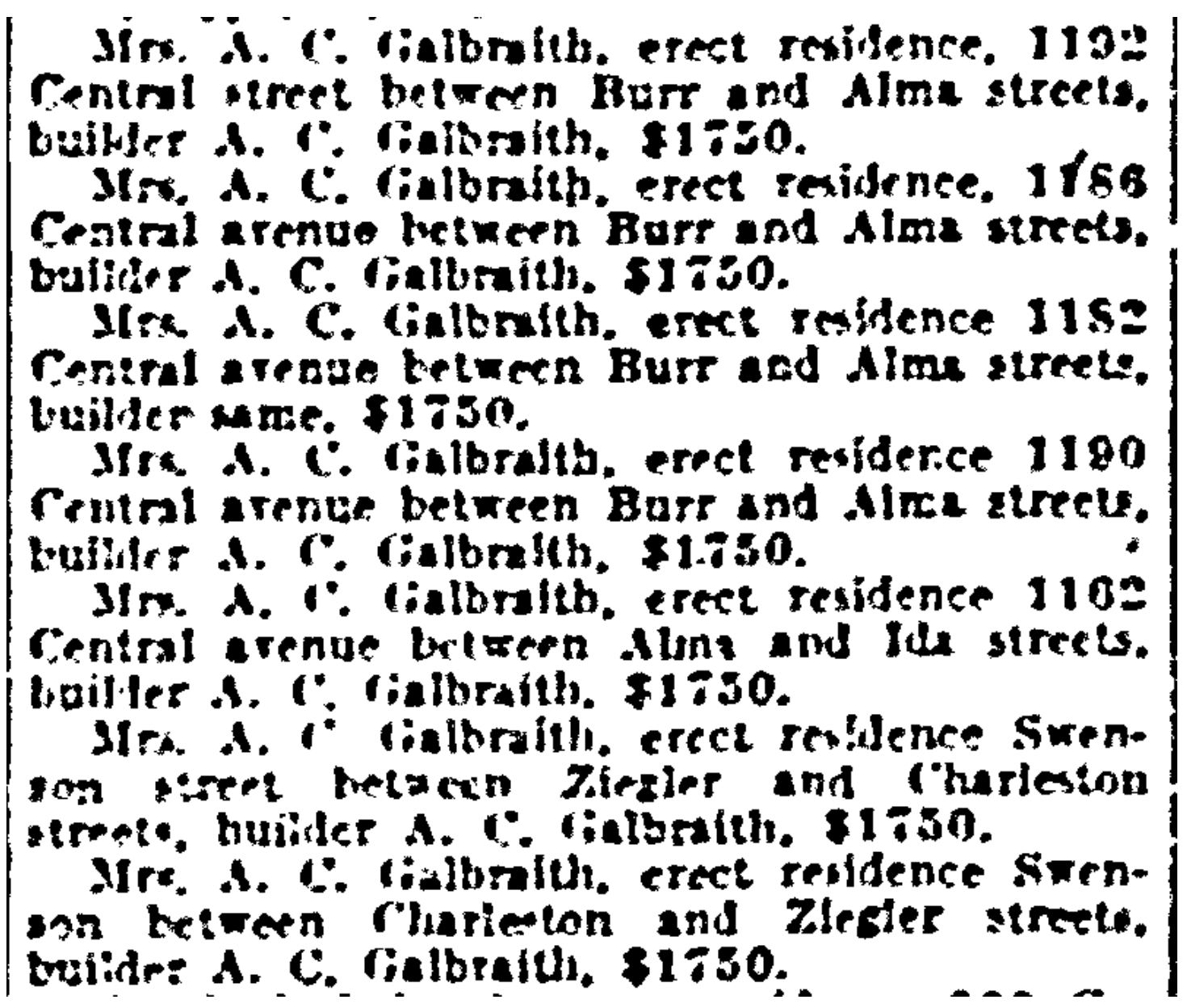
From the Oregon Journal, June 22, 1923
Perhaps the pinnacle of Alex Galabraith’s construction career was the First National Bank building at 230 S. First Street in St. Helens, Oregon, which he built for $20,000. The 1,700 square-foot building packs a lot of ostentatious “financial institution” design into a small city lot. Most recently it has served as an office of the Association of Western Pulp and Paper Workers Union.
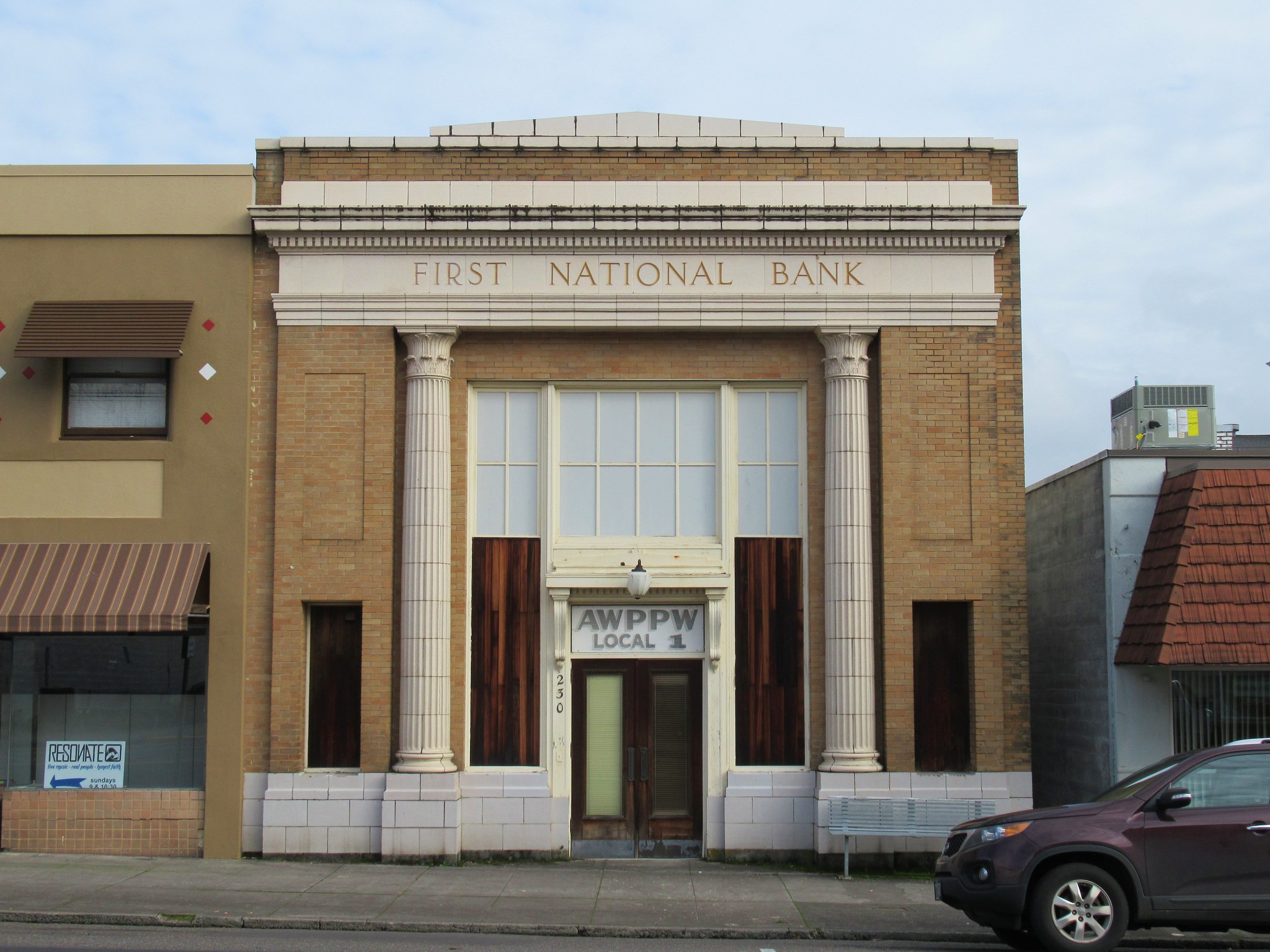
230 S. First Avenue, St. Helens, Oregon. Built by Galbraith in 1925. Photo credit: Jasperdo/Flickr
This is the last building I was able to find built by Galbraith, though he likely built other residential and commercial buildings in the closing years of the 1920s before the Great Depression turned the real estate market—and the Galbraith’s lives—upside down.
The 1930 census shows that Emilie and Alex had split: she moved back to Edmonton for several years and Alex moved in with his son Howard at 106 Swenson (today’s 8317 N. Swenson). In 1937-1938 Alex was living with Mabel and Howard, who at that time shared a home at 3024 N. Halleck. The next year, 1939, the children signed their father’s wedding record as witnesses when at age 62 Alex married Lucy Fults Kennedy.
The newlyweds moved into 8104 N. Ivanhoe and Alex took a job working as a superintendent for the Works Progress Administration. In the late 1930s, he was the project superintendent on construction of the tunnels and road to the top of Rocky Butte. On September 20, 1939, Alex was one of the speakers at ribbon cutting for the tunnel. In the early 1940s he became a licensed real estate broker working for Cooley and Rinehart, a large Portland real estate firm, where he worked until the late 1950s. Alex died on January 19, 1963 and is interred at Riverview Abbey Crematorium. Emilie died in St. Johns on July 1, 1967.
A partial list of homes built by Alex Galbraith includes the following:
5808 N. Princeton February 1921
7872 N. Kellogg (demolished) February 1921
8522 N. Oswego July 1921
8514 N. Oswego July 1921
8504 N. Oswego July 1921
5731 N. Syracuse October 1921
Two houses at Ivanhoe and Alama (demolished) October 1921
4105 NE 11th October 1921
6932 N. Jersey December 1921
6922 N. Jersey December 1921
7104 N. Central August 1922
6900 Block of N Central (five houses demolished for Roosevelt HS) June 1922
Pre-address change numbers 1192, 1186, 1182, 1190, 1162
8317 N. Swenson June 1922
8305 N. Swenson June 1922
6504 NE 26th July 1922
2717 NE Stanton July 1922
8330 SE Morrison July 1922
8124 SE Morrison July 1922 same design as 5816
8134 SE Morrison July 1922
2812 SE 43rd August 1922
6906 N. Leonard September 1922
6930 N. Leonard September 1922
7014 N. Leonard (demolished) September 1922
7036 N. Leonard (demolished) + 3 other houses on the north side of the street
Pre-address change numbers 1199, 1203, 1205
7123 N. Lombard (demolished) September 1922
7225 N. Lombard October 1922 for Chauncey Yoder
7217 N. Lombard October 1922 same design as 5816
7225 N. Lombard October 1922
7301 N. Lombard (demolished) October 1922
5005 N. Oberlin October 1922 for Fred Yoder
Two houses on Lombard between Burr and Buchanan (demolished) October 1922
7561 N. Woolsey March 1923
7548 N. Brandon March 1923 same design as 5816
3833 NE 23rd April 1923
1134 N. Alberta (demolished for I-5) June 1923
3640 NE Bryce June 1924
9523 N. Fairhaven June 1924
230 S. First St., St. Helens (First National Bank) 1925

 Alameda Old House History