Max Shimshak 1897-1978
Max Shimshak was a prolific Portland homebuilder from 1920-1950, building many high-end homes on Portland’s eastside, in Lake Oswego and the Dunthorpe neighborhood.
Shimshak’s eastside work was concentrated in Alameda, Beaumont, Irvington, Dolph Park and Eastmoreland, He frequently worked with noted regional architects including Wade Pipes, Roscoe Hemenway and Francis Jacobberger. An article in The Oregonian in 1985 about the evolution of building practices recounted Shimshak’s demanding standards.
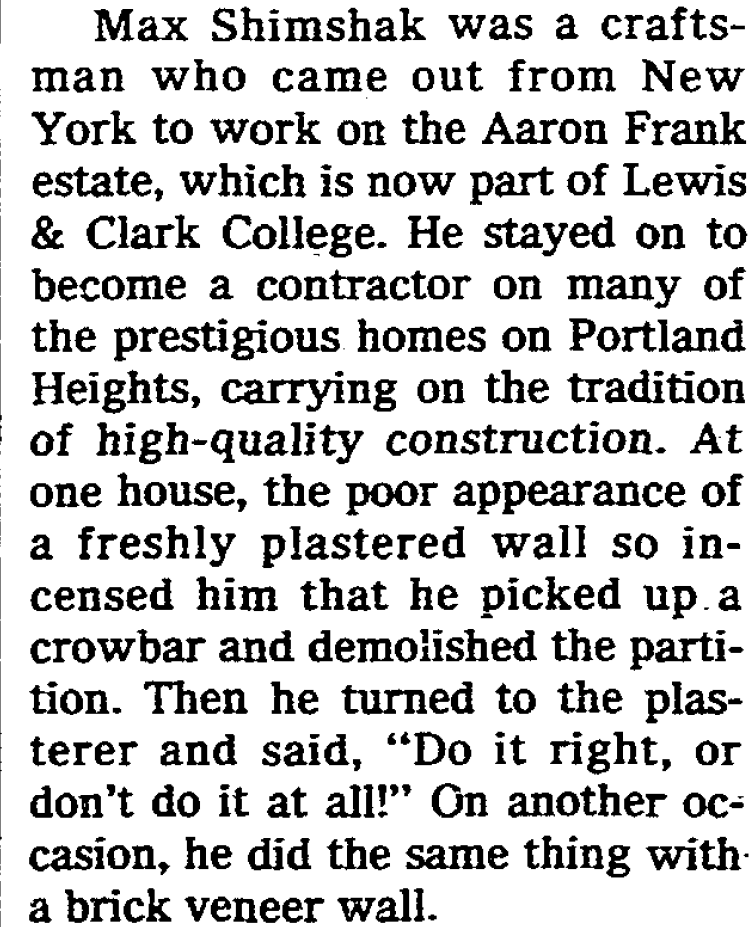
From The Oregonian, February 24, 1985
Born Manus Schimschak in Stepin, Russia on February 15, 1897, Shimshak immigrated to the US with many other Russian Jews fleeing violent pogroms, arriving in New York Harbor on May 23, 1911. He came to Portland in 1917, Americanized his name, and began his homebuilding career, starting with a home on NE 17th in Irvington. He was well known and respected in the Portland real estate market.
Shimshak was active in the Neveh Shalom and Neveh Zedek synagogues and oversaw construction of the Robinson Jewish Home. He was active in his construction business which he ran with his son Jack up until his retirement in 1977 at age 80. He died in Portland on April 27, 1978. For many years after his death, advertisements for houses he built continued to boast that they were a Max Shimshak home. He advertised himself as “Builder of Fine Homes.”
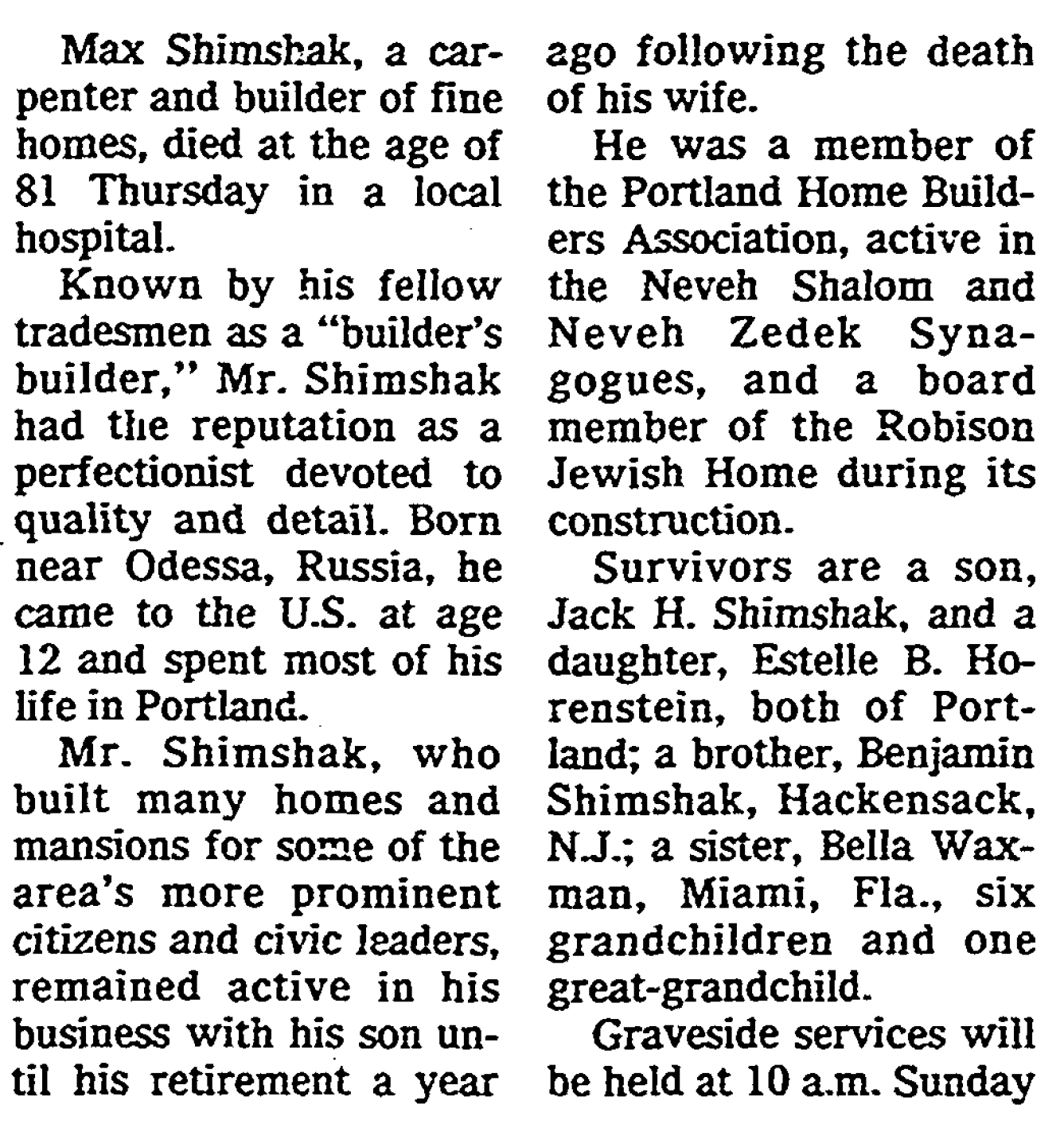
From The Oregon Journal, April 29, 1978
Shimshak frequently worked with well-known architects Roscoe Hemenway, Wade Pipes and Francis Jaccoberger. Hemenway designed more than 200 residences in the Portland area and like Shimshak, his work continues to be recognized and hold prestige today.
A partial list of homes built my Max Shimshak includes:
2945 NE 17th (1919)
2500 NE Mason (1927)
2447 NE Dunckley (1927)
3801 NE 21st (1927)
3854 NE 21st (1927)
4121 NE 24th (1928)
2510 NE Klickitat (1929)
3273 NE Dunckley (1930)
2920 NE 35th (1932)
3201 NE Alameda (1935)
2820 NE 17th (1936)

 Alameda Old House History
In the mid-1930s, Max Shimshak built two homes side-by-side on NE U.S. Grant Place, numbers 2806 and 2818. The highly detailed brick homes replaced wooden houses that had been on the lots for a few decades since the area had initially developed on the northern edge of Fernwood. Immediately adjacent to the north of the new houses was Dolph Park, which was developed from the Dolph-Cardinell orchards starting in the mid-1920s. Shimshak built number 2806 for Abe Blank, Circulation Manager of The Oregonian newspaper. Blank was a Jewish immigrant from Ukraine. Shimshak built number 2818 apparently without an immediate buyer, and it remained on the market for several months. Samuel I. Pearlman bought 2818 and lived there with his family for many years. Pearlman, a Jewish immigrant from Russia, was co-owner of Pearlman Brothers Furniture Company on SE Grand Avenue. Numbers 2806 and 2818 were not part of Dolph Park itself and thus were not subject to its restrictive covenants governing home ownership.
Thank you Stephen. Be sure to have a look at our post about Dolph Park: https://alamedahistory.org/2022/08/20/dolph-park-restrictions-shaped-the-early-neighborhood-creating-an-enclave-of-wealth-and-big-houses/