Our recent post on the prolific Portland homebuilders known as Hiller Brothers Inc. grew out of our research on one of their classic bungalows on NE Knott Street. In the post, we mentioned several family resemblances among these homes: windows, built-ins, doors, hardware.
As it turns out there’s another distinctive feature that came to light as neighbors began talking with neighbors. It’s an archway that looks like this:
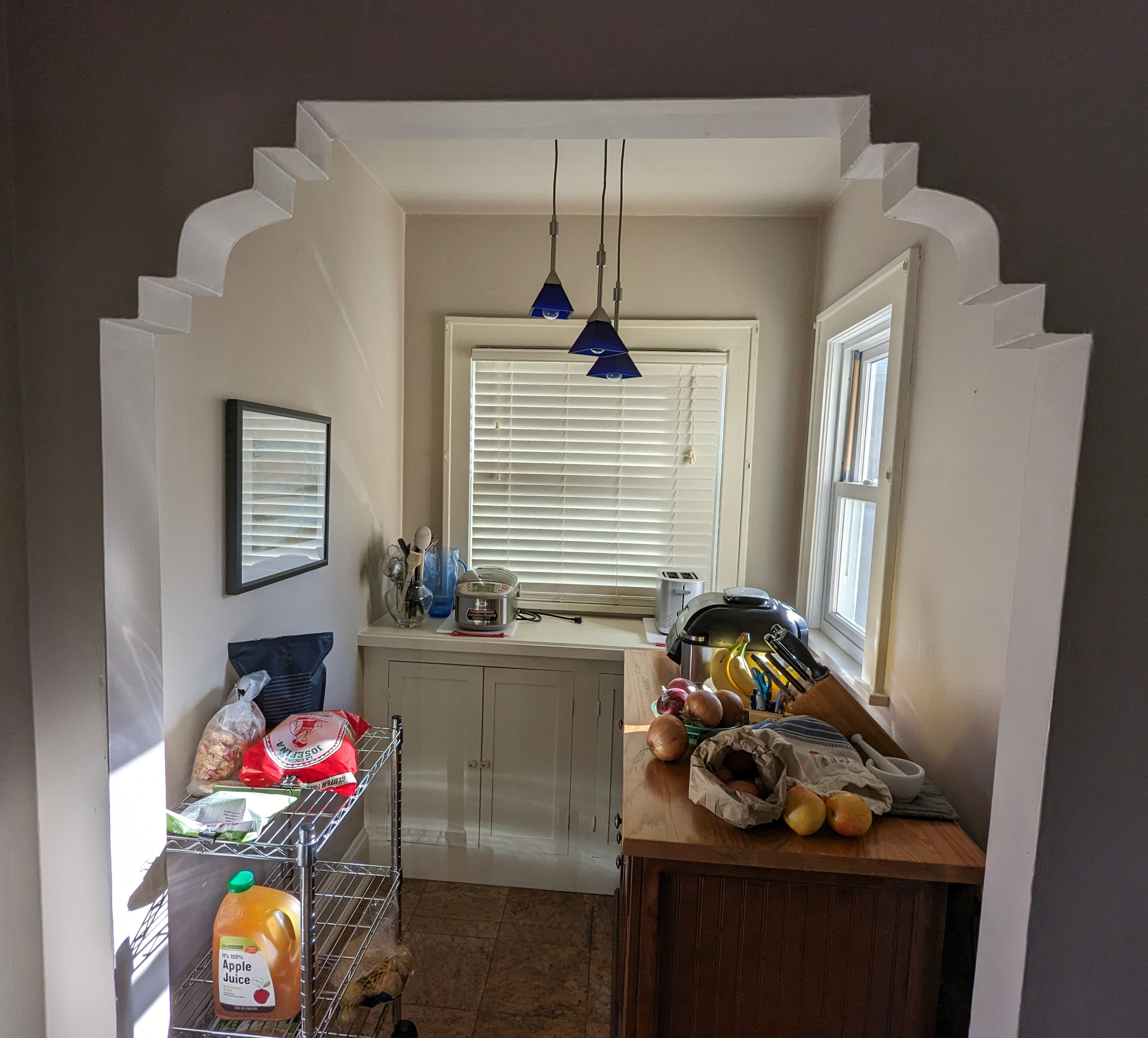
That distinctive coved shape defining the room is called a cavetto, or quarter-circle, joined to a couple of 90-degree steps top and bottom to create a decorative entry feature that reveals this cozy space–once a breakfast nook–located just off the kitchen. In at least a couple of the Hiller homes we know of, the distinctive cavetto cove is still there and the small space has been converted into a pantry-like area that offers a worktop as well. In some homes, the nook has likely already been annexed into kitchen extensions. Some homeowners might be eyeing that nook and arch right now mulling over remodeling plans.
It would be interesting to hear from others on the Hiller Brothers address list if this cavetto cove and nook feature look familiar. We bet there are more than few still out there.
Which leads to the topic of nooks (more formally inglenooks), a worthy eventual blog post.
Do you have a favorite nook space that operates near the heartbeat of the house? We do, in our 1912 Arts and Crafts bungalow, but it’s a design generation earlier than the Hillers and their hard working architect Hubert A. Williams.


 Alameda Old House History