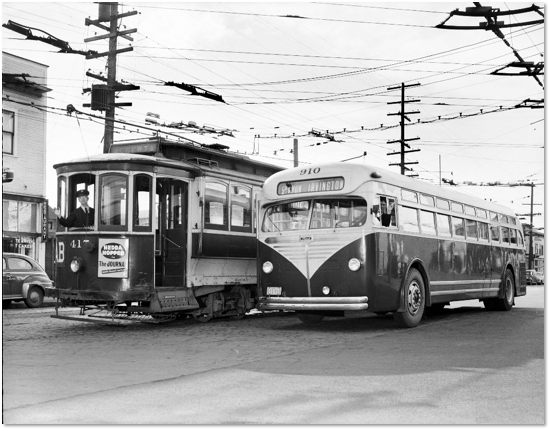
Streetcars and buses like these have served the Alameda neighborhood since 1910. TriMet service cuts made in August 2026 ended a 116-year tradition of transit service to the neighborhood. This photo–showing the old Alberta Streetcar and its bus replacement–ran in the 1947 Portland Transit Company annual report to illustrate the end of streetcar service and the beginning of bus service on that route. The caption: “Walt Baker, trolley skipper since 1911, greets Merritt Lutman, pilot of a new Mack bus.”
It’s official: the TriMet bus service cuts and route adjustments made starting today represent the first time in 116 years the majority of the Alameda neighborhood has been disconnected from public transit to downtown Portland.
On August 23rd, TriMet officially eliminated two bus lines completely citing low ridership, and reduced service on 34 other lines, including Bus 17, which since 1948 has traveled much of the route originally covered by the old Broadway Streetcar, through the central part of Alameda and Irvington.
TriMet says the cuts—paired with elimination of 400 positions and layoff of 170 employees—are necessary to help address a $158 million budget shortfall.
Almost ever single day since 1910, weather permitting, Alameda has been served by public transit, beginning when the subdivision was first carved out of brush, fields and forests along the Alameda Ridge. Back then, the Alameda Land Company paid to build the streetcar to its terminus at NE 29th and Mason as a way of bringing potential homebuyers into the neighborhood and later providing an attractive transit link to downtown for the growing neighborhood.
In 1910, the area was an undeveloped patch of mud and brush. Streets were not paved until 1912 and automobiles were scarce, making public transit in the form of the Broadway Streetcar essential to day-to-day life.
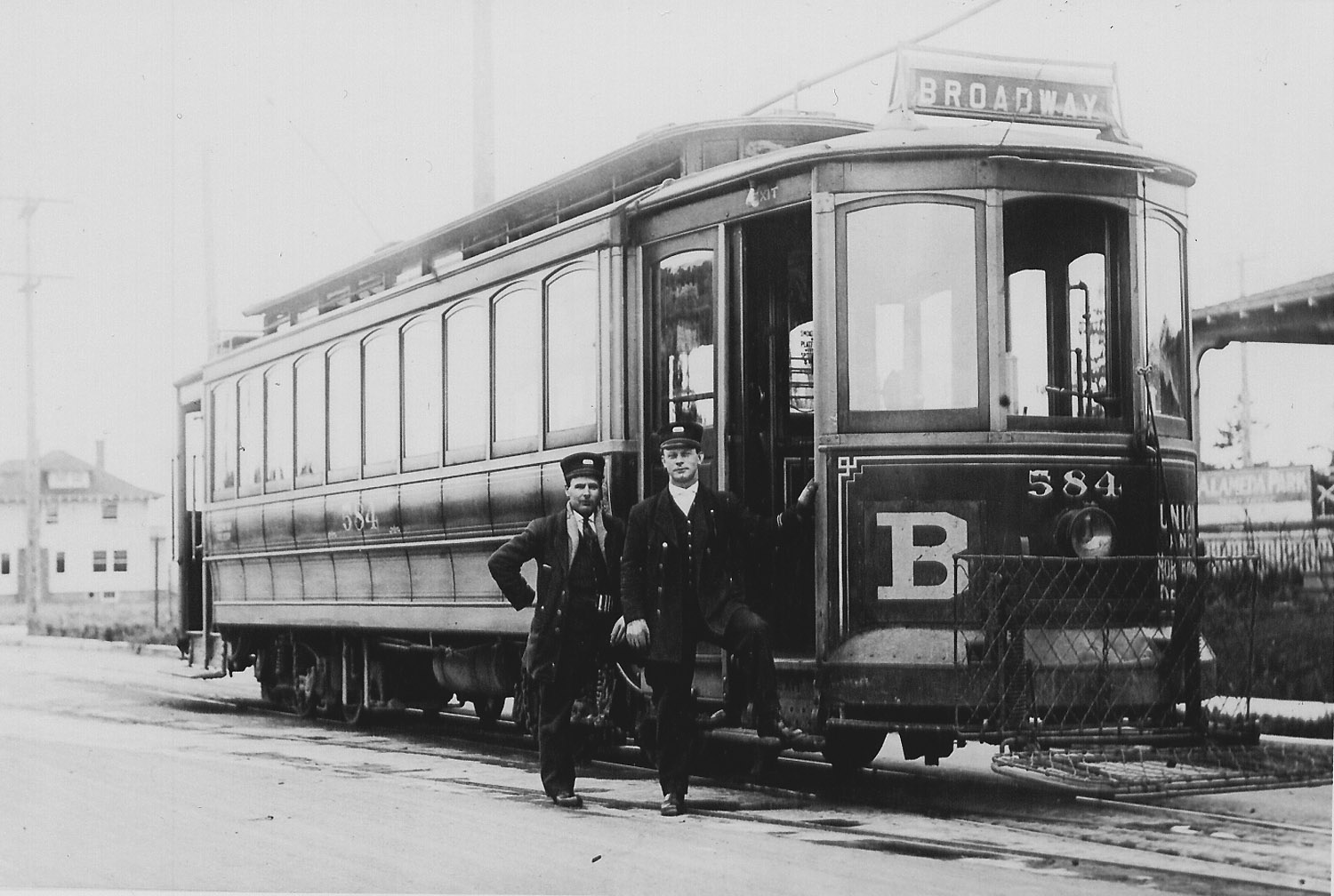
The Broadway Streetcar at the end of the line, looking north near NE 29th and Mason, about 1910. The house in the background to the left is still there today. A banner on the porch of the Alameda Land Company Tract Office to the right announces the availability of homes. Photo Courtesy of the Bill Hayes Collection.
A narrative map of the Broadway Streetcar’s complete 8.8 mile circuit between Alameda and downtown Portland would go something like this, beginning at the outbound end at NE 29th and Mason: Once the streetcar arrived at the end of the line from downtown, the motorman would step outside, drop the trolley pole on one end of the car and secure it to the roof. He would raise the pole on the other end for the trip downtown and hook it to the overhead line. And off he would go to the south on NE 29th, passing straight through today’s “Bus and Bicycle Only” notch at Regents and Alameda, then down the hill to 24th, where the rails turned south.
At 24th and Fremont, the line jogged west for two blocks before turning south on 22nd. The streetcar continued south on 22nd toward Broadway, with a minor “s” turn at Tillamook before the corner onto Broadway, where it turned west toward downtown and across the Broadway Bridge. The downtown end of the line was at Broadway and Jefferson, where the process began again as the motorman readied for the outbound trip. A key difference on the outbound leg was that the car turned north on 24th not 22nd.
The loop formed by the 22nd and 24th couplet—the Fremont Loop—makes for a nice walking circuit even today.
In 1923, a trip downtown cost an adult 8 cents. Kids could buy a special packet of school tickets allowing 25 rides for $1. In 1932, a monthly pass for unlimited rides cost $1.25. Alamedans used the streetcar as a vital link to shopping, churchgoing, commuting to the office, trips to the doctor. Some even rode the line for entertainment.
During the day, cars ran every 10 minutes, and Alamedans referred to them as “regular cars” or “trains.” During the morning and evening rush hours, additional cars called “trippers” were put into the circuit to handle additional riders. Trippers did not climb the hill to 29th and Mason, traveling only on the Fremont Loop to save time. At night, our line was one of the handful in Portland that featured an “owl car,” a single train that made the circuit once an hour between midnight and 5 a.m. Owl service was a special distinction.
Streetcar ridership began to decrease in the mid 1920s in favor of the automobile which by then had become commonplace. The Broadway streetcar continued service until August 1, 1948 when it was replaced by bus traveling a simplified route. The tracks were soon paved over. By 1950, all of Portland’s once ubiquitous streetcar lines were gone.
In the early days of neighborhood life, our streetcar was indispensable. It was a crucial catalyst that made development of Alameda possible, making us a “streetcar suburb.” It linked us to downtown and to other neighborhoods near and far. To hear the stories of an earlier generation of Alamedans who knew and rode the streetcar, it linked us to each other in a way too. In some ways, not unlike the Bus 17 which has been a regular feature of neighborhood life since the demise of streetcar service in 1948.
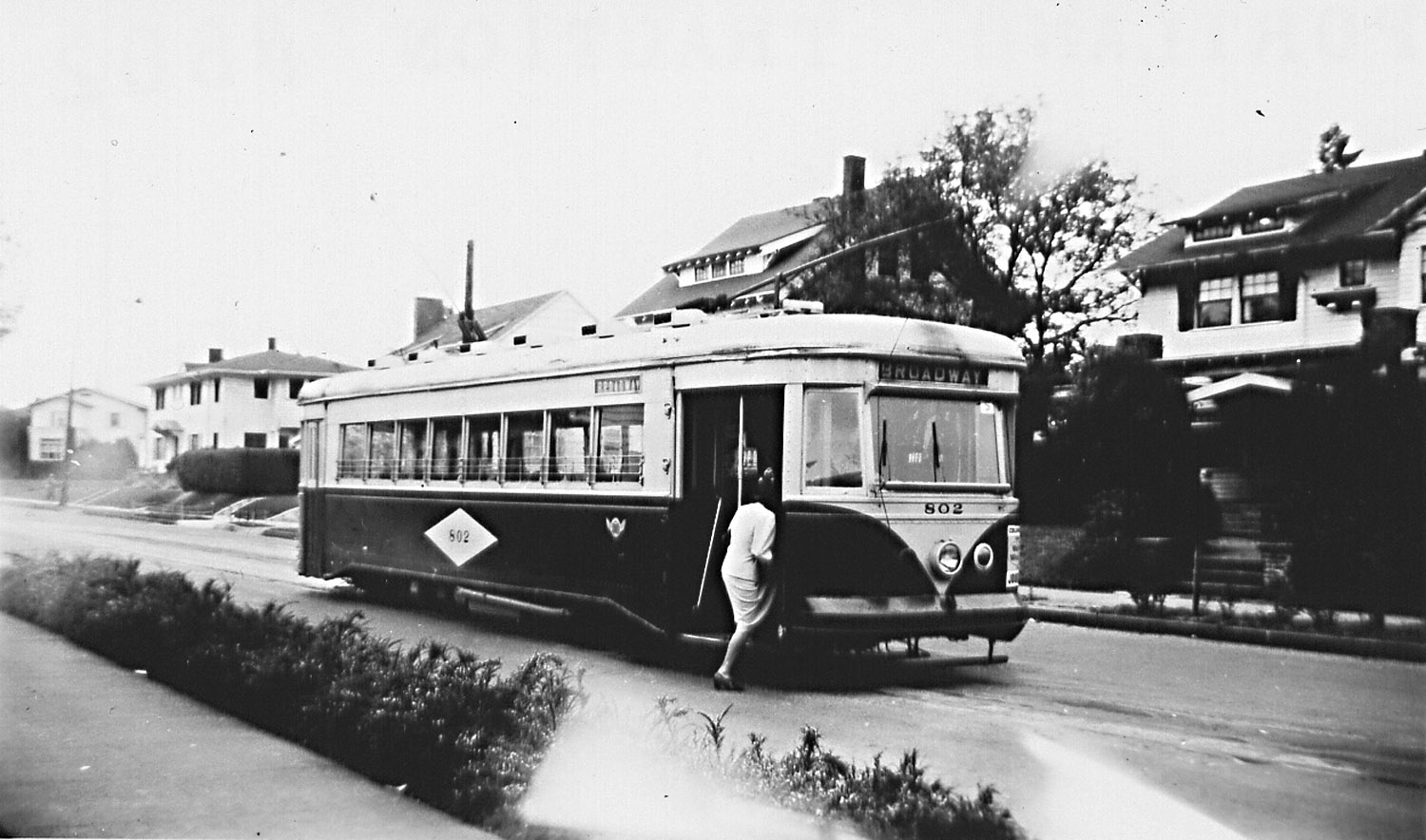
Broadway Streetcar, looking south from NE 29th and Mason, about 1948, a few months before streetcar service was replaced by bus and the tracks were paved over. Courtesy of Bill Hayes
TriMet has renamed the line to “Holgate/NE 33rd,” eliminating the interior neighborhood stops on NE 24th, NE 27th and NE 29th avenues. The route will now travel north-south along NE 33rd Avenue every 30 minutes.
You can read more about budget reductions and about changes to the Bus 17 route and other TriMet routes at trimet.org/servicechanges


When it all came down to it, I’m surprised that the Alameda route became the sacrificial victim. Tri-Met had tried repeatedly to kill the 33rd Ave. line — it used to go into downtown. I had to change over to the Alameda line, and there were dozens of folks riding between 8 and 8:30. I would have thought that Irvington might have had enough clout to stop this; but no.
I am sorry this is happening. Our city counselors need to listen to the everyday commuters and taxpayers who would be glad to ride transit were it not for the little guarantee that people actually feel they would not be harassed or threatened on the bus by people where there is zero accountability and can pretty much do whatever they want. This is NOT fair nor equitable to the thousands of people trying to just live here.
Take some heart….
Our streetcar system here in Rochester – a good one I note – was demolished in 1941, one of the first to be removed in all of the US. We had a subway system until 1956. After that: just cars and a bus system that took its routes from the streetcar even though our city’s demographics had substantially changed. In 1930 the city population was about 330,000. Today: about 210,000. Same routes, though time between buses is now quadrupled or quintupled (or much more) from the old days. Total system ridership as of 2025 is a spectacularly dismal 7,000 per day.
And Chicago, where we come from, once had the best streetcar system in the country. It was a system of cablecars! 1958: gone.
Most of us across this nation live in cities shaped and formed by streetcars. Most of us still enjoy the commercial strips (restaurant, bar, shoe store, nail salon, candy store, hardware store…) and residential neighborhoods that were the precipitate of that form of transit. Once cars go away – sometime soon I trust – perhaps we can enjoy our cities like we did once before.
Nice details Doug. These things become self-fulfilling. Cars making shopping easier, so people with cars stop riding the streetcar. So revenue drops, so routes are cut, lather, rinse and repeat.
I do wonder why Portland hasn’t brought back “Jitney” service, like Mexico’s “Peseros” They are a private car (mini van, whatever) that runs a specific route. Faster and more expensive than a bus, but much cheaper than owning a car.
Thanks Doug. Excellent roundup of the century+ part of our community. My grandparents (who lived a few blocks from 29th and Mason) rode ‘The Broadway Bus’ …. They called the payment ‘Car Fare.’ I rode it a bit in grade school (in the 60’s), when it was a private company, Rose City Transit…. And again for a couple years in the 80’s when I worked downtown and didn’t want to pay parking fees…..Where was I when Mt. St. Helen’s blew ashes 5 miles into the sky? With an unobstructed view, on a Tri Met Bus, heading home, on the ramp approaching The Broadway Bridge….Oh My!
i have live on the bus 17 line for over 36 yrs . When we moved to 27th off of alberta the was bus number 9. The bus was 70 cents to ride and it came every 15mins . One day when my mom was riding the bus she was talking to the bus driver and with total surprise she was the past owner of our house. It was nice to hear about the past owner and her family history. All my life i lived in this neighborhood, and i seen alot of changes but i never seen this one coming!
Sad to see it go.
Your piece is another example of “When the building/tracks/monument/artifact goes so goes the story. Thank you for this moving tribute to what was a vital artery in the creation of these many neighborhoods.
I ride the #20 because it solves so many problems getting downtown quickly and cheaply. Now it hardly runs very often, maybe more in the morning hours. We can hope.
It’s not a small thing!! Mobility, both individually and as a community, is everything!.
Hope the commuters over the interstate bridge get a free ride. There’s a concept!