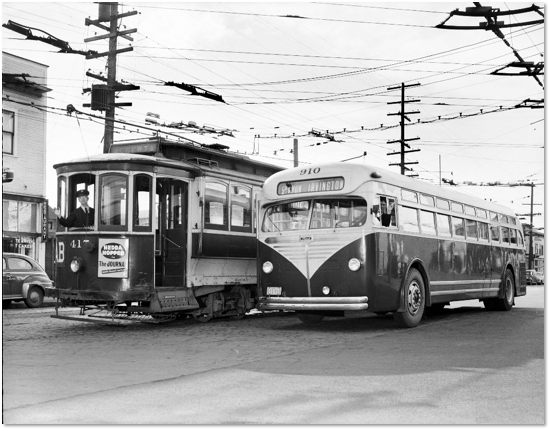
Streetcars and buses like these have served the Alameda neighborhood since 1910. TriMet service cuts made in August 2026 ended a 116-year tradition of transit service to the neighborhood. This photo–showing the old Alberta Streetcar and its bus replacement–ran in the 1947 Portland Transit Company annual report to illustrate the end of streetcar service and the beginning of bus service on that route. The caption: “Walt Baker, trolley skipper since 1911, greets Merritt Lutman, pilot of a new Mack bus.”
It’s official: the TriMet bus service cuts and route adjustments made starting today represent the first time in 116 years the majority of the Alameda neighborhood has been disconnected from public transit to downtown Portland.
On August 23rd, TriMet officially eliminated two bus lines completely citing low ridership, and reduced service on 34 other lines, including Bus 17, which since 1948 has traveled much of the route originally covered by the old Broadway Streetcar, through the central part of Alameda and Irvington.
TriMet says the cuts—paired with elimination of 400 positions and layoff of 170 employees—are necessary to help address a $158 million budget shortfall.
Almost ever single day since 1910, weather permitting, Alameda has been served by public transit, beginning when the subdivision was first carved out of brush, fields and forests along the Alameda Ridge. Back then, the Alameda Land Company paid to build the streetcar to its terminus at NE 29th and Mason as a way of bringing potential homebuyers into the neighborhood and later providing an attractive transit link to downtown for the growing neighborhood.
In 1910, the area was an undeveloped patch of mud and brush. Streets were not paved until 1912 and automobiles were scarce, making public transit in the form of the Broadway Streetcar essential to day-to-day life.
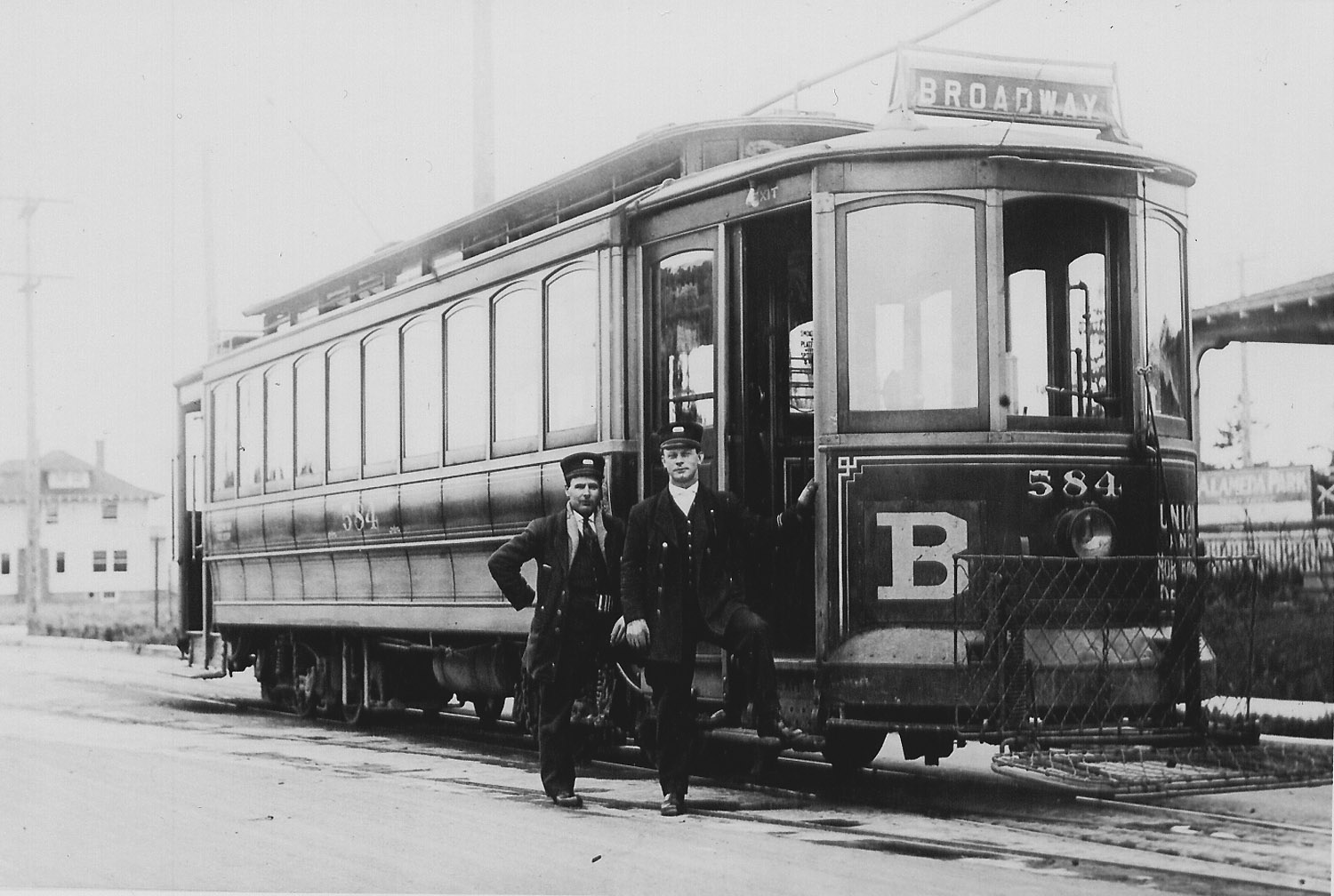
The Broadway Streetcar at the end of the line, looking north near NE 29th and Mason, about 1910. The house in the background to the left is still there today. A banner on the porch of the Alameda Land Company Tract Office to the right announces the availability of homes. Photo Courtesy of the Bill Hayes Collection.
A narrative map of the Broadway Streetcar’s complete 8.8 mile circuit between Alameda and downtown Portland would go something like this, beginning at the outbound end at NE 29th and Mason: Once the streetcar arrived at the end of the line from downtown, the motorman would step outside, drop the trolley pole on one end of the car and secure it to the roof. He would raise the pole on the other end for the trip downtown and hook it to the overhead line. And off he would go to the south on NE 29th, passing straight through today’s “Bus and Bicycle Only” notch at Regents and Alameda, then down the hill to 24th, where the rails turned south.
At 24th and Fremont, the line jogged west for two blocks before turning south on 22nd. The streetcar continued south on 22nd toward Broadway, with a minor “s” turn at Tillamook before the corner onto Broadway, where it turned west toward downtown and across the Broadway Bridge. The downtown end of the line was at Broadway and Jefferson, where the process began again as the motorman readied for the outbound trip. A key difference on the outbound leg was that the car turned north on 24th not 22nd.
The loop formed by the 22nd and 24th couplet—the Fremont Loop—makes for a nice walking circuit even today.
In 1923, a trip downtown cost an adult 8 cents. Kids could buy a special packet of school tickets allowing 25 rides for $1. In 1932, a monthly pass for unlimited rides cost $1.25. Alamedans used the streetcar as a vital link to shopping, churchgoing, commuting to the office, trips to the doctor. Some even rode the line for entertainment.
During the day, cars ran every 10 minutes, and Alamedans referred to them as “regular cars” or “trains.” During the morning and evening rush hours, additional cars called “trippers” were put into the circuit to handle additional riders. Trippers did not climb the hill to 29th and Mason, traveling only on the Fremont Loop to save time. At night, our line was one of the handful in Portland that featured an “owl car,” a single train that made the circuit once an hour between midnight and 5 a.m. Owl service was a special distinction.
Streetcar ridership began to decrease in the mid 1920s in favor of the automobile which by then had become commonplace. The Broadway streetcar continued service until August 1, 1948 when it was replaced by bus traveling a simplified route. The tracks were soon paved over. By 1950, all of Portland’s once ubiquitous streetcar lines were gone.
In the early days of neighborhood life, our streetcar was indispensable. It was a crucial catalyst that made development of Alameda possible, making us a “streetcar suburb.” It linked us to downtown and to other neighborhoods near and far. To hear the stories of an earlier generation of Alamedans who knew and rode the streetcar, it linked us to each other in a way too. In some ways, not unlike the Bus 17 which has been a regular feature of neighborhood life since the demise of streetcar service in 1948.
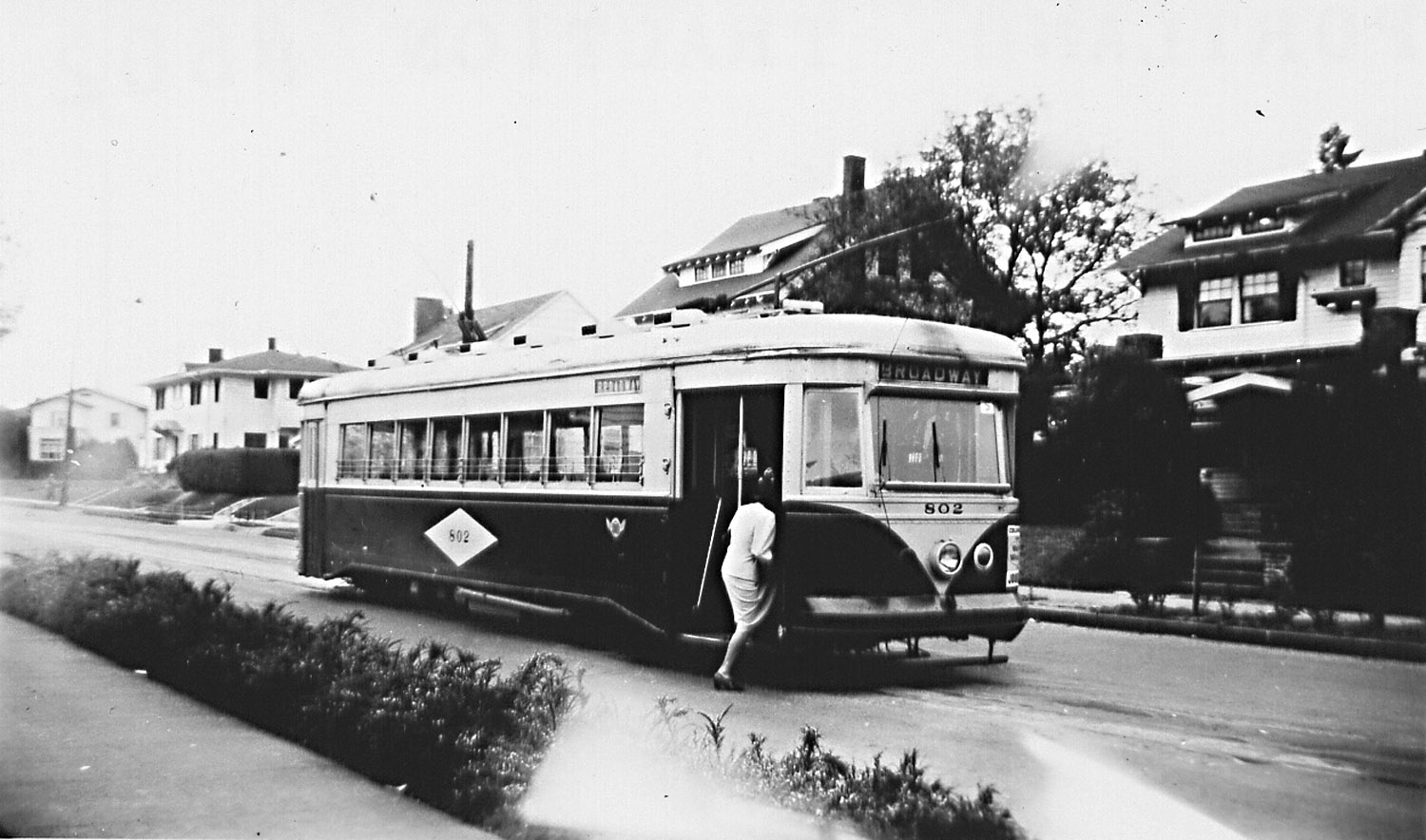
Broadway Streetcar, looking south from NE 29th and Mason, about 1948, a few months before streetcar service was replaced by bus and the tracks were paved over. Courtesy of Bill Hayes
TriMet has renamed the line to “Holgate/NE 33rd,” eliminating the interior neighborhood stops on NE 24th, NE 27th and NE 29th avenues. The route will now travel north-south along NE 33rd Avenue every 30 minutes.
You can read more about budget reductions and about changes to the Bus 17 route and other TriMet routes at trimet.org/servicechanges


