Winter 1936
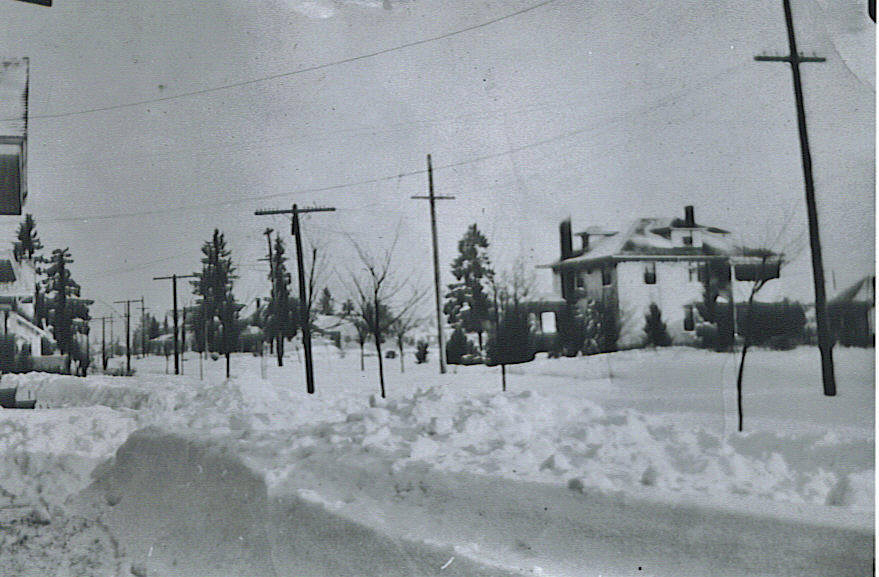
Winter 1936, looking north on NE 30th toward intersection with Mason. Click for a larger size image.
Winter 2008
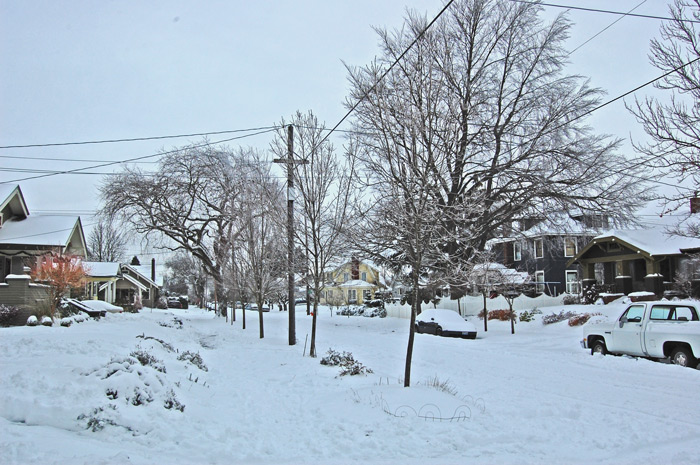
Winter 2008, looking north on NE 30th toward Mason. Click for a larger size image.
There’s a great Billy Collins poem called “A History of Weather” that I’ve been thinking about all week. We’ve had a lot of snow here in Portland, not record-breaking, but still more than anyone has seen around these parts for 40 years. Right now we have about 15 inches on the ground and the city has been at a virtual stop for the last couple days. We started to thaw today, but another 4-8 inches of snow are in the forecast for the next couple days.
In the poem, Collins creates a funny, wistful elegy for atmospheres of the past, and contemplates weather as a common human bond across the ages. Contemplating what a weather history poem should include, Collins writes, “There will be a section on the frozen nights of antiquity…” I’ve been thinking about the frozen days and nights of the past, the transforming quiet and joy visited on the kids of this street and neighborhood over the years.
So after shoveling the front walk yesterday, I dug into my Alameda archive and found a picture taken a few doors south of my house in 1936, the year Portland received about 35 inches of snow. The photo has been passed down to me by the family of the little boy who grew up here in the teens and twenties. He was fledged by 1936 (family members were in the house til the late 1950s), but the photo stayed in his family because it depicted remarkable conditions.
Being obsessed with lining up past and present for clues, I prowled around this morning hunting — camera in one hand, old photo in the other — for the original photographer’s footprints, which are not entirely available today due to some landscaping changes down the block.
The big house on the corner (white in 1936, blue today) is the Copenhagen House, built in 1912 by the family of Les Copenhagen. Today’s big beech in the sideyard is just a start of a tree in 1936. Power poles have thinned out a bit, though still an eyesore. The gable end of the house facing the camera up the block can be seen in both images. A little closer in, if you squint at the 1936 image, you can see Walter Morrison out shoveling the front walk of my house. Farther up the block and across the street, today’s yellow Dutch colonial was just a vacant lot. Other vacant lots allow a view off into the distance.
Families in 1936 probably took pictures of their unusual winter weather event, just like we have this week. Unfortunately, most of those images are lost to time. We’re lucky to have this one, 71 years old. Makes you think about the pictures you take, the pictures you save, the pictures you decide to throw. I’m always on the lookout for old pictures of Alameda…
To cap off this entry about the history of snow, thought I’d share a very interesting info-graphic from The Oregonian today that clearly indicates that our predecessors knew a lot more about snow than we do. Check it out:
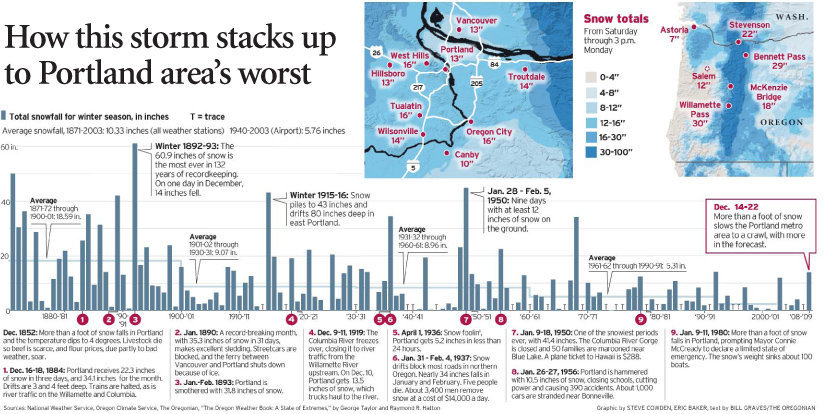
From The Oregonian, Page 1, 12-23-2008. Click for a larger size image.
For more insight and photos on Portland’s winter weather history, check out this post from February 2021 which turns back the clock on ice storms and river ice well into the 1850s.


 Alameda Old House History