Closing up the front porch

It’s been a fascinating journey so far to understand the story of the von Homeyer house at NE 24th and Mason. The original construction drawings and early photos, the story of the brothers who lived in the house all their lives, and now interesting insights about the front porch, which was enclosed more than 65 years ago.

Maybe you’ve seen the before and after photos that can’t help but make you contemplate earlier days (click in for a a closer look):
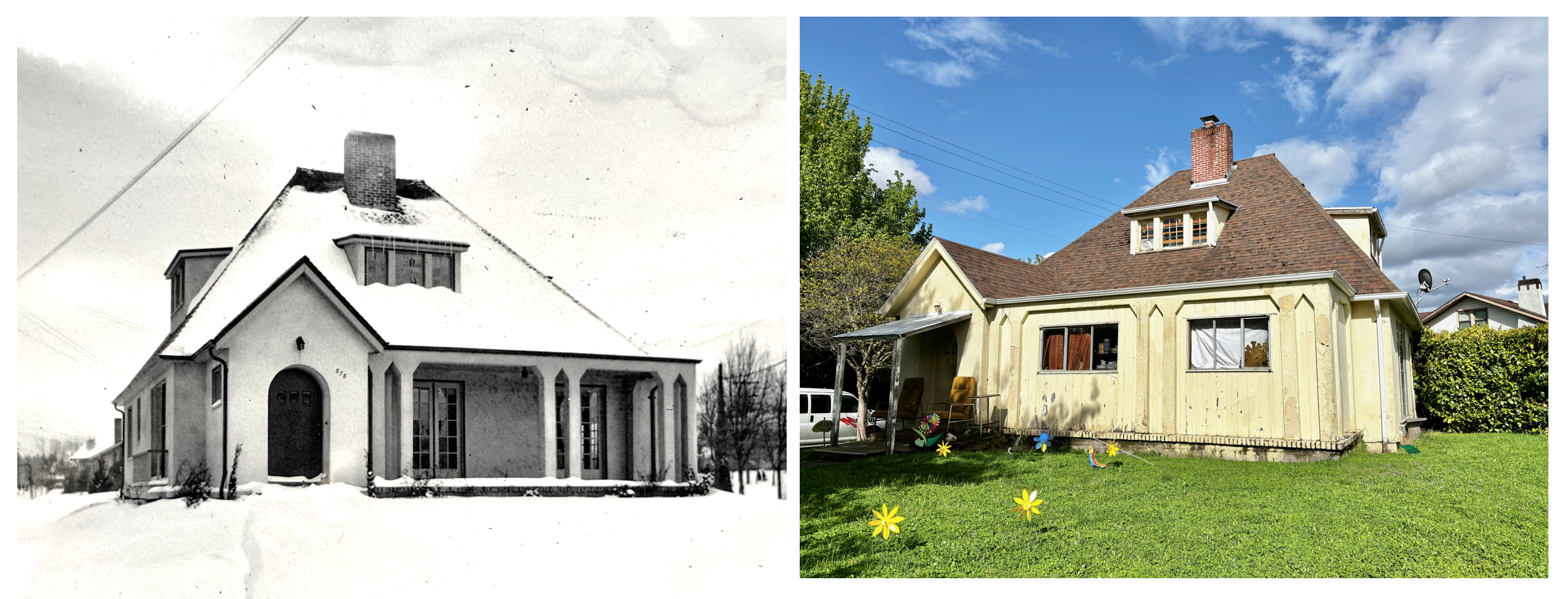
Check out the original front porch from the 1920s photo on the left, and as it appears today. Current homeowner Michael Schmitt says he hopes to set the original porch free as he adapts the house for its next century.

As it turns out, the porch was covered over in January and February 1959. We know this according to a request we filed for historic building permits from the Bureau of Development Services, which is something every history-inclined homeowner can do as a way of knowing why things are the way they are today.

To be sure, a good percentage of minor work done on our old houses may have been done without permit, leaving no paper trail. But in this case, adding new exterior walls is documented both with a building permit (issued downtown by the Bureau of Buildings), and an inspection card (filled out in the field by the building inspector). Have a look:

This $350 construction job was done in January 1959 by Harold Burbach using sheeting, siding and aluminum slider windows (but without cutting any new openings on the existing exterior walls or altering the French doors). Evidently the inspector attempted to mark the job as completed during visits in August 1959 and then January 1961, but received no response.

The newly enclosed space created an alcove off the piano teaching studio used by Frances von Homeyer and her many students, perhaps a place to store sheet music, of which Frances had a lot. We’re working on understanding the wide impact Frances’s music and teaching had here in the neighborhood and across Portland, which appears to be significant.

Our request to the Bureau of Development Services for historic building permits and documents also yielded the original 1925 permit and an inspection card that records a straightforward construction process. Both confirm the house was built by Kilgreen and Company for $3,780, that it was built for Hans von Homeyer (who was then living across the river in Vancouver…Frances is not mentioned), and that by Christmas 1925 construction was entering the final stages.

You can request your building permit and inspection cards online (the helpful folks at Resource Records will send you PDFs of any documents in the file for your house) which costs $15. Just a heads up: in our experience about 10-15 percent of houses don’t have any historic permitting documents, or very few…record keeping was not great before the 1920s.

If you do make the request online, you’ll need to provide the county property number for your house, which you can find under the “Assessor Detail” on portlandmaps.com when you look up your address (it starts with an R). If you do go to portlandmaps (which is an amazing data-rich resource), be sure to check out the link to “historic plumbing permits” for your address. These can be just as enlightening as building permits about original owner, builder and pre-address change address, with bonus details about cesspools, vent stacks and all manner of early 1900s plumbing techniques.

There are other resources to learn more about your house and its former occupants. Here’s the list we suggest. This kind of detective work is fun and can lead to all kinds of insights. At our house, it allowed me to find the little boy who grew up here, which led to his photos from 1917 and insights that directly shaped how we rebuilt our front porch, which was the very first post that got AH started way back in 2007.

The next stories from the von Homeyer house will be people stories: Frances and the piano, the amazing photo archive, and interesting images from the early 1900s in Portland and Vancouver. Thanks again to Michael and Jaylen Schmitt who have invited us along on this journey.

Study of Alameda Building Permits Provides Insights

In 2010, we completed a survey through city building inspection cards, collecting information on every home built here in the Alameda Park addition. It’s taken two years and more than a dozen visits to the Bureau of Development Services (which has been very accommodating and helpful), but time well spent, given the insight it offers into the development of the early neighborhood. Everything from the date of construction—it’s interesting to see what parts of the neighborhood were built first—to identifying the most prolific builders, and all of it helps paint a picture of how Alameda Park developed.

Original building record for Alameda School, taken out on November 7, 1921. Information from more than 1,025 Alameda Park building records were reviewed as part of the study.

When you aggregate the information from the permits, there are some trends and patterns that emerge:

The first observation has to do with the general timing of construction in Alameda Park, from just two homes built in 1909 to a peak of 139 built in 1922. One factor in the timing of this was the ebb and flow of the economy. Strong in 1910, but the infrastructure hadn’t yet caught up. Slow in 1918-1919. Explosive in the 1920s with both a strong economy and demand, and an infrastructure that was truly ready for development.

Building permits issued in the Alameda Park subdivision, by year, 1909-1934. From permit study by Doug Decker, 2010.

By 1934—the end of this graph—about 85 percent of the neighborhood had been built out (the late 1930s and 1940s are a mere trickle of a couple or three homes per year, if that). 1922 would have been an interesting time here in Alameda, with an influx of neighbors. If you haven’t read it, go back and look up our post about the Alameda Park Community Church and the pastor’s desire to bring together new neighbors who were strangers. That was 1922 here in Alameda.

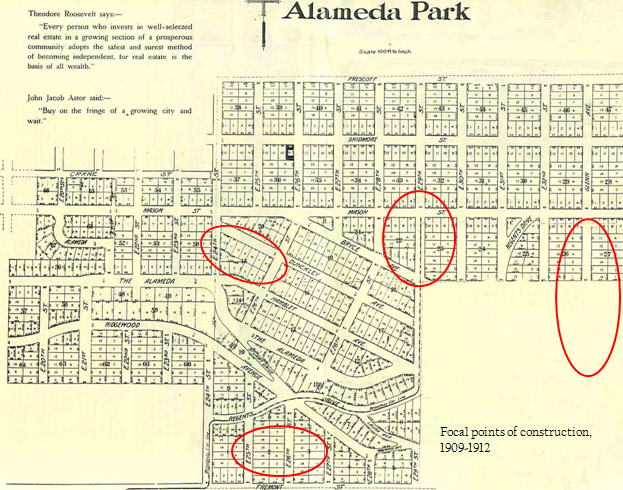
Another observation from the permit study is to have a look at the spread of construction activity to see which portions of the neighborhood were built out first: the areas around 24th and Dunckley; 25th and 26th below the ridge; 29th and Mason; and 32nd Place (then called Glenn) from Mason to Hamblet. These highlighted areas below indicate in general the earliest construction from 1909 to 1912.

It’s also interesting to see who was doing the building during these years. A handful of builders built a large percentage of the homes. The list we’ve compiled below shows total homes constructed in Alameda Park by each of the most prolific builders. Many of these we’ve profiled here, others we’re still working on.

Builder Total Alameda Homes Built Building Activity
Oregon Home Builders 24 homes built 1914-1917
Ken Birkemeier 21 homes built 1932-1952
Harry Phillips 21 homes built 1921-1928
Matot Construction Co. 20 homes built 1921-1926
Frank Read 19 homes built 1923-1941
Nils O. Eklund 17 homes built 1916-1922
Grady Mahaffy 13 homes built 1922-1936
Wickman Building Co. 10 homes built 1921-1923

In addition to the general trends, there are specific sad stories: more houses than you might imagine have had fires (and fire repairs, hence the permit records). A couple of homes were actually struck by lightning. A fad of game rooms, recreation rooms and wet bars were put in during the 1950s, and even an exercise room way back when. Sadly, too frequent removal of trim, built-in shelves and other architectural details in a attempt at modernization (gasp). Interesting to note how many wooden front porches were rotting apart by the 1950s, and a spate of concrete porches and steps poured in replacement.

It’s also clear, when you look at the records, why Portland’s addressing system was changed in the early 1930s. Some of our homes here in Alameda have had three addresses prior to the Great Renumbering (particularly on NE Bryce Avenue) as numbers had to be skootched over to make room for new houses built on empty lots. Let’s just say the original numbering system was less than scientific. You can see this on the actual building permits themselves, where one address has been scratched out and the new one written in. History in the making. It wasn’t scratched out in the example above, but you can clearly see Alameda School’s pre-address change number: 864 Fremont.

Another observation as we completed the study was just how many homes do not have an original building permit. Over the years, for whatever reasons, the City has lost perhaps as many as 20 percent of the original building permits, particularly in the early years. For these homes, we have to rely on original plumbing permits which always give the construction date, but can be sketchy with owner and contractor information.

Regardless, as you handle these permits, some 1,025 in all, you feel time passing through your fingers. You see the clerk typists punching in the details. You sense the contractors standing in line, waiting at a counter wishing they could be back on the job site instead of in the permit office. You witness the many inspectors and their mostly neat observations, drawings, complaints and even sarcastic remarks in shorthand on the 4 x 6 manila cards.

And you can’t help but wonder what it will be like 100 years from now when someone wants to research the history of your house. What story will your house be able to tell?