Like a mosaic of fine old tiles, hundreds of subdivision plats rest atop Portland’s neighborhood landscape, creating a base-layer of orderly streets and lots beneath the places we know today. Drawn up over the last 140 years by different developers, each plat has a name: some are catchy, some are descriptive, a few remain in common use to describe the places we know. Most have been lost to time, like George Place.
We’ve written about most of the underlying Alameda plats here and for a series of recent stories in the Alameda Newsletter: Gleneyrie, Olmsted Park, Homedale, the Pearson Addition, Waynewood (which was remade from the labyrinth created by six of the original plats), not to mention the nearby Kennedy Addition, the distinction between plats and neighborhood boundaries, and many other plats on both sides of the Willamette. There’s even a plats category here on the blog if you are inclined to a deeper dive.
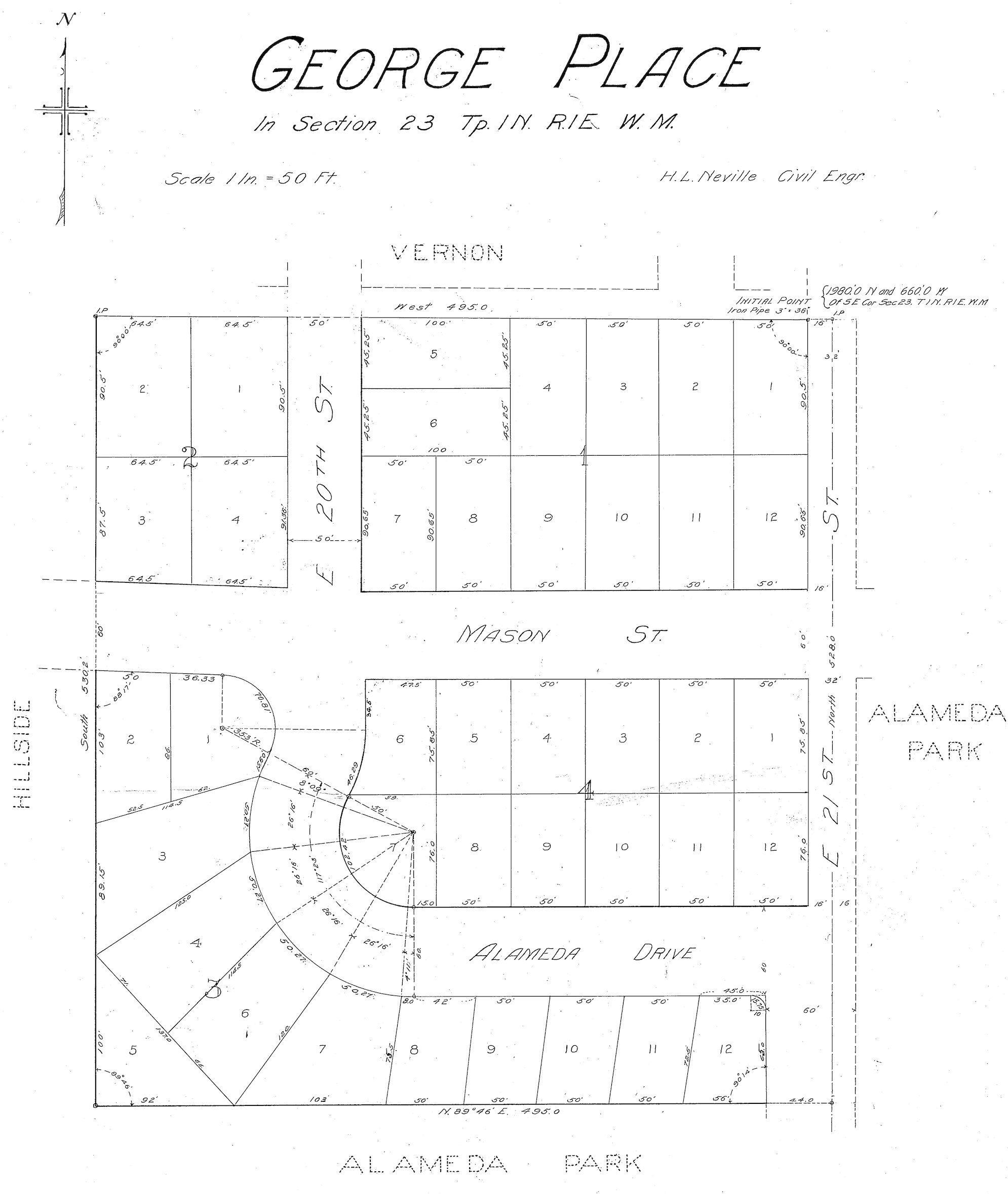
In this parade of plats, we should make sure one of the smallest ones doesn’t get away: George Place, a tidy square of 40 lots where grid meets slope at the far southwest edge of the Alameda Plateau. Take a look:
Namesakes Judge Melvin Clark George and Mary Eckler George traversed the Oregon Trail with their families as children and grew up on homesteads in the upper Willamette Valley. They married in 1873 and Melvin was soon elected to the Oregon State Senate (1876-1880), and then to Congress in 1881, where he served two terms before returning to Oregon to teach medical law at Willamette University (1885-1889). He served as Multnomah County Circuit Judge (1897-1907) and retired from the bench at age 58 to become director of public schools in Portland.

Melvin George, circa 1900
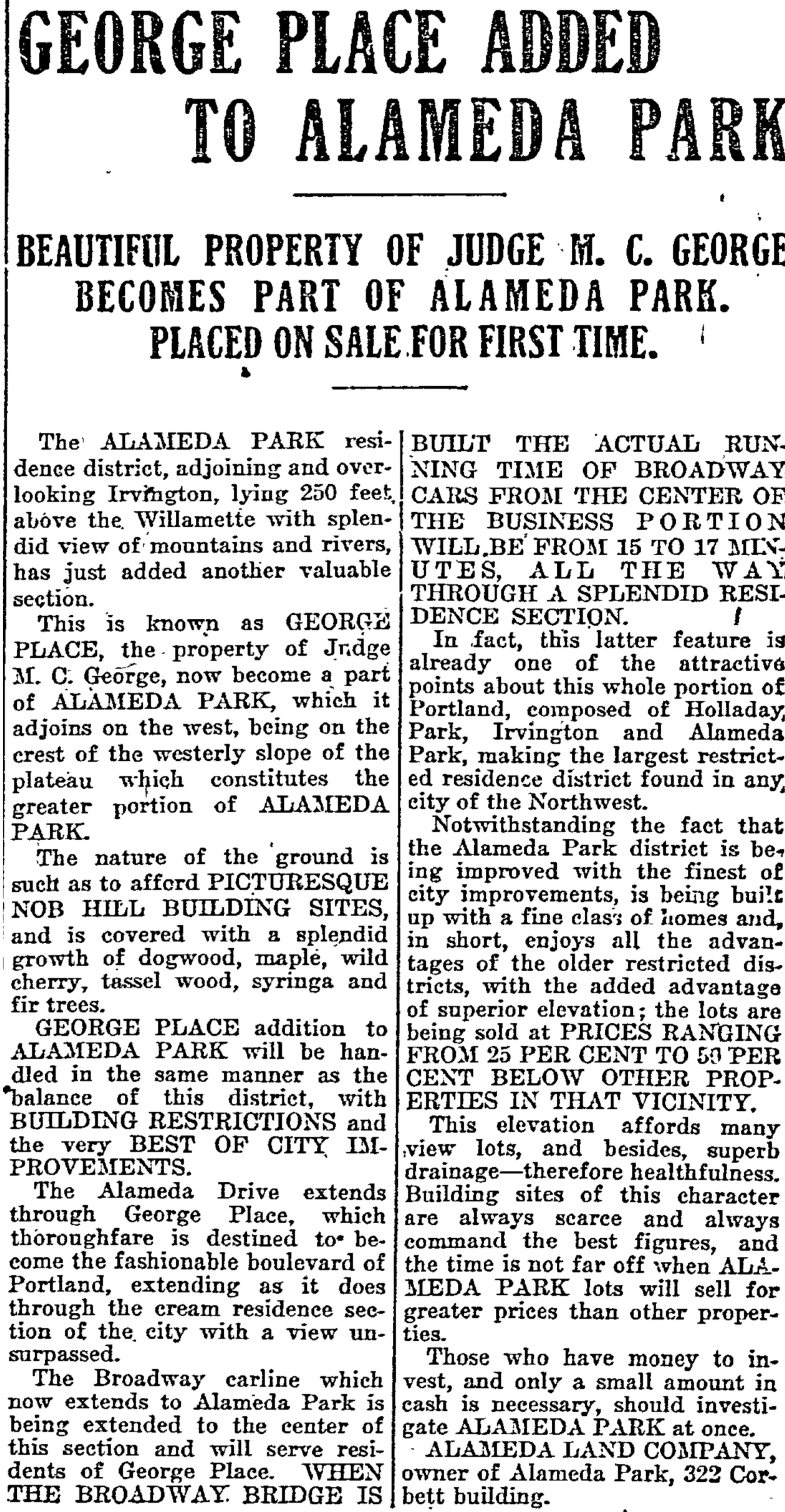
Sometime around the turn of the 20th Century, seeing development potential on the horizon (literally), the Georges purchased six acres atop the ridge. They filed the George Place plat with the Multnomah County Surveyor on April 25, 1911, two years after the Alameda Land Company platted the Alameda Park Addition which anchored their eastern flank.
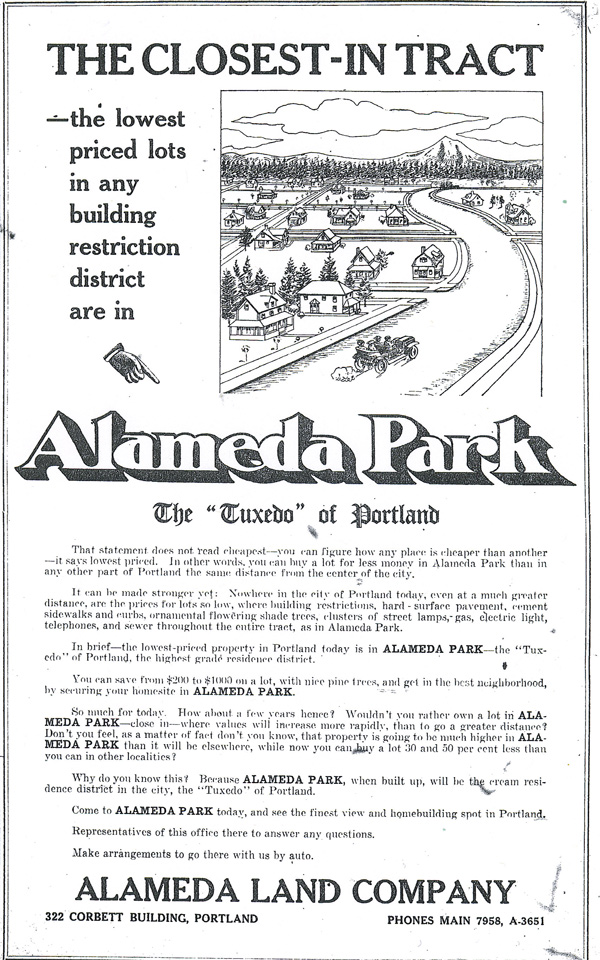
At the time, the Alameda Land Company was blitzing The Oregonian and the Oregon Journal with advertisements stirring excitement for the much larger Alameda Park Addition. Agreements were evidently made and Alameda Land Company took over marketing the property, dedicating one full advertising panel to the topic in June 1910.
From The Oregonian, June 4, 1910
Of course in 1910, all of these places were still purely imaginary: the plats may have been filed or on the drawing board, but streets were just being carved out of the gravel, trees felled, stumps removed. In 1910, it was still a giant brush patch, with orchards and dairies down on the flats below.
Lot sales and homebuilding were slow to catch on in George Place during these first years. Streets and infrastructure were in place by the mid-teens, but Portland’s economy began to cool in the run up to World War I. A few lots did sell, but the George Place six acres remained mostly unbuilt until the early 1920s, when a new real estate and homebuilding company known as the Hiller Brothers Company bought the lots and started building into a fast improving real estate market. By the way, this is one of the things we love about paying enough attention to a particular place: pretty soon everything you bump into starts to connect (see our profile of Hiller Brothers on The Builders page).
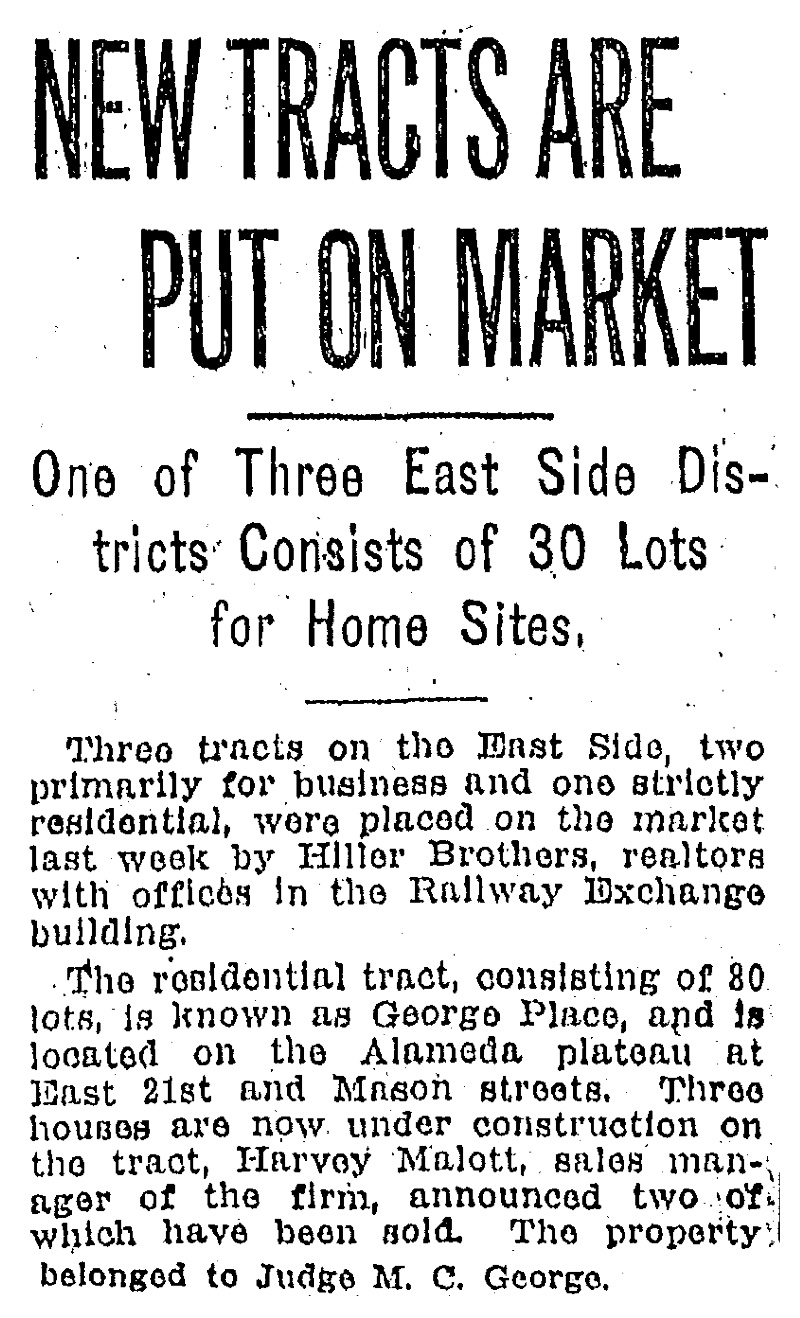
From The Oregonian, March 28, 1926. Not sure where the reporter got 80 lots, you can count the 40 lots in four blocks on the plat above.
In 1926, the streets were still gravel, but three houses were under construction including the one with the best view, for company owners James and Sarah Hiller at 2024 NE Alameda Drive. Hiller Brothers built many of the homes here, using plans provided by architect Hubert A. Williams. English cottage style was clearly the most popular. The Great Depression paused homebuilding activity leaving multiple vacant lots in George Place that finally filled in during the 1940s and early 1950s.
As for the Georges, they raised their family in a comfortable house up the hill on Market Street in southwest Portland’s Goose Hollow, with no evidence in newspaper coverage they ever lived on or paid much attention to George Place on Alameda Ridge. Melvin died at age 83 on February 22, 1933. Mary lived on to age 91 and died on September 24, 1942. They are buried together in Lone Fir Cemetery.


 Alameda Old House History