Gems from the Treasure Trove

It’s been quiet on the Alameda old house history blog for the last month or so, but time to get back into the swing of things as the kids return to school, and as the weather transitions to more research-friendly conditions like cloudy, cool and wet. Actually, I think this stretch from now through late October holds some of my favorite Oregon weather.

In addition to perking along with a few research projects this summer (but not much blogging), we’ve been working on a kitchen remodel in our almost-hundred-year-old house. We’ve tried to be faithful to the historic design concepts even though we are using standard current kitchen technology. We’ve been fortunate to have a great architect in Arciform and an excellent contractor in Joe Petrina and Petrina Construction. You can read more about our kitchen adventure here, and maybe share your own pearls of wisdom about surviving a kitchen remodel.

As we’ve worked through the remodel process, we’ve kept a keen eye for clues from the past, and we’ve found some interesting items…nothing earth shattering, but some quaint signs of the time. Thanks to some insulating material (as in crumpled up newspaper) we confirmed the long-held thought that a back porch extension was made to the house sometime in 1930.  Below is a clip about the Reo Convention coming to Portland, from the Sunday Oregonian on February 2, 1930.
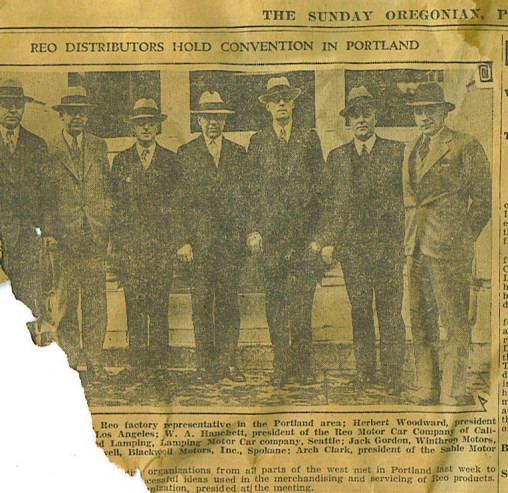
 7-14-Exhibit-7


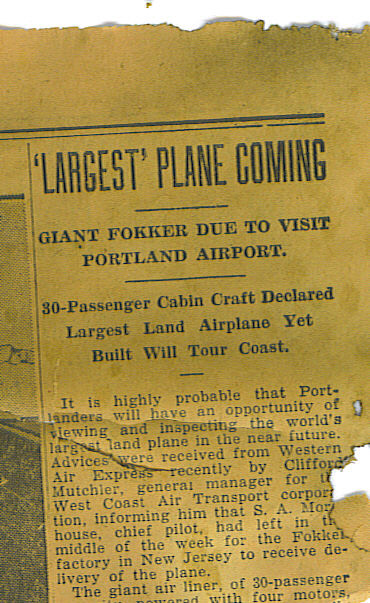
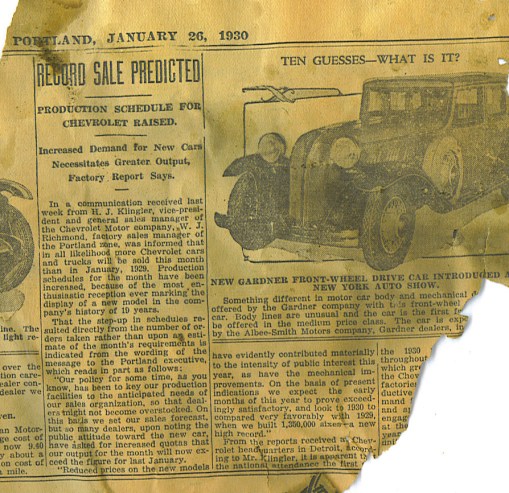
Here’s an interesting scoop about the world’s largest passenger plane — a 30-seat Fokker – coming to Portland. And below that, from January 26, 1930, a story about a record order expected for new Chevrolets to keep up with a booming demand for new cars. Apparently, the market had not yet found the bottom. Hmm.
7-14-Exhibit-3

Exhibit 8


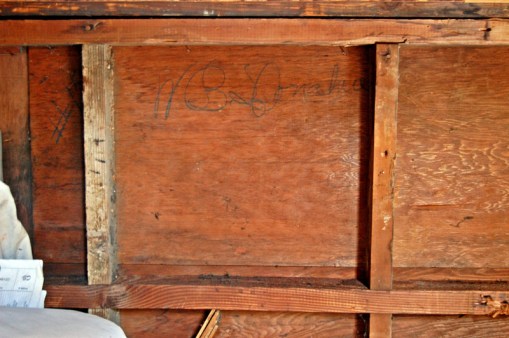
But probably one of the most interesting finds during the remodel was the signed name of our original builder, William B. Donahue, who we have profiled here on the blog. We found this little gem buried deep inside a wall, signed in what looks like blue grease pencil or blue chalk on the back of a wainscot panel that faces our breakfast nook, on the other side of the kitchen wall. Check it out:
9-15-post-Donahue-Signature

Because we’ve found documents and letters sent by Donahue years after his construction endeavors, we think we can recognize the handwriting. If you look to the left of the crossbrace, you can see the “#1.” Could be that Donahue was sorting out the plywood he wanted for the wainscot, and this had a number 1 grade side (the other side). Not sure. But it sure was a treat to find.

When you are working on your renovations, be sure to tell the contractor and the crew that you are interested in old house archaeology. You might even ask them for their stories about the most unusual items they’ve ever found working on these time capsules we call our homes.

What have you found?

Save the Date: January 23rd Alameda History Presentation

Interested in learning more about Alameda? I’m doing an education program for the Architectural Heritage Center, which has been rescheduled to Saturday, January 23rd from 10:00-11:30 in the Center’s auditorium on Southeast Grand Ave. It will be a good opportunity to have a closer look at the evolution of Alameda, and specifically at several of the prolific builders and their design styles that have shaped the neighborhood we know today. It’s also a great excuse to drop by and get to know the Architectural Heritage Center a little better. And you might even meet a neighbor or two!

You can find more information about the program, and a link to registration, at the AHC website: http://www.visitahc.org/content/upcoming-programs

Haunted by Harry Phillips’ Story

I’ve just posted the next builder biography, this one about Harry Phillips, who built many of the homes on NE Gile Terrace and Ridgewood in the 1920s. Phillips’ story is fascinating, tragic and indicative of his times. His work, appreciated and admired today, has clearly stood the test of time.

I’ve often wondered how builders weathered the storm of the Great Depression. I know Albert Irwin did only remodeling work in the mid-1930s. Others, like William Donahue, got out of the business altogether. Harry Phillips wasn’t as fortunate.

Phillips’ sons Jerry and Roger—now in their 80s—generously agreed to be interviewed about their parents, the work of their father, and their own growing up years. I feel very fortunate to have been able to gather their story in before it would have been lost to time.

Check out the biography of Harry Phillips on The Builders page.

Do you live in a Phillips home or have any insight to share about the family? Drop me a note.

A Legacy Written in Stone (ok, concrete)

Who hasn’t come across the time stamp of history on neighborhood sidewalks? If you’re paying attention, even on a simple stroll around the block, you’ll find yourself on the trail of the past.

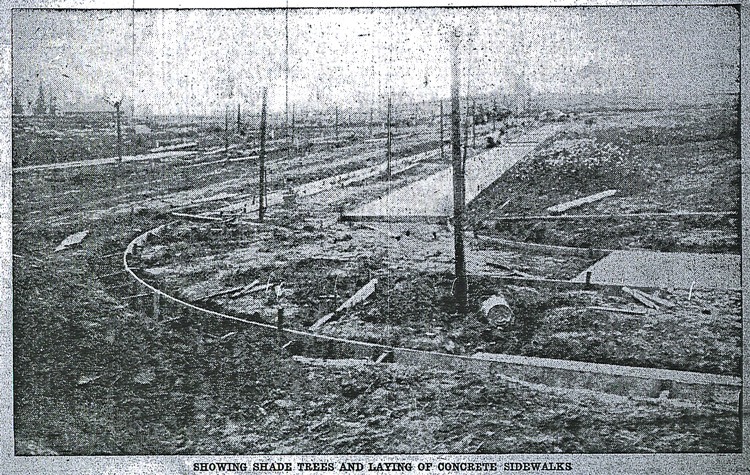
Curbs and sidewalks under construction, from The Oregonian, June 3, 1910.

Curbs and sidewalks under construction, from The Oregonian, June 3, 1910.

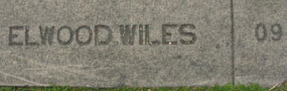
On most blocks–typically near the corners–you’ll find the name of the contractor who installed the sidewalks and curbs, along with the date of their construction, and even the names of the streets. Think of it as a signature, and appreciate the irony that even though the prestigious builders of the big houses are long gone, the identity of the grunt-work done by  ditch diggers, form builders and concrete finishers has stood the test of time.

The curbs and sidewalks on my block–block 23 of the Alameda Park Addition–were built by Warren Construction Company in the summer of 1912. Warren Construction, like other companies, had contracts with the city to excavate, frame and pour many city blocks worth of sidewalks and curbs. Look carefully and you’ll find the printed names of Hassam Construction, Krieq, Elwood Wiles and others.

elwood-wiles-stamp

So, here’s some insight into two of the of the companies you’re going to bump into walking around the Alameda Park neighborhood, and some great factoids you’ll want to hang onto for scintillating dinner conversation. After you’ve paid enough attention to these names–and learned a little about the companies and when they operated–you can almost tell what era and corner of the neighborhood you’re in just by looking at the names on the sidewalks.

Warren Construction Company

This company once employed world-renowned chemist and Nobel Prize winner Linus Pauling as its chief asphalt inspector. Pauling, born in Portland in 1901, was a young man when he worked summers for Warren, testing the quality of its asphalt production facility. Pauling recalled, years later, how company bosses didn’t want him to go on with his studies…they wanted him to stay put on quality control. In addition to giving one of the world’s greatest chemists his start, Warren Construction also made a name for itself building and installing all of the concrete decking on the Interstate Bridge (first opened in 1917), and applying the asphalt surface once the bridge deck was complete. They also worked on the Columbia River Highway as well.


Elwood Wiles

If you are a walker, this man is a household name. You see him everywhere on Portland’s east side. For years, I wondered about his identity, and after doing the research, I finally have a few answers. Wiles was born in Canada in 1874, and came to Portland in 1887. After high school he worked in a variety of jobs for a local harness maker before going into the sidewalk business. From 1903 til about 1917, Wiles held the majority of all city contracts for excavating, framing and pouring curbs and sidewalks. After the big building boom of these years, Wiles dabbled in timber speculation, concrete pipe manufacturing, stocks and bonds, and insurance. In his later years, he owned an illuminated traffic sign company. He died in Portland in December 1956. Be sure to check out this photo of Wiles and biography I’ve written in  The Builders section here on the site.

Interested in helping create an inventory of sidewalk contractors in Alameda? A couple of us are setting out to do some documentation, and we could use a studious person with some time to spare (and a digital camera) to help. If you’re interested in joining in, drop me a note: doug@alamedahistory.org.

Click here to see what’s been done in the Hawthorne neighborhood.

If this topic really piques your interest, check this out.

Ken Birkemeier, Prolific Alameda Builder

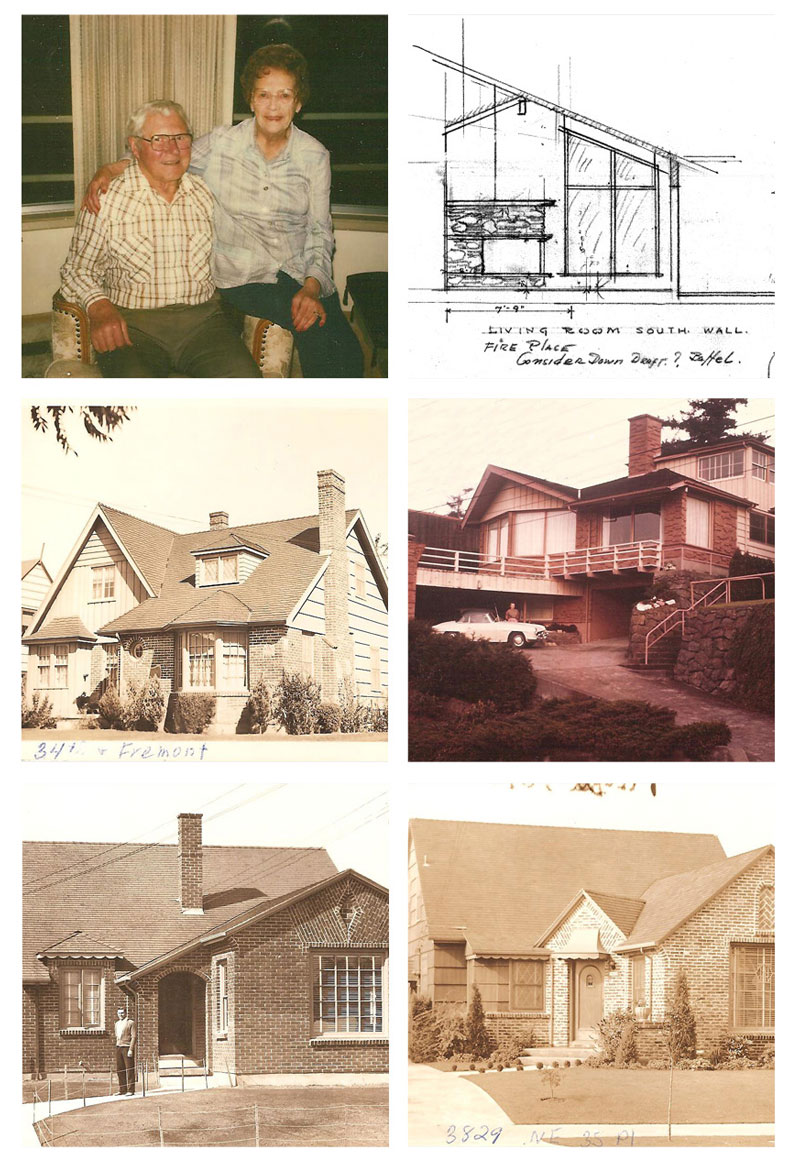
A collection of images relating to Ken Birkemeier. Top left, Ken and his wife of 50 years Marge. Photos and drawings courtesy of Dan Birkemeier.

A collection of images relating to Ken Birkemeier. Top left, Ken and his wife of 50 years Marge. Below, homes he built in the neighborhood. More pictures in The Builders section. Photos and drawings courtesy of Dan Birkemeier.

After a very interesting few weeks of research, correspondence with the Birkemeier family, and lots of walking around the neighborhood looking at dozens of houses he built, I’ve posted some background on local architect and builder Kenneth L. Birkemeier. You’ll find the details (and some more photos) over in the new section called The Builders (click here). It was great to hear memories from various family members, particularly the story from his grandson Dan, who is today an architect in Seattle.

You’ll note that I’m inviting your stories or photos of Birkemeier homes, so let me hear from you and I’ll share them here on the blog.

The new section is up to four major builders now, with dozens more to go. One thought that occurred as I walked around the neighborhood this week is that Irwin, Read and Berkemeier must have known each other. Between the three of them, they designed and built dozens of houses here in the neighborhood…they must have been bumping into each other along the way.

Next on my list is Harry Phillips, who designed and built many of the homes along Ridgewood and Gile Terrace in the late 1920s. I also want to delve into the history behind the reference to the “Town of Wayne,” which is a small plat south of Fremont and between 32nd and 29th.

Inquiring minds want to know: Who was Wayne?

New Section on The Builders

Today I’ve added a new section to the Alameda History website that provides a focus on the builders. Look up above and to the right and you’ll see the word “The Builders.” From there you can click into a sub-page that provides links off into biographies I’m writing about the men and women who shaped our neighborhood landscape. I’ve started out with three builders I am very familiar with, but soon there will be more.

Fans of houses built by Ken Birkemeier will be glad to know I’ve made contact with his family and will have lots to share soon, including early photos of some houses and a complete listing of Birkemeier houses in the neighborhood.

My goal in focusing on the builders is to pay tribute to them, to take account of and remember their work, and to create an interest, appreciation and curiosity about the homes we all live in.