Spring history walks and program calendar set

Planning for spring and summer season guided history walks is underway: I’ll be leading four walks for the Architectural Heritage Center through Northeast Portland neighborhoods. Registration (and fee) with AHC is required for these, and they’ll send you meet-up details as well.

Coming right up on Friday, March 6th at 5:00, I’m doing a free program at the Oregon City Library looking at Portland’s historic love affair with the Willamette River: Windemuth and Bundy’s: Where Portland Played in the River. The OC Library requests registration (which is free!).

Just an FYI, I’m always glad to consider leading walks and programs for groups interested in exploring local history. Let’s talk if you’re interested. Meanwhile, have a look at the calendar:
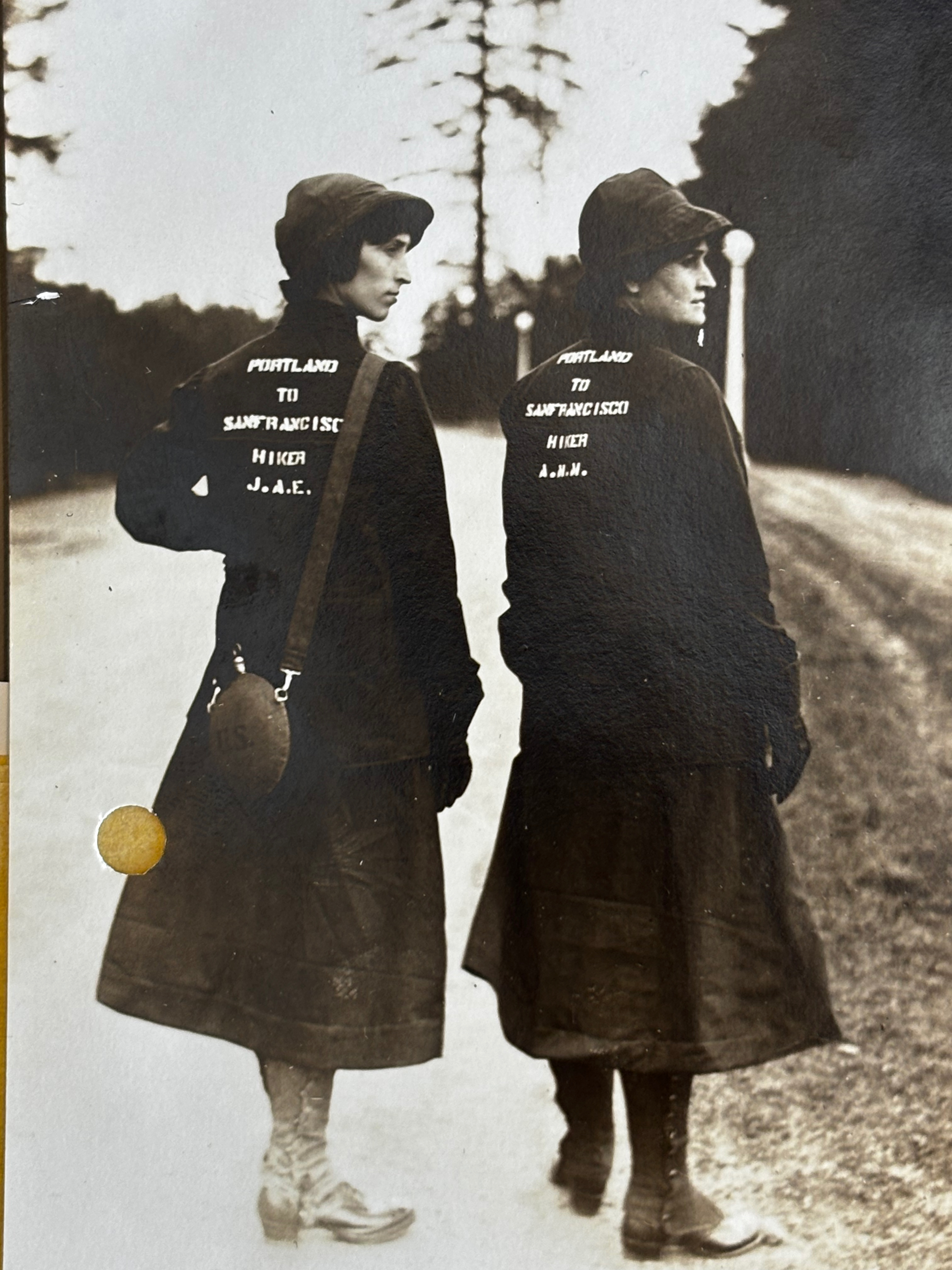
We won’t be walking to California like this Portland mother-daughter duo from 1915 who always inspire us. But we will be walking! Join the fun.

Saturday, May 30, 2026 at 10:00 am – Beaumont Neighborhood History Walk

One of Northeast Portland’s signature planned neighborhoods, Beaumont—“the beautiful mountain”—was platted in 1910, had its own named school, business district and streetcar route, and was home to one of Portland’s wealthiest and most powerful families that built a compound for its seven children. Join me for a walk along Alameda Ridge that ties these stories together and explores 116 years of neighborhood development. Registration link.

Saturday, June 6, 2026 at 10:00 am —Wilshire Neighborhood History Walk

Northeast Portland’s Wilshire neighborhood has long been tied to its neighbor Beaumont. But its history and development followed a very different trajectory. On this Saturday morning stroll, we’ll walk through a planned neighborhood that was never developed, explore multiple attempts to create Wilshire Park (which almost failed!), and line up with then-and-now photo points that show dairy pasture and forest stands at the heart of today’s residential neighborhood. Registration link.

Tuesday. June 30, 2026 at 10:00 am —Alameda Neighborhood History Walk

This Tuesday morning walk will explore the connections between past and present that shape the Alameda neighborhood we know today. This 90-minute stroll will cover just over a mile with multiple stops focusing on pre-development conditions, planning and construction of the neighborhood, the Broadway Streetcar, architectural house styles, and stories of local interest. Most of this walk is on flat terrain other than a gradual stretch that ascends the Alameda Ridge. Registration link.

Tuesday, July 14, 2026 at 10:00 am —Vernon Neighborhood History Walk

Come explore the layers of history in the Vernon neighborhood, from development of Alberta Park, to the fall and rise of neighborhood schools, to patterns of redlining from the 1930s-1950s, the presence of dairies, a much-loved old synagogue, a popular streetcar and a street full of small businesses. We’ll walk back in time to understand the how legacies of the past have shaped the neighborhood of today. Registration link.

Alameda History Program Scheduled: Saturday October 23

If you’re like us as we turn the corner into fall, we’re mapping out the next few months and trying to fit in all the family goings on, important programs and events we want to be sure to take in.

Here’s one for your calendar: We’re presenting a program on the history of the Alameda neighborhood at the Architectural Heritage Center on the morning of Saturday, October 23rd. It’s an encore presentation of a sold-out program we gave in January of this year, but with some added new research from the last nine months.

The program is entitled “The Alameda Neighborhood: It’s Founding and Early Life.” We believe all who attended enjoyed it, and we certainly enjoyed the many conversations it spawned afterwards.

The Architectural Heritage Center hasn’t posted their fall listing of programs yet, but when they do, you’ll be able to register for the Alameda program on-line. Stay tuned for that. In the meantime, save the date.

Hope you can join us for a trip back through time…

Study of Alameda Building Permits Provides Insights

In 2010, we completed a survey through city building inspection cards, collecting information on every home built here in the Alameda Park addition. It’s taken two years and more than a dozen visits to the Bureau of Development Services (which has been very accommodating and helpful), but time well spent, given the insight it offers into the development of the early neighborhood. Everything from the date of construction—it’s interesting to see what parts of the neighborhood were built first—to identifying the most prolific builders, and all of it helps paint a picture of how Alameda Park developed.

Original building record for Alameda School, taken out on November 7, 1921. Information from more than 1,025 Alameda Park building records were reviewed as part of the study.

When you aggregate the information from the permits, there are some trends and patterns that emerge:

The first observation has to do with the general timing of construction in Alameda Park, from just two homes built in 1909 to a peak of 139 built in 1922. One factor in the timing of this was the ebb and flow of the economy. Strong in 1910, but the infrastructure hadn’t yet caught up. Slow in 1918-1919. Explosive in the 1920s with both a strong economy and demand, and an infrastructure that was truly ready for development.

Building permits issued in the Alameda Park subdivision, by year, 1909-1934. From permit study by Doug Decker, 2010.

By 1934—the end of this graph—about 85 percent of the neighborhood had been built out (the late 1930s and 1940s are a mere trickle of a couple or three homes per year, if that). 1922 would have been an interesting time here in Alameda, with an influx of neighbors. If you haven’t read it, go back and look up our post about the Alameda Park Community Church and the pastor’s desire to bring together new neighbors who were strangers. That was 1922 here in Alameda.

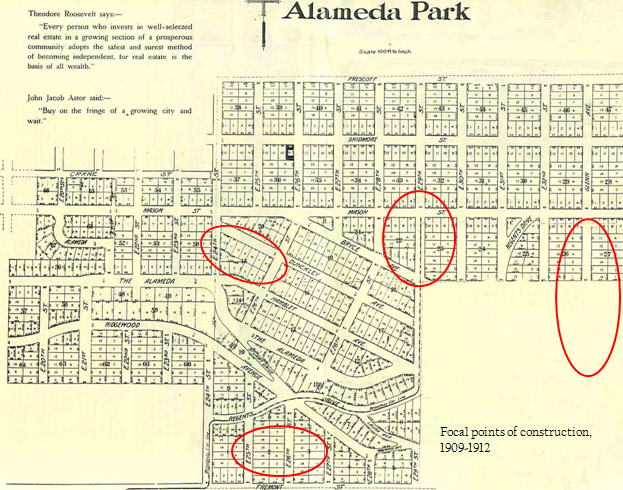
Another observation from the permit study is to have a look at the spread of construction activity to see which portions of the neighborhood were built out first: the areas around 24th and Dunckley; 25th and 26th below the ridge; 29th and Mason; and 32nd Place (then called Glenn) from Mason to Hamblet. These highlighted areas below indicate in general the earliest construction from 1909 to 1912.

It’s also interesting to see who was doing the building during these years. A handful of builders built a large percentage of the homes. The list we’ve compiled below shows total homes constructed in Alameda Park by each of the most prolific builders. Many of these we’ve profiled here, others we’re still working on.

Builder Total Alameda Homes Built Building Activity
Oregon Home Builders 24 homes built 1914-1917
Ken Birkemeier 21 homes built 1932-1952
Harry Phillips 21 homes built 1921-1928
Matot Construction Co. 20 homes built 1921-1926
Frank Read 19 homes built 1923-1941
Nils O. Eklund 17 homes built 1916-1922
Grady Mahaffy 13 homes built 1922-1936
Wickman Building Co. 10 homes built 1921-1923

In addition to the general trends, there are specific sad stories: more houses than you might imagine have had fires (and fire repairs, hence the permit records). A couple of homes were actually struck by lightning. A fad of game rooms, recreation rooms and wet bars were put in during the 1950s, and even an exercise room way back when. Sadly, too frequent removal of trim, built-in shelves and other architectural details in a attempt at modernization (gasp). Interesting to note how many wooden front porches were rotting apart by the 1950s, and a spate of concrete porches and steps poured in replacement.

It’s also clear, when you look at the records, why Portland’s addressing system was changed in the early 1930s. Some of our homes here in Alameda have had three addresses prior to the Great Renumbering (particularly on NE Bryce Avenue) as numbers had to be skootched over to make room for new houses built on empty lots. Let’s just say the original numbering system was less than scientific. You can see this on the actual building permits themselves, where one address has been scratched out and the new one written in. History in the making. It wasn’t scratched out in the example above, but you can clearly see Alameda School’s pre-address change number: 864 Fremont.

Another observation as we completed the study was just how many homes do not have an original building permit. Over the years, for whatever reasons, the City has lost perhaps as many as 20 percent of the original building permits, particularly in the early years. For these homes, we have to rely on original plumbing permits which always give the construction date, but can be sketchy with owner and contractor information.

Regardless, as you handle these permits, some 1,025 in all, you feel time passing through your fingers. You see the clerk typists punching in the details. You sense the contractors standing in line, waiting at a counter wishing they could be back on the job site instead of in the permit office. You witness the many inspectors and their mostly neat observations, drawings, complaints and even sarcastic remarks in shorthand on the 4 x 6 manila cards.

And you can’t help but wonder what it will be like 100 years from now when someone wants to research the history of your house. What story will your house be able to tell?

The Tuxedo of Portland | Looking Back 99 Years

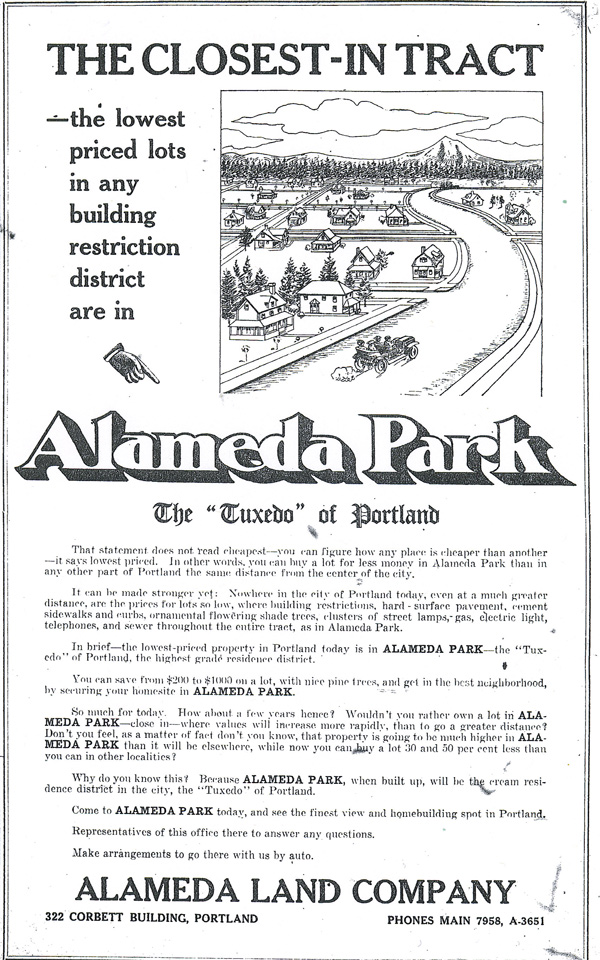
As the Alameda Neighborhood approaches its 100th anniversary, I thought it might be of interest to turn the clock back for a sense of what people were thinking about this part of the city in those days. I’ve done a comprehensive review of The Oregonian from 1909 to 1929 and have hundreds of articles and advertisements that shed light on the life of Alameda, Beaumont, Rose City Park and other Northeast Portland neighborhoods. Here’s one, an advertisement from 99 years ago: Sunday, October 24, 1909:


10-24-09 Advertisement for Alameda Park Neighborhood, from The Oregonian

10-24-09 Advertisement for Alameda Park Neighborhood, from The Oregonian


Plenty of food for thought here. The cartoon-like drawing showing a few houses (note the front porches) scattered on open blocks; the serpentine Alameda leading off toward Mt. Hood; street trees planted in orderly fashion. And the car. The text extols the affordable nature of the lots here in Alameda Park, the amenities, including flowering shade trees, telephone, electricity and sewer. The “Tuxedo” of Portland. Hmm.

Ninety-nine years ago this month, the streets were in, but not yet hard-surfaced (that was still almost three years off, completed in the spring of 1912). Curbs and sidewalks had not yet been framed and poured, nor was there any gas or electric installed. The only sounds of home construction were coming from Concordia and Vernon–neighborhoods to the north–where building was fast and furious. But here in Alameda, despite what the ad might have you think, it was a quiet place at the far northeast edge of the city limits. The first boom of Alameda construction was still a year or more away.

As we enter the 100th anniversary phase, in 2009-2011, I’ll be sharing clippings on a “real-time” basis. You can read all the Alameda news that was fit to print on the day it ran, exactly 100 years ago. What better way to learn about our history…no such thing as old news.