Street scenes illustrate change at 42nd & Killingsworth

Third in a three-part series

As Portland slowly rebounded from the Great Depression of the early 1930s and interest rekindled in Portland residential real estate, the stage was set for a new era at NE 42nd and Killingsworth. Open lands were available for development, subdivisions were platted with buildable lots ready to go, and new infrastructure was on the way in the form of paved roads and big plans for the new Portland Airport. A small wood-frame general store had been built in the late 1920s at what was then the quiet rural crossroads, and other nearby mom-and-pop stores were opening to meet the needs of surrounding residents.

By 1951, the corner was home to multiple gas stations, a barber shop, a cleaners, an ice cream shop and a café. The small wood frame building on the northeast corner had become the Publix Market, operated by Cliff and Mary Tadakuma. Here’s a look:

1951 Looking Northwest

Looking to the northwest at the intersection of NE 42nd and Killingsworth about 1951. The Publix Market is at the northeast corner, on the right. The Lyle Sumner service station is on the Northwest corner. Note that the intersection is not signaled. Photo courtesy of Joyce Tadakuma Gee.

Before the war, Portland had a thriving population of immigrant and first-generation Japanese families who were integrated into all aspects of civic life. In early 1942, following the attack on Pearl Harbor and declaration of war, Japanese Americans were forcibly removed from most West Coast cities and relocated to internment camps in remote inland areas of the American West. The federal policy fractured families physically and emotionally, and resulted in significant economic losses for Japanese-Americans who owned businesses and property.

As families were loaded into buses and trains during the “evacuation,” heart-breaking decisions were made about the disposition of lands and businesses. Beginning in the 1930s, the Shiogi family had operated a market known as “Publix Market” at the corner of North Killingsworth and Gay Street in North Portland (the storefront that today houses Milk Glass Market, 2150 N. Killingsworth). When the Shiogis were removed to the Minidoka Internment Camp in Idaho, they “gave” their store to neighbors for safe-keeping.

In the fall of 1945, upon returning after the war, the family attempted to re-open the store but found anti-Japanese sentiment in Portland to be too strong. Younger members of the family—daughter Mary and her husband Cliff Tadakuma—who had endured the internment experience only to be discriminated against at home in Portland, moved to Hawaii for several years in search of a more hospitable environment. Mary found work as a housekeeper. Cliff became a gardener on a large estate.

In 1950, Mary and Cliff Tadakuma—with their young daughter Joyce who had been born at Minidoka—returned to Portland from Hawaii and decided to try again to reopen Publix Market, but this time in a different location farther out Killingsworth, in northeast Portland.

Mary had grown up in Portland, a first generation Japanese-American. Cliff had grown up in Maui and graduated from Oregon State University with a degree in chemical engineering (and where the two had met). While their interests and expertise were not necessarily in running a small grocery store, it was a better option than housekeeping and gardening when they returned to Portland.

The couple leased the old wood frame building at the northeast corner of NE 42nd and Killingsworth. The store was adjacent to a densely populated trailer court established during the booming war years, and the surrounding residential neighborhood was growing as well. With the help of Mary’s parents Lori and Hood Shiogi who had run the market when it was located in North Portland, Mary and Cliff set about re-establishing Publix Market.

Daughter Joyce Tadakuma Gee was six years old at the time and recalls that her family lived in the back of the store. Behind the shelves and retail area were two small bedrooms, a bathroom a living room and a small kitchen. Joyce—who is a long-time Portland resident—attended nearby Whitaker Elementary School, located on Columbia Boulevard. “I remember being so envious of classmates of mine who had ‘real’ homes to live in,” she recalled when interviewed in 2020.

Neighbor Doris Woolley grew up on Jarrett Street just north of Publix Market, and remembered that everyone referred to the store simply as “Cliff and Mary’s.” Doris—who passed away in 2020 at age 92—recalled that all of the residents of the trailer park and neighbors north of Killingsworth were loyal to Cliff and Mary and would only shop at Publix Market, even though there were two other small markets nearby.

“It was a great store and they had pretty much everything you wanted,” Woolley recalled.  “Plus, they would let you run an account. In those days a lot of people would charge their groceries during the week and pay for them once they got their paychecks at the end of each week.”

Asked about her recollections of Cliff and Mary’s Japanese American origins and any tensions during the post-war years, Woolley remembered only that everyone liked Cliff and Mary. “They were very kind to everyone.”

Mary Tadakuma died in 1954. Cliff remarried and moved with daughter Joyce to Hood River, where he ran a grocery market until his death in 1978.

1958 Looking North

This 1958 photo (courtesy of City of Portland Archives, a2005-001-984) looks north on NE 42nd just south of Killingsworth. Publix Market is gone, replaced by the Panarama, a liquidation store. The Chevron service station across 42nd to the west has changed hands since the earlier photo and was being operated by Rod Martin. Behind the Panarama Market was the parking lot and sign for the brand-new Safeway store. The intersection was controlled by stop signs facing NE 42nd Avenue.

The white clapboard market building was built about 1927 and was initially operated as a grocery store by Bill and Jennie Batson. Panrama survived the 1957 opening of Safeway, but by 1961 the building had been demolished and replaced by a parking lot and service station.

Safeway Opens in January 1957

A combination of changes in the grocery business—with tendencies to larger chain stores—and an increasing population and market made the corner a natural for the Safeway store, built on the site of what had been the trailer park and small grocery store in the 1940s-1950s.

The store opened in January 1957 as part of a three-store opening blitz in the Portland area, as described in this full page ad from The Oregonian on January 10 1957.


1964 siting of John Adams High School

Construction of John Adams High School just southeast of Fernhill Park in the mid-1960s caused quite a stir and protest from the neighborhood. More than 200 angry neighbors turned out at a Portland School Board meeting on September 14, 1964 to share their disbelief that the School Board would demolish and relocate more than two dozen homes, three duplexes, a local greenhouse/nursery known as Knapps and a PGE substation to make room for the school.

From The Oregonian, September 3, 1964. The homes and businesses inside the dotted line were demolished or relocated to make room for John Adams High School.

From the Oregon Journal, September 3, 1964. Greenhouses for Knapp’s Nursery on NE Simpson are visible in the photo to the left, which looks north on NE 42nd.

The emotion and sense of loss in the letters and petitions submitted to the school board make for tough reading. Despite this strenuous protest, demolition went ahead, construction followed, and John Adams High School opened in September 1969.

From the Oregon Journal, September 15, 1964

A dozen years later, when high school enrollment dropped in the early 1980s, the building was repurposed as a middle school and operated for another 18 years before being closed in 2000 due to health concerns about mold and radon gas. The building sat empty and was frequently vandalized until being torn down in 2006 leaving the large open space south of the track. Newcomers to the area today might not even know that vacant piece of ground south of the track was once a high school and middle school.

1965 Looking South
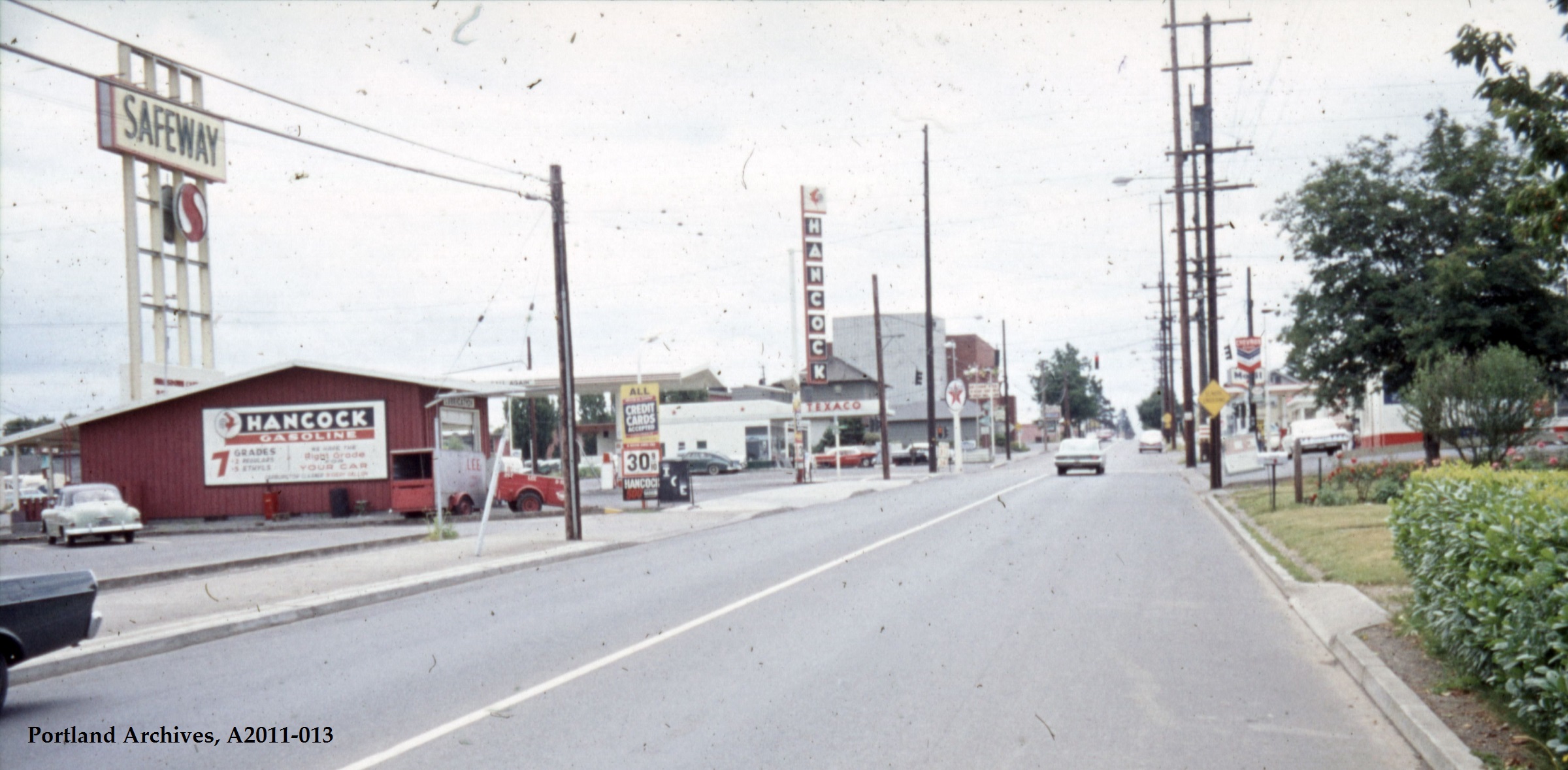
This view from 1965 looks south along NE 42nd Avenue. The tall buildings in the background are the relatively new St. Charles Church. The intersection has a traffic signal, and each corner features a different gas station: Texaco, Hancock, Mobil and Chevron. The Hancock building stands about where the Publix Market building once stood. The Safeway sign looms large over the intersection. Photo courtesy Portland City Archives, a2011-013.

Safeway operated in this location until about 1972, when the property was acquired by Portland Community College and the building remodeled to become a workforce training facility. In 2024, a completely new PCC building at the corner is now the Portland Metropolitan Workforce Training Center. And construction is underway just to the east on an affordable housing development managed by Home Forward that will include 84 units.

From open space that once provided wildlife habitat and material needs for Indigenous people; to homestead and farm fields that supplied a growing population of newcomers; to park land, school grounds, green houses, family homes and retail; and today affordable housing, workforce development and some great restaurants; this place has continued to evolve, layer upon layer of history and of life.

Fernhill Park: From wild thicket to popular neighborhood park

It’s often the small and even random things in the past—stuff we don’t pay much attention to or think about now—that make a big difference in outcomes that shape the future.

How Northeast Portland’s Fernhill Park has turned out today is kind of like that: Peel back the layers of history and you can see why things are the way they are today. That’s kind of our broken-record message here at AH, but it’s true.

The hills and gullies that make Fernhill Park distinctive today made it less desirable for crops in the early 1900s.

One of the most prominent features of the park today, located across rolling hills near NE 41st and Holman in Northeast Portland, is responsible for it being a park at all, and probably not for the reason you think. The hills and gullies on the park’s north side, a great place to run the dog in the spring and summer or to sled in the winter, distinguish this place from other nearby city parks.

But back in the day, when much of this area was farmland, this up-and-down topography was a thicket of trees and brush and not very good for growing crops. A close examination of aerial photos from the 1920s, 1930s and 1940s show agricultural fields on all sides right up to the edges where the ground falls off into the ravines of today’s park area. So—the reasoning went—if the city really wants to buy that property from us farmers, go right ahead, we can’t grow anything there anyway.

And that’s just what happened.

After voters approved a property tax levy in 1938 to create more parks and playgrounds for a growing Portland, the city set out on a 10-year process of buying those hills and gullies, starting out in 1940 with a 10-acre parcel owned by the Jackson family right in the middle of it all.

During those years, several dirt roads criss-crossed the north side of the park, one even ran right up the bottom of the gully at the heart of today’s off-leash area in the northeast side of the park, pausing at a wide spot that served as a dump and debris field where car bodies and all manner of junk were strewn.

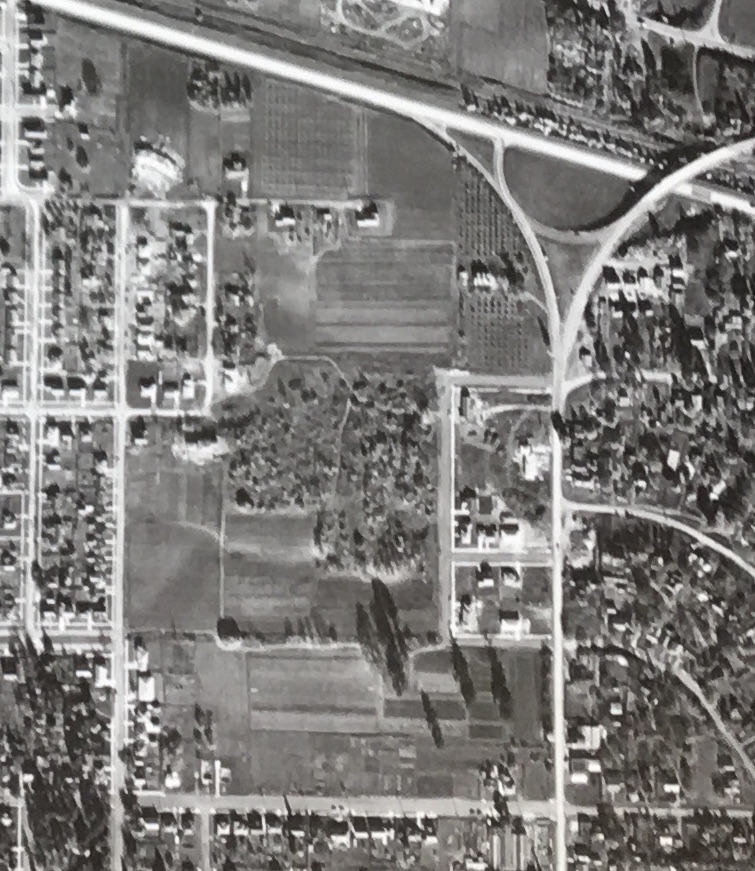
This detail of an aerial photo from 1940 shows the area of today’s Fernhill Park in the middle surrounded by farm fields on all sides. NE 42nd Avenue is the north-south street on the far right and doesn’t yet go through to Columbia Boulevard (it bends around the corner to the right where Holman is today). The north-south street on the left (that also doesn’t go through) is NE 37th Avenue. The east-west dirt road at the top of the park became today’s Holman Street. Paths, a road and a dump area are visible in the top center of the brush patch. Mike Brink’s grandparents’ home is in the upper right corner with the rows of trees and barn to the south. Photo courtesy of the University of Oregon Map and Aerial Photography Library.

It wasn’t an official dump, but more like a secluded out-of-the-way place where folks from the surrounding area knew they could get away with off-loading a truckful of junk if they needed to. So they did. In the late 1930s and early 1940s, when the NE 42nd Avenue connection to Columbia Boulevard was built, some of the dirt fill needed to make the grade change for the overpass was dug out from and supplied by the gully on the east side of the park along today’s NE 41st Avenue.

Prior to 1940, when NE 42nd didn’t go through to Columbia Boulevard, you could stand near the northeast corner of what is today’s park and see the Kennedy School across the fields and orchards stretching west to NE 33rd Avenue, with more open fields south to Killingsworth and north to the banks of the Columbia Slough. Then during the building boom of the 1940s and 50s, subdivisions marched east transforming the fields into neighborhoods.

Just 10 years later in 1950 the neighborhood was filling in. NE 42nd now goes through to Columbia Boulevard (look for the Tourist Cabins and the Spur Tavern…they’re there). NE 41st has been built and house construction is underway.  And Mike Brink’s grandparents have planted an orchard with orderly rows of filberts south of the house and bing cherries north of the house. Photo courtesy City of Portland Archives.

Often referred to as “truck farms” because the produce was trucked to market (and some of it was sold out of the back of trucks at busy intersections and small markets around town), these surrounding fields produced fruit and vegetables for Portland households. One farm near the corner of what is today’s NE 41st and Holman was owned and run by a Japanese immigrant family, as were others in the area. During WWII, Japanese farming families across the Pacific Northwest were removed from their land and placed in internment camps in southeast Oregon and central California.

We know from our recent visits with Mike Brink—who grew up in the 1940s and 50s in the tourist cabins at NE 42nd and Holman now about to be demolished—that the fields and orchards stretching out in all directions were filled with filberts, apricots, bing cherries, raspberries, strawberries and other crops. Mike remembers walking through them and through the heavily wooded thicket that is today’s Fernhill Park on his way to and from St. Andrew’s School at NE 9th and Alberta. He’d leave the cabins in the morning, pass by his grandparents farmhouse that stood near today’s intersection of NE 41st and Highland, then take the path through the woods and fields over to Ainsworth Street where he’d walk to the corner of NE 30th and Ainsworth, which was the end of the line for the Alberta Streetcar (you should check out this link because it shows the streetcar waiting where Mike used to catch it at NE 30th and Ainsworth). Hopping on a mostly empty streetcar, he’d ride south on 30th and then west on Alberta to school, reversing the process in the afternoon, maybe stopping at a neighbor’s house for hot chocolate on the way home. Quite a solo daily adventure for an elementary school kid, but times were different.

Mike doesn’t remember it being talked about in his house during those years, but gradually, the city was buying up parcels of the woods when bond money was available and when the locals were willing to sell. A couple more parcels in 1942 and 1943. Six in 1949.

As the park took shape through the late 1940s and early 1950s, some locals referred to it as Ainsworth Park, a name that appears frequently in real estate advertising of that era. By the early 1950s, most of the open land Mike remembers to the north of the park had been converted to subdivision (the Vanlaeken and Leitritz additions for readers keeping track of plat names). NE Highland Street was put through the middle of his family’s farm and his grandparents moved to a new house in the neighborhood as the working farm landscape they once knew was transformed into suburbia. By June of 1951 when most of the park buying was done, the city had invested $60,479 and had acquired 25.95 acres.

In this detail of a 1956 aerial photo, the family farm is gone replaced by the cul de sac that is today’s Highland Street and homes are under construction; all of the lots are built up between NE 41st and 42nd in the middle of the photo; a baseball diamond has arrived in the middle of it all; the paths, road and dump are gone. Once again, the Tourist Cabins and the Spur Tavern stand out clearly just right of center toward the top. Photo courtesy of the University of Oregon Map and Aerial Photography Library.

Contemporary view from a hill on the north side of the park, looking off into the Vanlaeken and Leitritz additions. Mike’s grandparents’ farm was off to the right.

On July 14, 1954, City Council passed an ordinance officially naming the area Fernhill Park, a name that was not in local usage prior, but that probably takes its meaning from the hills on the north side of the park.

Construction of Adams High School just southeast of Fernhill Park in the mid-1960s caused quite a stir and protest from the neighborhood. Hundreds of angry neighbors turned out at a series of Portland School Board meetings in September 1964 to share their disbelief that the School Board would demolish 26 homes, three duplexes, a local greenhouse/nursery known as Knapps and a PGE substation to make room for the school. The emotion and sense of loss in the letters and petitions submitted to the school board make for tough reading. Despite this strenuous protest, demolition of the homes and businesses went ahead, construction followed, and John Adams High School opened in September 1969.

From The Oregonian, September 3, 1964. The homes and businesses inside the dotted line were demolished to make room for Adams High School.

A dozen years later, when high school enrollment dropped in the early 1980s, the building was repurposed as a middle school and operated for another 18 years before being closed in 2000 due to health concerns about mold. The building sat empty and was frequently vandalized until being torn down in 2006 leaving the large open space south of the track. Newcomers to the area today might not even know that vacant piece of ground south of the track was once a school, and before that a neighborhood, and before that farm fields, and before that an Oregon Trail-era homestead.

No history of the area would be complete without taking it back to the earliest record, when this property was homesteaded under the 1850 Donation Land Claim Act, which Congress passed to encourage settlement of the Oregon country. Isaac and Mary Rennison came across the Oregon Trail in 1852 and settled on and farmed the property, filing their Donation Land Claim in 1855 that encompasses the area bounded today by NE 33rd and NE 60th, Holman and Killingsworth.

Before all this recorded history, let’s not forget that these lands on the south shore of the Columbia River and the Columbia Slough were frequented by the Native Americans who called this area home for more than 500 generations.

Interesting, isn’t it, how the places we know and care about today as our local parks came to us partly because of unpredictable events or circumstances: Alberta Park was a brush patch owned by a Chinese immigrant who didn’t want to sell, or to control the brush and trees while the neighborhood developed around it, so the city condemned the property out from underneath him and turned it into a park. Wilshire Park was tied up in a complex probate process inadvertently delaying development until the city took out a bank loan to buy the property on the eve of its being turned into a subdivision. And much of Fernhill Park was property no one really wanted anyway because it wasn’t good cropland. Today, we take these places for granted as fixtures of neighborhood life.

With these lessons of history in mind, what should we be thinking about and taking action on today that would change some future outcome about how our neighborhood feels and operates in the future? Demolition and densification? Traffic? Hmm. More on that next week.