Construction Update: 24th and Mason

Neighbors interested in adaptive reuse of old buildings have had a front row seat this summer and fall as the von Homeyer house at NE 24th and Mason has been brought back from the brink of being a candidate for tear-down. Today, it’s on the cusp of its new life, with all of its systems transformed, spaces rearranged and upgraded, and virtually every interior and exterior surface either new or restored.

It’s as if the house is brand new: every window (the old ones were salvaged), all the doors, roof, heating (and now air conditioning), electrical, plumbing, floors, all wall surfaces, fireplace (the original mantel and built-in bookshelves are still there). Repaired and waterproofed foundation, new sanitary sewer line, fiber optics. Everything about the kitchen. It’s been a busy place.
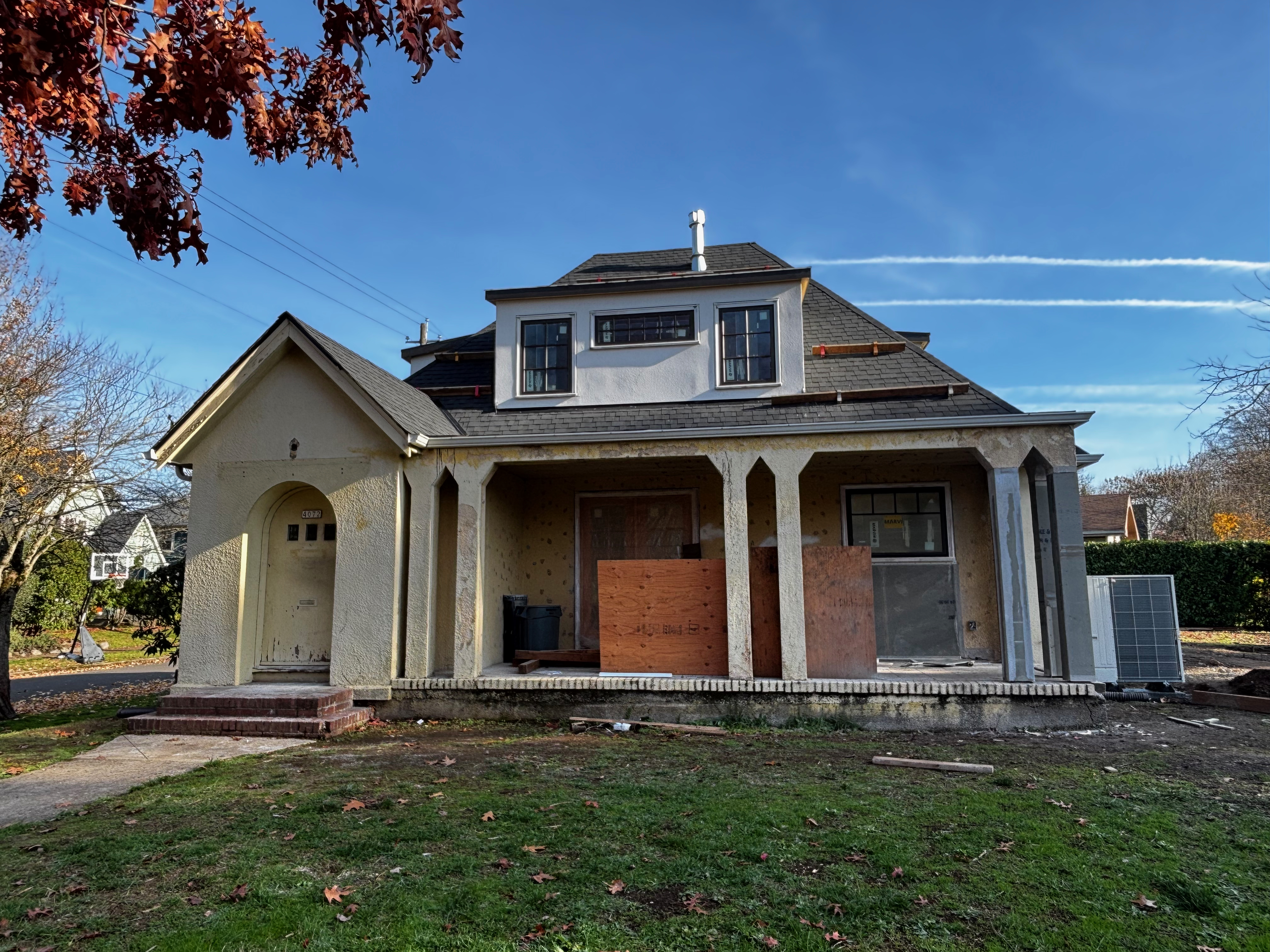
NE 24th and Mason, photographed in December 2024. Note repaired front porch columns at far right.

But still, when you see the “then” picture from 1925 when the house was built, and a recent photo from this December, it’s definitely the same time traveler, just transformed for its next 100 years.
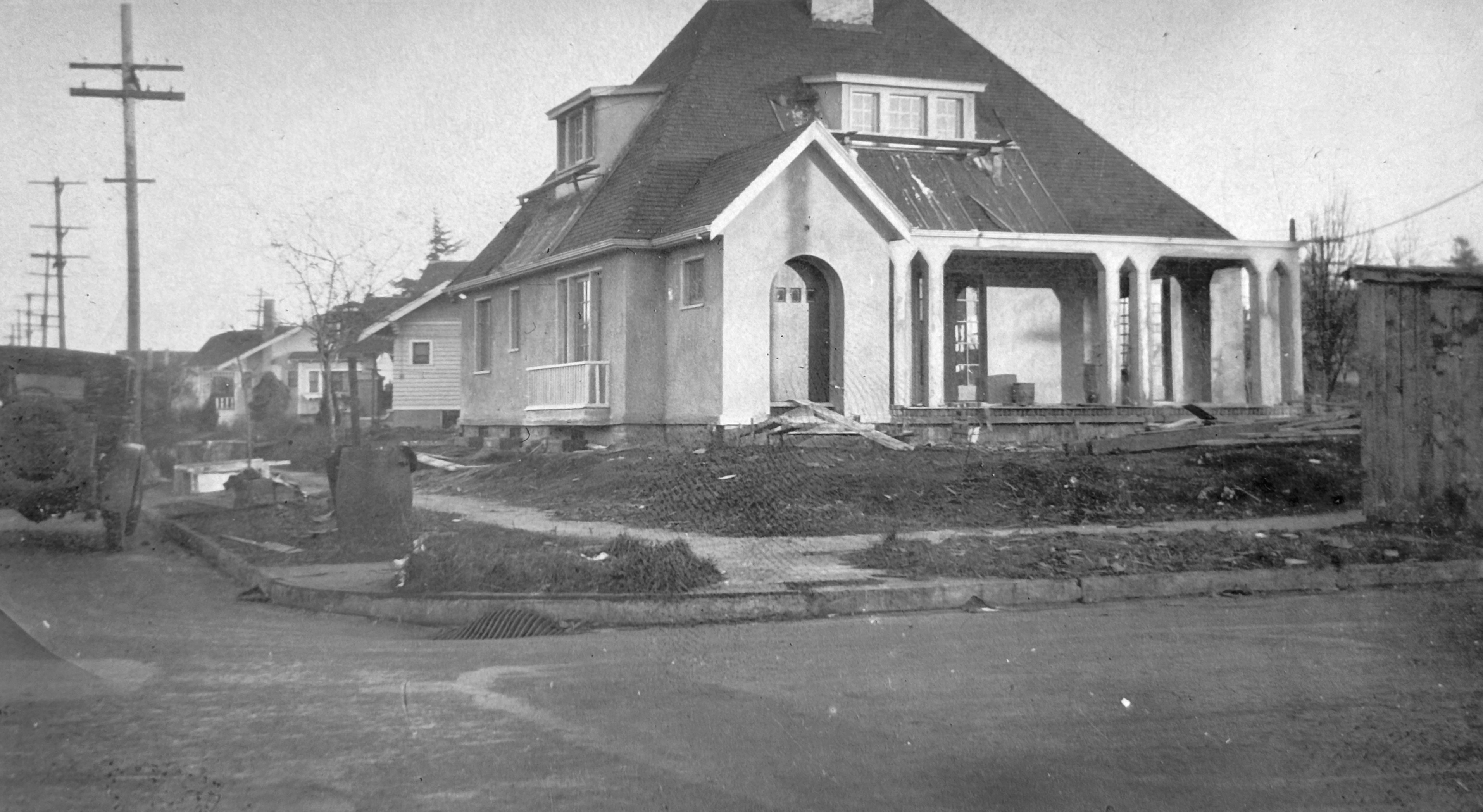
AH readers will recall that neighbors Jaylen and Michael Schmitt bought the house earlier this year after the youngest son of the von Homeyer family, now in his 90s, moved to a care facility. The house had been in the same family for almost 100 years, and the brothers lived there their entire lives.

The Schmitts, like many in the neighborhood, were concerned the house would eventually be a tear-down and that something else built there could be an eyesore or worse. When they bought it, the house was jammed to the ceilings with boxes, papers and an incredible collection of items from several lifetimes. They reached out to us for help sorting through a trove of documents and curating some of the items. We re-homed 30 pounds of precious photos to far-flung family.

Four months of thinning and organizing led to a well-attended estate sale in May and gradually as the house was emptied, the Schmitts worked with architect Mary Hogue of MkM Architecture to plan for adapting the house.

On the first floor, the existing bedroom and bathroom remain (all the plaster throughout the house has been replaced with drywall). The kitchen has been enlarged and will feature an island, two sinks and all the latest appliances. A newly re-opened and restored front porch is accessed by new french doors leading from the living room.
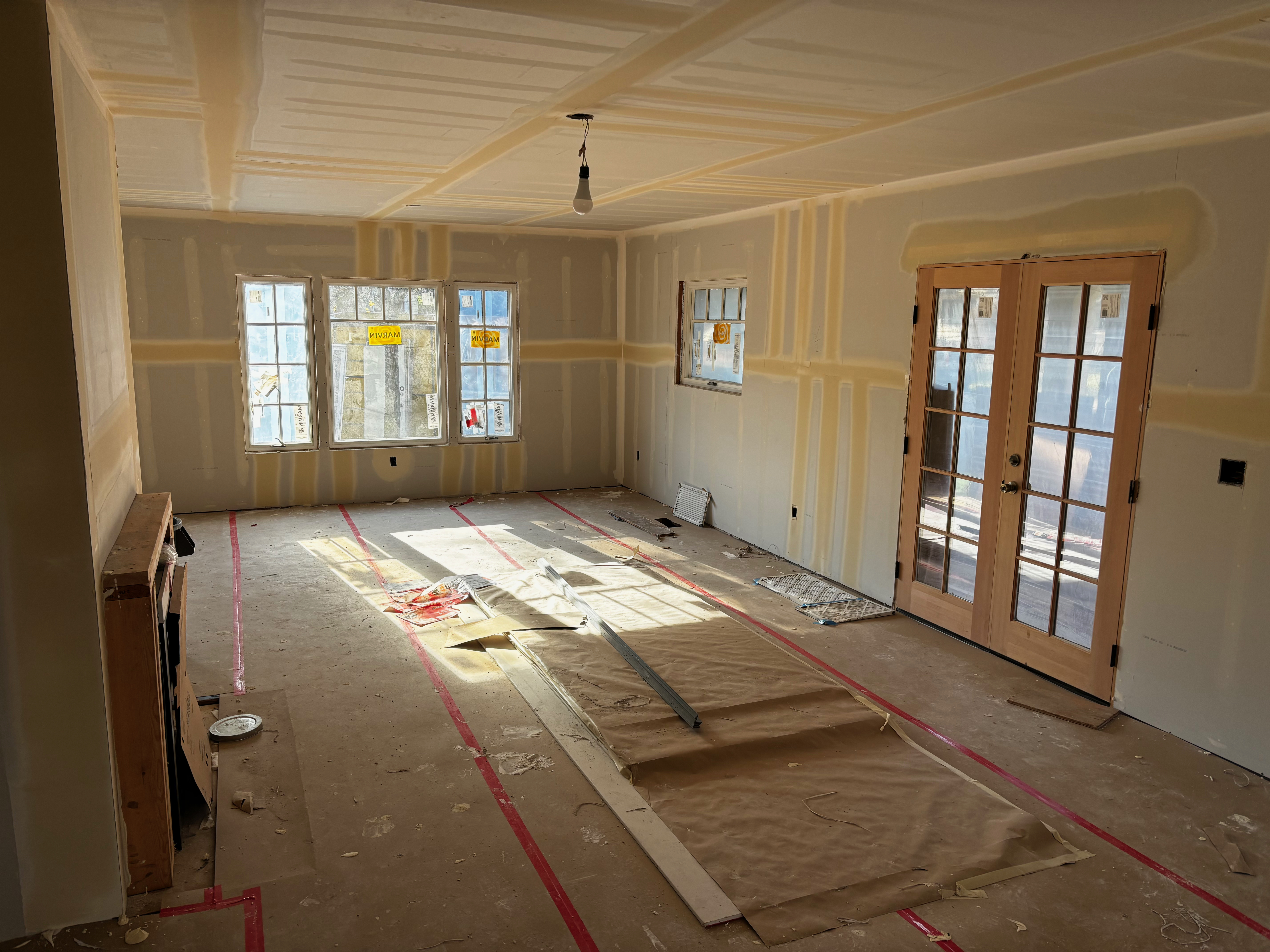
Looking into the living room / dining room. New French doors lead out onto the newly restored front porch. Framing is in, at left, for the fireplace.

The large kitchen features two sinks, will have a central island with cabinets, wall-hung cabinets all around, and a door out into the large backyard.

Upstairs, there are now two full bedrooms, each with its own bathroom, and a giant walk-in closet and dressing area with a huge bank of windows, and a combo washing machine/dryer.
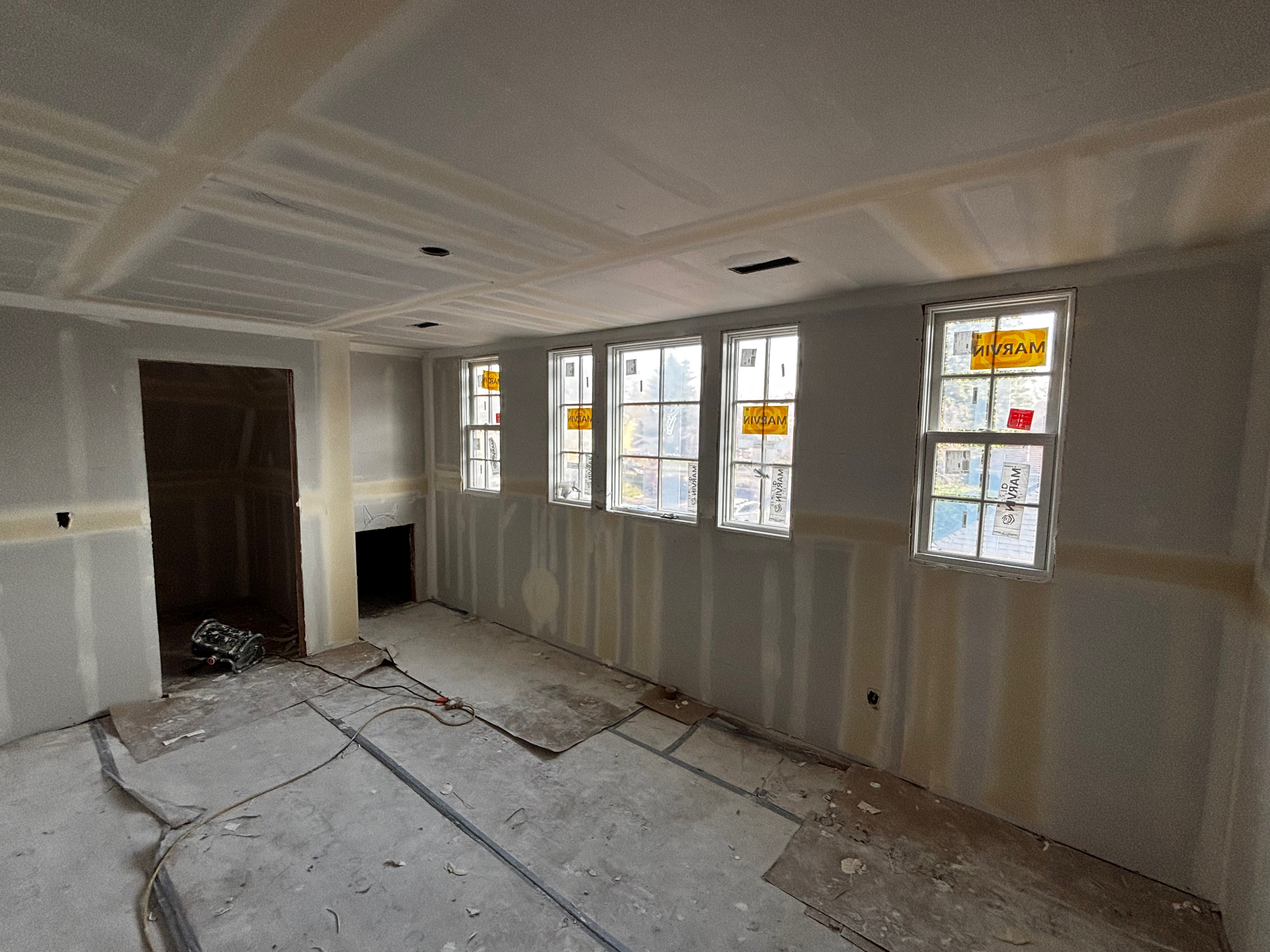
This bedroom upstairs features lots of light and a large closet.
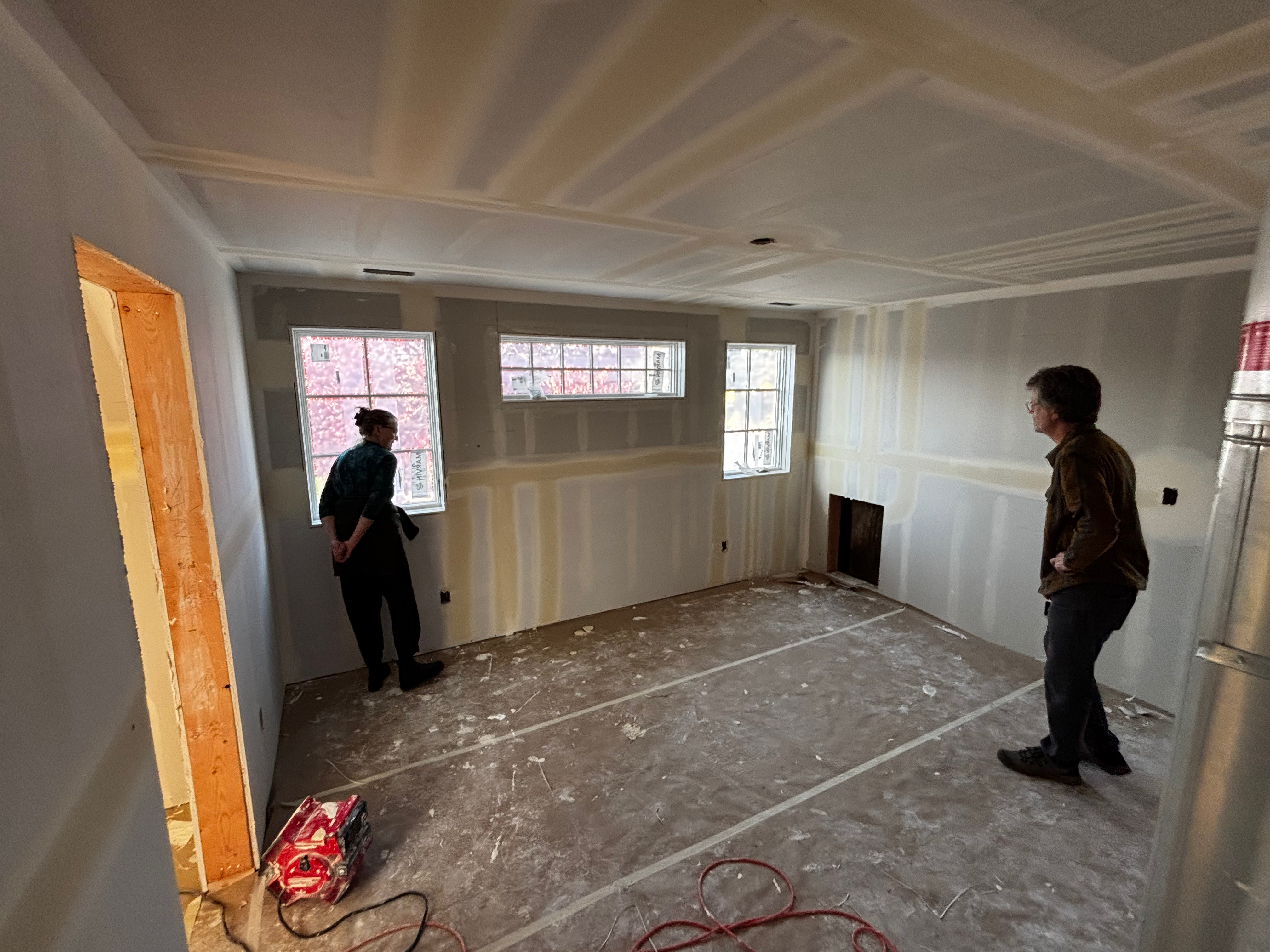
Upstairs, the primary bedroom features large windows and a giant walk-in closet to the left. An en suite bathroom is to the right.
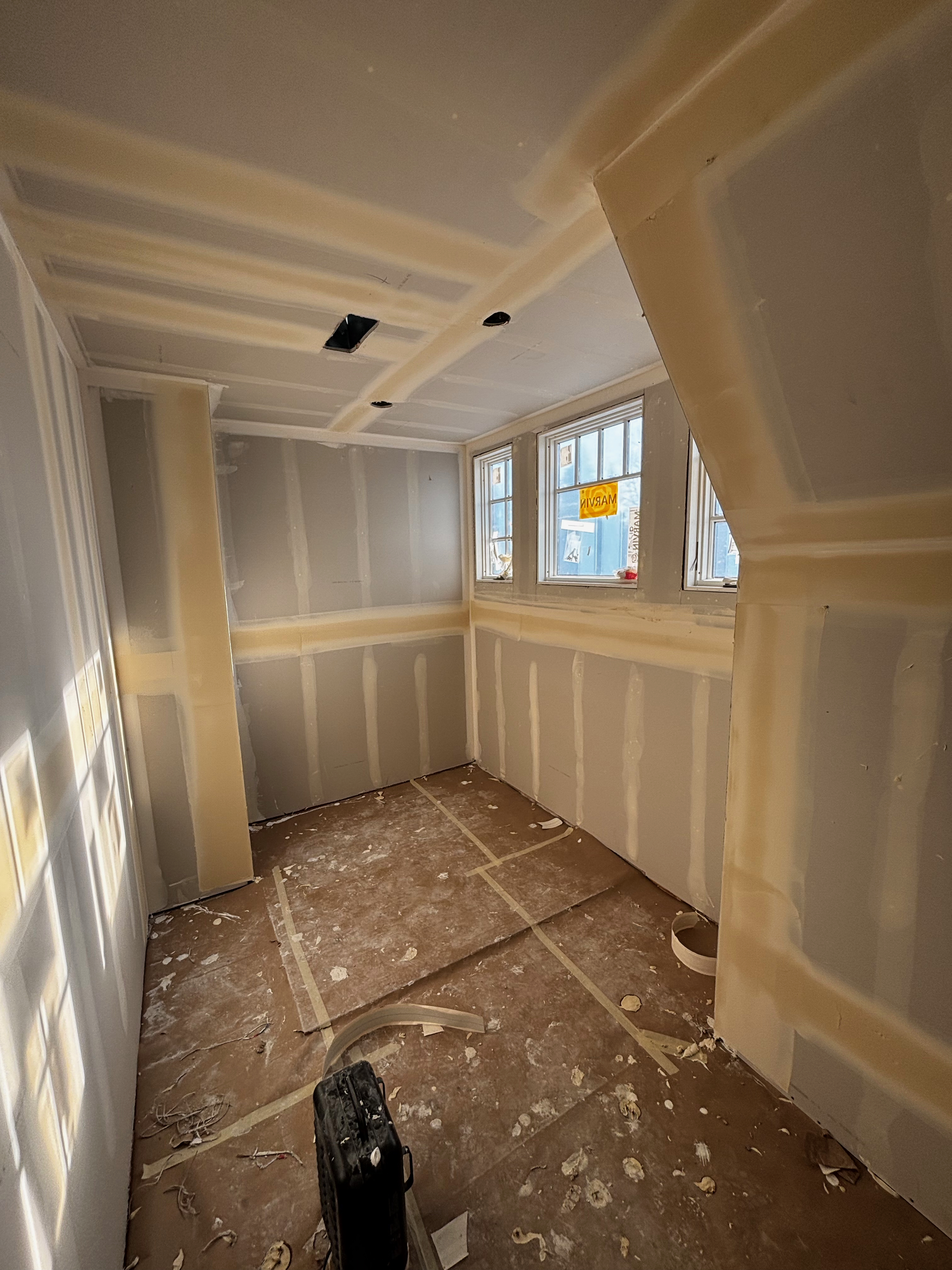
The walk-in closet off the primary bedroom is filled with light.

In the basement: another bedroom and bathroom; a giant family room and entertainment area wired for surround-sound; and a utility room with washer/dryer and sink.

Michael Schmitt, who lives nearby, has been on site almost every single day. Michael is using a builder and subs to do most of the work, and calls himself a “heavily involved owner.” He says he’s become a very good “cleaner-upper.”

“I want to make sure this house is put together as expertly as possible,” Michael explains. So, he has had a parade of tradespeople helping: framers, plumbers, electricians, stucco experts, drywallers, HVAC experts.

It’s been stressful. Michael reckons he hasn’t had a good night’s sleep this year between worrying about what might be the next surprise, and trying to figure out the puzzle of transforming almost every aspect of the house.
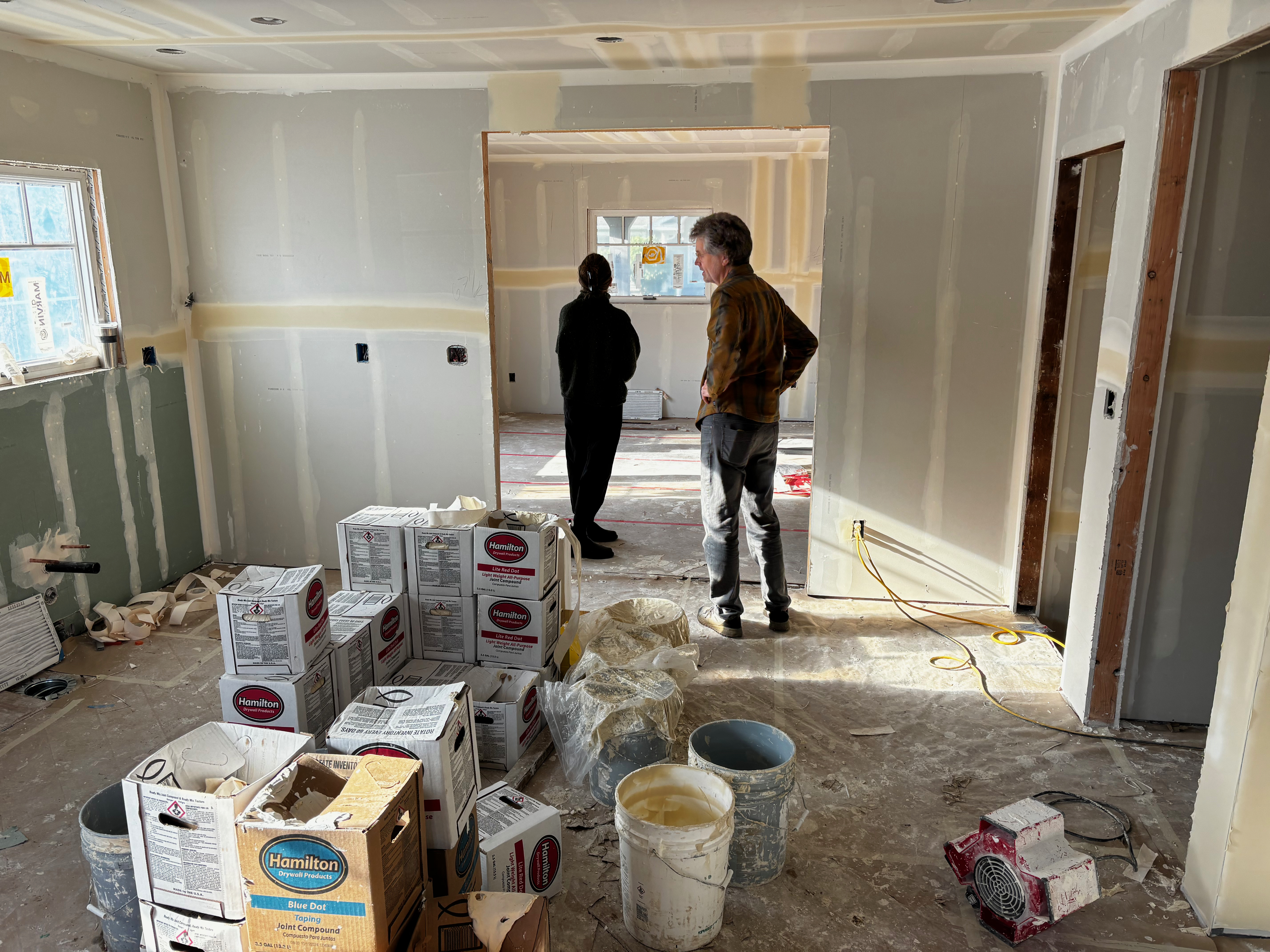
“If I were to offer my earlier self some advice based on this year, I’d have to say ‘you’ve got to be 100 percent crazy to do this.’”

While it has been stressful, it’s also been rewarding in so many ways. First, the Schmitts saved the house and property from what surely would have been a much larger building (or buildings). That alone makes it worth all the work. But Michael has enjoyed working with a great team of experienced tradespeople, getting to know his neighbors better and saying hello to the daily stream of passersby, many of whom offer thanks and encouragement.

This week, work on the house is at about the 60-70 percent level. Last week was drywall installation and mudding. Yet to come: painting, trim and finish carpentry, plumbing fixtures, floors, kitchen cabinets (and everything about the kitchen). So many details. And then there is the landscaping, driveway, fencing. Still plenty of work to do.

Michael is hoping the house will be ready to put on the market in the spring. When that time comes, he’ll be ready to cross the finish line and welcome new neighbors. “This will end up being a year and half of my life,” he muses when reflecting on all the stages of the work so far. And while it’s been a journey of ups and downs, all the learning, progress, transformations and new friendships have helped make it worthwhile.

We’ll check back with Michael in the new year.

Trove of documents provide insight into 1920s von Homeyer House construction

Last month we began a series of stories about the prominent yellow stucco home in the Alameda neighborhood at the confluence of NE 24th, Mason and Dunckley streets. In our first installment, we met the house and its most recent residents–the von Homeyer brothers–at the close of almost a century of that family’s occupancy.

The home was built by their newlywed parents Hans and Frances in 1925-1926 and occupied until recently by the youngest son Karl, now in his 90s. Older brother Hans (referred to as “Hansey” to distinguish him from the father Hans and the grandfather Hans) lived in the house all his life too, and died in 2002.

Because both generations of the family saved so many things–particularly paper–we can gain a special insight into the homebuilding process of the 1920s that has been lost to time for most other homes of this vintage.

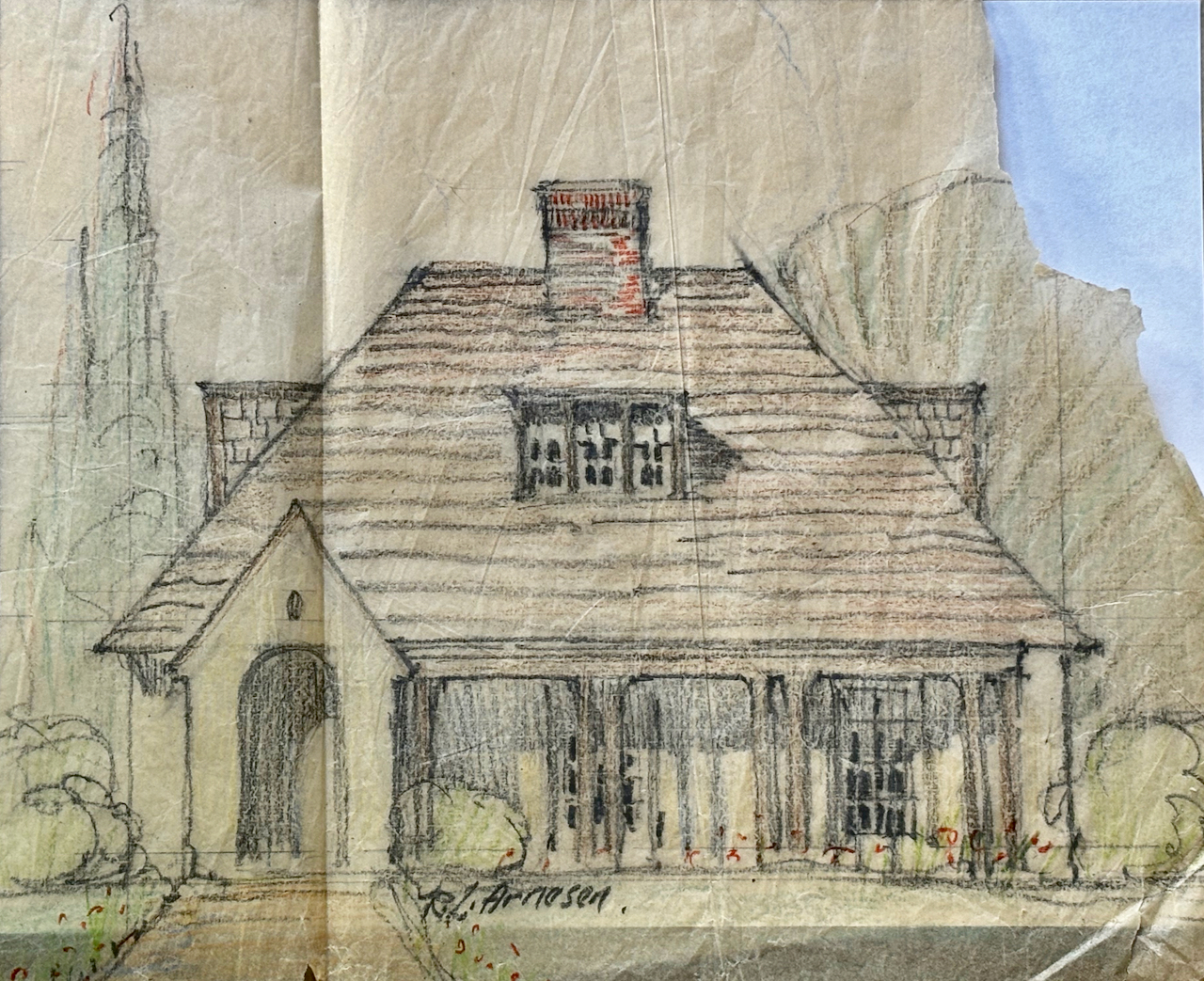
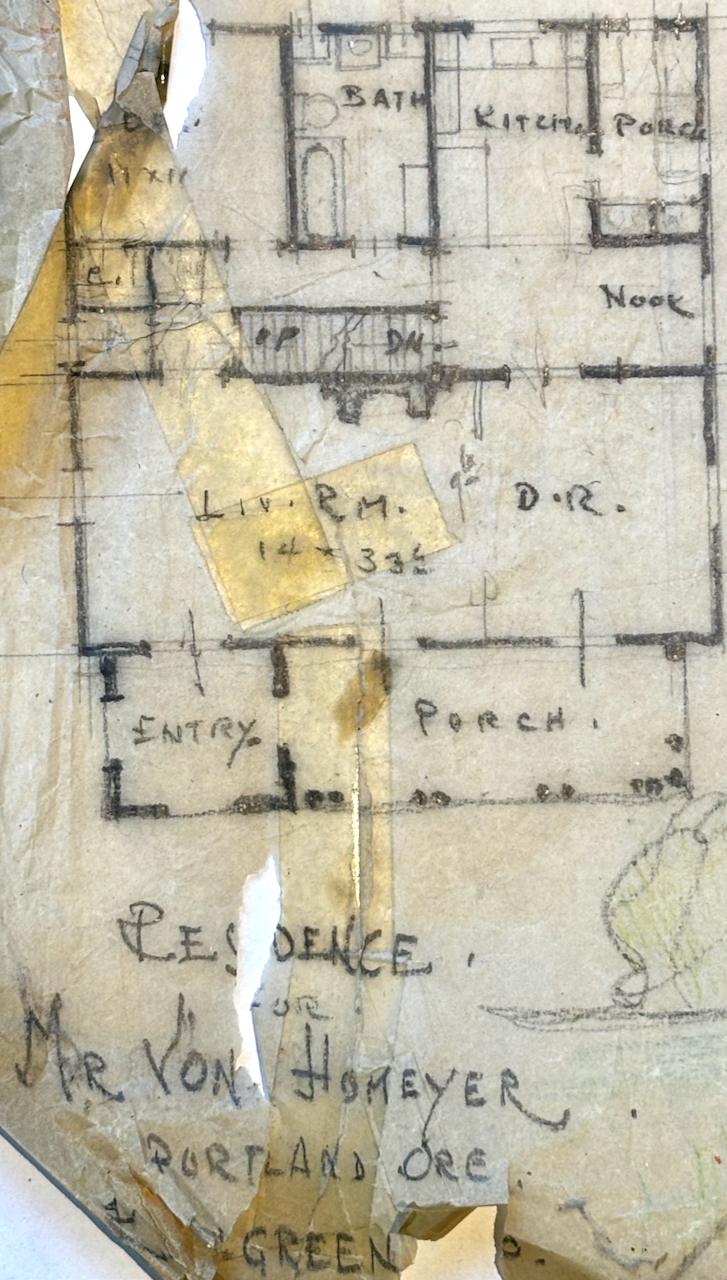
For instance, an early sketch of the house by architect Ragnar Lambert Arnesen, on onion skin paper, along with a floorplan.

Arnesen, then a 29-year-old immigrant from Stockholm, worked with Killgreen and Company, a design-build commercial and residential construction firm that started up in 1925 at the peak of Portland’s homebuilding business (by the way, the Swedish influence on Portland homebuilding is significant). By 1930, Arnesen had relocated to Dearborn, Michigan, and Killgreen and Co. had been shuttered by a collapsing economy. 

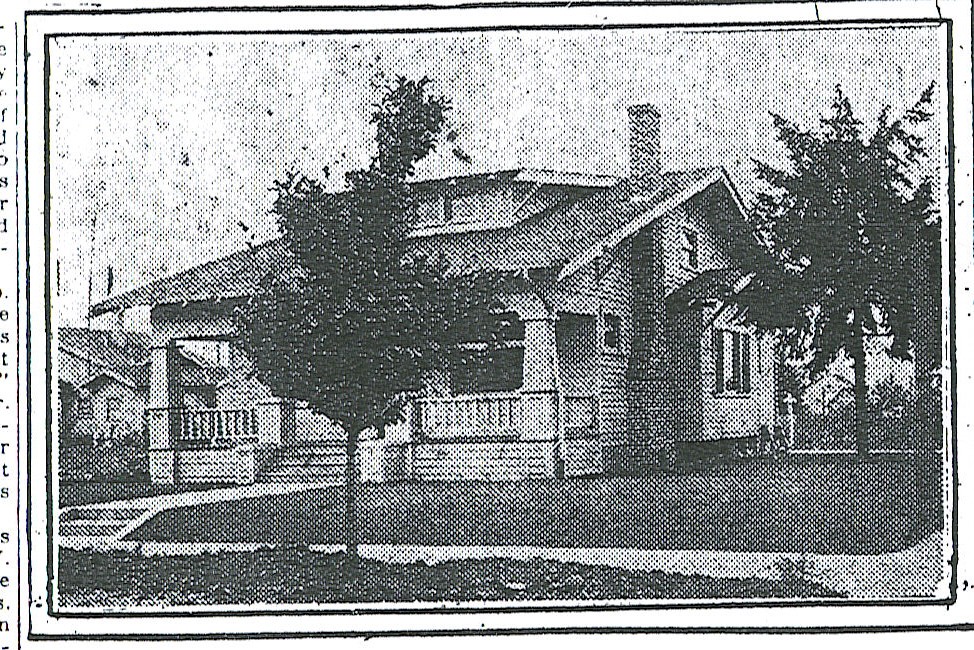
Hans von Homeyer was 27 years old in 1925 and busy establishing himself. He might have come across Arnesen and Killgreen from an advertisement in The Oregonian, like this one from April 19, 1925:

Hans was in business with his brother and his parents who owned multiple cleaning and dyeing shops in Portland and Vancouver, so his own network was wide…maybe that’s how he came across Killgreen. We’ll share more about the von Homeyer family business in future posts because it’s a very interesting story and the photos are fascinating as well.

Hans and Frances Westhoff, daughter of a Vancouver clothier family, were engaged to be married and looking to start their family and home in Northeast Portland. They found the lot in the Alameda neighborhood (which was then only about half built-up), engaged Killgreen and its architect Arnesen, took out a mortgage, and got down to the business of planning and construction.

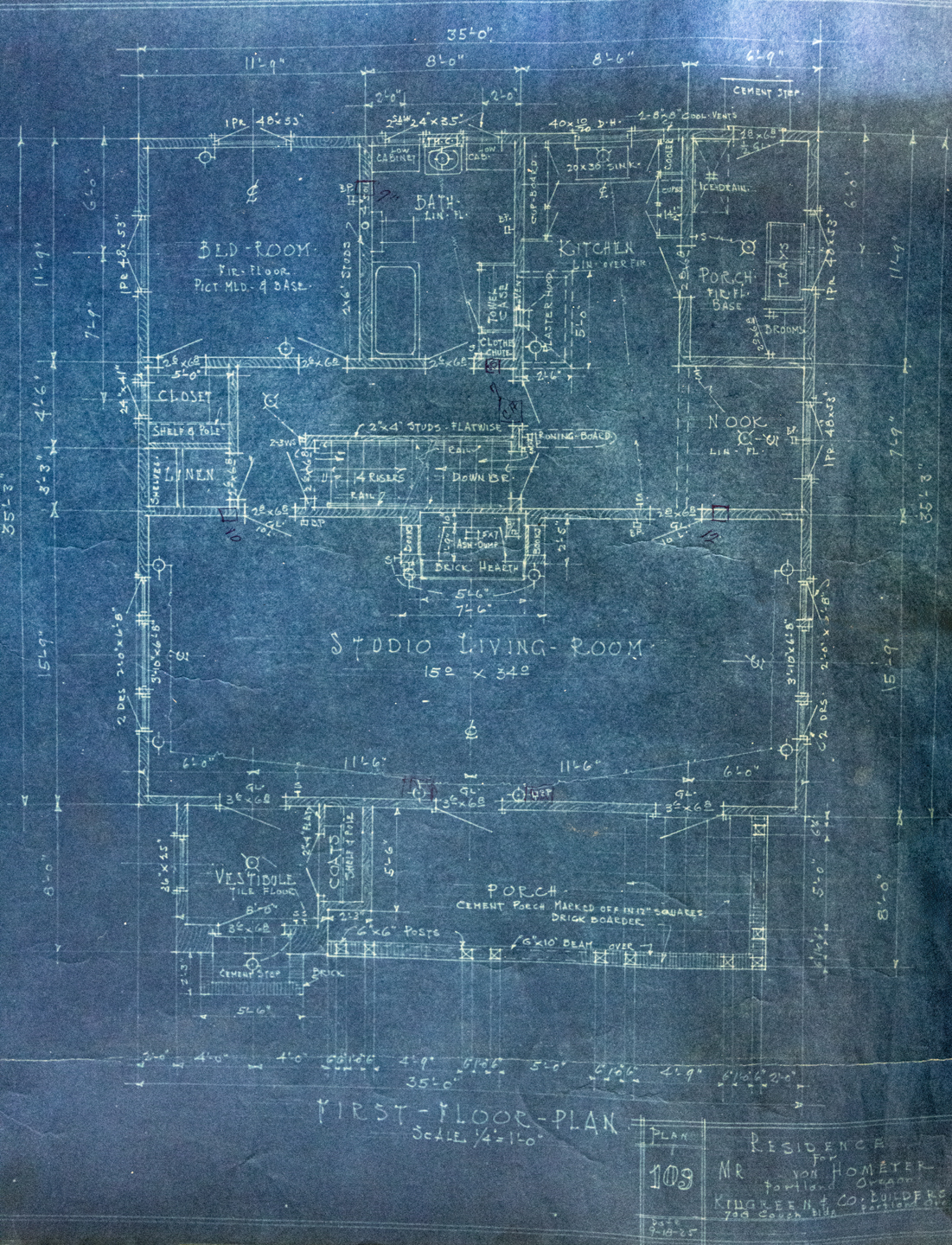
Arnesen’s early sketch led to the set of blueprints:

An important note: in the time between the first sketch and the blueprints, the primary shared living space in the home went from “Liv. Rm D.R.” to “Studio Living Room,” a hint of a much larger story.

Frances, then just 24, was an accomplished pianist building her own network as a well-known and respected piano teacher. She needed a studio to house her piano, two organs and teaching space. Ultimately, the house was designed to accommodate piano teaching and performance, which flourished in the years that followed. We’ll write more about Frances and her piano in future posts. Her gift for music touched hundreds of students–everyone in Alameda and surrounding neighborhoods knew her and plenty learned and played in that big room. Her music defined that space for so many years.
Back to the ad hoc archive of what the von Homeyers saved that allows us a view into the homebuilding process:

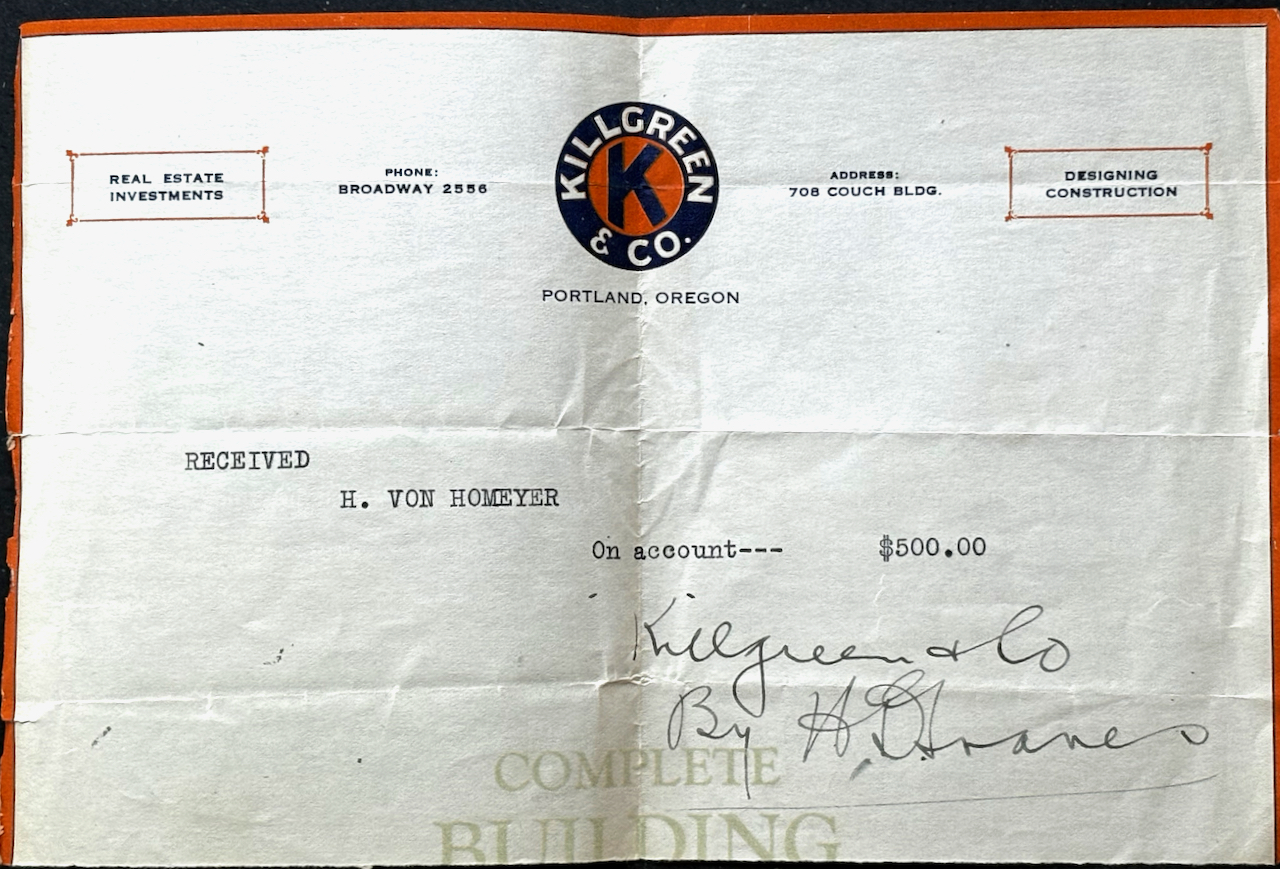
The contract–a signed agreement between Hans and Killgreen dated October 2, 1925 for the total cost of design and construction: $3,780, paid on completion of the house, with $500 at signing of the contract, $540 each week for five weeks and $500 upon completion of construction.

A copy of the receipts from Killgreen for each payment:

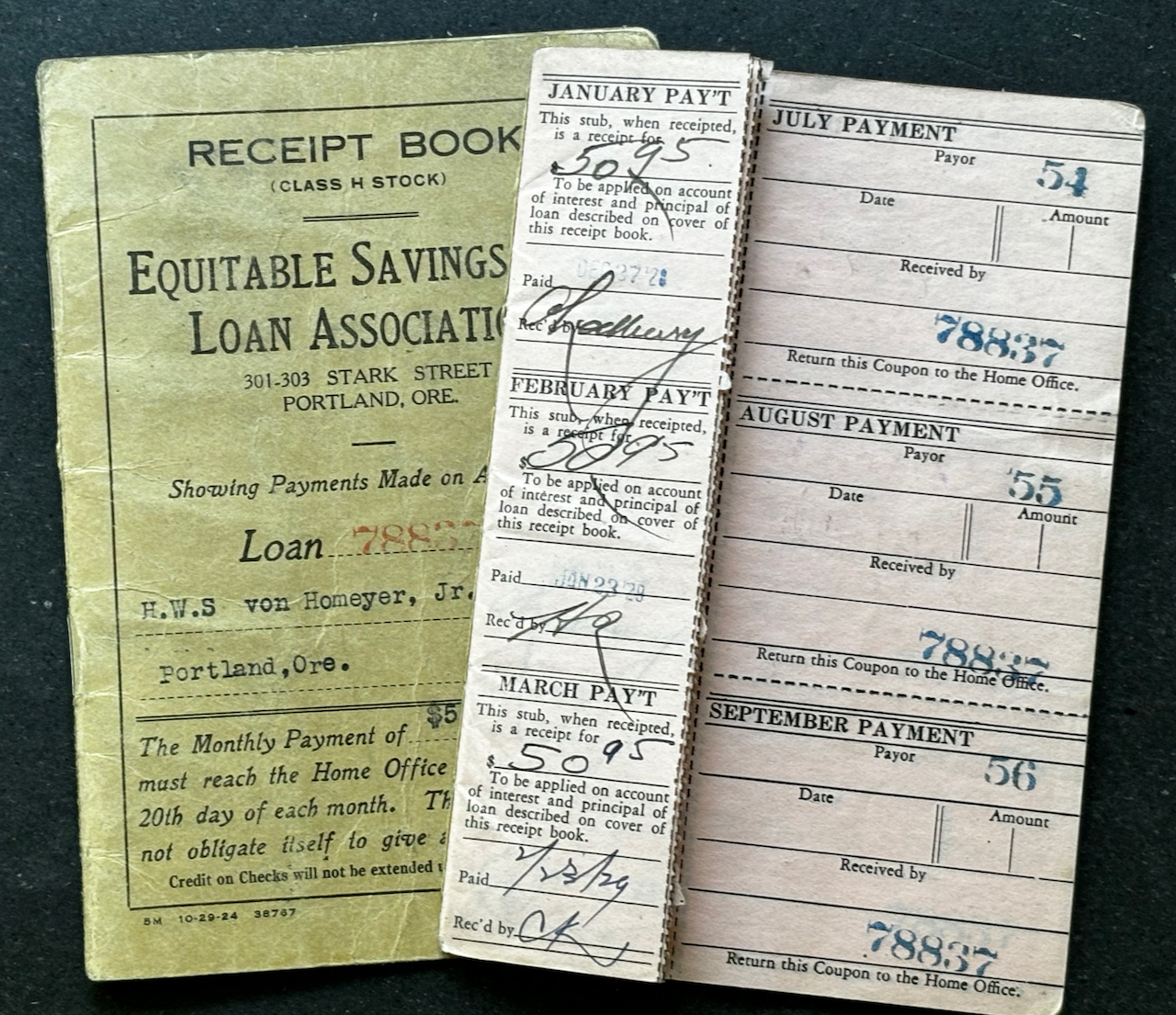
The bank receipt book from Equitable Savings and Loan with the monthly mortgage payment stubs for $50.95, paid through May of 1930:

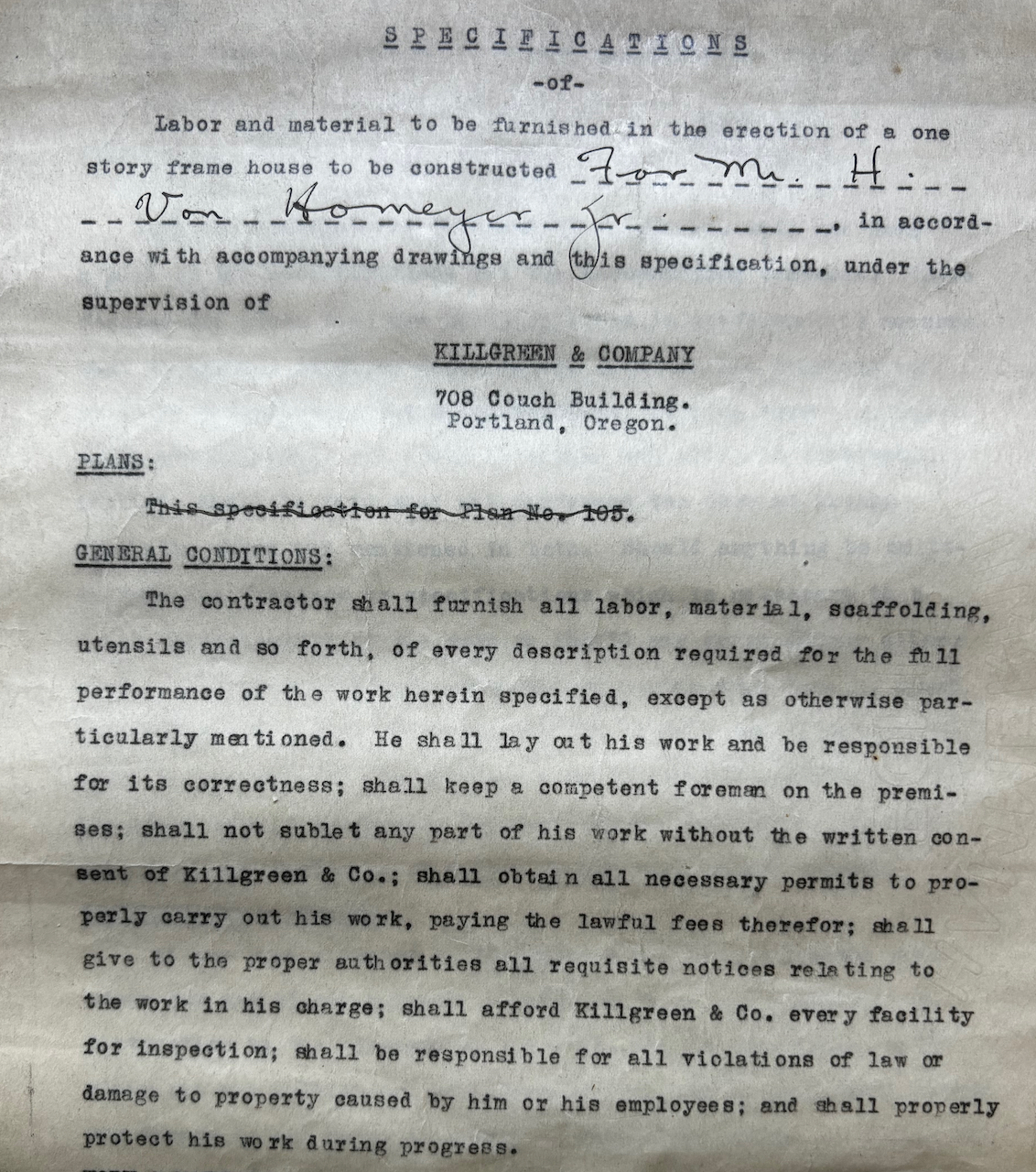
Thirteen pages of written specifications for construction of the house that accompanied the blueprints and pertained to every detail including the amounts and types of sand, mortar and lime that would be used for brickwork:

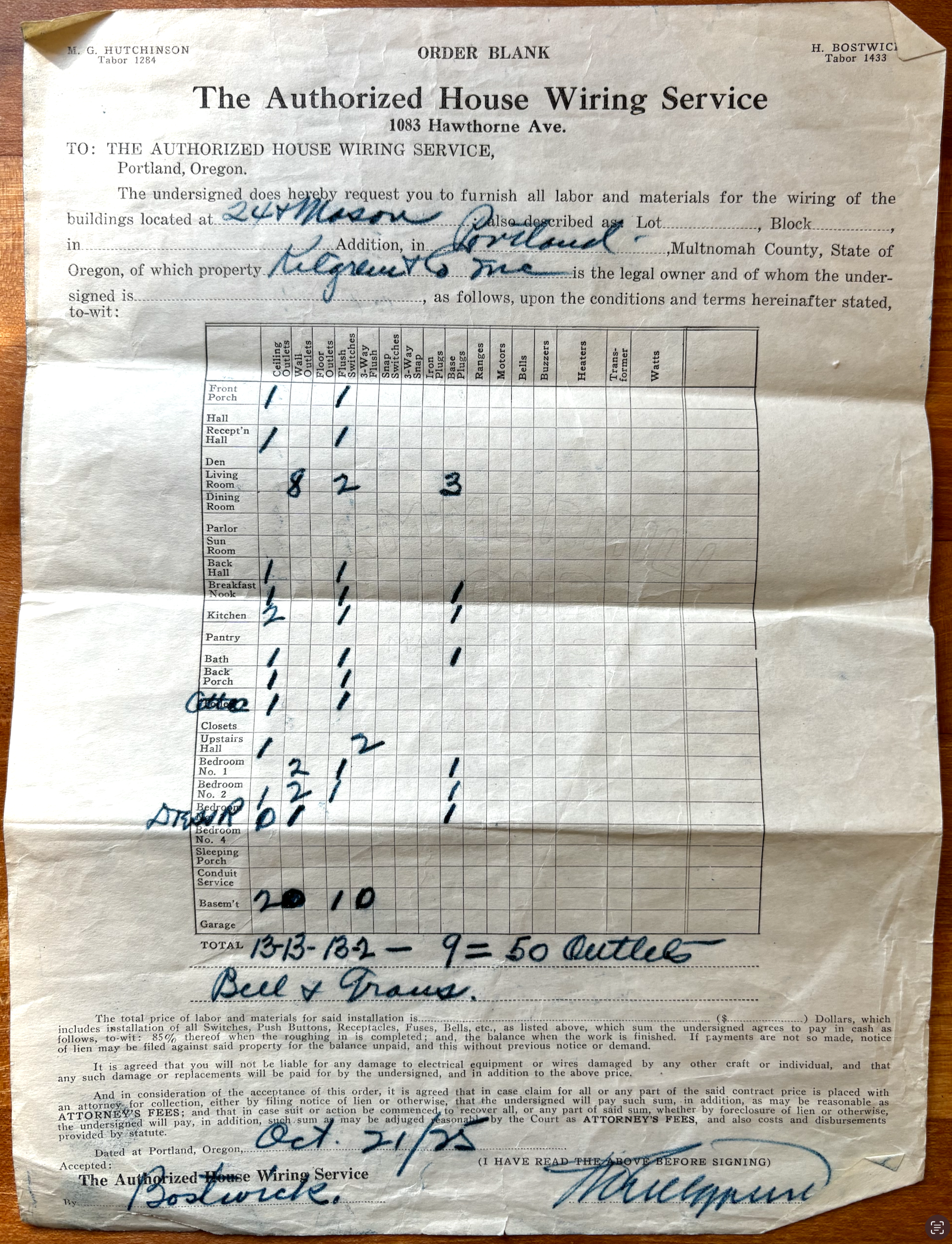
A detailed listing of all house wiring components installed by electricians (one of our favorites):

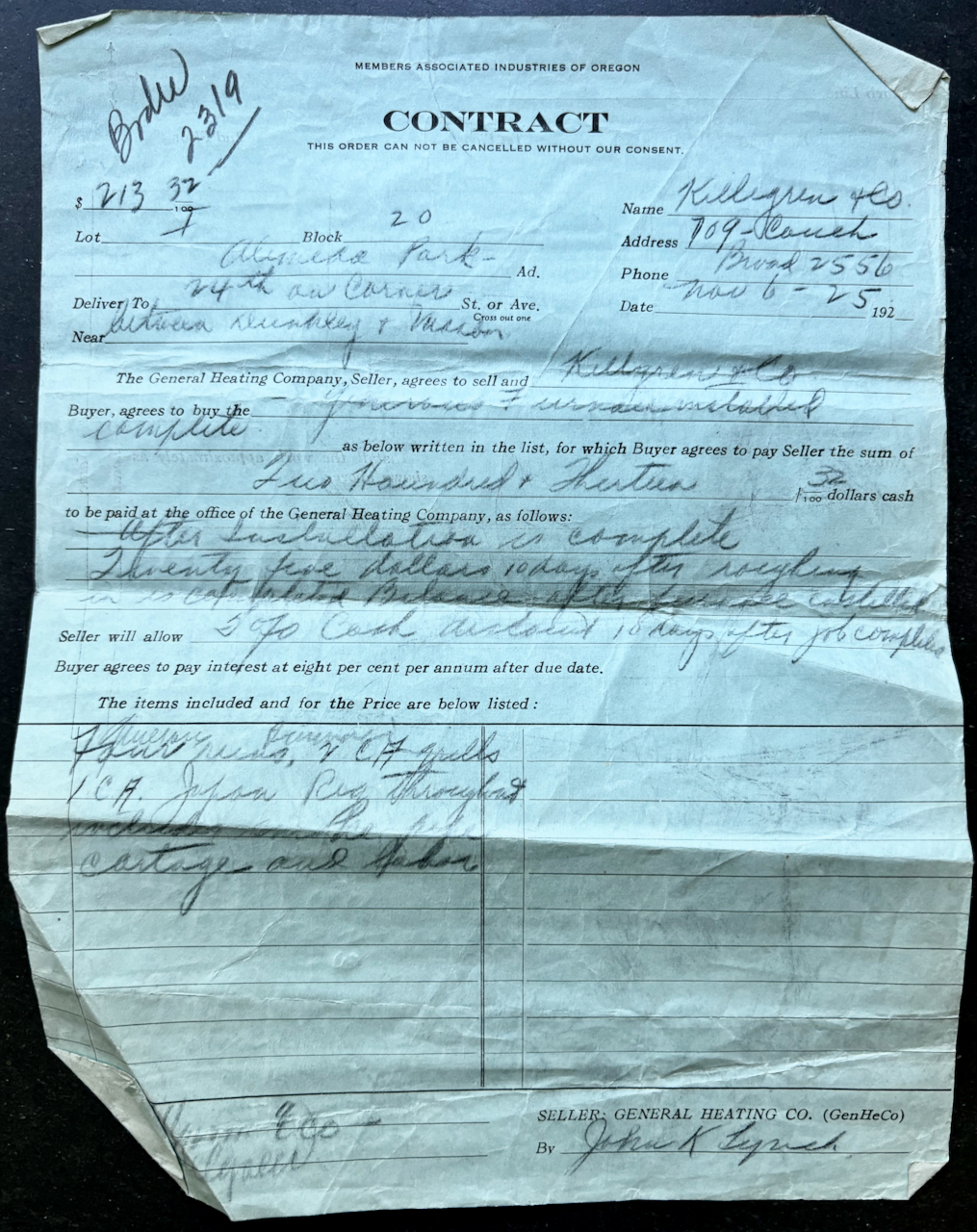
The contract with General Heating Company for installation of the furnace: $213.32:

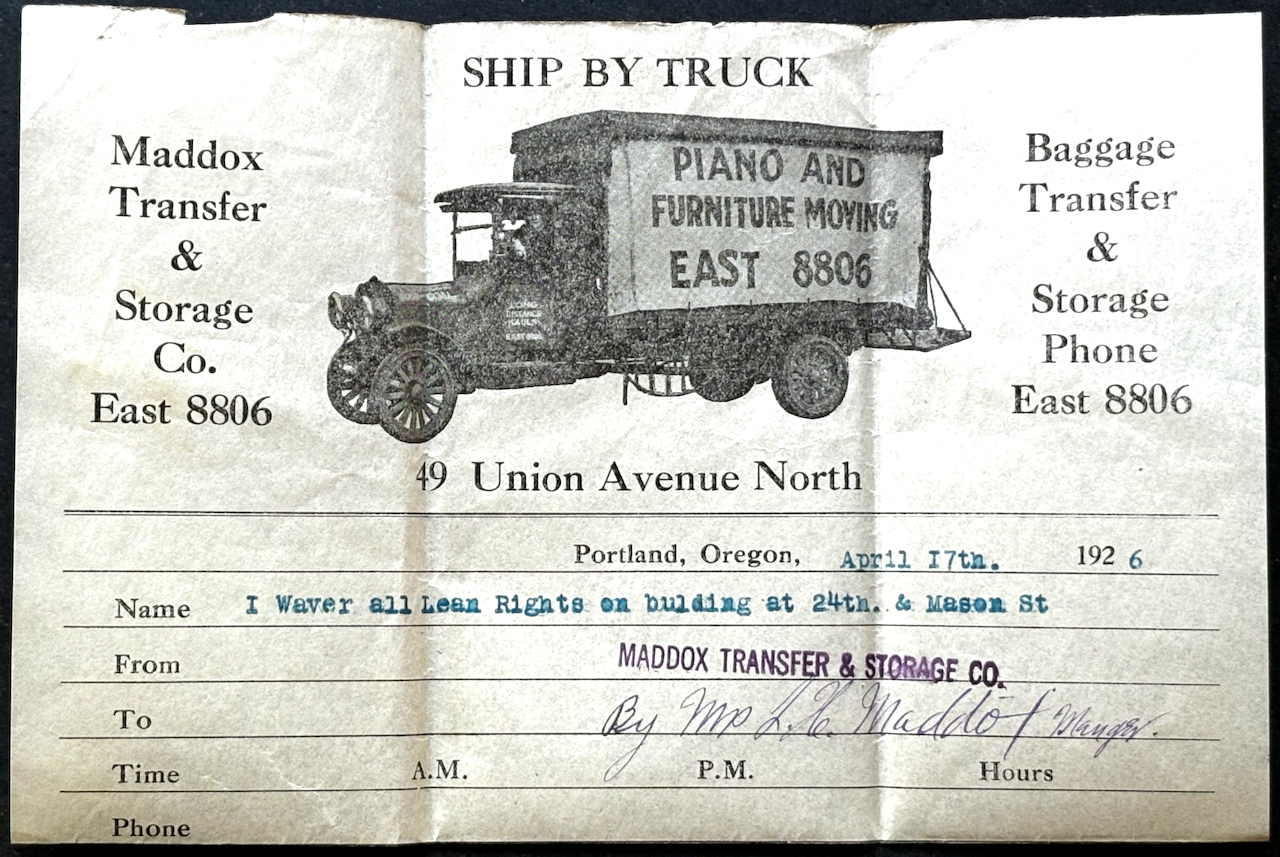
And perhaps the most important document, a receipt from piano mover Maddox Transfer dated April 17, 1926, which is a good indication of when the couple–and Frances’s piano–moved into the house:

In addition to the many receipts, contracts, correspondence and other documents related to construction, several photographs from the winter and spring of 1926 document the process.

Construction clutter indicates work still underway

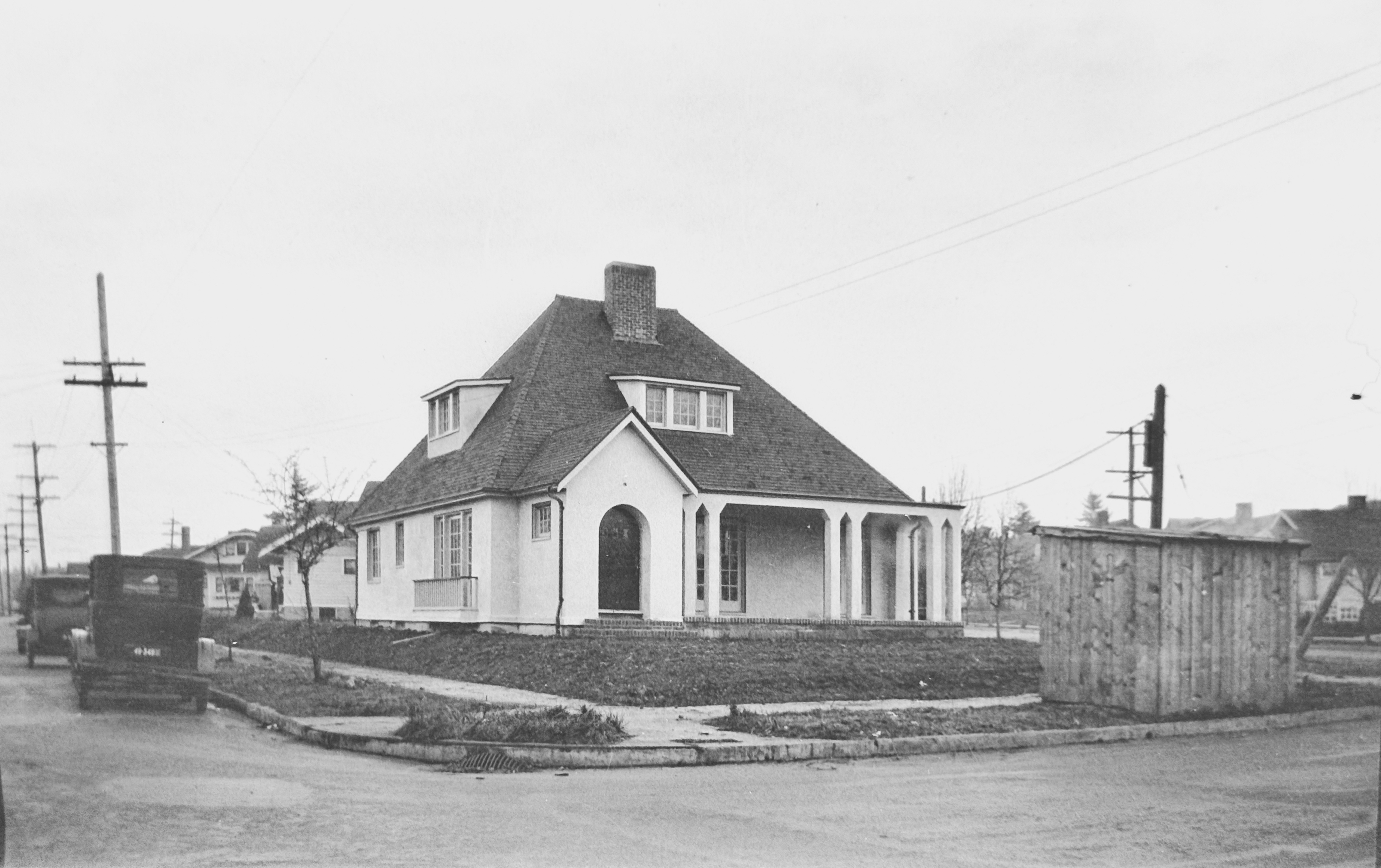
Almost done. The small building in the parking strip is a saw shed, which housed the builder’s tools and supplies. Saw sheds were common on residential construction sites.

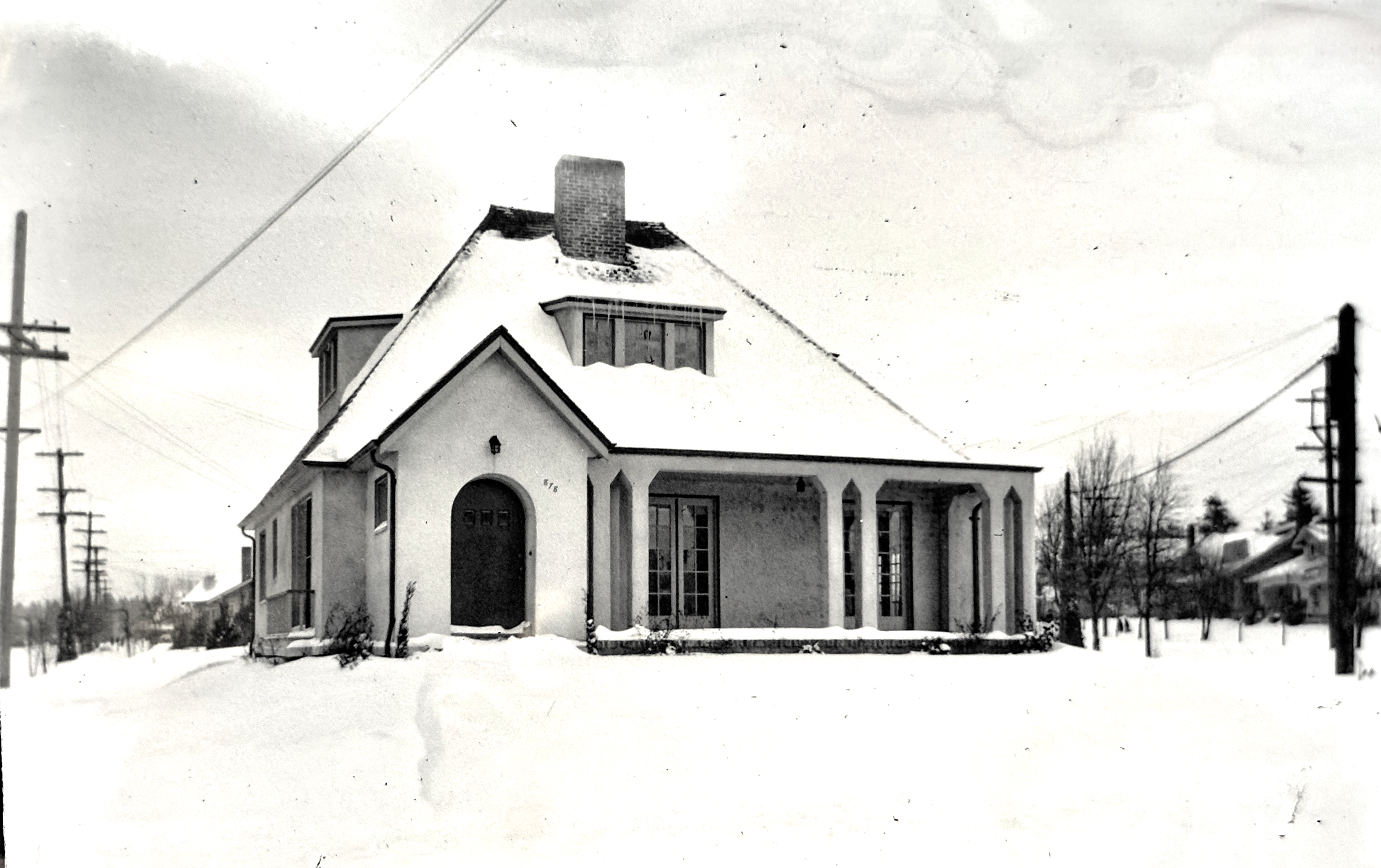
The finished home, addressed as 878 East 24th Street North, before Portland’s Great Renumbering.

How unusual it is to be able to see all these moving parts associated with the homebuilding process from the 1920s. Not so different from business agreements, loans, waivers and releases today. But more personal, more detailed, more bespoke than the computer printouts of today.

That the family kept them together in a set of files all these years–along with the abstract of title, the deed and other documents–signifies their importance, a kind of family trove of sacred documents. Now, they’re all organized and safe and will be staying with the house going forward.

A Mason Street bungalow origin story

We’ve been exploring the early history of the 1913 Arts and Crafts bungalow at 2503 NE Mason—one of the three we wrote about last week—and the plot has thickened. Its builder, a relocated Canadian citizen, Colorado miner, and livery stable owner, moved to Portland in 1911 and became a home builder, ship builder, all-around handyman and eventually a property developer working on projects in the Hollywood area and near Mt. Hood.

According to building permit and real estate records, Sterling A. Rogers started excavating the basement the very same week he bought the vacant lot in the recently platted Alameda Park addition for $823 in May 1913.

Sterling and wife Lena had arrived in Portland in 1911 after selling their horses, home and livery business in Dunton, Colorado to his brother Robert. Sterling and Lena, then 29 and 26 respectively, had enough of the hard winters in the San Juan Mountains of southwestern Colorado. After a winter escape to the West Coast in 1909, they must have decided it was time to leave. Sterling had been a kind of renaissance man in Dunton, locating mines, constructing buildings, acquiring and looking after horses and wagons.

The Telluride Daily Journal described him like this in its May 23, 1903 edition:

Sterling Rogers, postmaster, merchant, hotel proprietor, and all around monopolist, of Dunton, was an arrival from the south on last evening’s train. He remained overnight and left this morning for Denver. He says that owing to the horrible condition of the roads between the Coke Ovens and Dunton, he cannot get enough lumber to put the finishing touches on his new hotel, but expects to be able to move into the building within the next two or three weeks.

Sterling finished the hotel, and added a pool and baths at the nearby hot springs, but in early 1911 the couple left for Portland. By December, he and Lena were buying vacant lots in the Vernon and Woodlawn neighborhoods. If the hard Colorado winters didn’t drive them out, could be they saw the writing on the wall: by 1919, Dunton had become a deserted and dilapidated ghost town, sidelined by its remoteness and primitive transportation connections, which Sterling knew all too well.

Rogers finished the Mason Street bungalow in August 1913 and advertised it for lease for $30 per month through the fall and early winter while the couple lived there:

From The Oregonian, January 18, 1914

Like many young Portland builders of that time, Sterling was trying to leverage financial momentum by living briefly in his brand-new house built on speculation, leasing or selling it quickly, and using the proceeds to fund other projects that could lead to a next-level income. The couple continued to buy, trade for, and seek additional vacant lots on the eastside. In the spring and summer of 1915, Sterling the entrepreneur was busy:

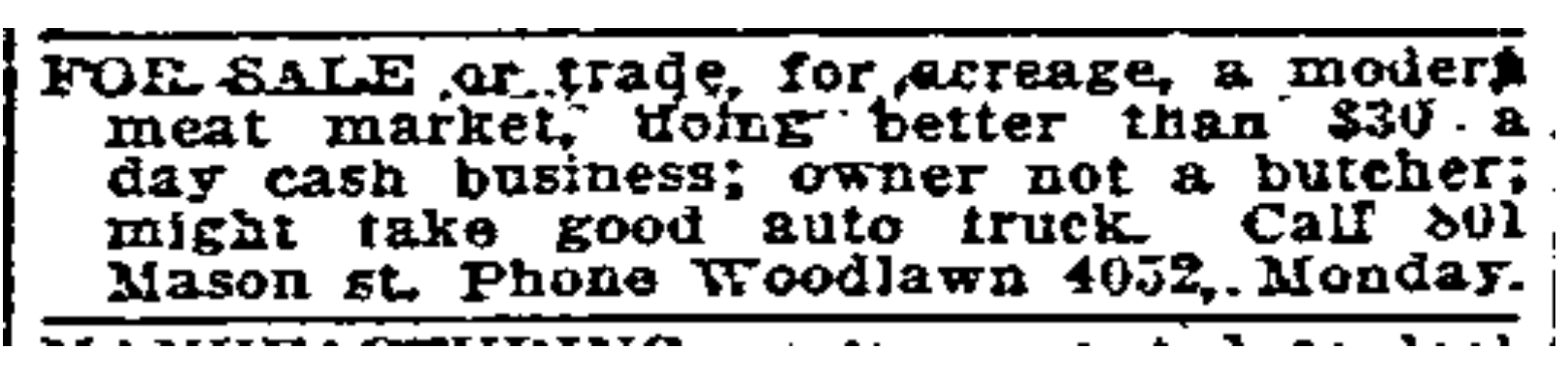
From The Oregonian, May 9, 1915

From The Oregon Journal, August 8, 1915

Sterling was not a butcher. The meat market had belonged to Daniel and Ethel Dyer, who not coincidentally had moved into the Mason Street house for about a year in 1916, under what must have been a creative financial agreement. But that didn’t last, and by 1917, Sterling and Lena were back. And according to auto registration records, they had indeed been accumulating quite a few vehicles, all registered to the Mason Street house.

In 1918, at age 35, Sterling registered for the World War 1 draft and gave his occupation as a ship carpenter (as well as his height at 5’9”, weight at 140, blue eyes and black hair) and home address as 801 Mason, today’s 2503. That year, he also petitioned for citizenship and renounced his allegiance to George the Fifth, King of the United Kingdom and the British dominions. Rogers had been born in the Canadian province of Prince Edward Island (Canada was then under the dominion of Great Britain). Lena was from South Dakota.

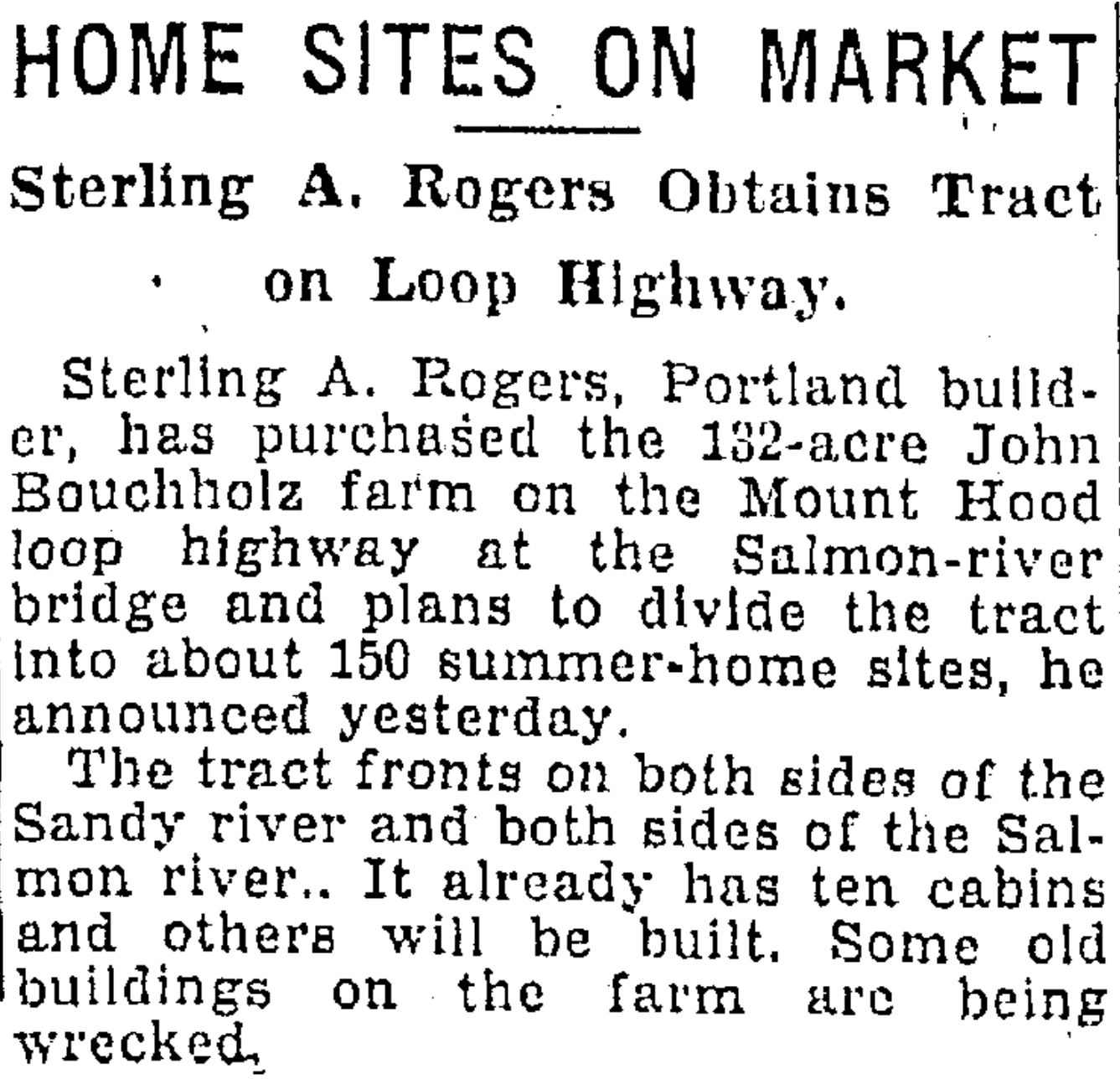
Meanwhile, the couple had been buying property along Sandy Boulevard and by 1920 they moved to a home long since torn down at the northeast corner of 43rd and Sandy. Sterling continued to speculate in real estate, take on repair jobs and build small bungalows—none as distinctive as the Mason Street house. In 1933 it looked like he was going to make it big with a planned development of summer homes on Mt. Hood (which sounds a lot like what is today’s Brightwood).

From The Oregonian, May 21, 1933

But the Great Depression of the early 1930s was a hard time to be building or selling anything. Sterling died of tuberculosis in 1936; his death certificate showed he had struggled with the disease since the mid 19-teens.

Rogers built it – Who designed it?

A look at the handful of relatively non-descript bungalows Sterling built in the 19-teens and 1920s—absent decorative trim, built-ins, columns or beveled glass—makes us think 2503 is a kit home, meaning he bought it as a package to be assembled, which was relatively common then. The design-forward detail of 2503 (see for yourself) is so unlike anything else he built.

So we’ve been poring over kit house and plan set catalogs looking for family resemblances. The external door and window trim is distinctive on this house, as are the three long beveled glass panel interior and exterior doors. Haven’t found it yet, but we’ll keep looking.

Having researched many early home builders, we’re well acquainted with the blend of boot-strap, hard-scrabble entrepreneurship they and their families brought to the building of our neighborhoods.

The homes we live in—the materials they are built with, and the people who did the building—are from a different era that’s hard to imagine today. Each of our homes has its own origin story, the windows, walls and ceilings shaped by people whose stories we’ll never know.

But it’s been fun getting to know Sterling.

Homecoming for Time Traveling Windows

Our 1912 Arts and Crafts bungalow has been home to eight families in its 110 years and I’ve made a point of connecting with someone from almost all of them. Seeing the house through the eyes and experiences of others has allowed my family to know this place in a unique way during our 30-plus years here, to appreciate the changes in life, community and in the fabric of the house itself over that century.

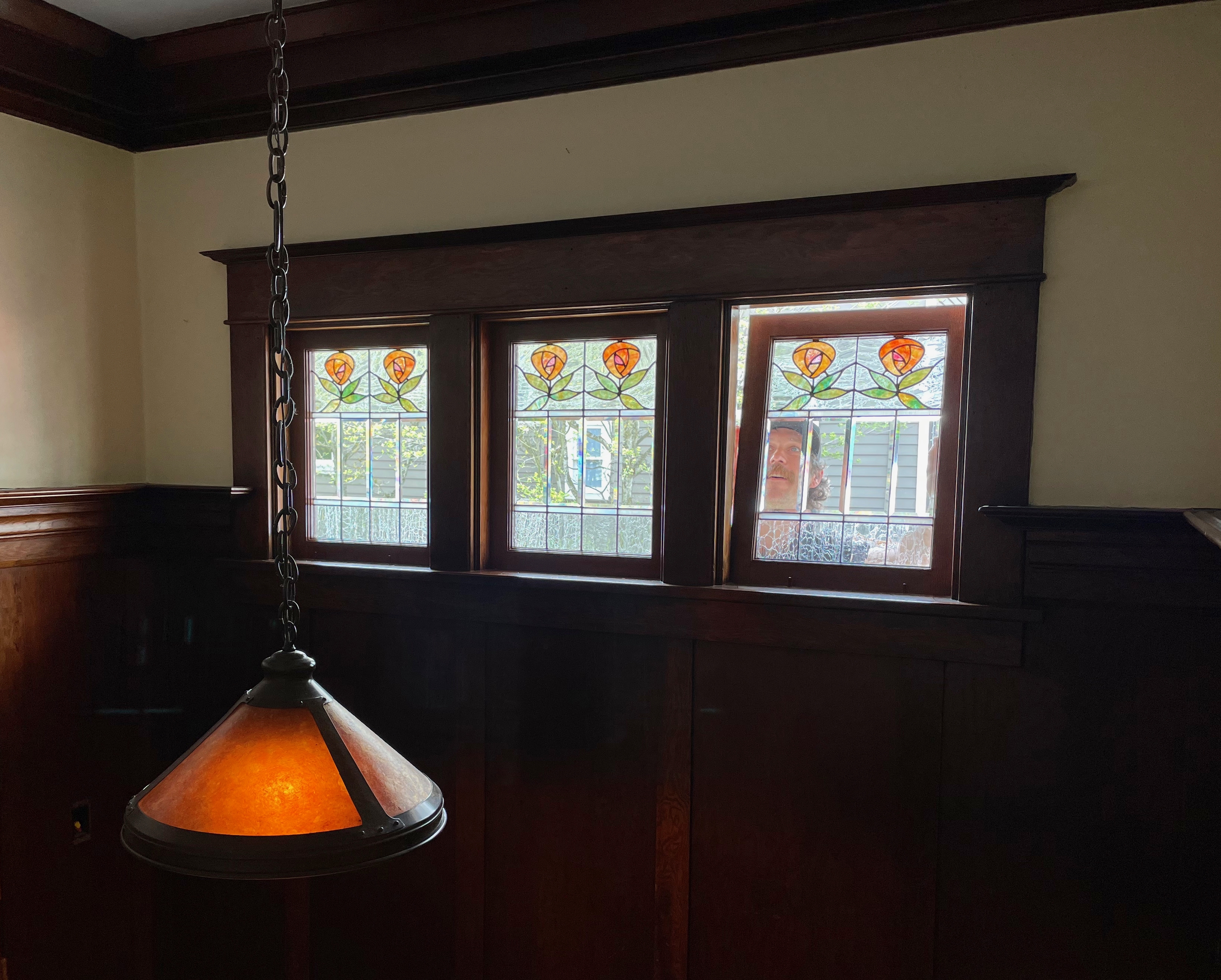
During these pandemic years I’ve been busy with a special project to connect past and present that’s both tangible and personal. This week it all came to fruition when modern-day craftsmen carefully reinstalled the three original stained-glass windows—now restored—that were removed from the house almost 50 years ago.

As a lover of old buildings and a person who appreciates homecomings, it was a take-your-breath-away moment when Carl put the last panel in place this week. Here, have a look:

Carl Klimt and the “golden spike” moment when the last wayward window was set into place, April 27, 2022.

Tracking down these three windows, understanding the circumstance of their removal and their subsequent travels, and getting them back in shape to be reunited with the house has been a story marked by chapters of kindness, generosity, good luck and persistence. At the heart of this labor of love, it’s been a story about putting pieces back together.

The setting

In late 1911 and early 1912, builder William B. Donahue completed a lone bungalow on NE 30th Avenue, the only house on the block at the time, located just a half block east from the end point of the Broadway Streetcar line, right next to the temporary “tract office” of the Alameda Land Company. Donahue knew the house would be a demonstration of sorts to show what he could build for potential homebuyers. So even though it was just a simple bungalow, he added some nice touches, including stained-glass and beveled-glass windows in all the right places inside and out.

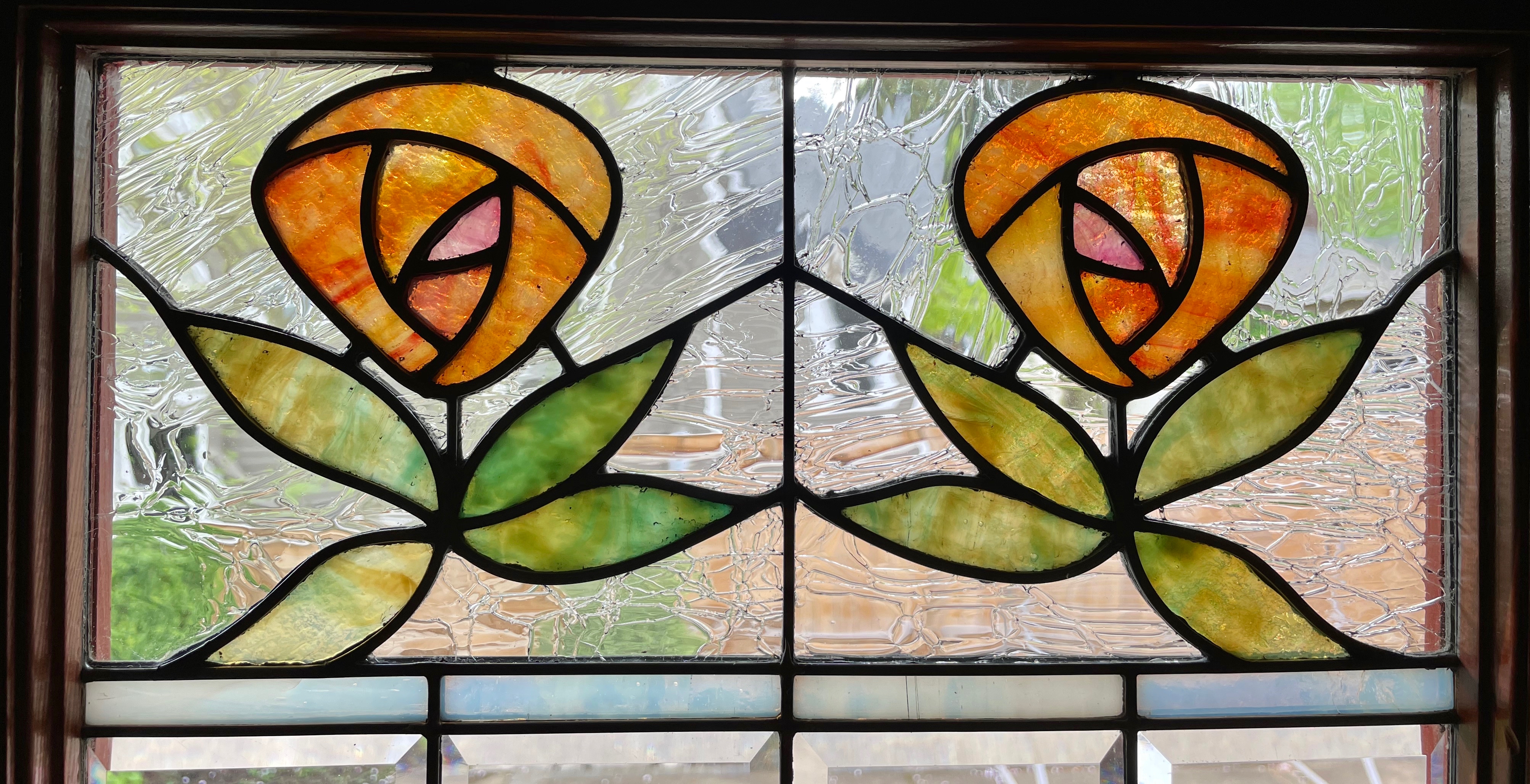
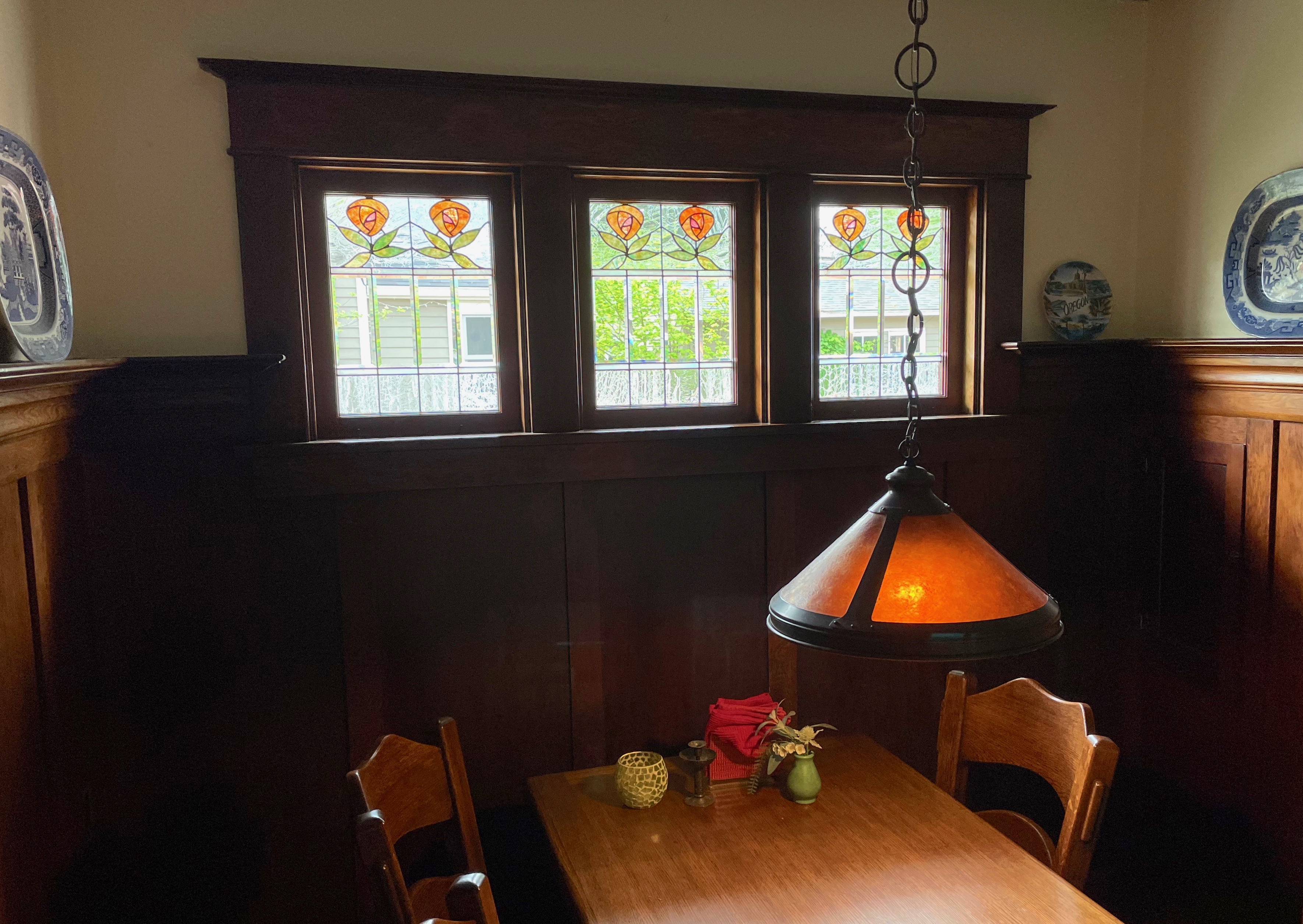
Detail of the restored windows.

Donahue’s floorplan included a breakfast nook between the formal dining room and the kitchen, with full wainscot paneling and a plate rail. For this welcoming, family-friendly room he chose a bank of high window openings to install three rose-patterned stained-glass windows.

Which is where the windows presided as four families cycled through the house: wars, pandemics, business ventures, children, dogs, birthdays and deaths, leavetakings, joys and losses. All discussed and decided at the nook table under those three beautiful windows.

The removal

The family who lived here from 1961 to 1975 loved this house. And when it came time for them to leave, they wanted to bring a piece of it with them, a keepsake and reminder of all their good memories here. The daughters were fledging and they agreed to each take a window, a gift from their father, who removed the sash and replaced them with three plain sheets of glass. The stained-glass was removed from the old window frames and put into new oak frames for display. One went to Arizona. One went to Spokane, and one stayed with the parents in Milwaukie. The windows continued to bring the comfort of family memories from their old home. Time passed as four more families cycled through under the blank window-eyes of the breakfast nook. No one here knew anything different.

The discovery

As I researched the story of this house, I sought out the families who lived here and I even found a relative of builder William B. Donahue. Through oral history interviews and letters, I learned about the view from the porch across empty lots clear to the 33rd Street Woods. Brothers playing on the roof. The goat and wagon that came for a visit. The upright piano that lived in the front hall. The life-long memory from the little boy sprawled out on the floor of the nook reading books while colored light streamed in around him, filtered through those stained glass windows. So many stories.

In November 2004, we hosted the Mom of the house from the 1960s on an impromptu visit when she dropped by the street to say hello to her old neighbors who still lived two doors down. When she walked through the house, wistfully, she mentioned the stained glass windows in the nook.

Because we had been dreaming about finding the old columns that were torn out of the living room in the 1940s by an earlier family (which we later faithfully rebuilt based on those I found still in existence in a similar Donahue-built house a few blocks away), her mention of stained glass windows in the nook was a very timely little bolt of lightning. Earlier that year we had restored the original front porch, which had also been demolished in the 1940s (a tough decade for old houses).

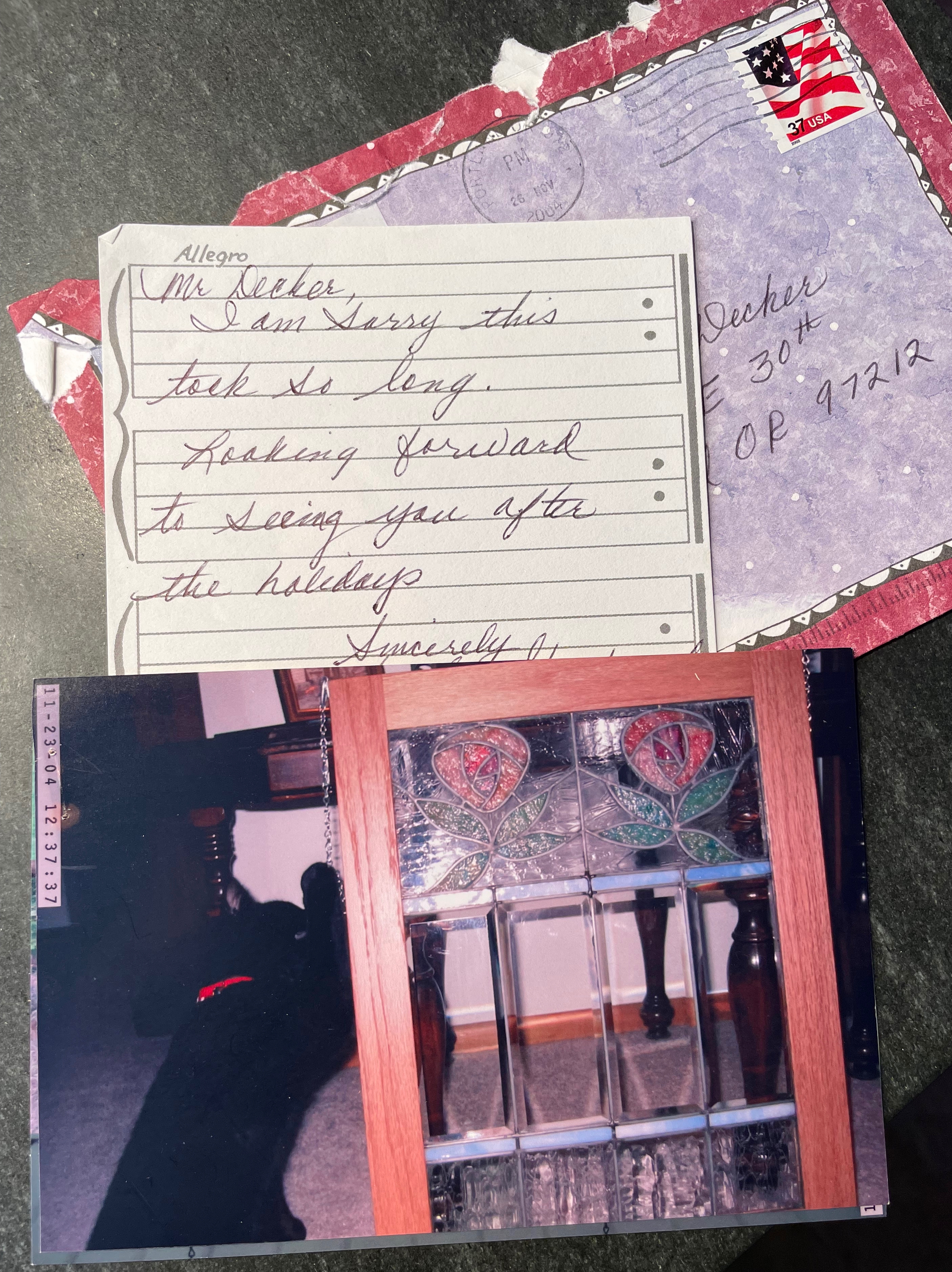
A few weeks after her visit, a photo and brief note arrived in the mail showing the old window she still had hanging in her kitchen. We almost couldn’t believe that rose-patterned window was once here.

When this photo and note arrived in the mail from a former resident we were ecstatic, but we also wondered, “Wait, what? That window was here?”

Through conversation over the months and years that followed, it emerged that her daughters still had the other two which had become sentimental companions from their growing up years. I began to imagine bringing the windows back here where they started. That was 18 years ago.

The return

In the last several years, with the thoughtful help of her son (now grown and with a family of his own), and through persistent friendly stories from me about the home’s history and our careful work of putting the pieces back together, a pathway began to emerge: when the family reached that point we all eventually reach of readiness to simplify our lives and possessions, the windows would be welcomed back home. Just as the family took solace in bringing them away when they left, we would find solace in their return.

Back and forth correspondence, phone calls, soul searching, acceptance and finally, readiness. Two of the windows came first: one of the daughters had passed away and the other was ready to release her window with her sister’s. Then a year later, the Mom of the house, now in her mid 80s, was ready to give us the third one. The day we met with her to receive it felt like an adoption.

The recovery

By then, I had fortunately found Jakub Kucharczyk, the art glass master who runs The Glaziery based here in Northeast Portland. Jakub and his team are one of a handful of knowledgeable and capable artists and craftspeople nationally who know old glass like ours and more importantly have the expertise to restore it using old ways and original materials.

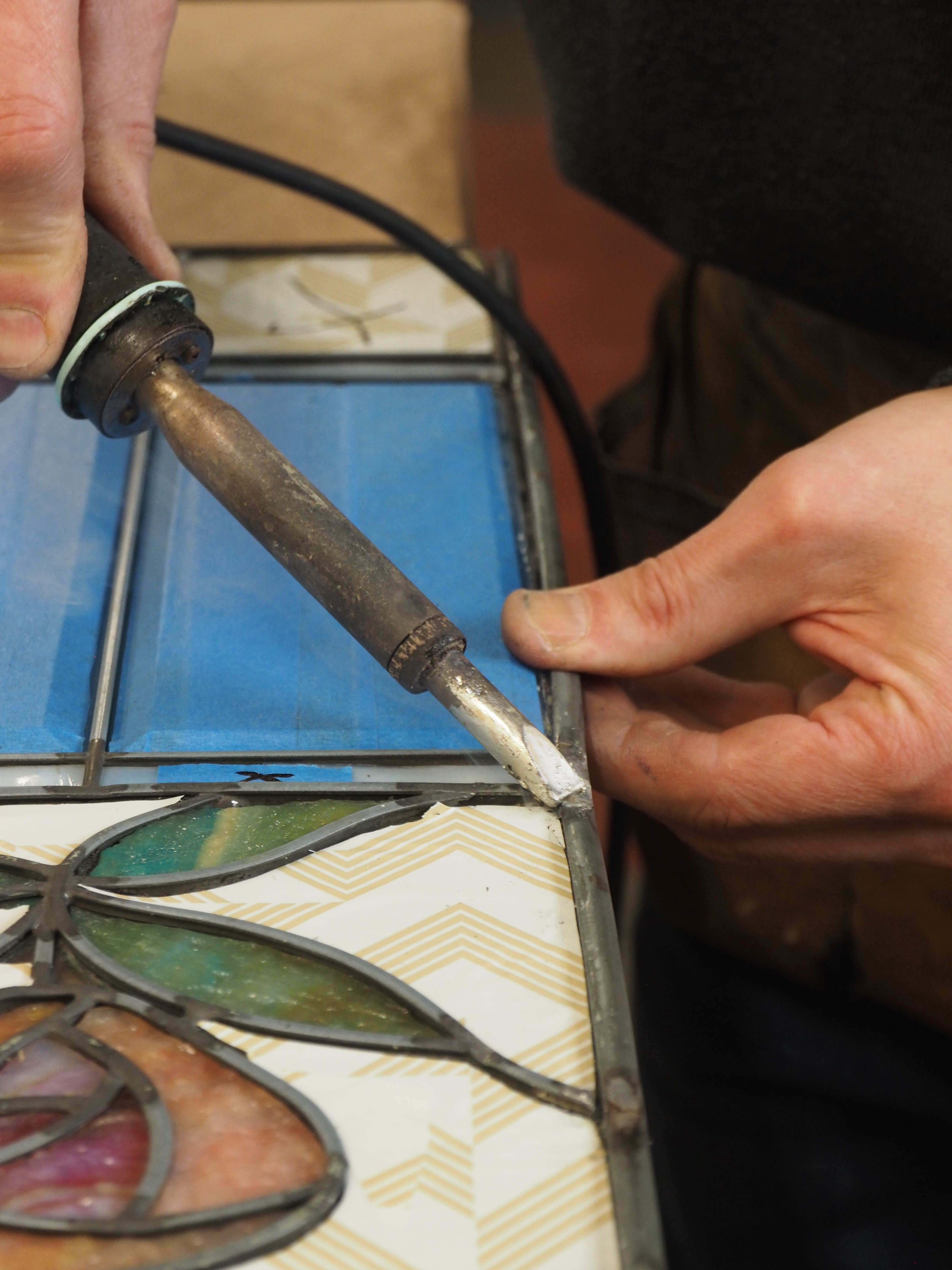
Resoldering one of the zinc channel borders. Zinc is more rigid than lead and perfect for art glass windows like these that need to stand up to wind, gravity and time. Photo courtesy of Jakub Kucharczyk, The Glaziery.

When Jakub examined our well-traveled windows he pointed out the hand-blown crackle glass from Germany that make up the tiles across the bottom, the subtle peach and rose colored Kokomo catspaw granite glass of the flower petals, the zinc channel borders that outline the shapes.

Most of the zinc joints were in pretty good shape but a few needed new flux and solder. One of the crackle glass panels needed to be replaced and Jakub had just the right old piece that looked like it came from the same batch. Even though a few pieces of the art glass were broken, we left them in favor of preserving the original materials, and Jakub made them as steady as could be. All the glass needed a good clean up, and all three panels were reputtied.

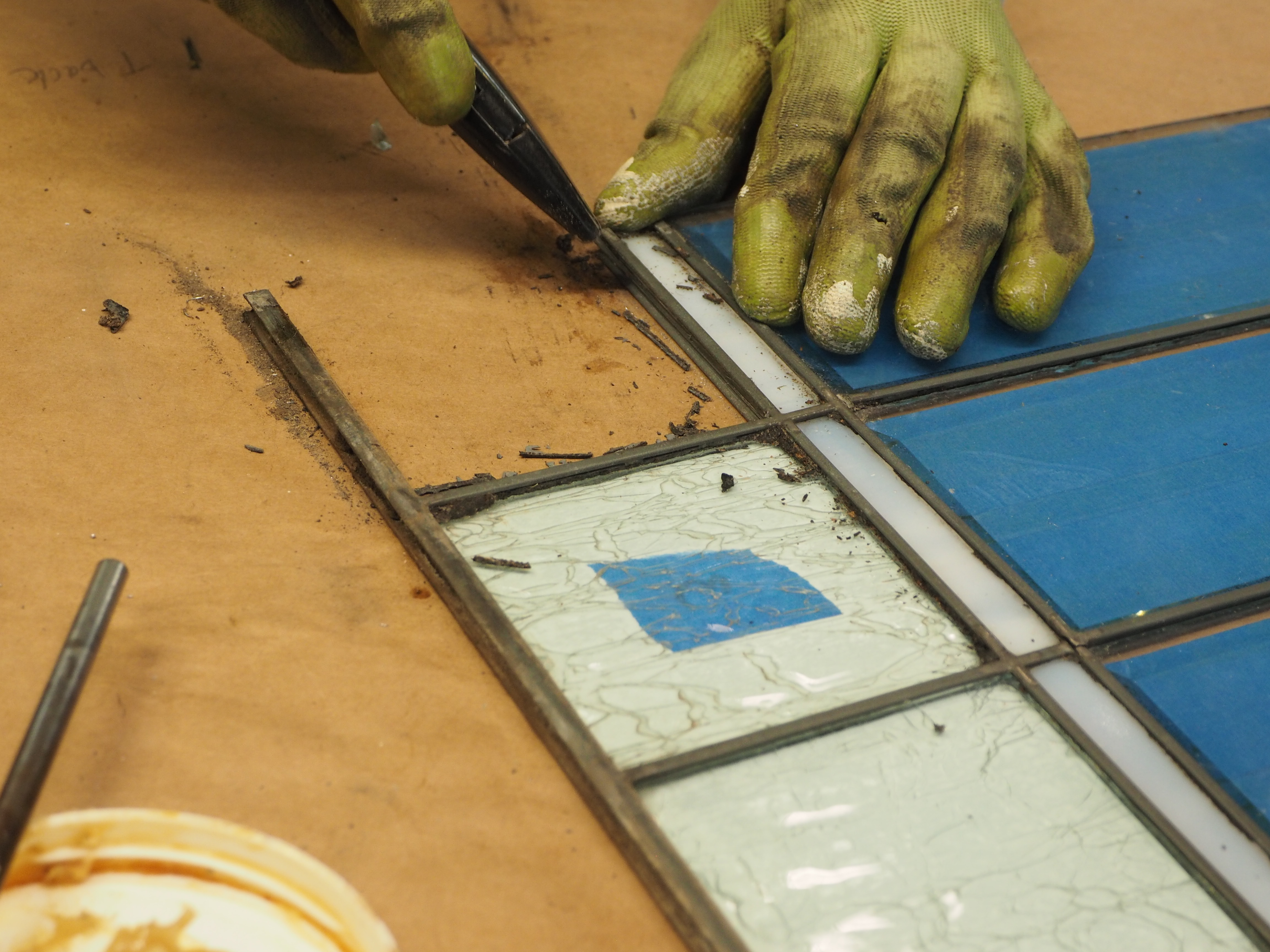
Removing the zinc border to replace one of the broken crackle glass panes. The blue masking material was placed over all the glass at the beginning of restoration as a protection.

Working with glass like this has become a lost art. 110 years ago, most cities had a competitive art glass workforce and marketplace. Today, Jakub and his team service an international marketplace looking to them to restore worn out windows and to build fine new art glass. This winter, he and his team removed the oak display frames built in the 1970s and made our panels ready for the next 100 years.

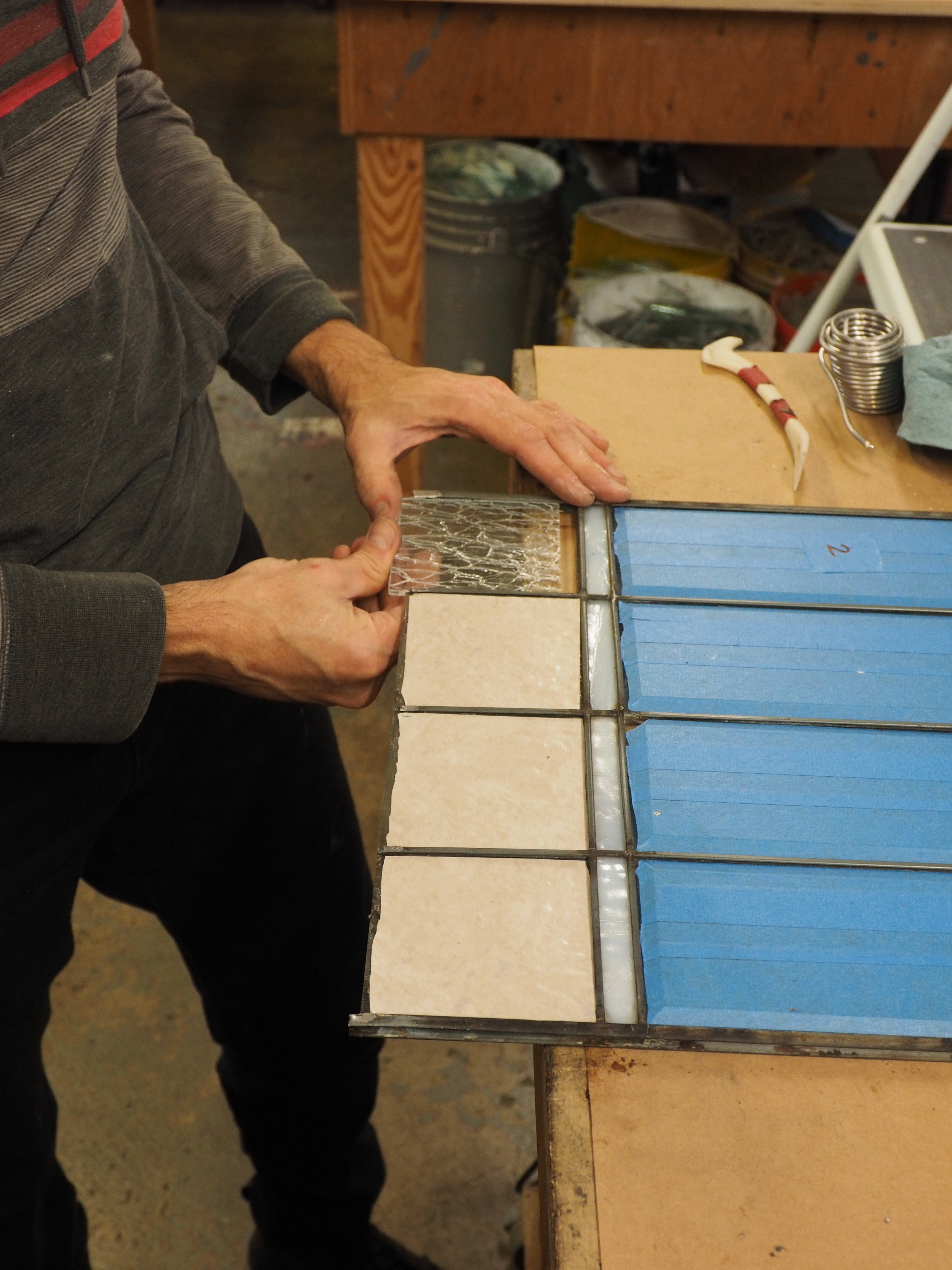
The new crackle glass panel is sized and inserted into the channel.

Meanwhile Stephen Colvin and Carl Klimt at The Sashwright Co. came out to measure the openings and teach us about window stops, reveals and hardware. Dale Farley at Wooddale Windows (also here in northeast Portland) took those dimensions and built new Douglas-fir sash for our old glass just the way the old-timers would, another lost art.

Back and forth we shuttled, dropping off the windows with Jakub for restoration, retrieving the new sash from Dale and delivering it back so Jakub could install the restored windows. Once we had them home, we matched the stain to the existing interior window trim in the nook and Marie painstakingly painted and stained them. Marie is very good at painstaking work.

Fast forward to this week. Carl and his crew returned for the install. I believe they were as excited as we were to make this reunion possible. Out came the empty-eyed single panes. And very carefully one at a time the old windows, newly sashed, were fit and snugged back into the openings they once knew.

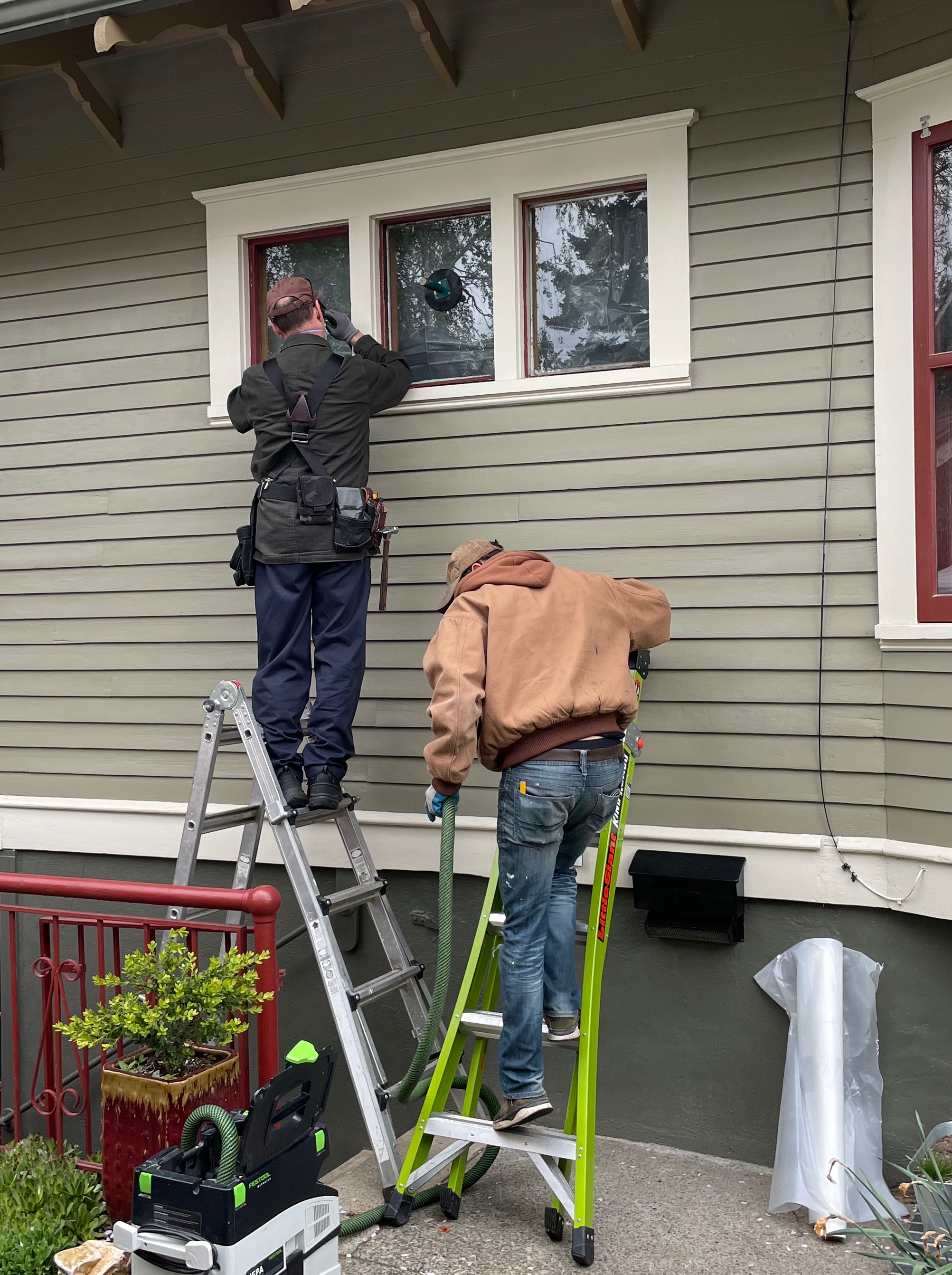
The Sashwright Co. team prepares to remove the clear glass panes that were put in place when the original windows were removed in the 1970s.

I still can’t quite believe they’re back. Every time we pass by, we stand and admire how these windows re-dignify that space, how they bring even more color and life back into the room. It’s still the place you want to sit in the morning with a cup of tea to contemplate the day ahead, or for friendly conversation at dinner.

But these time traveling windows now-come-home have made this space something more, a kind of shrine to the house itself, its builder, the craftspeople who have helped repair and restore it, and more than a century of friends and family who have passed through.

Who built our houses? Check out these new builder biographies for your address

We’ve recently completed short biographies of six more builders responsible for many of our homes on Portland’s eastside and beyond. The section here on the blog called The Builders now has profiles of 18 builders responsible for thousands of homes, mostly built between 1910-1950.

Builders working on an eastside bungalow in the early 1900s. Courtesy of Oregon Historical Society, Negative 37092.

Through our research, we’ve been able to make contact with many of the builders’ families and have added photos and other biographical information that provide a glimpse of the builders’ lives. Included with each biography is a list of addresses of homes by each builder.

One common theme emerges when you read these: most of the builders were immigrants, many of them from Russia and from Scandanavia. All have interesting stories.

Recent additions include:

Judson Hubbell 1872-1954

Ernie Johnson & Nelson Anderson 1920-1924

Max Kaffesider 1873-1960

Emil G. Peterson 1882-1960

Max Shimshak 1897-1978

Adaptive reuse on NE 30th: A viable alternative to teardown

When the dumpsters and porta-potty arrived a few weeks ago out in front of the old house, we presumed the worst. We’d seen the 1921 Craftsman bungalow near NE 30th and Skidmore decline as bags of garbage piled up on the front porch, bushes grew up over the car in the driveway and the electricity was turned off.

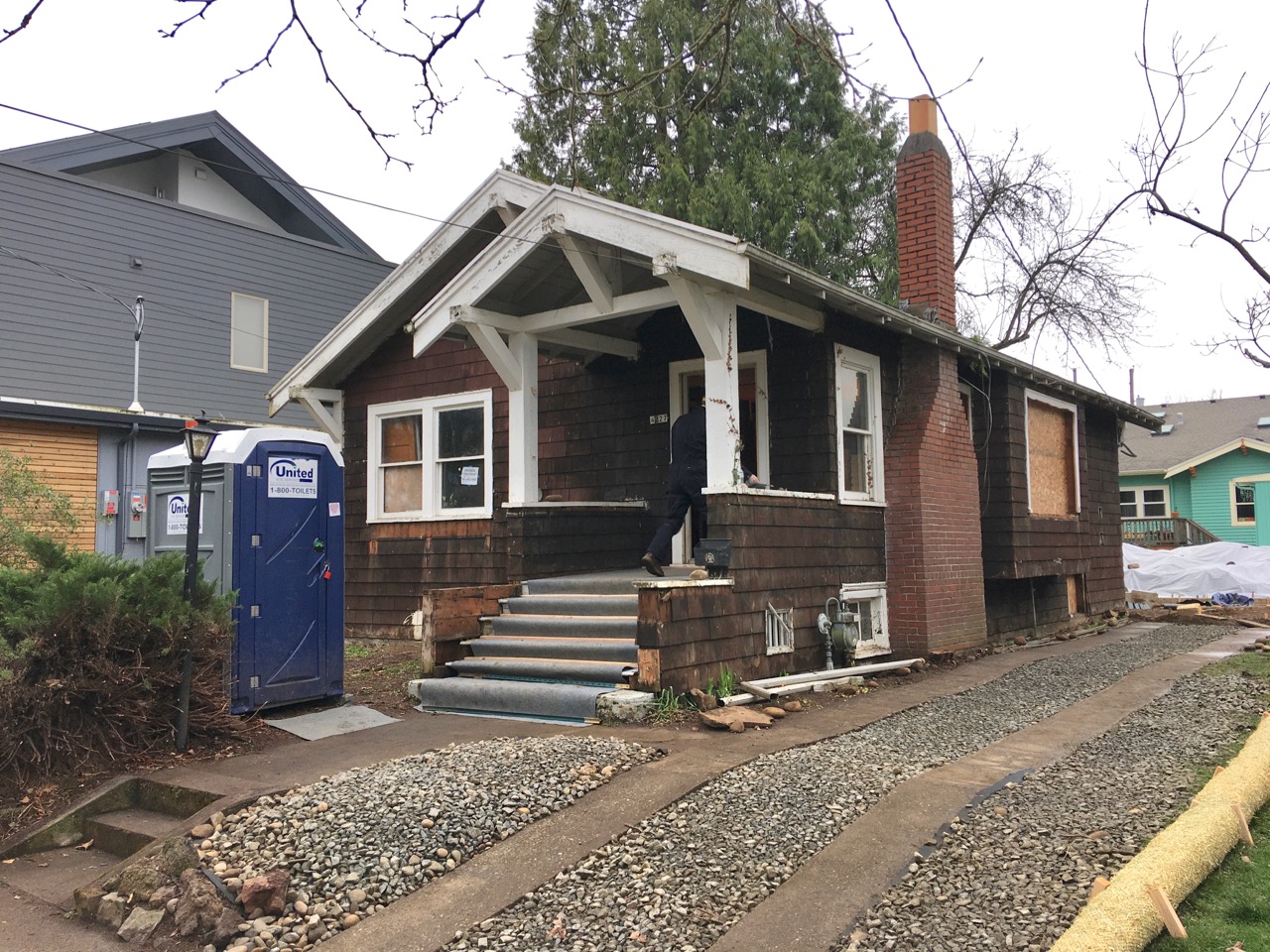
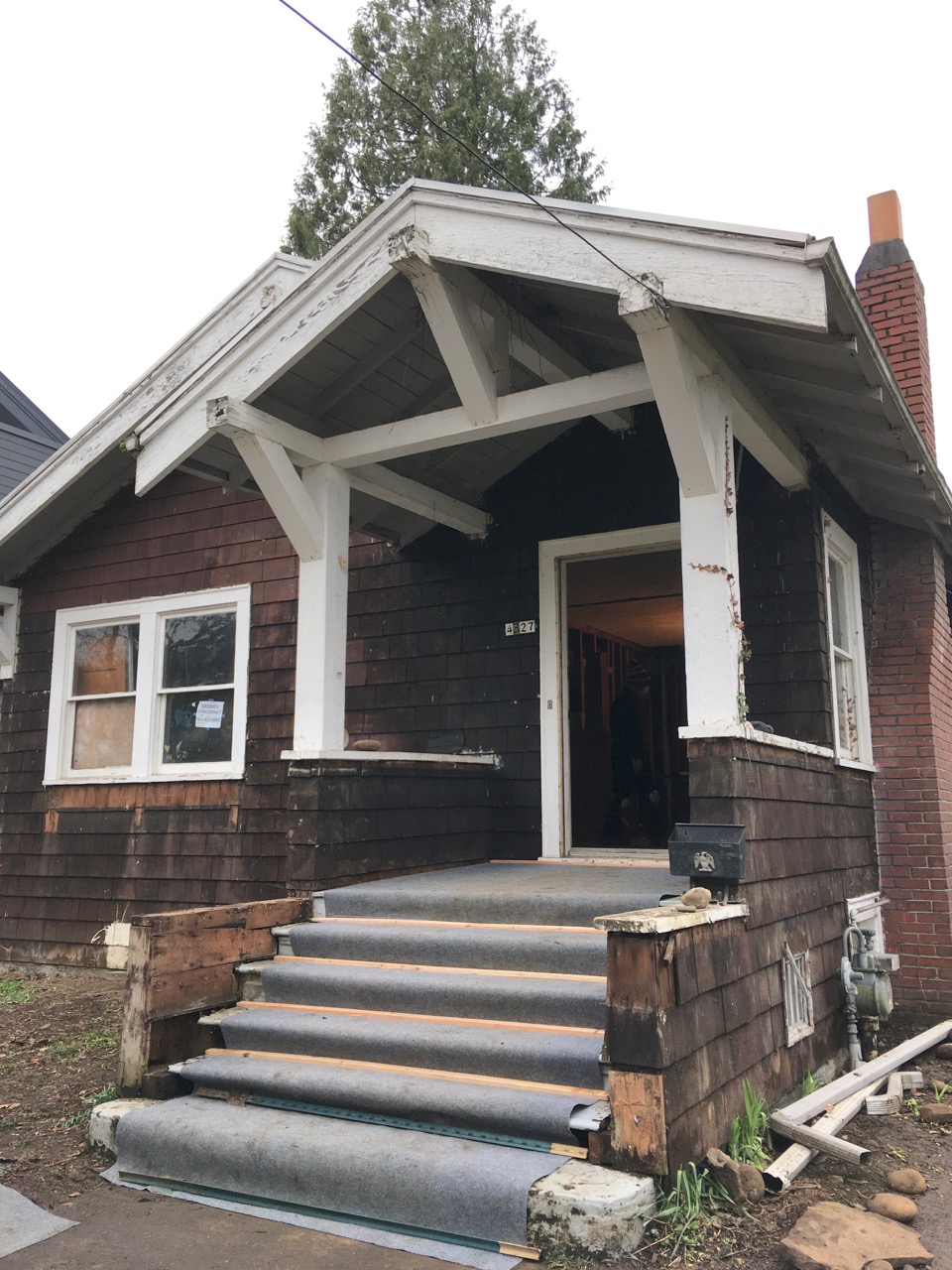
This compact 1921 bungalow near NE 30th and Skidmore in Alameda is being revived from what looked like a sure path toward teardown. March 2, 2020.

Taken with its slow descent over the last couple of years, the recent signals seemed clear enough the property had changed hands and would be torn down to make way for another quickly-built three-story unit (or two) that maximized lot lines and financial returns. We’ve seen this story play out before, including for the old bungalow that used to stand right next door to this unlikely survivor.

But this story is headed in a different direction.

The 1,000-square-foot 1921 Alameda bungalow that looked like the next candidate for a teardown is now being revived, restored and repurposed by a nearby neighbor couple who couldn’t bear to see another teardown / big box happen and who wanted to make room for their extended family (they’re adding an addition to the back of the old bungalow to give the modern family a bit more space).

Harry Ford and Amy Garlock, who live in the house directly across the backyard lot line, watched back in 2016 as the former house kitty-corner across the backyard did get torn down and replaced by two three-story semi-attached boxes which sold for almost $1 million each. When it looked like the bungalow directly behind them was headed down the same path, they began to wonder if there was something they could do.

“We bought it partly so that there wouldn’t be another giant duplex in our backyard,” says Ford.

But Ford also explains the house—which will share a big now-open backyard with their own place on NE 29th—will help meet a very real contemporary need: a quality place to live for their aging-in-place parents.

It’s interesting to note that back in the day, a similar multi-generational family-as-neighbor arrangement was in place just around the corner with the family that once lived in the now-gone bungalow and their in-laws who lived right next door. Former residents of that house remembered dinners that went back and forth, the sharing of tools, supplies, grandparents helping with babysitting. It worked out great for everyone.

Today, Ford is looking forward to having his in-laws just across the backyard, and to interrupting the teardown trend by keeping—and adapting—the historic fabric of the neighborhood. He acknowledges that pretty much any other purchaser of the very run-down house would have razed, rebuilt and sold high to repay the construction loan, then moved on to the next project.

For his family though, the ability to acquire an existing older home at a reasonable price literally in their own backyard, combined with the ability to meet the families’ needs at the moment and for the foreseeable future, made this a reasonable thing to do. Ford and Garlock look at the investment in restoration as a good long-term proposition given the multiple types of “bottom lines” it helps them achieve: economics, quality of life, aesthetics and sustainability.

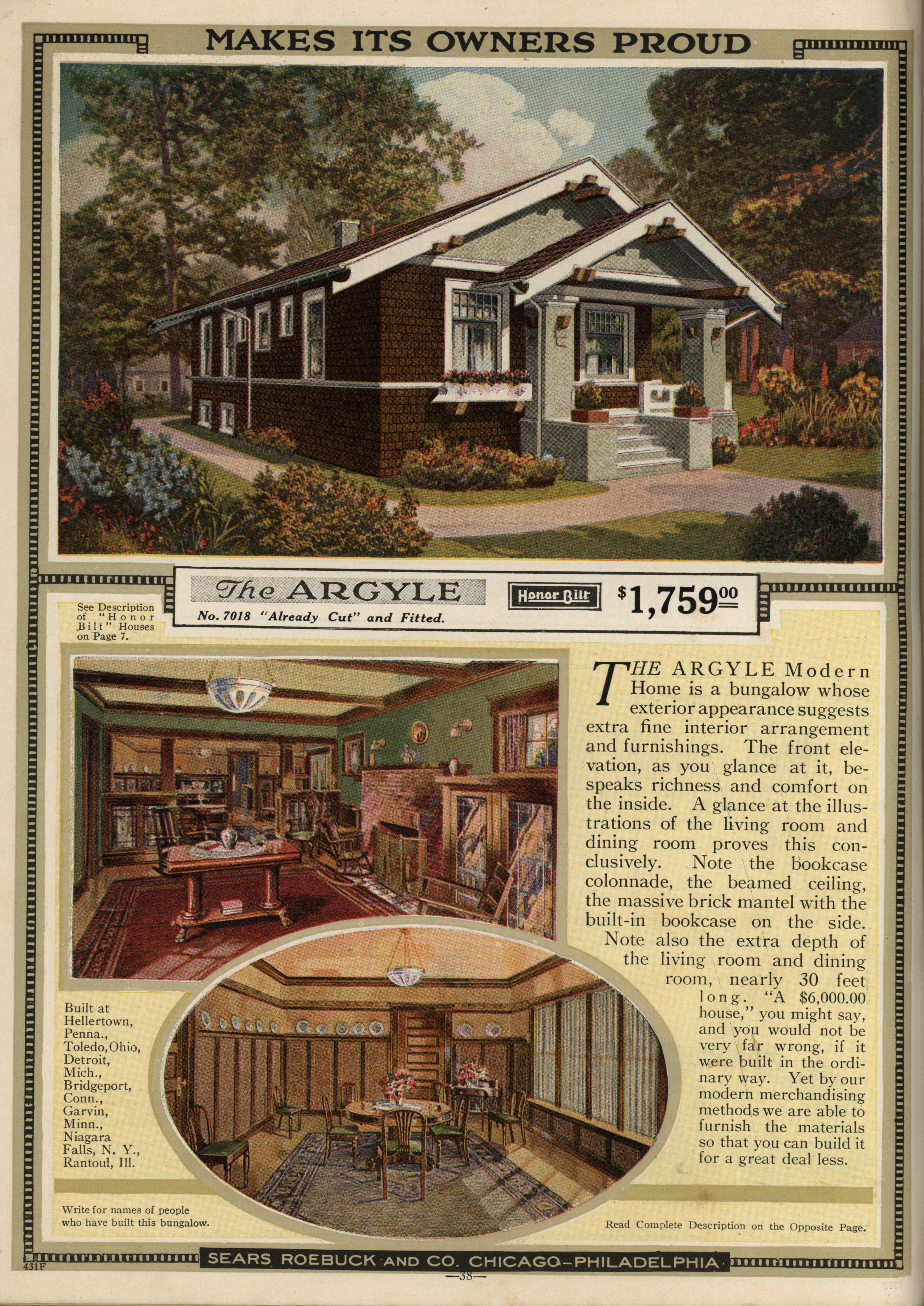
The origin of the house has an interesting story: when AH started exploring the home’s history this week, we determined that it’s a Sears Roebuck house, built in 1921 by builder Albert W. Horn. The floor plan is pure Sears Argyle, one of the company’s most successful kit homes, sold from 1917-1925. Here, take a look:

The Argyle page from a 1921 Sears Roebuck catalog. From 1908 through 1940, Sears sold more than 70,000 kit homes that were built in almost every major US city by homeowners, their friends and in some cases like this one, actual home builders.


1921 Sears Roebuck Argyle floor plan, from the catalog. A solid match with the NE 30th Avenue bungalow.


On a recent visit, the scope of the work necessary to bring back the 1921 bungalow was evident: Heating, plumbing, electrical, all interior walls, kitchen, bathroom, fireplace, chimney, exterior siding, finishes, window trim. The 100-year-old foundation and framing are solid. Everything else needs attention.

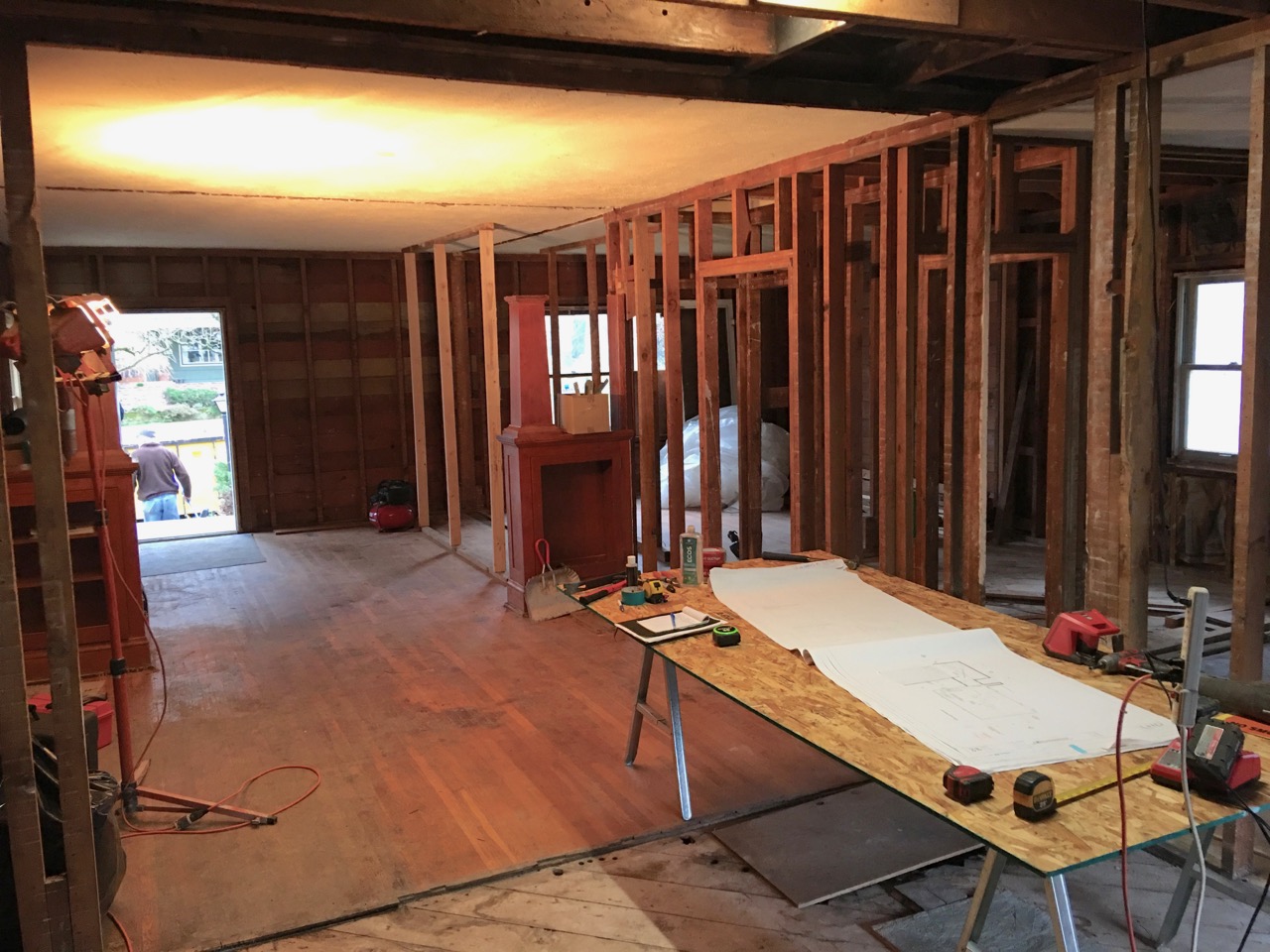
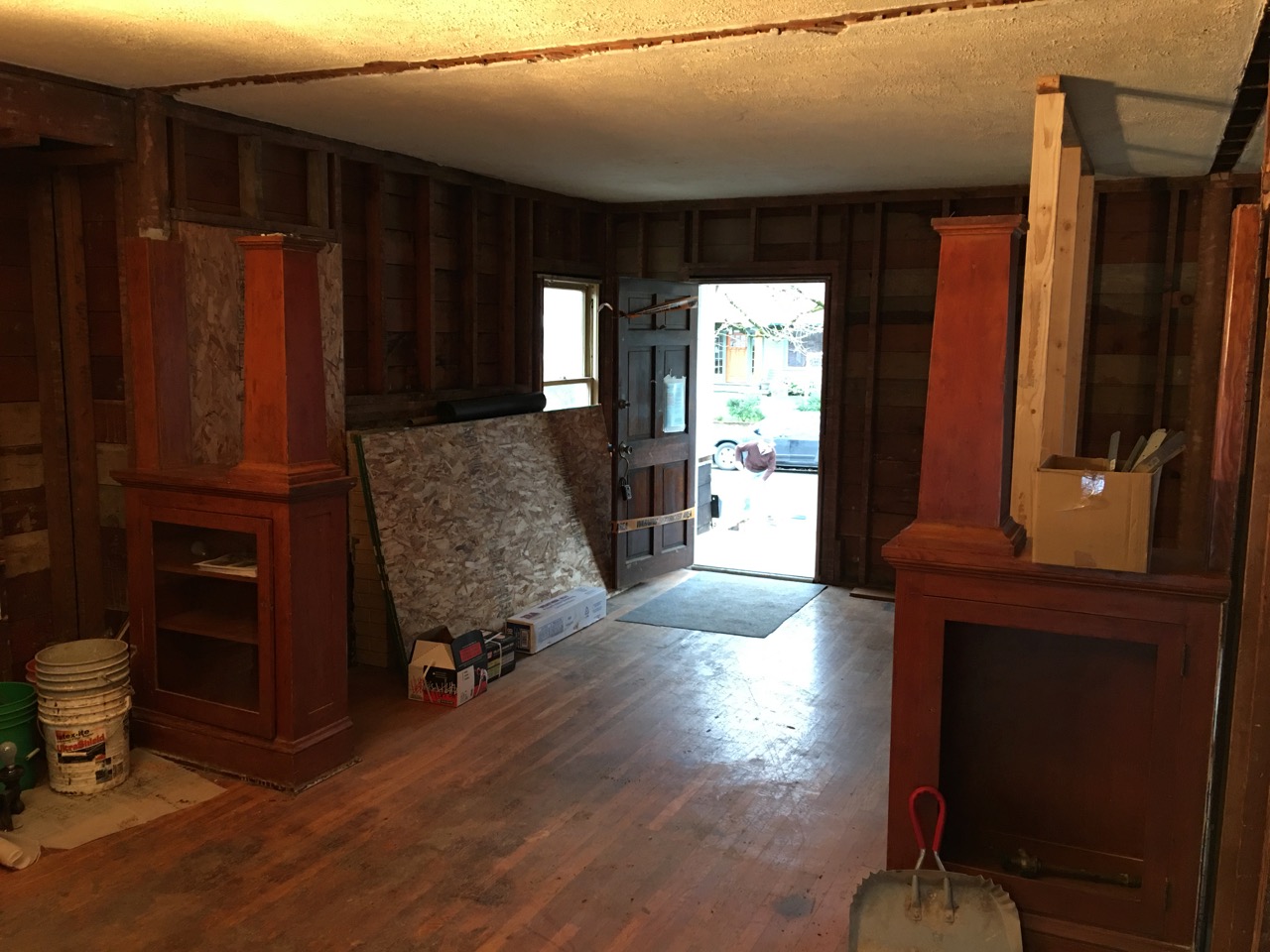
Standing in the kitchen looking toward the front door through the dining room and living room. There’s a bedroom in the front right, a bathroom down the hall and a bedroom in the back, just to the right in this picture. Turn 90 degrees to the right and there’s a stairway into the full basement. March 2, 2020.

“Sometimes, going down to the studs in an old house like this is just easier because you know exactly what you’re working with,” said Craig McNinch of McNinch Construction who is running the project utilizing drawings by Lynn Harritt. He also restored Ford and Garlock’s current bungalow on NE 29th. “This place has great bones,” says McNinch, gesturing to the full dimension 2 x 4 framing lumber, the solid oak floors and the foundation.

From the dining room looking into the living room. A portal wall framed the opening between the two rooms and came down to meet the columns that are atop the built-in cabinets. Behind the sheets of pressboard material on the left is a fireplace. Just like the historic Argyle plans. March 2, 2020.

McNinch has worked on many restoration projects in the area and acknowledges this one is indeed a challenge. But he likes the vision of restoring what was once a new and exciting home for a young family, the backyard connection of the two houses and families, and the constant stream of positive comments he’s had from neighbors and passersby who are happily surprised with the work. During a recent afternoon, we heard McNinch and his crew loudly encouraged to “keep up the good work” by a passing driver calling from a rolled-down window.

Asbestos abatement contractors recently removed the asphalt shingles revealing the original brown cedar shingle siding. March 2020.

Ford and Garlock’s project to revive the old place reminds all of us that there are alternatives to demolition; that it’s ok to adapt something old to meet current needs; that the grace and history of an old place adds its own kind of meaning to family life.

Stay tuned for updates and more on Sears Roebuck homes.

Gone but not forgotten

It’s been gone since mid-October when the orange excavator took the house to the ground and dump trucks carted it away as debris, but the Kettleberg house that was demolished at Northeast 30th and Skidmore has not been forgotten.

George and Manila Kettleberg home, built 1921. 2933 NE Skidmore. From The Oregonian, September 11, 1921.

George and Manila Kettleberg home, built 1921. 2933 NE Skidmore. From The Oregonian, September 11, 1921. The Kettlebergs lived there for almost 50 years; their daughter Dorothy and husband Walter lived next door.

Neighbors still shake their heads as they look at the hole in the ground and remember the 1921 Craftsman bungalow that stood on that spot for 95 years. We’ve talked to a few who still can’t believe two 3,000-square-foot houses will be built in its place. Some neighbors still refer to the corner as Willis and June’s, even though Willis moved away when June passed on a few years back and no one has heard from him since.

According to the City of Portland, the house’s address 2933 no longer exists. A search of portlandmaps.com shows the planned locations and permitting for the two new buildings that will occupy that lot, now known as 2945 NE Skidmore and 4305 NE 30th. We tried to have a look online at the historic plumbing permit for 2933 the other day, but it’s gone now too.

The house is still alive in memory, though. Last week we received a note from George and Manila Kettleberg’s great grandson Robert who explained to us that his grandmother Dorothy and her sister Nancy grew up in that house. George and Manila bought the house brand new in 1921, and raised their girls there.

In the early 1950s daughter Dorothy and her husband Walter moved in two doors down. And then a few years later, Dorothy and Walter moved in right next door to her parents George and Manila. That end of the block wasn’t like a family, they were family. Life flowed back and forth between those three bungalows.

Robert remembers his dad saying it worked out pretty good for him because he could always run between the houses to see who was serving the best dinner. Many footprints left back and forth between those houses.

Construction in the big hole hasn’t started yet, but we’re guessing by spring there will be plenty of activity. Two new big places will go up crowding the lot. Then it will be up to us neighbors to keep the stories of Kettleberg corner alive: almost 50 years of one family’s life.

That’s the thing about old houses. They remind us of who we’ve been; they keep us connected to places our families have known intimately; they contain the passing of time.

Slowing down time that has already passed

It’s been quiet here on the blog lately because we’ve been busy working on several studies of homes and businesses in northeast Portland. Each time we do a study—which involves becoming immersed in documents, maps, photos, archives, and family stories—we focus in on connecting past and present, which is what this work is all about.

These connections allow generations of owners—the people who have lived in, shaped and loved these buildings—to listen to each other, to learn, and sometimes to nod their heads in common understanding and amazement. What an honor and privilege to be able to help make those connections, to learn those stories and to understand and visualize the passage of time. And each time we take on a project, we learn more about the neighborhood as a whole.

As we’ve zeroed in on this work in the last month (to the exclusion of the blog), it has occurred to us what we’re really doing is taking a hold of time that has already passed and trying to slow it down long enough to look around inside for understanding and for answers. Frequently, that’s what we get. Sometimes we just get more questions.

With the completion of this latest handful of studies, we’re going to have some room to focus on some new (old) projects and studies. Interested?

Meanwhile here on the blog, stay tuned for something new soon about Mom and Pop grocery stores

Kitchen Archaeology | The California Cooler

Our neighbors Rob and Marti are carefully and heroically remodeling their 1923 bungalow kitchen. They’re doing a great job. We’ve been following their progress and in a recent driveway conversation, Rob held up an old house part (the square frame in the photo below) and asked a kitchen archaeology question we thought other old house readers might be interested in reading about too. Recognize this?

DSCN7476

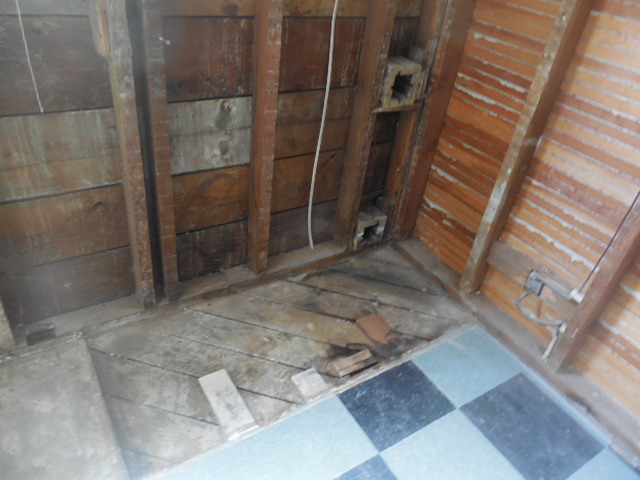
It’s the face of a vent removed from an outside kitchen wall, one of two that were part of an early and natural cooling method known as a “California Cooler.” In a time before refrigeration—and borne out of the bungalow ethic of keeping things simple and natural—these indoor cabinets were the next best thing and were built into many eastside kitchens and homes.

Here’s another look, showing the frame in the original clapboard siding, which was shingled over in the 1950s (thanks to Rob Donnelly for the photos):

DSCN7475

Here’s how they worked: the vents were stacked vertically one at the bottom of the cabinet and one near the top, and always placed on an outside wall. Maybe you have seen the exterior evidence: two small frames with screen or mesh on an outside kitchen wall. Here’s what they looked like from the inside. The old cupboard has been removed showing just the vents.

DSCN5981

Inside the kitchen, the vents led into a cabinet with shelves, which were often just slats with space between to promote ventilation. The cabinet or cupboard had a door on the front, just like any other cupboard in the kitchen.

But the physics of convection made this cupboard different: warm air would escape through the top vent, which acted like a chimney, and cooler air was drawn in through the bottom vent. The result was a measurably cooler space that kept foods fresher longer, and promoted cooling for just-baked items.

The extremes of summer and of winter obviously weren’t optimal (“honey, why is it so cold in the kitchen?”). But they did work, and were omnipresent in the older homes we love. Today, some kitchen designers and builders interested in sustainability and energy efficiency are even recreating this old technology for the same reasons they were first installed a century ago.

Now that you know what to look for, keep your eyes peeled when you are out and about in the neighborhood for twin openings on an exterior kitchen wall, and chances are you are seeing evidence of a California cooler. Do you have one? Send us a photo.

Mark your calendar: Alameda History at the Mission Theater and Pub, Monday, January 13

After a pause in our ongoing quest and passion for Alameda history, we’re back on track in the New Year with a free program as part of the Oregon Encyclopedia History Night series, at 7:00 p.m., Monday, January 13 at the Mission Theater in Northwest Portland. Consider yourself invited.

In pictures and words, we’ll track the early development of Northeast Portland’s Alameda neighborhood, profile key builders and building styles, and share a social history of the homes, families and changing generations of this 100-plus-year-old neighborhood.

Come experience how these layers of local history add up to a deeper understanding of the neighborhood today. This updated presentation will touch on Alameda School, the Pearson Ponderosa Pine, Wilshire Park, the Subud Center/Alameda Park Community Church, the Broadway Streetcar and other institutions and businesses that have defined Alameda life over the years.

It’s free. The beer is good. You might see your neighbors and other history-inclined folks.

7:00 pm, Monday, January 13 at the Mission Theater, 1624 NW Glisan, Portland.