We’ve just heard from our friends at the Architectural Heritage Center that there are still some seats left for the Saturday, January 23rd presentation about Alameda History. We’ll be taking a trip back through time to look at how the neighborhood developed, some of the key builders, and stories from across the years that help characterize the life and times of the Alameda Park neighborhood. The program runs from 10:00-11:30 a.m. at the Architectural Heritage Center, 701 S.E. Grand Ave., Portland.
Category Archives: Research
Alameda Community Church: The Rest of the Story
There are always at least two sides to any story (usually a lot more), and we’ve recently found a description of the events surrounding the neighborhood opposition to the Alameda Park Community Church that sheds further light on exactly what happened around here in the fall of 1921.
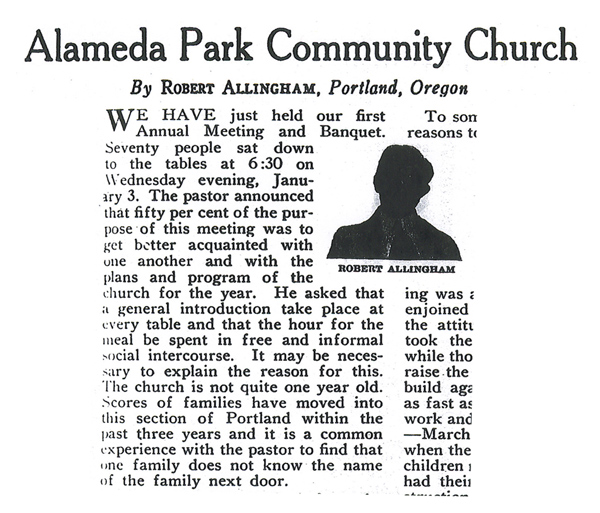
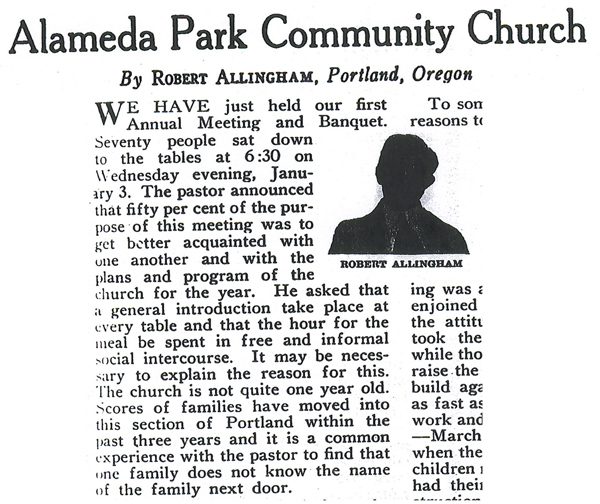
Let us whet your appetite with this clip, from the April 1923 edition of The American Missionary, published by the Congregational Home Missionary Society:
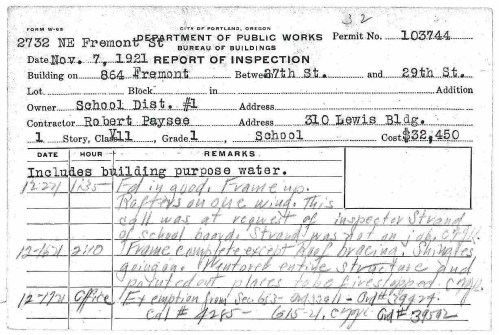
To help put this in context, if you haven’t already read it, we’d recommend reading the page on the church (today’s Subud Center) which you can find by clicking here. Be sure to have a good look at the photos too.
In order to appreciate what The Rev. Allingham is about to tell us, you have to know that some in the Alameda Park neighborhood were up in arms about the construction of the church at NE 30th and Mason. Several protests were organized, a petition got up, and a fair amount of consternation resulted, including relocation of a construction site. The story hits close to home for us because the leading petitioners were the folks who lived in our house for 50 years, and the original intended construction site are the two lots immediately north of us.
Let’s catch up with The Rev. Allingham:
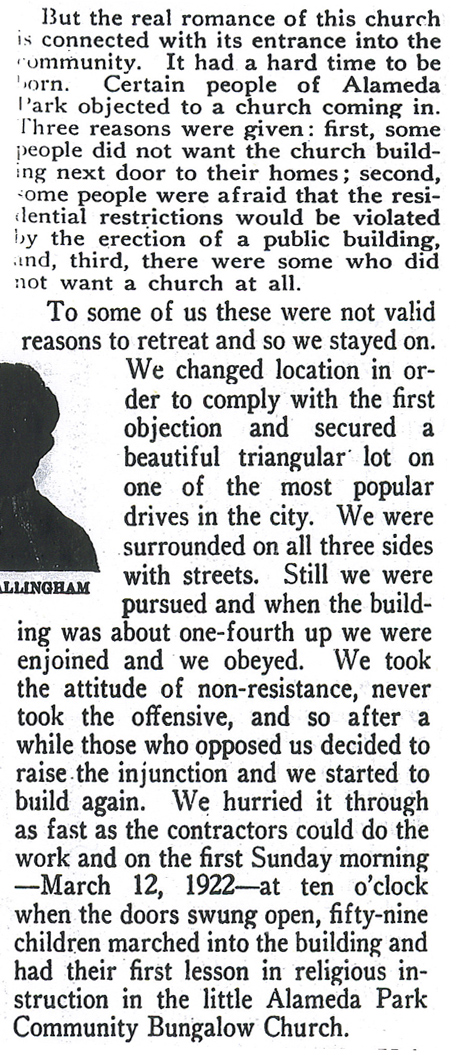
The turning of the other cheek. He continues:
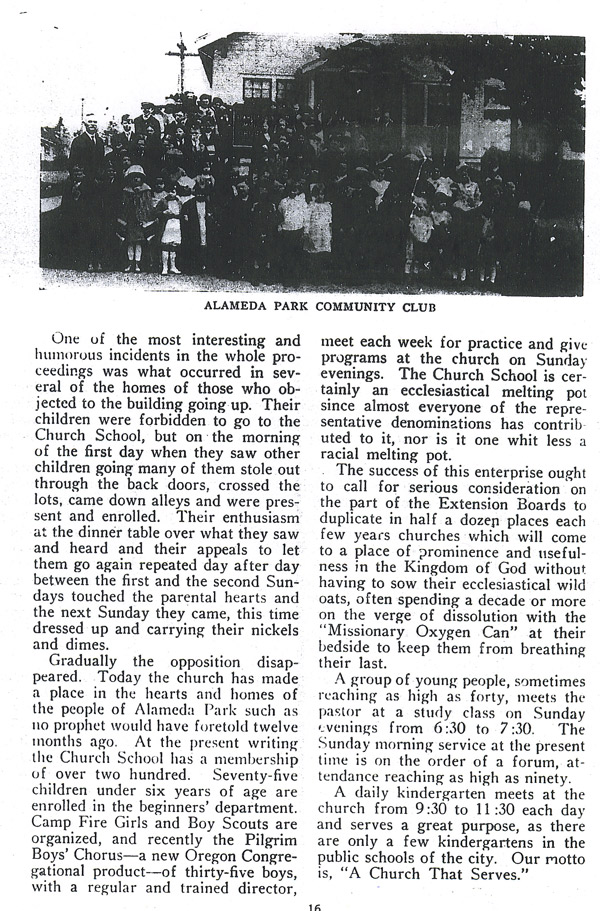
The reference to the children from the homes that objected to the church: that’s probably Bruce and Jean Morrison who lived here and were probably some of those kids who snuck out the back door of home to check out Sunday mornings at the Bungalow Church. Hmm. And the church seems to have served the community up into the 1950s and early 1960s. We’ll continue looking for additional stories and articles that chronicle the building’s life and times. In the meantime, with The Rev. Allingham’s words in our minds, stroll past the building at Regents and Mason and listen for the echoes of all those children.
Old School
We received word last week from Portland Public Schools that they’re sharing an inventory of their many historic properties, including our favorite Alameda Elementary School, and nearby Beaumont Middle School.
You can find these reports and many others at this link, which is interestingly housed within the Office of School Modernization.
Looks like Alameda faired well in the analysis in terms of its historic integrity, but Beaumont–due to many alterations made over time–did not. Both buildings were designed by George Jones, the one-man Portland school architectural institution (actually two man institution, his father Thomas had also been architect for the Portland School District years earlier).
The good news for Alameda Elementary School is that it scores well as a candidate for listing on the National Register of Historic Places. Perhaps a small group of interested parents and historic building fans might be up to the task…? Count us in if we can find a quorum.
Be sure to have a look at these other posts related to Alameda School.
Portland’s Phone Network, Circa 1911
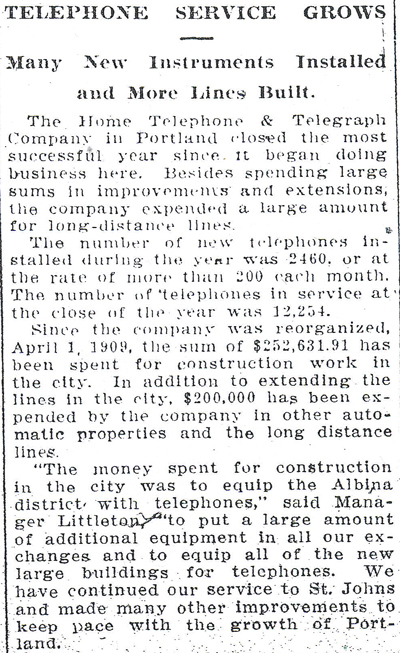
In the midst of the communication technology that has come to define our busy lives—mobile everything and 24/7 communication—we thought a little historical context might be of interest. During a recent session with The Oregonian microfilm, we came across this little nugget from January 11, 1911.

From The Oregonian, January 11, 1911.
Just wanted to make sure you caught that: the Home Telephone & Telegraph Company, working at a very busy pace, installed 2,460 phones in calendar year 1910, bringing the total number of working phones in Portland to 12,254. Just for interest sake, Portland’s total population in 1911 was 212,290. Between 1910-1911, more than 13,000 building permits were issued in Portland, a record that made the City Building Department (formerly located in City Hall) a very busy place. Construction in Portland, and in our brand new neighborhoods here in the Northeast quarter of the city, was taking place at a pace which we can hardly imagine today.
In our 1912 bungalow, the first phone was hidden away in a box tucked into the wainscot in the breakfast nook. A later version had its very own table mounted to the wall in the hallway outside the master bedroom. Not sure when the “twisted pair” arrived here, but our hunch–based on what was a growing trend both in homebuilding and telephone business–is that we were wired from the beginning. What’s the history of the phone in your house?
At a time when we take wi-max, wi-fi, cell phones and the internet for granted, the notion of 12,254 working phones in Portland makes us want to slow down a bit, and wonder if people were actually better connected then.
Finding Albina
I’ve just finished a research project on a century-old house in the Boise neighborhood, an area known in earlier years as Albina. The house, on North Borthwick, was a rental for many years that held at least 17 different families and dozens of occupants of all ages. The research task was to track down all of the past residents and to learn something about their lives. What a fascinating pleasure it was to unearth the stories from newspaper clips, Polk directories and a handful of remaining public documents.
The part of the neighborhood I was focusing on was a Scandinavian stronghold in the early years: the house was built by a Swedish immigrant and for the first 40 years of its rental life, the house knew only immigrant families.
In the course of the research, I had occasion to read and enjoy a great book by former Northeast Portland resident and author Roy Roos, The History of Albina, which I recommend to readers of this blog.
The back of the book contains a thumbnail history of many properties in the Boise, King, Humboldt and Piedmont neighborhoods. You’ll recognize some of these buildings, particularly the ones up and down Martin Luther King Boulevard. But it’s the front part of the book—the narrative that describes how neighborhood geography has changed over time, and particularly the maps—that will haunt you. So much has been lost in these neighborhoods. Virtually all of Albina has been altered by development of Emanuel Hospital, construction of Interstate 5, and construction of the Fremont Bridge and its various ramps and fly overs. Overlay the map of old Albina on the geography of today and you can get a sense of just how much is gone.
If you are haunted by layers of history and enjoy seeking clues that link today with the past, read Roy’s book and then get out there on the ground, maps in hand, to imagine what must have been. You can find his book at Powell’s and many other booksellers locally and on the internet. Here’s a link to a neat story that ran in The Oregonian following the book’s publication.
Hat’s off to Roy for keeping these stories and places alive.
Haunted by Harry Phillips’ Story
I’ve just posted the next builder biography, this one about Harry Phillips, who built many of the homes on NE Gile Terrace and Ridgewood in the 1920s. Phillips’ story is fascinating, tragic and indicative of his times. His work, appreciated and admired today, has clearly stood the test of time.
I’ve often wondered how builders weathered the storm of the Great Depression. I know Albert Irwin did only remodeling work in the mid-1930s. Others, like William Donahue, got out of the business altogether. Harry Phillips wasn’t as fortunate.
Phillips’ sons Jerry and Roger—now in their 80s—generously agreed to be interviewed about their parents, the work of their father, and their own growing up years. I feel very fortunate to have been able to gather their story in before it would have been lost to time.
Check out the biography of Harry Phillips on The Builders page.
Do you live in a Phillips home or have any insight to share about the family? Drop me a note.
Old House History in The News
We see this morning that a recent interview with The Oregonian has turned into a very nice story, which ran in the Thursday, March 26th edition of the paper. Feature writer Larry Bingham wrote the piece out of an interest in old house history, and in keeping with the paper’s focus on Oregon history during this susquicentennial year. You can find the story here at this link. Thanks Larry!
Ken Birkemeier, Prolific Alameda Builder

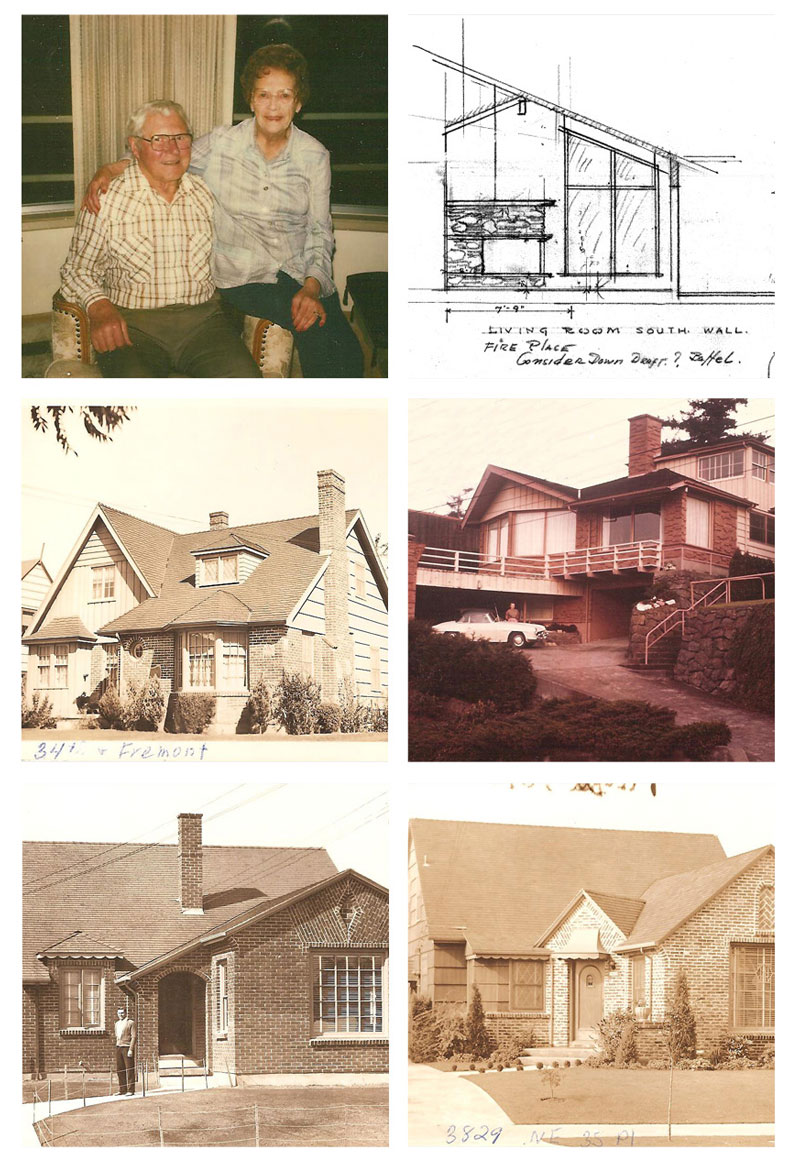
A collection of images relating to Ken Birkemeier. Top left, Ken and his wife of 50 years Marge. Below, homes he built in the neighborhood. More pictures in The Builders section. Photos and drawings courtesy of Dan Birkemeier.
After a very interesting few weeks of research, correspondence with the Birkemeier family, and lots of walking around the neighborhood looking at dozens of houses he built, I’ve posted some background on local architect and builder Kenneth L. Birkemeier. You’ll find the details (and some more photos) over in the new section called The Builders (click here). It was great to hear memories from various family members, particularly the story from his grandson Dan, who is today an architect in Seattle.
You’ll note that I’m inviting your stories or photos of Birkemeier homes, so let me hear from you and I’ll share them here on the blog.
The new section is up to four major builders now, with dozens more to go. One thought that occurred as I walked around the neighborhood this week is that Irwin, Read and Berkemeier must have known each other. Between the three of them, they designed and built dozens of houses here in the neighborhood…they must have been bumping into each other along the way.
Next on my list is Harry Phillips, who designed and built many of the homes along Ridgewood and Gile Terrace in the late 1920s. I also want to delve into the history behind the reference to the “Town of Wayne,” which is a small plat south of Fremont and between 32nd and 29th.
Inquiring minds want to know: Who was Wayne?
The Tuxedo of Portland | Looking Back 99 Years
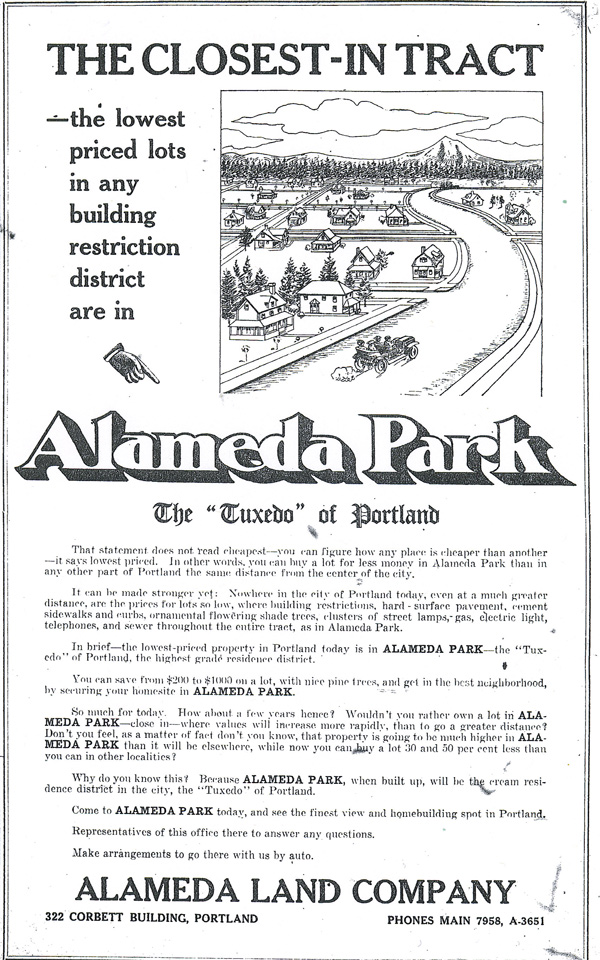
As the Alameda Neighborhood approaches its 100th anniversary, I thought it might be of interest to turn the clock back for a sense of what people were thinking about this part of the city in those days. I’ve done a comprehensive review of The Oregonian from 1909 to 1929 and have hundreds of articles and advertisements that shed light on the life of Alameda, Beaumont, Rose City Park and other Northeast Portland neighborhoods. Here’s one, an advertisement from 99 years ago: Sunday, October 24, 1909:
Plenty of food for thought here. The cartoon-like drawing showing a few houses (note the front porches) scattered on open blocks; the serpentine Alameda leading off toward Mt. Hood; street trees planted in orderly fashion. And the car. The text extols the affordable nature of the lots here in Alameda Park, the amenities, including flowering shade trees, telephone, electricity and sewer. The “Tuxedo” of Portland. Hmm.
Ninety-nine years ago this month, the streets were in, but not yet hard-surfaced (that was still almost three years off, completed in the spring of 1912). Curbs and sidewalks had not yet been framed and poured, nor was there any gas or electric installed. The only sounds of home construction were coming from Concordia and Vernon–neighborhoods to the north–where building was fast and furious. But here in Alameda, despite what the ad might have you think, it was a quiet place at the far northeast edge of the city limits. The first boom of Alameda construction was still a year or more away.
As we enter the 100th anniversary phase, in 2009-2011, I’ll be sharing clippings on a “real-time” basis. You can read all the Alameda news that was fit to print on the day it ran, exactly 100 years ago. What better way to learn about our history…no such thing as old news.
Grant Park Grocery & Market
Grant Park Grocery and Market, NE 33rd and Knott, about 1933. Photo courtesy of Jerry Hoffelner. The man in the first row, second from the right with the blue “x” penned onto his apron, is Jerry’s dad, George Hoffelner. The other men have yet to be identified. Can you help?
I’m researching a very old house near 29th and Knott. One of the many people who lived in the house over the years worked for a while at the Grant Park Grocery and Market, which we know today as the Family Medical Group office on the southwest corner of NE 33rd and Knott.
The image above, taken about 1933, shows the grocery staff decked out in their white aprons ready for action. Like many small stores, these guys often delivered the groceries direct to your door…an idea recently picked up on by some of the modern mega-grocery stores.
This image is taken on the east face of the building (facing 33rd). The original entrance for the market was not on the diagonal at the corner like it is today, though it seems there was always an entry there. My hunch is that was the entry to the pharmacy and fountain that used to be there. The grocery business was owned and operated by Ernest Bjorklund. Next time you are stopped at the light there, have a good look at this interesting building and tip your hat to Mr. Bjorklund and his squad of helpful grocery clerks.
I’m looking for any help with memories, stories, photos or information about either the Grant Park Market or the pharmacy and fountain.
Here’s a shot of that same spot today. The door appears to be an “emergency exit” today. The graceful lights are gone, as is the cool curved doorway and the sidewalk ramp leading to the door (it’s now just part of the garden bed).