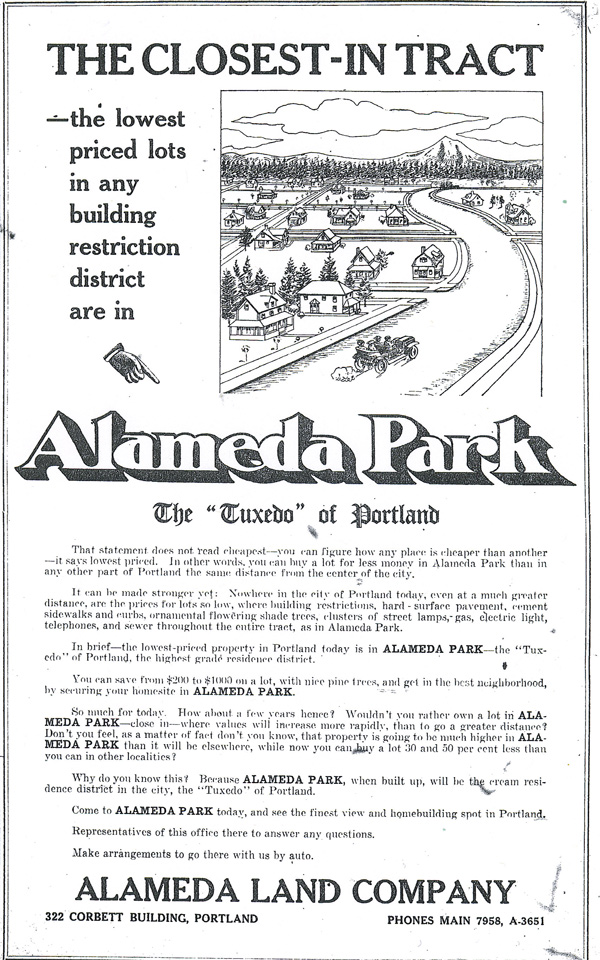
It’s not too late to sign up for one of the programs we’re doing for the Architectural Heritage Center this summer, kicking off this Saturday morning with a program at AHC focused on Portlanders’ historic connection with the Willamette River.
Saturday, May 10th from 10:00-11:30 we’ll explore the colorful history of Portland’s southeast waterfront in the vicinity of Ross Island, where Portlanders flocked to two hugely popular swimming and waterplay venues: Bundy’s Baths and Windemuth. We’ve written about these here on the blog and will be delivering a program with photos, maps and stories that help bring these former Portland water recreation mainstays back to life. Program based at AHC, 701 SE Grand, Portland.
Vernon Walk – Thursday, June 5th from 6:00-8:00 p.m. we’ll be leading a history walk that explores the Vernon neighborhood, from development of Alberta Park, to the fall and rise of neighborhood schools, to patterns of redlining from the 1930s-1950s, the presence of a dairy, a much-loved synagogue and a street full of small businesses.
Alameda Walk – Wednesday, June 11th from 10:00-Noon This walk through the Alameda neighborhood will include insights about pre-development conditions, planning and construction of the neighborhood, the Broadway Streetcar, home construction and architectural styles and points of local interest including the story behind Deadman’s Hill and the 1920s uproar over the former Alameda Park Community Church.
Like a mosaic of fine old tiles, hundreds of subdivision plats rest atop Portland’s neighborhood landscape, creating a base-layer of orderly streets and lots beneath the places we know today. Drawn up over the last 140 years by different developers, each plat has a name: some are catchy, some are descriptive, a few remain in common use to describe the places we know. Most have been lost to time, like George Place.
We’ve written about most of the underlying Alameda plats here and for a series of recent stories in the Alameda Newsletter: Gleneyrie, Olmsted Park, Homedale, the Pearson Addition, Waynewood (which was remade from the labyrinth created by six of the original plats), not to mention the nearby Kennedy Addition, the distinction between plats and neighborhood boundaries, and many other plats on both sides of the Willamette. There’s even a plats category here on the blog if you are inclined to a deeper dive.
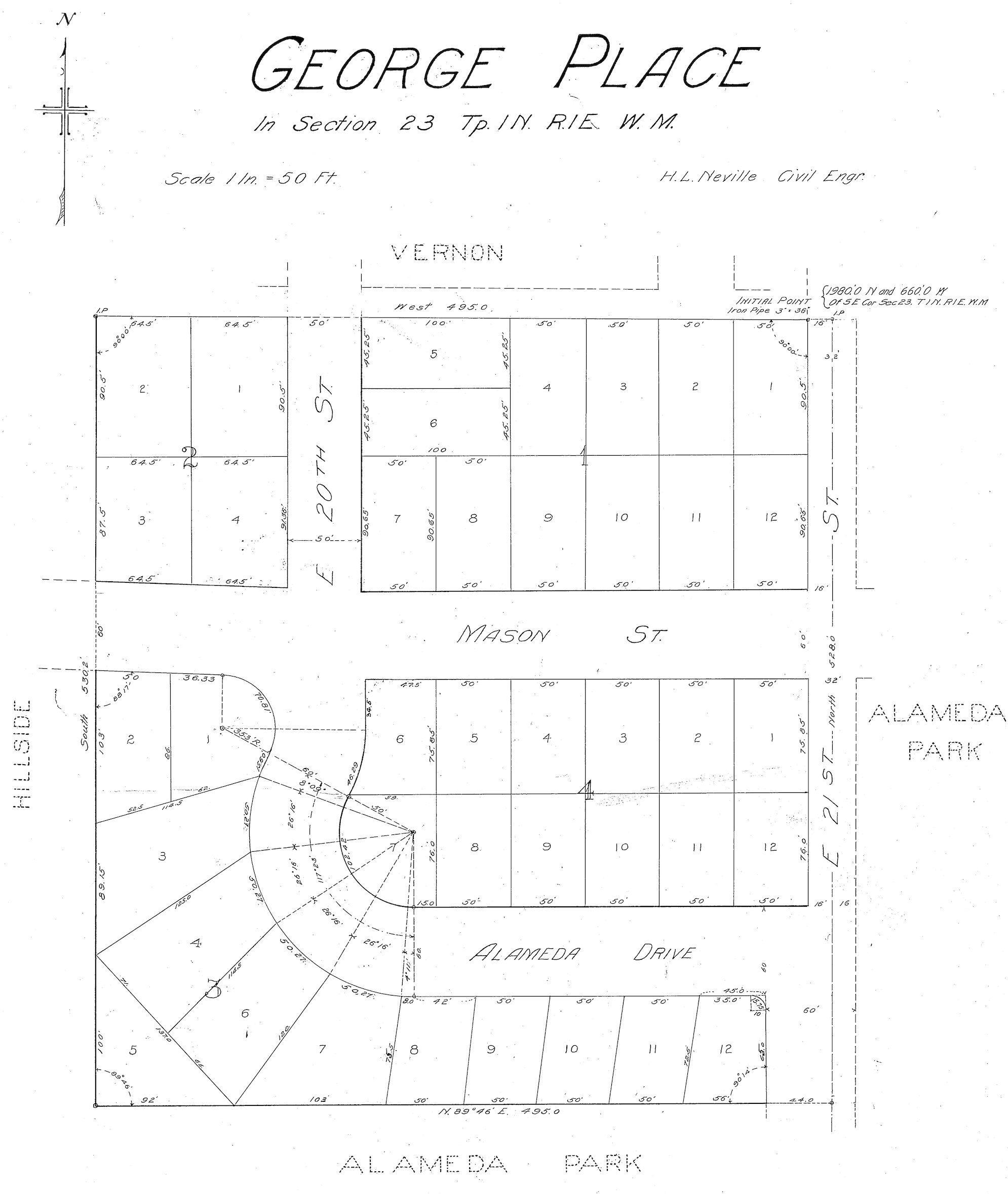
In this parade of plats, we should make sure one of the smallest ones doesn’t get away: George Place, a tidy square of 40 lots where grid meets slope at the far southwest edge of the Alameda Plateau. Take a look:
Namesakes Judge Melvin Clark George and Mary Eckler George traversed the Oregon Trail with their families as children and grew up on homesteads in the upper Willamette Valley. They married in 1873 and Melvin was soon elected to the Oregon State Senate (1876-1880), and then to Congress in 1881, where he served two terms before returning to Oregon to teach medical law at Willamette University (1885-1889). He served as Multnomah County Circuit Judge (1897-1907) and retired from the bench at age 58 to become director of public schools in Portland.
Melvin George, circa 1900
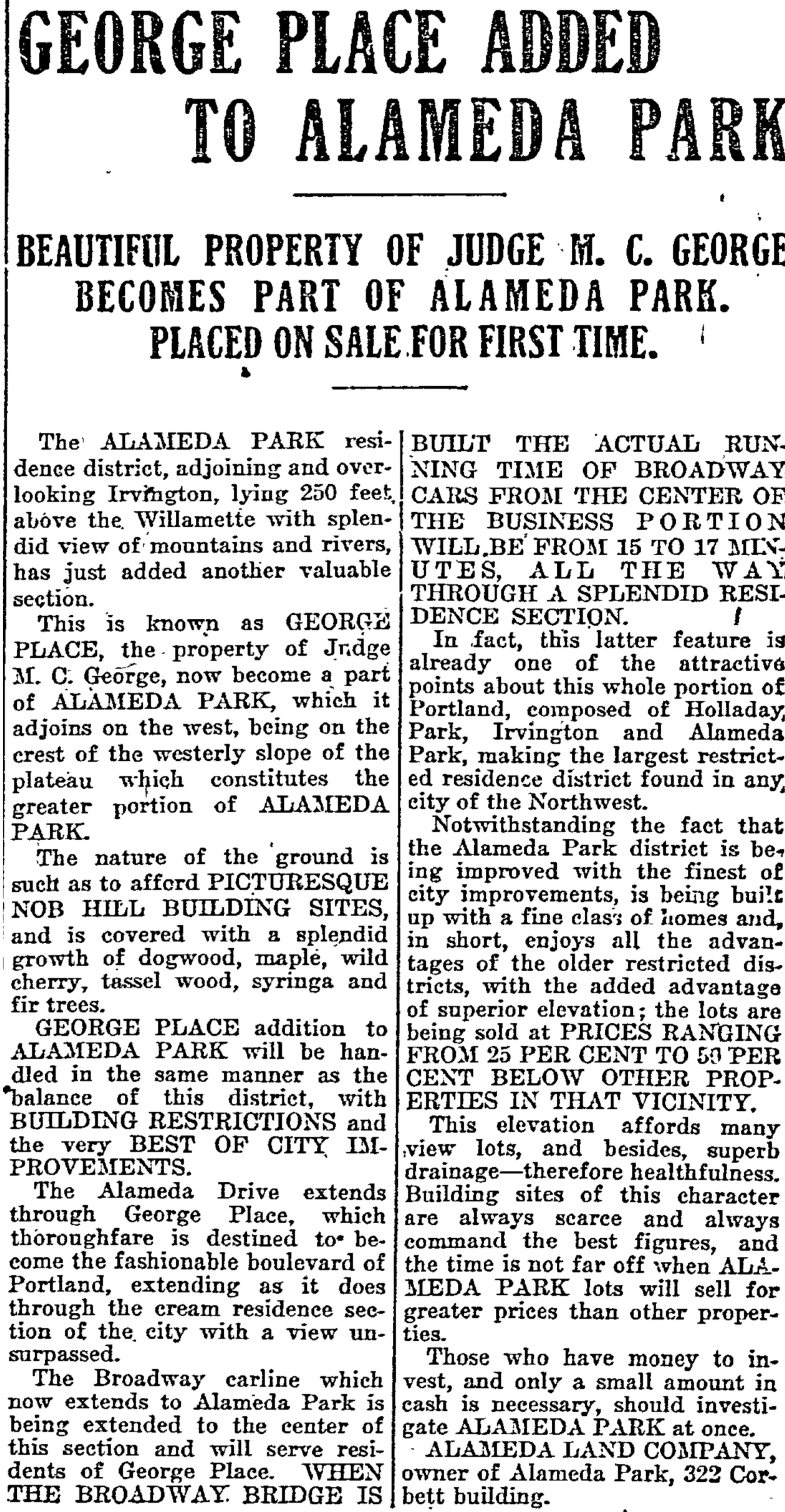
Sometime around the turn of the 20th Century, seeing development potential on the horizon (literally), the Georges purchased six acres atop the ridge. They filed the George Place plat with the Multnomah County Surveyor on April 25, 1911, two years after the Alameda Land Company platted the Alameda Park Addition which anchored their eastern flank.
At the time, the Alameda Land Company was blitzing The Oregonian and the Oregon Journal with advertisements stirring excitement for the much larger Alameda Park Addition. Agreements were evidently made and Alameda Land Company took over marketing the property, dedicating one full advertising panel to the topic in June 1910.
From The Oregonian, June 4, 1910
Of course in 1910, all of these places were still purely imaginary: the plats may have been filed or on the drawing board, but streets were just being carved out of the gravel, trees felled, stumps removed. In 1910, it was still a giant brush patch, with orchards and dairies down on the flats below.
Lot sales and homebuilding were slow to catch on in George Place during these first years. Streets and infrastructure were in place by the mid-teens, but Portland’s economy began to cool in the run up to World War I. A few lots did sell, but the George Place six acres remained mostly unbuilt until the early 1920s, when a new real estate and homebuilding company known as the Hiller Brothers Company bought the lots and started building into a fast improving real estate market. By the way, this is one of the things we love about paying enough attention to a particular place: pretty soon everything you bump into starts to connect (see our profile of Hiller Brothers on The Builders page).
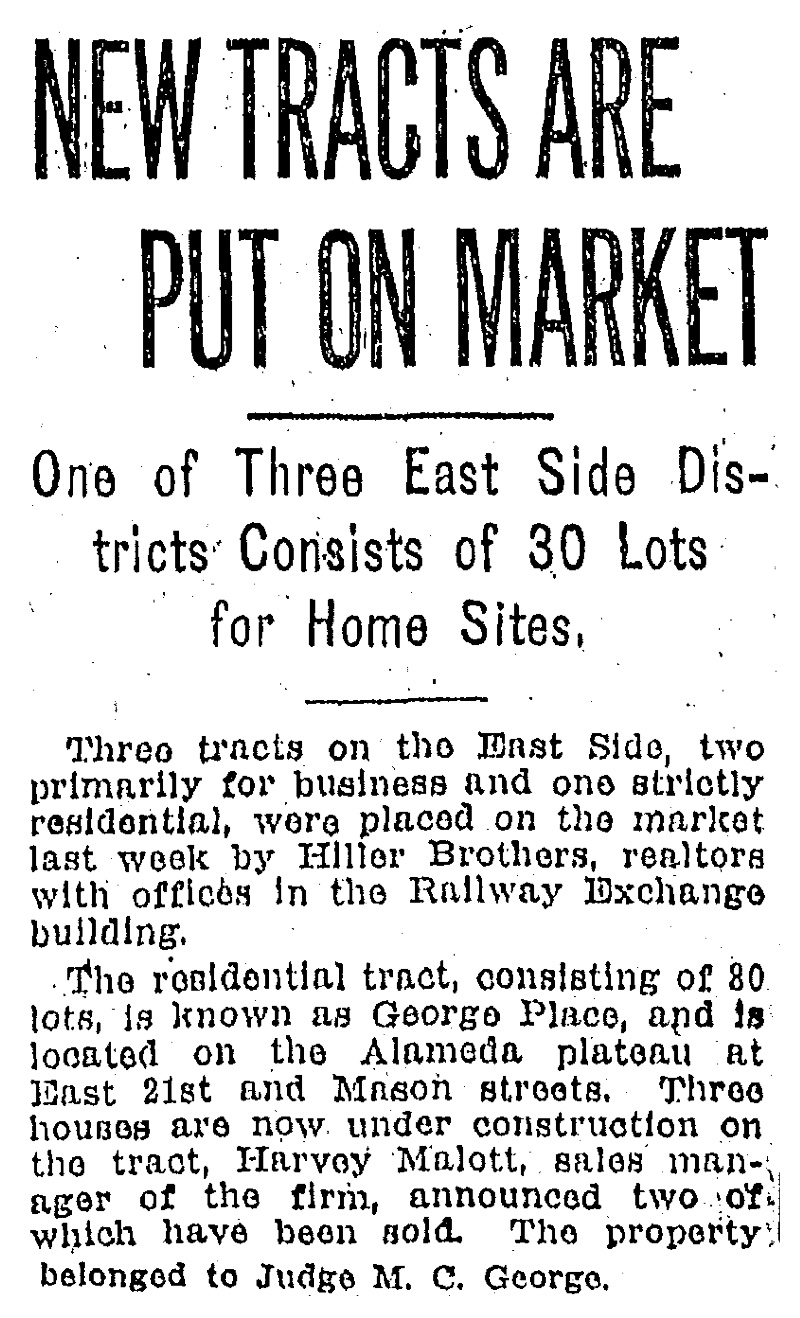
From The Oregonian, March 28, 1926. Not sure where the reporter got 80 lots, you can count the 40 lots in four blocks on the plat above.
In 1926, the streets were still gravel, but three houses were under construction including the one with the best view, for company owners James and Sarah Hiller at 2024 NE Alameda Drive. Hiller Brothers built many of the homes here, using plans provided by architect Hubert A. Williams. English cottage style was clearly the most popular. The Great Depression paused homebuilding activity leaving multiple vacant lots in George Place that finally filled in during the 1940s and early 1950s.
As for the Georges, they raised their family in a comfortable house up the hill on Market Street in southwest Portland’s Goose Hollow, with no evidence in newspaper coverage they ever lived on or paid much attention to George Place on Alameda Ridge. Melvin died at age 83 on February 22, 1933. Mary lived on to age 91 and died on September 24, 1942. They are buried together in Lone Fir Cemetery.
AH readers know walking is the best way to observe the eastside’s century-plus houses and neighborhoods. At a slow pace, you can see the craftsmanship, the years of wear and change, the hands of five or six generations building, improving, maintaining (and sometimes not).
On our regular dog walks this summer, we’ve been watching three particular bungalows on NE Mason in the Alameda neighborhood, just a few blocks apart. All have been time travelers with their own stories and are now in transition. Two of them are essentially gone and no longer in their earlier forms; but one special little one is, at least for now.
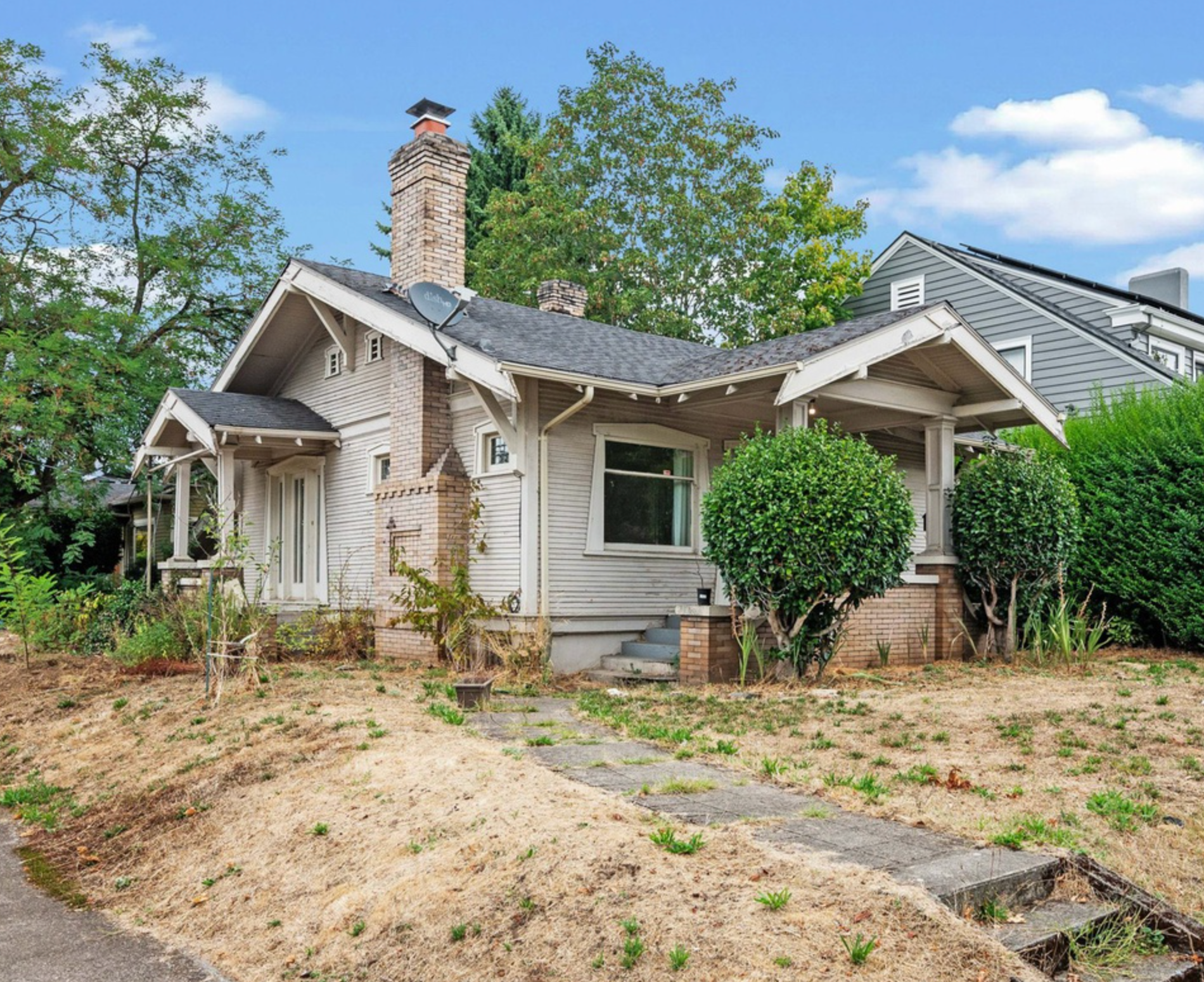
1914 Arts and Crafts bungalow at 2503 NE Mason, September 2023.
The 1914 Arts and Crafts bungalow on the NE corner of NE 25th and Mason is a small beauty with unique and original trim and detail, both inside and out. You would remember it if you’ve seen it (we’ve never seen a house quite like it). It’s small but distinctive, has been essentially unchanged in almost 110 years, and it’s on the market now, listed by Emily Hetrick at Keller Williams.
Interior of 2503 NE Mason, September 2023. Note the coved ceiling, box beams in both rooms, beveled glass built-ins, beveled glass windows and doors, period decorative columns. Fine 110-year-old architectural detail inside and out.
A few years back, we had the good fortune to connect with family members who remember it from the 1940s and 1950s as the perfect small bungalow. Back in the day, David White remembers visiting his great aunt and uncle who lived there. Here’s a photo of their niece–David’s mother Agnes–at the front porch from 1940. That very same view is very much available today.
Agnes Coulter in 1940, front porch of 2503 NE Mason. Note distinctive window and door trim, still in place today. And of course the smiling subject and her flowers. Courtesy of David White.
David’s grandmother Isabella Coulter ran the Alameda Park Grocery at NE 27th and Going, which we wrote a three-part series about back in 2015. By day, Isabella worked in the store. In later years, after closing time, she returned home a few blocks south to this small corner bungalow she shared with her sister and brother-in-law. Frequently, nieces and grand nephews visited the bungalow and those memories are strong and clear.
Because it is small and because it’s on a corner, we’re a little worried about its future. We’re researching its early history at the moment and will have more to share, and would be glad to introduce the new owners to its long-time-ago former family who knew and loved it well.
A few weeks later we posted the origin story of this great little bungalow, which you can read here.
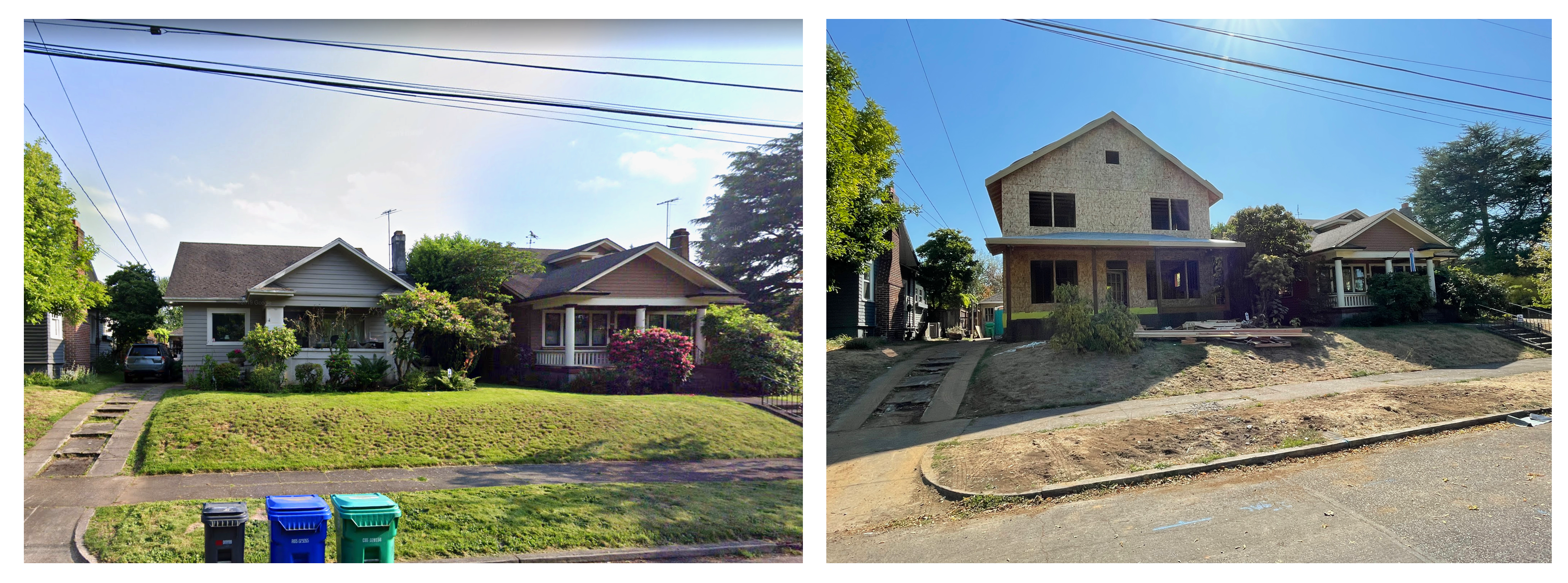
A couple blocks east on the south side of the street was the Clifton bungalow, built in the summer of 1921 by Enoch Clifton, who with his brother Knute immigrated from Norway and went into the homebuilding business on Portland’s eastside, making bungalows just like this one throughout the neighborhood. Their niece Nancy Clifton lived in the home for many years up until her passing earlier this year. The bungalow was bought by Liberty NW Homes in Oregon City and all but razed—the building permit refers to the work as an “addition.”
Here’s a look at before and during.
2617 NE Mason (on the left) before, and this week. The new house utilizes the foundation and several external walls of the former bungalow.
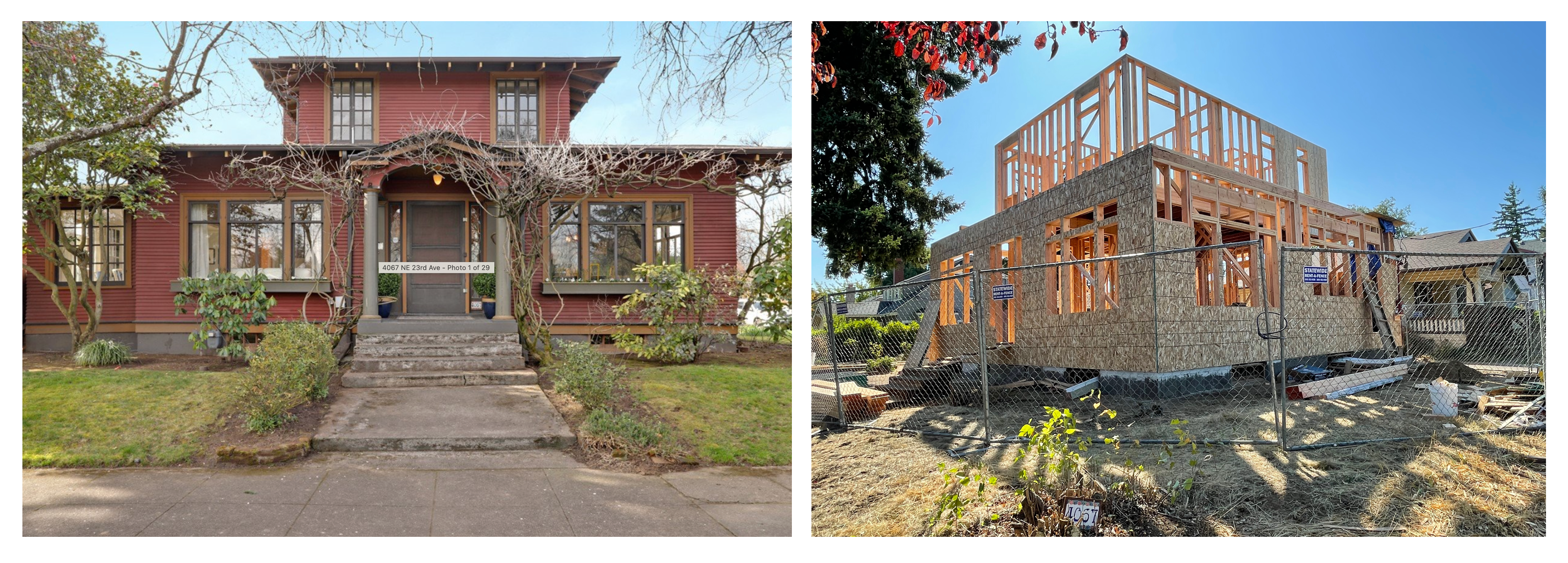
A few blocks west, on the southwest corner of Mason and NE 23rd (pictured below), we’ve watched the small red 1915 Arts and Crafts bungalow being taken apart piece by piece. Another somewhat unusual home, this one distinctive for its center hip-roofed cupola-like second story. The new home going up incorporates the foundation, and is also considered an addition, but the permit notes “whole house to be reconfigured.” The new framing does suggest echoes of the former building.
Here’s the before and during…
4067 NE 23rd before, and this week. It could be that the new construction will mirror aspects of the former.
For at least one of the bungalows on NE Mason Street, time will tell.
Note:
Summer seems to be “off season” for the blog: it’s hard to compete with sunshine and all things outdoors in Oregon. But the promise of rain and these cooler days brings us back inside. We have lots of topics for the blog this winter and fall, so even though it gets quiet around here between June and October, we won’t be a stranger in the rainy weeks and months ahead.
Today, we think of the Alameda neighborhood as one contiguous area with well-recognized boundaries: The city’s Office of Neighborhood Involvement identifies Alameda as that area from Prescott on the north to Knott on the south; from NE 21st on the west to NE 33rd on the East. One single named neighborhood today, containing about 2,400 dwellings and more than 5,000 people.
But hiding underneath today’s one single map is a treasure of 23 old maps—subdivision plats—all drawn at different times by different people as they transformed this landscape one small piece at a time from forests and fields to the grid of streets we know today. We’ve been taking a systematic look at these plats, some of which like one particularly chaotic collision just north of Knott, we’ve written about.
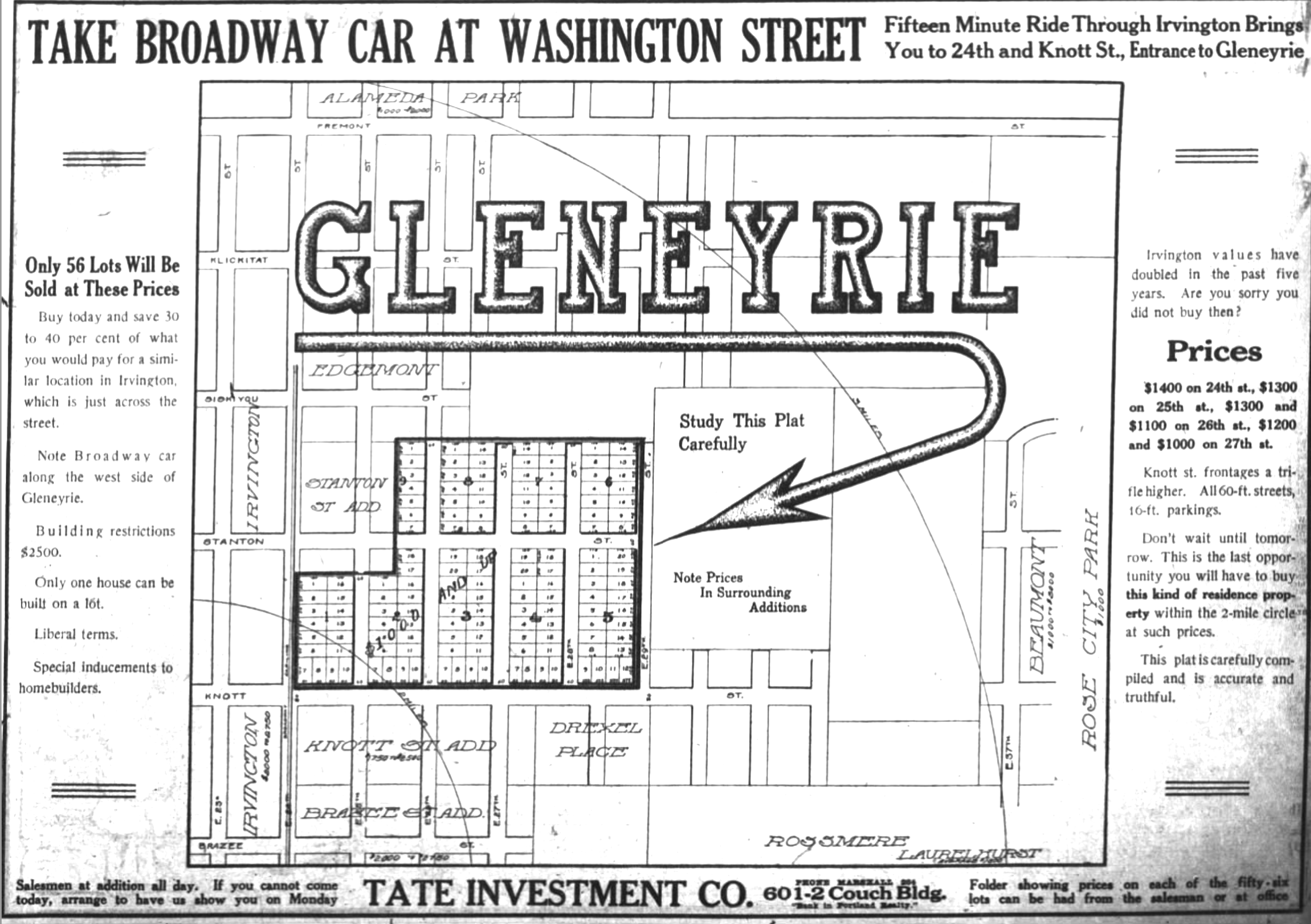
Here’s one we’ve been looking into recently: Gleneyrie, a subdivision plat filed in July 1911 by three couples who were the principals of the Tate Investment Company: Thomas and Inez Foster; Jost and Maria Held; and Robert and Nellie Tate. That fall, they placed their first ad for the property, below, which was then still just a concept (click in for a larger view).
From The Oregonian, October 22, 1911
The Tate Company investors purchased their 24 acres of the former Bowering Homestead Donation Land Claim in the years after the 1905 Lewis and Clark Exposition with an eye toward real estate development. The surrounding open fields, orchards and dairy property were rapidly being converted to residential use to keep up with Portland’s booming real estate market and population. And there was much money to be made by investors ready to speculate on a rising market. The Tate Investment Company also developed Dixon Place, another plat just north of Fremont between NE 15th and NE 21st avenues.
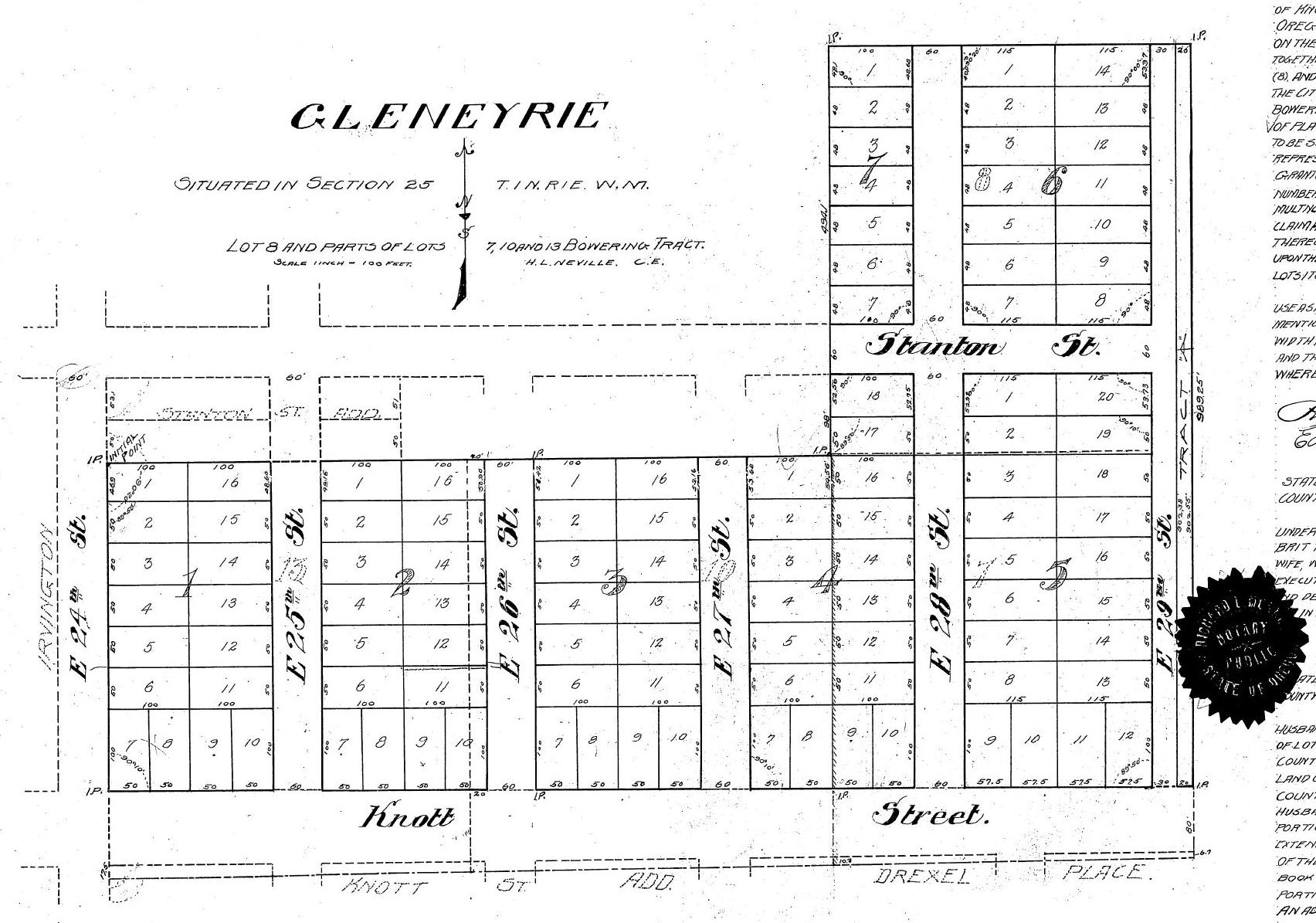
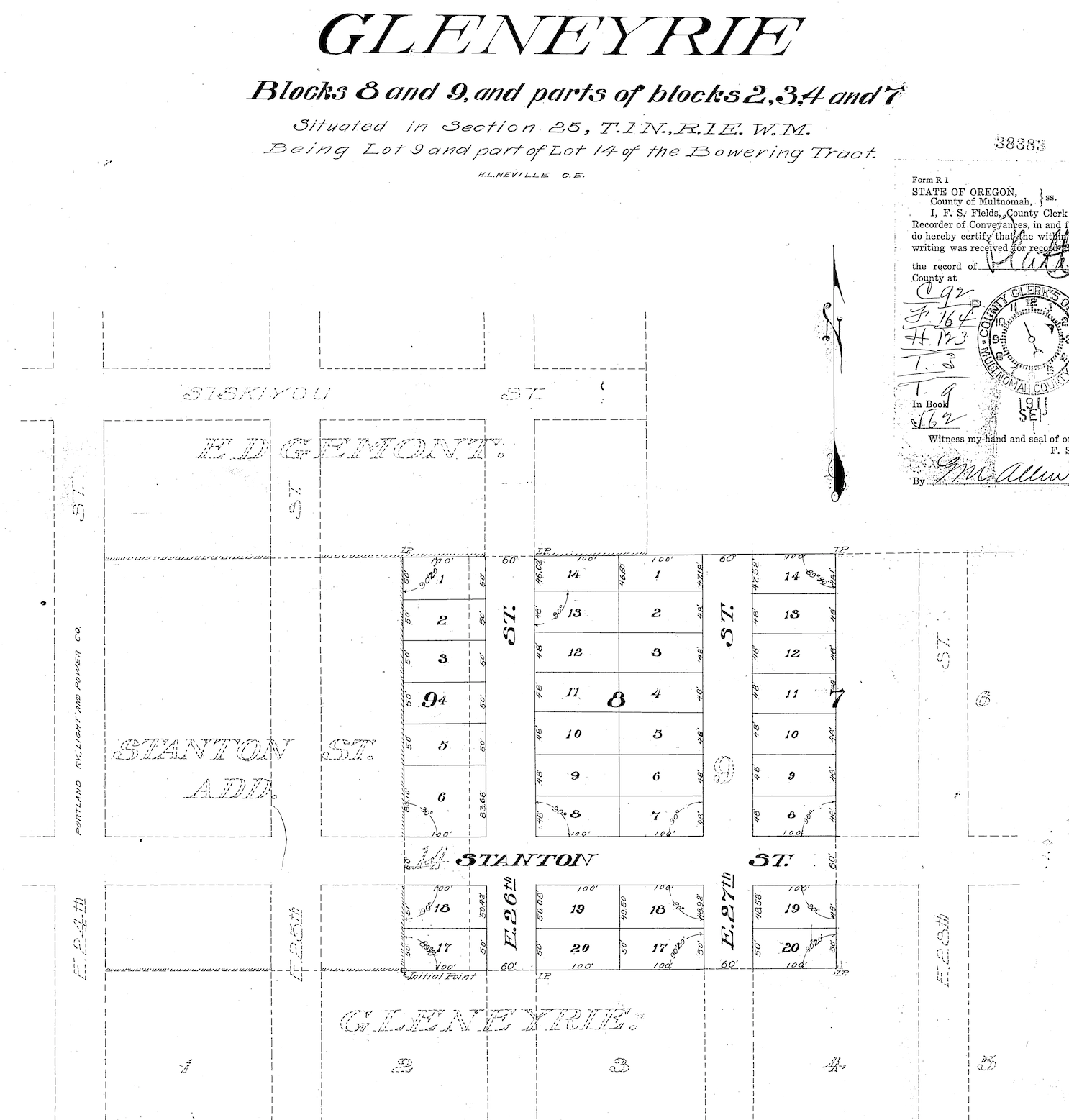
Here’s a look at the official Gleneyrie plat, filed with the Multnomah County Surveyor and County Clerk on July 25, 1911: from NE 24th to NE 29th, between Siskiyou and Knott.
One week later, Tate added additional area to Gleneyrie taking in East 26th and 27th north to the existing boundary on the eastern edge of the plat.
The namesake Gleneyrie was a Tudor-style castle in Colorado built in 1871 by William Jackson Palmer, founder of Colorado Springs: big, beautiful, fancy and well-known. And the name sounded good too, which was key. By 1915, Portland developers had filed more than 900 plats—development plans that divide an acreage into a subdivision of lots and streets—many of which were as small as one block or less, and all named by developers searching for an attractive sounding name.
Today’s Alameda neighborhood is made up of 23 separate plats, all filed at different times by different developers who were competing with each other and speculating on market conditions when they bought chunks of what had been old homesteads and farms claimed in the 1850s and 1860s.
In some areas the plats have retained their distinct personality and name. But here in Alameda—named for the 1909 Alameda Park Addition plat filed just to the north—the identity of the individual plats like Gleneyrie eventually dissolved into the commonly used neighborhood name we know today.
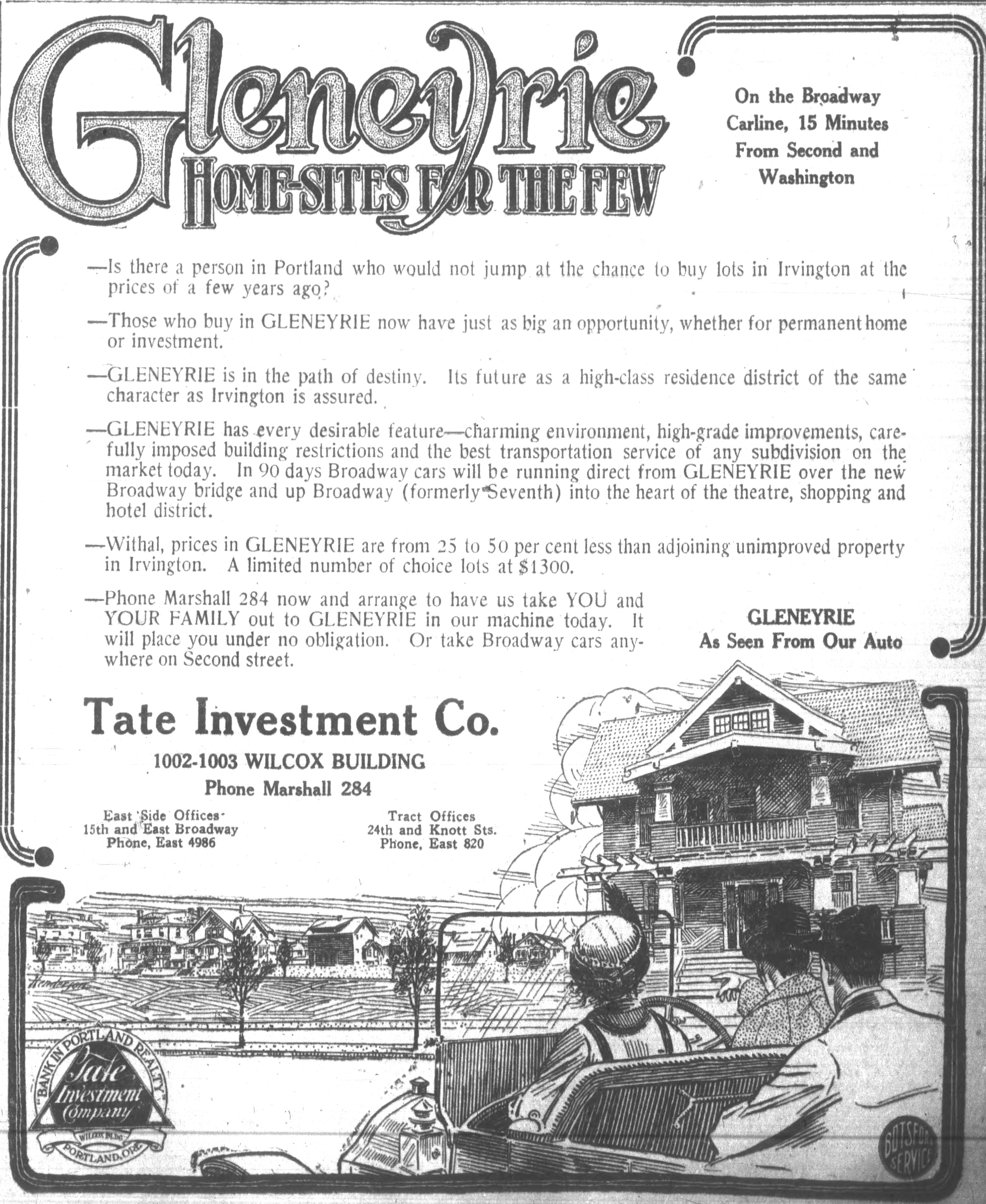
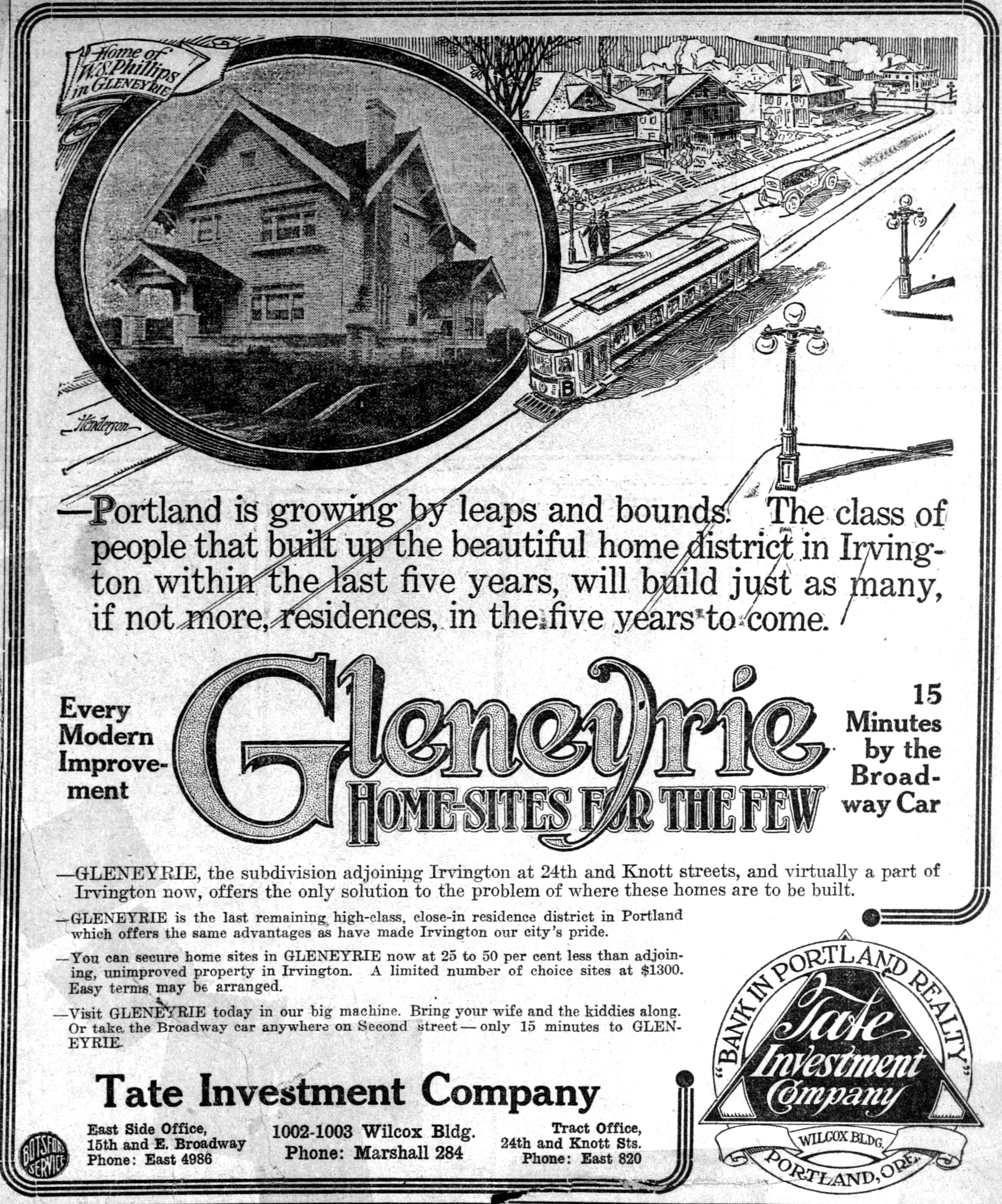
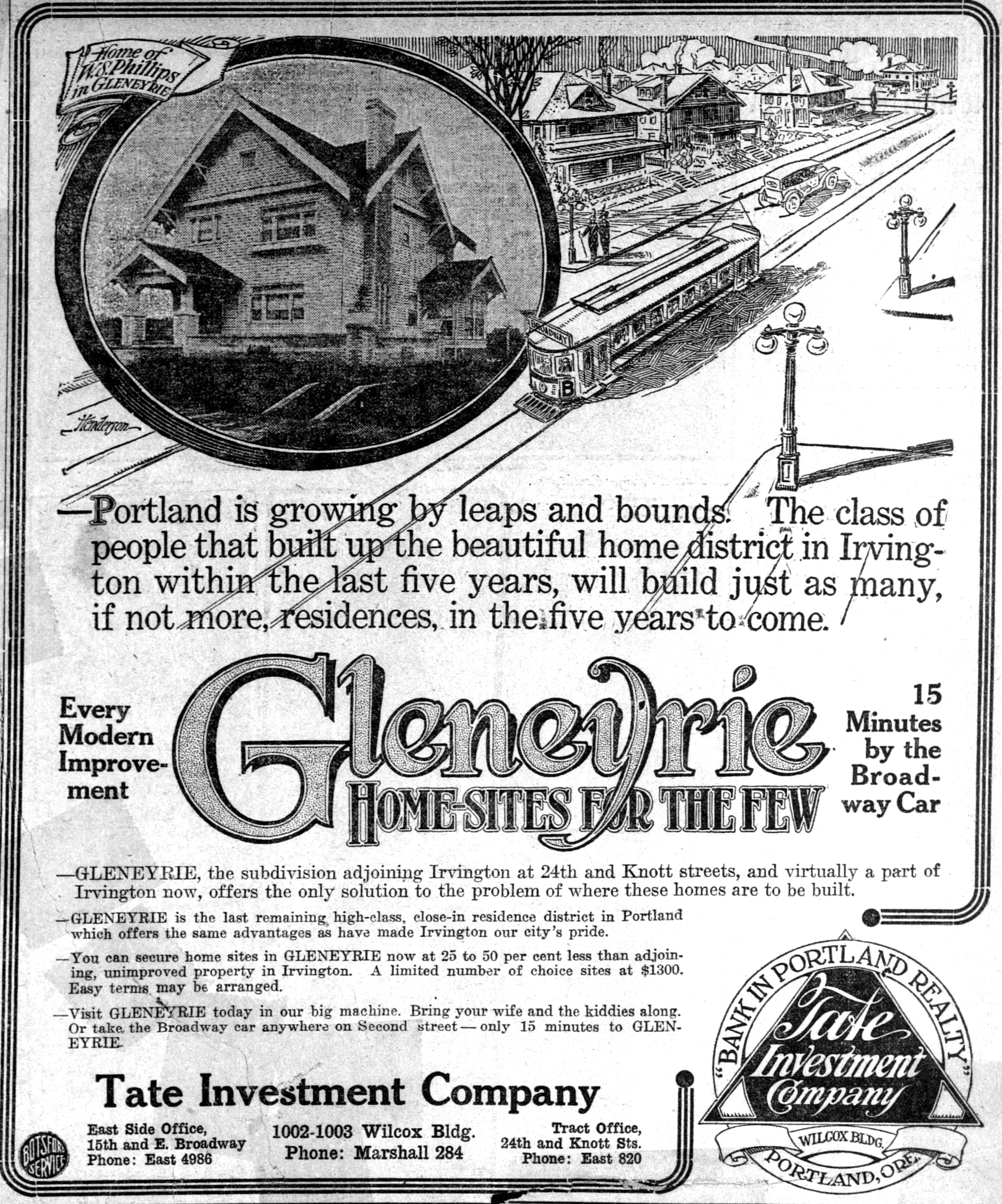
But in the Spring of 1913, when having a catchy name might help compete with all the other real estate advertising, the Tate Investment Company pushed out a series of full-page and half-page illustrated ads in The Oregonian and the Oregon Journal to market the attributes of their new subdivision. And they tied their marketing more closely to Irvington—a well established prestigious brand—than to Alameda, which had just been launched (and was trying to coattail on Irvington as well).
From The Oregonian, April 14, 1913
From The Oregonian, April 20, 1913
While all this advertising was underway, work out on the ground of what was Gleneyrie transformed the property from what were rolling fields into a mostly level subdivision. Significant grading work was done on the property to remove hills and fill in swales and ponds. Newspaper accounts from 1913 indicated 50,000 cubic yards of fill was removed: that’s more than 4,000 modern-day dump truck loads.
One of the leading early builders in Gleneyrie was Arnt Anderson, one of the two-dozen-plus builders we’ve written about on The Builders page. Anderson built some amazing homes that have passed the test of time…before he was arrested, convicted and imprisoned for grand larceny.
Today, ask anyone to tell you where Gleneyrie is and you’ll probably get a blank stare. But back in the day, the folks at the Tate Investment Company were trying hard to make it a household name. Literally.
Wondering about the other 22 plats in today’s Alameda? Here’s the full list: Alameda Park, Homedale, Olmsted Park, Irvington, Edgemont, Pearson’s Addition, Town of Wayne, Town of Wayne Replat, Waynewood, Irvingwood, Meadow Park, Dunsmeade, Irvindale, Hillside, George Place, Gile Addition, Bowering Donation Land Claim Tract, Norton’s Subdivision, Stanton Street Addition, Hudson’s Addition and Meadow Park.







 Alameda Old House History