Style Points | The Tudor Cottage

irwin-tudor.jpg 

This Alameda Tudor Cottage, located at 3143 NE 32nd Place, was built in 1929 by architect and builder Albert H. Irwin. Irwin built more than 25 Tudor Cottage and Tudor-Norman farmhouse style homes in Alameda, Beaumont, Portland Heights and other locations. For more information on Albert Irwin, click into a profile I’ve written about him in The Builders. Photo Courtesy of Albert Irwin Collection-Paul Crocker.

The Tudor

  • References to an earlier time period;
  • Distinguishing between Tudor Revival and English Tudor Cottage
  • The Style in Alameda and other Northeast Portland Neighborhoods

We’ll distinguish between Tudor Revival and Tudor English Cottage. But first, some background on key elements of Tudor.

Roots in Tudor England

Based loosely on English style from 16th Century England-the period when the Tudor family ruled England-and evolved from a type of architecture and construction known as post and beam.

Large timbers framed the buildings and plaster was used to fill in the areas inside the posts and beams (the ancestor of stucco), providing a rustic appeal. The form included steeply pitched roofs, elongated windows, often ornate use of patterned brick or stone, small window panes, a cross gabled structure, large chimneys (with chimney pots).

Reviving the Tudor in America

Tudor Revival refers to those homes-usually larger and often two or three stories-built in Portland as early as 1910, though the style began to be used elsewhere in the country just before the turn of the last century. These larger homes mimicked the early post and beam style, but not the actual structural use of posts and beams, by using half-timbers affixed to a stucco exterior. Alameda’s “Autzen Mansion” near 26th and Alameda is a good example of a classic Tudor Revival residence.

Tudor Revival homes were costly to build. Their steep and complex roof systems, decorative brick work, use of stucco and wood trim all took time and extra care.

Why was the Tudor Revival popular? For many the style was attractive because of the reference it made to early England, to a more “romantic” time. At a time of great industrial growth and change, it provided a link to a “simpler” era. It was also a distinctive look, different from the Victorian and Queen Anne periods which it followed.


The English Tudor Cottage-A Simpler and Popular Form

A variation on this, which was very popular here in Portland and elsewhere, was referred to as the English Tudor Cottage, English Revival Cottage, or simply as “English” style. It differed from the classic Tudor Revival in several ways:

  • These were smaller and more modest homes, built for middle-income families, usually one story.
  • They were built on smaller lots, typically between the mid 1920s and late 1930s.
  • The cottage version might have the half-timber over stucco style. But often not. The exterior material might be all stucco, or brick, or even shingle.
  • Look for the long rectangular windows, and often-even on the cottage-use of leaded glass windows.
  • The steeply pitched roof is still a common feature on these homes, as is a cross gable style…where the roof ridgelines run perpendicular to each other, with the gable end facing forward.
  • The market for these homes in the late 1920s and 1930s was strong. Sears and Roebuck even produced a very popular kit version of this house.

The Portland Context

A study of Sanborn maps from the mid 1920s shows that much of the northerly portions of Alameda (and other nearby neighborhoods like Beaumont and Rose City Park) had been developed. The predominant house type built during the earlier years was the bungalow, though there are plenty of four-squares, arts and crafts and colonials as well.

The English Tudor Cottage style was indeed popular and commonly used in the areas built after the mid-1920s, again typically in the southern and eastern portions of the neighborhood. Home construction was strong in parts of Northeast Portland in the late 1920s but then slowed after 1929 and didn’t really recover until the late 1930s.

The English Tudor Cottage would have been popular during this era because it was less expensive to build and to buy; it had an attractive feel and look, with references to classic and higher-end homes; it was more “modern” compared to the common and aging bungalows that were all around; it was typically a bit smaller than homes built in the teens and early 1920s (smaller families).

Be sure to take a look at the Tudor English Cottage plans and story that ran in the December 20, 1925 issue of The Oregonian.

 

Time Treasures | What have you found?

In some ways, our old houses are like unintentional time capsules. The guys who built them long ago — and who have patched them together over the years — were resourceful, using materials at hand to get the job done. When we opened up a bathroom wall recently, we found handfuls of heavy wrapping paper used to prop up an electrical junction box (gulp). Packing materials from the original porcelain fixtures were used for shims or to frame out the medicine cabinet. Old newspapers were used all the time for insulation. These little treasures give us a moment’s glimpse into the past: people here in this room were trying to solve a problem and they used what they could get their hands on.

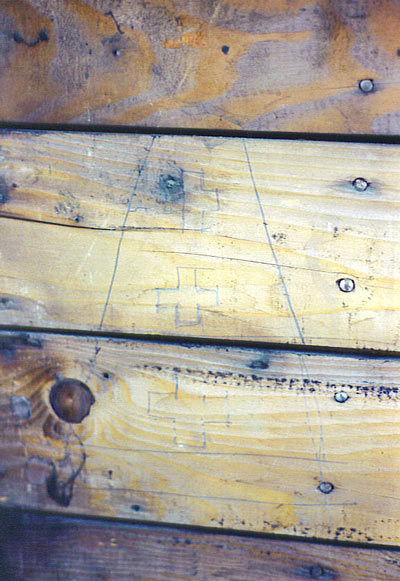
One of my favorite time treasures is a series of sketches found on the rough shiplap sheathing underneath the clapboard exterior of the house.

sketch-2.jpg

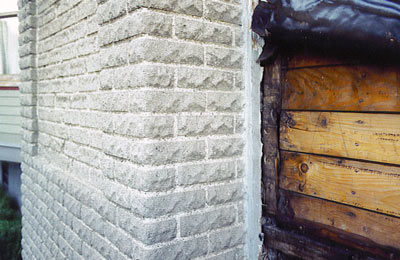
Our builder, William B. Donahue (or his mason), used some unusual brick patterns on his chimney exteriors (I’ve found four other Donahue houses in the neighborhood…more on that in a future post). On the outside face of the firebox he used brick to create crosses, patterns and other symbols. When we were replacing some cracked siding a few years back,  I found a series of sketches on the sheathing right next to the chimney that showed he was thinking about a cross.

sketch-1.jpg

Strangely, he didn’t put a pattern in our brick, but the sketches show he was thinking about it. Elsewhere — pretty much everywhere when we take something apart — are quickly scrawled measurements in pencil, signs of a carpenter at work almost 100 years ago.

Over the years, past homeowners and their families have surrendered all kinds of items, lost to the crack at the edge of the floor, the space behind the plate rail trim, or that hole where the radiator pipe goes downstairs. We’ve found an ivory diaper pin, a buffalo-head nickel and a lovely heart-shaped locket that escaped from a necklace. On the back is the inscription “From grandpa.” How long did someone look for that? Did grandpa replace it with another keepsake when no one could find the precious lost locket?

grandpa-locket.jpg

Who knows what else is here in the walls, under the floors, lost in the garden bed, or scribbled in some long covered-up corner. Whenever we’re working on the house, I’m always on the lookout.

What have you found?

Sanborn Fire Insurance Maps | 1924 Snapshot in Time

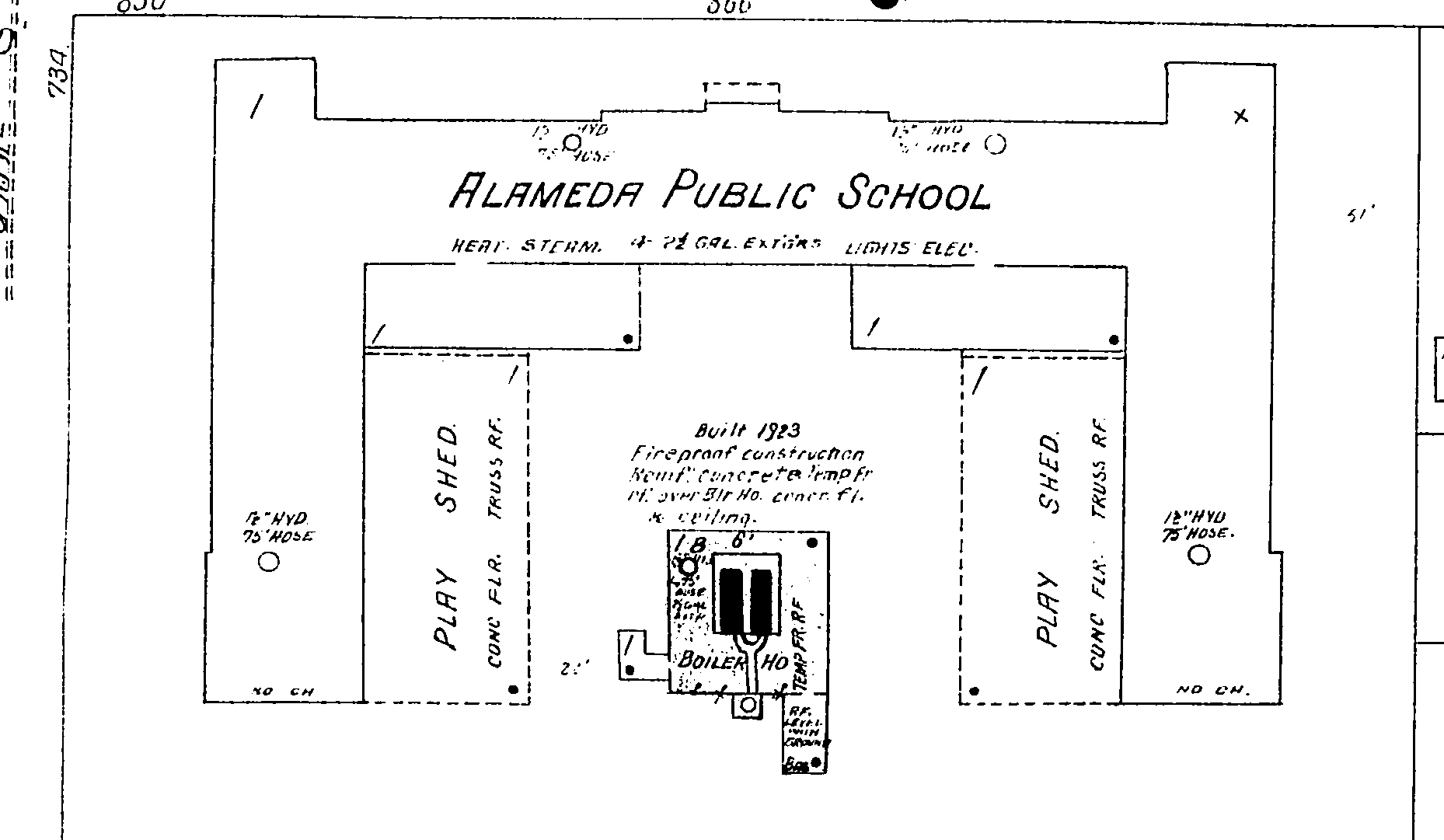
What started out as a monumental effort to map fire risk in neighborhoods built from combustible materials has become a trove of information for old house researchers. The Sanborn Company started out in the 1860s mapping neighborhoods and buildings to help give fire insurance underwriters information upon which to write their insurance policies. The maps show in impressive detail the construction materials of every structure in a neighborhood, the heat source of institutional buildings, the location and size of water mains, and basic construction information (as in, where was the front porch?), etc.

alameda-school.gif

The outline of Alameda School, 1924, showing the location of the boiler and incinerator, and standpipes for water. Detail from Sanborn Plate 613, Volume 6.


The scope of the mapping effort is almost unbelievable: 12,000 U.S. towns and cities were mapped, most of them several times, by an army of surveyor / mapmakers. With this information, volumes of maps were drawn up and published producing a durable snapshot in time of neighborhood development. And all of this in the era before digitial mapping techniques.

Writer and public historian Kim Keister writes: “Stated simply, the Sanborn maps survive as a guide to American urbanization that is unrivaled by other cartography and, for that matter, by few documentary resources of any kind.”

A quick spin through a few of the maps from Alameda, made in 1924, provides some interesting insight. Remember, this is before the address change of the 1930s, so the numbers you see won’t make sense today. You can click on any of these images for a closer look at the map selection.

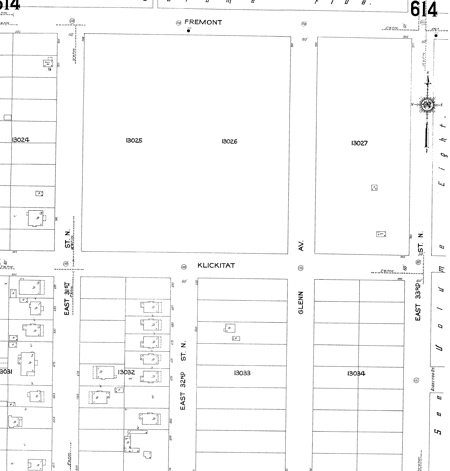
Below, just look at how few homes there were in this part of the neighborhood. In some cases, streets weren’t even in yet. The northern part of the neighborhood — the Alameda Park Addition shown on the plat map here on the blog — was developed first, when the areas south of Alameda Elementary School were just open fields.


614.jpg

Detail from Plate 614, Volume 6.


From time to time you come across a building that must have pre-dated the grid of the neighborhood, like this one below where the building is sitting at odd angles to the street. Sometimes, you’ll find barns and outbuildings showing as well.

626-detail.jpg

Detail from Plate 626, Volume 6

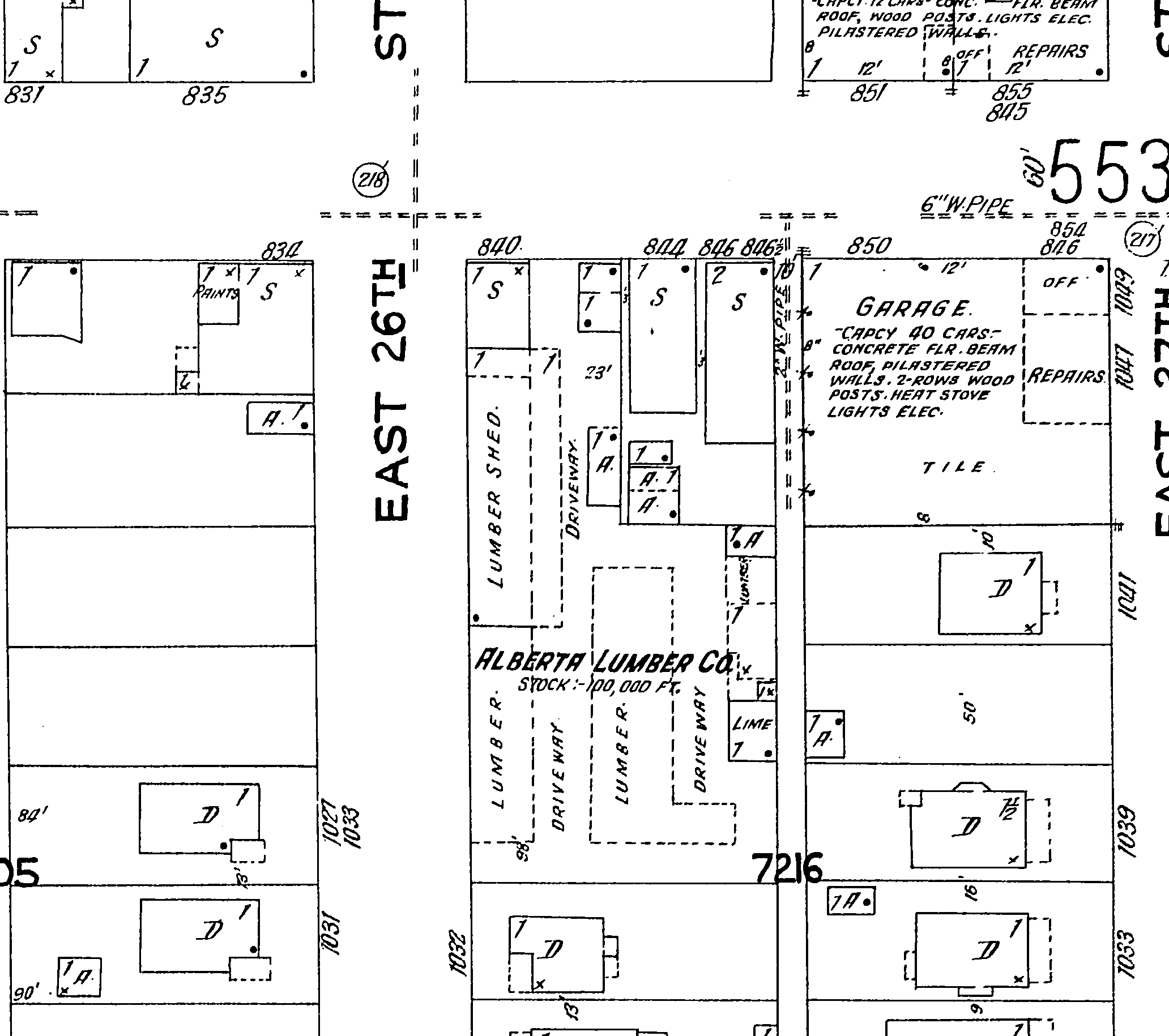
Check out this spot up at Alberta and NE 26th: my guess is that a lot of the wood and supplies to build our houses came out of here. Today it is a parking lot:

alberta-lumber.gif

Detail from Plate 552, Volume 5.


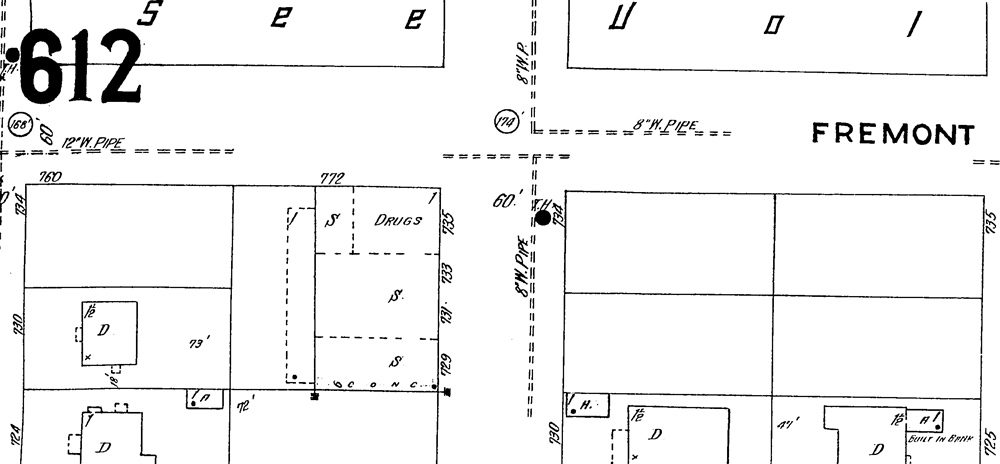
Here’s a snapshot of the Alameda business district, which housed a dry goods store, a shoe repair, and a drug store. More on that in future posts. That’s Fremont running left and right, and NE 24th running up and down.

612.jpg

Detail from Plate 612, Volume 6

Small versions of these maps are available on-line through Multnomah County Library, which also has a hard copy of the original maps (so does the Oregon Historical Society). They are amazing and colorful documents to behold. If you have the time and interest, they’re well worth a look. I’ve printed out copies and assembled them together to give a full map of the neighborhood, circa 1924. An interesting snapshot. Click here for a link to the Library’s Sanborn database. If you click over to the Library site to look at the Alameda-related Sanborns, have your library card number ready, and look for the Portland, Oregon Sanborns from 1924. We are in both Volume 5 and Volume 6.

When Research Pays Off

pair-1-then.jpg pair-1-now.jpg

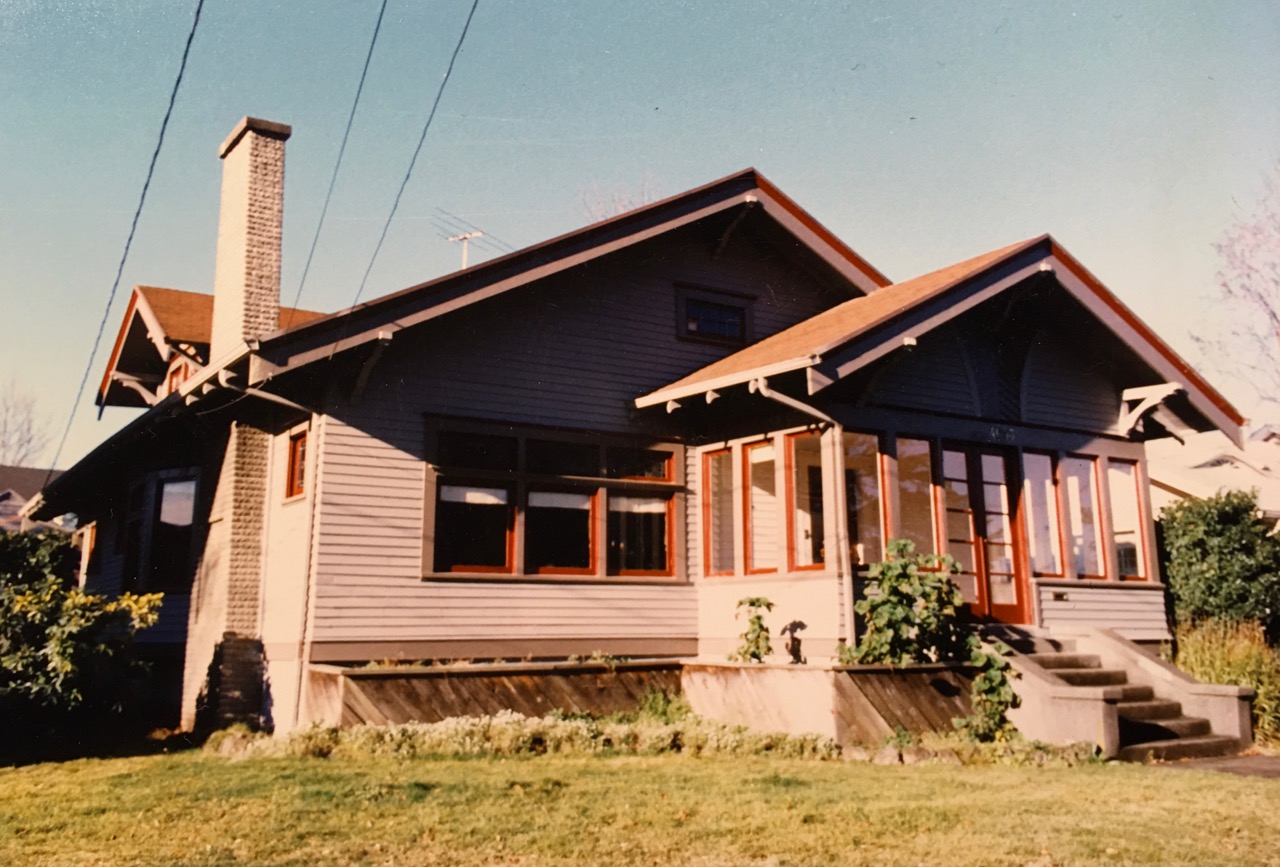
In the 1940s, after 30 years of exposure and wear-and-tear, the family living here decided to remodel their deteriorating front porch. They removed the columns and poured a concrete deck. Then they enclosed it with casement windows and turned it into a sun porch. Below is what it looked like when we moved in in the late 1980s:

Front porch, December 1989

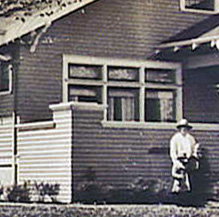
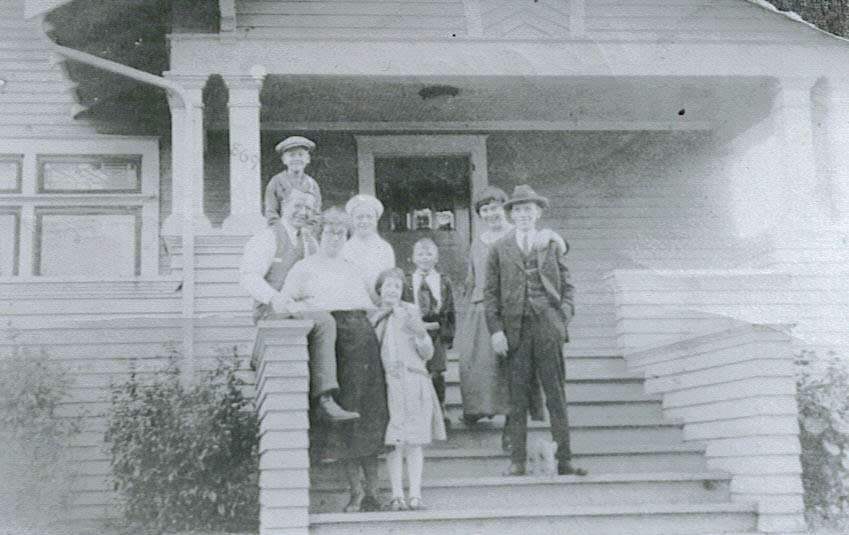
Our detective work on the reconstruction showed the ghosts of some early columns and other features, but we had to use our imaginations to guess at what it looked like originally. I had been looking for members of the family who lived in our house (one single family was here from 1912 until 1959, which is a good long time for one family to be in the house…we were lucky in that). Through determined research, I found the little boy who grew up here…he was in his 90s when I found him. That’s Bruce Morrison in the cap with his hand on his dad’s shoulder on the left side in the photo below. We had lunch together and he told me all about growing up in our house.

pair-3-then.jpg

pair-3-now.jpg

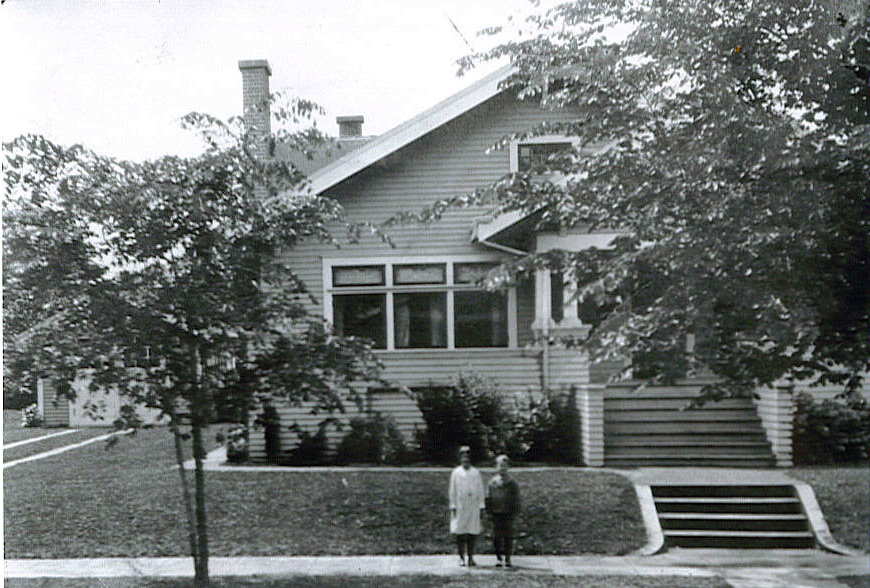
In addition to sharing all kinds of stories about the house and neighborhood, Bruce put me on to a bunch of photographs of the house from the teens and early 1920s. Jackpot! We couldn’t believe our eyes. We were generally right about the columns, but the idea of the extended porch, with its false pedestal corners, was well beyond our imaginations.


Photo courtesy of Morrison Family

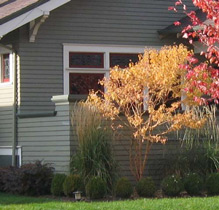
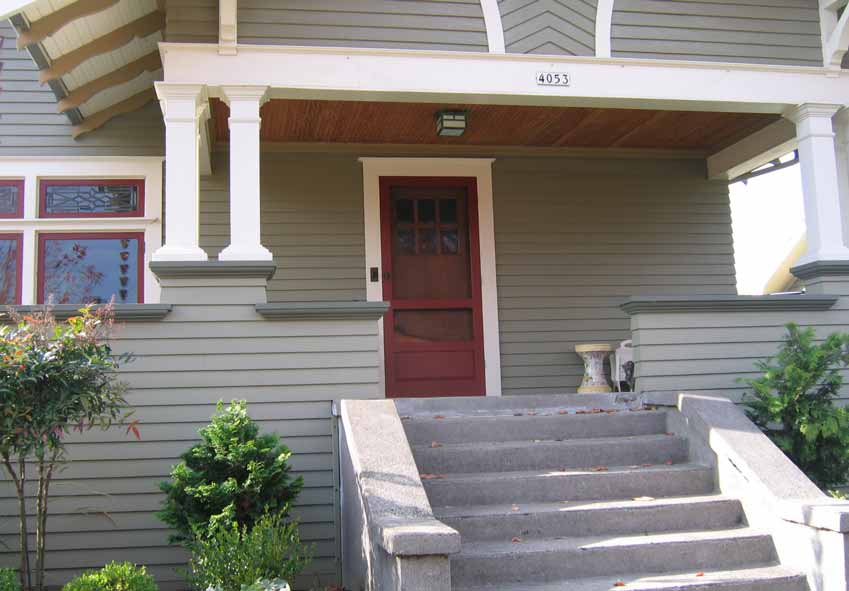
So, we sat down at the drawing board, old photos in hand, and did some scaling of the ghost porch using measurements of house parts visible then and still here today. And then we found a very talented and patient carpenter to put it all back together.


pair-2-then.jpg

pair-2-now.jpg


roof-then.jpgroof-now.jpg

After a little landscaping and reconstruction of some long-gone sidewalks, we’re confident the family who moved in those long years ago would clearly recognize the place today. Research pays off: you might be surprised at what you’ll learn.

Welcome to Old House History

Thanks for visiting this site, which is a place to share knowledge, tools and observations on appreciating the life of old houses. Specific pages dwell on particular topics relating to the history of the Alameda neighborhood in Northeast Portland. Other pages provide information on researching the history of your home. The idea is to create a conversation about how old houses (and their neighborhoods) have been shaped by the families who have lived in and loved them for generations, and how our houses in turn have shaped our lives.

Alameda Stories introduces you to particular aspects of life in the early neighborhood.

Research Services describes how an experienced researcher and writer can help unlock your home’s stories.

Alameda Street Names describes the origin of street names we know today.

Resources will help you learn more about how to search out the history of your home by yourself.

The Map provides a look at the neighborhood as it was originally platted. Can you find your lot?