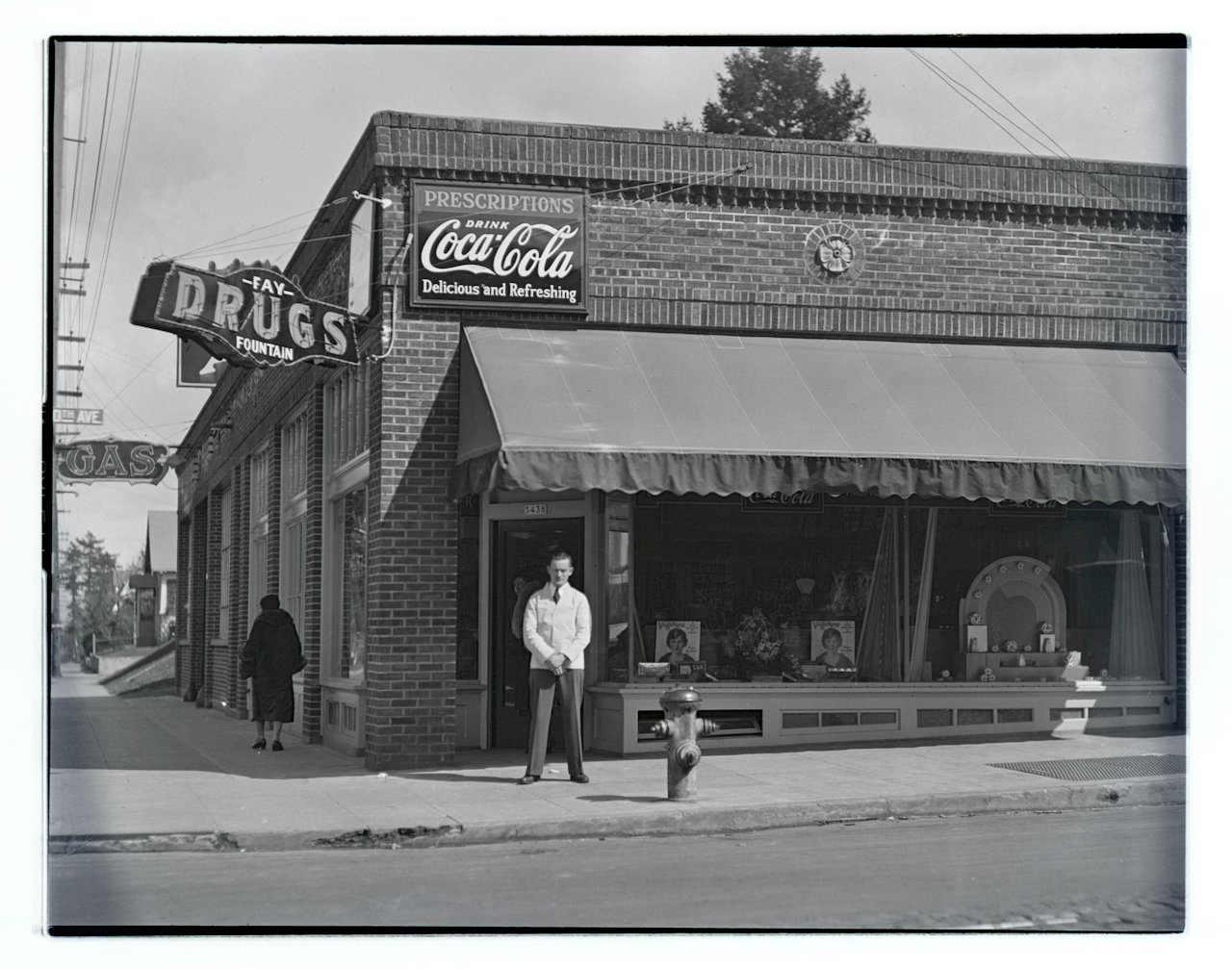
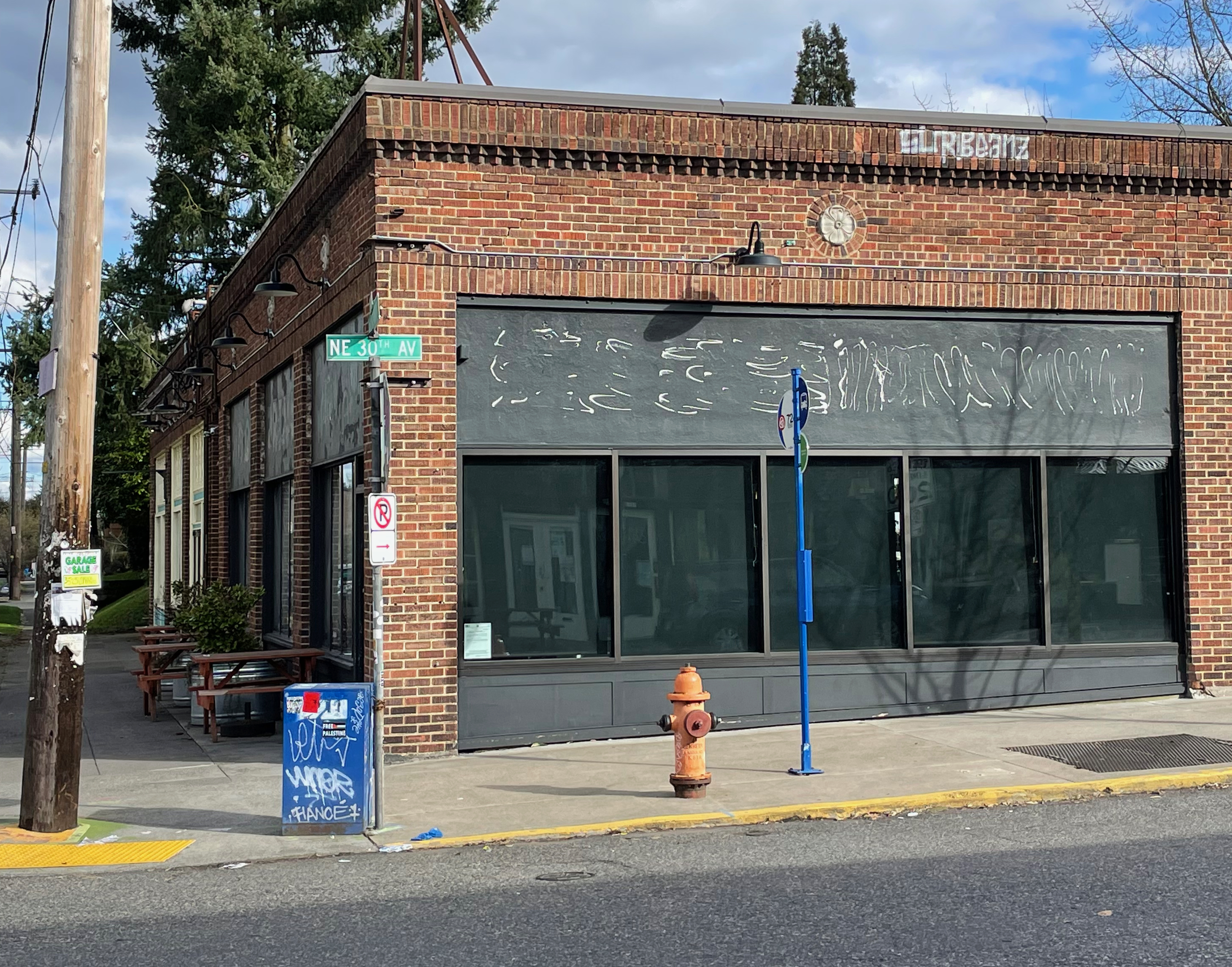
Photographs taken 91 years apart remind us about change and constancy at a busy corner in the neighborhood. Check it out:
Top: View looking east, Joseph Laurence Fay (1906-1951) poses in front of his business at the southeast corner of NE 30th and Killingsworth in 1933. Photo from the Oregon Journal Negative Collection at the Oregon Historical Society, Lot 1368; Box 372; 372A1209. Bottom: The same view in March 2024, when this storefront was in transition.
Built in 1927, this commercial block of storefronts has housed everything from Fay’s Drugs and Fountain–pictured here in a photo from the Oregon Journal in 1933–to the RCA Service Company, to the Portland Venetian Blind Company. In the 1950s it was home to neighborhood dentist Dr. Tinkle. More recently, it’s been a coffee shop and café, a bar and a game arcade.
This busy corner, known as Foxchase, is well worth exploring: several good restaurants, a great cocktail lounge, a new bakery and more. And the story of Foxchase is pretty fascinating too, be sure to check it out.
We’ve added two more builder biographies to our growing collection of Portland area home builders from the early 20th Century: A.C. Galbraith, a prolific builder of small bungalows, based in St. Johns; and W.H Dunn, a retired Canadian wheat-grower-turned-builder who started his building career late and operated in Irvington, Alameda and Laurelhurst.
Both were in early on the building boom of the 1920s. Both worked mostly from standard plan sets. Both built most of their houses on speculation, without a contract or particular client in mind on faith the house would sell. And both were crushed by the Great Depression, like so many builders.
Their trials and accomplishments add to our understanding of the times.
More builder profiles to follow (we love doing these) and appreciate the suggestions from readers. If you haven’t read the bio of Harry Phillips and the recent comments from his great-great granddaughter who found our profile of Harry, do check it out.
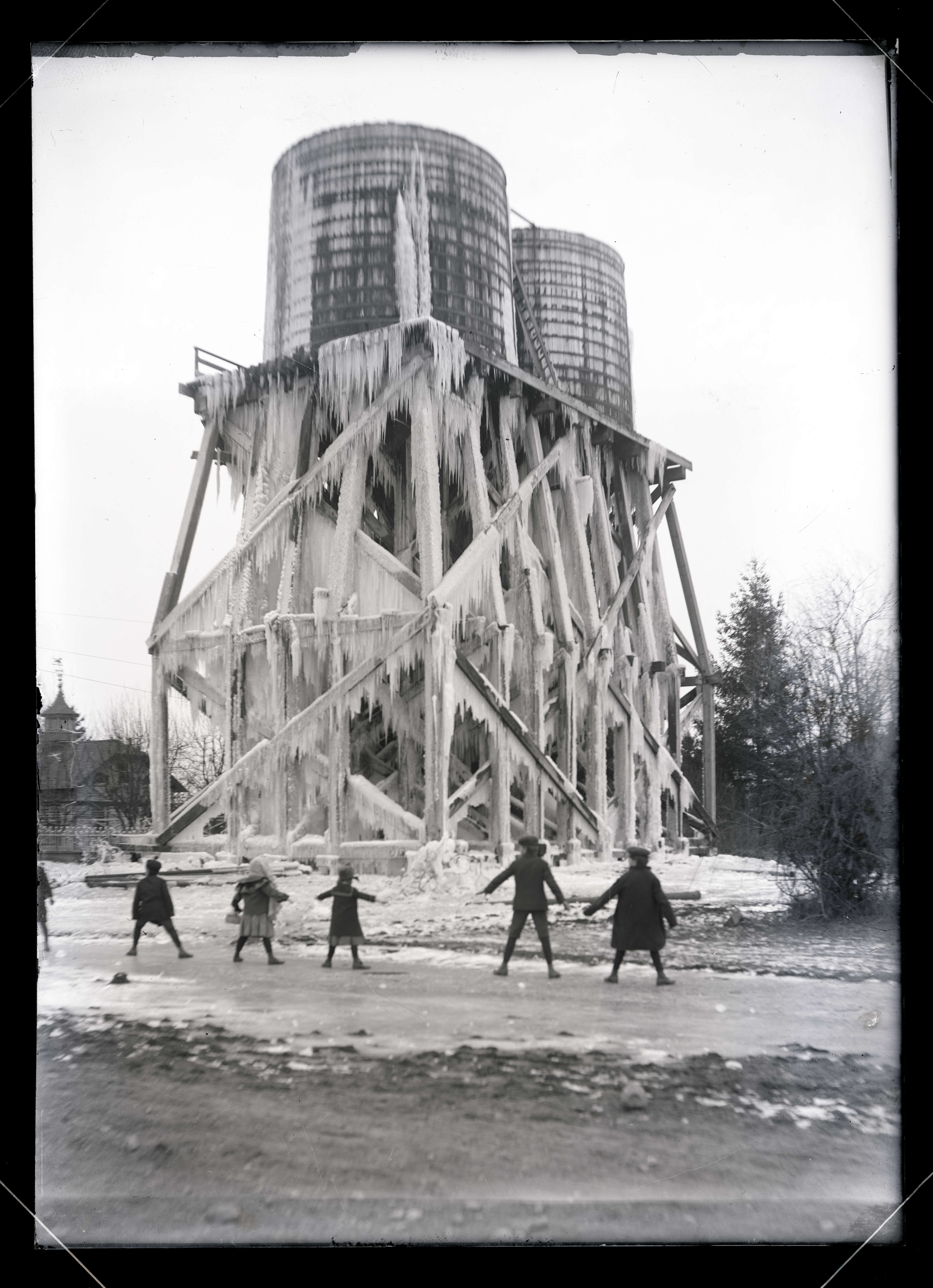
Sellwood Water Tower during the 1916 silver thaw event.Courtesy of Oregon Historical Society, image OrgLot151_PGE139-4
Due to the current ice storm, this evening’s scheduled program on the Oregon Home Builders has been rescheduled to the same time and place on Wednesday evening, January 31st. The free program is sponsored by the Alameda Neighborhood Association and RSVPs are required.
To reserve your spot, please e-mail the Alameda Neighborhood Association at alamedanewsletter@gmail.com. Doors open at 7:00 and the association will have light refreshments on hand.
In the midst of the current blizzard, we’ve been reminiscing about past winters and pieces we’ve written here over the last 17 years (can it really be 17 years?) that explore the timelessness of snow.
Deadman’s Hill, February 2021
There’s the piece that explores the story behind Deadman’s Hill, which will once again be alive with sledders reenacting more than a century of tradition.
There’s our Billy Collins poem-inspired History of Snow piece that looks back at a century of Portland winters and a few photos from the snowy neighborhood in 1936.
There’s the Oregon Historical Society treasure trove of ice storm photos from 1916, and an analysis of ice storms before 1916.
We’re in it now. But the daffodils are patiently waiting.
In collaboration with the Alameda Neighborhood Association, I’ll be presenting a program on the work of the Oregon Home Builders Co., Wednesday, January 17, 2024 from 7:30-9:00 p.m. at the Fremont United Methodist Church (2620 NE Fremont), and you’re invited (RSVPs required, see below).
The Oregon Home Builders company set out in 1912 to pursue its vision of homebuilding market domination by selling stock to investors and by building memorable homes for its customers. During five years between 1912-1917, the company built more than 125 homes, including many in Alameda, several of which are listed today in the National Register of Historic Places.
The company was unique among homebuilders of the era because it catered to both ends of the economic spectrum: large, charismatic custom-designed homes for the wealthy, and simple, affordable thoughtfully-designed bungalows for those just entering the housing market. Join me for an inside look at the intriguing rise and fall of the company and the legacy of its homes today.
To reserve your spot for the January 17, 2024 program, please e-mail the Alameda Neighborhood Association at alamedanewsletter@gmail.com. Reservation deadline is January 10th. Doors open at 7:00 and the association will have light refreshments on hand.
The Alameda Neighborhood Association is a neighbor-led board that advocates for smart policies, takes action on neighbors’ concerns, facilitates communication about neighborhood issues, hosts events to bring residents together and publishes the quarterly newsletter AlamedaPDX.
In the spirit of all the year-end reviews and lists floating around at the bottom of the year, we thought it might be interesting to look back to 1923 for a little perspective.
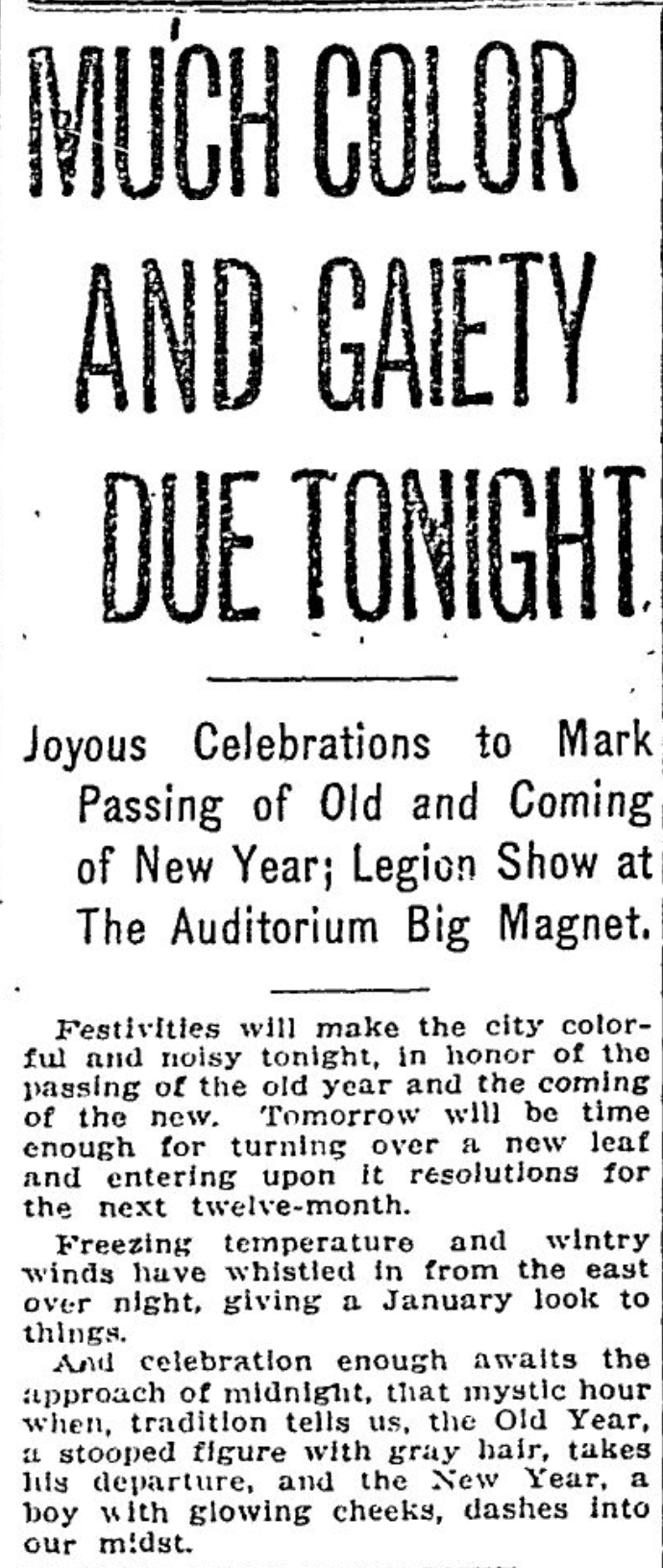
100 years ago tonight, Portland was in the jaws of a cold snap with temperatures in the teens accompanied by a dusting of snow. The front page of our evening paper—the Oregon Journal—previewed celebrations on tap in local theaters, cabarets and dance halls and included stories about plans for bridges over the Willamette River at Ross Island and on Burnside.
From the Oregon Journal, December 31, 1923
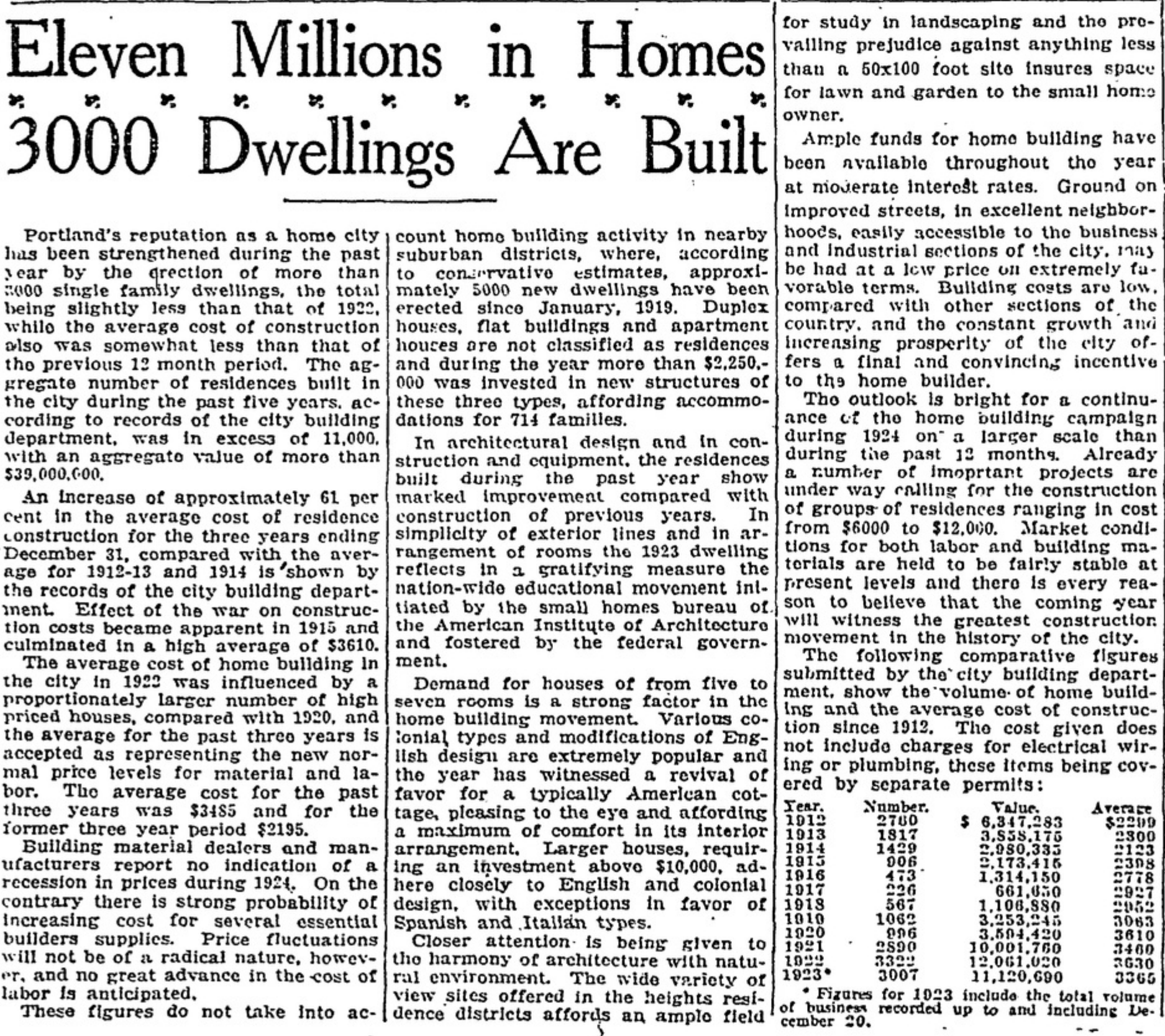
Elsewhere in the newspaper 100 years ago tonight—and on our favorite topic of historic homebuilding—is a review of the very busy building business in Portland for 1923. 3,000 single family dwellings built at a value of $11 million. Have a look at the numbers that go back to 1912, a barometer of economic conditions in Portland that track with the trends we’ve found in our building permit review. Interesting discussion of architectural styles too:
From the Oregon Journal, December 31, 1923
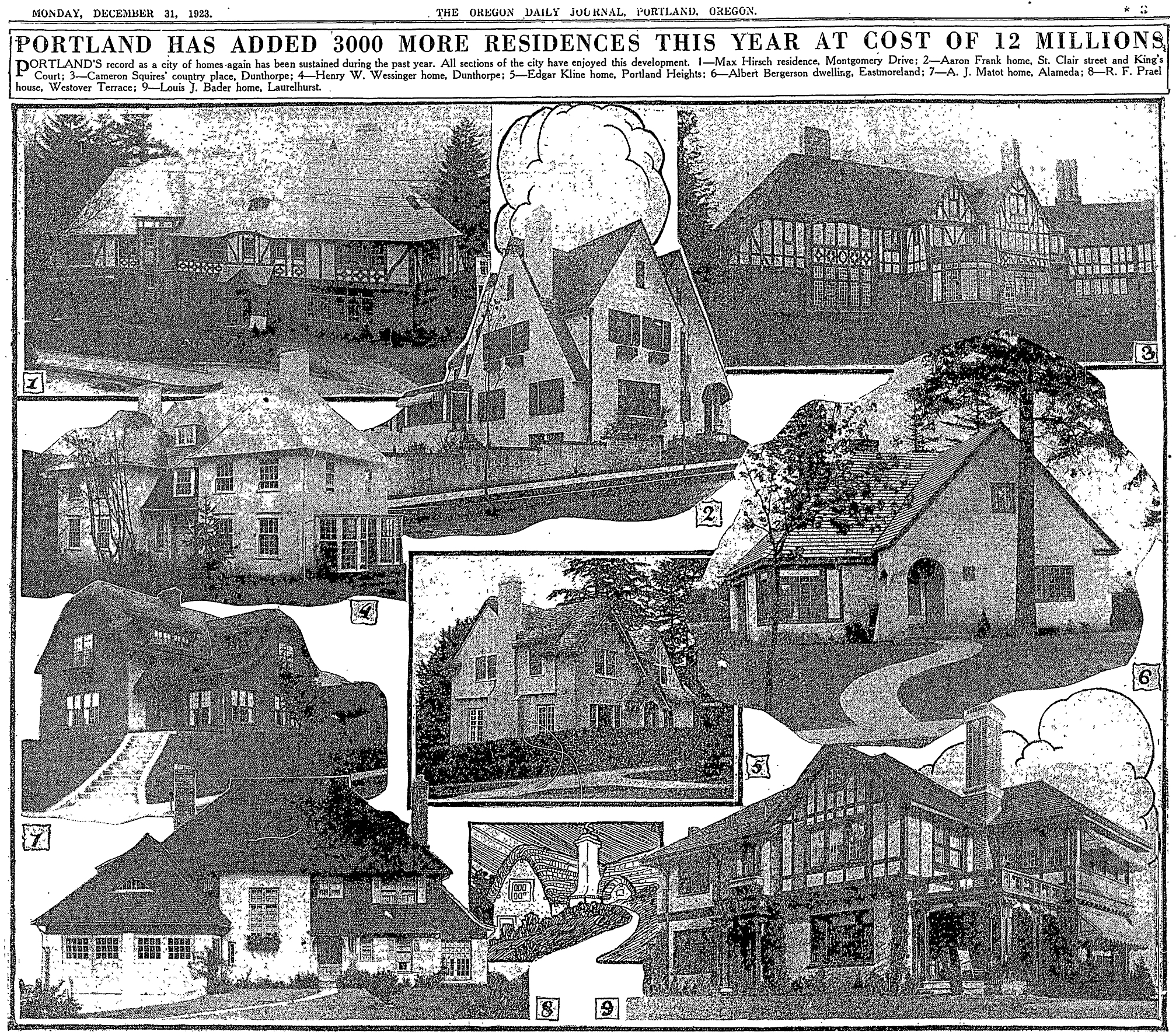
Appearing with this story is a homebuilder’s greatest hits photo montage from 1923. Click in for a closer look:
Two new profiles to add to The Builders collection, both Swedish immigrants, one who had a brother in the business that we have already profiled, though they chose to spell their last names differently.
Stockholm Harbor, summer 2023
Herman Nelson, who immigrated through Canada in his early 20s a few years ahead of his younger brother builder Emil Nilson; and August Malmquist, or as he is more frequently referred to on building permits as A.C. Malmquist. Learning more about the third Nelson/Nilson brother, Oscar, is still on our to-do list.
Included in all of these profiles is a list of homes built by these builders, so by all means check to see if your address is here.
These three Swedish carpenters built hundreds of houses in Northeast Portland neighborhoods, and operated mostly as Mom-and-Pop businesses, with spouses’ names occasionally showing up on real estate transactions. Their business was building houses, but they were family people too, and were active members in the Swedish community in Oregon.
We are reminded about the contributions made by so many immigrants to the shaping of these neighborhoods, and about the racial restrictions and systems that have kept others away.
Like a mosaic of fine old tiles, hundreds of subdivision plats rest atop Portland’s neighborhood landscape, creating a base-layer of orderly streets and lots beneath the places we know today. Drawn up over the last 140 years by different developers, each plat has a name: some are catchy, some are descriptive, a few remain in common use to describe the places we know. Most have been lost to time, like George Place.
We’ve written about most of the underlying Alameda plats here and for a series of recent stories in the Alameda Newsletter: Gleneyrie, Olmsted Park, Homedale, the Pearson Addition, Waynewood (which was remade from the labyrinth created by six of the original plats), not to mention the nearby Kennedy Addition, the distinction between plats and neighborhood boundaries, and many other plats on both sides of the Willamette. There’s even a plats category here on the blog if you are inclined to a deeper dive.
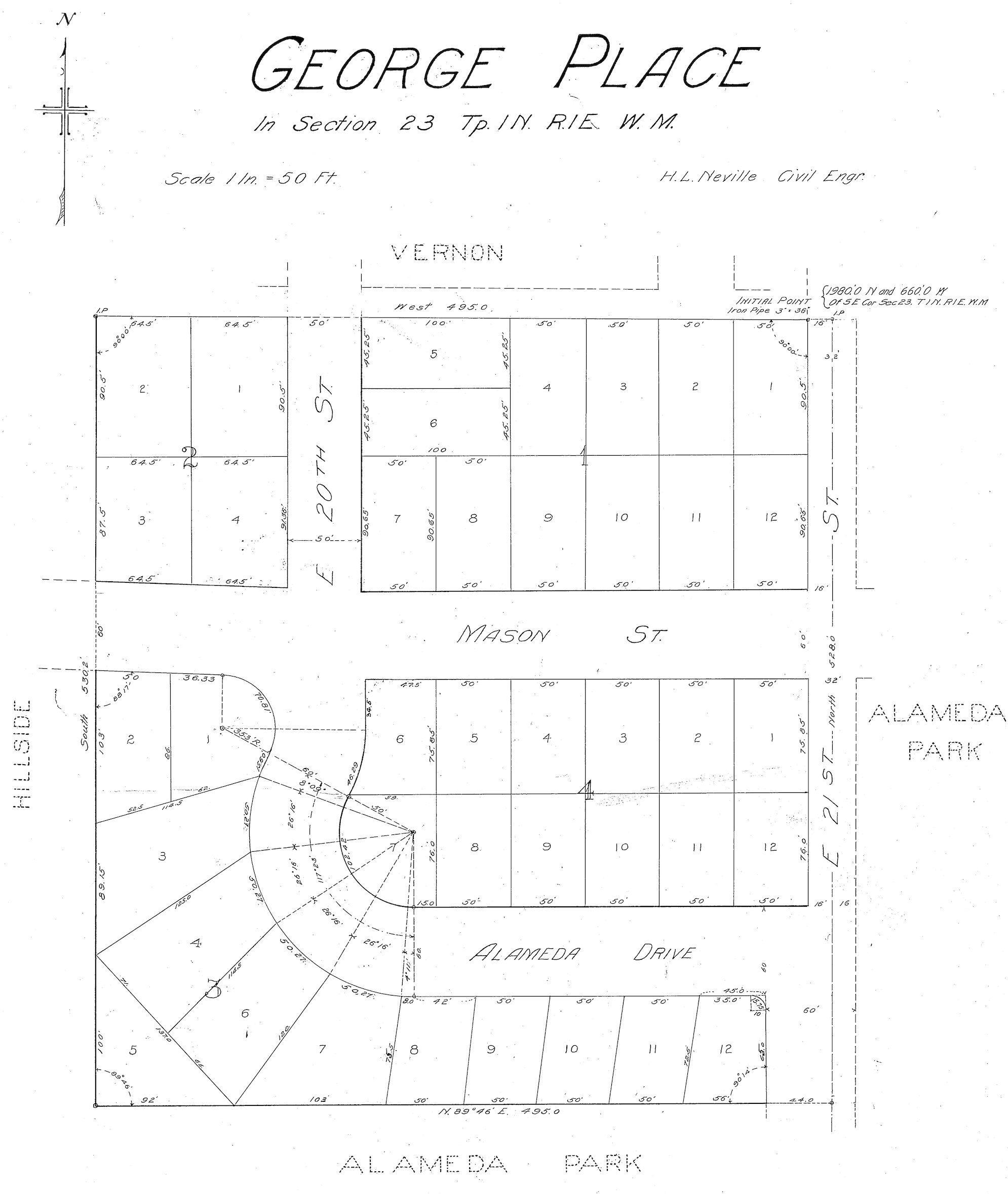
In this parade of plats, we should make sure one of the smallest ones doesn’t get away: George Place, a tidy square of 40 lots where grid meets slope at the far southwest edge of the Alameda Plateau. Take a look:
Namesakes Judge Melvin Clark George and Mary Eckler George traversed the Oregon Trail with their families as children and grew up on homesteads in the upper Willamette Valley. They married in 1873 and Melvin was soon elected to the Oregon State Senate (1876-1880), and then to Congress in 1881, where he served two terms before returning to Oregon to teach medical law at Willamette University (1885-1889). He served as Multnomah County Circuit Judge (1897-1907) and retired from the bench at age 58 to become director of public schools in Portland.
Melvin George, circa 1900
Sometime around the turn of the 20th Century, seeing development potential on the horizon (literally), the Georges purchased six acres atop the ridge. They filed the George Place plat with the Multnomah County Surveyor on April 25, 1911, two years after the Alameda Land Company platted the Alameda Park Addition which anchored their eastern flank.
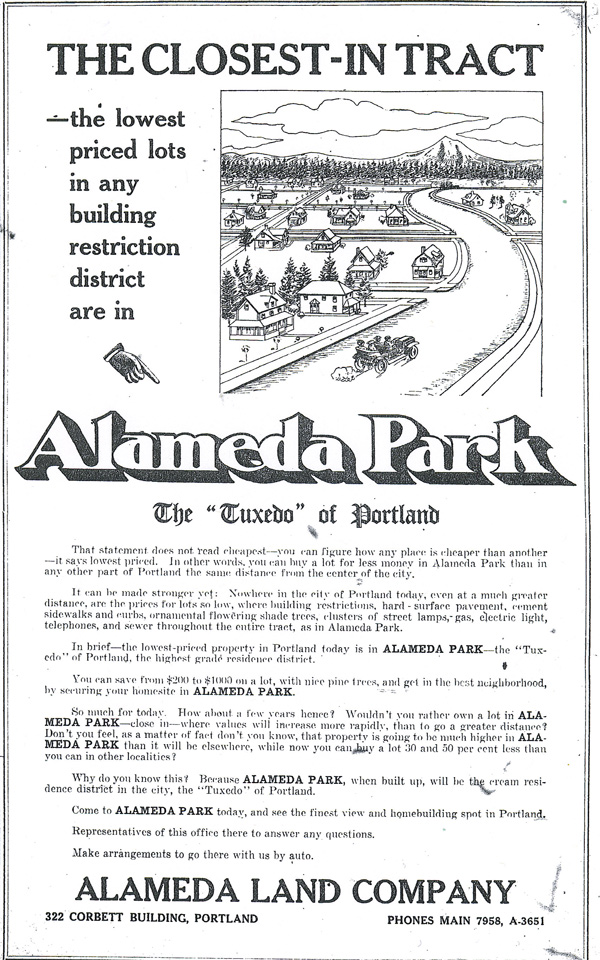
At the time, the Alameda Land Company was blitzing The Oregonian and the Oregon Journal with advertisements stirring excitement for the much larger Alameda Park Addition. Agreements were evidently made and Alameda Land Company took over marketing the property, dedicating one full advertising panel to the topic in June 1910.
From The Oregonian, June 4, 1910
Of course in 1910, all of these places were still purely imaginary: the plats may have been filed or on the drawing board, but streets were just being carved out of the gravel, trees felled, stumps removed. In 1910, it was still a giant brush patch, with orchards and dairies down on the flats below.
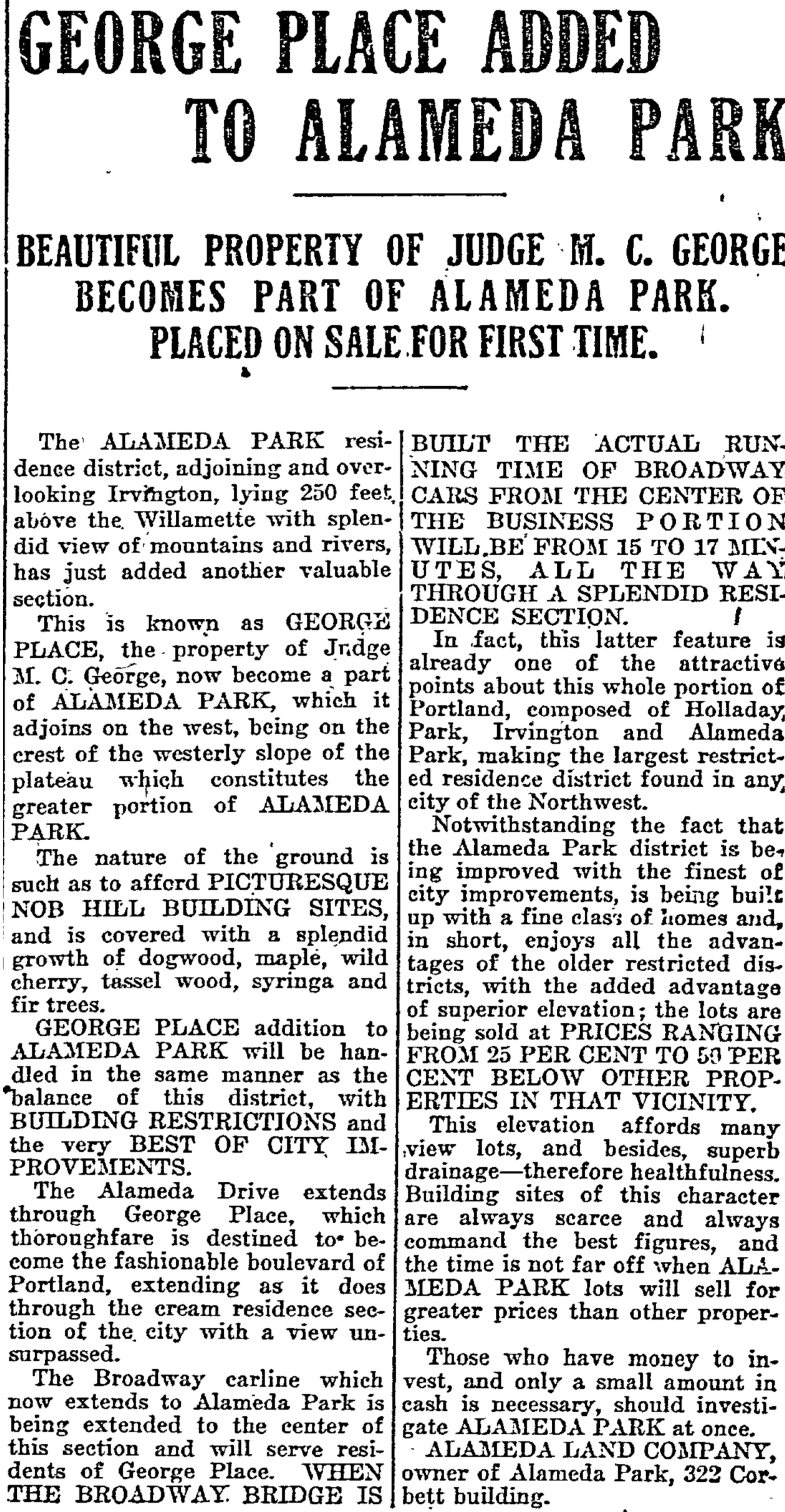
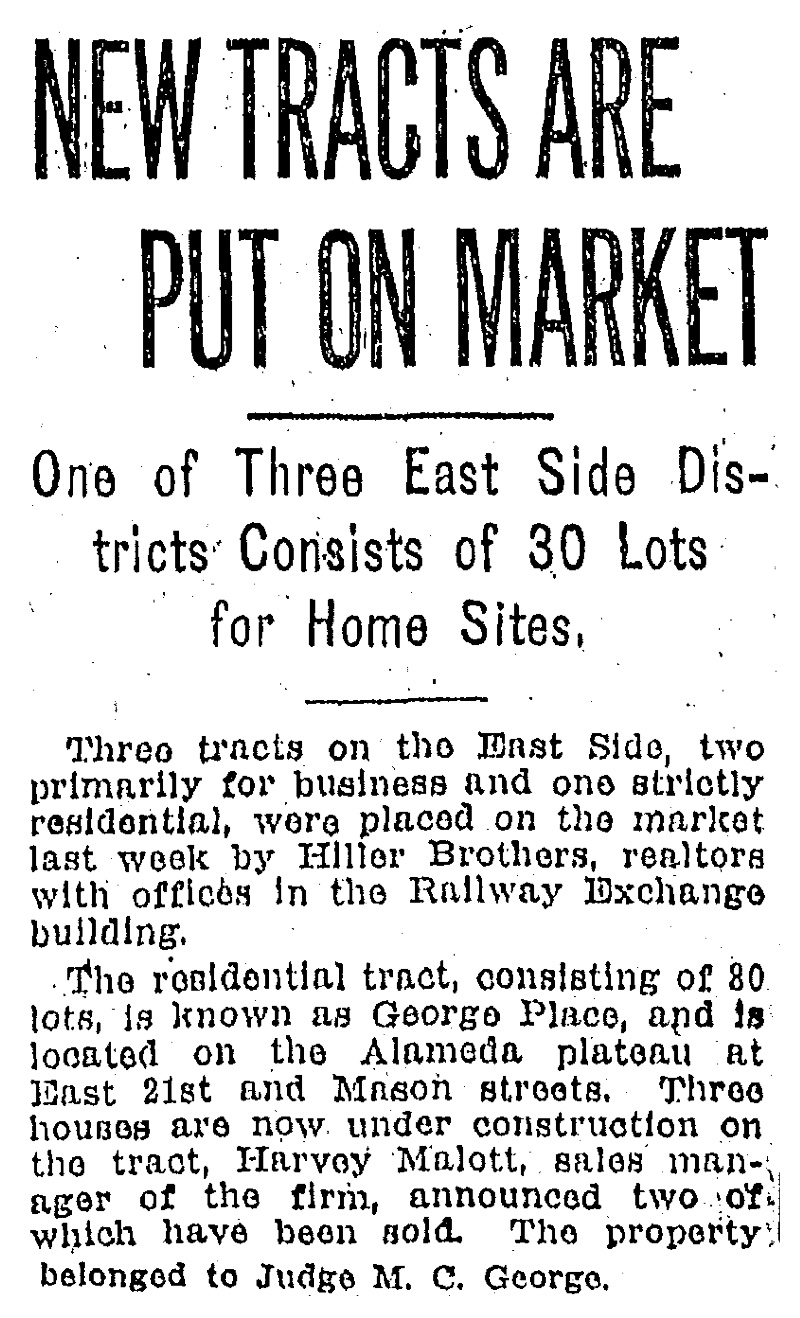
Lot sales and homebuilding were slow to catch on in George Place during these first years. Streets and infrastructure were in place by the mid-teens, but Portland’s economy began to cool in the run up to World War I. A few lots did sell, but the George Place six acres remained mostly unbuilt until the early 1920s, when a new real estate and homebuilding company known as the Hiller Brothers Company bought the lots and started building into a fast improving real estate market. By the way, this is one of the things we love about paying enough attention to a particular place: pretty soon everything you bump into starts to connect (see our profile of Hiller Brothers on The Builders page).
From The Oregonian, March 28, 1926. Not sure where the reporter got 80 lots, you can count the 40 lots in four blocks on the plat above.
In 1926, the streets were still gravel, but three houses were under construction including the one with the best view, for company owners James and Sarah Hiller at 2024 NE Alameda Drive. Hiller Brothers built many of the homes here, using plans provided by architect Hubert A. Williams. English cottage style was clearly the most popular. The Great Depression paused homebuilding activity leaving multiple vacant lots in George Place that finally filled in during the 1940s and early 1950s.
As for the Georges, they raised their family in a comfortable house up the hill on Market Street in southwest Portland’s Goose Hollow, with no evidence in newspaper coverage they ever lived on or paid much attention to George Place on Alameda Ridge. Melvin died at age 83 on February 22, 1933. Mary lived on to age 91 and died on September 24, 1942. They are buried together in Lone Fir Cemetery.
There’s been a spike of recent interest here on the blog about original construction dates and early builders, which is great. Every house has an origin story all its own and they’re always interesting. I’m currently working on profiles of several more builders to join the 25 already in The Builders section, and I’ve appreciated the suggestions from readers about who to focus on next.
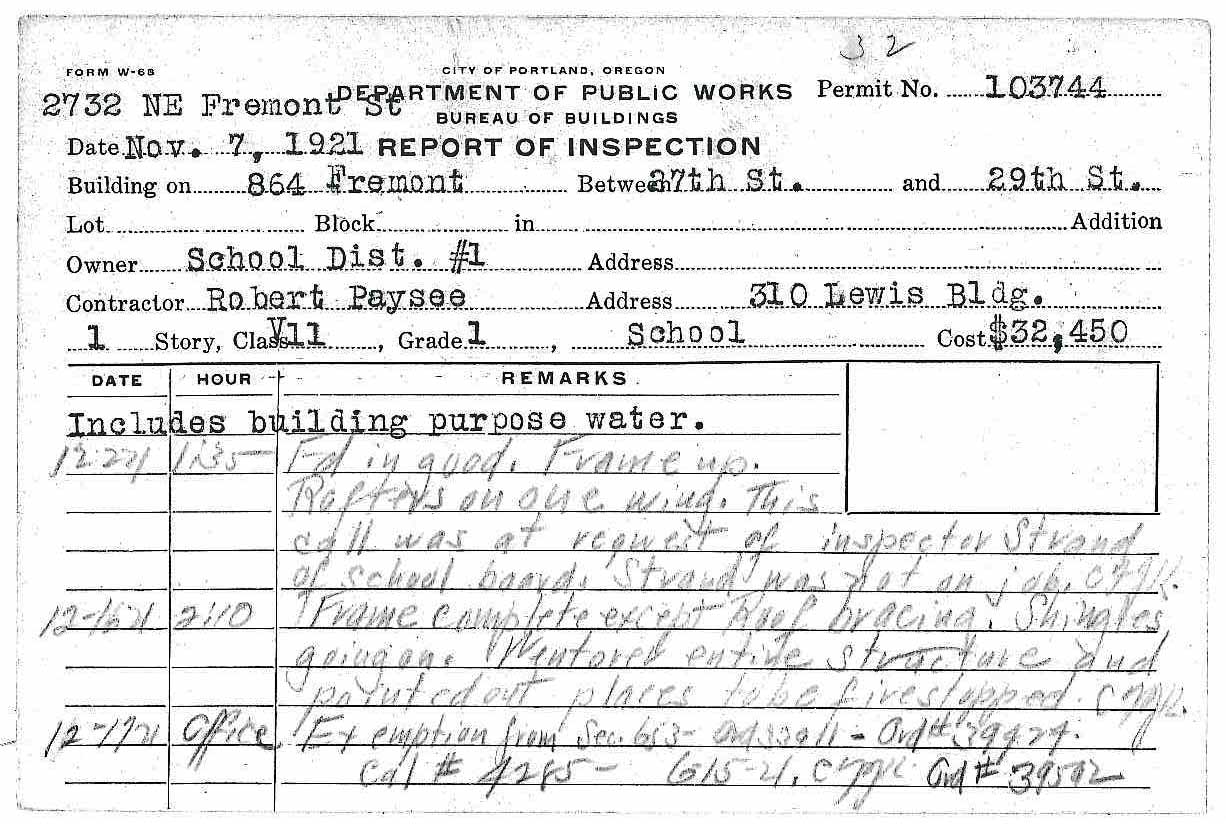
Thinking about these things, I am reminded about the study of building inspection cards I did a few years back which really helped me understand geographic patterns of growth, Portland’s early waves of expansion and recession, and a very busy group of early homebuilders.
Construction inspection card from 1921 for Alameda School.
On many evenings over two years in the mid-2000s, I was granted research access behind the counter at the Bureau of Development Services to examine construction inspection cards. Slowly and carefully, I handled every inspection card in the Alameda Park addition and noted details into a growing record. While my scope of interest is much wider than just Alameda, it’s hard to boil the ocean so I had to define the boundaries of the search. The thought of recording details from every eastside inspection card (by hand) is overwhelming.
Back in 2010, I posted a summary of that research here on the blog. Because AH is up to about 300 posts since 2007, it’s possible current readers haven’t seen it. I realize that’s an ongoing challenge, by the way, of wayfinding through the content here (try using the categories feature, with drag-down menus which you can find on the far right edge of the blog).
Our recent post on the prolific Portland homebuilders known as Hiller Brothers Inc. grew out of our research on one of their classic bungalows on NE Knott Street. In the post, we mentioned several family resemblances among these homes: windows, built-ins, doors, hardware.
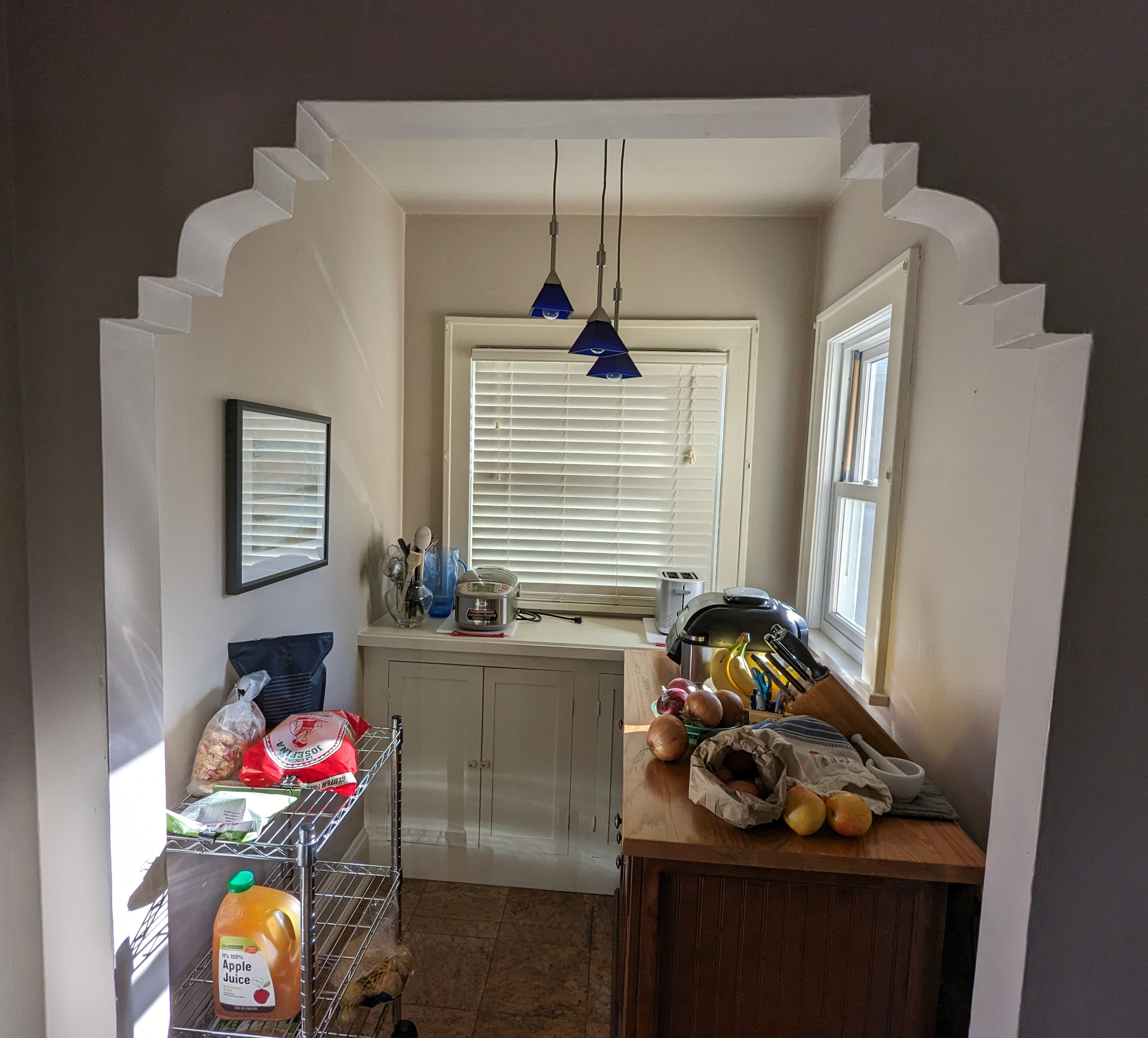
As it turns out there’s another distinctive feature that came to light as neighbors began talking with neighbors. It’s an archway that looks like this:
That distinctive coved shape defining the room is called a cavetto, or quarter-circle, joined to a couple of 90-degree steps top and bottom to create a decorative entry feature that reveals this cozy space–once a breakfast nook–located just off the kitchen. In at least a couple of the Hiller homes we know of, the distinctive cavetto cove is still there and the small space has been converted into a pantry-like area that offers a worktop as well. In some homes, the nook has likely already been annexed into kitchen extensions. Some homeowners might be eyeing that nook and arch right now mulling over remodeling plans.
It would be interesting to hear from others on the Hiller Brothers address list if this cavetto cove and nook feature look familiar. We bet there are more than few still out there.
Which leads to the topic of nooks (more formally inglenooks), a worthy eventual blog post.
Do you have a favorite nook space that operates near the heartbeat of the house? We do, in our 1912 Arts and Crafts bungalow, but it’s a design generation earlier than the Hillers and their hard working architect Hubert A. Williams.











 Alameda Old House History