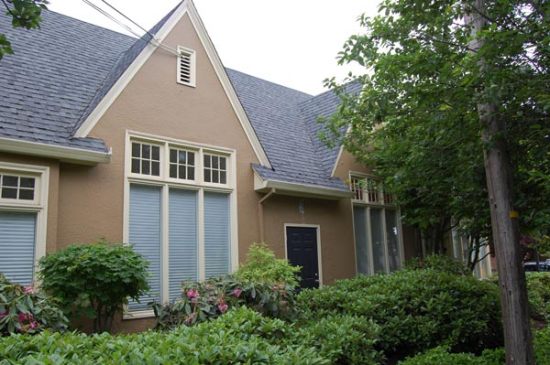
Alameda’s Commercial Corner | 24th and Fremont

Looking southwest at the corner of NE 24th and Fremont, early 1920s. Note delivery bike visible behind power pole. OrHi 49061.

There was a time when the building we know today as the home of Lucca and Garden Fever—at the southwest corner of 24th and Fremont—looked after most of the neighborhood’s needs for grocery and personal goods. Alameda Pharmacy, Alameda Grocery, John Rumpakis’s Alameda Shoe Repair, even the dentist’s office, upstairs above the pharmacy, were neighborhood landmarks that everyone knew, shopped in, and pretty much took for granted (except the ice cream sodas at the pharmacy which were supposed to be legendary). The pharmacy and grocery even provided a delivery-by-bicycle option for homemakers who needed a few small items, but couldn’t get out of the house. It was a win-win situation for Alameda and for the local family-owned business during those early years.

To be sure, some shopping needs were taken care of away from the neighborhood. Even then, there were smaller markets or “convenience” style stores of the day located within walking distance (see this post on the Davis Dairy Store, one such locally-owned convenience market). Built in 1922 during the peak of neighborhood construction, the Alameda Grocery commercial building at 24th and Fremont quite literally had a corner on the market.

That is, until the mid 1930s, when a fully-built-out neighborhood with a growing population, combined with a slowly recovering economy and new trends in shopping, opened up new opportunities for big business which began to shape the corner.

Enter the Safeway Corporation: a publicly-traded rampant success story, with headquarters in Oakland, California and more than 3,200 chain stores nationwide. The company’s penetration of local grocery markets was so complete that by 1935, many states around the country were passing legislation—urged by local merchants who were getting slammed by Safeway chain stores—that taxed the huge company’s local operations to discourage competition.

But not in Portland. By 1937, Safeway had 54 stores here, including 46 stores located in eastside neighborhoods, and even one on the doorstep of Alameda at the southwest corner of NE 24th and Broadway (today it’s Brake Team, an auto service garage) built in 1936. Most of these stores were modest in size, and not like the sprawling stores we know today. Undoubtedly, the local Safeway on Broadway cut into the market share of Alameda Grocery. But nothing like what happened starting in 1938.
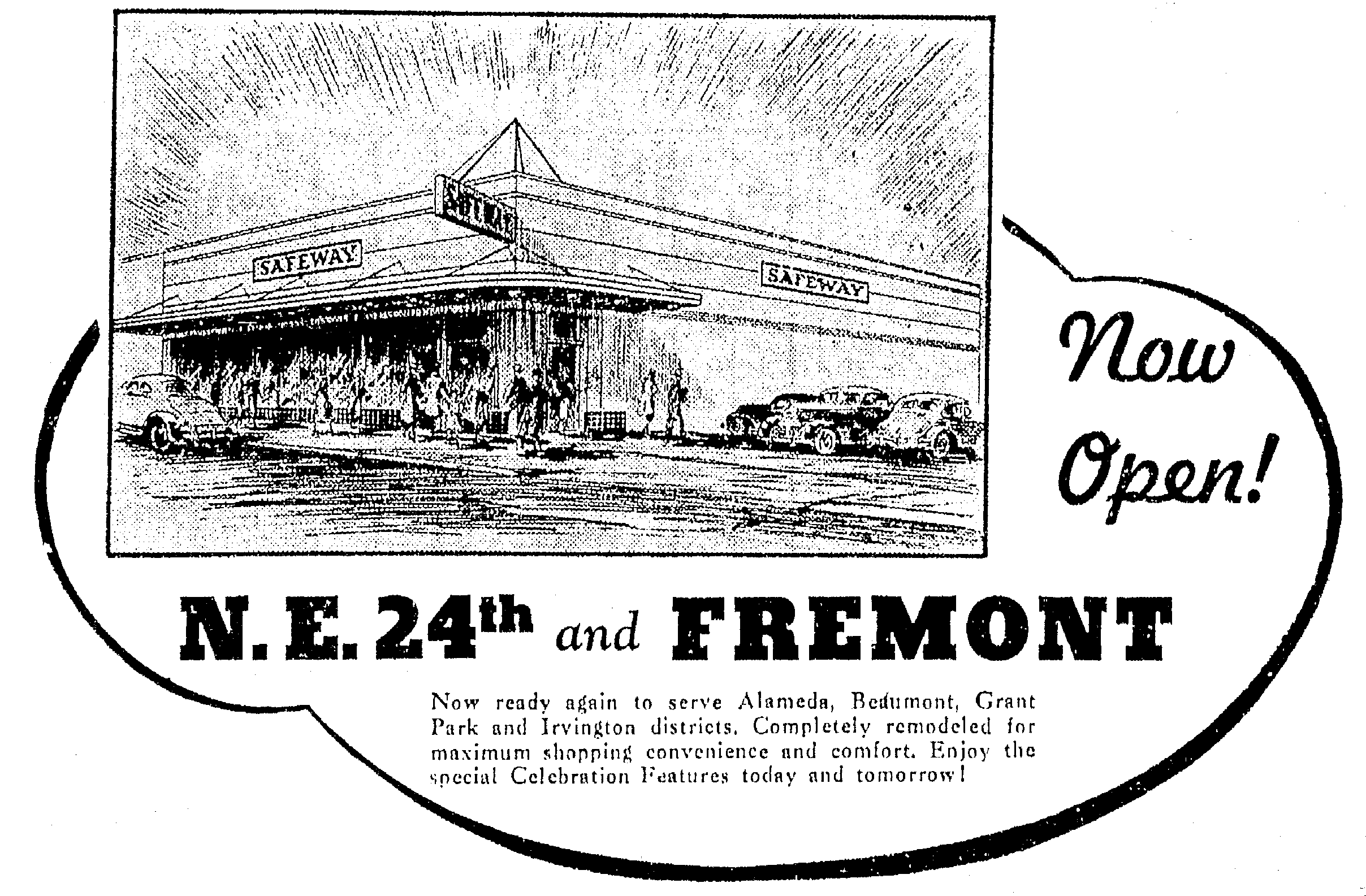
Click on the image for a larger view. This ad is from The Oregonian on September 13, 1940 announcing a remodel and reopening of the Alameda Safeway.

On July 16, 1938, Safeway opened a store in the building we know today as the home of Alameda Dental and Frontier Bank on the southeast corner of the intersection. The property had been leased from the Albers Brothers Milling Company, who incidentally also owned the Alameda grocery and pharmacy building across the street. Retail activity in the single-storey 50-by-100 foot concrete Safeway building began to take a big bite out of Alameda Grocery’s market share.

By 1940, Safeway expanded and remodeled, while Alameda Grocery across the street struggled to hold on. About that time, Safeway made plans to expand beyond the footprint of the existing store to take in the entire north end of the block. But as The Oregonian reported on March 20, 1942, the Portland City Council narrowly defeated a zoning change that would have allowed this major expansion. Despite voicing concerns about home values in the neighborhood, Mayor Earl Riley voted to expand the commercial zoning to permit the Safeway expansion:
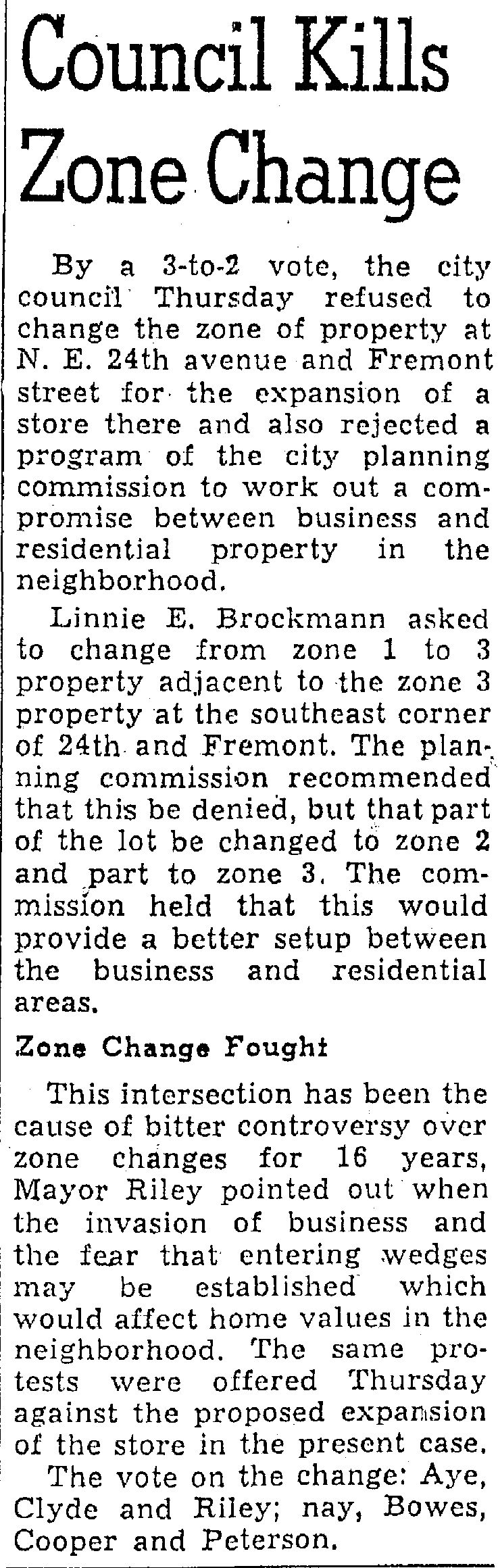
From The Oregonian, March 20, 1942.

Safeway’s expansion into residential neighborhoods was not a phenomenon isolated to Alameda. Blog reader and longtime Grant Park resident John Hamnett writes that in nearby Grant Park, local residents fought a pitched battle with the City of Portland regarding a plan to build a Safeway adjacent to the Grant Park Grocery, a similar locally-owned market at the southwest corner of NE 33rd and Knott. The vision for that zone change took in all of the southwest corner, and further considered zoning the entire intersection commercial at all four corners. In May 1942, City Council voted 4-1 to allow the Safeway development. Incredulous neighbors protested time and again concerned about their property values, but the City would not relent. Finally, in March 1943, neighbors filed suit against the city for allowing the zone change, and won in a clear decision handed down by Circuit Judge Walter L. Tooze.

Back at NE 24th and Fremont, two gas stations were added on the northwest and northeast corners—the true portal of the Alameda Park subdivision (today site of a parking lot, and Perry’s on Fremont). Generational and ownership changes were remaking the anchor businesses on the south side of the street as well. Eventually, as Safeway’s business model changed (fewer, larger stores instead of the 50-foot by 100-foot businesses sprinkled all over Portland), the former Safeway store went back to being a family-owned business, loved and known by a generation of Alamedans as Brandel’s. Nature’s Fresh Northwest (or simply “Natures”) eventually took over the Alameda Grocery building. And today, after a string of unsuccessful restaurant tenants, Lucca seems to have hit its stride.

Check out this story from The Oregonian on January 17, 1984, which is a snapshot as the corner transitioned from some difficult times in the 1970s to the place we know today:
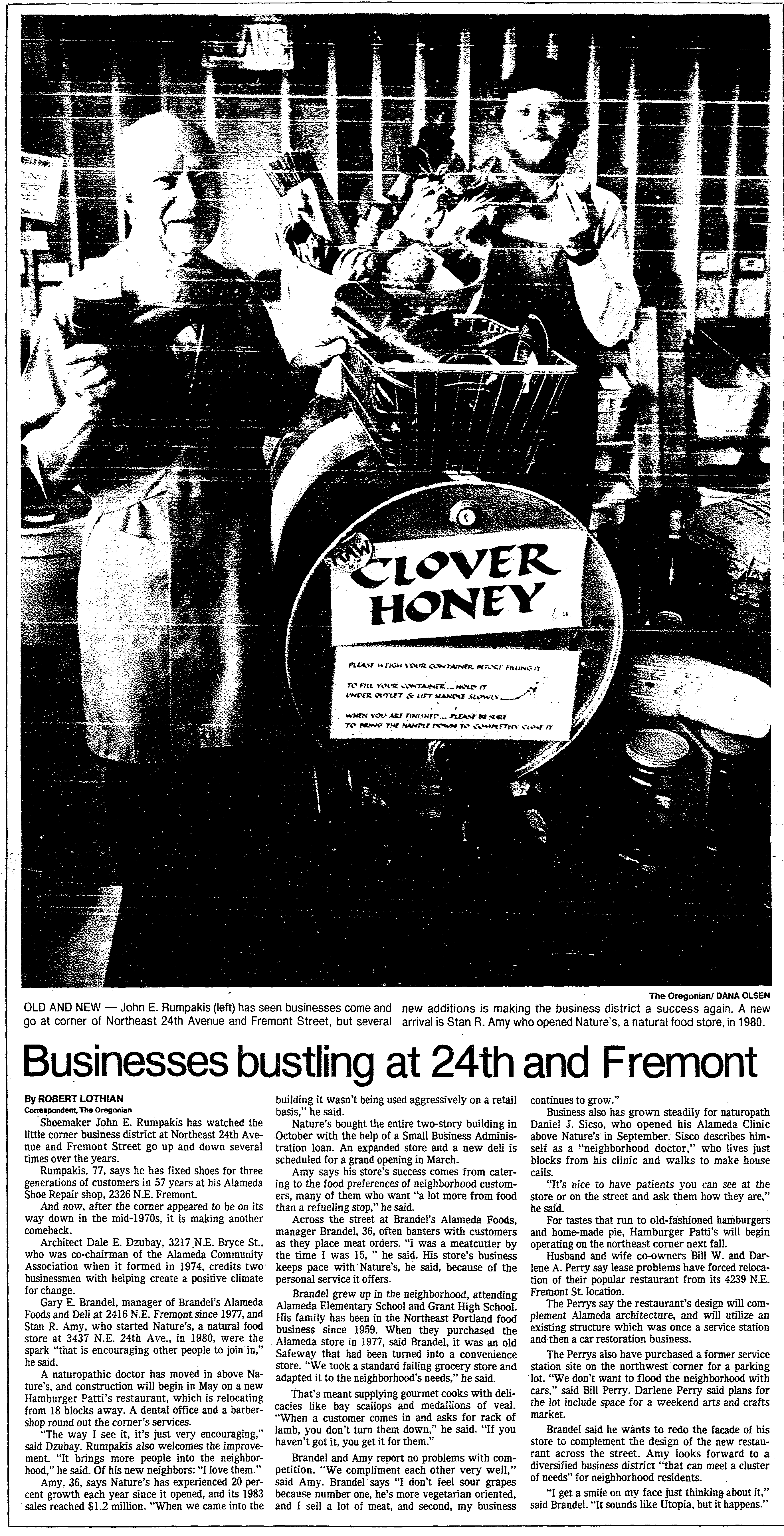
From The Oregonian, January 17, 1984. Click on the image for a larger view.

We still miss Brandel’s and the ease of slipping into that old Safeway building for a gallon of milk on the way home. But every time we pass through that intersection, we pause for a moment to think about how our neighborhood geography could have turned out quite differently.

Davis Dairy Store Remembered

From time to time we like to plumb the depths of memory for stories about neighborhood businesses. This one is reaching a ways back, but we’re looking for a little help with any personal memories about this store, which operated out of the bustling commercial corner of NE 30th and Killingsworth.

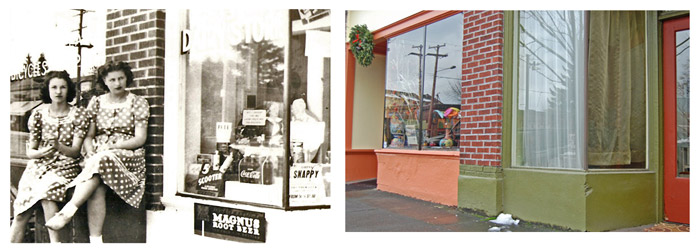
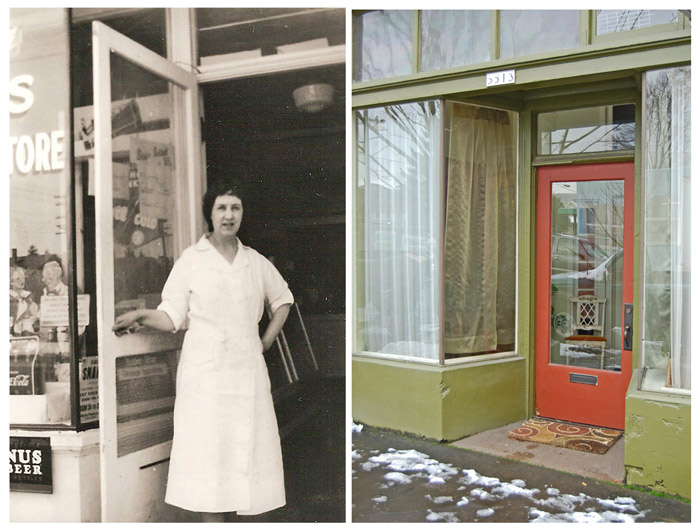
The Davis Dairy Store, located at 5513 NE 30th, was operated by three generations of women from the Davis family, who also built and lived in the home at 2427 NE Dunckley here in the Alameda Park addition. A recent visitor to the blog—Teresa Roth—sent us some shards of memory from her mother Lucille, and some photographs to ponder. Here is Lucille’s mother Irene Davis, the matriarch of the store, standing near the open door in 1938, and the same spot today:

Left, Irene Davis at the Davis Dairy Store, 5513 NE 30th Ave., 1938. Right, the same doorway today. Historic photo courtesy of the Davis Family and Teresa Roth.


Irene’s daughter Lucille (far left) and cousin Isabel Buckendorf sitting out front in 1938. Note the words “bicycle shop” on the window behind them to the left, and the reflection of the power pole, which hasn’t moved much in 70 years. Historic photo courtesy of the Davis Family and Teresa Roth.

Irene and her husband Ernest built the Dunckley home and likely the business as well, though he was a machinist and she a stenographic secretary. The couple divorced in the mid 1920s. For as long as the couple’s daughter Lucille can remember, the store was just part of the family. Lucille, now in her mid 80s, and her daughter Teresa stroll through the neighborhood from time to time when they are in town together, remembering friends, cousins and happy moments.

After the divorce in the mid 1920s, Irene ran the store, with Lucille’s help during the summer, and likely with the help of her sister Mae, a piano teacher. Irene and Mae’s mother Martha LeFabre lived with them as well in the Dunckley Street house: three generations running the house and the business.

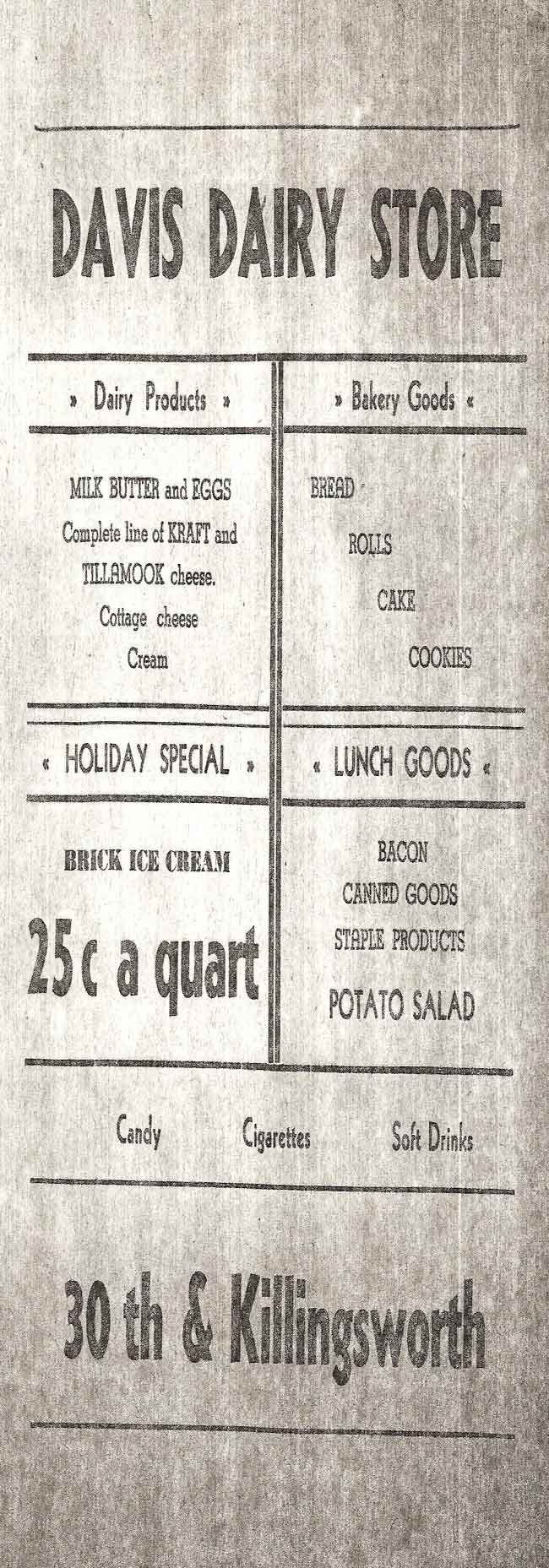
No one around today remembers exactly when the store opened or closed, but we do know it would have been popular with kids. Here’s an advertisement from 1938.

Flyer from Davis Dairy Store, 1938. Courtesy of the Davis Family and Teresa Roth.

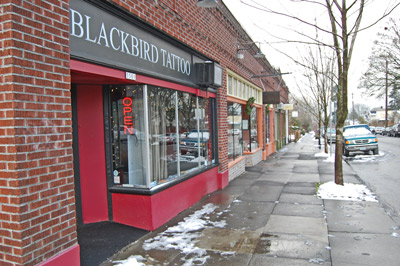
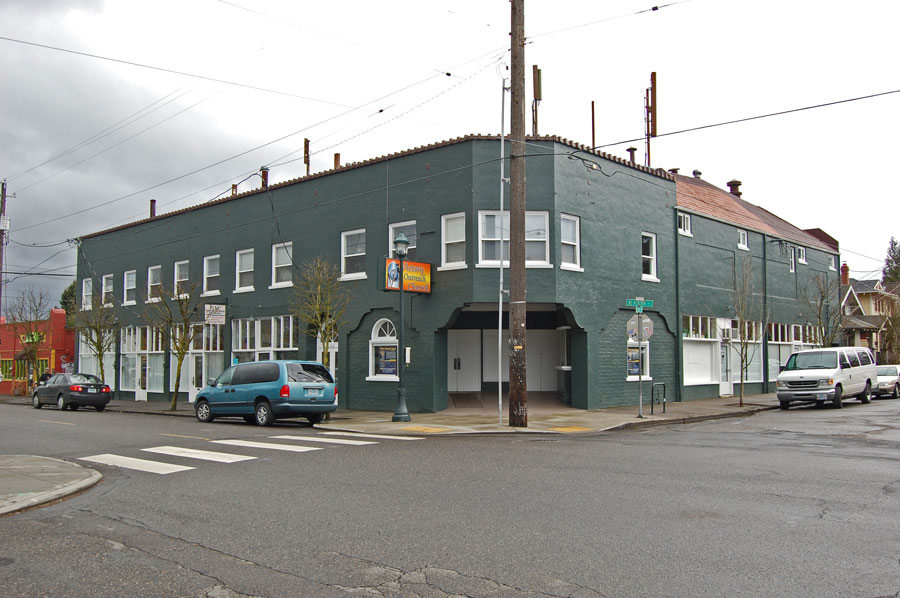
The corner of NE 30th and Killingsworth has experienced a recent renaissance that echoes the vitality of the intersection in the 1920s and 1930s. Today, the area is officially known as the Concordia Neighborhood, though in those days it was known to both residents and customers as Irvington Park and many refer to it by its plat name: Foxchase. Just for context, here’s a shot of the overall commercial building today, which features some very tasty restaurants, including DOC, which we recommend.

Any memories to share about the Davis Dairy Store or this bright and busy neighborhood corner?

According to the 1938 Polk City Directory, joining the Davis Dairy Store at 30th and Killingsworth were the following businesses:

5425 NE 30th             Serafino Boitano Shoe Repair

5425 NE 30th             Parrot Cleaners

5430 NE 30th              Jason Frost Grocer | Theo Larson Meats

5433 NE 30th             Anderson’s Food Market

5438 NE 30th              30th Avenue Pharmacy and Post Office

5501 NE 30th             The Ark Beer Parlor

5507 NE 30th             Irvington Park Variety Store (now Blackbird Tatoo)

5509 NE 30th             30th Avenue Bicycle and Hardware

5515-19 NE 30th        Twin Pines Barber and Beauty Shop

Alameda Theater Memories

A few months back, we came upon a photograph, taken on May 6, 1926, showing the nearly completed Alameda Theater, located at NE 30th and Alberta. Have a good look at it and soak up the details, and then look at an image from today. 


Alameda Theater, NE 30th and Alberta. Photo taken in May 1926. Note construction materials to the left. View looking southeast.

Alameda Theater, NE 30th and Alberta. Photo taken in May 1926. Note construction materials to the left. View looking southeast.

The same view today.

The same view today.

Remarkably, most of the original exterior is still intact. The corner entry and box office; the two prominent display cases that frame the opening; the ornamental trim along the building’s parapet; the box office just inside the entry portico; the spider web window and Georgian doorway just left of the theater entry which opens into a steep stairwell to the second floor; even the store fronts to the left of the main entry (the transom windows are still operational).

You can’t see it in the earlier photo, but the original Mediterranean style roof tiles are still in place. The marquee was removed some years back, but a 1926 time traveler would definitely recognize the building today, at least on the outside (they might ask about all those antennas on the roof). On a recent visit, the building was locked so we didn’t have a chance to look around inside.

The observant reader will also note the streetcar tracks making a sweeping left turn from Northeast 30th to Alberta Street eastbound…the Alberta Line, which operated from 1903 to 1949.

Here’s a snapshot of its history:

From 1927-1937, it operated as the Alameda Theater (even though it is a few blocks north of the Alameda Park subdivision proper).

From 1937-1964 it was simply known as the 30th Avenue Cinema.

From 1964-1969 it went by the catchy name of “Cine 30.”

From 1969 until it closed for good as a theater in 1978, it went back to its earlier name: Alameda Theater.

Since 1978, the building has served as the home of the Macedonia Church of God, and its current role as home to the Victory Outreach Church.

Along the way, trips to the movies entertained generations of our neighbors, and provided some enduring memories, particularly for a couple of brothers who grew up here in the neighborhood in the 1950s. Steve and Marshall Turner talk about the theater in the same breath as Hunderups, the other neighborhood hang out at NE 30th and Prescott (see the earlier post about Hunderups). We’ve been in touch with Steve and Marshall, and they’ve shared these memories of a misspent youth:

We have fond memories of the 30th Ave. Theater. It was a place where kids could go with their friends and act like kids and generally misbehave without too much chance of parental repercussion.

We looked forward to the Saturday matinees which cost $0.25 cents as I recall. We would usually make a stop at Hunderup’s Drug Store on the way to “buy” candy because it was cheaper to charge it all to our account at Hunderup’s than to actually pay for it at the theater.

Matinees usually consisted of a cartoon such as Tom & Jerry, Woody Woodpecker, Porky Pig, Casper the Ghost, or Daffy Duck. Cartoons were followed by a News Reel and a short serial such as Flash Gordon, The Rocket Man, The Three Stooges, Spin & Marty, or Abbot  & Costello.

The main features always seemed to be a Sci-Fi film such as House on Haunted Hill starring Vincent Price, It Came From Beneath the Sea; Them (a movie about ants that became gigantic through atomic radiation); The Attack of The 50 Foot Woman; The Day The Earth Stood Still; It Came From Outer Space; Forbidden Planet; The Blob War of The Worlds; This Island Earth; and Monster on The Campus, starring Arthur Franz, just to name a few.

Sometimes management would feature a local personality to entertain the kids. We remember seeing Mr. Moon and Addie Bobkins too.

The manager would sometimes get up on stage before the movie started and remind us to be on our best behavior. But, of course, as soon as the lights were dimmed 5,000 pieces of candy would be flying through the air. Experienced movie viewers would never sit directly below the balcony as they were easy targets for “spilled” soft drinks and wads of chewed up juicy fruits, dots, or jujubes. If we had to sit on the main level it was always to the rear so as to not be in the line of fire from the viewers above.

The screen itself was even a target and since we didn’t like the black colored dots very well these made good ammunition. Every once in a while you could hear a loud “whump” against the screen.  Mr. Moon himself took a black dot in the temple. Once in a while we took pea shooters or squirt guns with us if we really felt mischievous.

In the movie Monster on the Campus, an actor who resembled Ralph Wampler, our Alameda Grade School Principal at the time, got killed. One of the neighbor kids yelled out “hey, they just killed “Wampie,” which got all the Alameda kids laughing and shouting.

Once the movie was over it was a good idea to hustle out of the balcony quickly to avoid being recognized by one of our targets below. We would then stop by the Blue Bird Ice Cream shop next door to buy an ice cream cone with the money we saved by charging our candy at Hunderup’s.

One of the last movies they showed was the Beatles’ film A Hard Days Night, but we didn’t see it.

Once the church is done with the building, somebody should buy this place, restore it, and start showing old monster movies. But they should consider shutting down the balcony.

What do you remember about the old 30th Avenue Theater?

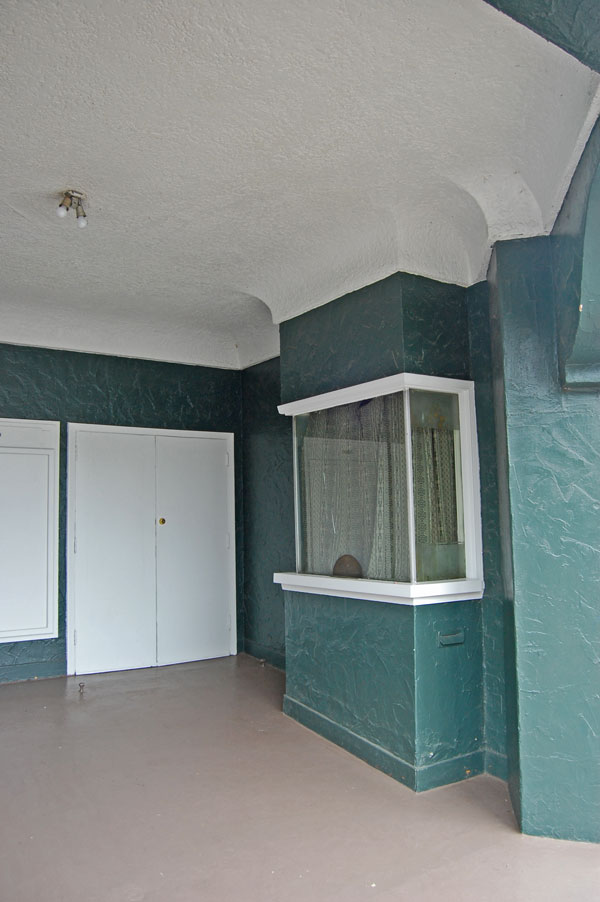
Alameda Theater Box Office, today a spot for the greeters at Victory Outreach Church.

Alameda Theater Box Office, today a spot for the greeters at Victory Outreach Church.

Prescott Fountain–Hunderups

I’ve embarked on a line of research that involves trying to understand the businesses that have served Alamedans over the years, with a focus on the smaller shops that existed around the perimeter of the neighborhood. Here’s one that will bring back some memories for those who knew it, and will intrigue those of us who didn’t.

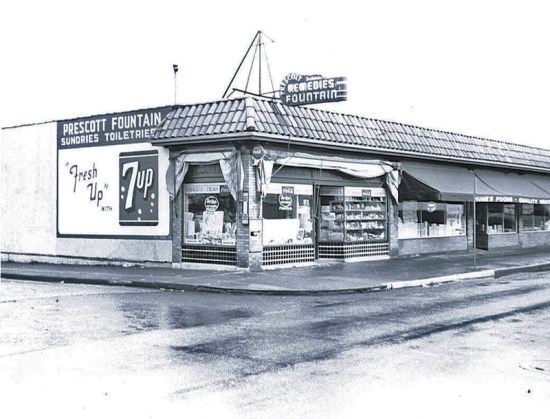
Prescott Fountain, 1955

 prescott-fountain-1955

This view is looking northeast from the corner of NE 29th and Prescott. Photo courtesy of Tom Robinson, Historic Photo Archive. Below is the same place, 54 years later.


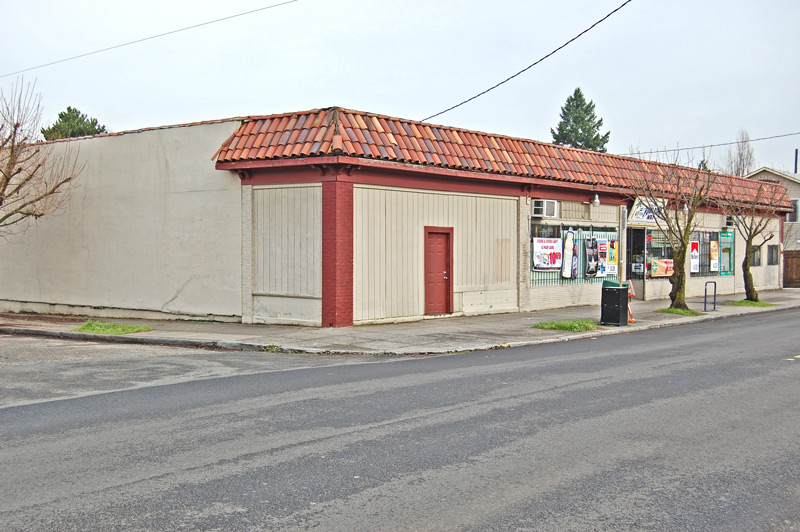
Food King Market, 2009

food-king-2009

We live not too far from Food King and drop in from time to time, almost always in the evening after other stores are closed, to get a gallon of milk for the morning. When I found this 1955 picture, I stopped in to see if the owners knew anything about the building, but they don’t, so I turned to others I know (thank you Steve Goodman and John Hamnett) who do.

The building was built in 1922, so there are a couple of generations who shopped here before this early picture was taken, and about which we don’t know much (yet). But here’s the lowdown on this place from the vantage point of the mid- to late-1950s.

I’ll let Steve Goodman tell this story from here:

First, this is actually four businesses. The left door (about one-quarter of the total building), was the Prescott Fountain. But no one called it that. From the late 50’s until it closed (sometime in the mid to late 60’s), it was know as Hunderups, for its owner (we kids pronounced it “Hun-drups”).

It was not what you might envision.  Likely in earlier days it was a modern, clean, well respected establishment, but that’s NOT how we knew it. Adults would never go in there.  It was a dingy hang-out for kids. Emphasis on dingy. It was dark (seemed like only about  two lights lit the whole place), dirty (old Mr. Hunderup, who resembled Charley Weaver, let the store go into disrepair and never cleaned it). The product on the shelves was all old and never sold. Items you’d expect in a old drug store, hot water bottles, etc.

But it did have an old fashioned counter and stools where grade school and high school kids (boys — never a girl) would gather.  He’d have candy behind the counter, but we hardly ever bought it, as fresher was available next door.

The attraction was the iced Cokes in a bottle. I don’t remember, probably a nickel or dime each.  He’d keep them in a “too cold” refrigerator, and kids would go there to socialize in an “adult free” zone, and drink the Cokes from the bottle with a straw. Sometimes Mr. Hunderup would have to break thru the ice with his ice-pick so we could get the straw in.

Rumor has it that someone once saw a rat running thru the store.  Maybe yes, maybe no – but in this dark, dirty establishment it wouldn’t surprise anyone.

My mother went in Hunderup’s once (once) looking for some item, and I think she disallowed me from going in there again — or couldn’t figure out why we’d want to.

I got the feeling that before it was the run-down place we knew, Mr. Hunderup might have owned it when it was nice and new(er), but just let it get run-down.  Looking back, he loved seeing us and chatting with us while we kept him in business.

Mr. Hunderup passed away in the late 60’s. They cleaned it all out (and we joked about how much they probably had to fumigate the place), and it soon became part of the store next door.”

Steve explains that the second door from the left was a thriving, clean, well-lit family owned neighborhood grocery called Hume’s Foods…you can see it on the awning in the photo. It sold in 1963 to the Brandel family (which later owned Alameda Foods at 24th and Fremont).

Steve remembers…

It was unlike the convenience stores of current.  They had a large produce section on the east side of the store. In the back was a large butcher case, well stocked and staffed by a real butcher. While this wasn’t a “supermarket,” it’s where many in the neighborhood did their weekly shopping; always busy. And it had several adults working there – back when they could support a family with that type of job.  No turnover, but the same people.  Mr. and Mrs. Brandel would always be in.  I can remember their faces like it was yesterday.  They kept ledgers behind the counter where some customers ran a tab.”

On the east end of the building, down beyond Brandel’s, was a beauty shop and a barber shop, complete with the twirling red and white barber pole and a row of hair dryers against the wall.

What do you know about this place? Care to share a memory about another neighborhood business?

Post Script| March 28, 2009: Thanks to the helpful memory of blog reader Steve Turner, we know that the proprieter was named August Herman Hunderup. I’ve done a little genealogy on Mr. Hunderup and learned that he was born in 1891 in Minnesota. In the 1920 census, he’s living with his parents on SE 87th Avenue and is listed as a “minister” at a Catholic Church. Death records show he passed away on September 3, 1970. I’d love to hear from any family members, or others, who have a memory of Mr. H and his quirky, memorable shop.

Grant Park Grocery & Market

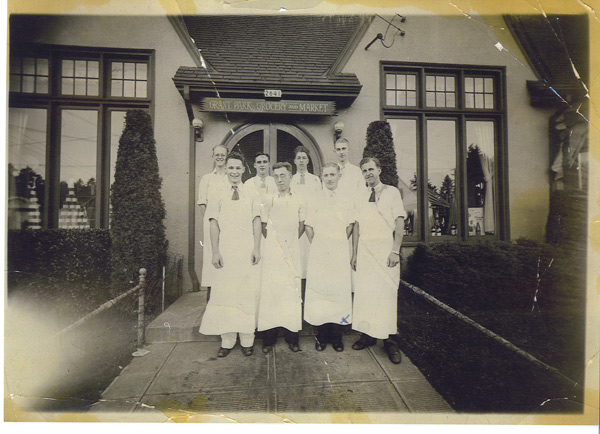
Grant Park Grocery and Market, about 1933. Photo courtesy of Jerry Hoffelner

Grant Park Grocery and Market, NE 33rd and Knott, about 1933. Photo courtesy of Jerry Hoffelner. The man in the first row, second from the right with the blue “x” penned onto his apron, is Jerry’s dad, George Hoffelner. The other men have yet to be identified. Can you help?

I’m researching a very old house near 29th and Knott. One of the many people who lived in the house over the years worked for a while at the Grant Park Grocery and Market, which we know today as the Family Medical Group office on the southwest corner of NE 33rd and Knott.

The image above, taken about 1933, shows the grocery staff decked out in their white aprons ready for action. Like many small stores, these guys often delivered the groceries direct to your door…an idea recently picked up on by some of the modern mega-grocery stores.

This image is taken on the east face of the building (facing 33rd). The original entrance for the market was not on the diagonal at the corner like it is today, though it seems there was always an entry there. My hunch is that was the entry to the pharmacy and fountain that used to be there. The grocery business was owned and operated by Ernest Bjorklund. Next time you are stopped at the light there, have a good look at this interesting building and tip your hat to Mr. Bjorklund and his squad of helpful grocery clerks.

I’m looking for any help with memories, stories, photos or information about either the Grant Park Market or the pharmacy and fountain.

Here’s a shot of that same spot today. The door appears to be an “emergency exit” today. The graceful lights are gone, as is the cool curved doorway and the sidewalk ramp leading to the door (it’s now just part of the garden bed).

Grant Park Grocery and Market building, June 2008