Alameda Tuesday Club—A Neighborhood Institution Since 1913

Local service and social club has been doing good works quietly for almost 100 years

When you think about Alameda neighborhood institutions and landmarks, a few standouts come to mind: the school, the churches, the ridge, Deadman’s Hill, our particular grid of streets, the big ponderosa pine at Fremont and 29th. We all have our list.

Chances are, though, that you don’t think about—or maybe even know about—one of the longest-lived, active and engaged institutions our neighborhood has known: the Alameda Tuesday Club.

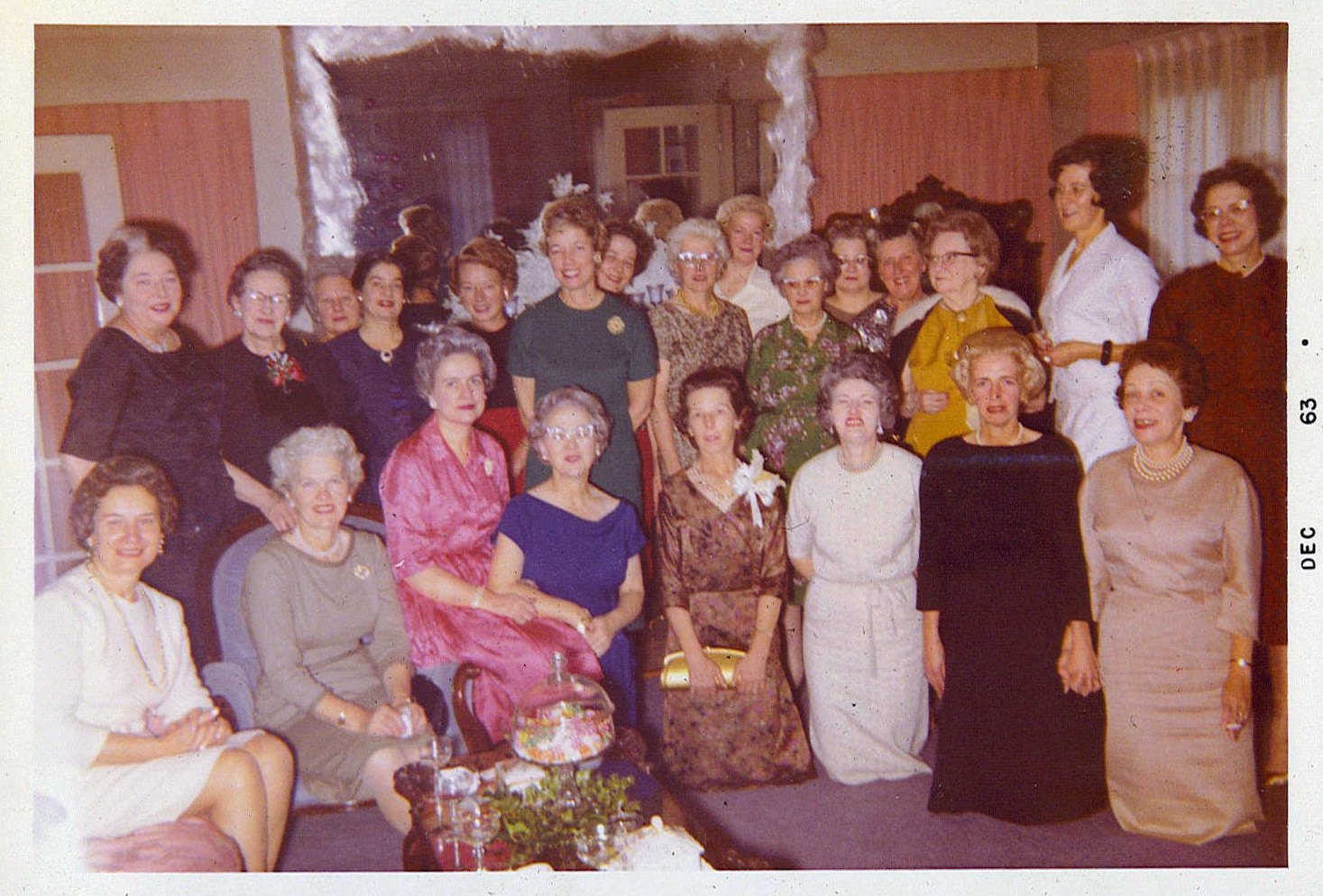
Members of the Alameda Tuesday Club gather in a local home in December 1963. Scrapbooks showing club activities are now in the collection at the Oregon Historical Society. Photo courtesy of the Metschan Family

Members of the Alameda Tuesday Club gather in a local home in December 1963. Scrapbooks showing club activities are now in the collection at the Oregon Historical Society. Photo courtesy of the Metschan Family

The ATC, as it is fondly referred to by its 36 members, is a social club with a service mission; a collection of active women from the Alameda neighborhood who are quietly carrying on a tradition that began at the dawn of the neighborhood itself. Since 1913, when the first homes were being built in the fields that are now our neighborhood, members of the club have been gathering on a regular basis in a different Alameda home each month for conversation, for learning, for tea and a meal, and to plan good works both close to home and far away.

In 1914, when a down-on-their-luck family was living rough in the 33rd Street Woods (a much wilder version of today’s Wilshire Park) and the Dad had tuberculosis, the club stepped in to provide food, coal, clothing and milk for the children.

When a well-known national suffragette came to town to advocate for a woman’s right to vote, the club boldly hosted an event with her as lead speaker.

When World War I soldiers from Portland were in the trenches in France, the ATC made and shipped bandages and other supplies overseas.

When the young neighborhood clearly needed a school, the Alameda Tuesday Club stepped up to help make the case.

You get the idea: These women are strong and know how to get things done. The list of charitable works over the years is long and generous. But they know how to have fun too: picnics, tea parties, an award-winning flower-bedecked float for the 1916 Rose Festival parade, fundraisers, costume parties.

These days, the club isn’t advocating for schools or building parade floats. But it does make generous gifts to charities, including most recently the West Women’s Shelter, Beaumont School Library, the Jefferson Dancers, the Oregon Food Bank, Friends of Children and SMART.

“When I first heard about the club, I thought it was such an anachronism,” says current president Kathie Rooney, who has been a member since 1986. “But when you are involved in charitable works and you get to know these women, the club takes on a whole different dimension. There is definitely an old fashioned social interaction. But we’re also talking about the issues of the day.”

Rooney explains that club bylaws have changed little since 1913, and still require members to live within the perimeter of the original Alameda Park Addition: from Fremont to Prescott and between NE 21st and NE 33rd. Membership in the club is by invitation only—as it has been from the beginning—and no more than 36 members are allowed. Monthly meetings rotate around the club, with a member hosting a lunch in her home on the second Tuesday of the month, nine months of the year. Some neighborhood homes have held multiple generations of ATC members and meetings.

And then there is the unwritten silver tea set rule: tradition has it that a silver tea set must be at every gathering of the club. Look back through the club scrapbooks (an amazing collection of images and notations set on black album pages now housed at the Oregon Historical Society) and you’ll see it there on a table, in the corner of a room, sometimes in use.

Terry O’Hanlon has been a member of the club since 1962 and has watched the neighborhood, and the club, change. When she joined, average club membership was a bit older than today, with most members between their early 50s and 80s (she was one of the youngest when she joined, in her 30s). Today, O’Hanlon is the eldest club member, and the youngest member is in her mid 40s. She also remembers Alameda filled with more young families and young children. Not so today, with plenty of two-parent working families.

“The pressures on professional women are different today than in my day,” she says, reflecting on the forces that have shaped the club over the years. “If you are working 40 or 50 hours a week, it’s hard to make it to an afternoon meeting like ours.”

Still, the friendship and camaraderie of the club—and its core philanthropic mission today—create a special sense of purpose that continues to fuel club meetings and activities. The tie to tradition, a respect for generations of Alameda women, and a real love for the neighborhood, distinguishes this special group.

-Doug Decker

Neighborhood Boundary vs. Subdivision Plat

Like a mosaic of fine old tiles, hundreds of subdivision plats rest atop Portland’s neighborhood landscape, creating a base-layer of orderly streets and lots beneath the places we know today. Drawn up over the last 140 years by different developers, each plat has a name: some are catchy, some are descriptive, a few remain in common use to describe the places we know. Most have been lost to time.

Neighborhood names are administratively determined by the Portland Bureau of Planning and Sustainability, which has plotted them on this handy map.

Plat or subdivision names are filed on the date of platting with the Multnomah County Surveyor and are boundaries of surveyed property tied to the legal description of the land. There are more than 900 individual plats in Portland.

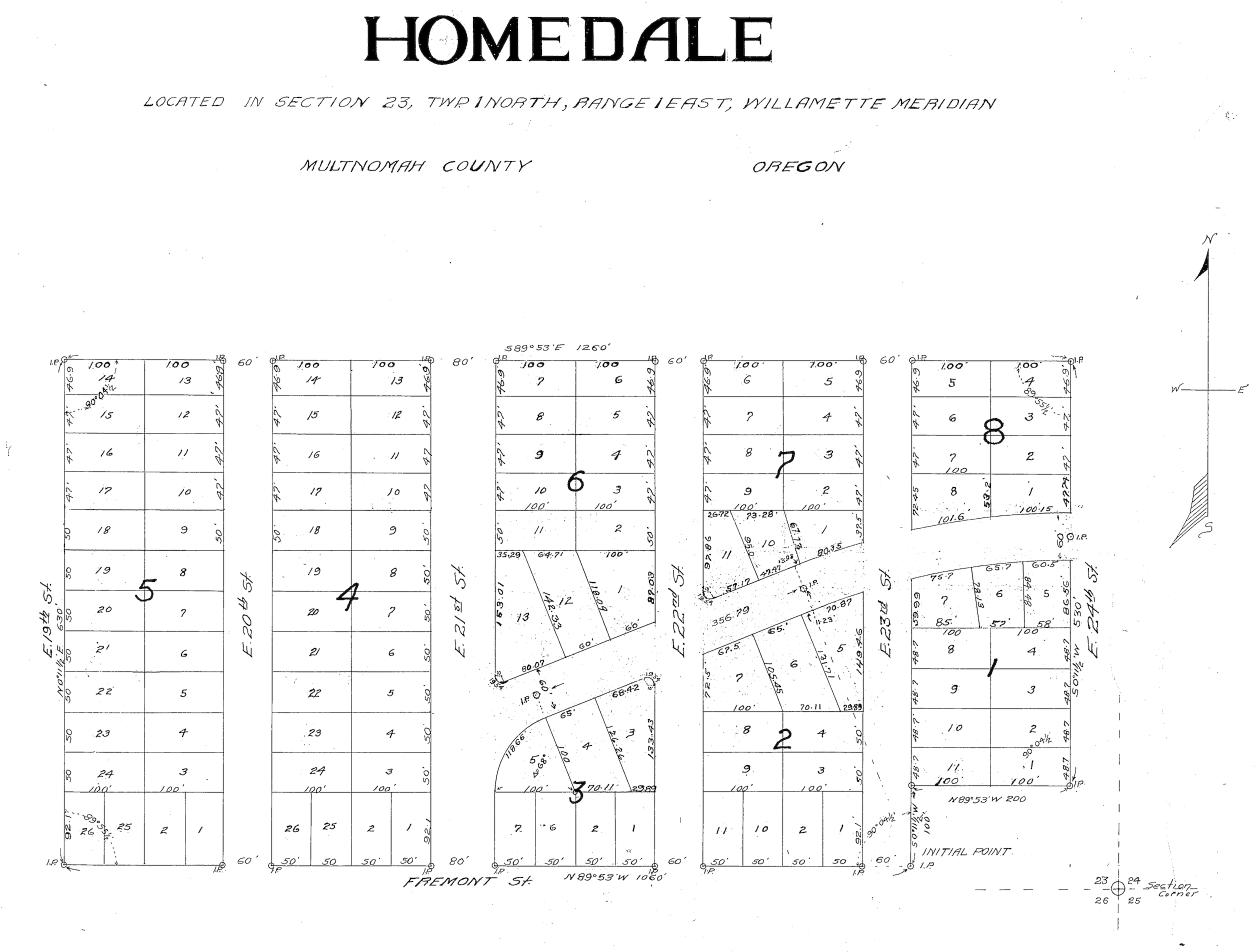
Here’s a good example of a plat that has nothing to do with the name of any neighborhood. It’s Homedale, and it spans today’s Sabin and Alameda neighborhoods. Try telling someone you live in Homedale (or any of the other 21 named plats in our neighborhood) and you’re likely to get a blank stare.

Homedale Plat

Within the confines of what the city thinks of as today’s Alameda Neighborhood are at least 21 plats of all sizes, from the Alameda Park plat, to the Homedale plat (1922), to the Town of Wayne plat (1882). Probably the only one that will ring a bell for most residents is Alameda Park, the namesake for what is today’s larger Alameda Neighborhood.

And just to make life a little more confusing, the Alameda Park plat exists within both the Alameda Neighborhood and the Sabin Neighborhood (late 20th century neighborhood administrative boundaries).

Here’s the full list of plats inside today’s Alameda neighborhood boundaries: Alameda Park, Homedale, Olmsted Park, Irvington, Edgemont, Pearson’s Addition, Town of Wayne, Town of Wayne Replat, Waynewood, Irvingwood, Meadow Park, Dunsmeade, Irvindale, Hillside, George Place, Bowering Donation Land Claim Tract, Norton’s Subdivision, Stanton Street Addition, Gleneyrie, Hudson’s Addition and Meadow Park.

With more than 20 plats in just one “neighborhood” alone, no wonder the city has chosen to lump geographical areas into single neighborhood names. No plats were moved, changed or amended to coincide with our neighborhood’s name. Rather, the place name we all know today — and it’s corresponding map — was determined decades after the ink was dry on the subdivision (plat) names.

Here’s a link to plat maps for Alameda and several surrounding areas.

Just for fun, dig out the thick pack of papers you signed at closing, or look at your property tax statement: you’ll find the name of the plat that includes the block and lot where you live. Just remember: this name exists separate from the name of our neighborhood.
Ken Birkemeier, Prolific Alameda Builder

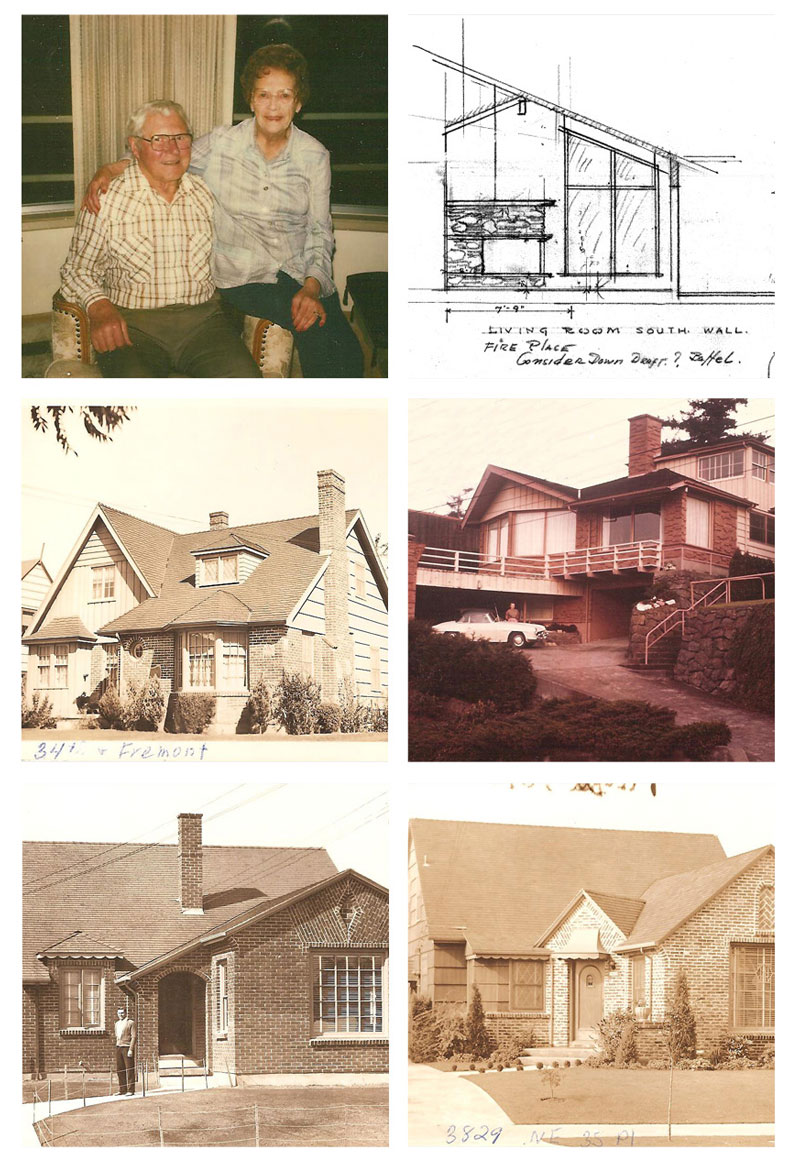
A collection of images relating to Ken Birkemeier. Top left, Ken and his wife of 50 years Marge. Photos and drawings courtesy of Dan Birkemeier.

A collection of images relating to Ken Birkemeier. Top left, Ken and his wife of 50 years Marge. Below, homes he built in the neighborhood. More pictures in The Builders section. Photos and drawings courtesy of Dan Birkemeier.

After a very interesting few weeks of research, correspondence with the Birkemeier family, and lots of walking around the neighborhood looking at dozens of houses he built, I’ve posted some background on local architect and builder Kenneth L. Birkemeier. You’ll find the details (and some more photos) over in the new section called The Builders (click here). It was great to hear memories from various family members, particularly the story from his grandson Dan, who is today an architect in Seattle.

You’ll note that I’m inviting your stories or photos of Birkemeier homes, so let me hear from you and I’ll share them here on the blog.

The new section is up to four major builders now, with dozens more to go. One thought that occurred as I walked around the neighborhood this week is that Irwin, Read and Berkemeier must have known each other. Between the three of them, they designed and built dozens of houses here in the neighborhood…they must have been bumping into each other along the way.

Next on my list is Harry Phillips, who designed and built many of the homes along Ridgewood and Gile Terrace in the late 1920s. I also want to delve into the history behind the reference to the “Town of Wayne,” which is a small plat south of Fremont and between 32nd and 29th.

Inquiring minds want to know: Who was Wayne?

“It lies on a slight eminence…”

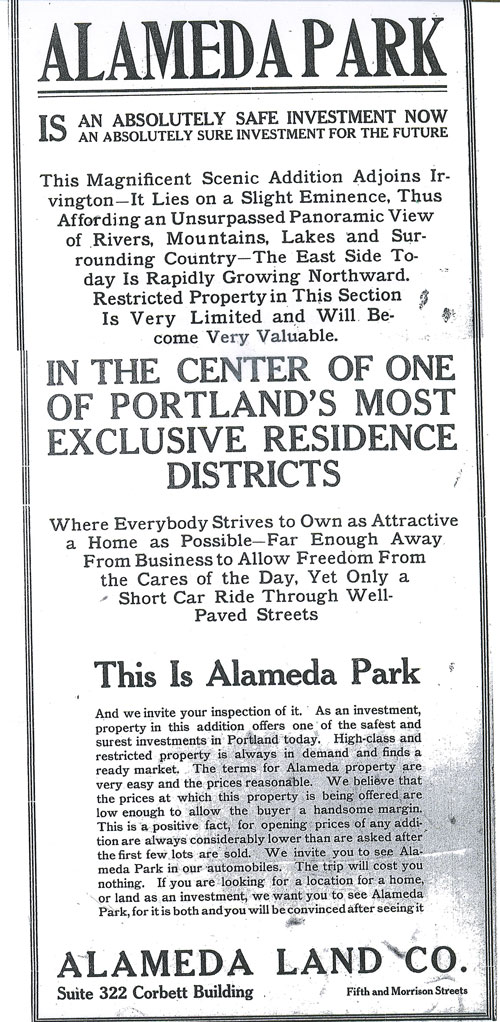
It was 100 years ago this week that the first newspaper advertisements began to run extolling the virtues of the newly platted Alameda Park district. The text is pretty flowery and the ad is jammed with words. Here, take a look:
From The Oregonian, March 16, 1909

From The Oregonian, March 16, 1909

This ad tells us much more about the men behind the Alameda Land Company than it does about the development itself. You get a very clear idea of who they were pitching to, and their intent to offer a “first in” deal to the early wave of investors and potential homeowners. It’s important to point out that in March 1909, there wasn’t much up here on the ridge but mud, Douglas-fir trees, brush, some small orchards and a rutted dirt road running up the hill (today’s 33rd Avenue). Panoramic views of lakes? Hmm. Not sure where they got that one. There was a small pond in the area near today’s NE 28th and Siskiyou. Maybe you could see that from the ridge…

Just one month previous to this advertisement, the Alameda Land Company filed its first plat. Even though there were no streets or curbs or water or any service in place, this March push of advertising was aimed at creating a personality for the new district and to put it on buyers’ radar screens. Different (but similar) ads ran each day this week.

Interesting to note that the March 1909 ads, which seemed to claim well-paved streets, were roundly criticized by the developers of neighboring plats, particularly Irvington, which by 1909 actually had well-paved streets, homes, water, gas and curbs. In their own advertisements taken out the following weeks, the Irvington crew called the Alameda Land Company a pack of liars, literally, for their exaggerated claims. The ad sales guys at The Oregonian must have loved it!

The First Alameda School

When most Alamedans think about our lovely old Alameda Elementary School, we are probably thinking about the beautiful and classic building that stands today on NE Fremont between 27th and 29th. Built in 1921, this school has been the neighborhood hearth for generations.

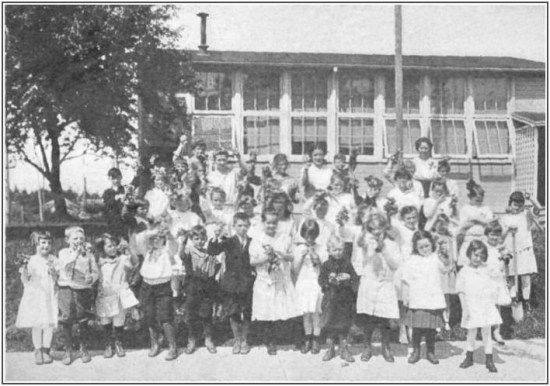
But did you know there was an even earlier Alameda School? I came upon this tidbit while reviewing 1914 articles from The Oregonian, but never dreamed I’d find a photo of the place. You can imagine how pleased I was to find this remarkable shot of the first school in the neighborhood, built in 1915. Check it out:

"First crop of radishes and lettuce at the Alameda Park School, Portland, Oregon, June, 1916. Even in the primary grades children may learn much about the science of growing things. Courtesy L.A. Alderman"

The original caption reads: "First crop of radishes and lettuce at the Alameda Park School, Portland, Oregon, June, 1916. Even in the primary grades children may learn much about the science of growing things. Courtesy L.A. Alderman"

The photo is from a book published in 1919 by Rand McNally called “Vocational Guidance for Girls,” by Marguerite Stockman Dickson. You can have a look at this book (a remarkable story all on its own), thanks to Project Gutenberg, by clicking here.  The Alameda photo is in Chapter V, where you’ll find some other interesting photos from Northeast Portland.

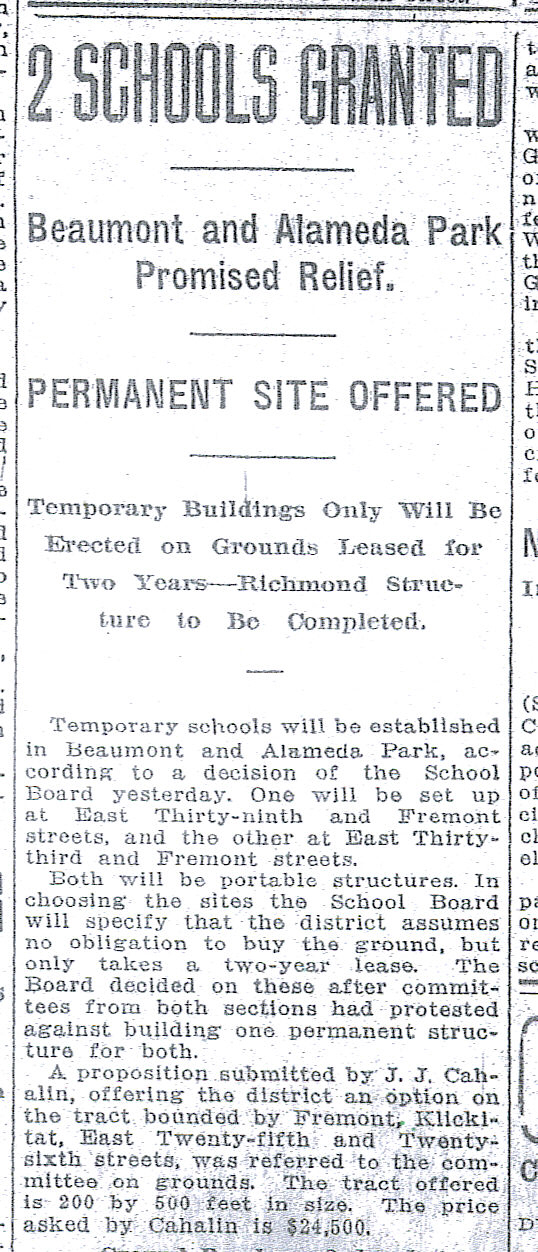
The caption clearly identifies this as the Alameda Park School in Portland, Oregon. That’s us. Pair this up with the news story from The Oregonian on September 18th, 1914 and we can begin to fit some pieces together. Take a look:

From The Oregonian, September 18, 1914.

From The Oregonian, September 18, 1914.

Things to ponder:

  • This original small school building was viewed as temporary when it was first built. Only a relatively small percentage of homes had been built in the neighborhood by then, so it was clear there would one day be a real need. Not so much in 1915, but local kids still needed a local school.
  • It was first imagined in context with a school up the road in the Beaumont neighborhood, which was also to be temporary. Like Alameda, that neighborhood was just starting out in 1915.
  • The newspaper indicates that one site for the school was at the top of Gravelly Hill, NE 33rd and Fremont. It also says the site being offered by J.J. Cahalin was on Fremont between 25th and 26th, the next block west from the current site of the Fremont United Methodist Church. I didn’t find a follow-up story, nor have I looked at the property records, but my hunch just from looking at the photo is that the Cahalin site was selected over the one at the top of the hill. I’ll run that down next time I’m looking at property records, but that just seems likely.
  • Interesting to note the tall windows, lattice-work porch and woodstove chimney. And the fact that the kids had a busy and productive garden.

Where did it sit exactly? Who built it? Who was headmaster? Mysteries yet to solve.

The Tuxedo of Portland | Looking Back 99 Years

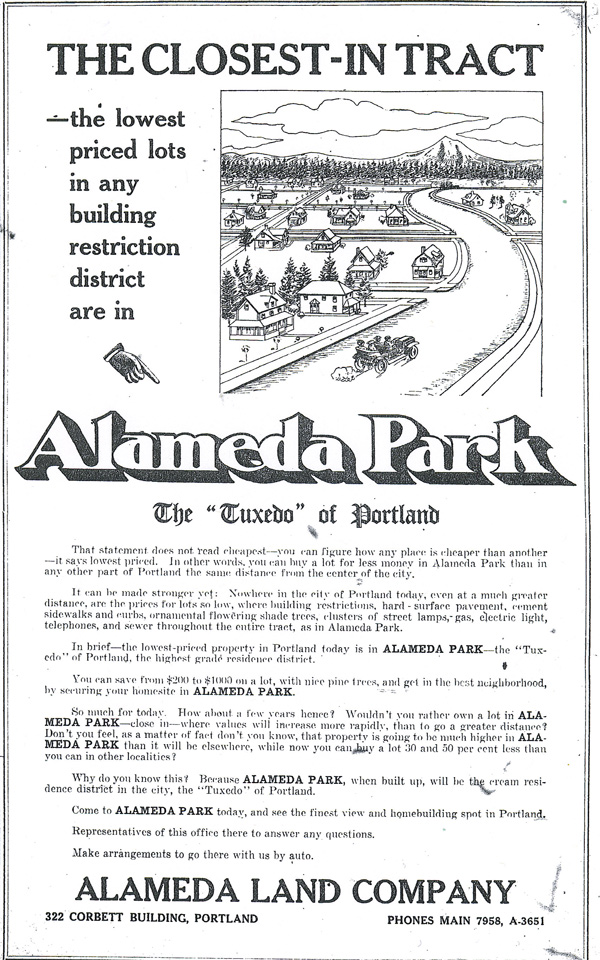
As the Alameda Neighborhood approaches its 100th anniversary, I thought it might be of interest to turn the clock back for a sense of what people were thinking about this part of the city in those days. I’ve done a comprehensive review of The Oregonian from 1909 to 1929 and have hundreds of articles and advertisements that shed light on the life of Alameda, Beaumont, Rose City Park and other Northeast Portland neighborhoods. Here’s one, an advertisement from 99 years ago: Sunday, October 24, 1909:


10-24-09 Advertisement for Alameda Park Neighborhood, from The Oregonian

10-24-09 Advertisement for Alameda Park Neighborhood, from The Oregonian


Plenty of food for thought here. The cartoon-like drawing showing a few houses (note the front porches) scattered on open blocks; the serpentine Alameda leading off toward Mt. Hood; street trees planted in orderly fashion. And the car. The text extols the affordable nature of the lots here in Alameda Park, the amenities, including flowering shade trees, telephone, electricity and sewer. The “Tuxedo” of Portland. Hmm.

Ninety-nine years ago this month, the streets were in, but not yet hard-surfaced (that was still almost three years off, completed in the spring of 1912). Curbs and sidewalks had not yet been framed and poured, nor was there any gas or electric installed. The only sounds of home construction were coming from Concordia and Vernon–neighborhoods to the north–where building was fast and furious. But here in Alameda, despite what the ad might have you think, it was a quiet place at the far northeast edge of the city limits. The first boom of Alameda construction was still a year or more away.

As we enter the 100th anniversary phase, in 2009-2011, I’ll be sharing clippings on a “real-time” basis. You can read all the Alameda news that was fit to print on the day it ran, exactly 100 years ago. What better way to learn about our history…no such thing as old news.

Alameda Park Community Church: A History

Funny how decisions are made sometimes, and how unpredictable forces shape the way things turn out.

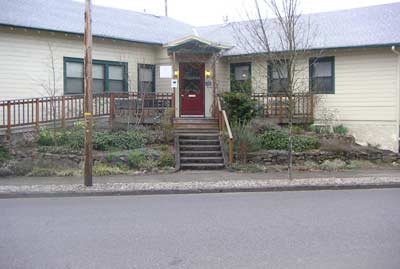
For 80 years, Alamedans have known the Alameda Park Community Church building– today’s Subud Center — as a friendly-looking building on an island just off Regents Drive at Mason.

church-now.jpg

Passersby inclined to wonder about its history perhaps think it was a big house originally, or a community center. Potluck dinners, friendly gatherings, sing-alongs, dances, lectures, church services, meditation sessions: Yes, this building has seen it all.

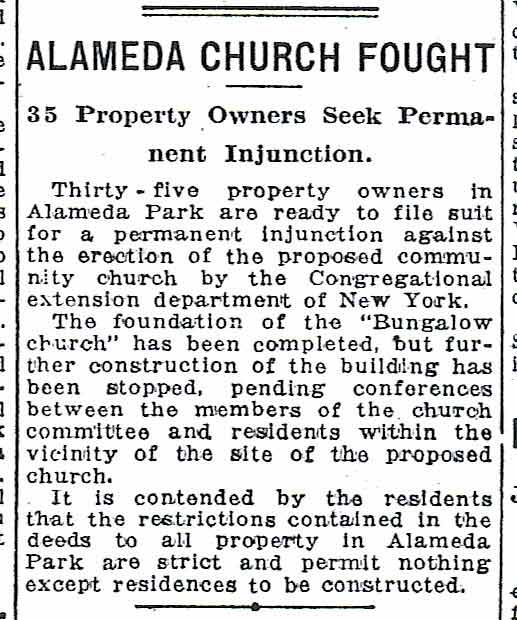
But it very nearly didn’t get built. Check out this story from The Oregonian on October 14, 1921:

4-october-1921-alameda-chur.jpg

And this was the second hurtle the project had to overcome, after being relocated, before work really got underway, from its original and intended location one block west near the corner of NE 30th and Mason. According to the building records, and a handed-down memory from Bruce Morrison, the “little boy” who grew up in my house (who was 90 when I interviewed him), it didn’t take long for his dad Walter Morrison to make a fuss when the builder began site preparation on the lots next to ours. Yes, there was a significant amount of construction going on in “The Park,” as in Alameda Park, the early name of our neighborhood.
But when Walter found out the building adjacent to his house was going to be a church, he took his protest directly to the Bureau of Buildings downtown, and to the Alameda Land Company, which had promised to build nothing but homes in the area until 1929. Like many other early homeowners in the area, the Morrisons purchased here because it was solely residential: No commercial or other buildings were permitted within the confines of Alameda Park. The Morrisons were church-going people…it seems that Edith and Walter just weren’t wild about the constant flow of traffic in front of their house.

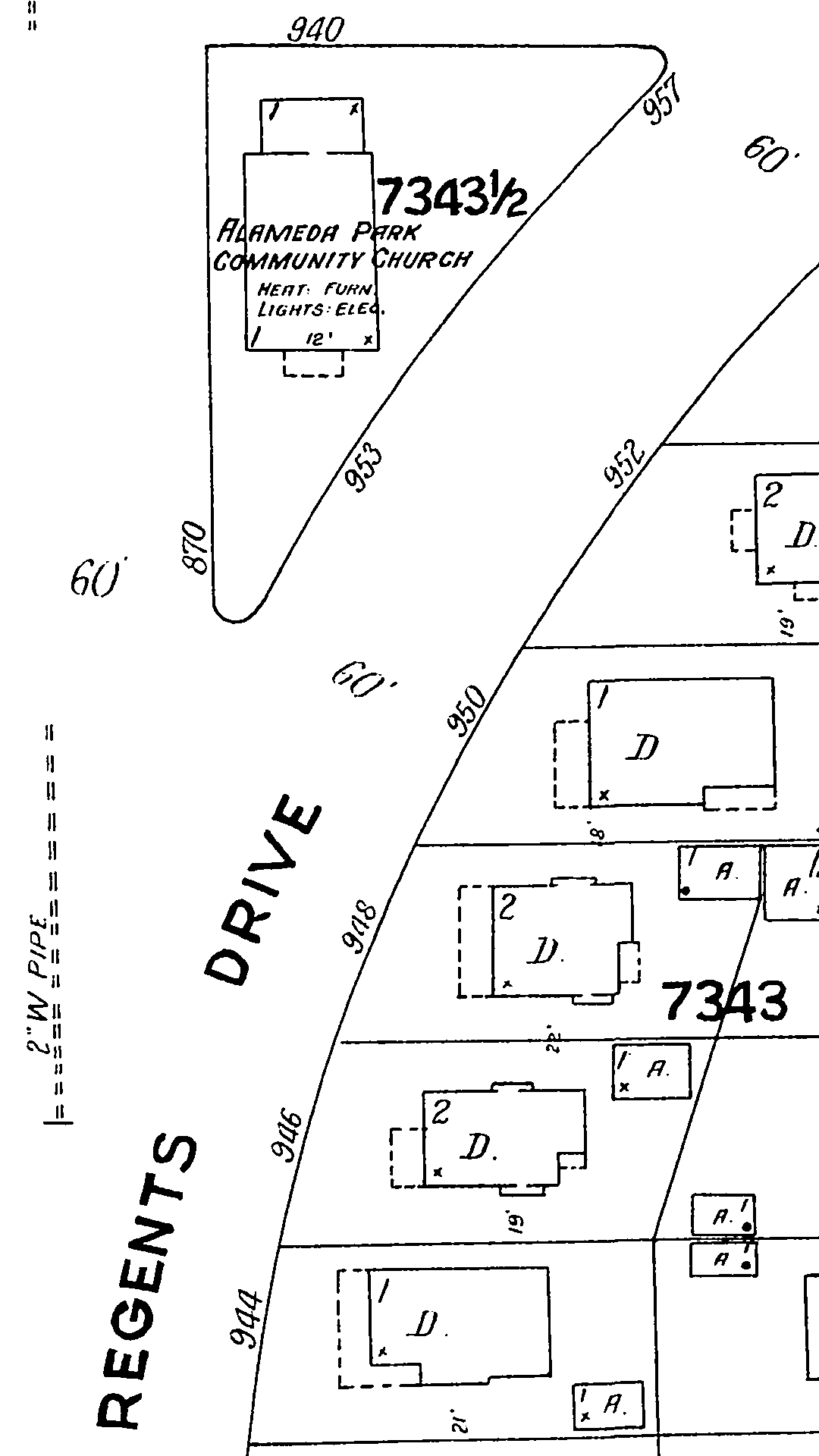
So, in response to Walter’s initial complaint, the city worked with the church and all agreed to move the location to the island off Regents Drive one block east, “Block C” as it is known in the property records.

apcc-detail.gif

Detail from Sanborn Map Volume 5, Plate 586, 1924.

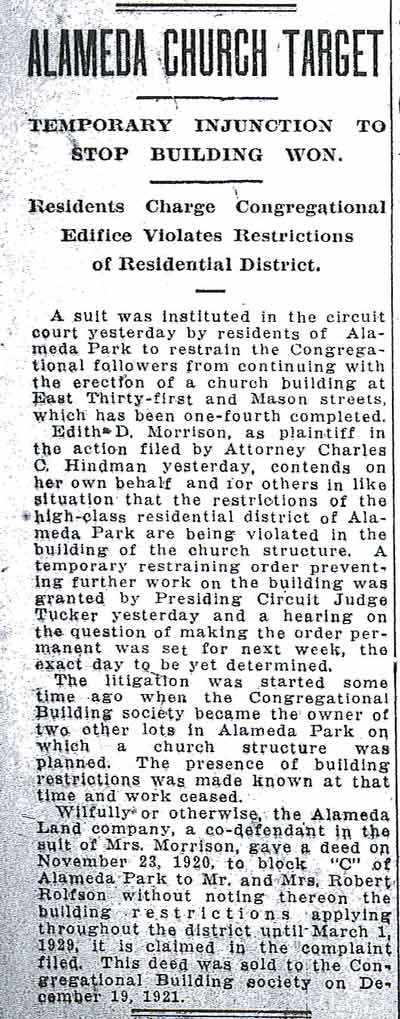
Logistically, this wasn’t too big a problem because not much work had been done on the initial site. The crew picked up its tools and moved one block east. Layout, site preparation and excavation followed, and then the foundation went in. And that’s when the 35 property owners raised a ruckus and shut down the construction. Here’s the next story, from The Oregonian on January 14, 1922:

14-january-1921-alameda-chu.jpg
 

Sounds messy, doesn’t it? The developer got involved, and other property owners. I can imagine some tense meetings and feelings between neighbors. Not nice. It was, however, pretty neat to find this clipping, which confirms the handed-down memory from Bruce Morrison…it’s in the next to last paragraph above.

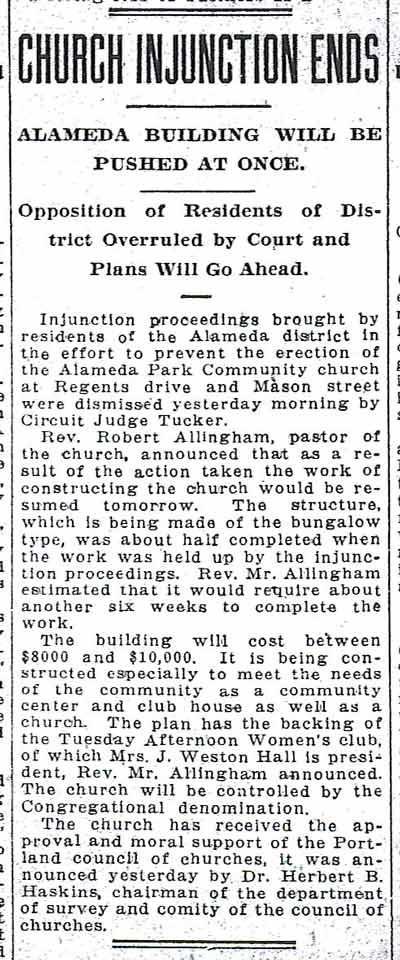
So what happened next? Read on, from The Oregonian on January 29, 1922:

29-january-1921-church-inju.jpg

So the judge dismissed the suit, some reasonable and community-minded behind-the-scenes agreements were probably made, and the construction was cleared to move forward at full speed. Which it did.

Built at a total cost of $5,000, the church was actually a kit, constructed by the Redimade Building Company, and plumbed by Alaska Plumbing and Heating for the Congregational Church Building Society, headquartered in New York City. An additional wing of the building was added in 1924 by the Traverse-Bennett Construction Company. Check out these drawings of the original church.

After dedication on Mmarch 12, 1922, The Rev. H.C. Johnson took over the permanent post from The Rev. Robert Allingham, and all kinds of good works, events and gatherings began to take place on “Block C.” Read more from The Rev. Allingham about what the experience of opening the church was like.

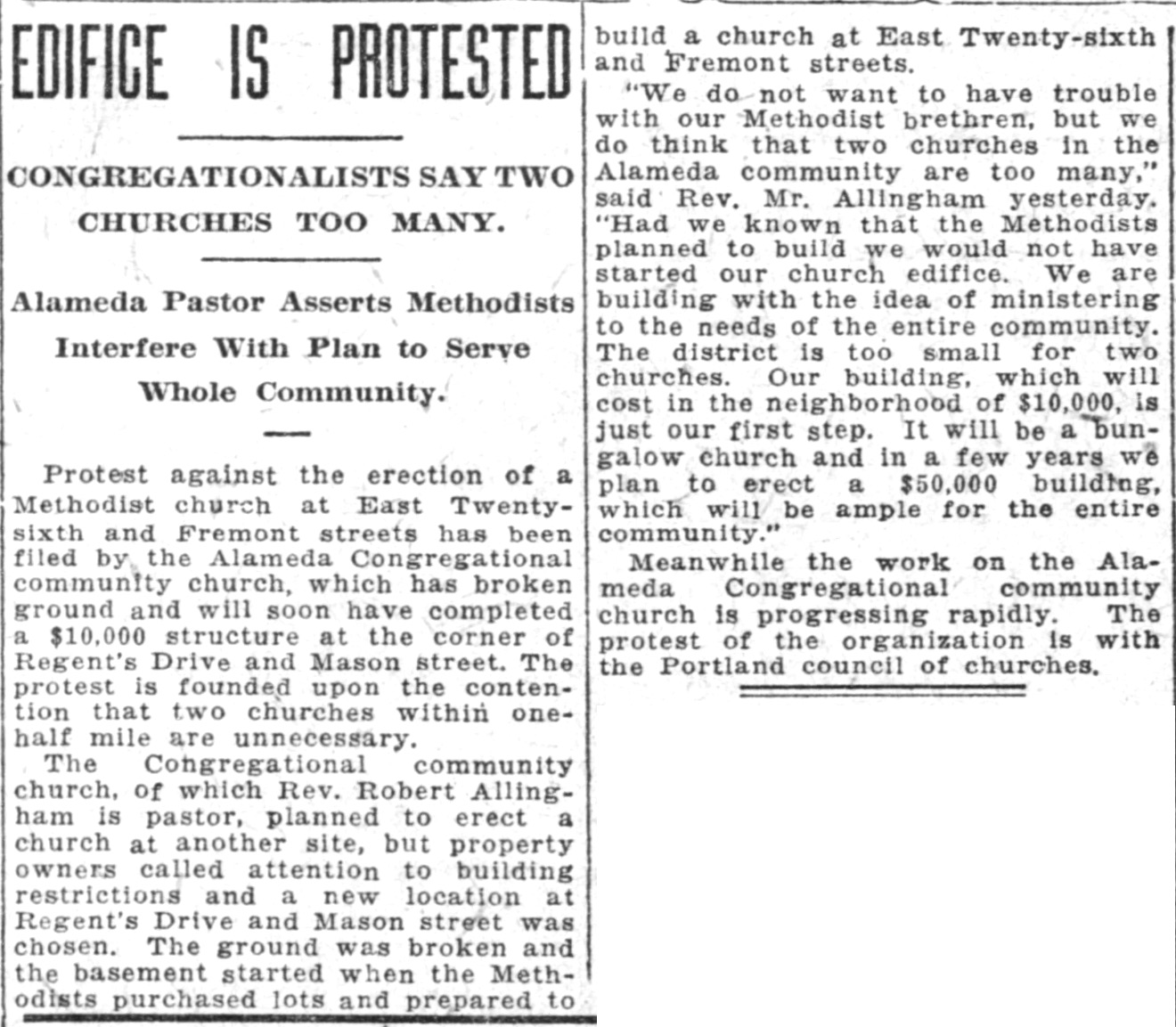
In a deeply ironic post-script to history, I am compelled to share the rest of this story from the turn-the-other-cheek department: When the Methodists filed the building permit to build the Fremont United Methodist Church at 27th and Fremont, The Reverend Allingham and the leadership at Alameda Park Community Church filed an injunction to prevent them from building their church.

In an article that appeared in The Oregonian, the Rev. Allingham says: “We do not want to have trouble with our Methodist brethren, but we do think that two churches in the Alameda community are too many.” Read on, from The Oregonian on January 6, 1922:

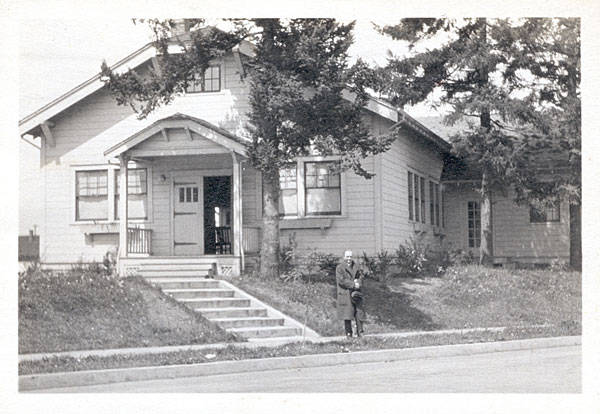
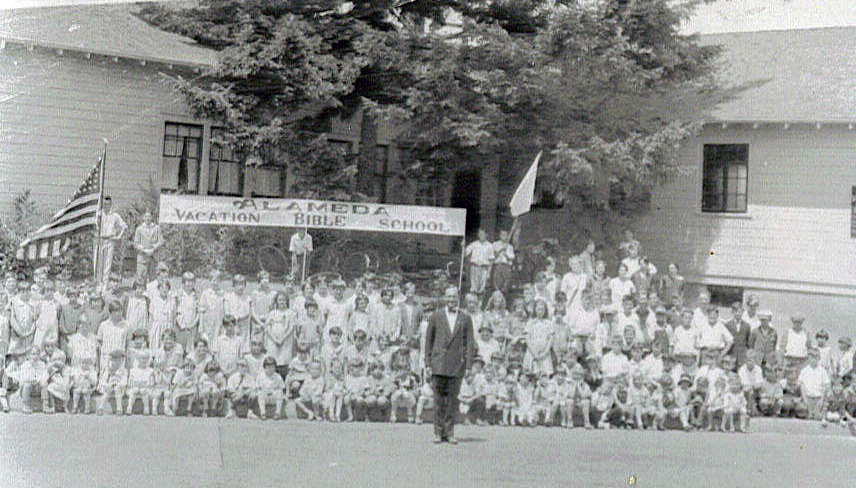
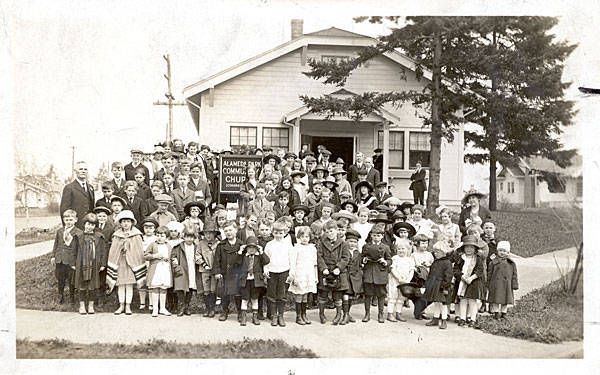
If you’ve read this far, you deserve a prize, so here are all the photos I’ve been able to find of the building.

alameda-park-community-church.jpg

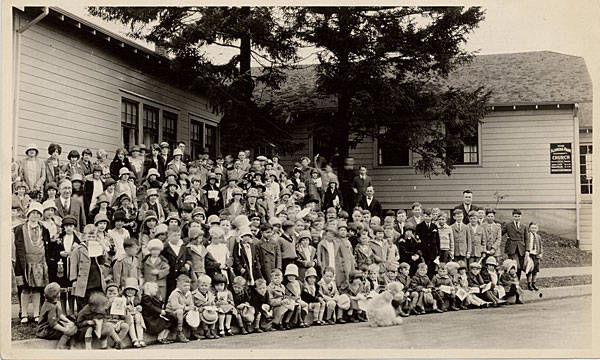
The Rev. H.C. Johnson at the Alameda Park Community Church, undated.  Courtesy of the Frank L. Moore Collection at the Amistad Research Center and Lousiana State University Digital Library.

church-1923.jpg

Alameda Park Community Church, 1923. Looking north, Regents Drive to the right and NE 31st Avenue to the left. Courtesy of the Frank L. Moore Collection at the Amistad Research Center and Lousiana State University Digital Library.

church-1930.jpg

Alameda Park Community Church, 1930. Courtesy of the Frank L. Moore Collection at the Amistad Research Center and Lousiana State University Digital Library.

alameda-community-church.jpg

Alameda Park Community Church, summer 1924. The Rev. H.C. Johnson and the Vacation Bible School. Courtesy of the Morrison Family Collection.

Do you know something more about the “Bungalow Church?” Drop me a note.

By the way, this wasn’t the end of neighborhood protests. Wait til you hear about the next one, made a few years later against a campground planned for 33rd and Mason!