Study of Alameda Building Permits Provides Insights

In 2010, we completed a survey through city building inspection cards, collecting information on every home built here in the Alameda Park addition. It’s taken two years and more than a dozen visits to the Bureau of Development Services (which has been very accommodating and helpful), but time well spent, given the insight it offers into the development of the early neighborhood. Everything from the date of construction—it’s interesting to see what parts of the neighborhood were built first—to identifying the most prolific builders, and all of it helps paint a picture of how Alameda Park developed.
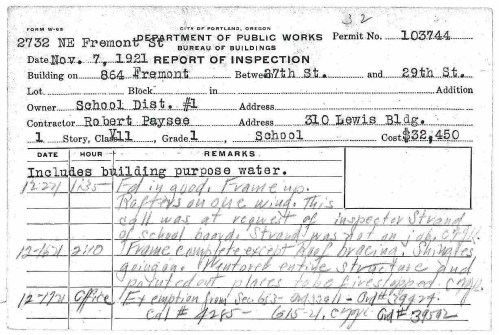
Original building record for Alameda School, taken out on November 7, 1921. Information from more than 1,025 Alameda Park building records were reviewed as part of the study.

When you aggregate the information from the permits, there are some trends and patterns that emerge:

The first observation has to do with the general timing of construction in Alameda Park, from just two homes built in 1909 to a peak of 139 built in 1922. One factor in the timing of this was the ebb and flow of the economy. Strong in 1910, but the infrastructure hadn’t yet caught up. Slow in 1918-1919. Explosive in the 1920s with both a strong economy and demand, and an infrastructure that was truly ready for development.

Building permits issued in the Alameda Park subdivision, by year, 1909-1934. From permit study by Doug Decker, 2010.

By 1934—the end of this graph—about 85 percent of the neighborhood had been built out (the late 1930s and 1940s are a mere trickle of a couple or three homes per year, if that). 1922 would have been an interesting time here in Alameda, with an influx of neighbors. If you haven’t read it, go back and look up our post about the Alameda Park Community Church and the pastor’s desire to bring together new neighbors who were strangers. That was 1922 here in Alameda.

Another observation from the permit study is to have a look at the spread of construction activity to see which portions of the neighborhood were built out first: the areas around 24th and Dunckley; 25th and 26th below the ridge; 29th and Mason; and 32nd Place (then called Glenn) from Mason to Hamblet. These highlighted areas below indicate in general the earliest construction from 1909 to 1912.

It’s also interesting to see who was doing the building during these years. A handful of builders built a large percentage of the homes. The list we’ve compiled below shows total homes constructed in Alameda Park by each of the most prolific builders. Many of these we’ve profiled here, others we’re still working on.

Builder Total Alameda Homes Built Building Activity
Oregon Home Builders 24 homes built 1914-1917
Ken Birkemeier 21 homes built 1932-1952
Harry Phillips 21 homes built 1921-1928
Matot Construction Co. 20 homes built 1921-1926
Frank Read 19 homes built 1923-1941
Nils O. Eklund 17 homes built 1916-1922
Grady Mahaffy 13 homes built 1922-1936
Wickman Building Co. 10 homes built 1921-1923

In addition to the general trends, there are specific sad stories: more houses than you might imagine have had fires (and fire repairs, hence the permit records). A couple of homes were actually struck by lightning. A fad of game rooms, recreation rooms and wet bars were put in during the 1950s, and even an exercise room way back when. Sadly, too frequent removal of trim, built-in shelves and other architectural details in a attempt at modernization (gasp). Interesting to note how many wooden front porches were rotting apart by the 1950s, and a spate of concrete porches and steps poured in replacement.

It’s also clear, when you look at the records, why Portland’s addressing system was changed in the early 1930s. Some of our homes here in Alameda have had three addresses prior to the Great Renumbering (particularly on NE Bryce Avenue) as numbers had to be skootched over to make room for new houses built on empty lots. Let’s just say the original numbering system was less than scientific. You can see this on the actual building permits themselves, where one address has been scratched out and the new one written in. History in the making. It wasn’t scratched out in the example above, but you can clearly see Alameda School’s pre-address change number: 864 Fremont.

Another observation as we completed the study was just how many homes do not have an original building permit. Over the years, for whatever reasons, the City has lost perhaps as many as 20 percent of the original building permits, particularly in the early years. For these homes, we have to rely on original plumbing permits which always give the construction date, but can be sketchy with owner and contractor information.

Regardless, as you handle these permits, some 1,025 in all, you feel time passing through your fingers. You see the clerk typists punching in the details. You sense the contractors standing in line, waiting at a counter wishing they could be back on the job site instead of in the permit office. You witness the many inspectors and their mostly neat observations, drawings, complaints and even sarcastic remarks in shorthand on the 4 x 6 manila cards.

And you can’t help but wonder what it will be like 100 years from now when someone wants to research the history of your house. What story will your house be able to tell?

Thanks AHC

Our presentation this weekend at the Architectural Heritage Center turned up some helpful leads into Alameda stories.  We were there to offer a presentation about the development and early life of the neighborhood and were pleased to see some familiar faces, including Maryon Kinsey, who is featured here on the blog. Afterwards, several neighbors approached us to share suggestions and ideas for further research. Thanks!

Our sister Bonnie Hull, the talented Salem artist and art blogger (be sure to visit her blog, which often features detailed profiles of local artists, a feature she calls “Living the Creative Life“) was in attendance and provides a very nice glimpse into our AHC program. Check out her reporting here. Thanks Bon.

We’ll likely be offering the program again at AHC—perhaps in the summer or fall—and  who knows maybe other places too…open to suggestions or invites.

Davis Dairy Store Remembered

From time to time we like to plumb the depths of memory for stories about neighborhood businesses. This one is reaching a ways back, but we’re looking for a little help with any personal memories about this store, which operated out of the bustling commercial corner of NE 30th and Killingsworth.

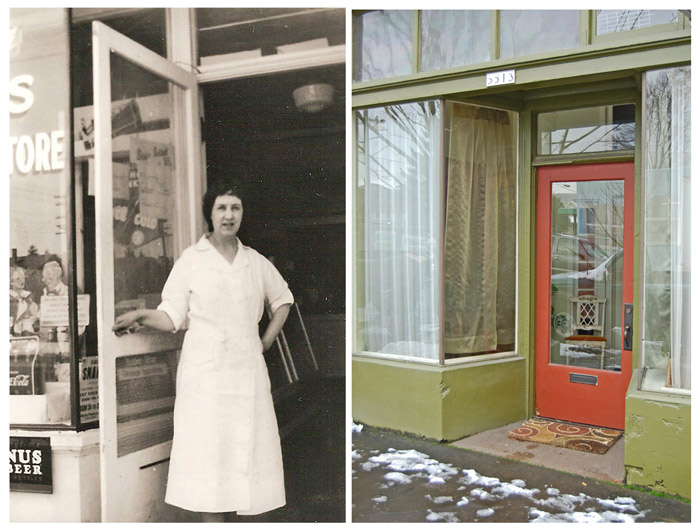
The Davis Dairy Store, located at 5513 NE 30th, was operated by three generations of women from the Davis family, who also built and lived in the home at 2427 NE Dunckley here in the Alameda Park addition. A recent visitor to the blog—Teresa Roth—sent us some shards of memory from her mother Lucille, and some photographs to ponder. Here is Lucille’s mother Irene Davis, the matriarch of the store, standing near the open door in 1938, and the same spot today:

Left, Irene Davis at the Davis Dairy Store, 5513 NE 30th Ave., 1938. Right, the same doorway today. Historic photo courtesy of the Davis Family and Teresa Roth.


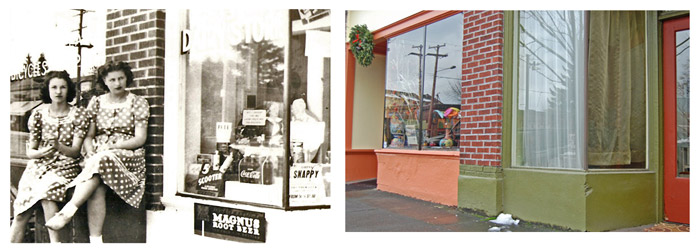
Irene’s daughter Lucille (far left) and cousin Isabel Buckendorf sitting out front in 1938. Note the words “bicycle shop” on the window behind them to the left, and the reflection of the power pole, which hasn’t moved much in 70 years. Historic photo courtesy of the Davis Family and Teresa Roth.

Irene and her husband Ernest built the Dunckley home and likely the business as well, though he was a machinist and she a stenographic secretary. The couple divorced in the mid 1920s. For as long as the couple’s daughter Lucille can remember, the store was just part of the family. Lucille, now in her mid 80s, and her daughter Teresa stroll through the neighborhood from time to time when they are in town together, remembering friends, cousins and happy moments.

After the divorce in the mid 1920s, Irene ran the store, with Lucille’s help during the summer, and likely with the help of her sister Mae, a piano teacher. Irene and Mae’s mother Martha LeFabre lived with them as well in the Dunckley Street house: three generations running the house and the business.

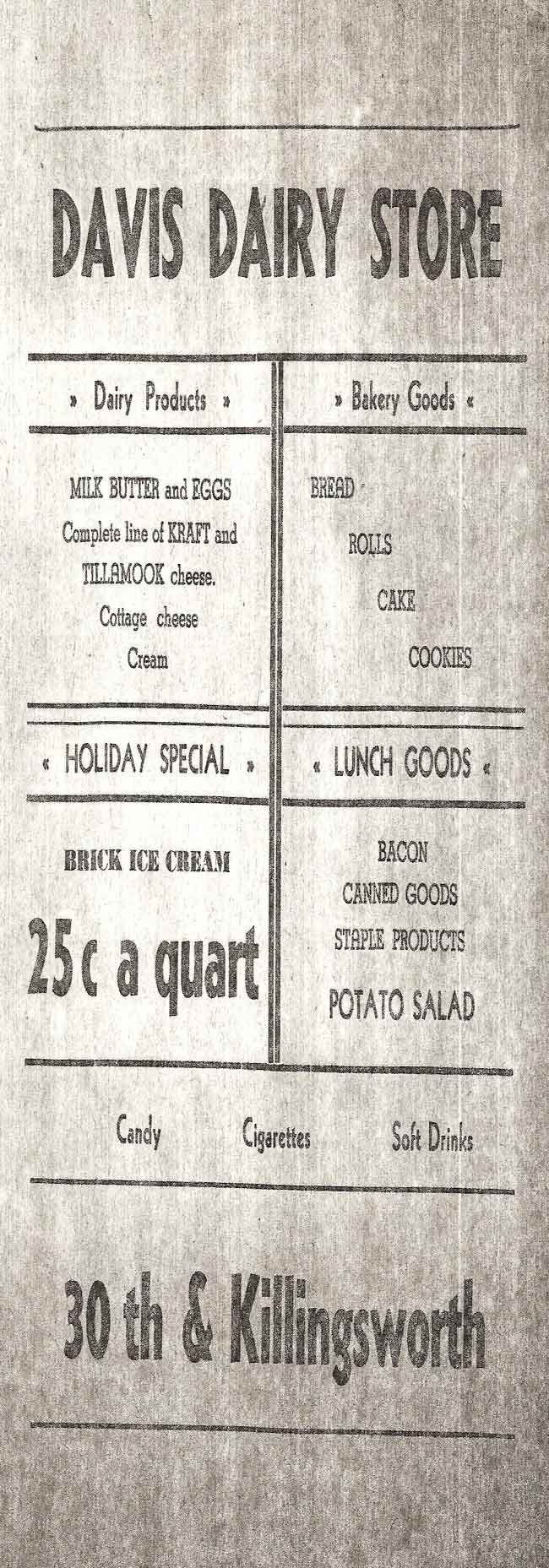
No one around today remembers exactly when the store opened or closed, but we do know it would have been popular with kids. Here’s an advertisement from 1938.

Flyer from Davis Dairy Store, 1938. Courtesy of the Davis Family and Teresa Roth.

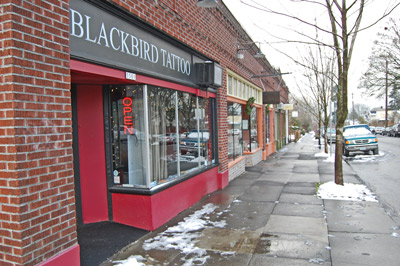
The corner of NE 30th and Killingsworth has experienced a recent renaissance that echoes the vitality of the intersection in the 1920s and 1930s. Today, the area is officially known as the Concordia Neighborhood, though in those days it was known to both residents and customers as Irvington Park and many refer to it by its plat name: Foxchase. Just for context, here’s a shot of the overall commercial building today, which features some very tasty restaurants, including DOC, which we recommend.

Any memories to share about the Davis Dairy Store or this bright and busy neighborhood corner?

According to the 1938 Polk City Directory, joining the Davis Dairy Store at 30th and Killingsworth were the following businesses:

5425 NE 30th             Serafino Boitano Shoe Repair

5425 NE 30th             Parrot Cleaners

5430 NE 30th              Jason Frost Grocer | Theo Larson Meats

5433 NE 30th             Anderson’s Food Market

5438 NE 30th              30th Avenue Pharmacy and Post Office

5501 NE 30th             The Ark Beer Parlor

5507 NE 30th             Irvington Park Variety Store (now Blackbird Tatoo)

5509 NE 30th             30th Avenue Bicycle and Hardware

5515-19 NE 30th        Twin Pines Barber and Beauty Shop

Alameda History Presentation | January 23rd

We’ve just heard from our friends at the Architectural Heritage Center that there are still some seats left for the Saturday, January 23rd presentation about Alameda History. We’ll be taking a trip back through time to look at how the neighborhood developed, some of the key builders, and stories from across the years that help characterize the life and times of the Alameda Park neighborhood. The program runs from 10:00-11:30 a.m. at the Architectural Heritage Center, 701 S.E. Grand Ave., Portland.

Click here for more information about registration.

Alameda Community Church: The Rest of the Story

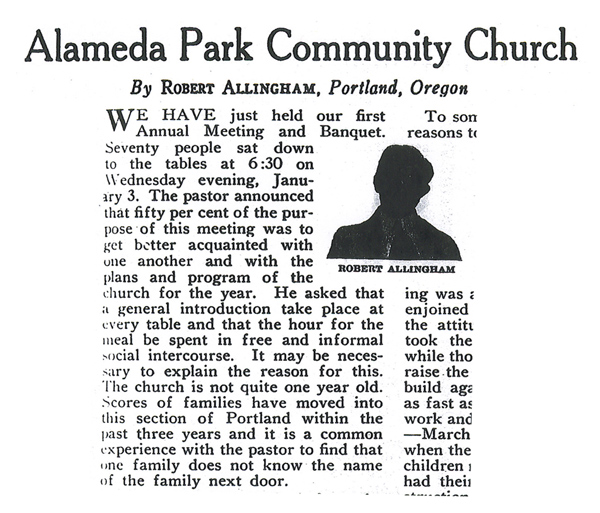
There are always at least two sides to any story (usually a lot more), and we’ve recently found a description of the events surrounding the neighborhood opposition to the Alameda Park Community Church that sheds further light on exactly what happened around here in the fall of 1921.

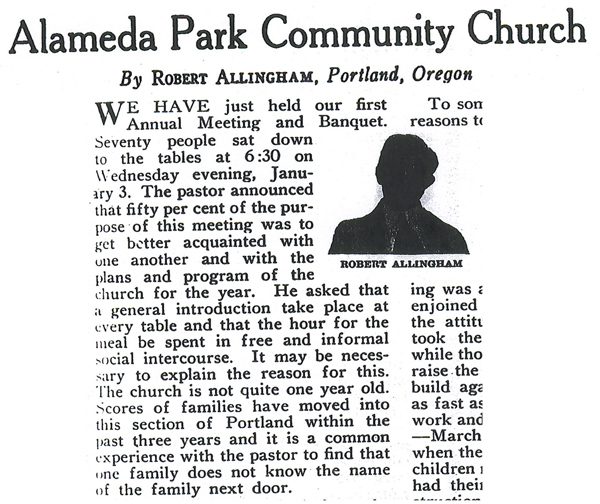
Let us whet your appetite with this clip, from the April 1923 edition of The American Missionary, published by the Congregational Home Missionary Society:

To help put this in context, if you haven’t already read it, we’d recommend reading the page on the church (today’s Subud Center) which you can find by clicking here. Be sure to have a good look at the photos too.

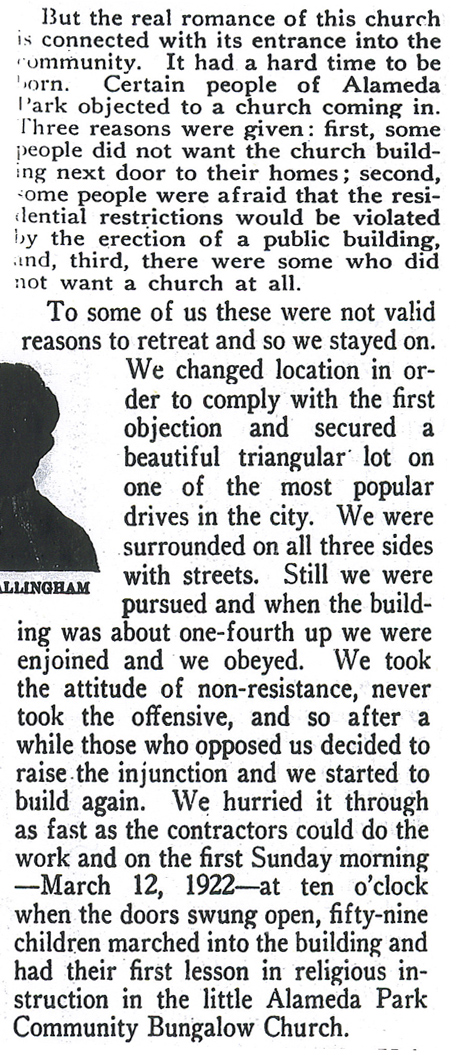
In order to appreciate what The Rev. Allingham is about to tell us, you have to know that some in the Alameda Park neighborhood were up in arms about the construction of the church at NE 30th and Mason. Several protests were organized, a petition got up, and a fair amount of consternation resulted, including relocation of a construction site. The story hits close to home for us because the leading petitioners were the folks who lived in our house for 50 years, and the original intended construction site are the two lots immediately north of us.

Let’s catch up with The Rev. Allingham: 

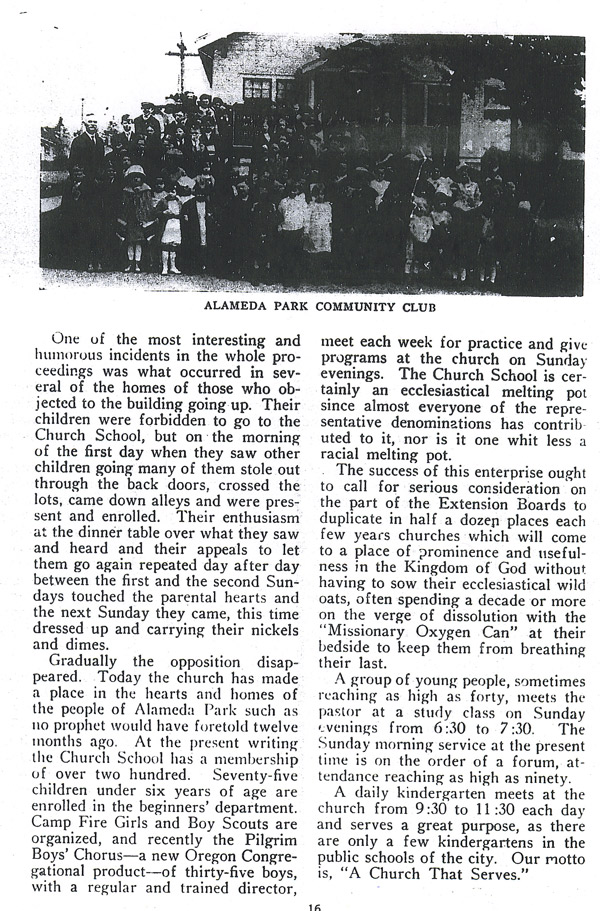
The turning of the other cheek. He continues:

The reference to the children from the homes that objected to the church: that’s probably Bruce and Jean Morrison who lived here and were probably some of those kids who snuck out the back door of home to check out Sunday mornings at the Bungalow Church. Hmm. And the church seems to have served the community up into the 1950s and early 1960s. We’ll continue looking for additional stories and articles that chronicle the building’s life and times. In the meantime, with The Rev. Allingham’s words in our minds, stroll past the building at Regents and Mason and listen for the echoes of all those children.

Alameda Park Community Church Drawings Found

If you’re a long-time reader of the blog, you’ll recall our piece on the controversy about construction of the Alameda Park Community Church (click here for that page). As a reminder, in the Fall of 1920, neighbors were not happy about plans to build the church on two lots at the southwest corner of 30th Avenue and Mason. The former owners of our house—Walter and Edith Morrison—led a campaign to oppose the building, and then to relocate the planned construction one block east to the island at the corner of Mason and Regents where it was ultimately built (but not before trying unsuccessfully to kick it out of the neigborhood altogether) .

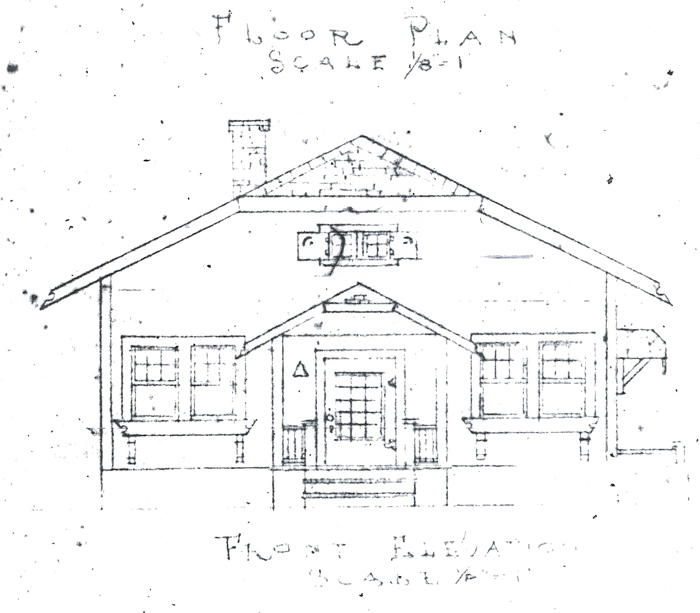
While researching recently through building permits and related documents filed on microfiche, we came across the original drawings for the building, all filed for construction at 30th Avenue and Mason. Take a look:

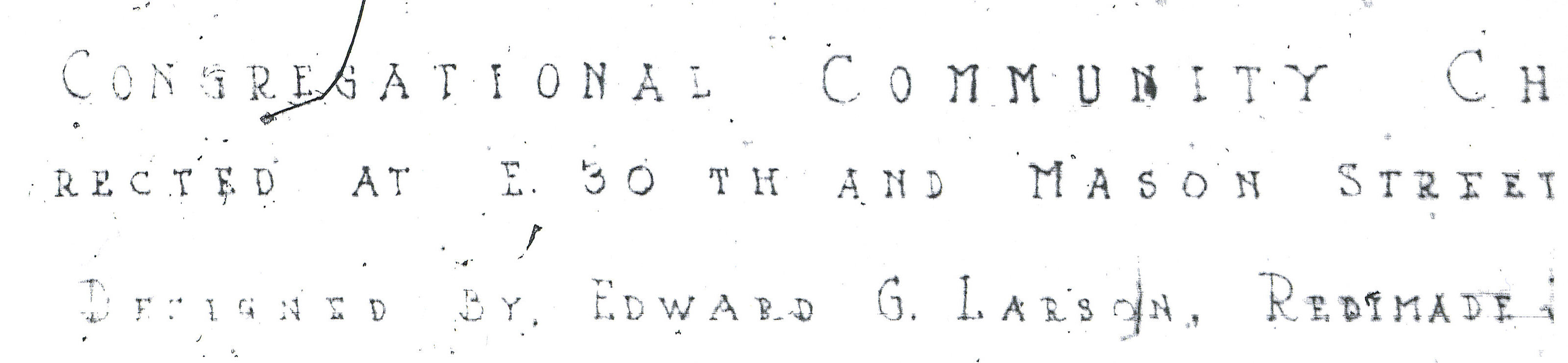
Detail from elevation drawings filed with construction documents for the city’s permit process. Note that the building was designed by architect Edward G. Larson, working for Redimade Building Company (which was based in Portland).

The church building, now known as the Subud Center, is still going strong and a neat place for meetings, events and large family gatherings.

We continue to keep any ear out for stories, memories and photos of this building. Have something you can share?

More on Harry Phillips

We’ve known there are many other Portland homes and buildings yet to be discovered that were built by Harry Phillips, in addition to the 19 we’ve found so far here in Alameda Park. Thanks to some attentive visitors to the blog, we have an important addition to make to the list.

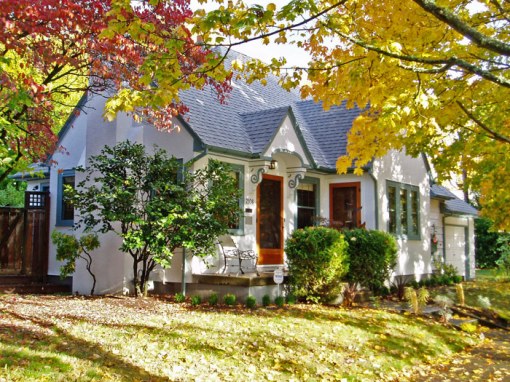
Prolific builder Harry Phillips built this English Cottage style Ladd’s Addition home in 1926 for his parents Henry and Louise Phillips. Photo courtesy of Tami and Brian Clare. 

The Henry and Louise Phillips home—located at 2108 SE Cypress—is a special English cottage that Harry built for his parents in 1926. Current residents of the home—Tami and Brian Clare—found our biography of Harry (click here to read the Phillips bio), which triggered a connection to their home. Tami and Brian had seen Harry’s name in the documentation about the house that was submitted as part of the Ladd’s Addition National Historic District nomination package. After visiting the blog, they put two and two together, and sent me a quick e-mail sharing their observation.

According to the nomination: “The house was built by building contractor Harry Phillips for Henry Phillips, possibly a relative, a machinist for Southern Pacific Company, who lived in the house with his wife, Louise.”

Brian and Tami wrote us with the following thoughts about the house:

“We love the style of our home, and so it was very exciting to find your website and know that there are other Harry Phillips homes in Portland!”

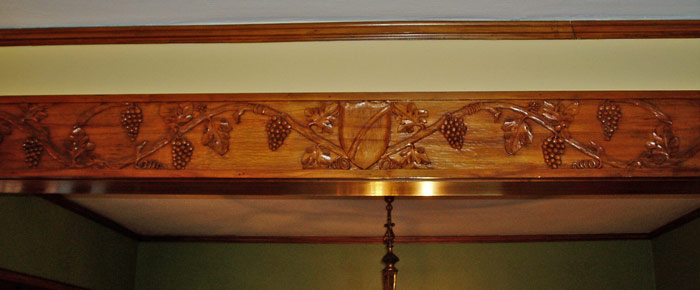
They were as excited to learn more about Harry as we were to find this special home he built for his folks. They also shared a photo of a carved ornamental beam, similar to beams found in other Phillips-built homes. Harry’s son Jerry attributes the design of the beam to architect George M. Wolff, who is believed to have designed many of Phillips’ homes.

Detail of a hand-carved beam, Henry and Louise Phillips Home. Photo courtesy of Tami and Brian Clare

Thanks to Tami and Brian for making this connection. We’ve recently put them in touch with Jerry to tell him about his grandparents’ home and to ask a few questions of their own.

In the process of perusing building permits for other research, we’ve come across another Phillips home to add to the list: 3035 NE 23rd.

Next to builder Frank Read, who built at least 20 homes in Alameda, Phillips was the busiest builder in this neighborhood.

Alameda Home Listed on National Register

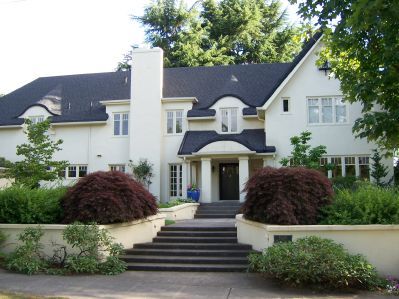
Word has arrived from Oregon’s State Historic Preservation Office (SHPO) that a prominent home in Alameda has been placed on the National Register of Historic Places: the Edward and Bertha Keller House, located at 3028 NE Alameda Street.

The Edward and Bertha Keller House, 3028 NE Alameda. Photo courtesy of Oregon SHPO.

Here’s the official word from SHPO, which was shared via the Oregon Preservation e-mail list:

Constructed in 1924, the Keller House is important as an example of the early works of master designer Elmer E. Feig and the English Cottage Revival style. Feig began his career in 1921 when he obtained a building contractor license while employed by the City of Portland Buildings Bureau as a plans examiner. Feig’s early work included a handful of homes, but he quickly transitioned to apartment buildings where he creatively merged a variety of European-revival styles such as Tudor, Spanish Colonial, Mediterranean, and California Mission. Among his commissions are 24 properties noted in the Portland Historic Resource Inventory as “having architectural merit” and the National Register-listed Spanish Colonial Revival-style Santa Barbara Apartments built in 1928.

SHPO has placed a copy of the nomination form on its website. Do take a look, (click here for a PDF of the application) which will give you appreciation both for the home, and the thoroughness of the application and review process.

This brings to five the total number of homes in the original Olmsted Park or Alameda Park plats that have made it onto the list. The other four are the Thomas J. Autzen house, located at 2425 NE Alameda; the Thomas Prince House, located at 2903 NE Alameda; the Louis and Elizabeth Woerner House, located at 2815 NE Alameda; and the Oliver K. and Margaret Jeffrey House 3033 NE Bryce.

Old School


Alameda School, 1923. Picture taken looking southeast from the corner of NE 27th and Fremont. OHS image OrHi 105623.

We received word last week from Portland Public Schools that they’re sharing an inventory of their many historic properties, including our favorite Alameda Elementary School, and nearby Beaumont Middle School.

You can find these reports and many others at this link, which is interestingly housed within the Office of School Modernization.

Looks like Alameda faired well in the analysis in terms of its historic integrity, but Beaumont–due to many alterations made over time–did not. Both buildings were designed by George Jones, the one-man Portland school architectural institution (actually two man institution, his father Thomas had also been architect for the Portland School District years earlier).

The good news for Alameda Elementary School is that it scores well as a candidate for listing on the National Register of Historic Places. Perhaps a small group of interested parents and historic building fans might be up to the task…? Count us in if we can find a quorum.

Be sure to have a look at these other posts related to Alameda School.

Save the Date: January 23rd Alameda History Presentation

Interested in learning more about Alameda? I’m doing an education program for the Architectural Heritage Center, which has been rescheduled to Saturday, January 23rd from 10:00-11:30 in the Center’s auditorium on Southeast Grand Ave. It will be a good opportunity to have a closer look at the evolution of Alameda, and specifically at several of the prolific builders and their design styles that have shaped the neighborhood we know today. It’s also a great excuse to drop by and get to know the Architectural Heritage Center a little better. And you might even meet a neighbor or two!

You can find more information about the program, and a link to registration, at the AHC website: http://www.visitahc.org/content/upcoming-programs