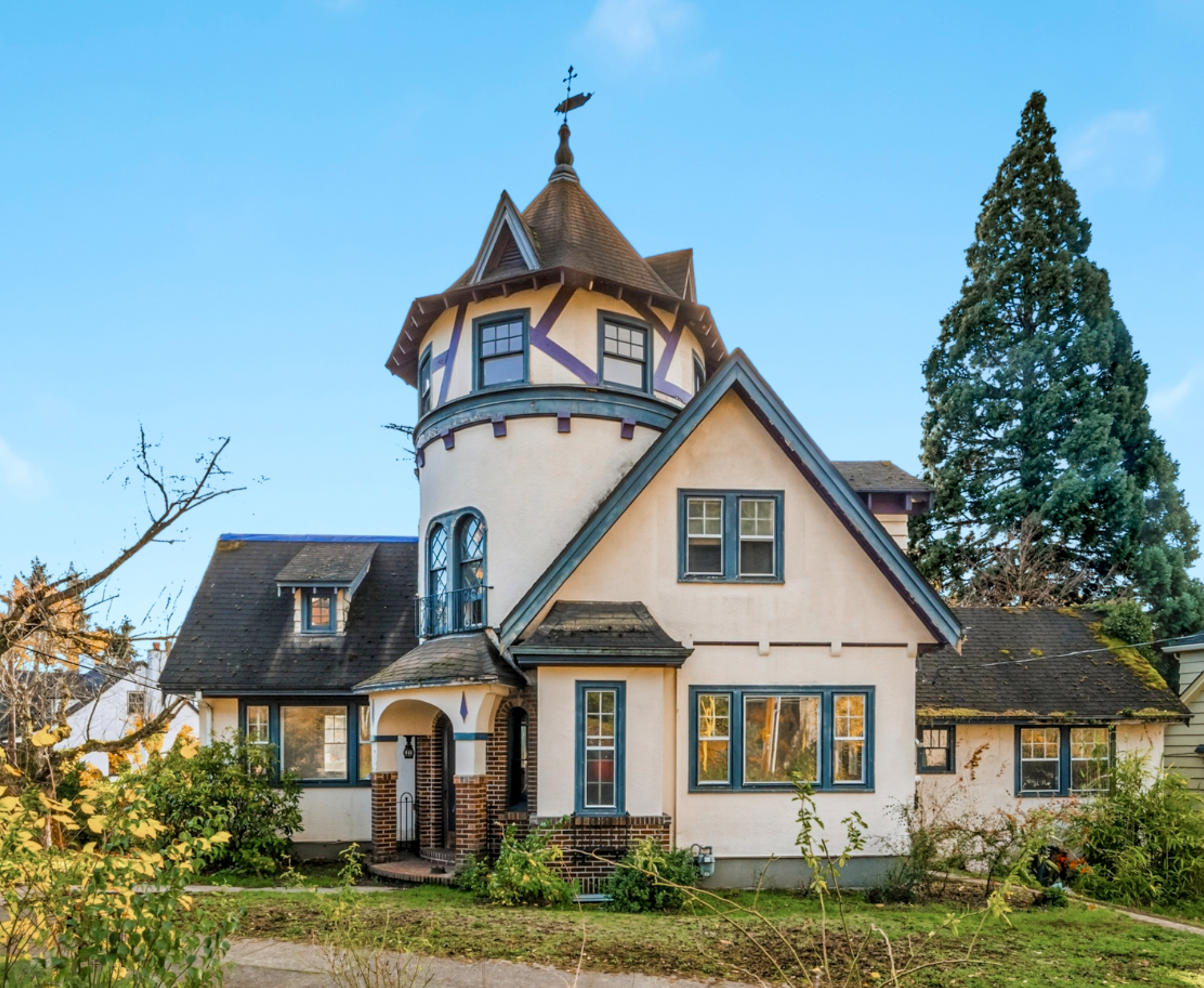
It’s always been a visual landmark on NE Wistaria Drive: the 1928 turreted English Tudor style house that anchors the big downhill bend at the confluence of Wistaria, NE 41st and Cedar Chavez Boulevard. The tower with its tip-top weather vane, 360-degree windows and tent-like roof dormers. The prominent gable ends and half-timbering. The brick, decorated entry way.
They don’t build them like this anymore.
For more than 30 years, we’ve walked by and felt the cry for help from the house and its former owner—who passed away in August—as the weeds took over, the windows cracked, the porch sagged and garbage piled up.
Neighbors are paying extra attention this week because the Wistaria turret house is now for sale. Many are hoping for a capable, patient, history-focused buyer who can bring it back to life.
We walked through this week to take a measure of how much work there is to be done. It is a major fixer-upper. All the building systems will need to be replaced and upgraded: electrical, plumbing, heating and ventilation; new kitchen, new roof. Every surface, finish, floor and window needs TLC. The foundation needs attention too, perched as it is on the slope of the ridge. Don’t forget the landscaping.
While the amount of work to be done is staggering, so is the grace and beauty of the original construction and the uniqueness of so many of the home’s interior spaces. There’s nothing else quite like the top turret room.
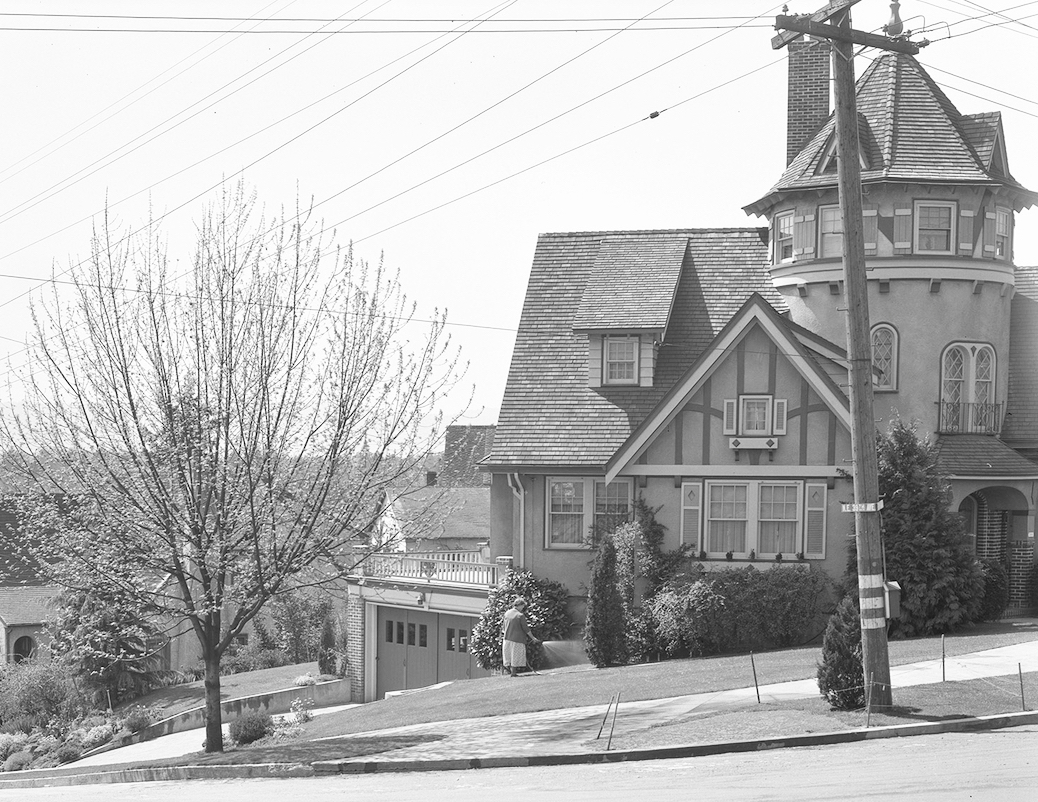
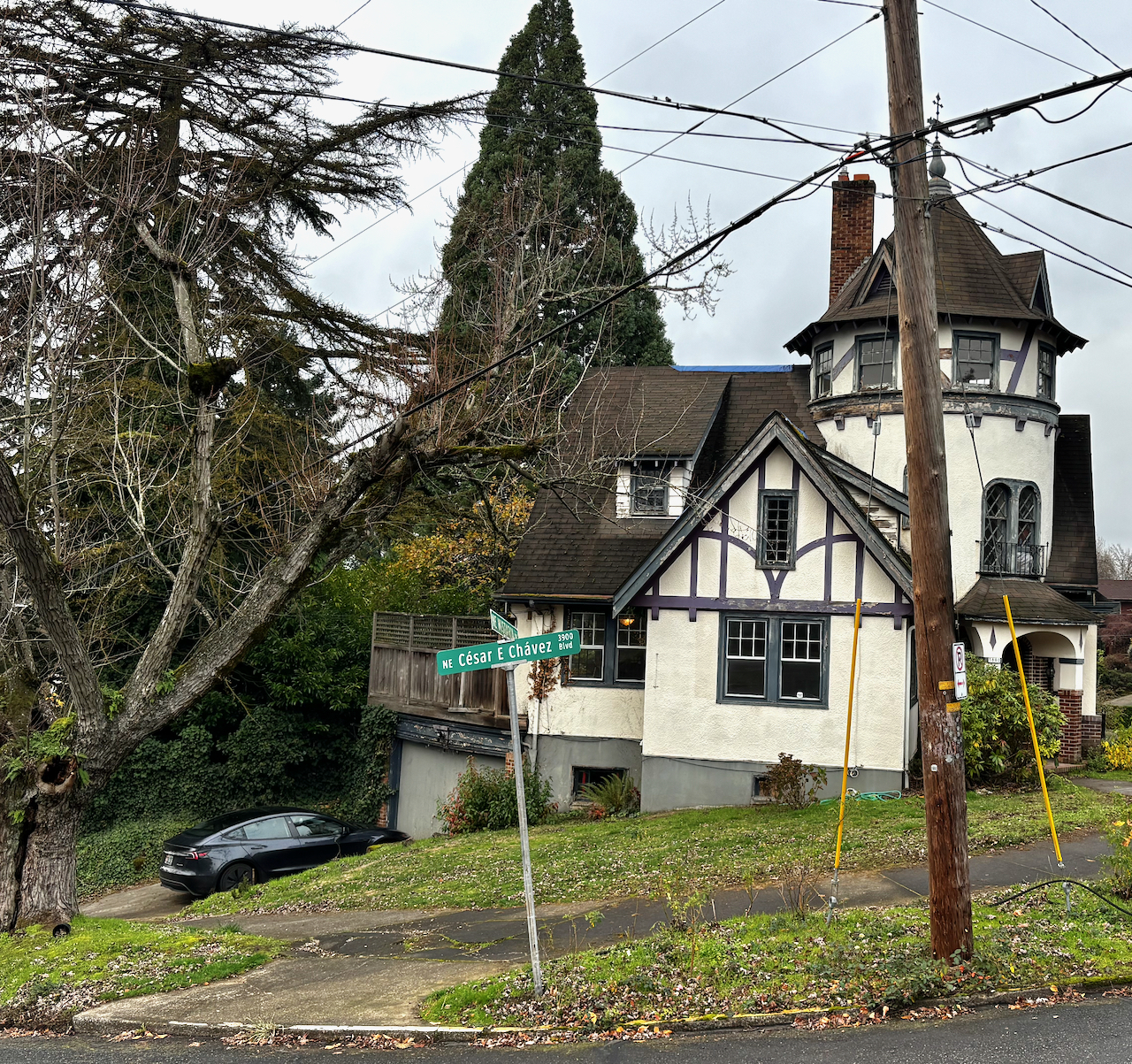
Check out this view of the house from April 1935, showing original owner Anna Hummel watering the garden (photo courtesy Portland City Archives AP/25295) and today.
3880 NE Wistaria Drive is listed by Cee Webster with Neighbors Realty. Cee has a deep appreciation for the character of the house and the reality of the work at hand, and has shared photos which you can find here. Cee will be accepting offers until December 8th at 9:00 a.m
In some ways, the complexity of the house mirrors the story of its earliest years. Built in 1928 by Jens Olsen for German immigrant Carl Hummel and his American wife Anna, the house embodies design aspects from Carl’s growing up years in Reutlingen, Germany.
Carl was a tailor. He and Anna arrived in Portland from Quincy, Illinois in 1907, and operated a tailoring, cleaning and dye business at NE 22nd and Sandy.
In the mid 1930s when trouble was brewing in Germany, Carl, then in his 60s, wanted to be back in his homeland. Working through an intermediary here in Portland, Carl arranged an exchange of homes and businesses with a Jewish German family who were trying to flee to the U.S. but had been blocked by the German government. Correspondence, telegrams and other documents archived by the United States Holocaust Memorial Museum convey the complexity of the exchange.
The situation for the fleeing German family was becoming dire; time was running out. The back-and-forth correspondence is steeped with anxiety and barely-contained impatience, but also with respect. If the families could organize a trade, neither would need to send money across international borders, which was forbidden.
Finally, in November 1936 with an agreement in place and papers approved, Carl and Anna moved home to Germany. Not long afterward, the very relieved Lowen family from Görlitz arrived in Portland as the new homeowners of the turret house on Wistaria. They became naturalized citizens and lived in the house for more than 30 years.
We’ll explore this story—and the unfolding next chapter of the turret house—in future posts.
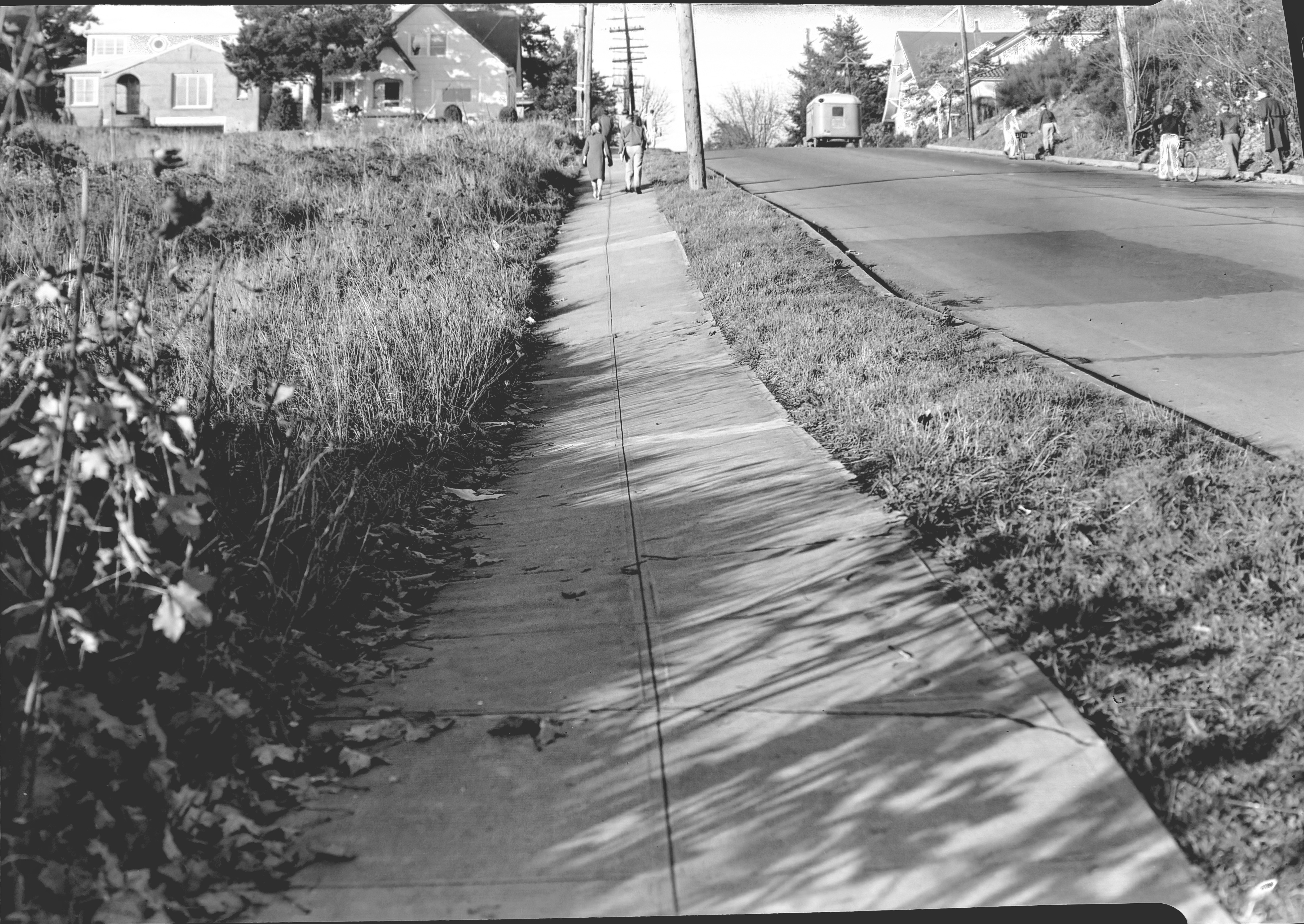
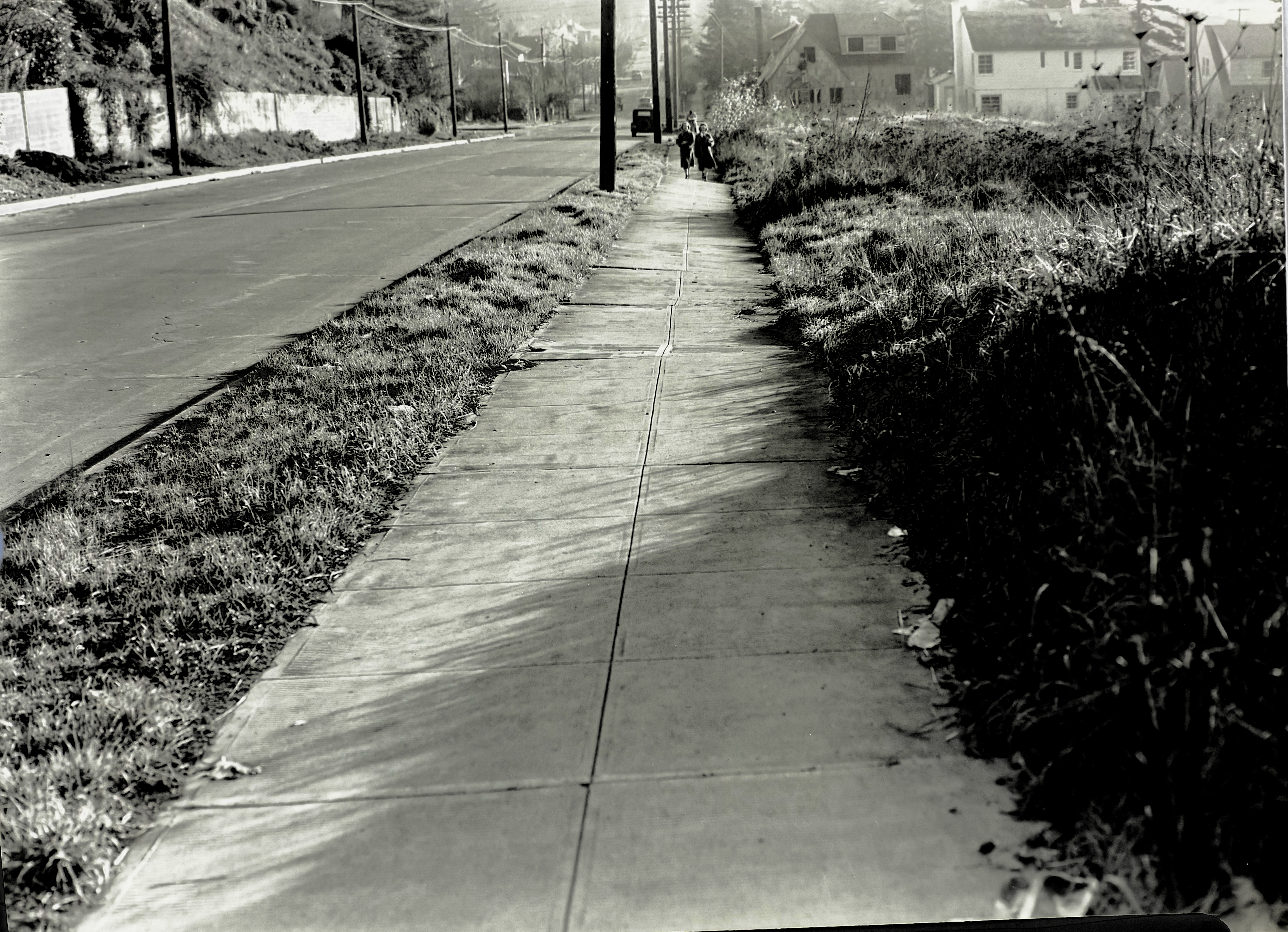
Here are two more views of the general vicinity taken 25 years later that show us how the slope was settling after being filled with garbage and soil. Photographed by the Public Works Department on November 21, 1938, these views look uphill and downhill on 33rd from just below the top of the hill. Click in for a good look and then we’ll discuss:
Looking north along the west side of NE 33rd, just downslope from NE Fremont. Image A2009.009.1272, courtesy of City Archives.
Looking south along the west side of NE 33rd, just downslope from NE Fremont. Image A2009.009.1271, courtesy of City Archives.
Judging by the sunlight and shadows–and what looks like an exodus from Grant High School–these photos were taken in the afternoon of that November day. The uphill photo shows just how much the mid-slope has settled, with the curb and street surface buckling and the entire sidewalk heaving to the west. Nothing has been built on these vacant lots, probably because they were still settling.
Look a bit farther up the hill and you can see two brand-new Ken Birkemeier houses at far left (3279 NE Fremont), perched on what had been the cutbank, and the bungalow to its east at the corner (3289 NE Fremont). Across the street farther east you can see the high-peaked roof of the home at 3304 NE Alameda, and the distinctive tile roof of the Mediterranean-style house at 3301 NE Fremont.
Also interesting to note: no signal light controlling the intersection, nor is there a stop sign facing 33rd (can’t read what is on that sign, but it’s not the standard octagonal STOP sign we know today, which was in common use by 1938). Perhaps Fremont had the stop sign and 33rd had the right of way.
Yet to be built at the top of the hill on the southwest corner was a mid-century home and swimming pool that would eventually collapse into the old pit area and be replaced in the 1990s by a much larger house (and geotechnical engineering). We wrote about it here: The lost house at 33rd and Fremont.
The downhill photo looking south shows just how much the sidewalk wants to fall off into the old pit. Below the pedestrians you can see a house under construction–3289 NE Klickitat, also by Ken Birkemeier who was very busy in this part of the neighborhood during those years.
Today we have Google streetview to document so many aspects of our neighborhood, but it’s been a treat to turn back the clock with these and the 1913 photos. We’re always on the lookout for early photos of our Northeast neighborhoods. Stay tuned for more findings. The promised Columbia Slough photo from 1913 is next.
Post Script:AttentiveReader John Golightly adds his observations that the sign at the intersection probably was a “SLOW” sign, which we agree with. Here’s a photo of a 1930s-era slow sign in its characteristic diamond shape:
Last weekend marked the final public tour of the A.L. Mills Open Air School at the southwest corner of SE 60th and Stark in the Mt. Tabor neighborhood.
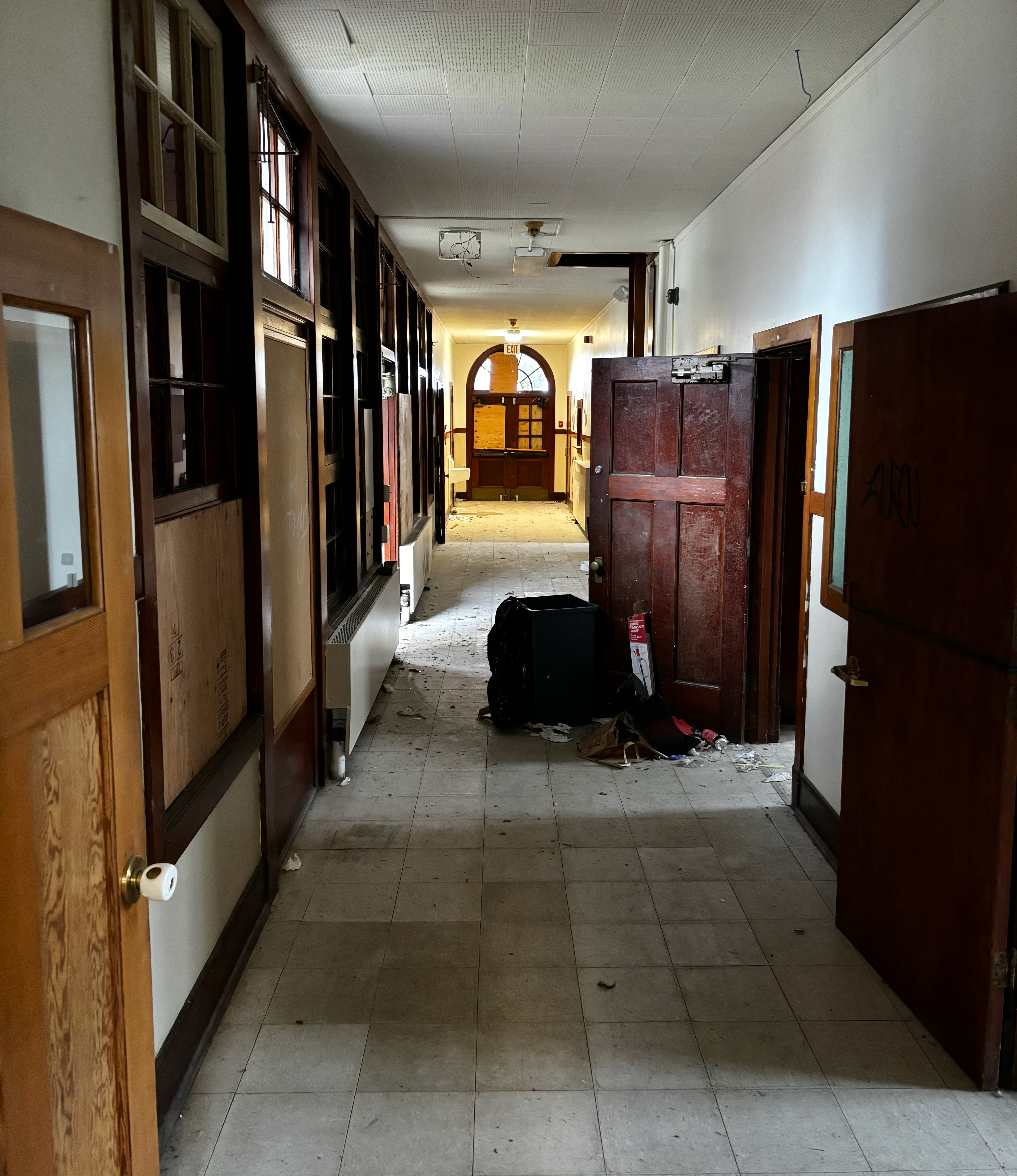
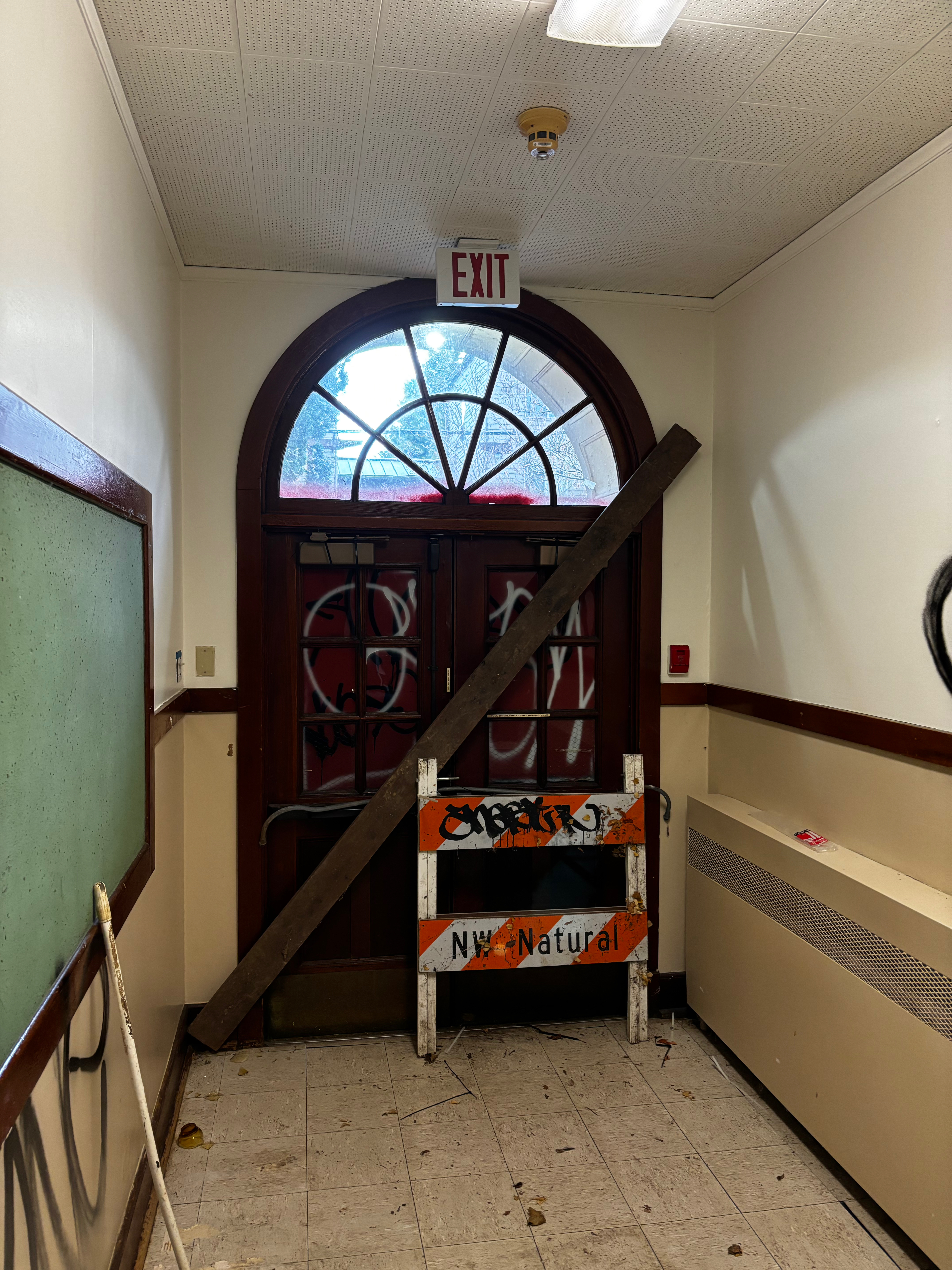
The empty long hallway at Open Air School, December 2024. The building has been empty since 2019.
The former school building, built in 1918-1919, will soon be deconstructed by the Portland Housing Bureau (PHB) to make way for an affordable housing development. For the last six weeks, we’ve been working with the Bureau and the Mt. Tabor Neighborhood Association to share stories of the building with neighbors and anyone interested in having a last look.
Some came because they’ve watched the old school’s recent decline, seen the graffiti and cyclone fence sprout and wondered what was inside. Others came because they’ve had connections to one of the four chapters of its earlier life. Everyone wanted to know what would come next.
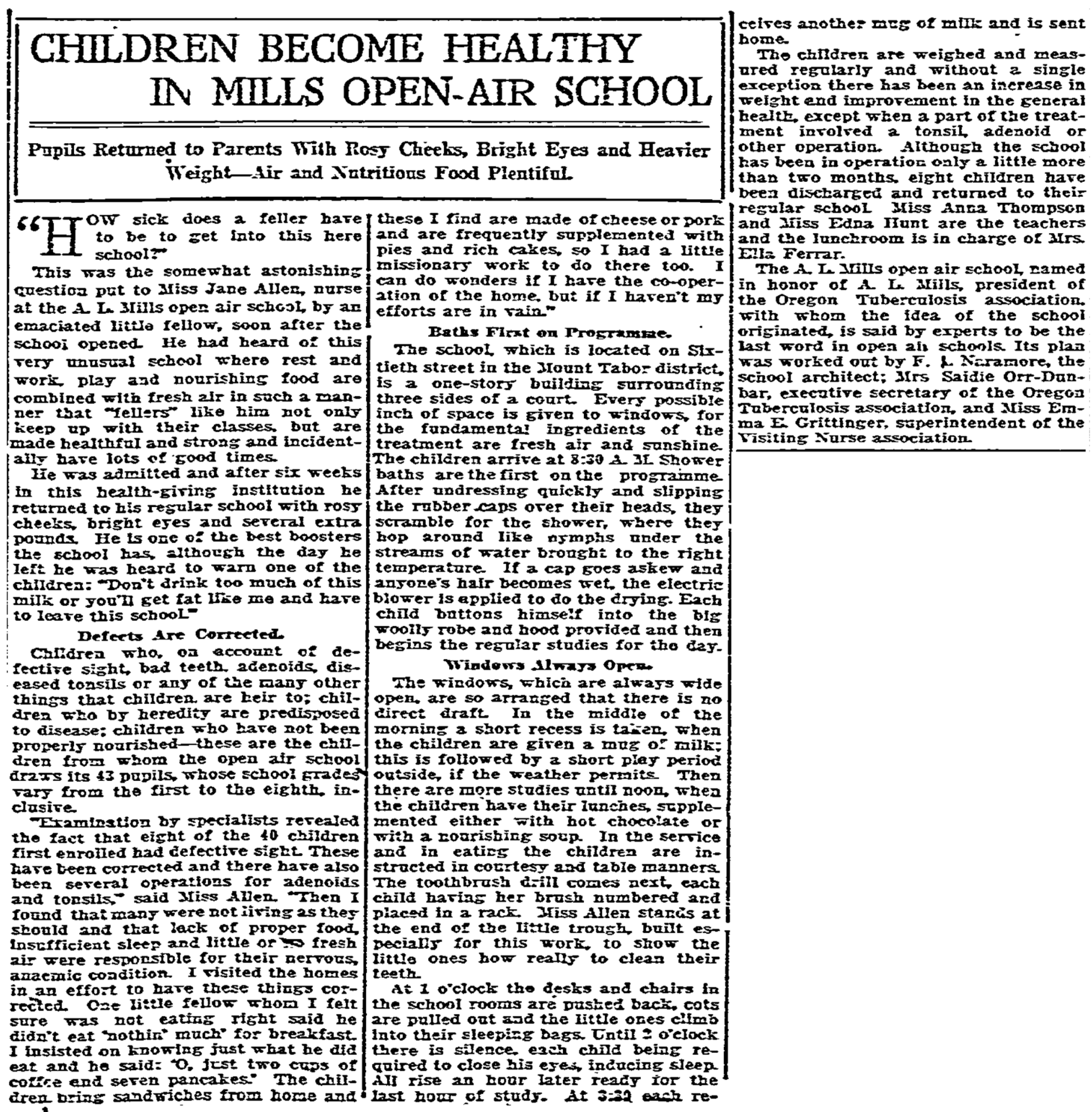
A.L. Mills Open Air School first of its kind
When it opened in 1919, the Abbott L. Mills Open Air School put Portland on the map nationally and internationally as the nation’s first entirely purpose-built open-air school, meaning that students and teachers spent their entire school day surrounded by fresh air. A handful of other communities across the country had experimented with a classroom here or there in an existing school. In Portland, the original Irvington School featured one open air classroom where the windows were open all day, all school year.
But with financial help and encouragement from the Oregon Tuberculosis Association, Portland Public Schools was able to build an entire school dedicated to helping “low vitality children” improve their health and therefore their resiliency to tuberculosis, which was a serious health threat of that era killing hundreds of thousands of people of all ages in the U.S. during the 1920s.
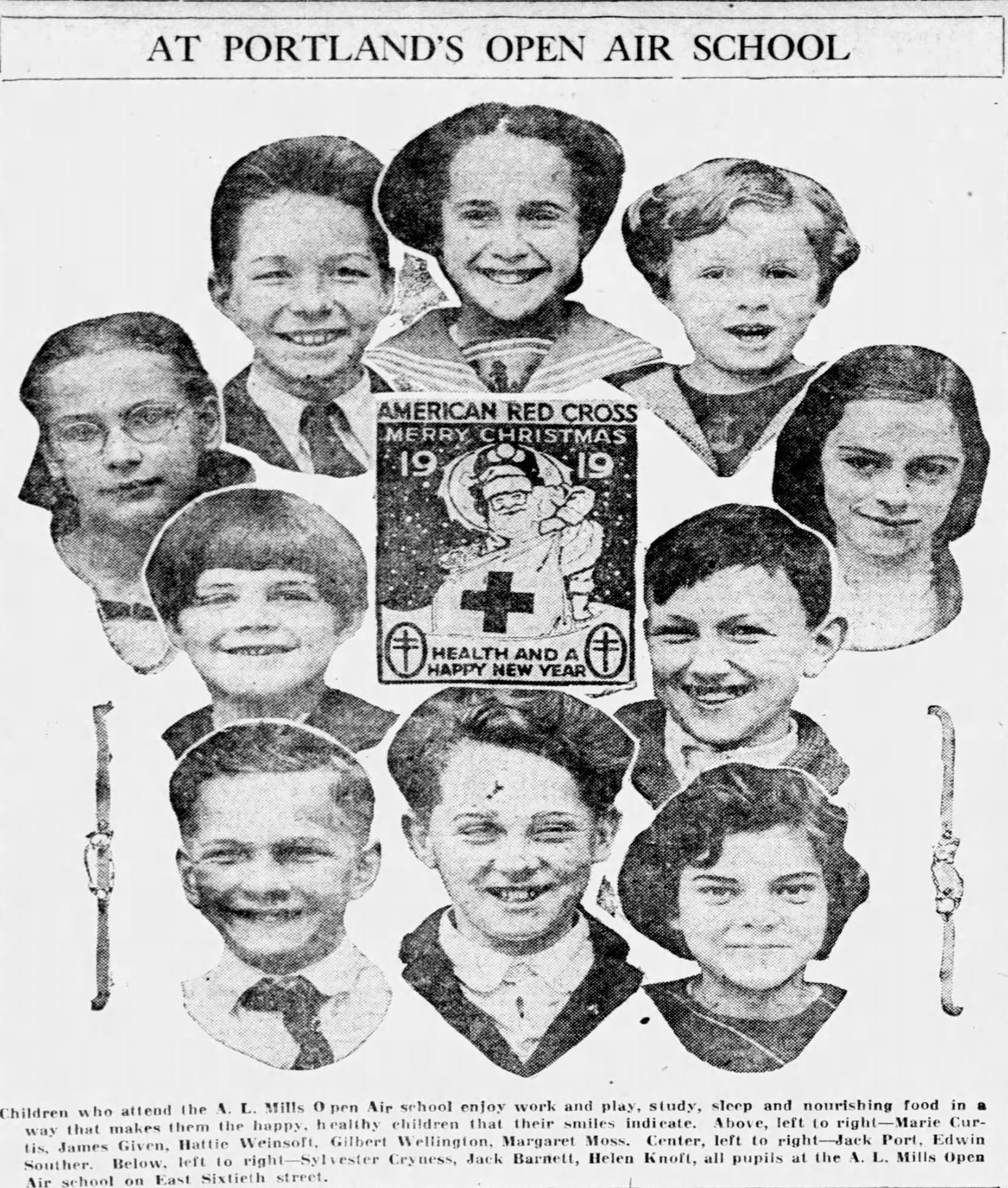
From the Oregon Journal, November 30, 1919
The Oregon Tuberculosis Association was led by Abbot L. Mills, former Oregon Speaker of the House, philanthropist, president of the First National Bank of Portland, and chief organizer of the Portland Open Air Sanatorium for Consumptives. Mills, who earlier served as vice president of the 1905 Lewis and Clark Exposition, was a tireless public health advocate around tuberculosis, and the chief push on funding for the school, so it’s entirely appropriate the building bears his name.
The open-air movement was an international public health philosophy based on the notion that being exposed to fresh, circulating air kept children, and people of all ages, healthier.
60th and Stark: Epicenter of Mt. Tabor community and Portland’s health spas
That’s why school and health officials selected the western slopes of Mt. Tabor, then a rural and bucolic elevated place distant from the churn of downtown Portland (Mt. Tabor was annexed into Portland in 1905). In 1902, the Portland Sanitarium opened just a block away at 60th and Belmont (site of the former Adventist Hospital). Another private sanitarium operated at 60th and Yamhill.
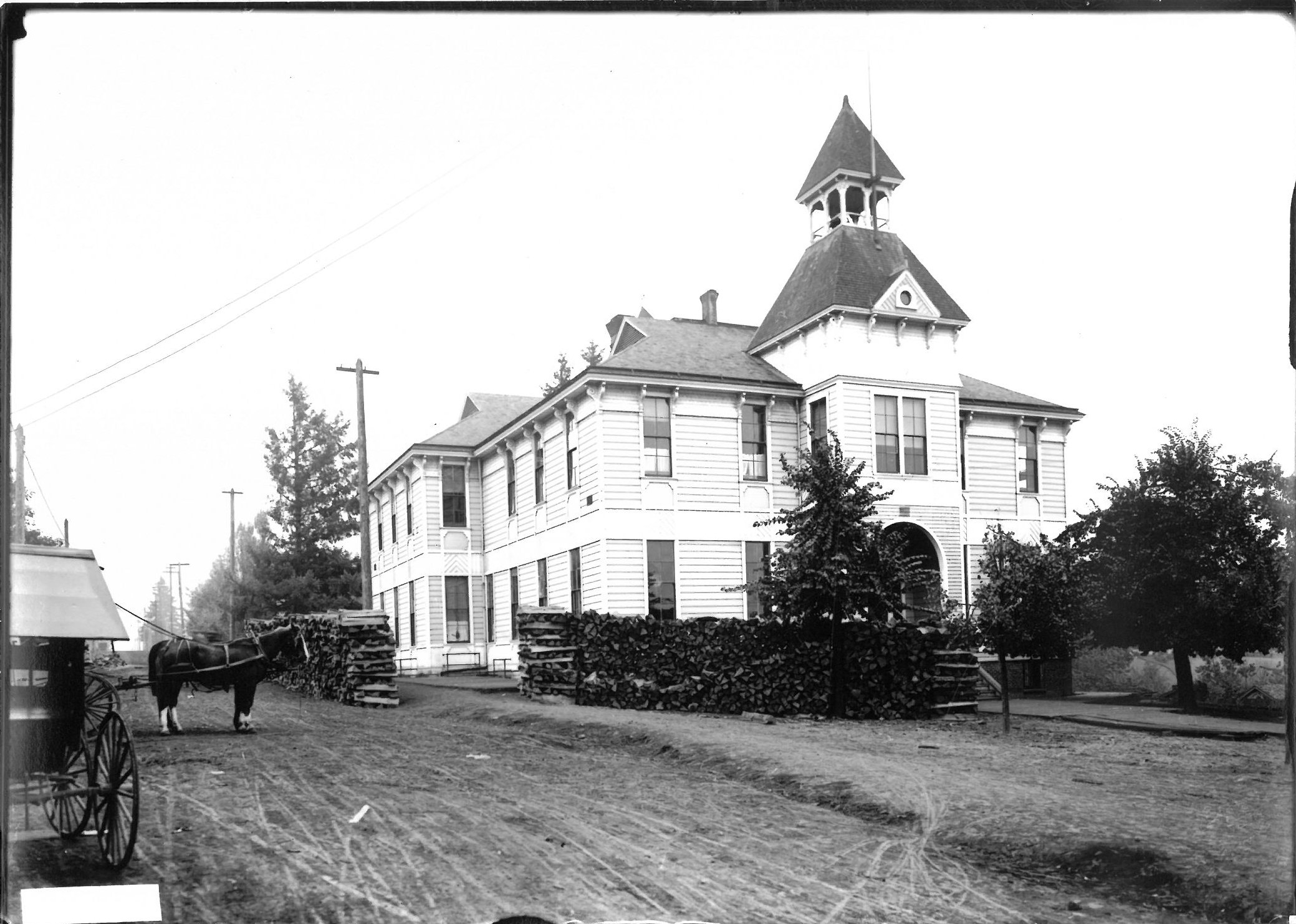
60th and Stark was also the crossroads and heart of the Mt. Tabor community. From 1880 until 1911 a former school operated on the site. Before that, a frontier school operated out of a log building in the same place.
Looking south on 60th at the corner with Stark (then known as Baseline Road), about 1907, four years before this school burned, clearing the site that has hosted the Open Air School since 1918. Drying cordwood is stacked for the furnace in the old school. Courtesy of the Oregon Historical Society, image Org-Lot-982, Box 8 Folder 6.
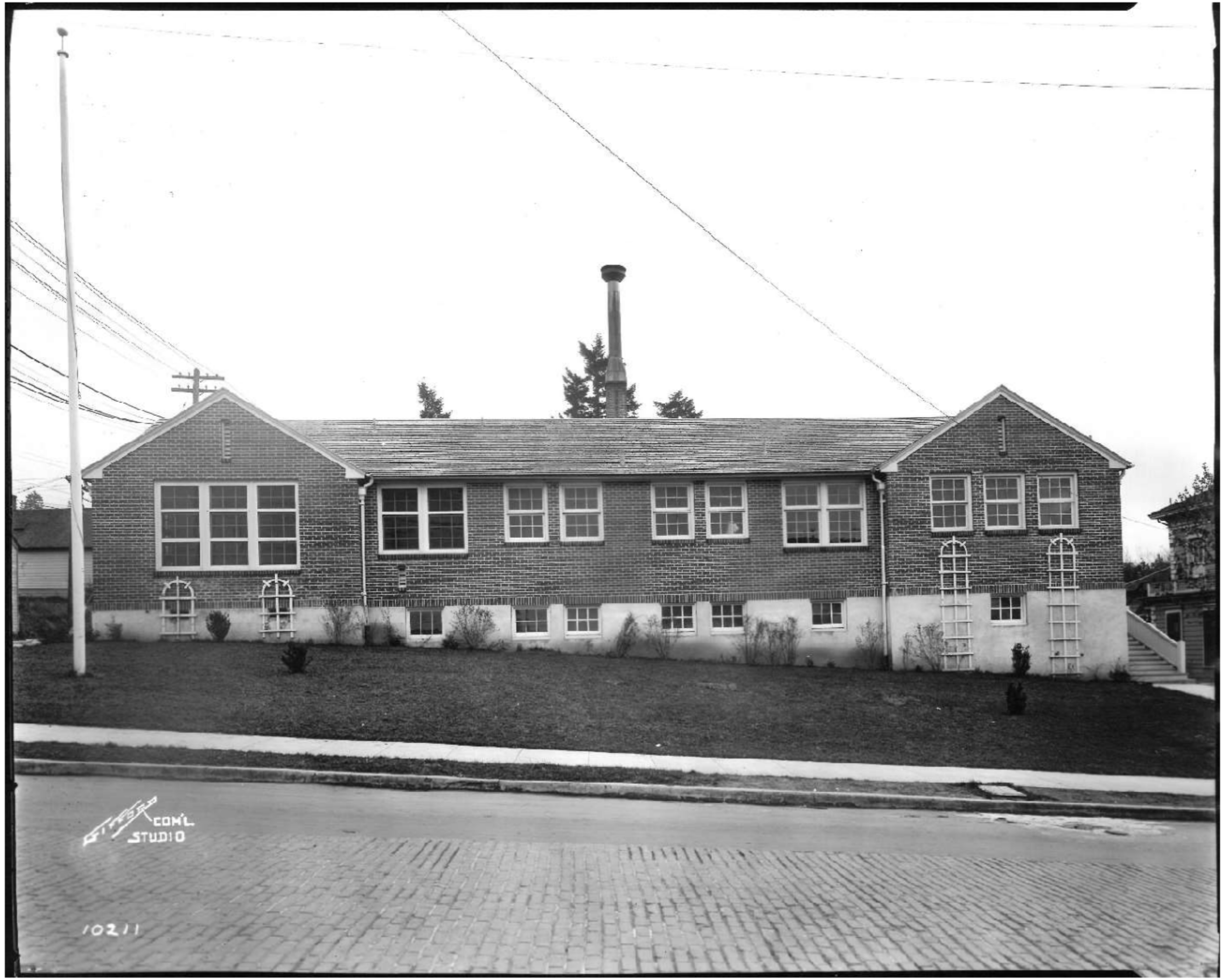
The two-room A.L. Mills Open Air School opened on January 27, 1919 with its full capacity of 50 students ages 5-15, two teachers and care team.
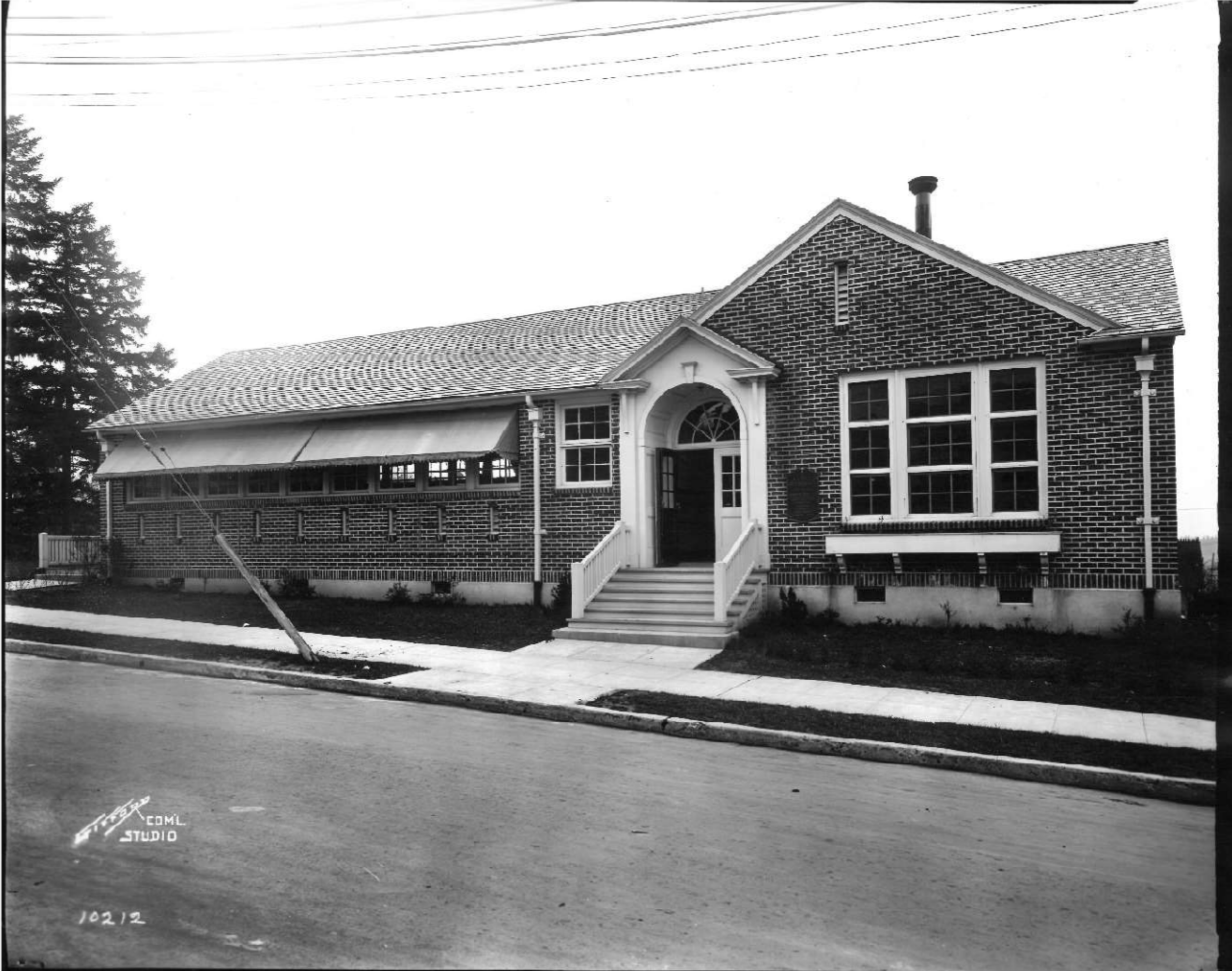
The Stark Street side of Open Air. Photograph Courtesy of the Oregon Historical Society, from the Ben Gifford Collection Box 8, Folder 5.Gifford photographed the school not long after its opening on January 27, 1919.
Miss Anna Thompson was principal of “Open Air,” its often-used nickname, and she never missed an opportunity to let everyone know her students were not tuberculous: they were children with health infirmities that made them vulnerable to TB.
Here’s an essay by Principal Thompson that appeared in The Oregonian on May 14, 1925:
“Because of the ardent interest and material support given by the Oregon Tuberculosis Association in the early history of the school, many people believe ‘Open Air’ to be a school for tuberculous children. This is a very grave mistake. Children who are tuberculous or infections from any cause whatsoever are not admitted. I want this fact impressed on parents and others. We are trying to prevent these children from growing into defective conditions–the purpose is preventative not remedial.“
Got that? Not a place for sick children: Miss Thompson and her colleagues were trying to keep them from getting sick.
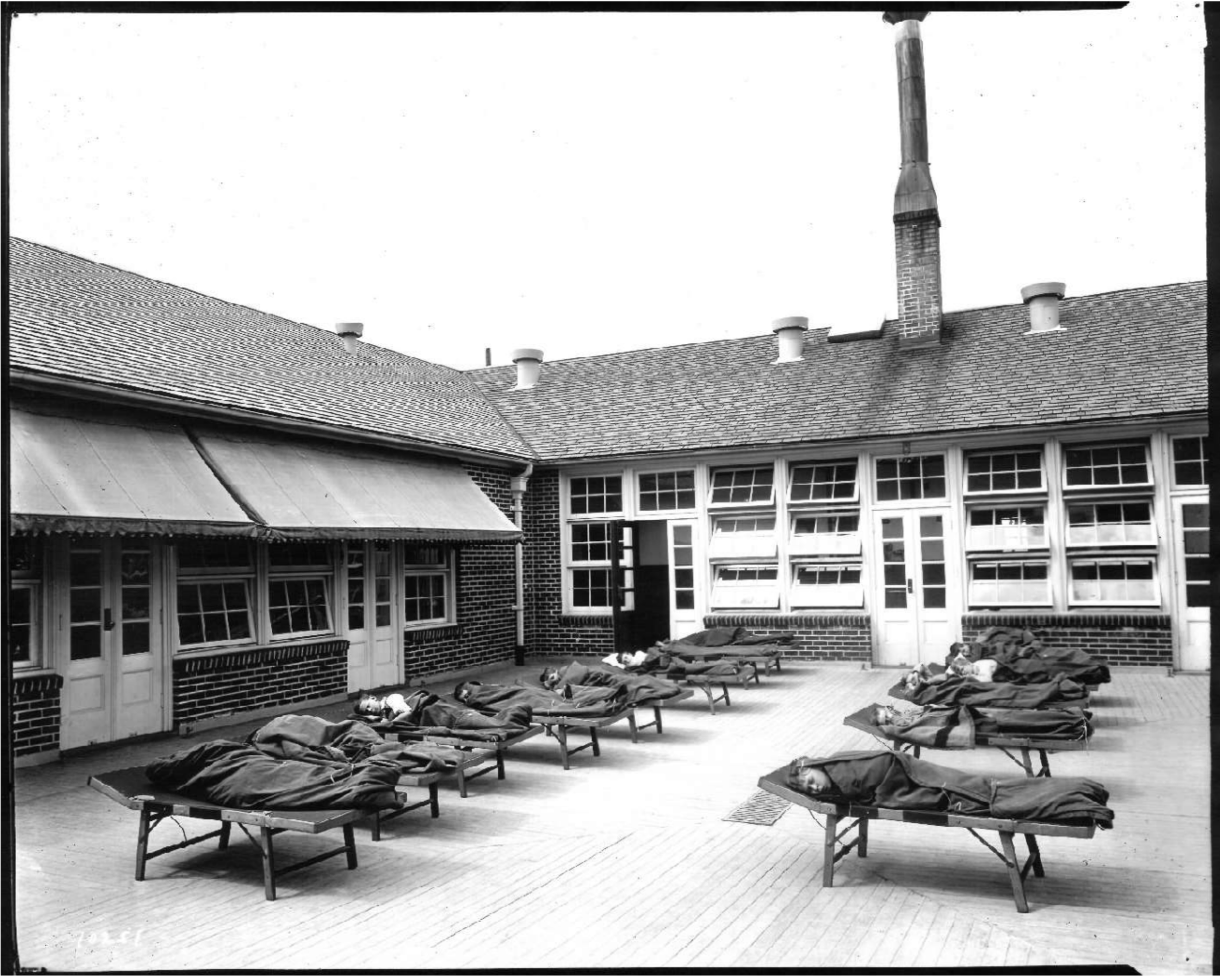
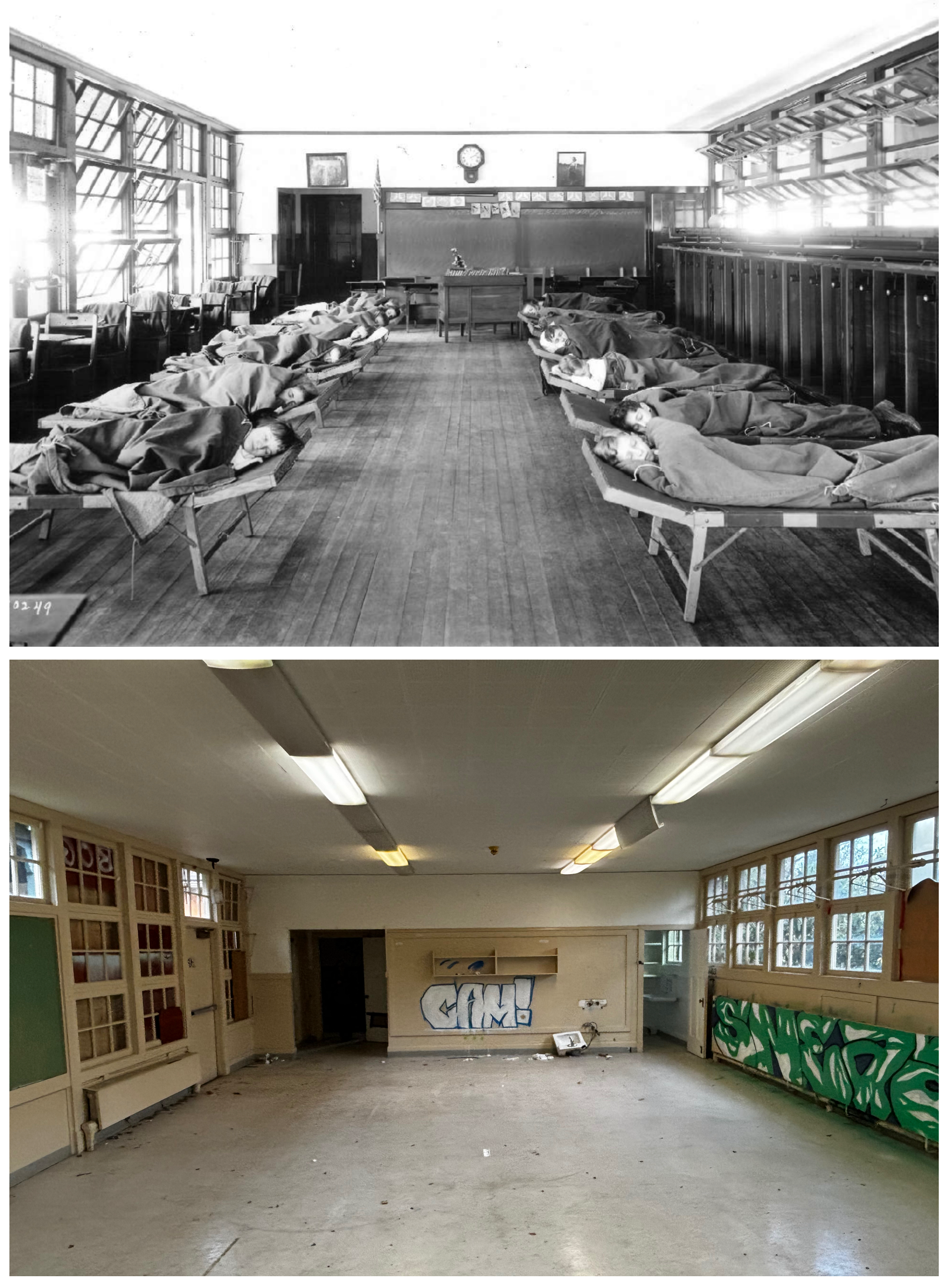
Afternoon nap time at Open Air. Photograph Courtesy of the Oregon Historical Society, from the Ben Gifford Collection Box 8, Folder 5.
Staff at Open Air included Principal Thompson, who also taught in one of the two rooms; a physician who was on site every Wednesday to examine each child; a full-time nurse; a matron who helped with showers, hygiene and meals; and a second teacher. The nurse visited each student’s home multiple times to make a plan with parents about how to work together and to keep tabs on progress.
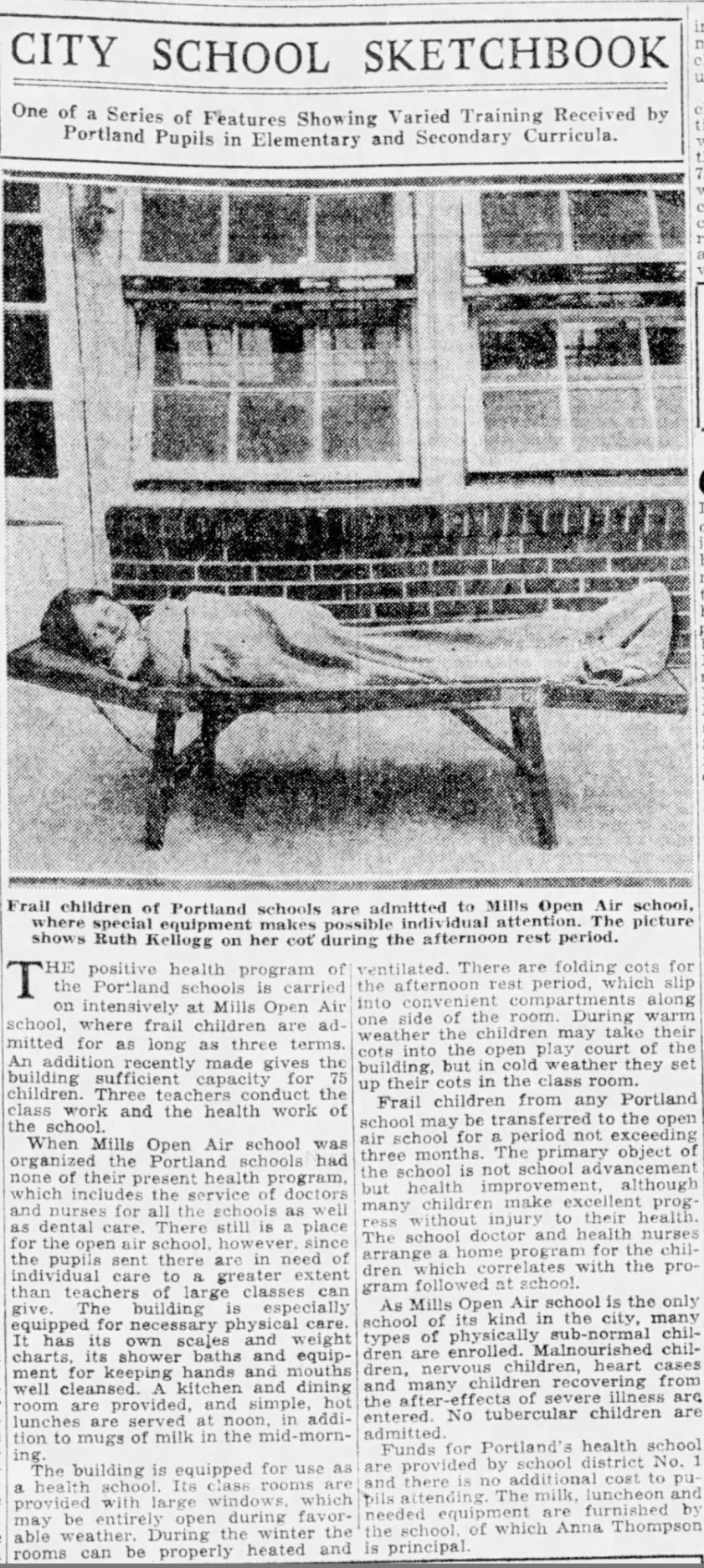
There were places for 50 students, drawn from all walks of life across the city. Their families applied and the children had to be examined by the doctor and nurse to be admitted, and to stay enrolled. Students could stay up to three terms to rebuild their weight and improve their health before going back to their neighborhood schools, so the composition of the student body shifted each term.
From The Oregonian, February 10, 1931.
In the 1920 school year, 77 total students were in attendance, which means 27 of them were “restored to health” and transferred back to their neighborhood schools, allowing other children to be admitted. The Oregonian in 1920 reported that at one point 15 of the 50 children were “only children,” who theoretically had the undivided attention of their parents–no siblings–a point that Principal Thompson liked to make, perhaps to bolster the fact that unhealthiness was not necessarily related to a lack of resources or attention.
A great description of a day in the life of Open Air ran in The Oregonian on December 10, 1922:
“Shower baths are the first order of the day at 8:00 and during this period once a week the pupils are weighed and inspected for symptoms of physical defects. After baths the pupils put on their sitting robes of heavy blanket material and enter the open window classrooms where they attend their studies until 10:25 at which time half a pint of milk is served in the lunch room to each pupil. This is followed by a period of supervised recreation. When the weather permits games are played on the court or lawn.
“The entire noon hour is given up in preparation for lunch, eating lunch, and preparation for rest. Getting ready for lunch requires washing face and hands, cleaning fingernails, combing hair.
“A copy of the menu of hot dishes for the following week’s lunches is sent home each Friday, so that the mothers will know how to supplement them with the right kind of sandwiches and other foods. For the past week, the menu has been: Monday, hot milk toast; Tuesday, apple tapioca; Wednesday, lamb stew with vegetables; Thursday, hot cocoa; Friday, hot rice”
“After the midday meal, the teeth are brushed and pupils returned to classroom where preparation for rest is made. Cots are spread with warm blankets and after a few vigorous breathing exercises, the rest period begins. At 2:00, the children rise from the cots, faces are washed and hair is combed and studies are resumed until 3:25 when milk is again served and the pupils are dismissed.“
From The Oregonian, December 10, 1922
In cold weather, the children wore heavy robes (pictured above) which were called “Eskimaux suits,” described like this in that same story:
“The brownie coveralls with hood provided by the school to be worn on chilly days are like a fraternity emblem among the pupils and are decidedly popular as their insignia of privileged rank. Sleeping robes are also provided, made of canvas lined with gray woolen blankets that launder well.“
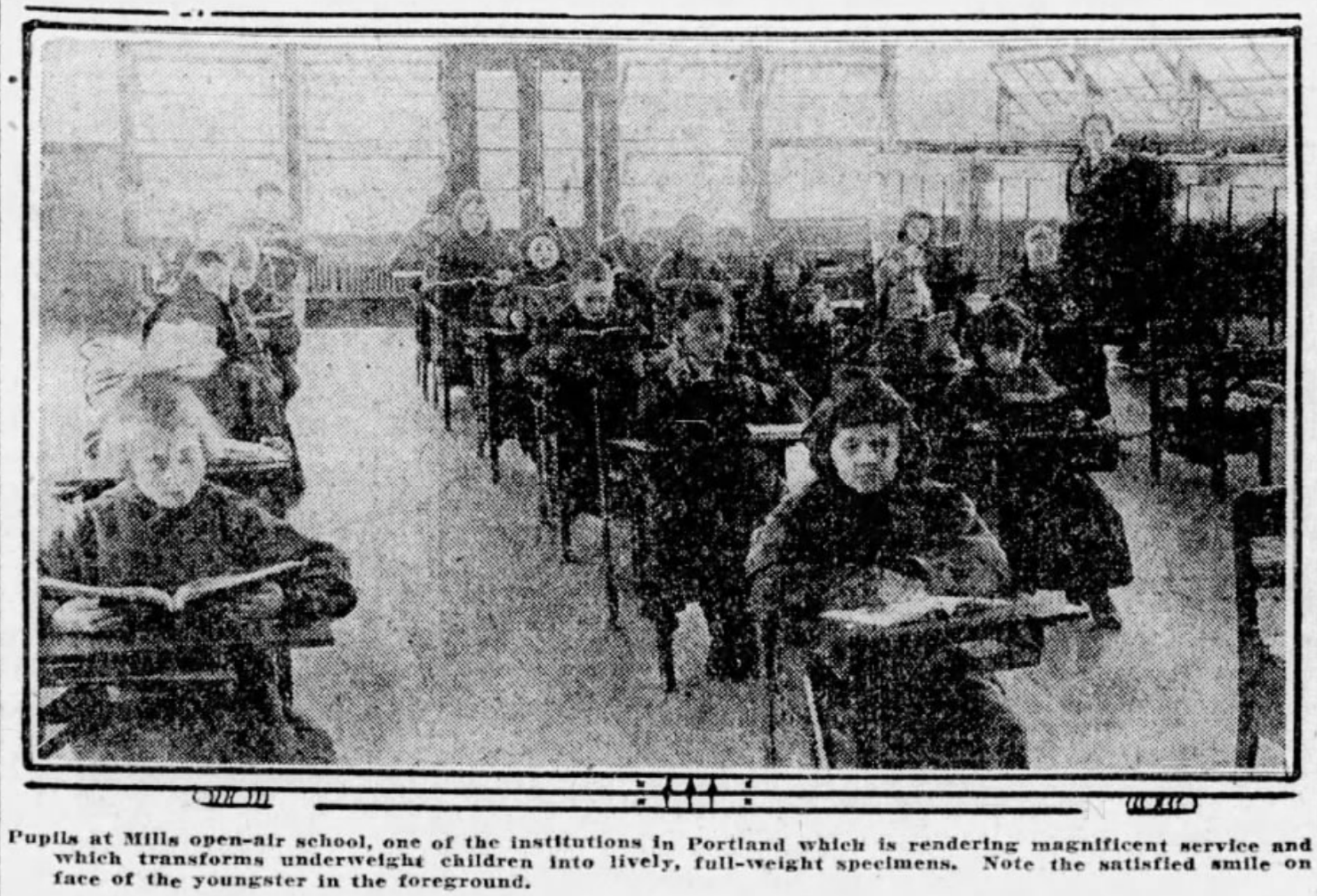
An observation of impact and results were noted in this story from The Oregonian on April 20, 1919, just a few months after the school opened:
From The Oregonian, April 20, 1919
Repurposed to meet current needs
By the late 1940s, the baby boom of Portland’s school-age children brought neighborhood schools to full capacity. With tuberculosis receding as a health threat and the need to make more space, the school board chose to close Open Air, sending students back to their neighborhood schools, and reconfiguring the building as Mt. Tabor Annex, the venue for all kindergarten and first-grade children from Mt. Tabor. A third classroom was built and the converted annex operated as a regular school until 1973.
When the population of school-age children receded, the building was surplussed, ending up in the portfolio of Portland Parks and Recreation, where it was once again repurposed, operating from 1974-1990 as the Mt. Tabor Community Arts Program and Community Theater Workshop.
Budget cuts in the 1990s ended the community arts and theater programs and the building was fallow for several years and on track to be sold to a private school operator, which ended up not happening. In 1994, Parks and Recreation leased the building to the YMCA, which operated it as a daycare for 25 years, until 2019. Operating costs and deferred maintenance ended that chapter just as the pandemic descended, and the old school was once again surplussed, eventually acquired by the Portland Housing Bureau. It’s been vacant since as the Housing Bureau has considered its options.
What’s Next
On each of the recent tours, PHB Capital Projects Manager Kate Piper explained to neighbors that the bureau will soon be deconstructing the old school and salvaging as much of the building material as possible. Redevelopment plans are not yet clear on what happens after that, or when, but removing the existing building from the site is a high priority to manage liability and to set the stage for future development.
This fall’s public tours of the building have helped resurrect and appreciate the stories of Open Air’s past. This time traveler will be going away, but the site has always been a place of change and evolution, meeting the community’s most pressing needs.
No one on the tours questioned the importance of housing, though most couldn’t help but be moved by the stories that have played out there: of Principal Anna Thompson and her team, the children—each on their own pathway to vitality—and the will of a community investing hope and energy in its most vulnerable.
With thanks to colleagues Paul Leistner, President of the Mt. Tabor Neighborhood Association; Kristen Minor, Architectural Historian who completed a detailed survey of the property; and Kate Piper at PHB for recognizing the importance of sharing the Open Air story and connecting with the neighborhood.
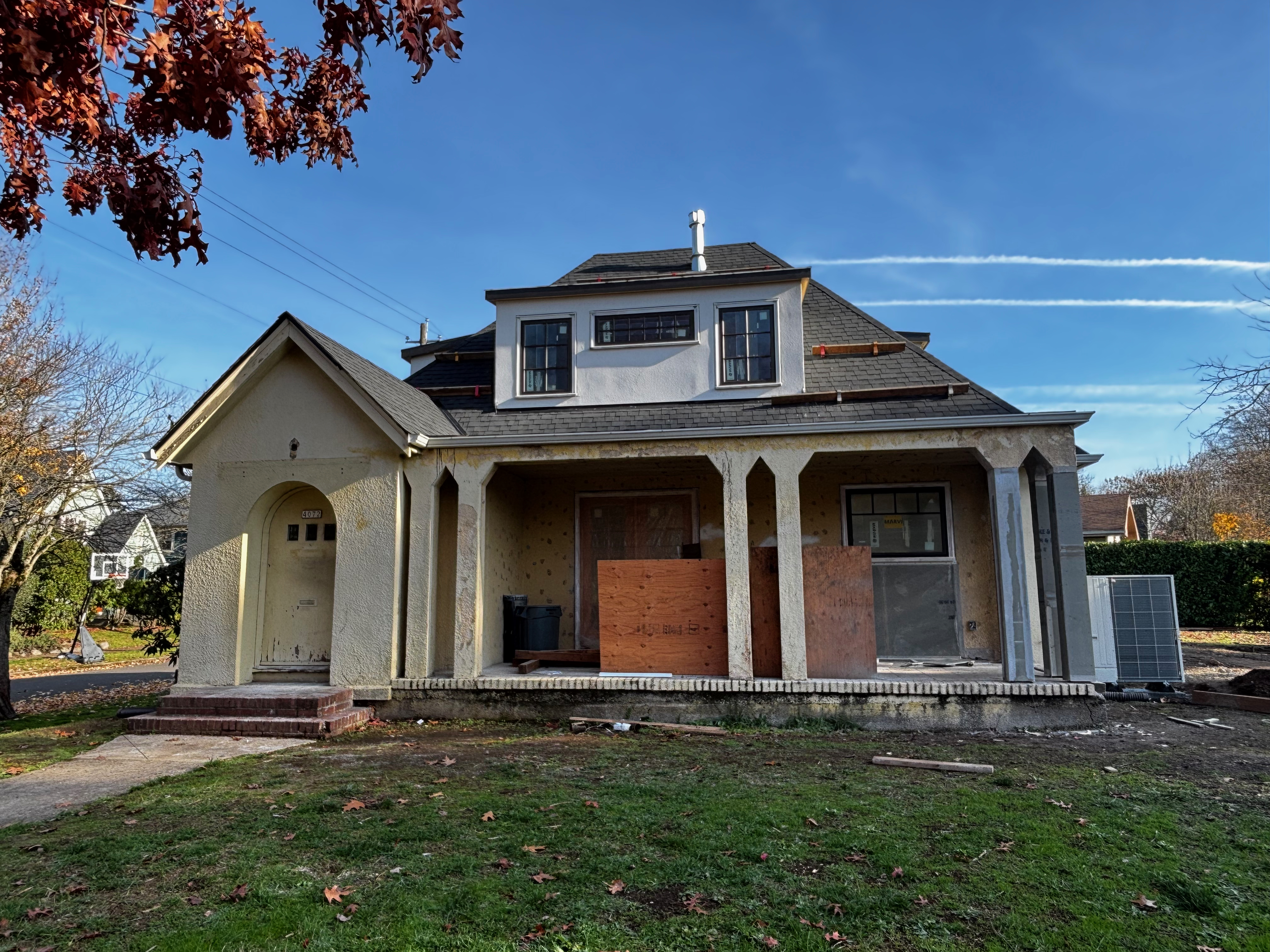
Neighbors interested in adaptive reuse of old buildings have had a front row seat this summer and fall as the von Homeyer house at NE 24th and Mason has been brought back from the brink of being a candidate for tear-down. Today, it’s on the cusp of its new life, with all of its systems transformed, spaces rearranged and upgraded, and virtually every interior and exterior surface either new or restored.
It’s as if the house is brand new: every window (the old ones were salvaged), all the doors, roof, heating (and now air conditioning), electrical, plumbing, floors, all wall surfaces, fireplace (the original mantel and built-in bookshelves are still there). Repaired and waterproofed foundation, new sanitary sewer line, fiber optics. Everything about the kitchen. It’s been a busy place.
NE 24th and Mason, photographed in December 2024. Note repaired front porch columns at far right.
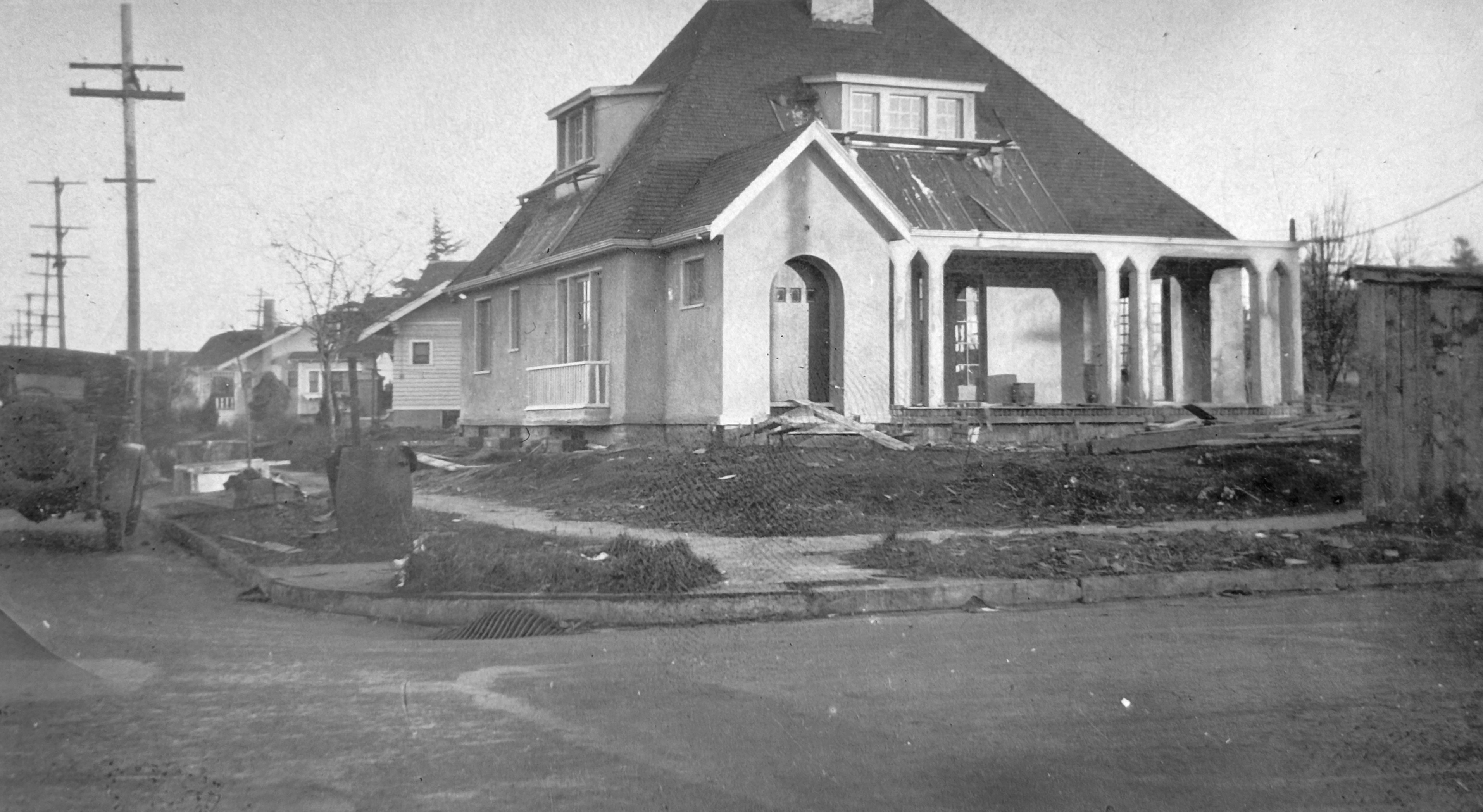
But still, when you see the “then” picture from 1925 when the house was built, and a recent photo from this December, it’s definitely the same time traveler, just transformed for its next 100 years.
AH readers will recall that neighbors Jaylen and Michael Schmitt bought the house earlier this year after the youngest son of the von Homeyer family, now in his 90s, moved to a care facility. The house had been in the same family for almost 100 years, and the brothers lived there their entire lives.
The Schmitts, like many in the neighborhood, were concerned the house would eventually be a tear-down and that something else built there could be an eyesore or worse. When they bought it, the house was jammed to the ceilings with boxes, papers and an incredible collection of items from several lifetimes. They reached out to us for help sorting through a trove of documents and curating some of the items. We re-homed 30 pounds of precious photos to far-flung family.
Four months of thinning and organizing led to a well-attended estate sale in May and gradually as the house was emptied, the Schmitts worked with architect Mary Hogue of MkM Architecture to plan for adapting the house.
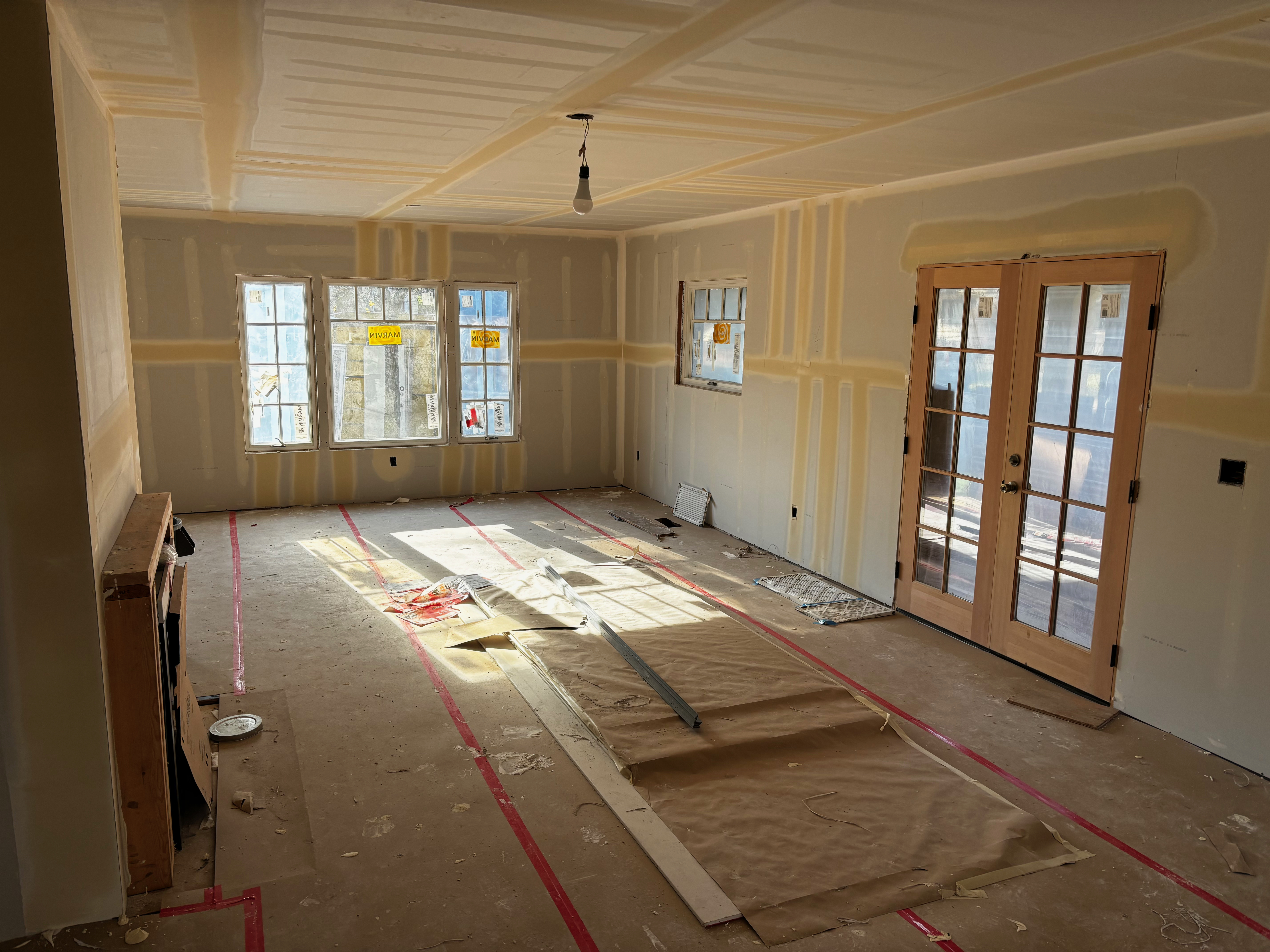
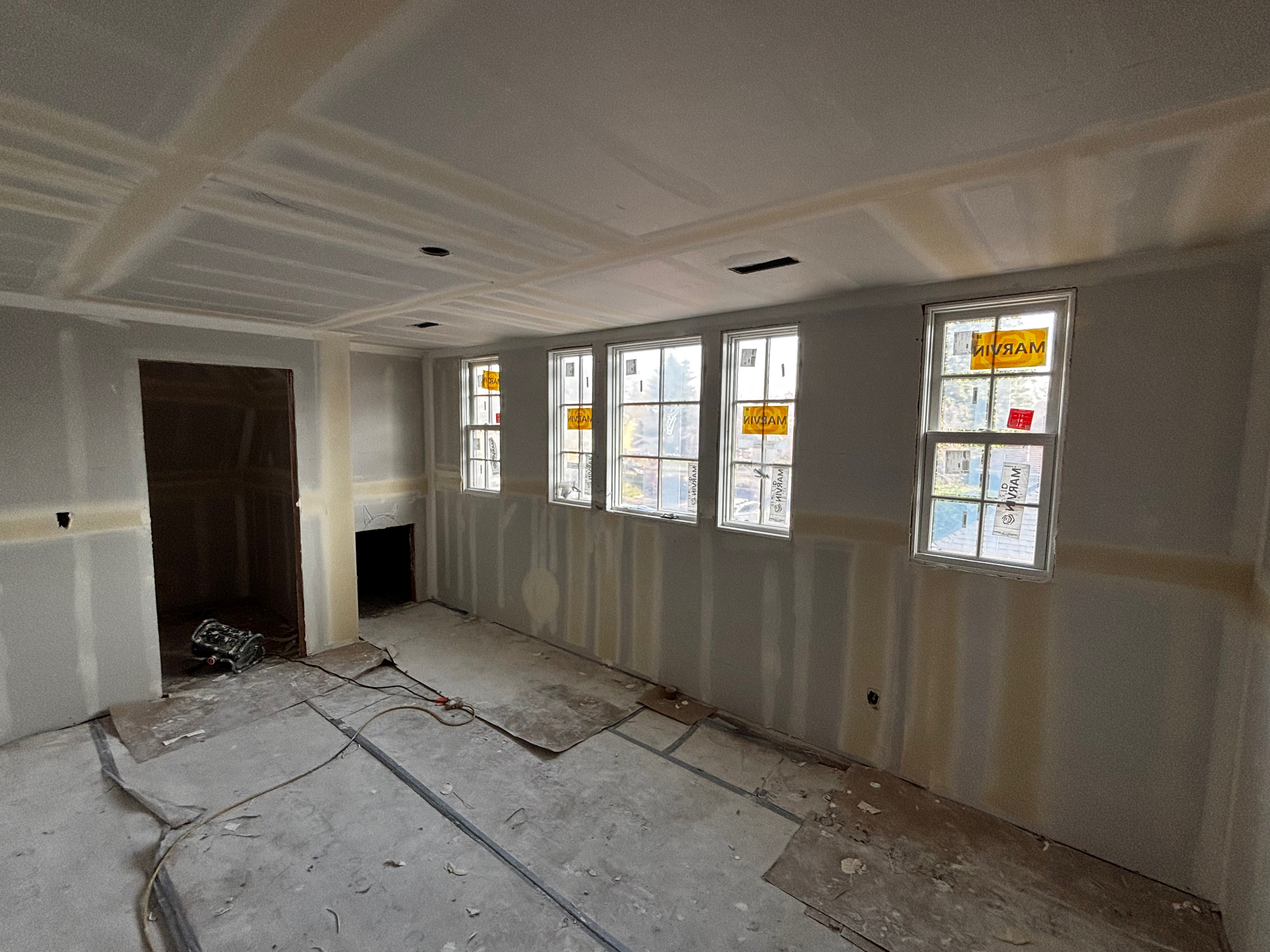
On the first floor, the existing bedroom and bathroom remain (all the plaster throughout the house has been replaced with drywall). The kitchen has been enlarged and will feature an island, two sinks and all the latest appliances. A newly re-opened and restored front porch is accessed by new french doors leading from the living room.
Looking into the living room / dining room. New French doors lead out onto the newly restored front porch. Framing is in, at left, for the fireplace.
The large kitchen features two sinks, will have a central island with cabinets, wall-hung cabinets all around, and a door out into the large backyard.
Upstairs, there are now two full bedrooms, each with its own bathroom, and a giant walk-in closet and dressing area with a huge bank of windows, and a combo washing machine/dryer.
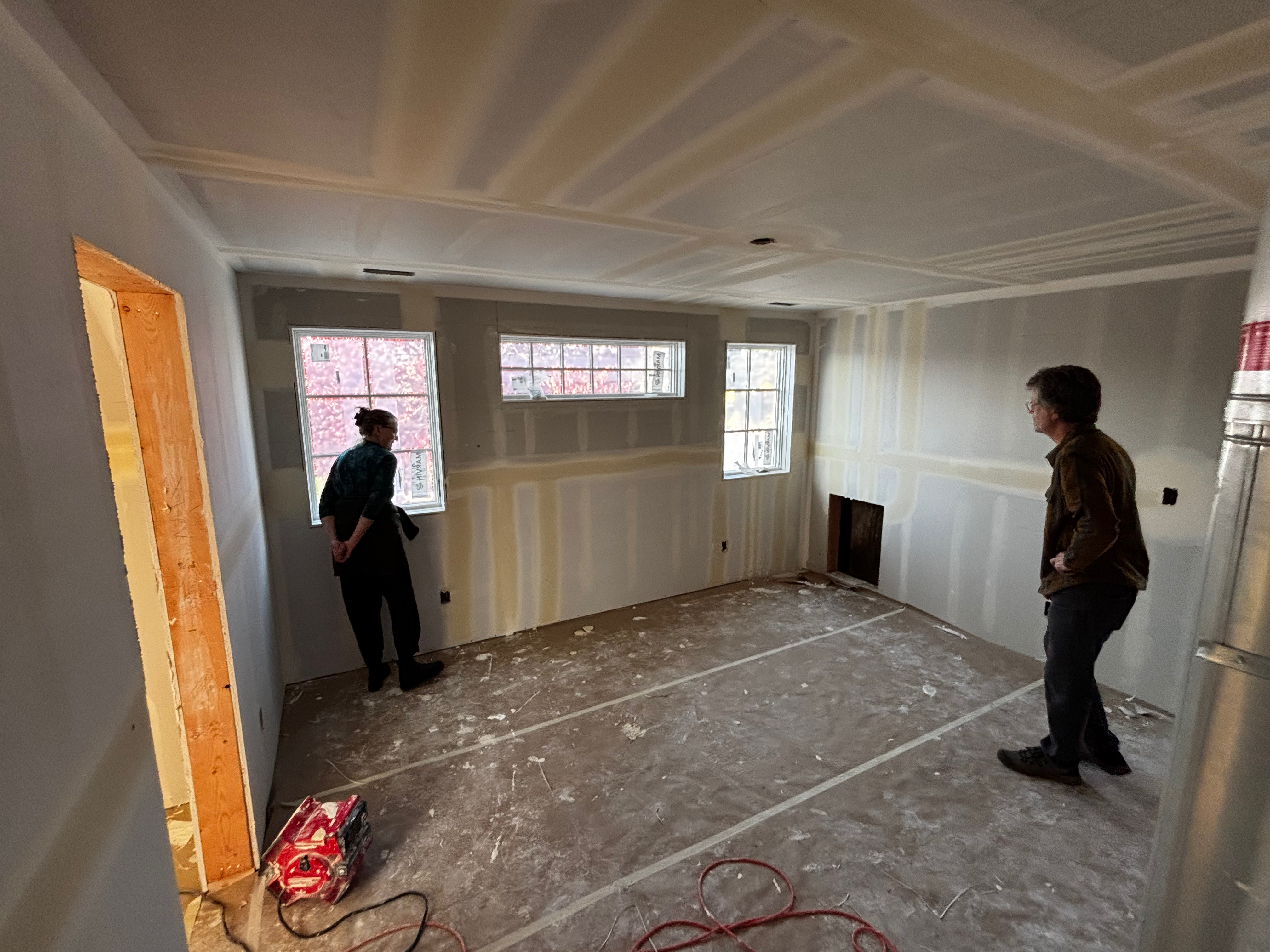
This bedroom upstairs features lots of light and a large closet.
Upstairs, the primary bedroom features large windows and a giant walk-in closet to the left. An en suite bathroom is to the right.
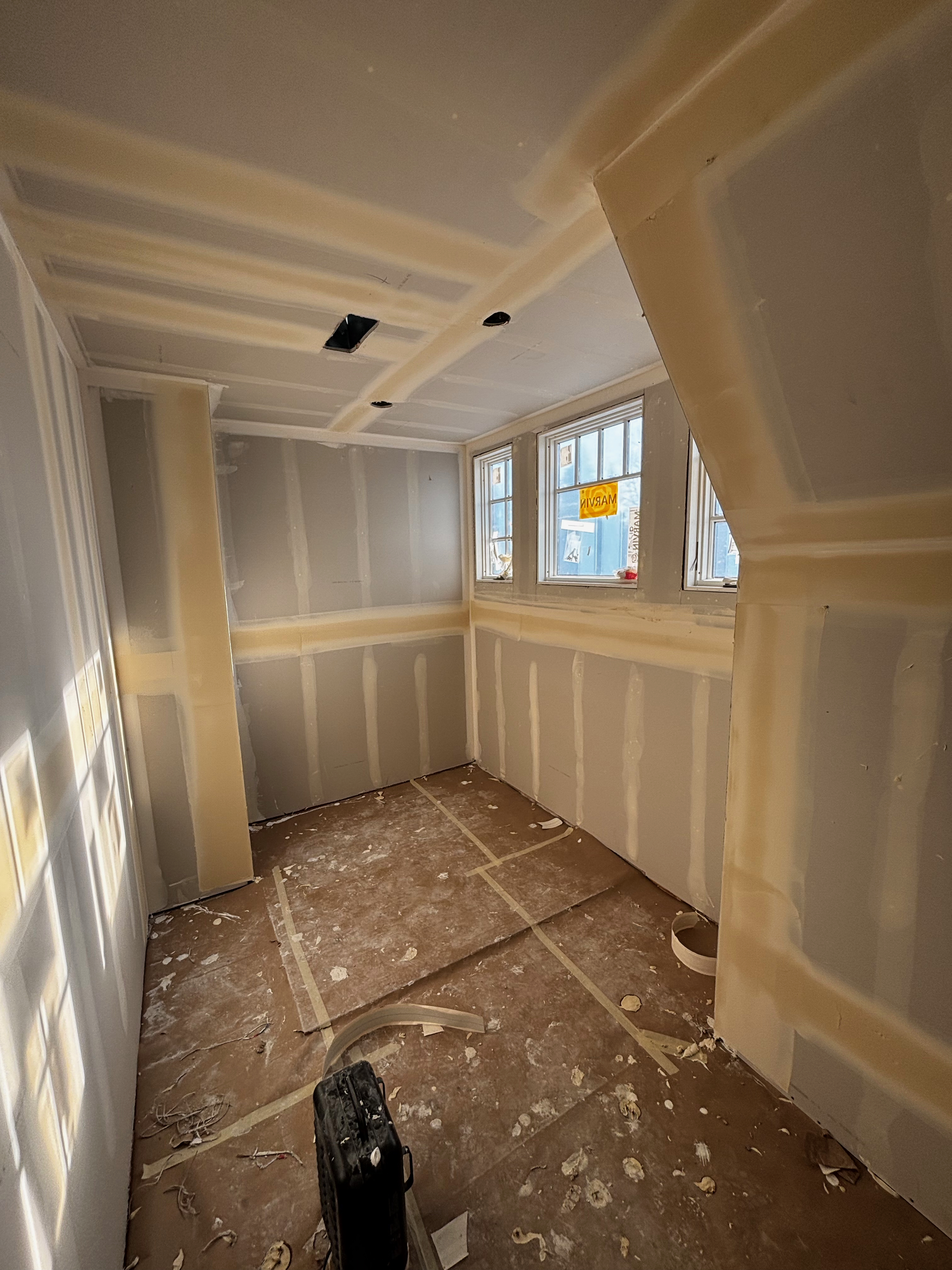
The walk-in closet off the primary bedroom is filled with light.
In the basement: another bedroom and bathroom; a giant family room and entertainment area wired for surround-sound; and a utility room with washer/dryer and sink.
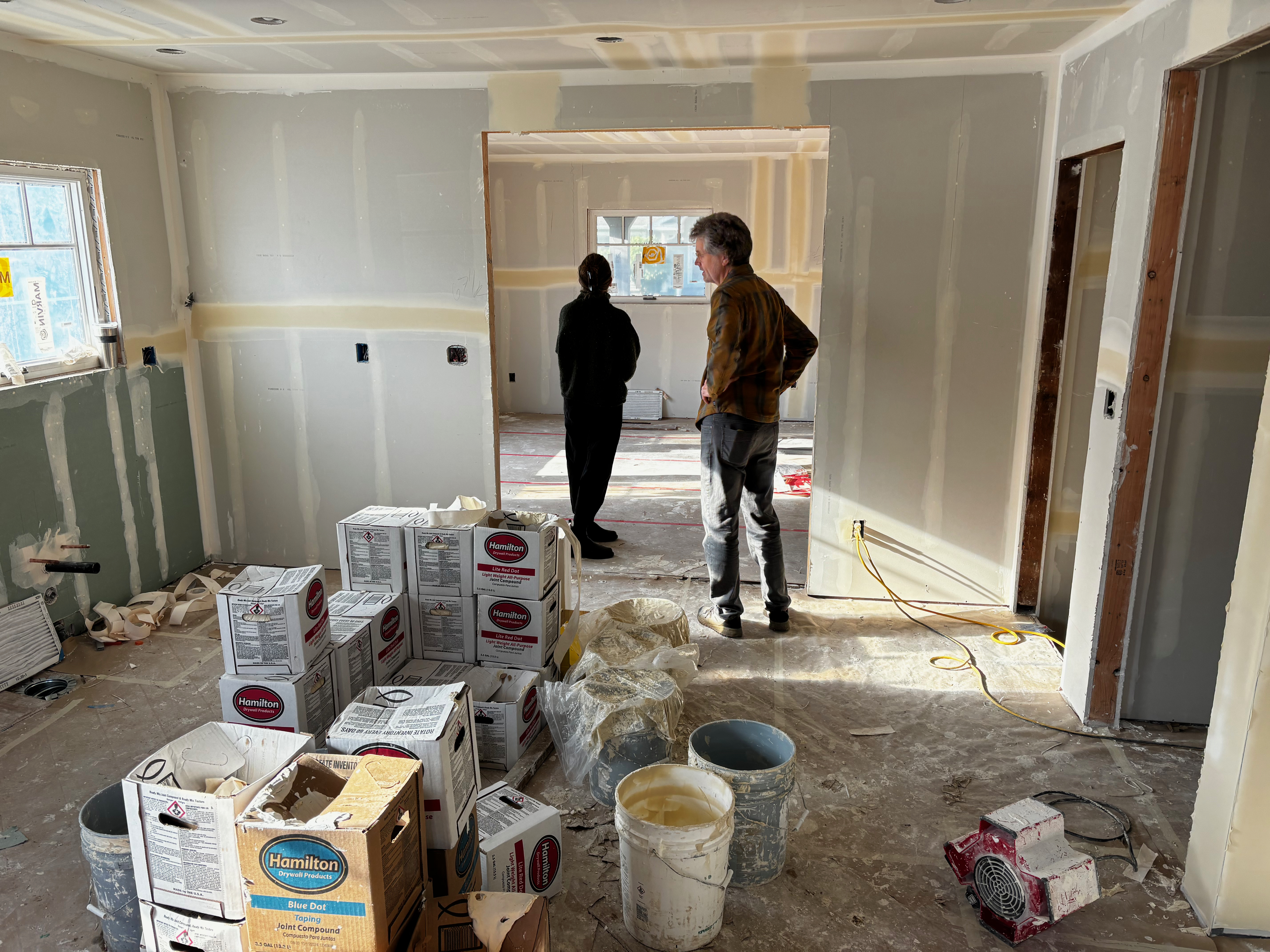
Michael Schmitt, who lives nearby, has been on site almost every single day. Michael is using a builder and subs to do most of the work, and calls himself a “heavily involved owner.” He says he’s become a very good “cleaner-upper.”
“I want to make sure this house is put together as expertly as possible,” Michael explains. So, he has had a parade of tradespeople helping: framers, plumbers, electricians, stucco experts, drywallers, HVAC experts.
It’s been stressful. Michael reckons he hasn’t had a good night’s sleep this year between worrying about what might be the next surprise, and trying to figure out the puzzle of transforming almost every aspect of the house.
“If I were to offer my earlier self some advice based on this year, I’d have to say ‘you’ve got to be 100 percent crazy to do this.’”
While it has been stressful, it’s also been rewarding in so many ways. First, the Schmitts saved the house and property from what surely would have been a much larger building (or buildings). That alone makes it worth all the work. But Michael has enjoyed working with a great team of experienced tradespeople, getting to know his neighbors better and saying hello to the daily stream of passersby, many of whom offer thanks and encouragement.
This week, work on the house is at about the 60-70 percent level. Last week was drywall installation and mudding. Yet to come: painting, trim and finish carpentry, plumbing fixtures, floors, kitchen cabinets (and everything about the kitchen). So many details. And then there is the landscaping, driveway, fencing. Still plenty of work to do.
Michael is hoping the house will be ready to put on the market in the spring. When that time comes, he’ll be ready to cross the finish line and welcome new neighbors. “This will end up being a year and half of my life,” he muses when reflecting on all the stages of the work so far. And while it’s been a journey of ups and downs, all the learning, progress, transformations and new friendships have helped make it worthwhile.
This month we’ve been working with the Portland Housing Bureau and the Mt. Tabor Neighborhood Association to research and to share the remarkable story of the A.L. Mills Open Air School located at the southwest corner of SE 60th and Stark.
SE 60th elevation of the A.L. Mills Open Air School, built for “low vitality” children in 1919. Photograph Courtesy of the Oregon Historical Society, from the Ben Gifford Collection Box 8, Folder 5.
You’ve driven by this little jog in 60th and maybe looked at the 106-year-old building—now surrounded by cyclone fencing—and wondered about its history. Empty now since 2019 and owned by the Portland Housing Bureau, the building will soon be deconstructed and the site repurposed for affordable housing.
In the meantime before the building is gone, both the Housing Bureau and the Mt. Tabor Neighborhood Association wanted to collect and share stories about the role the old school has played in neighborhood life, and to offer neighbors a chance to come take one last look. They reached out to us for help, which has allowed our customary deep dive for stories and insights that bring the building to life, at least in our imaginations.
The east classroom at the A.L. Mills Open Air School in the early 1920s and today. Early photo courtesy of the Oregon Historical Society, from the Ben Gifford Collection Box 8, File 5.Current photo by author.
These last three weekends, we’ve led tours to share these stories, which will culminate in a final open house and tour on Saturday morning, December 7th from 10:00-Noon. Here’s a link to more information.
Later in December here on the blog, we’ll devote a full post to the stories and photos we’ve uncovered about the school and the site, but for now a short summary would go like this:
Built in 1918-1919 as Oregon’s only school entirely devoted to being “open air” throughout the school year, which was thought to be healthful during the rise of tuberculosis and other diseases. Children studied, played, ate and napped in the open-air classrooms, which were defined by their large banks of windows. The students were issued special warm clothing and monitored closely by a school nurse who also coordinated one-on-one with families on menu planning and other behaviors to help children return to vitality.
In 1949, after 30 years as an open-air school, the building was repurposed as an annex to the burgeoning nearby Mt. Tabor School. An additional classroom was built and until the early 1970s, the site hosted baby boomer kindergarten and first grade students who went on to Mt. Tabor School.
After the school function ended in 1973, the building was repurposed again as the home of a community arts and theater program run by Portland Parks and Recreation. Budget cuts in the early 1990s ended those programs and the property was on track to be sold to a private owner before being repurposed again and leased by Portland Parks to the YMCA which operated it as a daycare until 2019.
Portland Parks surplused the property in 2016 to the Portland Housing Bureau. The YMCA daycare operation ended in 2019 and the building has been vacant since then. Today, the Housing Bureau is readying the site for redevelopment as affordable housing.
Just to add a little more depth, before the Open Air School, the site hosted an imposing two-story bell-towered wood-frame elementary school between 1880-1911 but it burned in January 1911. Before that the site hosted the area’s first school, conducted in a frontier log structure. Plus, that corner of SE 60th and Stark was the center of the vibrant Mt. Tabor community before being annexed into Portland in 1905.
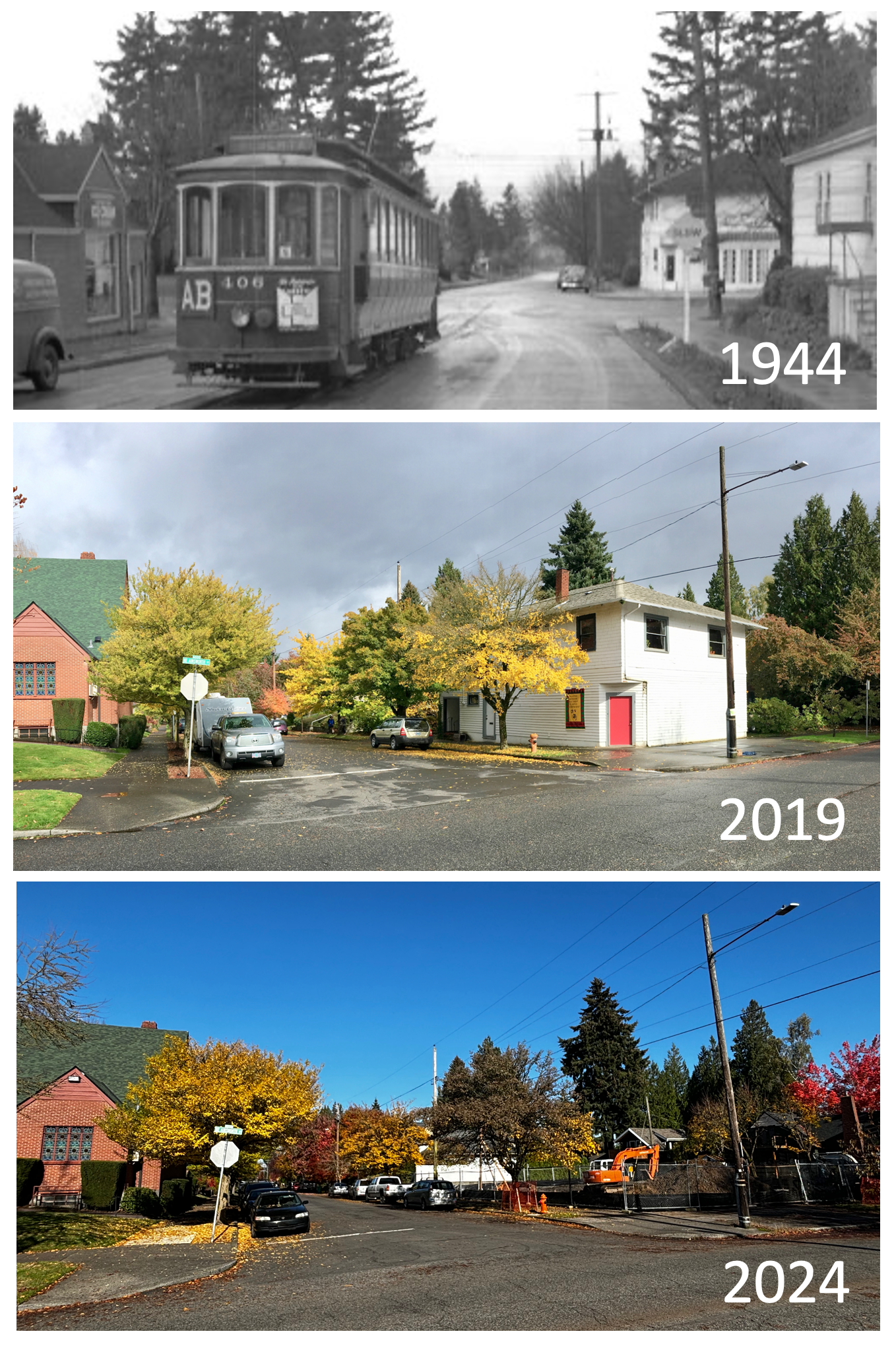
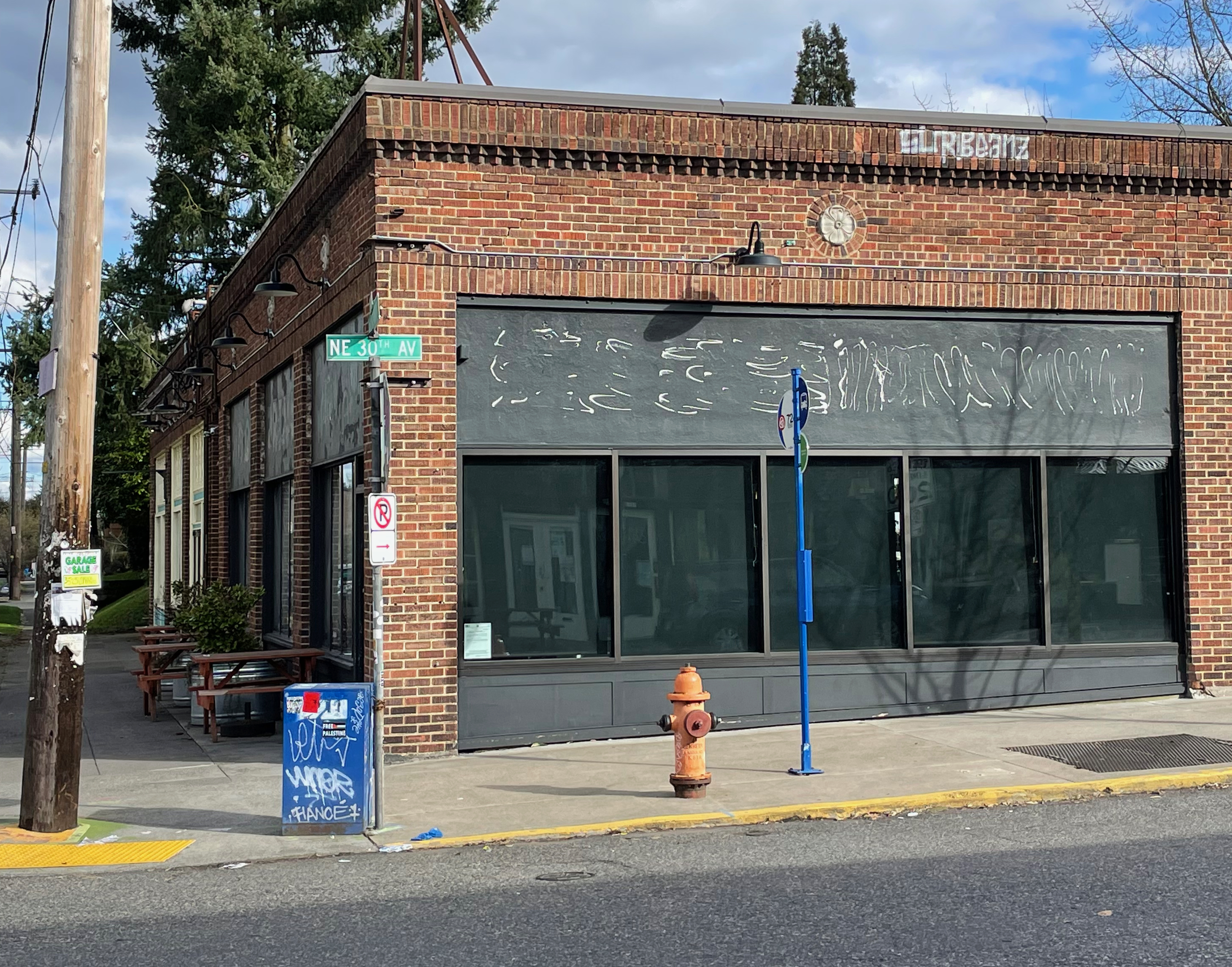
The former 101-year-old Hinrich’s Grocery building, at the northeast corner of NE 30th and Ainsworth, has been demolished recently to make way for a 14-unit townhouse on the lot.
We came upon the change while walking, and were reminded of photos we’ve taken at the corner before, and a photo from 1944 that shows the building and the north terminus of the Alberta Streetcar.
We’ve written about this corner before, which was dubbed “the finest corner in Concordia” back in 1915, following a summer evening’s soiree of dance, music and trees sparkling with electric lights.
The 1944 photo shows a corner entry and what looks like French doors that open out onto Ainsworth. We’ve been in the neighborhood since the late 1980s and that south wall of French doors during our time has always been covered over with siding.
Over the years, the building has housed many businesses, including the Mauser-Lamont Insurance Agency, Town Mart Cleaners, Emerson’s Grocery (1930s), and Hinrich’s Grocery (1920s).
Development permits on file suggest the now-vacant lot will be developed as a new 14-unit townhouse in two buildings with no garage.
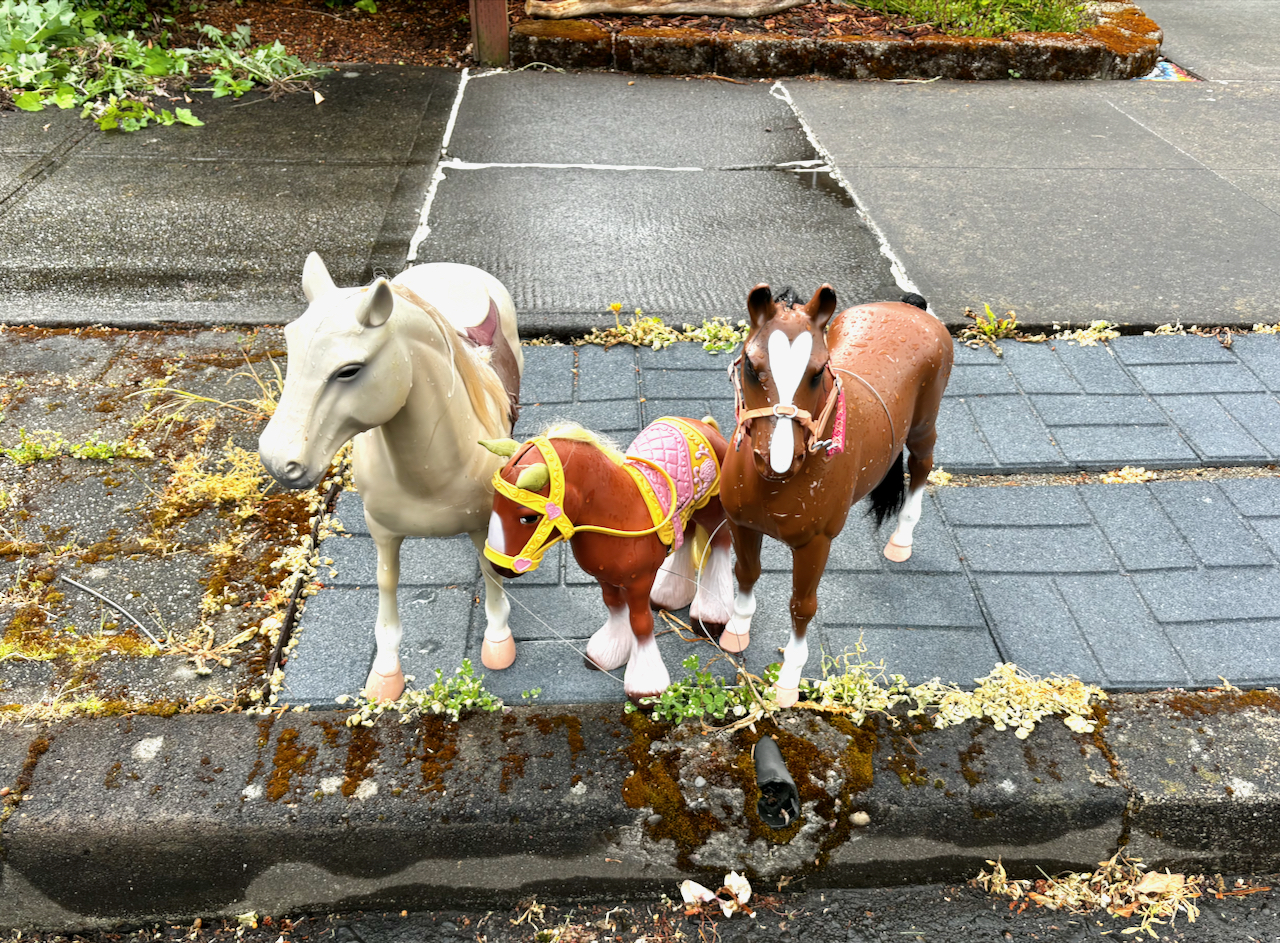
We’ve noticed a marked increase lately in the neighborhood horse population:
A northeast Portland micro herd.
Could be nostalgia, whimsy, a salute to the animals that first made these neighborhoods possible, a response to our growing coyote population. Speculate as you will, but there is definitely something going on.
This happy trend reminded us about a deeper look we made a few years back into those iron rings cast into our curbs, called “horse tethering rings,” which for a time were mandated by city ordinance as a way of making Portland streets safer. Widely used well into the 1920s before cars took over, tethering rings have traveled the full arc from vital to useless, from problematic to quaint, and now to cool.
Since it appears more and more horses are waiting patiently at our curbs, we thought it would be good to remind ourselves about the tethering rings, and to celebrate a uniquely Portland sensibility.
If you’ve spent time in the Alameda neighborhood, you’ve probably seen this house and wondered about its story:
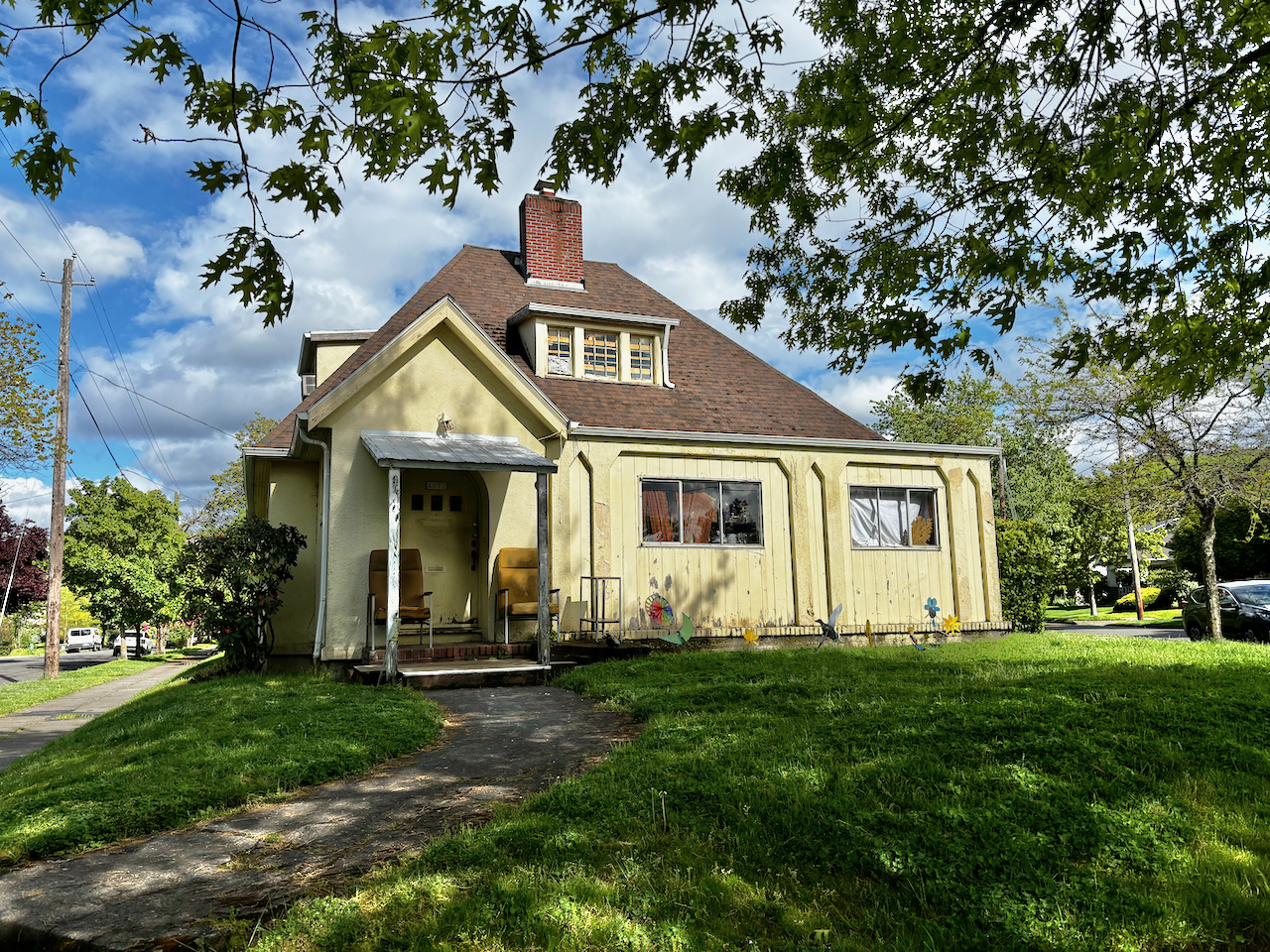
The von Homeyer house, NE 24th and Mason, May 2024. Brothers Karl and Hans lived their entire lives in the house and on summer evenings greeted neighbors and watched the world go by from their front porch chairs.
It’s the steep-roofed, run-down yellow house on the prow of the intersection where NE 24th, Mason and Dunckley streets come together, built and occupied for all of its life—since 1926—by a single family: the von Homeyers.
Older neighbors might remember the brothers—Hans and Karl—who on summer afternoons and evenings would sit on the front porch and visit with dog-walkers, runners, and anyone willing to say hello. We’ve lived in the neighborhood since the late 1980s and always enjoyed a brief chat with the idiosyncratic brothers who had tinfoil on their windows and seven cars in the backyard, but were always friendly and ready to visit or share a laugh.
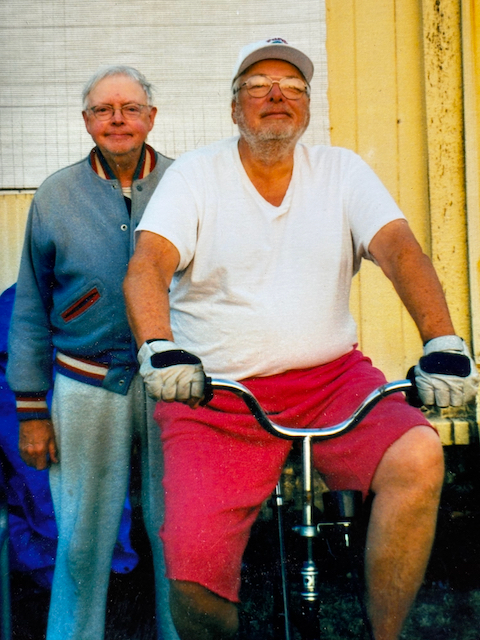
Karl and Hans Homeyer, in the 1990s
Hans and Karl never married and lived in the house all their lives. Hans died in 2002. Younger brother Karl is now in his 90s and moved into a Portland care facility last year. The home was built in 1926 by their parents, Hans W.S. von Homeyer, who died in 1969, and Frances Westhoff von Homeyer, who died in 1990.
Earlier this year, after being unoccupied (but not empty) for almost a year, the house was purchased as-is by across-the-street neighbors Jaylen and Michael Schmitt, who knew “the boys” and couldn’t bear to see the place torn down, which is what most people probably thought was going to happen because it is in such tough shape. Inside, the house was jam packed with decades of papers and other items piled high leaving little room to walk or sit.
“We’ve always been worried that it would be demolished and replaced by something that wouldn’t be right for his iconic piece of property, ” says Michael, recalling the classic bungalow that was torn down in 2017 a few blocks east at NE 30th and Skidmore and replaced by a duplex, despite neighbors’ concerns. And another bungalow on NE Mason that was torn down last summer and replaced by a much larger house.
With help from a small army of friends and neighbors, the Schmitts have been sorting through boxes, bags, and containers that were stacked from floor to ceiling holding everything from video games to ammunition; from 1940s-era ice delivery receipts to vintage clothing. Michael reached out to me for help sorting, contextualizing and organizing hundreds of photographs and personal papers that tell the story of the families and the original design and construction of the house. It’s been a fascinating assignment.
This spring, I’m helping the Schmitts create an archive that documents the life of the house and its family that can travel forward in time, and that offers a narrative about the last 100 years here.
In future posts, we’ll write more about that, and about how we’ve been curating the photo archive. The insights are as amazing as the photos and go off on many different and fascinating tangents. We’ll also explore the design, construction and history of this house, its family, and the interesting role they played in the early neighborhood.
But for now, things are beginning to happen and the neighborhood will begin to see activity around the house. The Schmitts are hosting an estate sale starting today through this weekend and the list of items for sale is pretty remarkable: fabrics and sewing patterns from the 1940s-1960s; lot of tools; a pinball machine, magazines galore and an amazing selection of auto racing trophies from the 1960s. Even if you are not in the market for a vintage steamer chest or sewing machine, the estate sale is an opportunity to see this time capsule of a house.
This weekend’s sale is an early step toward restoring and adapting the house for the future. An architect is working with the Schmitts on subtle changes that add bedrooms and bathrooms, and update the kitchen which is still in original and very worn 1926 condition. Other less visible but crucial changes, like updates to all major building systems, are in the plans too.
“Whatever we do, we want to be in keeping with the spirit of the original design and with a sense of the neighborhood,” Michael says, recognizing the real estate market of today is much different than 100 years ago. To make it a marketable property going forward, they’ll be adding a bedroom and bathroom in the basement and also on the first or second floor. The steep rooflines and the shed-roof dormers on the second floor make fitting another bedroom up there a little tricky. More analysis and imagination required before they can answer that question.
One design change we’re looking forward to seeing: the signature west front columns and French doors–walled up long ago–finally set free, a kind of time travel return to the architect’s original vision.
NE 24th and Mason,early 1930s. Photo courtesy of the von Homeyer Collection.
For now as work gets rolling with this spring’s estate sale, it’s enough to acknowledge the significant amount of work required to bring this house back to life, the many stories this place has to tell, and the vision of neighbors committed to restoring and adapting a unique property for its second century.
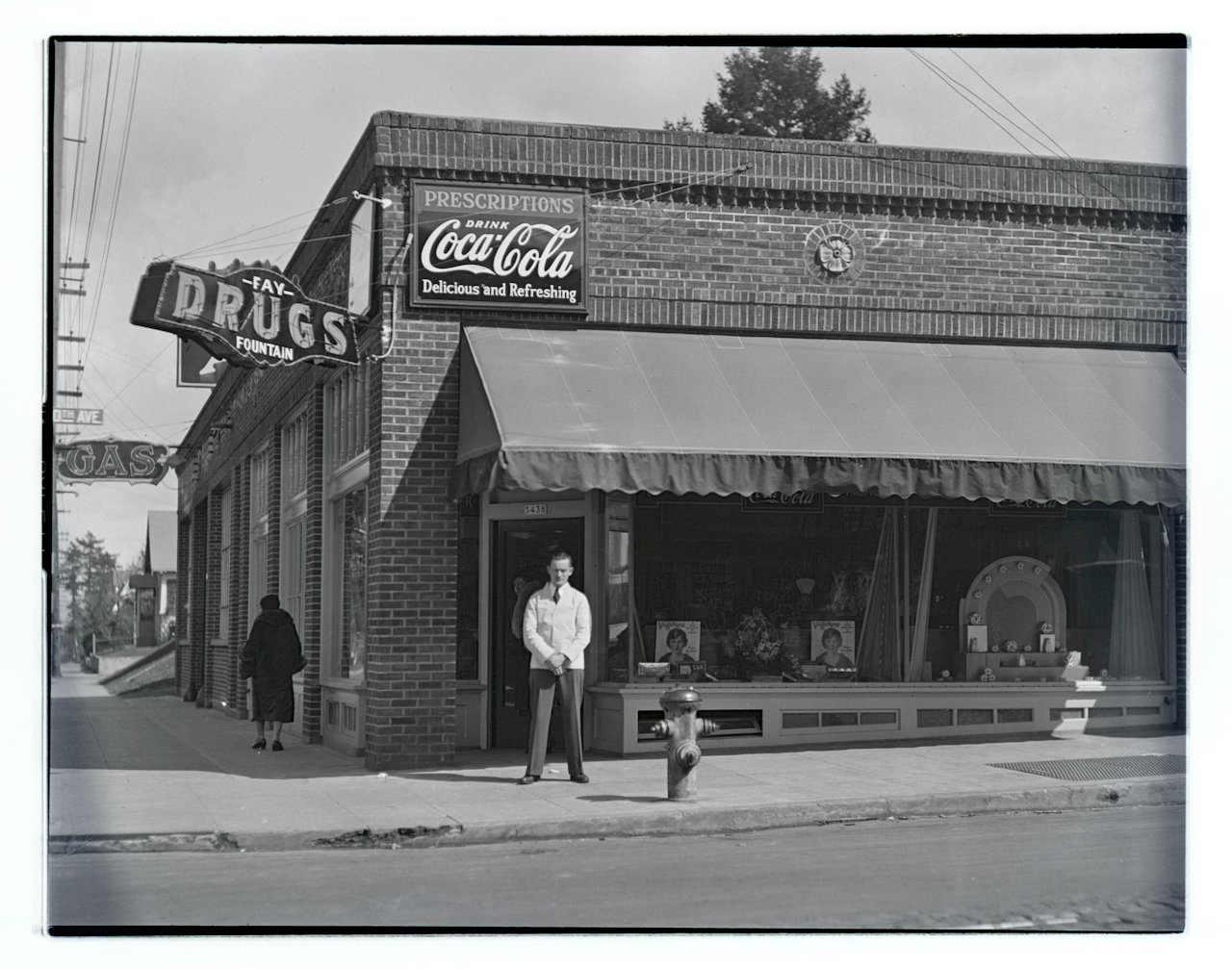
Photographs taken 91 years apart remind us about change and constancy at a busy corner in the neighborhood. Check it out:
Top: View looking east, Joseph Laurence Fay (1906-1951) poses in front of his business at the southeast corner of NE 30th and Killingsworth in 1933. Photo from the Oregon Journal Negative Collection at the Oregon Historical Society, Lot 1368; Box 372; 372A1209. Bottom: The same view in March 2024, when this storefront was in transition.
Built in 1927, this commercial block of storefronts has housed everything from Fay’s Drugs and Fountain–pictured here in a photo from the Oregon Journal in 1933–to the RCA Service Company, to the Portland Venetian Blind Company. In the 1950s it was home to neighborhood dentist Dr. Tinkle. More recently, it’s been a coffee shop and café, a bar and a game arcade.
This busy corner, known as Foxchase, is well worth exploring: several good restaurants, a great cocktail lounge, a new bakery and more. And the story of Foxchase is pretty fascinating too, be sure to check it out.
In the midst of the current blizzard, we’ve been reminiscing about past winters and pieces we’ve written here over the last 17 years (can it really be 17 years?) that explore the timelessness of snow.
Deadman’s Hill, February 2021
There’s the piece that explores the story behind Deadman’s Hill, which will once again be alive with sledders reenacting more than a century of tradition.
There’s our Billy Collins poem-inspired History of Snow piece that looks back at a century of Portland winters and a few photos from the snowy neighborhood in 1936.
There’s the Oregon Historical Society treasure trove of ice storm photos from 1916, and an analysis of ice storms before 1916.
We’re in it now. But the daffodils are patiently waiting.













 Alameda Old House History