Our recent post on the prolific Portland homebuilders known as Hiller Brothers Inc. grew out of our research on one of their classic bungalows on NE Knott Street. In the post, we mentioned several family resemblances among these homes: windows, built-ins, doors, hardware.
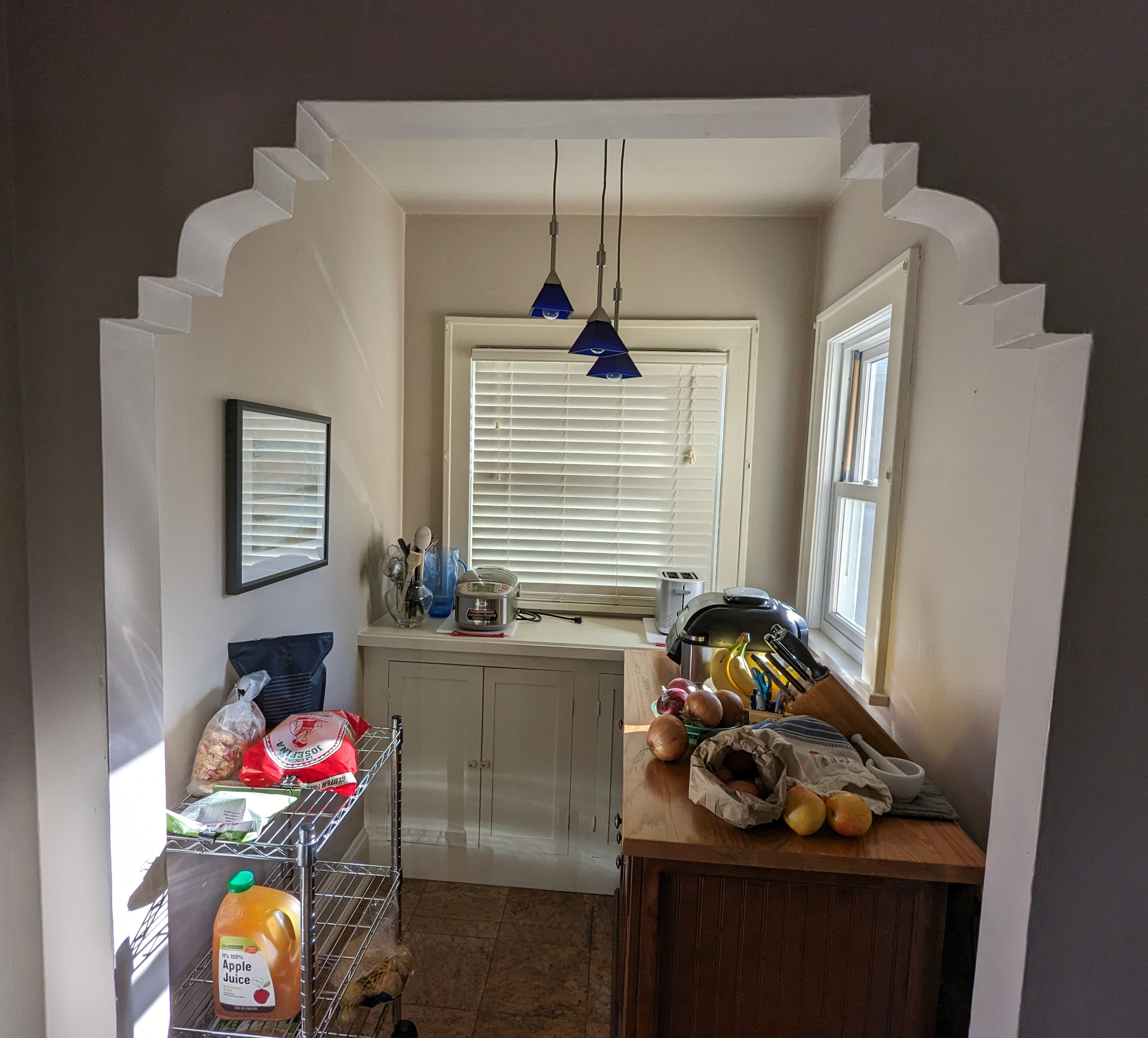
As it turns out there’s another distinctive feature that came to light as neighbors began talking with neighbors. It’s an archway that looks like this:
That distinctive coved shape defining the room is called a cavetto, or quarter-circle, joined to a couple of 90-degree steps top and bottom to create a decorative entry feature that reveals this cozy space–once a breakfast nook–located just off the kitchen. In at least a couple of the Hiller homes we know of, the distinctive cavetto cove is still there and the small space has been converted into a pantry-like area that offers a worktop as well. In some homes, the nook has likely already been annexed into kitchen extensions. Some homeowners might be eyeing that nook and arch right now mulling over remodeling plans.
It would be interesting to hear from others on the Hiller Brothers address list if this cavetto cove and nook feature look familiar. We bet there are more than few still out there.
Which leads to the topic of nooks (more formally inglenooks), a worthy eventual blog post.
Do you have a favorite nook space that operates near the heartbeat of the house? We do, in our 1912 Arts and Crafts bungalow, but it’s a design generation earlier than the Hillers and their hard working architect Hubert A. Williams.
AH readers know walking is the best way to observe the eastside’s century-plus houses and neighborhoods. At a slow pace, you can see the craftsmanship, the years of wear and change, the hands of five or six generations building, improving, maintaining (and sometimes not).
On our regular dog walks this summer, we’ve been watching three particular bungalows on NE Mason in the Alameda neighborhood, just a few blocks apart. All have been time travelers with their own stories and are now in transition. Two of them are essentially gone and no longer in their earlier forms; but one special little one is, at least for now.
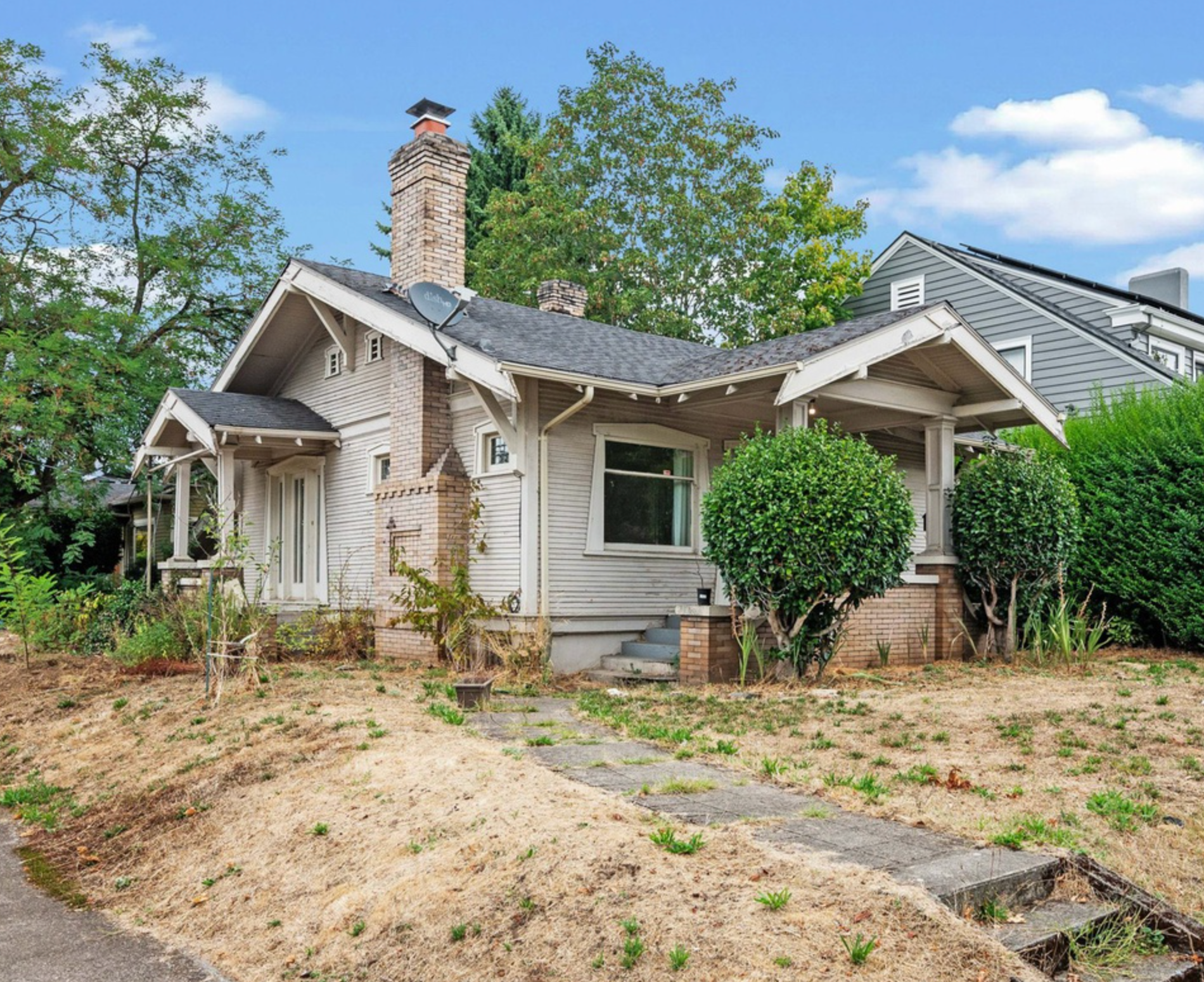
1914 Arts and Crafts bungalow at 2503 NE Mason, September 2023.
The 1914 Arts and Crafts bungalow on the NE corner of NE 25th and Mason is a small beauty with unique and original trim and detail, both inside and out. You would remember it if you’ve seen it (we’ve never seen a house quite like it). It’s small but distinctive, has been essentially unchanged in almost 110 years, and it’s on the market now, listed by Emily Hetrick at Keller Williams.
Interior of 2503 NE Mason, September 2023. Note the coved ceiling, box beams in both rooms, beveled glass built-ins, beveled glass windows and doors, period decorative columns. Fine 110-year-old architectural detail inside and out.
A few years back, we had the good fortune to connect with family members who remember it from the 1940s and 1950s as the perfect small bungalow. Back in the day, David White remembers visiting his great aunt and uncle who lived there. Here’s a photo of their niece–David’s mother Agnes–at the front porch from 1940. That very same view is very much available today.
Agnes Coulter in 1940, front porch of 2503 NE Mason. Note distinctive window and door trim, still in place today. And of course the smiling subject and her flowers. Courtesy of David White.
David’s grandmother Isabella Coulter ran the Alameda Park Grocery at NE 27th and Going, which we wrote a three-part series about back in 2015. By day, Isabella worked in the store. In later years, after closing time, she returned home a few blocks south to this small corner bungalow she shared with her sister and brother-in-law. Frequently, nieces and grand nephews visited the bungalow and those memories are strong and clear.
Because it is small and because it’s on a corner, we’re a little worried about its future. We’re researching its early history at the moment and will have more to share, and would be glad to introduce the new owners to its long-time-ago former family who knew and loved it well.
A few weeks later we posted the origin story of this great little bungalow, which you can read here.
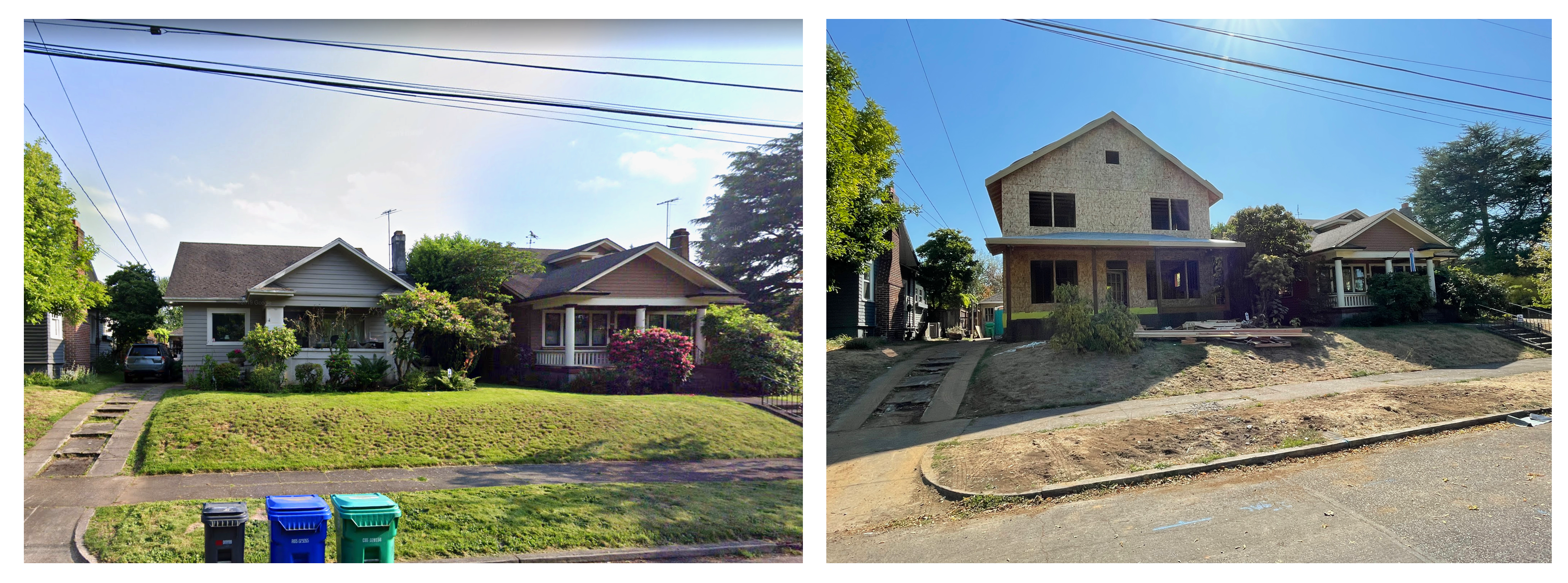
A couple blocks east on the south side of the street was the Clifton bungalow, built in the summer of 1921 by Enoch Clifton, who with his brother Knute immigrated from Norway and went into the homebuilding business on Portland’s eastside, making bungalows just like this one throughout the neighborhood. Their niece Nancy Clifton lived in the home for many years up until her passing earlier this year. The bungalow was bought by Liberty NW Homes in Oregon City and all but razed—the building permit refers to the work as an “addition.”
Here’s a look at before and during.
2617 NE Mason (on the left) before, and this week. The new house utilizes the foundation and several external walls of the former bungalow.
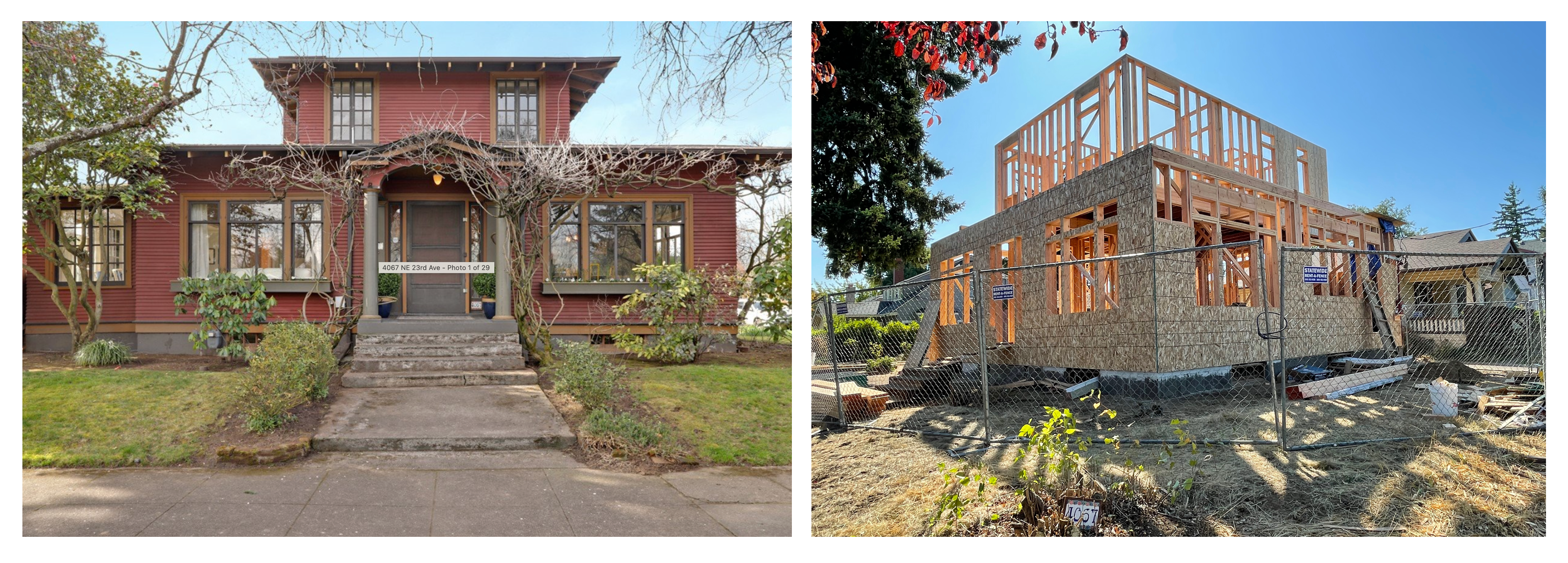
A few blocks west, on the southwest corner of Mason and NE 23rd (pictured below), we’ve watched the small red 1915 Arts and Crafts bungalow being taken apart piece by piece. Another somewhat unusual home, this one distinctive for its center hip-roofed cupola-like second story. The new home going up incorporates the foundation, and is also considered an addition, but the permit notes “whole house to be reconfigured.” The new framing does suggest echoes of the former building.
Here’s the before and during…
4067 NE 23rd before, and this week. It could be that the new construction will mirror aspects of the former.
For at least one of the bungalows on NE Mason Street, time will tell.
Note:
Summer seems to be “off season” for the blog: it’s hard to compete with sunshine and all things outdoors in Oregon. But the promise of rain and these cooler days brings us back inside. We have lots of topics for the blog this winter and fall, so even though it gets quiet around here between June and October, we won’t be a stranger in the rainy weeks and months ahead.
It’s been a busy fall around here with work on national register nominations, house history studies completed and underway, guided history walks and some river time. But not a lot of blog posting…time to get back in that groove.
We’ve just wrapped up the study of a 1911 “Colonial revival” style home in Irvington that reinforces the importance of looking at a thing long enough to actually see it. This is an important lesson whenever it arrives, and we appreciated it as such. We thought you might too.
Maybe you’ve seen this house: the stately white two-plus story home at the southwest corner of NE 21st Avenue and Knott. It’s just come on the market.
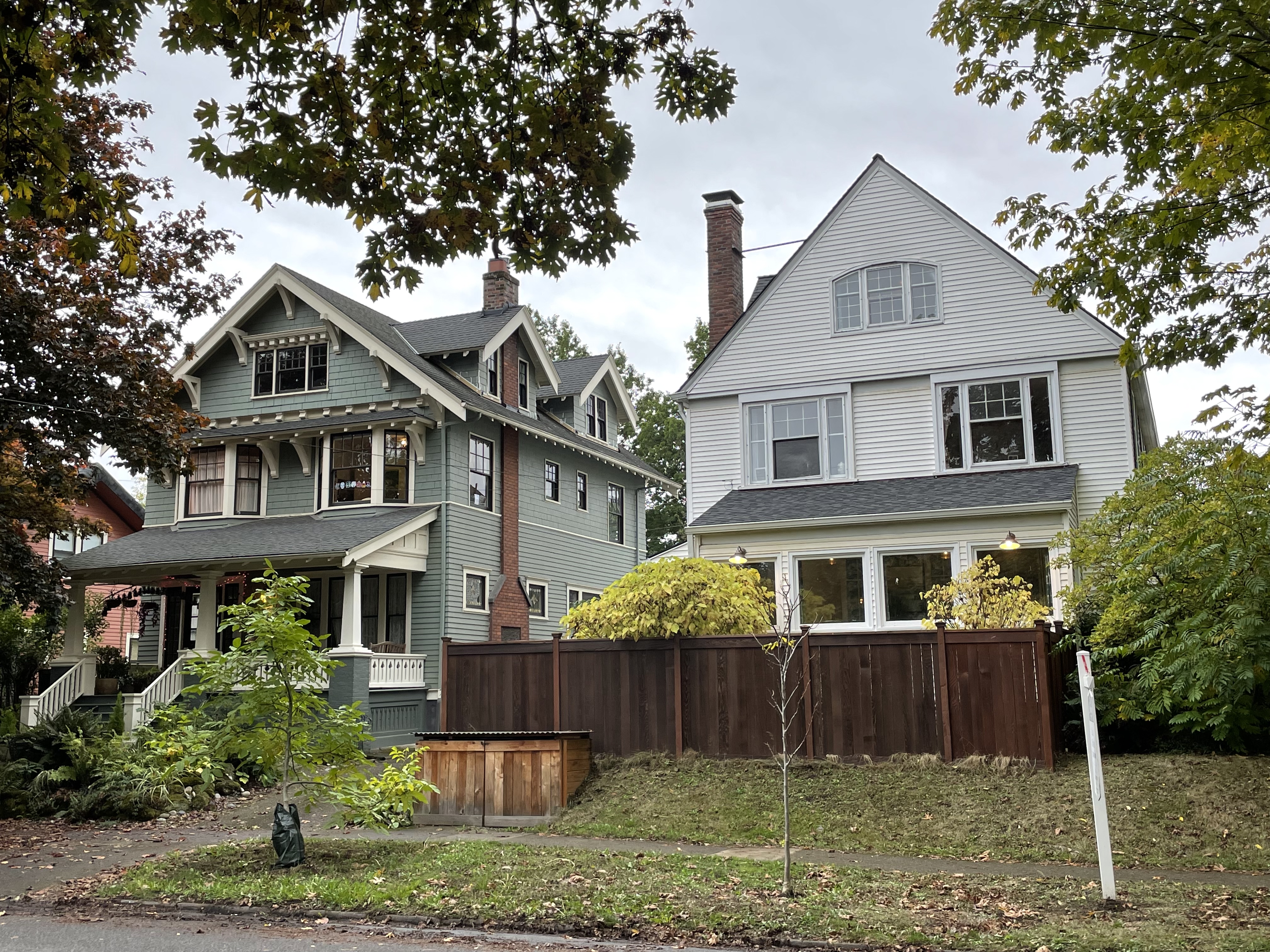
Viewed from Knott Street looking south, this house wants you know it’s in the Colonial Revival style, complete with the Georgian style doorway, bay window and upstairs shutters. Photo courtesy of Lulu Barker.
Below, the same house, viewed from NE 21st looking west, and in context with the house just to the south—which as it turns out is actually its twin, built at the same time by the same builder.
A good way to gauge the magnitude of change is to stand east of the two houses and compare, knowing they were built as Arts and Crafts twins originally in 1911. Photographed October 2022.
The two houses were built between November 1910-March 1911 by brothers-in-law James E. Coleman and Robert J. Ginn doing business as Coleman & Ginn. Both men were farmers with ties to Moro in Sherman County and had been drawn to Portland by its booming real estate business. The house to the south sold quickly, but the corner house with its front porch and entry facing NE 21st didn’t sell, so the Coleman family moved in for a few years until departing Portland for Moro during the economic downturn of the late 19-teens.
The next family—George and Hulda Guild—made some big changes. For the first few years, all their documents of record used the NE 21st Avenue address (which was 555 East 21st Street North, in the taxonomy of Portland’s pre-Great Renumbering address change).
But in the fall of 1920, all of the official documents for this house and the newspaper social listings stop reciting the NE 21st address and begin orienting to Knott Street. The formal entrance to the house had been shifted from the east-facing front porch entry of the original Arts and Crafts house on NE 21st Avenue, to a new Colonial Revival front entry facing north toward Knott Street.
This choice may have been driven in part by the rising popularity of the Colonial Revival style. By the early 1920s, large three-story Arts and Crafts homes were slipping out of vogue in favor of multiple revival styles. Another factor may have been the prestige of having a Knott Street address. Irvington homes facing Knott Street are typically grander than many of the homes on numbered streets, and perhaps George Guild, as president of Columbia Paper Box Company, would rather have resided on Knott Street than on 21st.
Whatever the reason, conversion would not have been simple. The distinctive Arts and Crafts dormers (on the north side) overhanging eaves and other architectural details were removed and the interior configuration and floor plan dramatically changed to accommodate entry from the north side of the house. There’s no documentation of this work on file with the city, so no record of date or extent, though a reasonable guess is the summer of 1920 when the Guilds started using their new Knott Street address.
Being able to see this transformation is all in how you look at it, where you look at it from, and the clues that history can bring, reminding us in a helpful way to question our perceptions and the things we think we know.
In an interesting post-script, this was also the home of Alfred Powers, one of Oregon’s best known authors, Dean of Creative Writing and Publishing for the Oregon university system, editor at Binford & Mort, and author of 18 books. During the years Alfred and wife Molly lived there (1942-1961), this house also held one of the largest private libraries in Oregon.
We’ve been down enough amazing research rabbit holes to recognize a special gem when we see one.
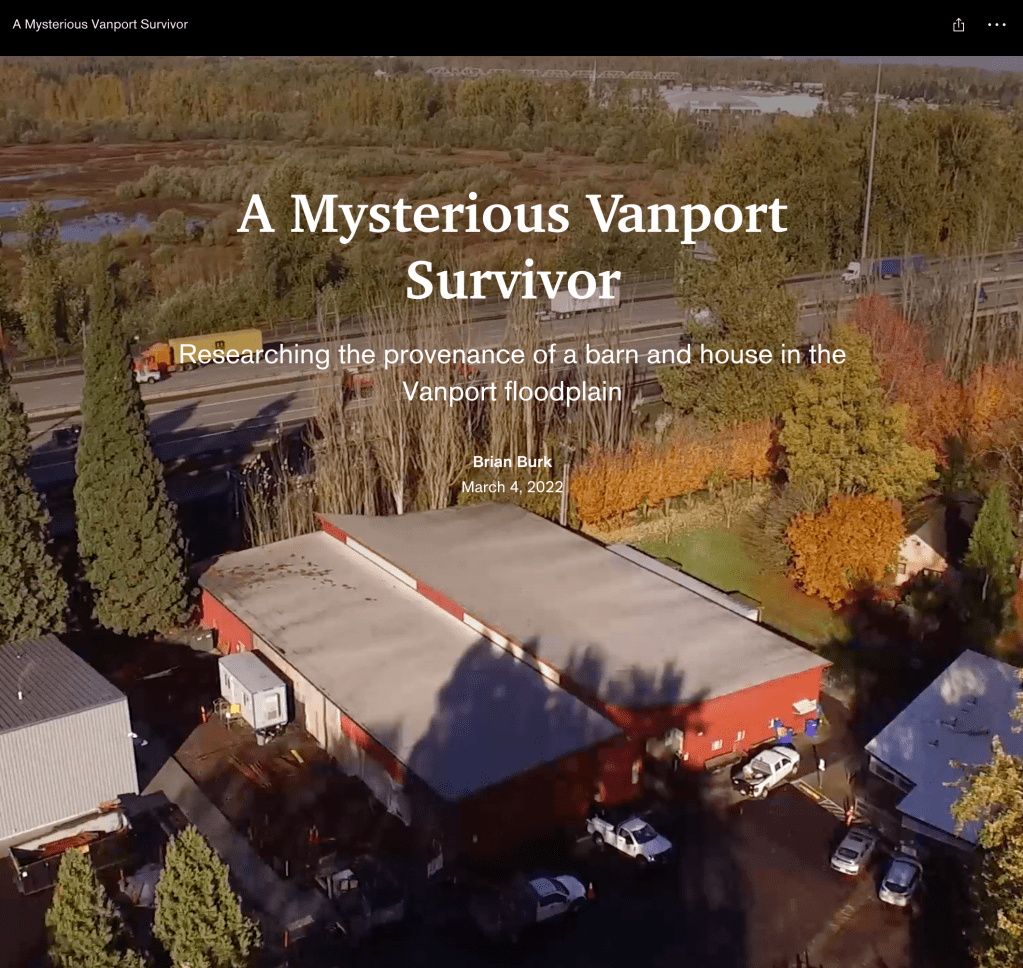
This spring, AH friend Brian Burk completed a research odyssey that turned up fascinating clues about the Vanport flood, an extinct airfield, daredevil pilot Tex Rankin, and one particular old barn and house, all of it centered on North Portland’s Delta Park. He calls it A Mysterious Vanport Survivor.Truly worth 15 minutes of your time. Note that you have to scroll down from the main page to see all the good stuff.
Brian’s multi-media website weaves all these pieces together artfully—along with his history detective narrative —to provide a lens that will change the way you look at a local landscape and history you thought you knew.
Brian is a multi-media journalist, born and raised in Northeast Portland, who loves documenting the beauty of the world and its people through still and moving images. You can see more of his work here.
The scaffolds and fences have come down from around the former First Universalist Church of Good Tidings / Metropolitan Community Church at NE 24th and Broadway, and soon the doors will open on the restored and repurposed 112-year-old church building.
The former First Universalist Church of Good Tidings was built in 1909 and has recently been restored and repurposed. It opens to the public soon. Photographed July 2021.
We wrote about the project here last November: neighborhood residents Brody Day and Dustin Harder have been adapting the old church into the new Steeplejack Brewing Company. The two acquired the building in April 2019 from the Metropolitan Community Church which was downsizing to a building in Southeast Portland following 42 years in the space. At the time, another offer was on the table from a local developer who wanted to demolish the church and build a five-story condominium on the site. After a meeting with the pastor and the congregation—and assurance that Harder and Day were planning to keep the building intact—they successfully closed the deal.
Steeplejack opens quietly to the public starting on Friday, July 23rd from 3:00-10:00 p.m. with a grand opening scheduled for Saturday, July 31st, when regular hours begin from 7:00 a.m.-10:00 p.m.
The old church has the distinction of being one of a few buildings in Portland dedicated by U.S. Presidents. William Howard Taft sealed up a small time capsule and set the cornerstone during the building’s opening on October 4, 1909. Day and Harder have the original box (it had been opened some years ago) and plan to set a new cornerstone, sealing in the old box, at 2:00 p.m. on Saturday, July 31st. Next week, they’ll be accepting very small time-travel items that might go into the box.
We had a chance to visit the newly-completed restoration as part of Steeplejack’s soft opening this week and offer these glimpses of the “new” old space:
The front door and location of the historic cornerstone and time capsule, which will be placed on Saturday. July 31 at 2:00 p.m. The original cornerstone was set by U.S. President William Howard Taft on October 4, 1909.The west face of the building. Note the heart shape in the large stained-glass window, and then have a look on the wall inside (below) as the sun shines through.An interior scene. Tables built with original structural wood reclaimed during the restoration.
For more than 100 years, young people of the neighborhood have brought their sleds, toboggans, skis, chunks of cardboard, plastic bags and pretty much everything else that slides to the top of slippery, snowy Stuart Drive for a run downhill.
This weekend’s snow-ice event brought out the crowds and a strange sense of pre-pandemic normalcy. These kids still can’t be together in the classroom. Judging from the spirit and smiles visible on the hill today, gravity and speed weren’t the only joys bringing people out. Kids laughed. Parents stood and talked. Plenty of masks were in evidence. “The kids really deserve this,” said one Mom.
Of course, whenever we’re on Deadman’s Hill we’re thinking of the dead man and the auto accident that claimed his life. Fred Jacobs was killed here on the morning of June 5, 1917. You should read the whole sad story of this freak accident. And while you’re here, you might want to read about the beautiful Craftsman house at the top of the hill that is as much of a landmark as the hill itself, designed and built in 1912 by George Asa Eastman, who was principal architect for the Oregon Home Builders Company, which built hundreds of local homes.
This weekend’s weather is memorable for many reasons, but lest we think this was a big-time snow event, you might want to check out this history of snow, including some interesting photos from the neighborhood during the big snow of 1936.
We’ve heard from the property owner working on restoration of the former Billy Rowe’s Tavern building (recently known as Bernie’s Southern Bistro) at the southeast corner of NE 29th and Alberta.
Unfortunately, the mural on the west wall must go.
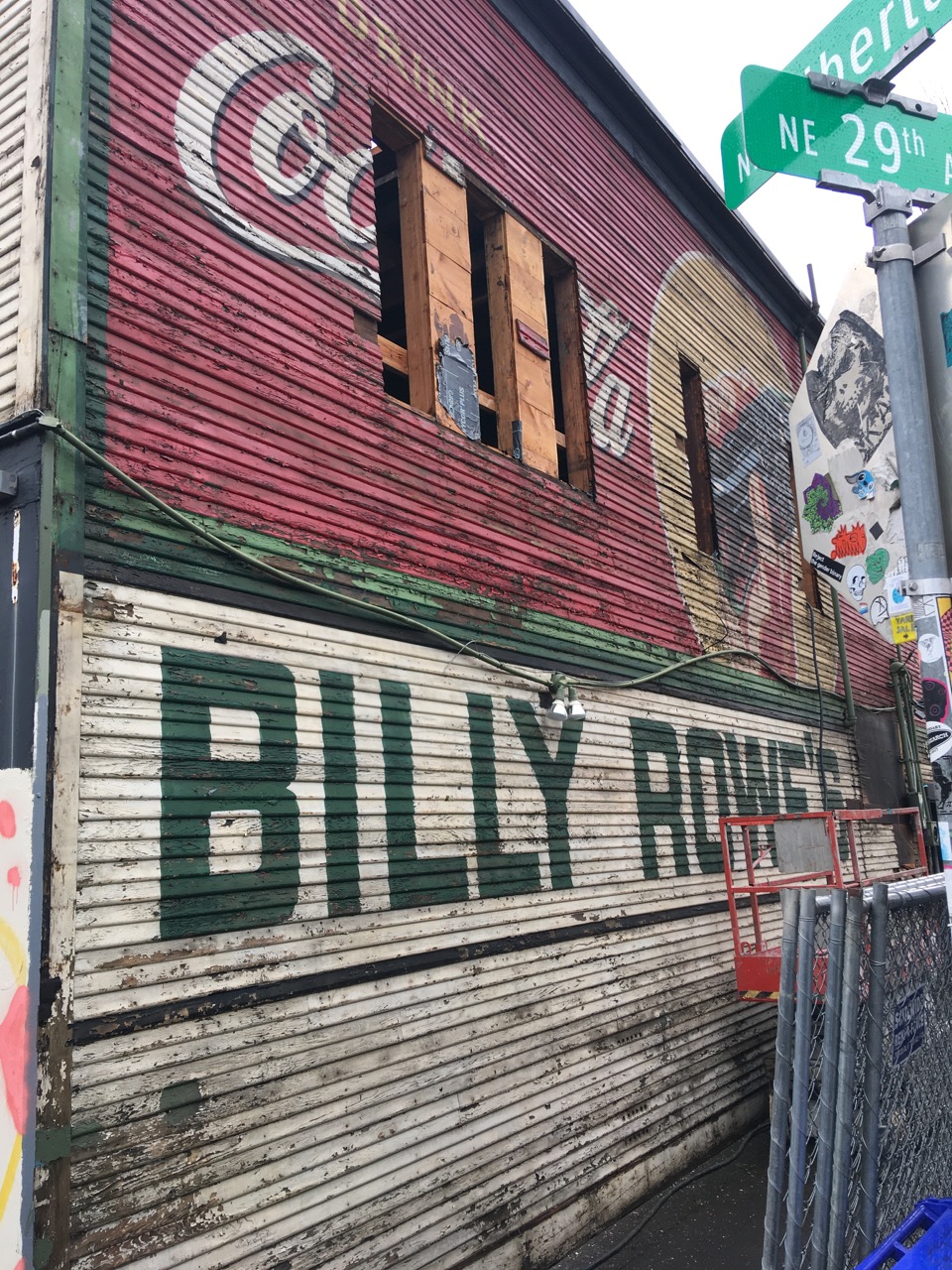
We’ve been watching this week as an amazing wall-size advertisement from the 1940s has resurfaced during restoration, and as we’ve learned more about Billy Rowe.
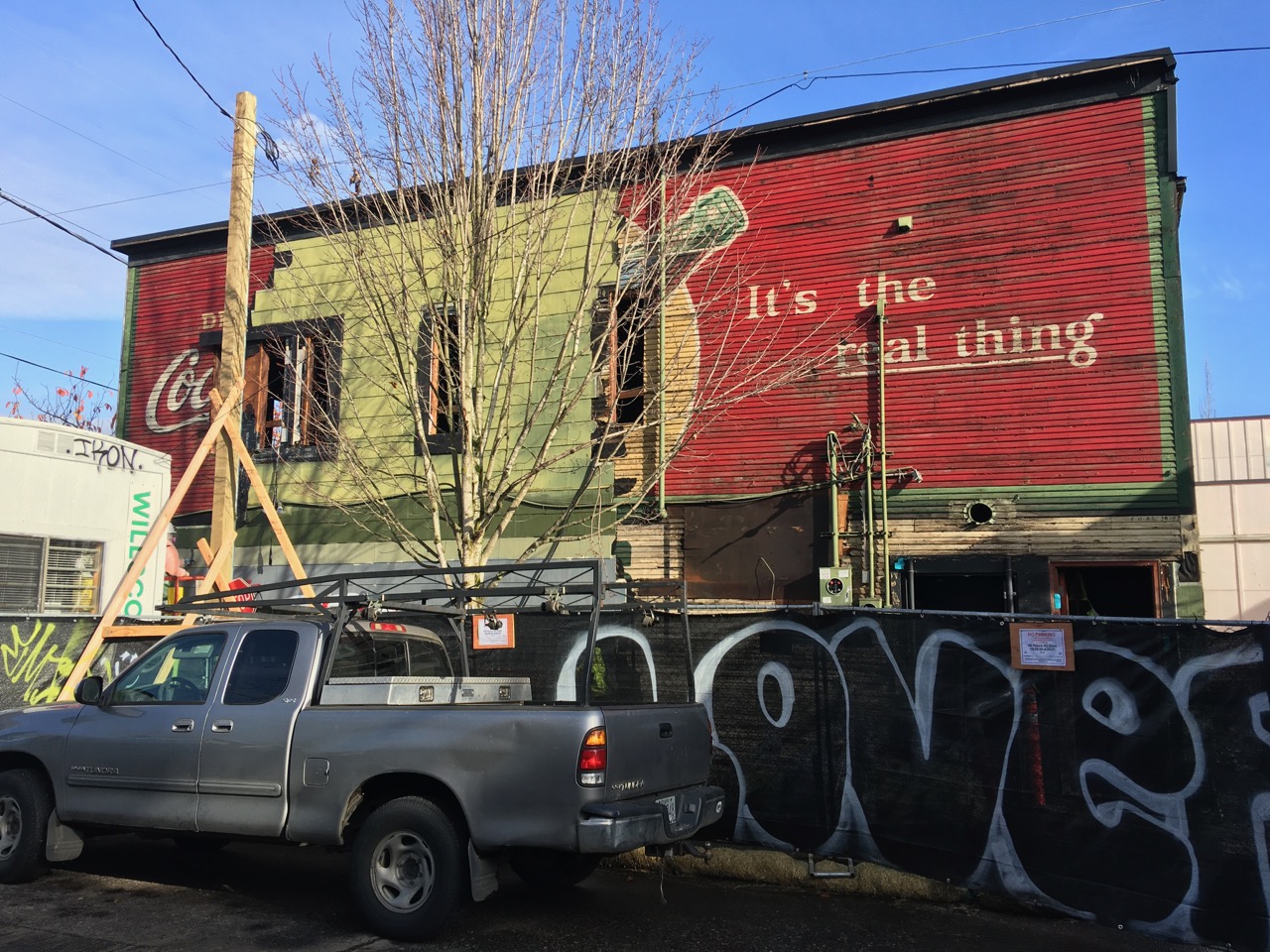
O’Cardinal Properties—the current building owner—was as amazed with the find as the neighborhood was, and intrigued with the possibility of incorporating the original material of the painted wall into the renovated space. But testing for lead late last week returned results that have ruled that out.
“We love the signs and would like to preserve it,” wrote O’Cardinal’s Property Manager Monica Geller in a weekend e-mail exchange.
“However, last week we got the paint tested for lead and it came back with extreme lead paint ratings that will not allow us to retain the mural as is, even with a strong clear coat intended to contain the lead paint.”
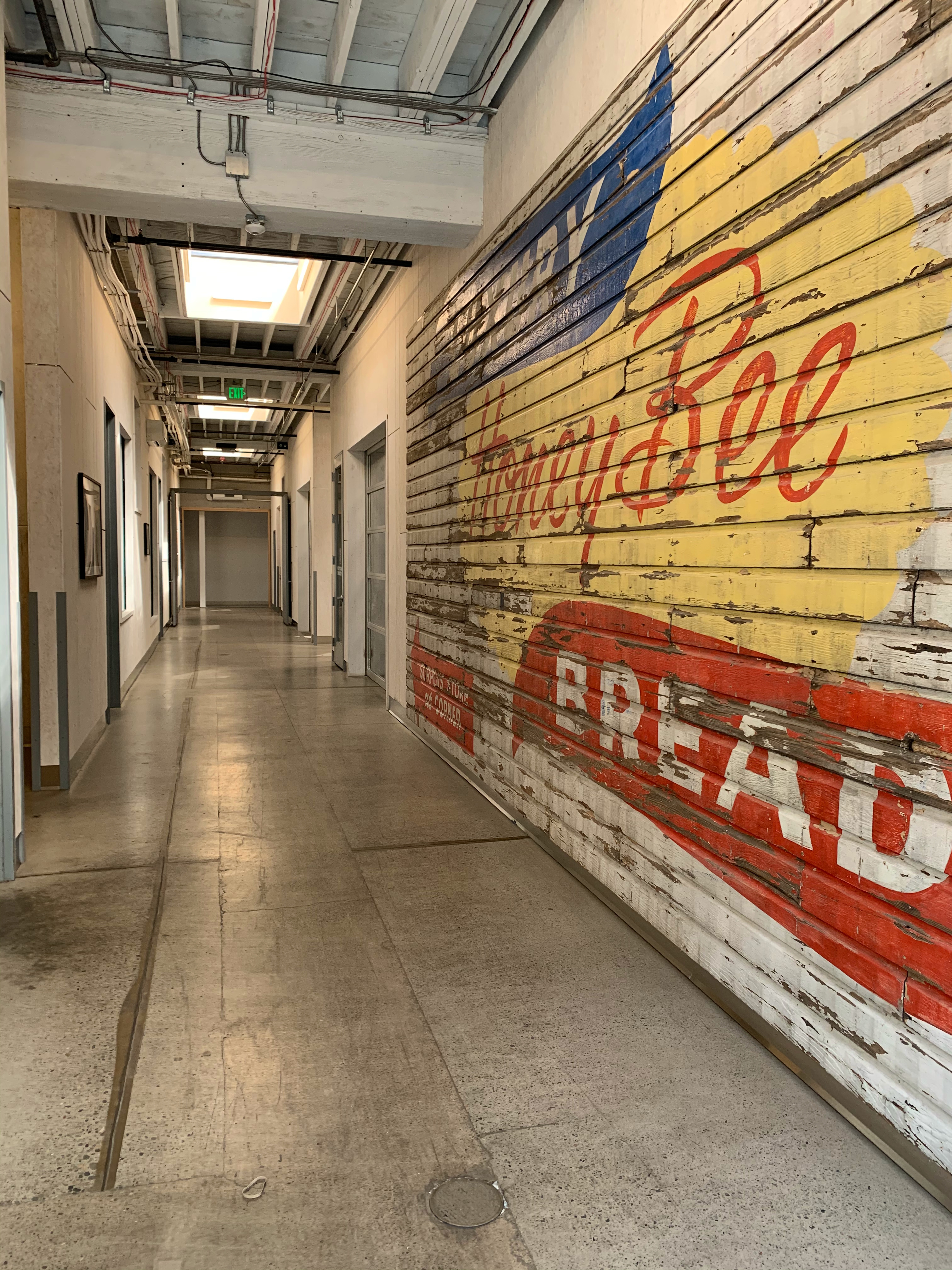
Geller and her colleagues are disappointed, especially given their interest and track record of adaptively re-using and renovating older buildings. In southeast Portland at SE 14th and Stark, O’Cardinal updated the 1929 Luxury Bread Building, carrying forward aspects of its history—including old siding, photos of the old bakery operation and family photos and stories from the former owners. Here’s a photo from inside Luxury Bread showing how O’Cardinal used a former painted mural there:
Repurposed wall siding inside the Luxury Bread Building recently restored by O’Cardinal Properties, 1403 SE Stark. Due to high levels of lead found in the Billy Rowe’s mural, something like this is not possible, according to O’Cardinal.
“We have a plan to take a hi-res photo and reproduce the image to use on the building to retain some of the heritage, “Geller continued.
“I know it is going to be hard for the neighborhood to see the boards come down,” she acknowledged, “but there is no feasible way for us to keep the mural in place, so it will be removed.”
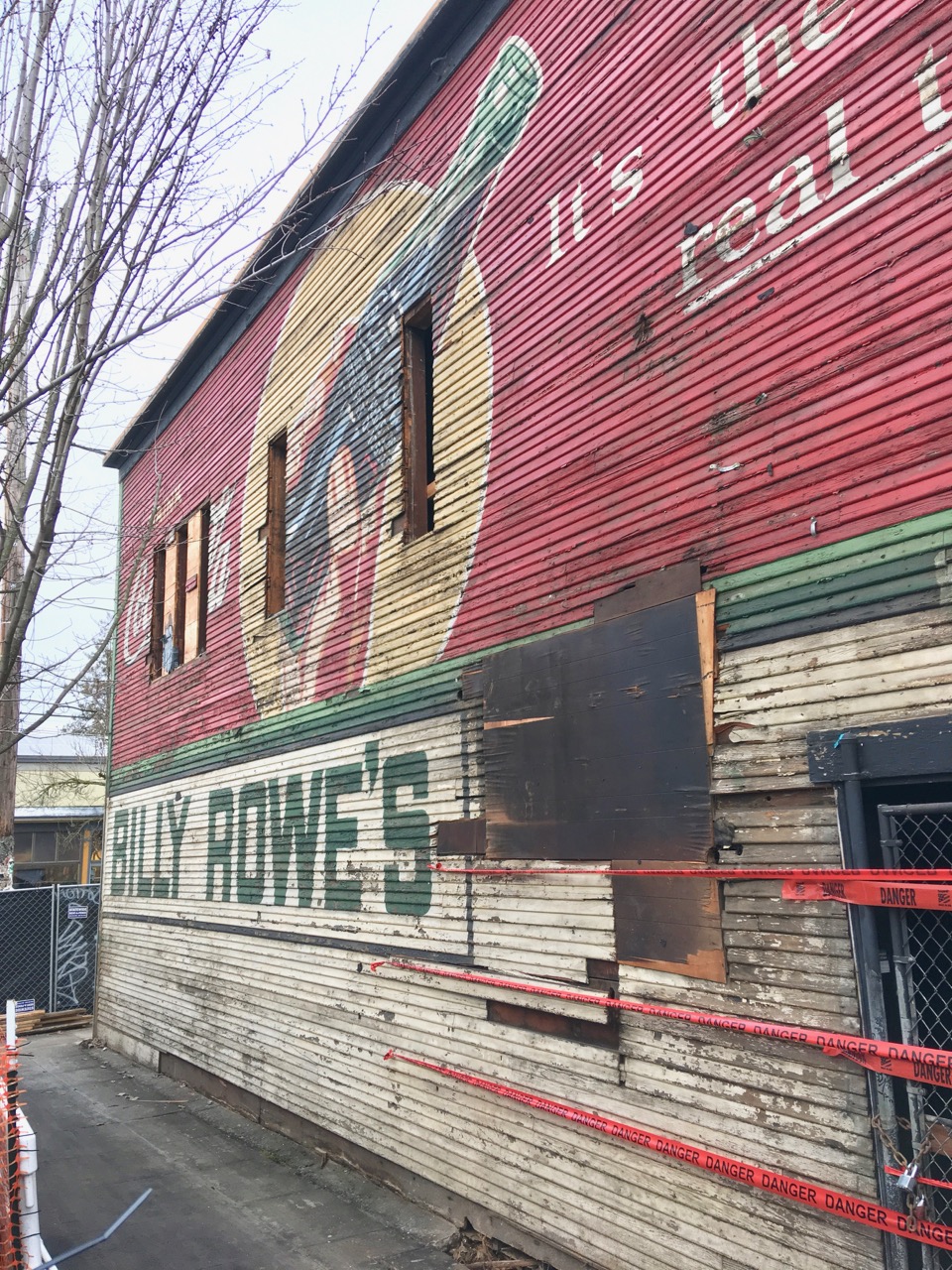
Like a giant postcard from 1946, the western wall of the former Billy Rowe’s Tavern reappeared yesterday at NE 29th and Alberta as workers removed shingle tiles during a major building renovation. When we visited yesterday morning, workers had exposed the vibrant colors of the Coca-Cola ad painted in 1946, but something more had yet to be revealed. Check it out:
The former Billy Rowe’s Tavern, in restoration November 25, 2020.
Naturally, we wondered about Billy.
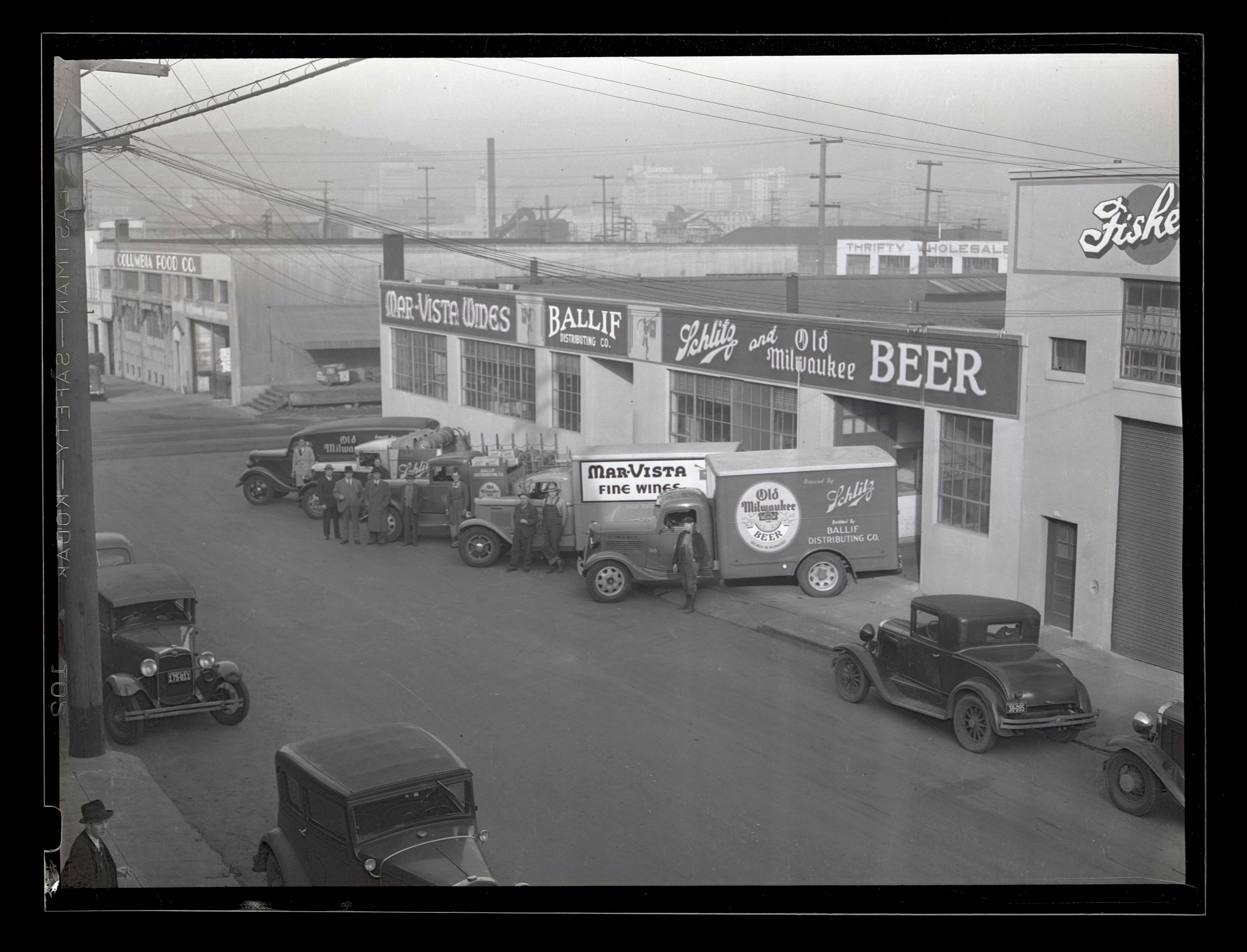
William Chauncey Rowe and wife Doris Isabelle Rowe opened the tavern at 2904 NE Alberta in 1943. Billy was a commissioner in the Boy Scouts, a member of the Portland Elks lodge and an active member in the Church of the Latter Day Saints. Doris was a member of the Elks Auxiliary. Before going into the tavern business, Billy was vice president of Ballif Distributing Company, a beer distributor based in southeast Portland.
Maybe he’s one of the overcoats here in this photo, from the incredible collection of Oregon Journal photos at the Oregon Historical Society. This photo is not specifically dated, but caption information indicates sometime between 1933-1941 (old car aficionados could probably pin that down, guessing late 1930s).
After leaving Ballif Distributing, Billy and Doris operated the tavern until their sudden death on the night of January 2, 1951 in a road accident north of Klamath Falls while returning to Portland. Newspaper reports describe a head-on crash in icy conditions. They were survived by two sons, Earl and Calvin.
The tavern appears to have passed out of Rowe family hands after that, but the name stuck (perhaps because it was painted in three-foot letters across the side of the building…the place was a local institution). In 1957, new owner Joseph Hoover was arrested on charges of promoting gambling on the premises and having a horoscope machine that made small payoffs to customers. Later that year, Portland City Council refused to renew Hoover’s tavern license.
Sometime after that–perhaps when the shingles went up on that west wall covering up Billy Rowe’s name–the place transitioned to Duke’s. Any AH readers able to share a story from the Billy Rowe era?
Update: On December 6th, the owners let us know the mural wall will have to come down due to high levels of lead paint. Click here to read more.
We always love to see layers of history being revealed in buildings and places we think we know. Check out this view from today’s walk up Alberta. Here we are at the southeast corner of Alberta and NE 29th, the building that used to house Bernie’s Southern Bistro.
Looking at the west side of the building from NE 29th. Sunshine!
Workers were carefully removing the green shingles, exposing a huge advertisement for the real thing painted directly onto the original shiplap siding.
According to the permit, it looks like the building is getting a complete renovation, with all interior walls, stairs and fixtures on both floors coming out; construction of a new stair, an upgrade to the old storefront and a complete seismic upgrade. Big job.
Built in 1921-1922 by D.L. Duncan, the building housed multiple businesses in its early days: a repair shop, a shoe store, a print shop. In its middle years and most recently it’s been a place to meet for a drink or a meal. From about 1940 until the late 1960s, it was Billy Rowe’s Tavern and then Duke’s Tavern before becoming Bernie’s Bistro.
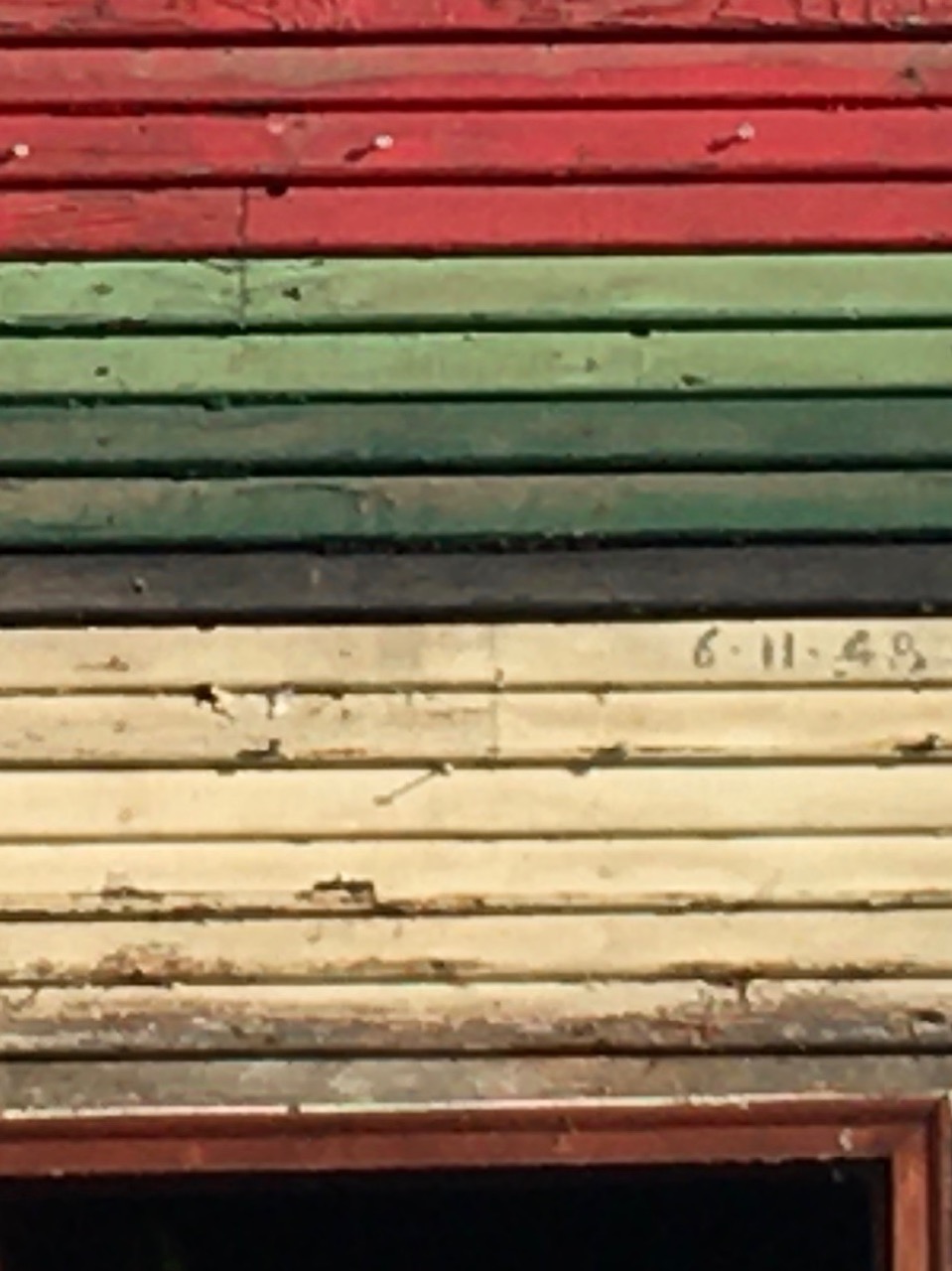
Small lettering just below the real thing suggests this advertisement was from the Billy Rowe’s era. Can you read the lettering? Looks like June 11, 1948. We know a few sign painters and will ask around for insights…there’s more to this story.
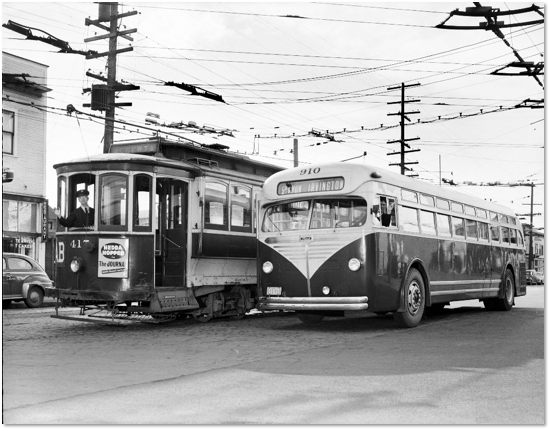
Just for fun–and you’ll be forgiven for being distracted by what’s in the foreground–here’s another view of the same building. Yep, that’s the corner of Billy Rowe’s Tavern there on the left by the streetcar, on February 3, 1948, at NE 29th and Alberta. The photo was published in the Portland Transit Company’s 1947 Annual Report to illustrate the end of an era. The caption: “Walt Baker, trolley skipper since 1911, greets Merritt Lutman, pilot of a new Mack bus.”
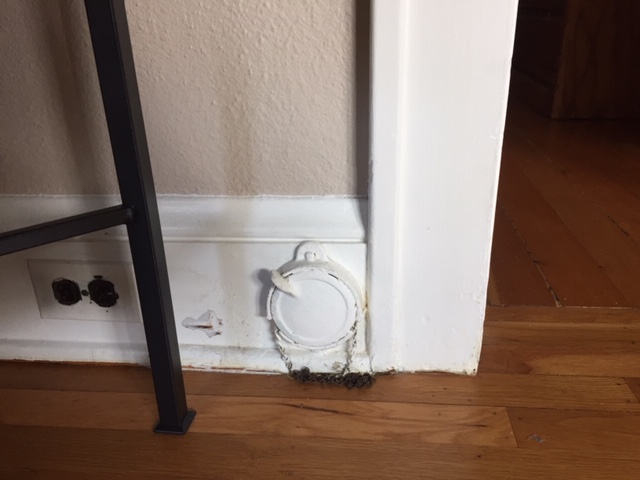
When was the last time you had a really good look at the clues from your house’s history? Cooped up with a little extra time on their hands, some AH readers have shared clues they’ve been wondering about, like this one. What the heck is that?
It’s an old central vacuum port, which was an amazing modern luxury when it was installed back in the 19-teens. Central systems, powered by an electric motor in the basement, began to appear by 1910 and by 1915-1920 were fairly common.
To indulge your curiosity and powers of observation–and with a little extra time on your hands to look around–enlist the support of your young historians in this week’s suggestions of things to think about and do. Click in below for this week’s installment:












 Alameda Old House History