I’ve been in touch with Dick Taylor, who grew up in Alameda during the 1930s. He’s one of the men whose brain I’ve been picking for details on the “old man” who I’ve heard stories about. Dick grew up on Shaver between NE 34th and NE 35th.
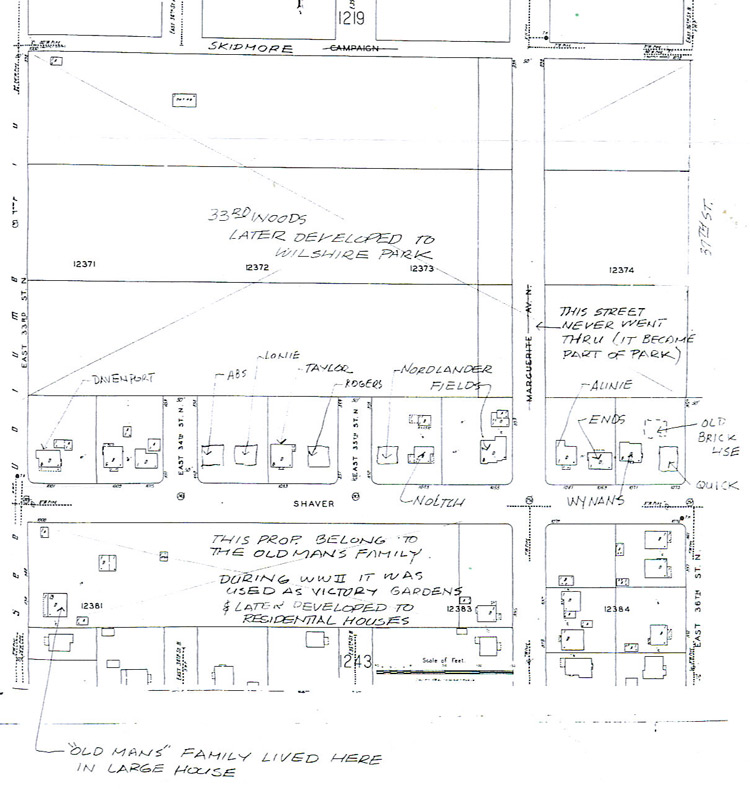
A few weeks back I sent him a copy of the Sanborn map of that vicinity from 1924. He kindly added some detail showing who lived where in the 1930s, and where the “old man” lived. Check out the annotated version of the map he sent me back, drawn from memory.
A couple of observations here: Note that the property on the south side of Shaver Street was a victory garden during the 1940s. Interesting too to point out there was an old brick house in the far southeast corner of Wilshire Park that Dick says was torn down. Have a look at his annotated map:
Click on the map for a larger image.
Here’s what Dick says about the “old man:”
He was the neighborhood character and had a reputation for starting fires. Almost everytime we would hear a fire engine, we knew the old man was up to starting a fire. He would always help extinguish it with a large gunny sack he always carried draped over his shoulder. As kids we used to play a game he taught us called “duck on the rock.”
Interesting to ponder the many interesting souls who have walked these streets.
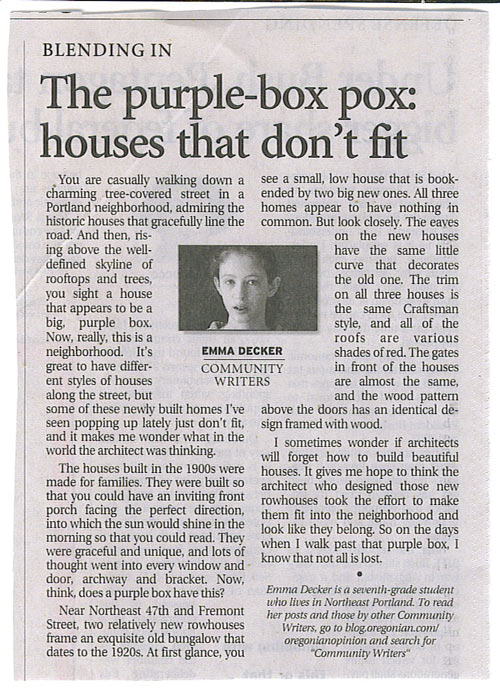
A great observation about old houses and their sometimes brash new neighbors. This column appeared in The Sunday Oregonian on March 16, 2008.
One thoughtful reader, responding to Emma’s column, writes:
Don’t you wonder what story the purple box is telling us? If the older homes were about family, and a love of making things that are handsomely decorated, or about sitting in the sun on our porches, maybe the purple box is about amnesia, or something like it.
In the last week, I’ve spoken with three men — three Alameda boys — who grew up in the neighborhood in the 1930s and 1940s. None of them live here any longer, though fragments of memories from their growing up years are crystal clear.
We’ve been concentrating on overlapping memories about a single person and situation. Even though these three were all here, living just a couple blocks from each other, it’s interesting to see what has been remembered and what hasn’t.
Our point of focus has been an elderly man who lived near NE 33rd and Shaver. Our timeframe is the 1930s. This man owned a dog — which is an important part of the memory — and was reportedly quite a character. One of our Alameda boys remembers him as living in an old home in the 33rd Street Woods, which was what everyone called Wilshire Park when it was just a wild patch of trees and brush. Another remembers him living in the big Craftsman (now painted yellow) near 33rd and Shaver, or possibly in a boarded-up house at 39th and Shaver, and that he owned the chunk of land south of Shaver from 33rd to 35th. Maybe he was here before all the commotion of development beginning in about 1910. Those fragments are not particularly clear. The third boy doesn’t remember him at all.
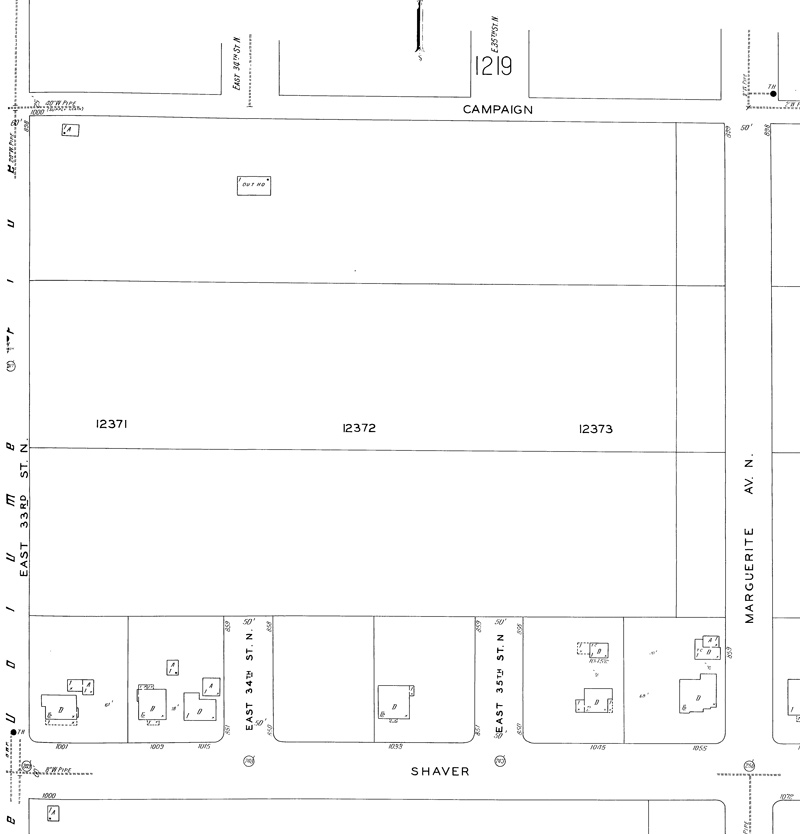
Here’s the Sanborn Map from 1924 that shows the 33rd Street Woods (now Wilshire Park). Note the outhouse situated in the northwest corner, and “Campaign Street” (now Skidmore). Marguerite Avenue is now NE 37th. This is a detail from Sanborn panel No. 1220. Click for a larger view.
Here’s the story we’ve been reassembling from memory fragments: Reportedly, this old man used to walk through the neighborhood with his big dog, which one of the boys remembered as a “police-type dog.” He didn’t drive, so when he needed to travel somewhere, he would walk to the end of the streetcar line at NE 29th and Mason and wait for the Broadway Streetcar. Sometimes during these intervals, he would lay down and nap on the grass of the home at 29th and Mason (the turquoise one, which is a special house for other reasons…a subject for a future post).
So — operating from reassembled memory fragments here — as the man slept sprawled out on the front yard, passersby grew concerned for his health and attempted to wake him, prompting the dog to bark and to bite. This apparently happened a good few times…enough that the police knew about the sleeping man and the big dog, and avoided being pulled into the situation. Was he Mr. Volk? Mr. Volkman? Mr Wilshire? His name was in the air, but not something that stuck with these 10-year-old boys.
It’s been an interesting contrast this week. A good portion of my Alameda research centers on what has been documented in black-and-white: building permits, census data, newspaper clippings, plats. The human dimension — the memories and stories — is much more malleable, often more difficult to track down, and way more precious.
Time is of the essence to capture these memories.
Post script: be sure to have a look at this follow-up hand-drawn map provided by one of the “Alameda boys,” along with another story about the old man.
A recent visitor to this blog asked if there was anything he could do to help with capturing the history of the Alameda neighborhood. Absolutely.
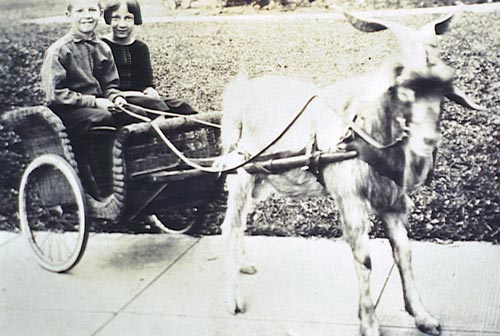
Bruce Morrison, the little boy who grew up in my house, remembered the day his younger sister Jean and brother Robert took a ride on the goat and cart out in front of the house. You never know what might turn up in an oral history interview!
There’s no time like the present to be reaching out to long-time residents to gain their insight and memories about what it’s been like to live in Alameda over the years. I’ve done dozens of oral history interviews with Alamedans and have developed a template of questions over time (which you can access by clicking here) that may be helpful.
Put on the coffee pot and invite your elder neighbor over for a trip down memory lane. Or better yet, bring a snack over to their house, where they might be more comfortable. Grab a tape recorder so you don’t miss anything. Start general and get specific. And fight the instinct to fill the silence. Just ask the question and listen. I’ve learned some interesting stories that would otherwise simply be lost to time.
Let me know if there is something I can do to support your oral history endeavor…sometimes it’s helpful to have a map of the neighborhood or old photo. I can send you something, if you like.
In fact, I’ll even offer to help conduct and transcribe the interview if you’ll help set it up. Just say the word. Personal memories are a non-renewable resource. Time is of the essence.
I’d be glad to post any oral history interviews you conduct here on the blog for neighbors to read and enjoy.
Funny how decisions are made sometimes, and how unpredictable forces shape the way things turn out.
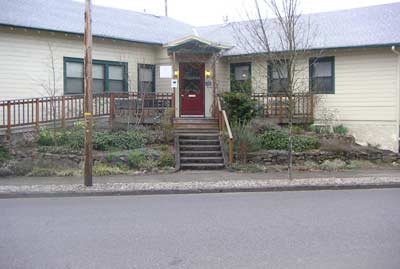
For 80 years, Alamedans have known the Alameda Park Community Church building– today’s Subud Center — as a friendly-looking building on an island just off Regents Drive at Mason.
Passersby inclined to wonder about its history perhaps think it was a big house originally, or a community center. Potluck dinners, friendly gatherings, sing-alongs, dances, lectures, church services, meditation sessions: Yes, this building has seen it all.
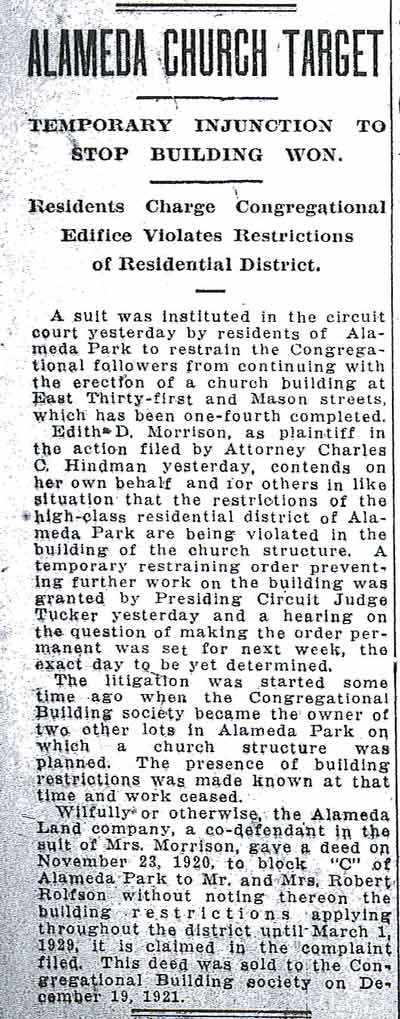
But it very nearly didn’t get built. Check out this story from The Oregonian on October 14, 1921:
And this was the second hurtle the project had to overcome, after being relocated, before work really got underway, from its original and intended location one block west near the corner of NE 30th and Mason. According to the building records, and a handed-down memory from Bruce Morrison, the “little boy” who grew up in my house (who was 90 when I interviewed him), it didn’t take long for his dad Walter Morrison to make a fuss when the builder began site preparation on the lots next to ours. Yes, there was a significant amount of construction going on in “The Park,” as in Alameda Park, the early name of our neighborhood.
But when Walter found out the building adjacent to his house was going to be a church, he took his protest directly to the Bureau of Buildings downtown, and to the Alameda Land Company, which had promised to build nothing but homes in the area until 1929. Like many other early homeowners in the area, the Morrisons purchased here because it was solely residential: No commercial or other buildings were permitted within the confines of Alameda Park. The Morrisons were church-going people…it seems that Edith and Walter just weren’t wild about the constant flow of traffic in front of their house.
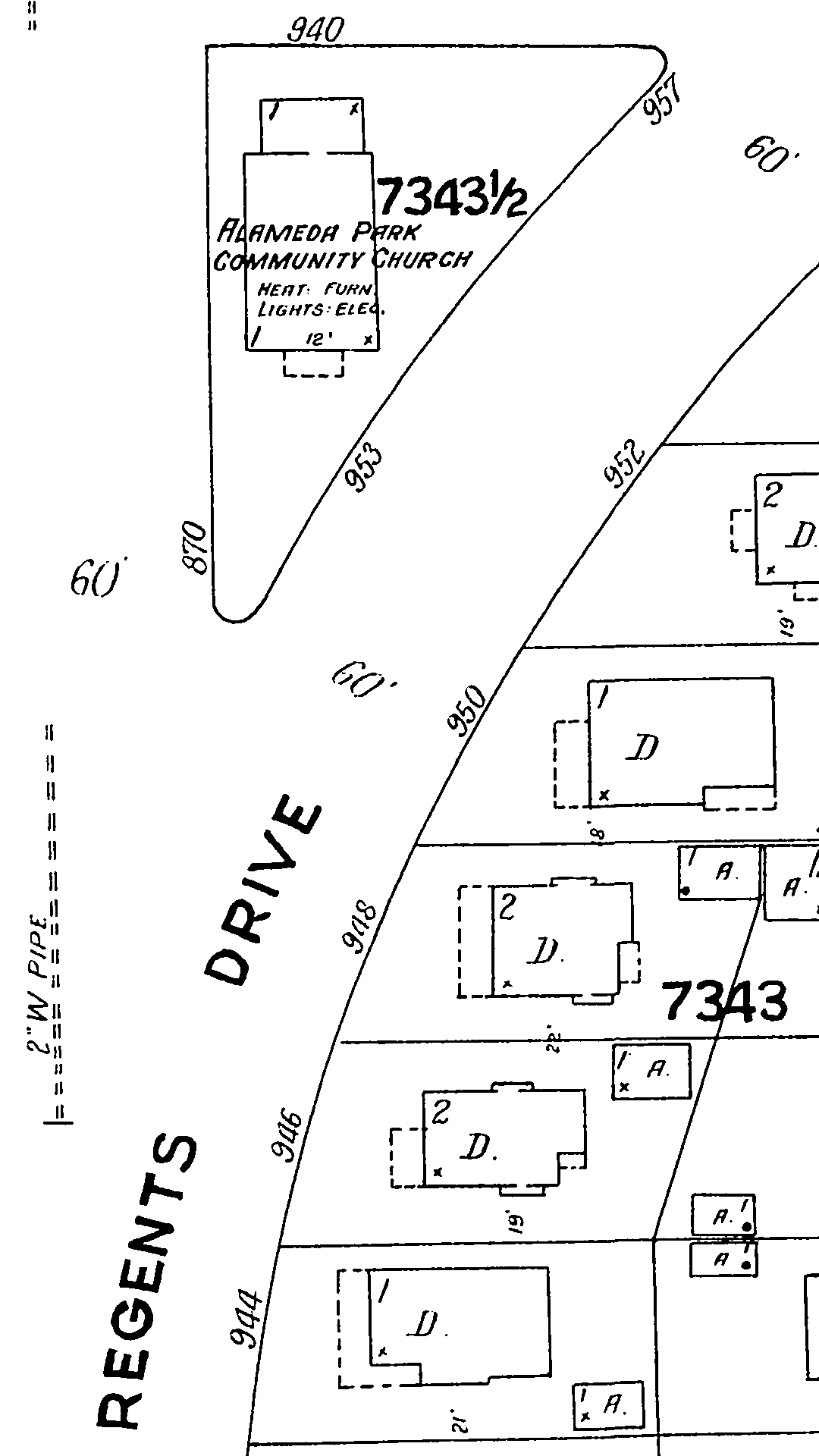
So, in response to Walter’s initial complaint, the city worked with the church and all agreed to move the location to the island off Regents Drive one block east, “Block C” as it is known in the property records.
Detail from Sanborn Map Volume 5, Plate 586, 1924.
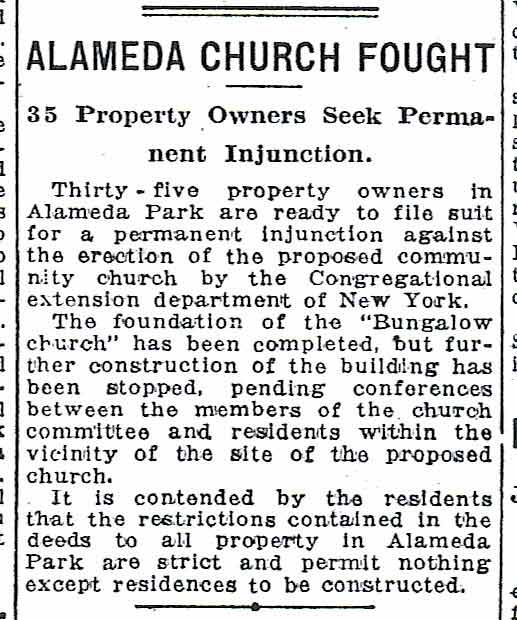
Logistically, this wasn’t too big a problem because not much work had been done on the initial site. The crew picked up its tools and moved one block east. Layout, site preparation and excavation followed, and then the foundation went in. And that’s when the 35 property owners raised a ruckus and shut down the construction. Here’s the next story, from The Oregonian on January 14, 1922:
Sounds messy, doesn’t it? The developer got involved, and other property owners. I can imagine some tense meetings and feelings between neighbors. Not nice. It was, however, pretty neat to find this clipping, which confirms the handed-down memory from Bruce Morrison…it’s in the next to last paragraph above.
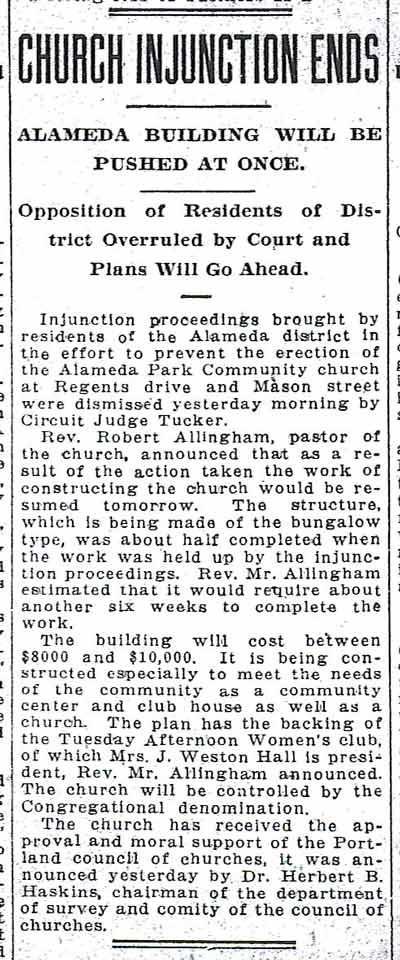
So what happened next? Read on, from The Oregonian on January 29, 1922:
So the judge dismissed the suit, some reasonable and community-minded behind-the-scenes agreements were probably made, and the construction was cleared to move forward at full speed. Which it did.
Built at a total cost of $5,000, the church was actually a kit, constructed by the Redimade Building Company, and plumbed by Alaska Plumbing and Heating for the Congregational Church Building Society, headquartered in New York City. An additional wing of the building was added in 1924 by the Traverse-Bennett Construction Company. Check out these drawings of the original church.
After dedication on Mmarch 12, 1922, The Rev. H.C. Johnson took over the permanent post from The Rev. Robert Allingham, and all kinds of good works, events and gatherings began to take place on “Block C.” Read more from The Rev. Allingham about what the experience of opening the church was like.
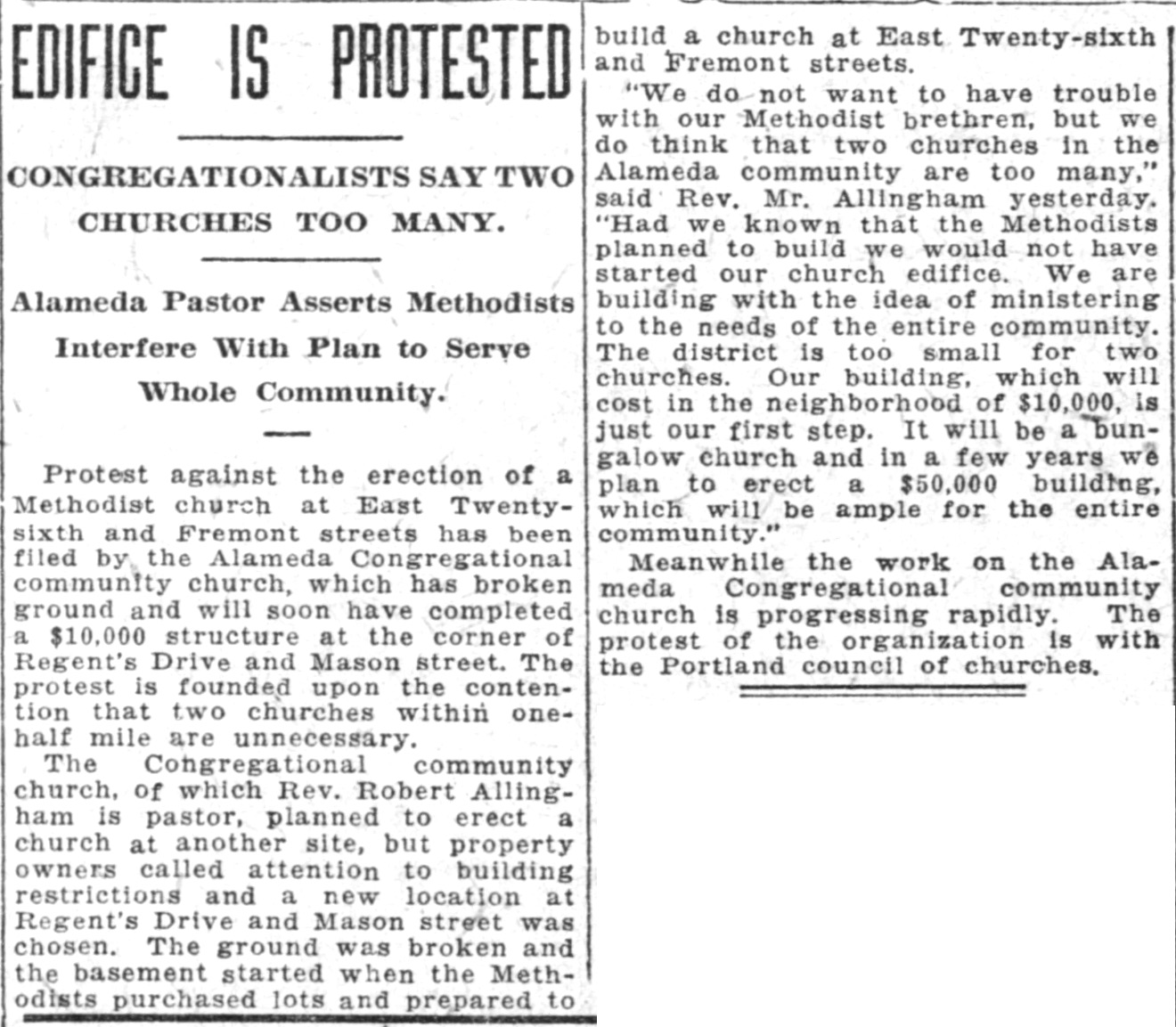
In a deeply ironic post-script to history, I am compelled to share the rest of this story from the turn-the-other-cheek department: When the Methodists filed the building permit to build the Fremont United Methodist Church at 27th and Fremont, The Reverend Allingham and the leadership at Alameda Park Community Church filed an injunction to prevent them from building their church.
In an article that appeared in The Oregonian, the Rev. Allingham says: “We do not want to have trouble with our Methodist brethren, but we do think that two churches in the Alameda community are too many.” Read on, from The Oregonian on January 6, 1922:
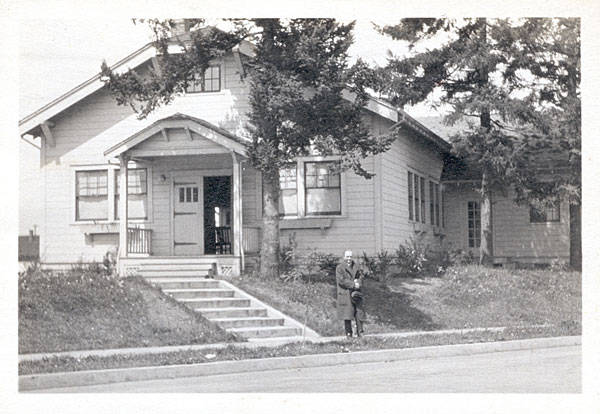
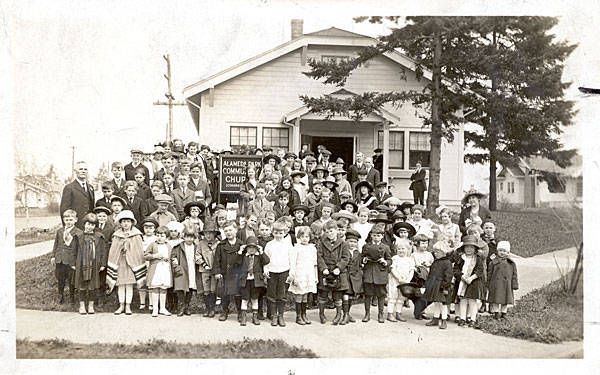
If you’ve read this far, you deserve a prize, so here are all the photos I’ve been able to find of the building.
The Rev. H.C. Johnson at the Alameda Park Community Church, undated.Courtesy of the Frank L. Moore Collection at the Amistad Research Center and Lousiana State University Digital Library.
Alameda Park Community Church, 1923. Looking north, Regents Drive to the right and NE 31st Avenue to the left. Courtesy of the Frank L. Moore Collection at the Amistad Research Center and Lousiana State University Digital Library.
Alameda Park Community Church, 1930. Courtesy of the Frank L. Moore Collection at the Amistad Research Center and Lousiana State University Digital Library.
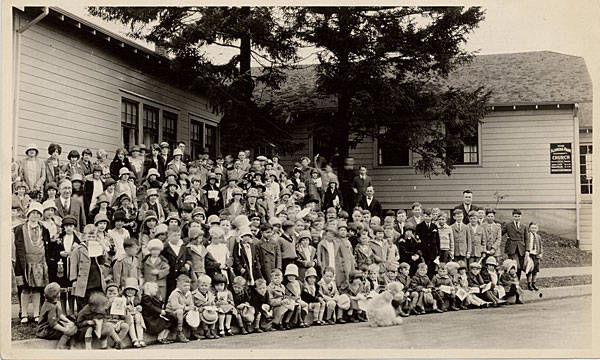
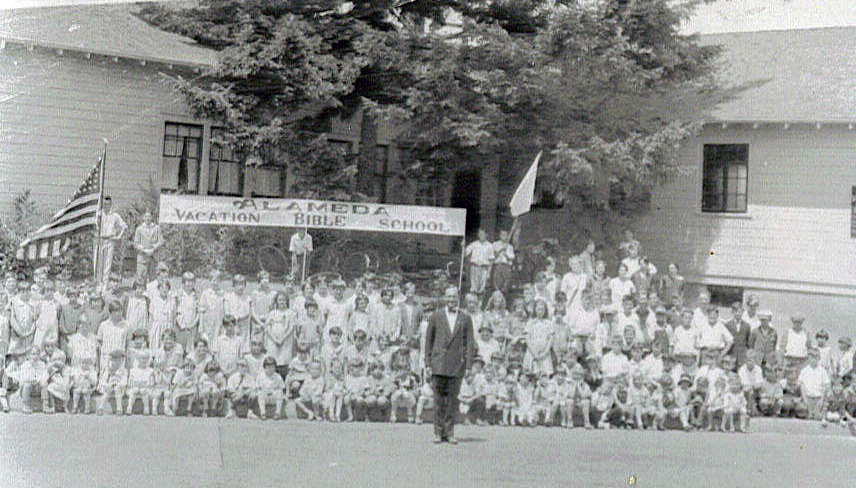
Alameda Park Community Church, summer 1924. The Rev. H.C. Johnson and the Vacation Bible School. Courtesy of the Morrison Family Collection.
Do you know something more about the “Bungalow Church?” Drop me a note.
By the way, this wasn’t the end of neighborhood protests. Wait til you hear about the next one, made a few years later against a campground planned for 33rd and Mason!
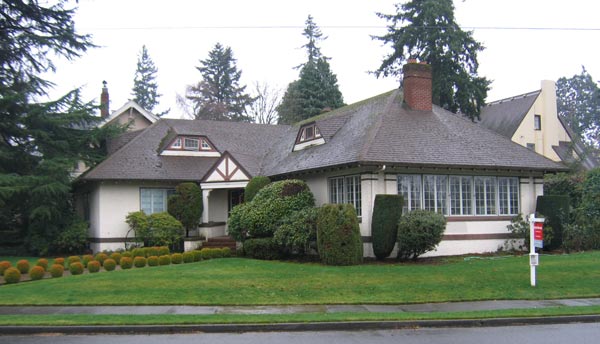
If you live in Alameda above the ridge, you’ve walked, ridden or driven past this very nice home many times. It’s on the wide sweep of Regents Drive, just north of the intersection with The Alameda, on the east side of the street.
3032 NE Regents Drive, Portland, Oregon. Built 1923 by C.O. Waller at a cost of $12,000, which was a lot of money in 1923. This was on the high end for construction costs of other houses built in the neighborhood at the same time. Some families who have lived here over the years have used the west wing of the house (with all the windows you can see above) as a place for their books.
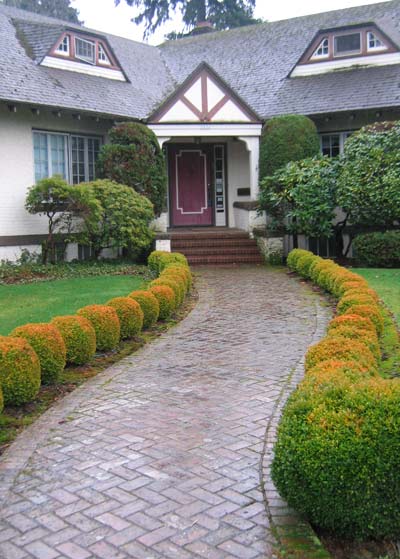
It’s been a favorite of ours, particularly all the casement windows; the curved approach walk with the formal shrubbery, the welcoming way in which the building is sited at the corner with Regents and Dunckley; the brick, the tile roof and all the Tudor details. It’s a nice place.
So we were intrigued recently when picking up the real estate flyer advertising this as the former Alameda Library. Hmm. Really?
As a historian who loves a good mystery, I dug into the resources to see what I could find. And despite the realtor’s listing citing this as a “local legend,” I can report the following, to the contrary:
The construction permit for this house was taken out on May 18, 1923 by Mr. C.O. Waller. Presumably, the house was completed in late 1923 or early 1924. That period was during the second boom of construction in the neighborhood, following the first wave from 1910-1914. There is no record of public bidding process about any buildings in the neighborhood (except for Alameda School, built in 1921 at a cost of about $40,000…and there was a flap about that bid which ended up in The Oregonian, another future post…stay tuned).
The house sits on two lots in the Olmsted Park Addition: lots 25 and 26. Interesting to note that it’s actually had three addresses during it’s lifetime. The first one was 924 Dunckley, which was changed to 3054 NE Dunckley during the great renumbering of the early 1930s (click here to learn more about that and about Alameda Street Names). And sometime — not sure when — it was changed to its current Regents Drive address, 3032.
The two subdivisions across the street from each other in this location — Alameda Park Addition to the west and the Olmsted Park Addition to the east — had strict building covenants and restrictions that prohibited the construction of anything except houses. That goes for commercial buildings, community buildings, even churches (as we know from the lawsuit and protests associated with the Alameda Park Community Church just up the block, built about the same time…more on that story soon). A public library would never have been permitted, or tolerated, in this spot. The most likely library that would have served the needs of this community were either in Albina on NE Knott (just west of MLK in what is today’s Tidal Wave used book store) or in the Hollywood area (that branch has moved around over the years).
I’ve met with a former resident who grew up across the street from 3032 and he recalls that it was not a library, but home to the Johnson family. Mr. Johnson was the contract carrier for The Oregonian (as in the chief distribution guru).
Perhaps the urban myth of “Alameda library” arose from the fact that several homeowners at that address have used that west facing wing — with all those windows — to place their bookshelves. Or from the fact that if you squint your eyes just right, the architecture and the layout of the building on the site does indeed feel like a welcoming, friendly public building.
Jean and Robert Morrison in front of their Alameda Arts and Crafts Bungalow, about 1925. Note the front porch with squared columns, wide bank of casement windows, overhanging eaves and low profile, all hallmarks of the bungalow style. Photo courtesy of the Morrison-Munson family.
The Bungalow
If you’re passing through a residential area of Northeast Portland, (or southeast Portland for that matter) it’s impossible to be more than a stone’s throw from a bungalow. Distinguishing features of this much-loved style include its typical storey-and-a-half height, prominent overhanging eaves and front porch, often angular lines, and square-tapered columns.
Indoors, family interaction was facilitated by a more open plan than the closed off parlors associated with earlier times. Larger windows, often in banks of two or three, invited natural light and fresh air inside and connected the home’s residents with the surrounding landscape outside.
Rooted in the English Arts and Crafts movement – as much a social revolution as it was a design aesthetic – bungalow designs seemed to say solid, simple, natural, durable, practical, healthy, rustic. Some architectural historians credit this venerable building form with permanently altering America’s relationship with the home, breaking with pretentious Victorian and Queen Anne styles and putting a simple, attractive, dwelling within reach of would-be owners.
While Portland didn’t invent the bungalow (credit is given to British ex-pats living in India), prolific local builders at the turn of the 20th Century got a lot of practice perfecting their style. In mid-April 1912, perhaps the peak of our bungalow love affair, Portland was third in the nation behind only New York and Chicago in terms of the total number of building permits issued (667), two thirds of which were for homes…and many of them bungalows.
The era in which our bungalows were built was one of incredible growth in Portland and other West Coast cities. A study I’m making of The Oregonian from 1909-1920 paints the picture of our city in a total building and expansion frenzy in a way us current residents can’t fully appreciate. New neighborhoods were being born on a monthly basis. Hardly a week passed without some mention in the paper about the bungalow style (often referred to as the California bungalow, in deference to its popularity in Los Angeles and other California cities). This article below, from The Oregonian on 21 May 1911, provides a narrative blueprint for what a bungalow should be. I live in a bungalow built about the time the article was written and it sounds like a turn-by-turn description of our house…
From The Oregonian, 21 May 1911. Click to see larger image of this story.
A testament to the cultural popularity of the bungalow can be seen in other segments of Portland life beyond housing: Movie theaters, community centers and even churches were built in the bungalow style. The Alameda Park Community Church near Regents and NE 31st, built in 1922 (now called Regents Center), was originally known as “Bungalow Church.” And a grocery on NE Going was known as “Bungalow grocery.”
The Craftsman / Arts and Crafts bungalow style was popular into the early 1930s, when the English cottage and Tudor cottage became more popular, as family sizes changed, and as the economy contracted. As homeowners’ design preferences changed, some of them remodeled (some might say remuddled) their bungalows to become more “modern.” Past owners of my house removed crown mouldings, columns, portions of dining room plate rail, leaded glass and light fixtures as they pursued their vision of modernity. Fortunately, the solid bones of most bungalows have survived those bad ideas, and homeowners today have access to many resources and materials to restore the original look and feel of the bungalow era.
It’s interesting to track development of our neighborhood simply by looking at house styles, with the bungalow, the four-square, and other Craftsman-style homes built first, giving way to the formal Tudor revival, the English cottage style, Mediterranean (we have a good few in the neighborhood), and Colonial influences.
Our national love affair with bungalow style has given rise to at least one national magazine, dozens of books, friends groups, websites, conventions and retail businesses. The themes embodied in Portland’s first bungalows – family, simplicity, connection with the natural world, practicality – are very much part of our design ethic today.
For further exploration If you grew up in, live in, or just care about a bungalow, you have to read Janet Ore’s fine book The Seattle Bungalow, published in 2007 by the University of Washington Press.
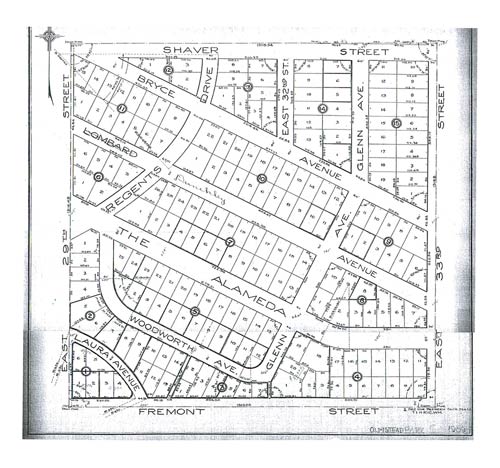
Here’s the cadastral map from 1909 showing the Olmstead Park plat. This roughly five-block square area is north of the Alameda Ridge and tucks in under the southeast corner of Alameda Park. Today this part of the neighborhood is clearly considered part of the Alameda District. Out on the ground even in 1911, these two brand new districts were indistinguishable, interwoven by the same streets, the same water, gas and sewer mains, and many of the same architects and builders who were beginning to populate this area with homes.
The Olmsted in “Olmstead Park” was probably John Charles Olmsted, stepson and nephew of the legendary landscape architect Frederick Law Olmsted (this is not a typo…someone added an “a” into the plat name over the years). John Charles Olmsted and his brother Frederick Law Olmsted, Jr. helped design Portland’s park system and were busy with other commissions here in Portland — including one for the Alameda Land Company — in the years after the 1905 Lewis and Clark Exposition (which they also designed).
By 1909, the neighborhoods to our north and south were already established, and the Portland Railway, Light and Power Company was opening its Broadway Streetcar line with a connection to the heart of Alameda Park and Olmstead Park.
In 1910, before home construction was underway, much of the property in Olmstead Park was owned by one man: B.M. Lombard, a real estate developer who owned large tracts in north and northeast Portland, and whose name is memorialized by North Portland’s Lombard Street. In fact if you look at the plat, you can see that today’s Dunckley Avenue was originally platted as Lombard. Other properties were owned by construction companies, investment banks and real estate developers, including Oregon Home Builders Inc., Colonial Construction Co., Hibernian Investment Bank, Provident Trust Company and Clodfelter Real Estate.
I’ll keep a copy of this in “The Maps” for future reference…
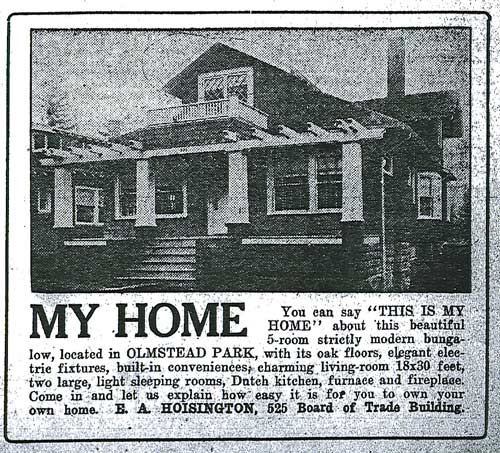
Advertisement from The Oregonian, 17 December 1911.
Because we are such a mobile population, it seems unusual when people stay rooted for a lifetime in their communities, and particulary so when they live as adults in the homes where they grew up. I’m doing a series of stories profiling Alamedans who live in the houses where they grew up. Here are people who have spent most of their lives under one roof.
By visiting with these Alamedans, we hope to witness how the neighborhood has changed–and how it has stayed the same–and how the unique context of a house influences our lives.
Enjoy. And let me know if there are some other folks I should talk to…
With less than a week until Christmas–and everyone talking about favorite books–I thought I would start a list of books you should have on your shelf if you are a fan of old houses. Please feel free to suggest from your library….
The Seattle Bungalow, by Janet Ore, University of Washington Press, 2007. This is an excellent, readable, personal and thought-provoking social history of the Pacific Northwest bungalow. Don’t get hung up by the title, though it does focus on the bungalow in the Seattle area, virtually all of what you read is applicable to how people were feeling about their beloved houses in Portland too. This could be renamed “How the Bungalow Saved The Industrializing World.” You need to read this book.
Wade Hampton Pipes: Arts and Crafts Architect in Portland, Oregon, by Anne Brewster Clarke, Binford and Mort Publishing, 1986. This thoughtfully researched and written monograph details the life and work of the prolific Portland architect and includes many photos and details about his houses, including one in the Alameda Park neighborhood.
Architects of Oregon: A Biographical Dictionary of Architects, by Richard Ellison Ritz, Lair Hill Publishing, 2002. This excellent source covers 650 Oregon architects, including many who specialized in residential work, including houses right here in Alameda. You’ll find it for sale at the Architectural Heritage Center.
The History & Development of Portland’s Irvington Neighborhood, by Roy E. Roos, self-published, 1997. This is a great home-grown work that describes how our next-door-neighborhood evolved. Roy’s work provides insight into prominent local builders, many of whom were busy in the Alameda neighborhood too.
The Architecture of Happiness, by Alain De Botton, Pantheon Books, 2006. While not directly about residential architecture, this book takes on the question of why and how we make connections with the spaces in which we live and work. This is a book that will have you appreciating your own four walls in new ways.










 Alameda Old House History