A Mason Street bungalow origin story

We’ve been exploring the early history of the 1913 Arts and Crafts bungalow at 2503 NE Mason—one of the three we wrote about last week—and the plot has thickened. Its builder, a relocated Canadian citizen, Colorado miner, and livery stable owner, moved to Portland in 1911 and became a home builder, ship builder, all-around handyman and eventually a property developer working on projects in the Hollywood area and near Mt. Hood.

According to building permit and real estate records, Sterling A. Rogers started excavating the basement the very same week he bought the vacant lot in the recently platted Alameda Park addition for $823 in May 1913.

Sterling and wife Lena had arrived in Portland in 1911 after selling their horses, home and livery business in Dunton, Colorado to his brother Robert. Sterling and Lena, then 29 and 26 respectively, had enough of the hard winters in the San Juan Mountains of southwestern Colorado. After a winter escape to the West Coast in 1909, they must have decided it was time to leave. Sterling had been a kind of renaissance man in Dunton, locating mines, constructing buildings, acquiring and looking after horses and wagons.

The Telluride Daily Journal described him like this in its May 23, 1903 edition:

Sterling Rogers, postmaster, merchant, hotel proprietor, and all around monopolist, of Dunton, was an arrival from the south on last evening’s train. He remained overnight and left this morning for Denver. He says that owing to the horrible condition of the roads between the Coke Ovens and Dunton, he cannot get enough lumber to put the finishing touches on his new hotel, but expects to be able to move into the building within the next two or three weeks.

Sterling finished the hotel, and added a pool and baths at the nearby hot springs, but in early 1911 the couple left for Portland. By December, he and Lena were buying vacant lots in the Vernon and Woodlawn neighborhoods. If the hard Colorado winters didn’t drive them out, could be they saw the writing on the wall: by 1919, Dunton had become a deserted and dilapidated ghost town, sidelined by its remoteness and primitive transportation connections, which Sterling knew all too well.

Rogers finished the Mason Street bungalow in August 1913 and advertised it for lease for $30 per month through the fall and early winter while the couple lived there:

From The Oregonian, January 18, 1914

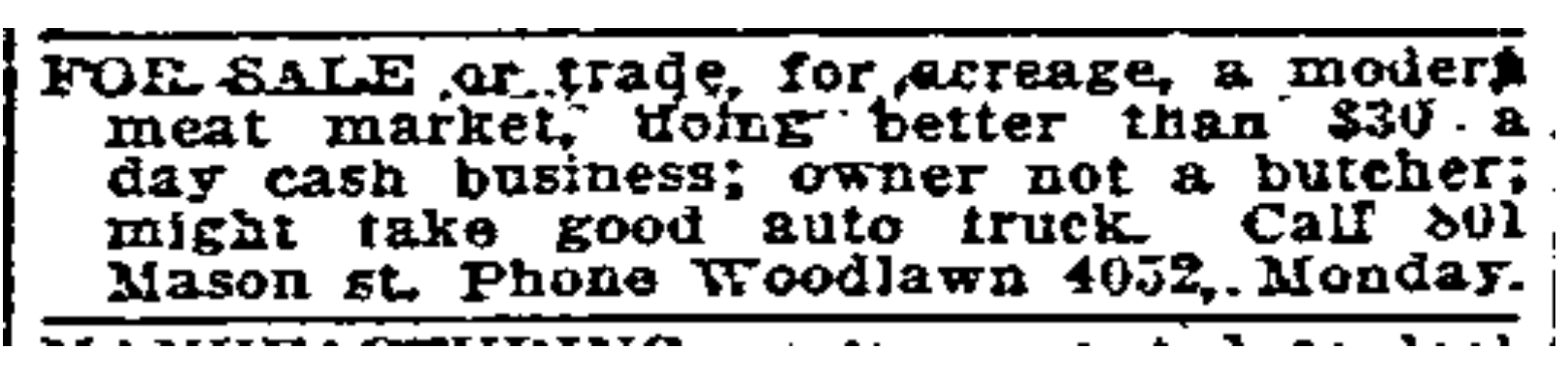
Like many young Portland builders of that time, Sterling was trying to leverage financial momentum by living briefly in his brand-new house built on speculation, leasing or selling it quickly, and using the proceeds to fund other projects that could lead to a next-level income. The couple continued to buy, trade for, and seek additional vacant lots on the eastside. In the spring and summer of 1915, Sterling the entrepreneur was busy:
From The Oregonian, May 9, 1915

From The Oregon Journal, August 8, 1915

Sterling was not a butcher. The meat market had belonged to Daniel and Ethel Dyer, who not coincidentally had moved into the Mason Street house for about a year in 1916, under what must have been a creative financial agreement. But that didn’t last, and by 1917, Sterling and Lena were back. And according to auto registration records, they had indeed been accumulating quite a few vehicles, all registered to the Mason Street house.

In 1918, at age 35, Sterling registered for the World War 1 draft and gave his occupation as a ship carpenter (as well as his height at 5’9”, weight at 140, blue eyes and black hair) and home address as 801 Mason, today’s 2503. That year, he also petitioned for citizenship and renounced his allegiance to George the Fifth, King of the United Kingdom and the British dominions. Rogers had been born in the Canadian province of Prince Edward Island (Canada was then under the dominion of Great Britain). Lena was from South Dakota.

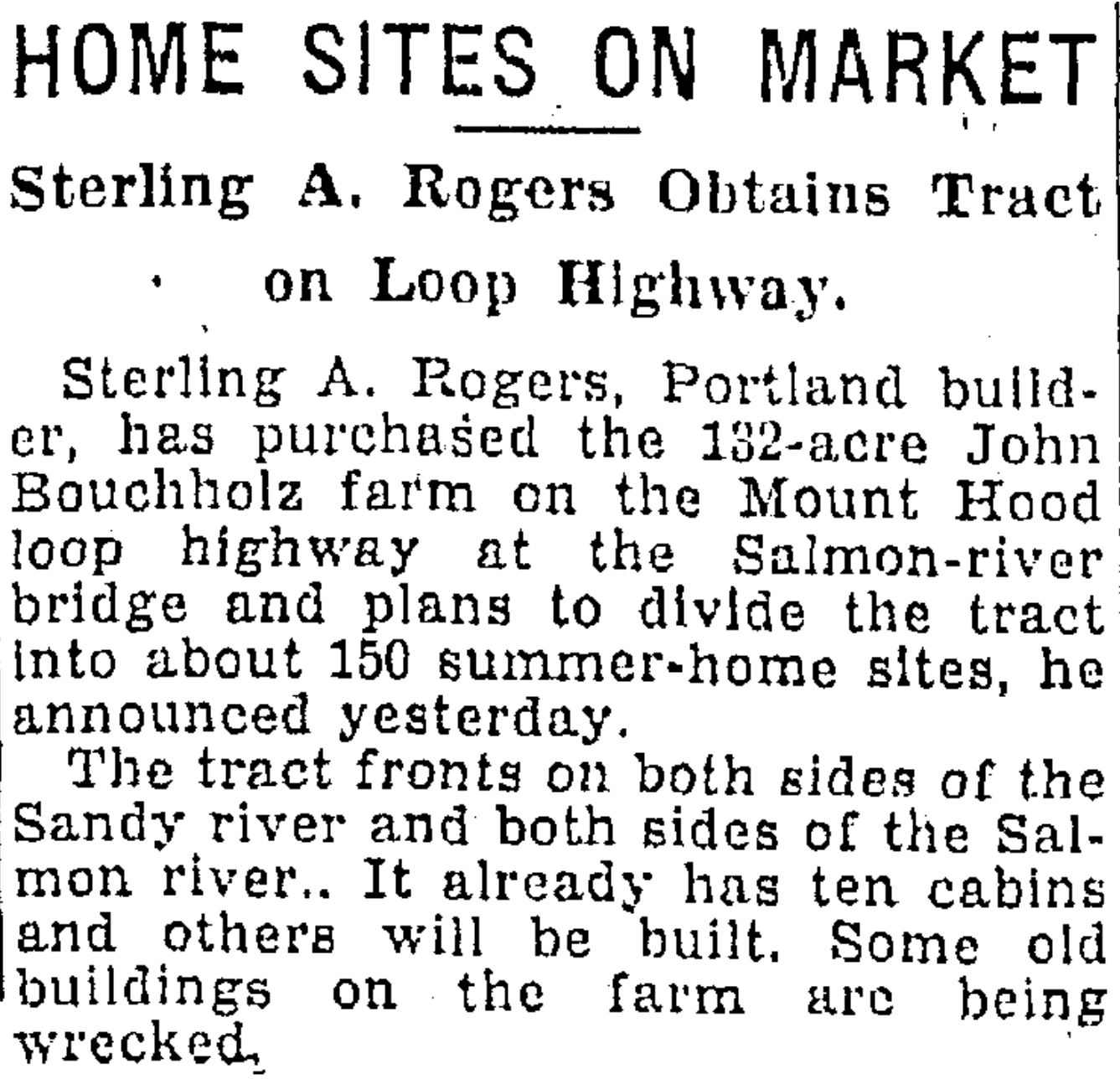
Meanwhile, the couple had been buying property along Sandy Boulevard and by 1920 they moved to a home long since torn down at the northeast corner of 43rd and Sandy. Sterling continued to speculate in real estate, take on repair jobs and build small bungalows—none as distinctive as the Mason Street house. In 1933 it looked like he was going to make it big with a planned development of summer homes on Mt. Hood (which sounds a lot like what is today’s Brightwood).
From The Oregonian, May 21, 1933

But the Great Depression of the early 1930s was a hard time to be building or selling anything. Sterling died of tuberculosis in 1936; his death certificate showed he had struggled with the disease since the mid 19-teens.

Rogers built it – Who designed it?

A look at the handful of relatively non-descript bungalows Sterling built in the 19-teens and 1920s—absent decorative trim, built-ins, columns or beveled glass—makes us think 2503 is a kit home, meaning he bought it as a package to be assembled, which was relatively common then. The design-forward detail of 2503 (see for yourself) is so unlike anything else he built.

So we’ve been poring over kit house and plan set catalogs looking for family resemblances. The external door and window trim is distinctive on this house, as are the three long beveled glass panel interior and exterior doors. Haven’t found it yet, but we’ll keep looking.

Having researched many early home builders, we’re well acquainted with the blend of boot-strap, hard-scrabble entrepreneurship they and their families brought to the building of our neighborhoods.

The homes we live in—the materials they are built with, and the people who did the building—are from a different era that’s hard to imagine today. Each of our homes has its own origin story, the windows, walls and ceilings shaped by people whose stories we’ll never know.

But it’s been fun getting to know Sterling.

More builder & architect profiles

Our house history research practice provides a steady stream of insight about neighborhood development while also allowing us to get to know the builders, the buildings they built, the early residents, and the times they all lived through.

From The Oregonian, September 9, 1923

In addition to the recent piece on florist-turned-builder Carl F. Ruef, we’ve added 10 new names to The Builders page, joining background on more than 20 other builders. Below is a synopsis of these newly added crafts people. Click each name to see their stories and the addresses they’ve designed and built…you might find your home or one you know!

Forrest W. Ayers

Builder of eastside Craftsman bungalows in the teens and 1920s.

Willis Chandler

From 1926-1928, Chandler built more than a dozen homes in Beaumont near the intersection of NE 41st and Alameda.

Ernest L. Graves

Part booster, part builder, Graves parlayed his experience as an engineer in World War 1 into an ability to manage large projects, building more than 70 bungalows in Irvington during the height of the building boom 1925-1926. Graves worked with architect H.H. Menges whose motto was “You furnish the lot, and I’ll furnish the plans.”

Orlo Ray William Hossack

Architect of stately homes in the Irvington and Dolph Park neighborhoods and beyond, and large government and institutional buildings like the Washington County Courthouse and Masonic lodges throughout the region, Hossack paused his successful architectural practice in the mid 1930s to go to work for the Civilian Conservation Corps and died on remote assignment in Idaho.

Emil Nelson

Advertising himself as “Master Builder” and Builder of Finer Homes,” this Swedish immigrant built dozens of homes in Alameda, Rose City Park and Eastmoreland.

Ralph Panhorst

Architect Ralph Panhorst grew up in Northeast Portland in the 19-teens and opened his own architectural practice at the age of 26, focusing on homes and apartment buildings. He was later known for his mid-century modern designs.

Ewald Theodore Pape

While not a registered architect, German immigrant E.T. Pape designed classic residences in Alameda, Laurelhurst, Eastmoreland and Dolph Park and a half-dozen mid-sized apartment buildings, three of which today are on the National Register of Historic Places.

James L. Quinn

This Scottish immigrant builder started out building bungalows in Montavilla and a four-square on NE Broadway before building Grant High School and multiple large projects in Portland and in the Klamath Falls area.

Charles C. Rich

A practicing architect in Portland and on the faculty at the University of Oregon School of Architecture in 1916-1917, Rich designed public buildings, wrote columns on architecture for The Oregonian, and finished a high profile Alameda home before leaving architecture and Oregon for good in 1918.

Carl F. Ruef, Alameda florist and builder

Five homes in the Alameda neighborhood were built by a multi-talented “moonlighting” florist during the boom years of the 1920s.

During the Great Depression years of the late 1920s and early 1930s, Alameda florist and home builder Carl F. Ruef lost his fight with his Alameda neighbors and the City of Portland to open a greenhouse and flower shop at NE 24th and Fremont. But his local handiwork survives as a testament to the resourcefulness of that time, the chutzpah of his big mid-life move, and the boom times of homebuilding in the mid 1920s.

Ruef built and lived in the Mediterranean-style home at 2208 NE Regents from 1924-1930 before building and moving into the small Tudor revival style home at 2425 NE Fremont. Both homes survive today and were bookends of his Alameda experience.

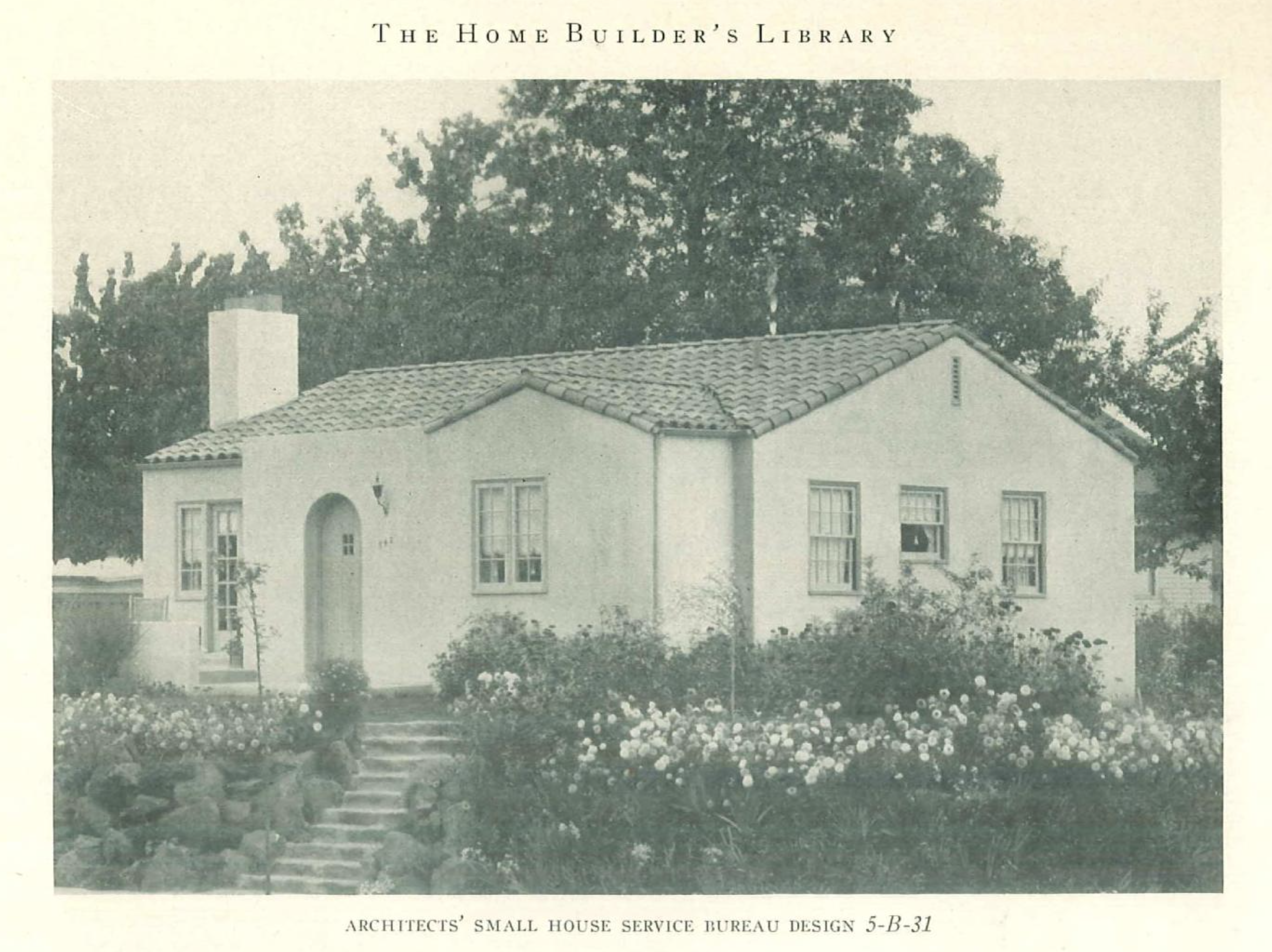
​​From The Small Home: Financing, Planning Building, Monthly Service Bulletin No. 41, July 1925. Published by The Architects’ Small House Service Bureau of the United States, Inc. This was the home of Carl F. and Florence Nichols Ruef from 1924-1930. Prior to Portland’s Great Renumbering of 1930-1931, the home was originally addressed as 742 Regents. Today it is 2208 NE Regents.

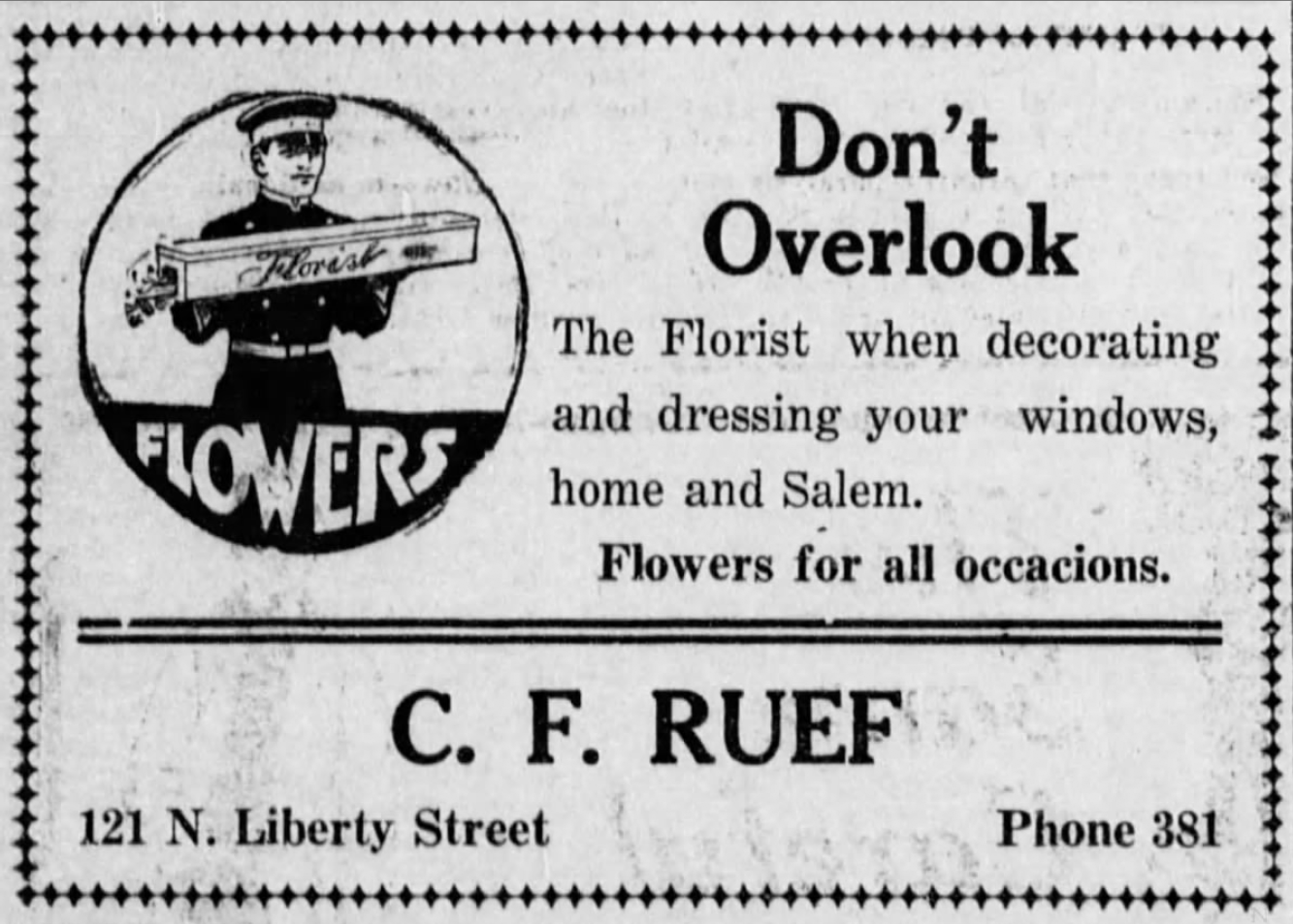
Carl F. Ruef was a first-generation American from German immigrant parents who was born in Claremont County Iowa on May 20, 1879 and grew up in Salem, Oregon. With his brother Edward, Ruef established the largest floral greenhouse operation in Oregon outside of Portland near the intersection of 17th and Market Street in Salem, with a retail storefront in downtown Salem. In the 19-teens Ruef, built a reputation as Salem’s leading florist, knowledgeable about all aspects of flower growing, gardening, and the cultivation of fruits and berries.

From the Capital Journal, October 31, 1916.

Carl Ruef lived at home with his parents until age 39, when in a bold moment after their deaths he sold the Salem greenhouses and florist business, married Statesman-Journal newspaper social columnist Florence Elizabeth Nichols (ten years his junior), had a baby daughter Mary, and moved to Portland.

Once in Portland, Ruef first appears in city directories as a gardener, living with wife and daughter at 2328 SE Yamhill Street. Evidently, he was also preparing to launch a career as a homebuilder. In 1923, he built 1832 SE Hazel (where the family lived briefly), and two homes that share a back fence: 3527 NE 29th Avenue and 2816 NE Ridgewood. In 1924, Ruef is listed in city directories as a builder; the Ruef family was living in the home he built at 2208 NE Regents, which still stands today.

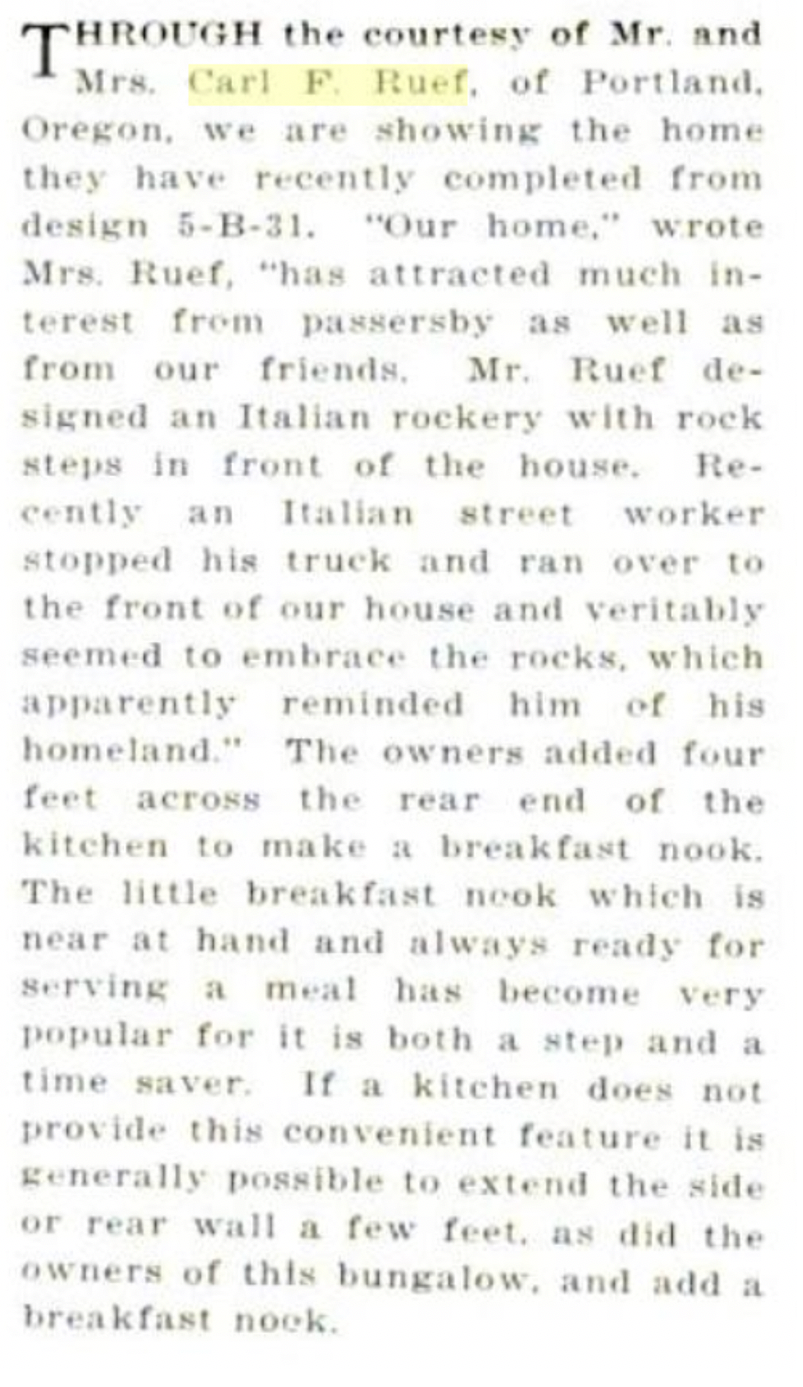
This third home known to be built by Ruef—located on the southeast corner of NE 22nd and Regents—appeared in several publications, including a catalog of building plans published by the Architects’ Small House Service Bureau. Accompanying the 1925 photo above is the following short story and a quote from Florence Ruef about the house and its landscaping:

1924 was a busy year for new homebuilder Ruef: he built the Regents, Ridgewood and NE 29th Avenue houses and the home at 3834 NE 23rd.

Starting in December 1925, the Ruefs attempted to sell the Regents house for $9,000, advertising it as follows: “Choice Spanish bungalow, a positive sacrifice by owner, tile roof, oversize grounds, gas fired hot water heater, illuminated at night.”

But the Regents house didn’t sell and the Ruef family continued to live there until 1930 when they moved into the final home he built, the tiny English Tudor at 2425 NE Fremont.

Meanwhile in the late 1920s, Ruef turned back toward the floral business, opening and then later selling the Irvington-Alameda Floral Company at 1631 NE Broadway.

The Great Depression years of the early 1930s were a challenging time for the Ruef family and for most families in Portland. They continued to live in the small English Tudor on Fremont where they rented out one of the three tiny bedrooms for $12 per month. On March 22, 1931 Ruef advertised the room for rent in one part of the classified ads, and in a different section sought a loan offering the house as collateral: “Want $2,750 on $8,000 new residence, 6 percent no brokerage fee.” He was evidently trying to capitalize a new floral business.

Working out of the small house on Fremont, Ruef attempted to turn his florist know-how into an income stream for his family, initially growing flowers in the backyard and eventually seeking city permission to put up a small sign advertising the business, and later to convert the garage into a greenhouse.

From The Oregonian, May 13, 1931

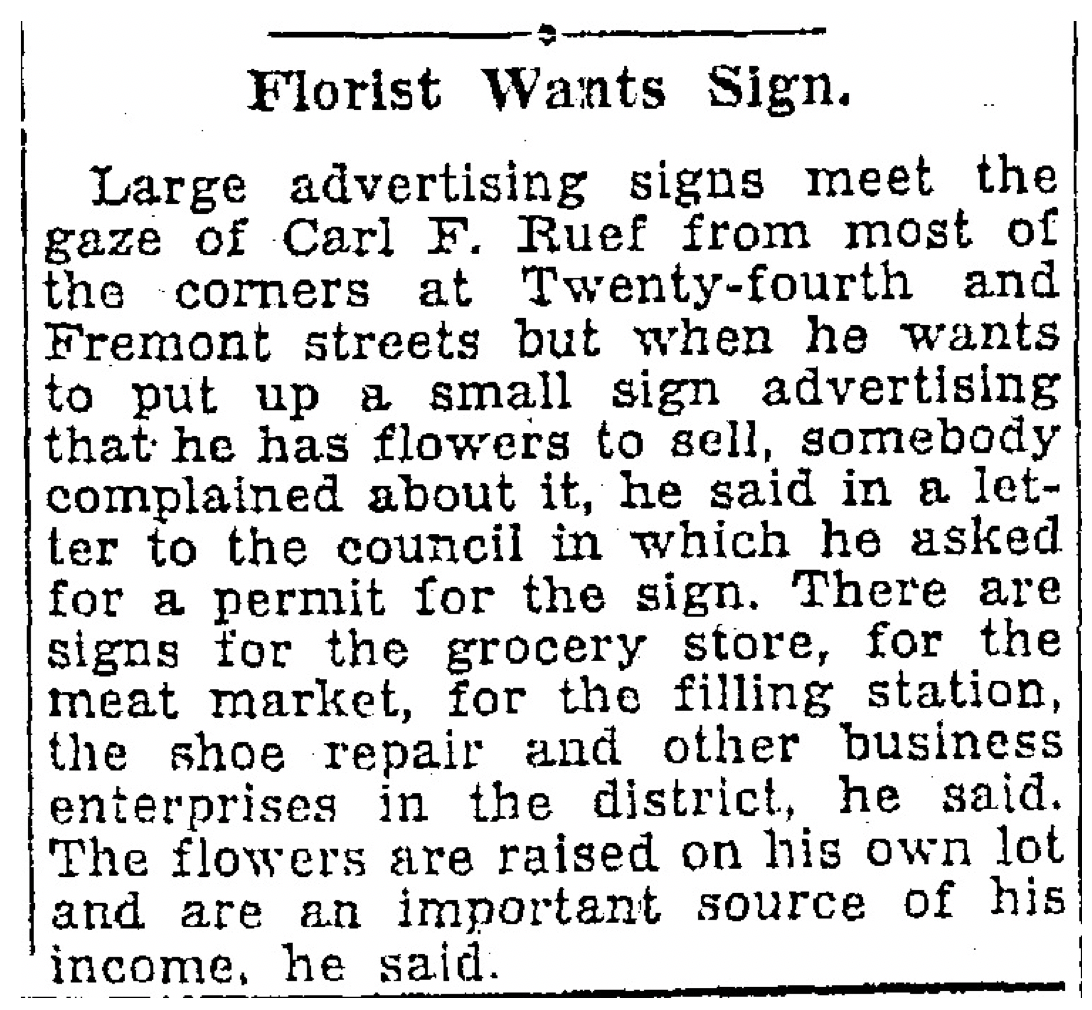
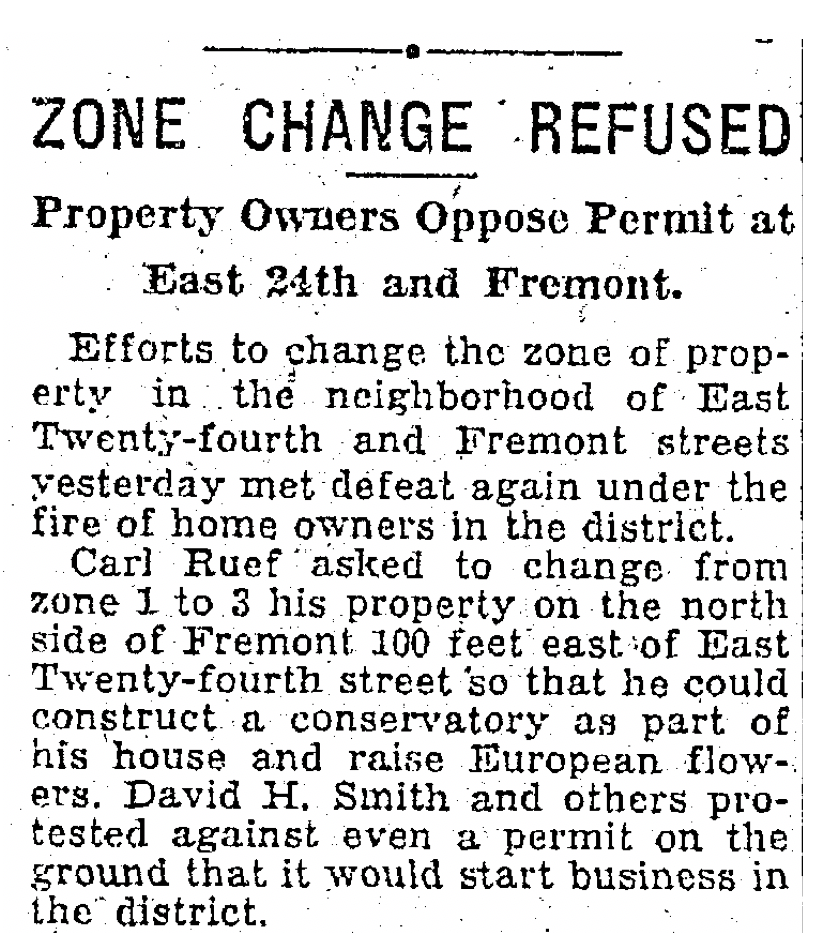
In May 1931 he requested a zone change and permission to put up a sign for his flower business facing Fremont: the lot to the west, location of today’s Childroots Daycare, was vacant during those years as was the residential lot to the east. But neighbors didn’t like the idea of businesses in the Alameda Park Addition period, stemming in part from the original deed restriction prohibiting businesses in the neighborhood, and complained to the city which in December shut down both the sign request and later the zone change which would have allowed Ruef to open a small flower shop.

From The Oregonian, December 31, 1931

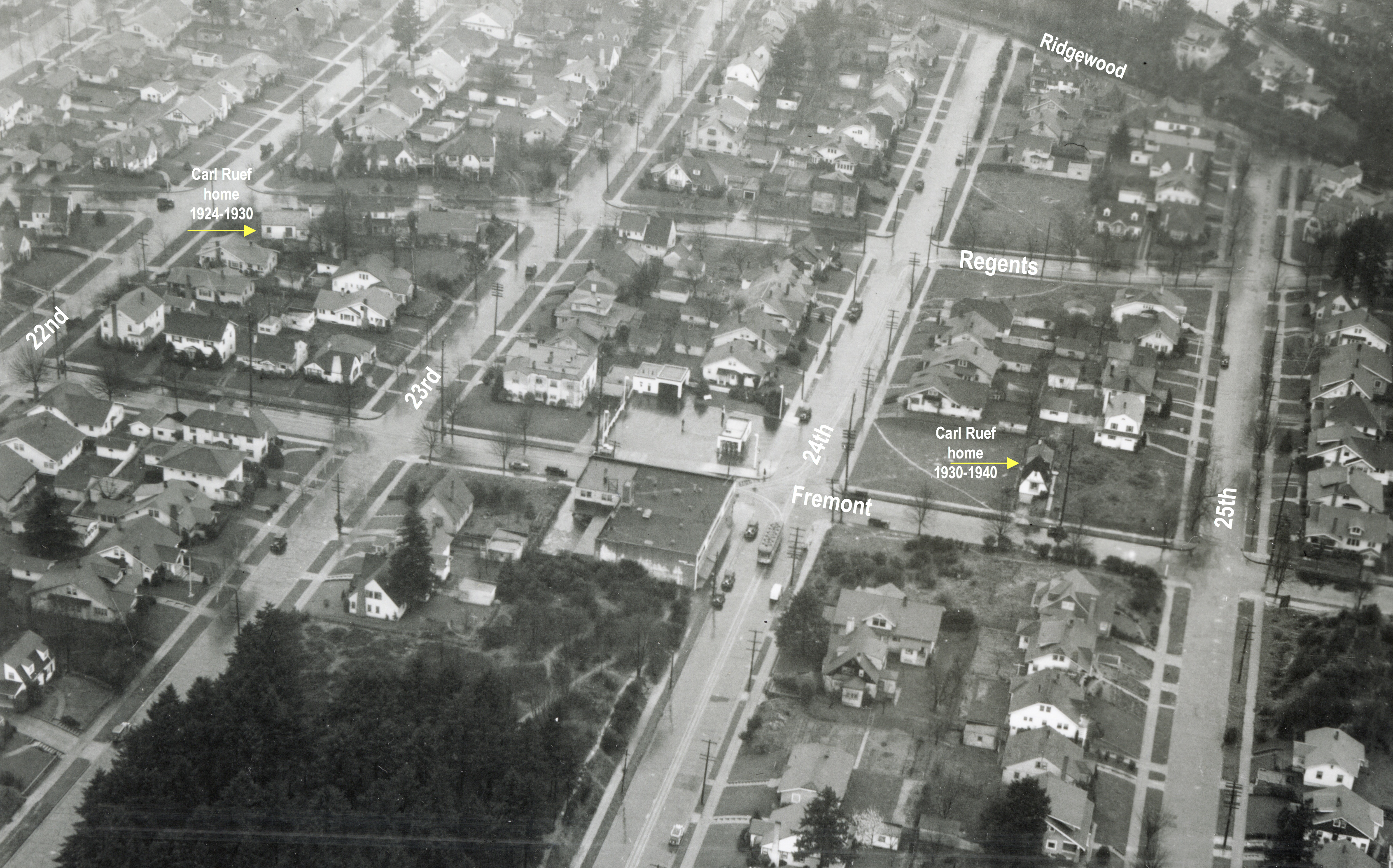
This annotated photograph from a rainy day in 1935 (click to enlarge) shows the home Ruef built at 2425 NE Fremont where he wanted to establish a flower shop, and the home he built in 1924 at 2208 NE Regents in upper left. The vacant lots either side of the Fremont house would have been perfect for the greenhouse he had in mind. Note: the Broadway Streetcar waiting at the corner of Fremont and 24th in front of the Alameda Pharmacy; the gas station on the northwest corner; and the vacant lots on both the southeast and northeast corners. Original photo courtesy of Portland City Archives, A2005-005.1421.2. For more views of this intersection, click here.

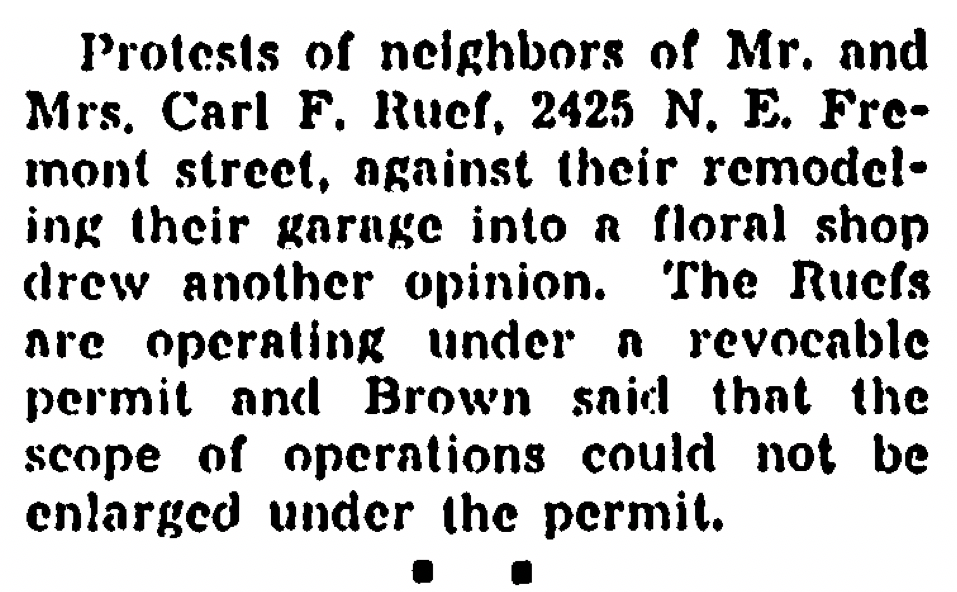
Due to the strong neighborhood opposition, the Ruefs gave up on the home-based business idea and in 1932 rented space at 3125 East Burnside for a new business, Carl Ruef Floral. They continued to live at 2425 NE Fremont and grow some flowers under a revocable city permit. The 1940 census found all three there, listing Carl at age 60, proprietor of a florist shop; Florence, 48, was keeping house; and daughter Mary, then 20, was a model of ladies’ apparel.

From the Oregon Journal, August 29, 1939

When Carl died suddenly one year later in December 1941, the family was living at 1412 SE 25th. His death certificate notes he was a “retired florist and landscape architect.”

Florence and Mary continued to live together until 1943, when Mary moved to Chicago with her new husband Howard Fay, and Florence remarried Portland railroad dispatcher Olof Olsson. Mary was back in the Portland area in the mid 1970s, remarried after her first husband’s death, working as a real estate agent until her own passing in 1985. Florence lived briefly in the late 1950s with her new husband in a Las Vegas trailer park before returning to the Portland area where she died in 1989 at age 100.

More builders: William G. Bohn and H.R. “Hallie” Kibler

This week we’ve added a couple more biographies of eastside builders and lists of their homes to The Builders page, bringing the library of profiles there to 20 homebuilders who’ve left their imprint on our neighborhoods.

This week, meet William G. Bohn, whose second-wind career in the 1920s capped a career in the wood business that started in the upper Midwest. His work stands today along NE 18th Avenue near Sabin School and in Montavilla. He was one of many who blended homebuilding, finance, and salesmanship to take advantage of the heady building years of the mid 1920s.

The second profile this week is H.R. “Hallie” Kibler—Portland’s “Reliable Builder” who started his homebuilding business at age 22 in 1915 (the two sturdy Craftsman bungalows at the northwest corner of 33rd and Prescott were his first and second jobs and still stand today). Kibler served in France during World War 1 and returned to Portland to build in Alameda and nearby neighborhoods before moving to Eastmoreland.

More profiles to follow soon. Our research practice provides a steady stream of insights about local builders.

On an unrelated note, we’ve been out walking in the early evenings here at the bottom of the year—when it feels like it’s getting dark by 4:00 in the afternoon. This is a great time to appreciate the holiday lights and the glow of neighborhood homes and get some exercise. Here are some suggestions to get outside and explore the neighborhoods.

Who built our houses? Check out these new builder biographies for your address

We’ve recently completed short biographies of six more builders responsible for many of our homes on Portland’s eastside and beyond. The section here on the blog called The Builders now has profiles of 18 builders responsible for thousands of homes, mostly built between 1910-1950.

Builders working on an eastside bungalow in the early 1900s. Courtesy of Oregon Historical Society, Negative 37092.

Through our research, we’ve been able to make contact with many of the builders’ families and have added photos and other biographical information that provide a glimpse of the builders’ lives. Included with each biography is a list of addresses of homes by each builder.

One common theme emerges when you read these: most of the builders were immigrants, many of them from Russia and from Scandanavia. All have interesting stories.

Recent additions include:

Judson Hubbell 1872-1954

Ernie Johnson & Nelson Anderson 1920-1924

Max Kaffesider 1873-1960

Emil G. Peterson 1882-1960

Max Shimshak 1897-1978

Taking Stock of Oregon Home Builders

We’re always on the lookout for further insights into the Oregon Home Builders Company, a prolific builder of quality Portland eastside homes from 1912-1917 and a cautionary story about the sometimes thin line between reaching and over-reaching.

Over the years we’ve been writing about OHB and it’s interesting founder Oliver Jeffery; the rest of the story of his aircraft factory, which is today covered with colorful art and graffiti at the southeast corner of NE 33rd and Broadway; its talented architect George Asa Eastman.

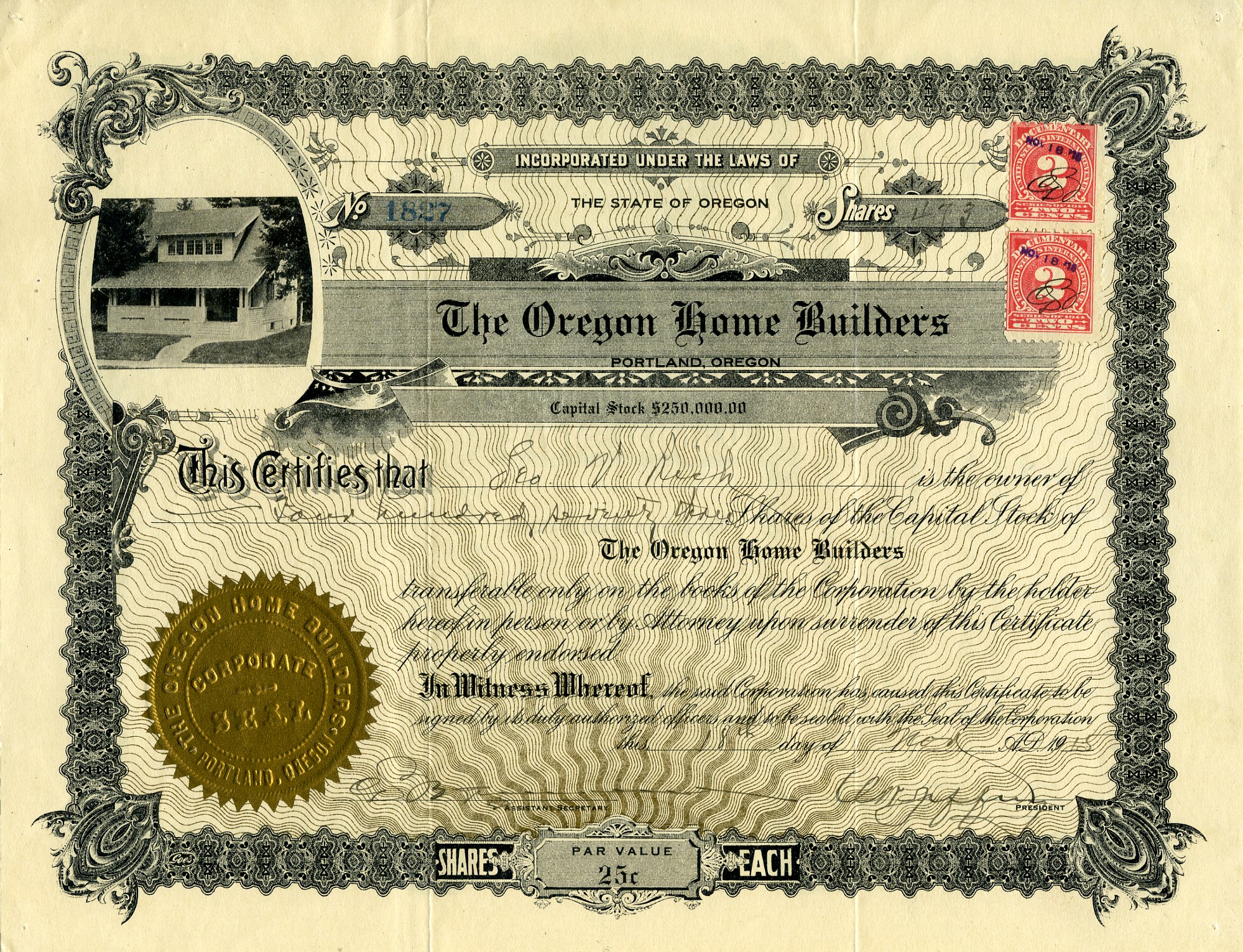
Recently, an AH reader shared with us another small piece of the story: a stock certificate from the company, signed by its president Oliver King Jeffery. Have a look:

1915 stock certificate from Oregon Home Builders. Courtesy of Steve Rippon Collection.

It looks to us that on November 18th, 1915, Leo V. Rich was the lucky owner of 493 shares of company stock, valued at 25 cents each, or $23.25. That’s $2,578 in 2021 dollars.

Rich, age 44 and single in 1915, was a foreman at Portland Woolen Mills, living in St. Johns on North Jersey Street, where he apparently had been saving his money. Maybe he read an edition or two of Keys to Success, the Oregon Home Builders newsletter and decided to invest. We hope he diversified.

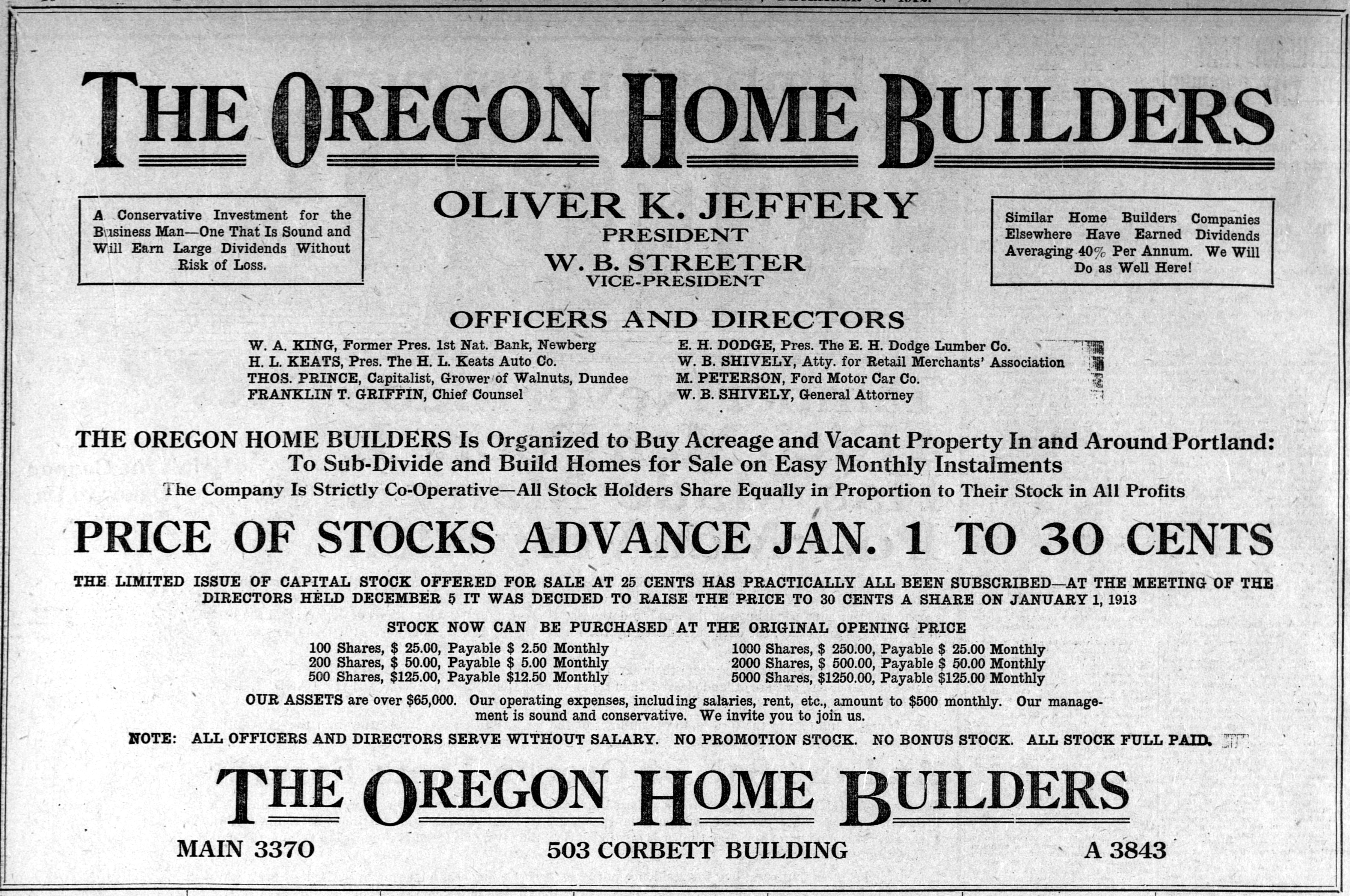
Jeffery would have been pleased. He never missed an opportunity to encourage people to buy stock:

From The Oregonian, December 8, 1912

Unfortunately, when the company went bankrupt in 1917, even though Jeffery was still in town assembling funding for his next enterprise, stockholders were left perplexed and wondering how to redeem their attractive but worthless stock certificates, like this one once held by Leo V. Rich.

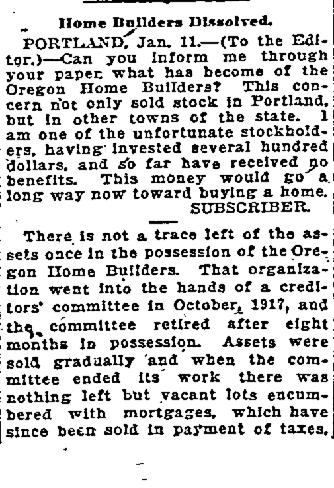
One of those stockholders wrote The Oregonian a few years later with a question about where the company went:

From The Oregonian, January 21, 1921

Keys To Success – Oregon Home Builders Newsletter

The Oregon Home Builders was a full-service development, design and construction real estate outfit that operated in Portland from its auspicious start in 1912 until bankruptcy in 1917. During that run of profit-making, the company also built more than 125 homes, mostly on Portland’s eastside, (and several in Gearhart at the coast), many of them durable and attractive. We did a deep dive earlier this year into the story of OHB and its interesting president, Oliver K. Jeffery.

AH readers will recall Jeffery was the builder of the Aircraft Factory building at NE 33rd and Broadway, which in reality produced aircraft parts for just a few months in the arc of its full life (which appears to be on hold during the pandemic under multiple layers of street art and graffiti).

OHB was prolific in its advertising and marketing—and selling of what became worthless stock. Hundreds of advertisements in The Oregonian and The Daily Oregon Journal during its five-year run were as focused on selling stock in the company as they were on selling the real estate and houses it was developing.

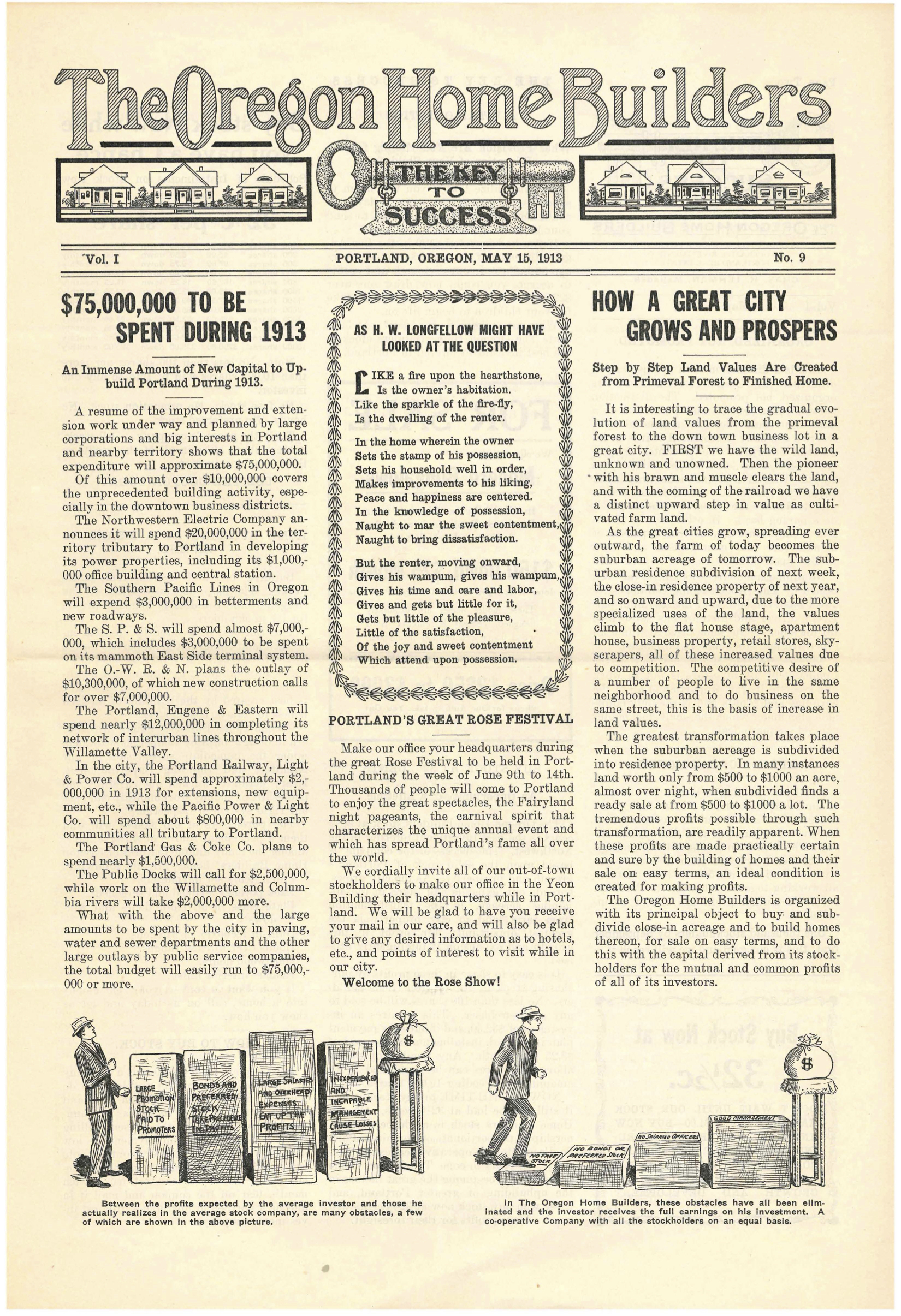
One of OHB’s tools for promoting itself was a newsletter called The Key to Success, that included what was packaged as news about the homebuilding business, other editorial thoughts and a continued drumbeat of encouragement for investors to sign up now for monthly company stock purchases.

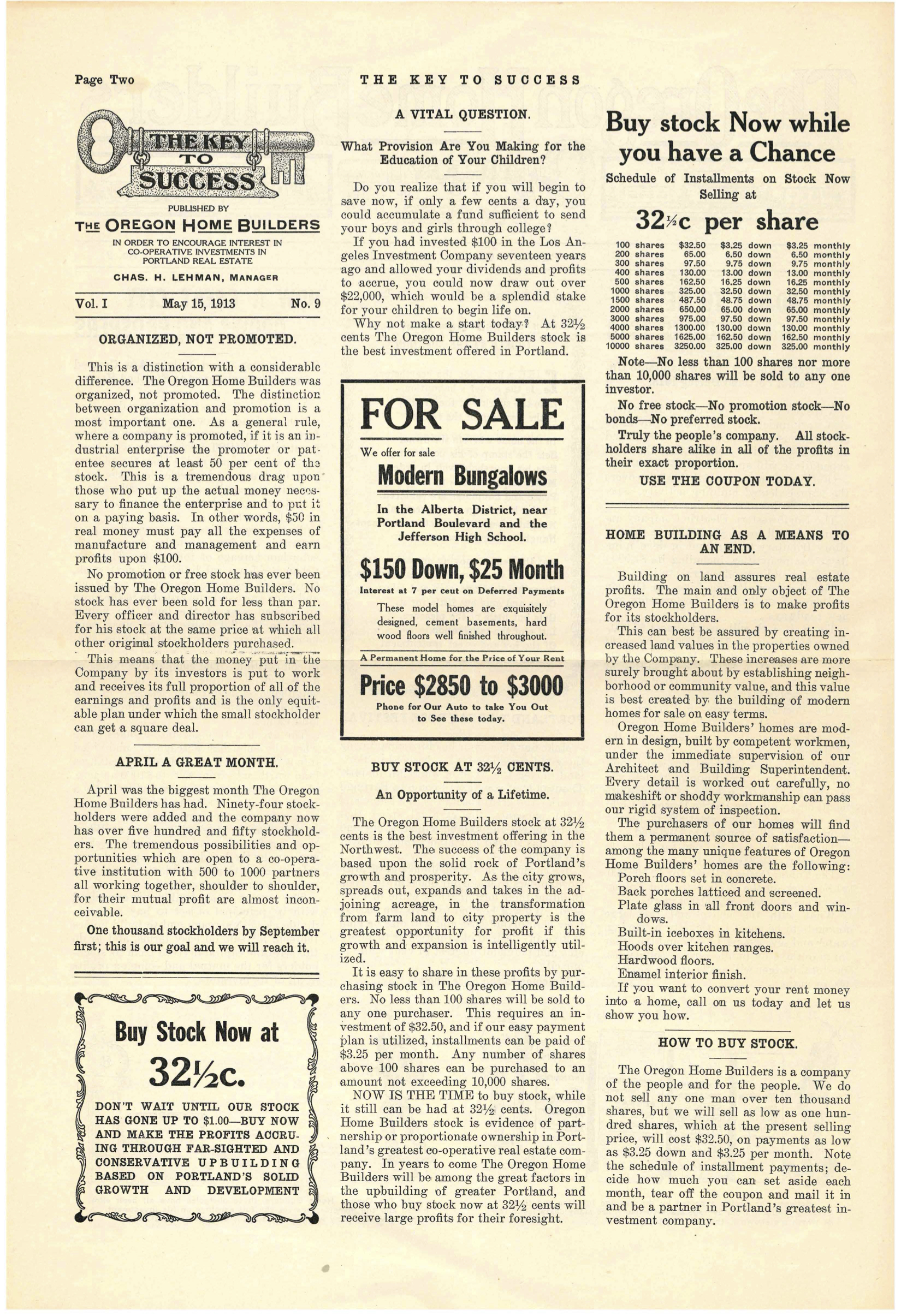
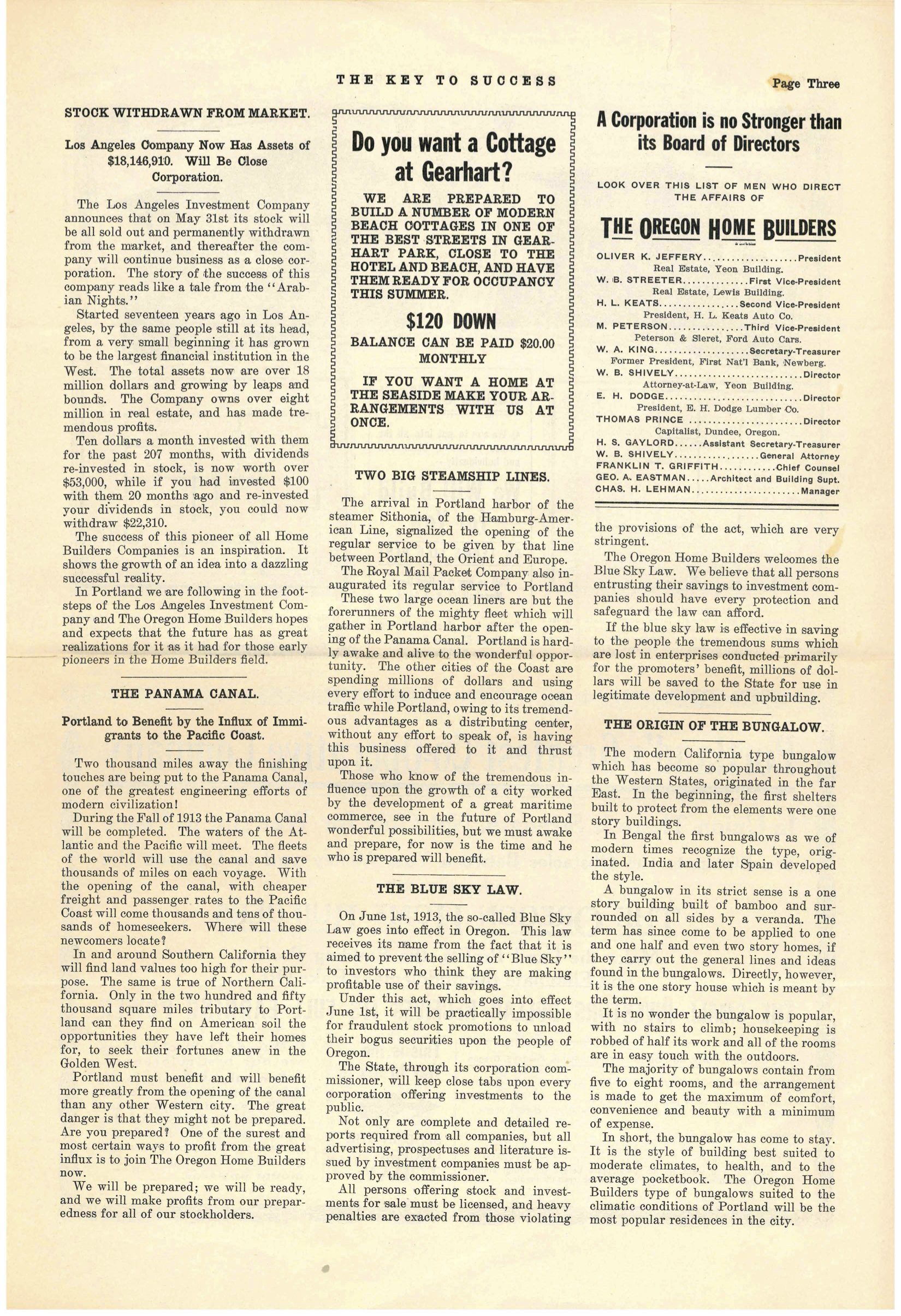
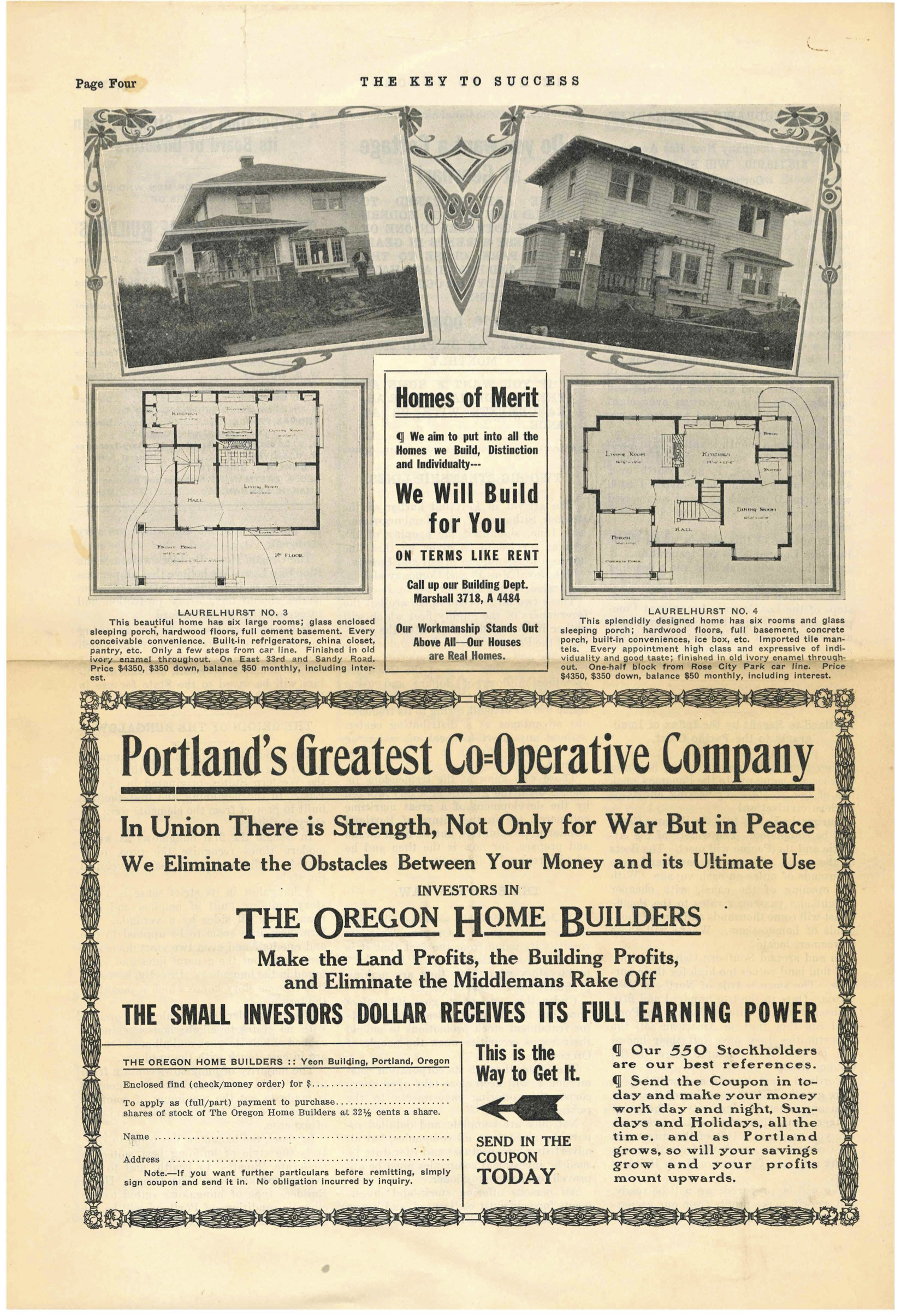
We’ve often wished for a look at this newsletter and recently came across Volume 1, Number 9 of Keys to Success, published on May 15, 1913, thanks to Val Ballestrem and the Architectural Heritage Center Library. We think you’ll enjoy reading it, with grain of salt and benefit of hindsight clearly in mind.

A few things to look for as you click into these for a better look:

  • The many-obstacles pathway version sketched at the bottom left of page 1—offered as the way the average stock company operates—turns out to have been the actual way it worked for OHB, as opposed to the envisioned low-overhead pathway on the right.
  • The Los Angeles Investment Company offered as OHB’s model on page 3 went bankrupt too, and its president Charles Elder was convicted of fraud and sentenced to 13 months in the federal McNeil Island Penitentiary.
  • There’s two great Craftsman-style homes pictured on page four from somewhere in Laurelhurst. We haven’t gone looking for them yet, but readers might recognize them. It’s possible the one on the left is gone now under commercial development at NE 33rd and Sandy.

The irony about all of this is that the headline “Homes of Merit,” is actually right on. The homes the company built have indeed passed the test of time, some even made it to the National Register of Historic Places.

When we get on the other side of the pandemic, I have an OHB walking tour ready to go, and an illustrated presentation that tells OHB’s fascinating story ready to share.

Always looking for more editions of Keys to Success or other insights about OHB…

Arnt Anderson: Talented Builder + Con Man

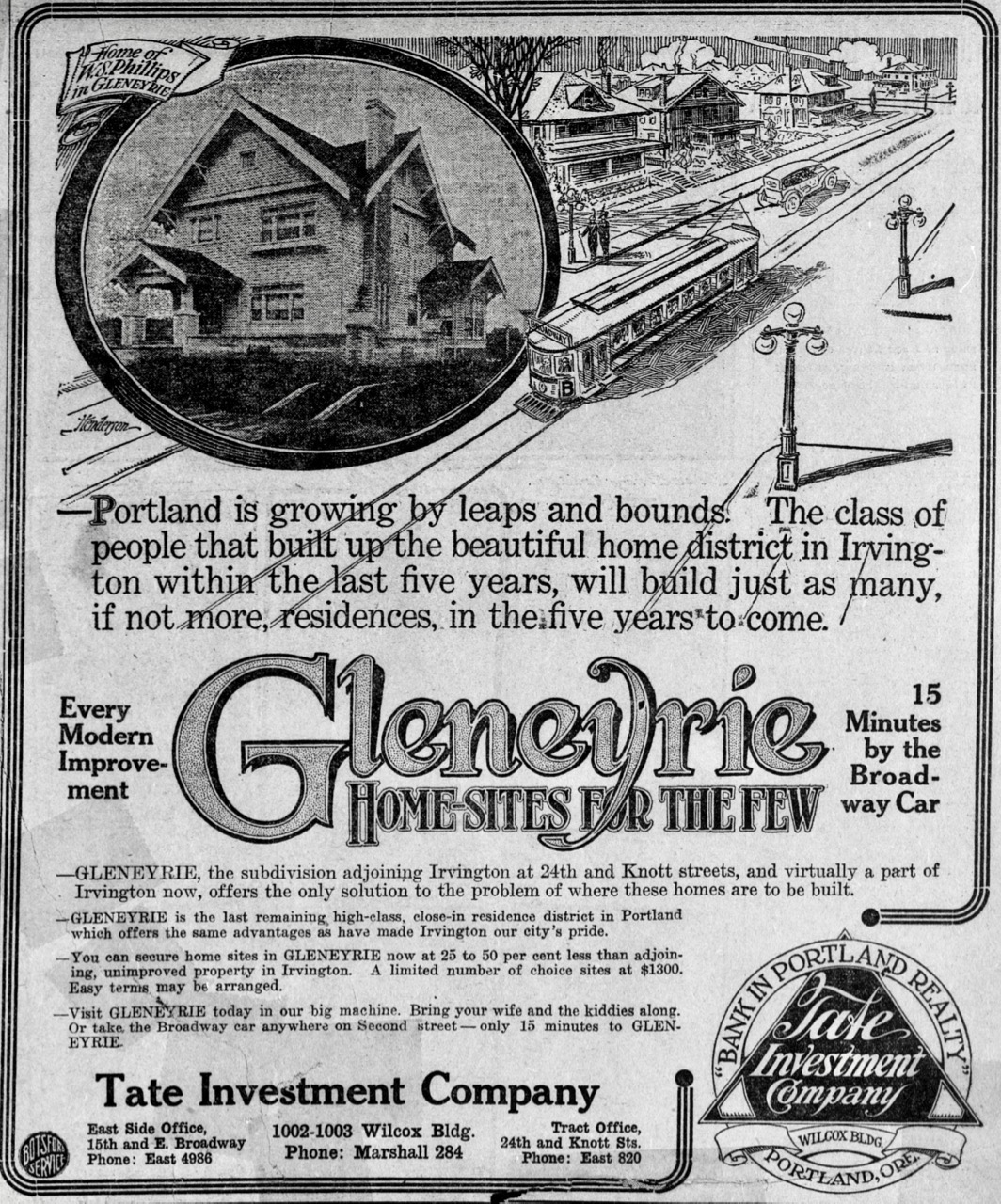
We’ve just finished a detailed look at local builder Arnt Anderson, which we’ve added to our section on The Builders. Anderson was responsible for about 20 large Craftsman-style homes in Alameda, Irvington, Beaumont and Montavilla between 1912-1915. These durable and graceful homes were some of the first built in the newly-established plats, including the plat known as Gleneyrie, which today is part of Irvington and Alameda.

Back then when the neighborhood was just starting out, the Tate Investment Company wanted you to come see Gleneyrie. And to have a look at a big house by Arnt Anderson. Check out this ad which includes a genuine Anderson and a stylized look at NE 24th Avenue (complete with the Broadway Streetcar).

From The Oregonian, April 20, 1913

We’ll be writing more here soon about development of Gleneyrie (which sits between NE 24th and NE 29th, from Knott to Stanton).

But for now, check out this biography (and list of houses) of the builder-turned-con artist who built some nice homes here in the neighborhood, but left town on a scam spree across the West and Midwest that ended in a Billings jail, a felony conviction and trip to the Washington state pen in Walla Walla.

New Builder Bios: Edward R. McLean and Earl A. Roberts

In our continuing quest to learn more about the people who designed and built homes here on Portland’s eastside, we’ve just published two new profiles: Edward R. McLean, who was an active and prolific homebuilder between 1922-1970; and Earl A. Roberts, who ran a residential design-build company with his dad and brother from 1908-1910 before his break-out success as an architect of high-end westside homes that vaulted him into a successful commercial architectural practice in Seattle between 1918 until his death in 1939. He also designed several prominent buildings in the Roseburg, Oregon area.

A listing of homes designed and built by the two men appears at the end of each biography. If you live in Beaumont, you better check out the list of McLean’s homes because you might live in one: he built quite a few in Beaumont. If you know something about a McLean house or the McLean family, drop us a line.

Interested in the story of who built your home or commercial property? Research Services.

More about kit homes and standardized house plans…

The recent discovery of the Sears Roebuck Argyle home just up the street—which is maybe more of a realization than an actual discovery…it’s been there for 100 years—got us to thinking about and looking around in search of other Sears Roebuck cousins.

There are plenty of them, which should not come as a surprise. Here’s a helpful field guide to identification.

In the same way that all art is derivative of other art, so too with residential architecture, defined by the period, the market, the ways of living at the time. As we’ve discussed in the profiles we’ve written about eastside builders, most used widely available sets of building plans.

Page through any of the catalogs from the early years and you’ll see lots of familiar designs, including maybe your own house. For a time during the building boom of the 1920s, The Oregonian actually published sets of plans of example houses, many of which were indeed built on the eastside.

A page from the 1936 Sears Modern Homes Catalog.

Here’s a link to the best repository of old house plans we’ve found (with many thanks to the folks at Antique Home Style). If you haven’t seen this, it’s going to be a rabbit hole you’ll want to go down, there’s so much to see and think about here. Even the marketing language from the catalogs will make you smile. The Wikipedia piece on Sears Modern Homes is actually pretty good as well.

And here’s another good local source of information about mail-order homes, and all things related to older buildings in our fine city.

Here’s the invitation and challenge: Next time you’re out for a walk (good for you and a great way to experience neighborhood history), see if you can find built versions of any of these plans. We’ll welcome any insights or photos of matches you find.