Open Air School Farewell

Last weekend marked the final public tour of the A.L. Mills Open Air School at the southwest corner of SE 60th and Stark in the Mt. Tabor neighborhood.
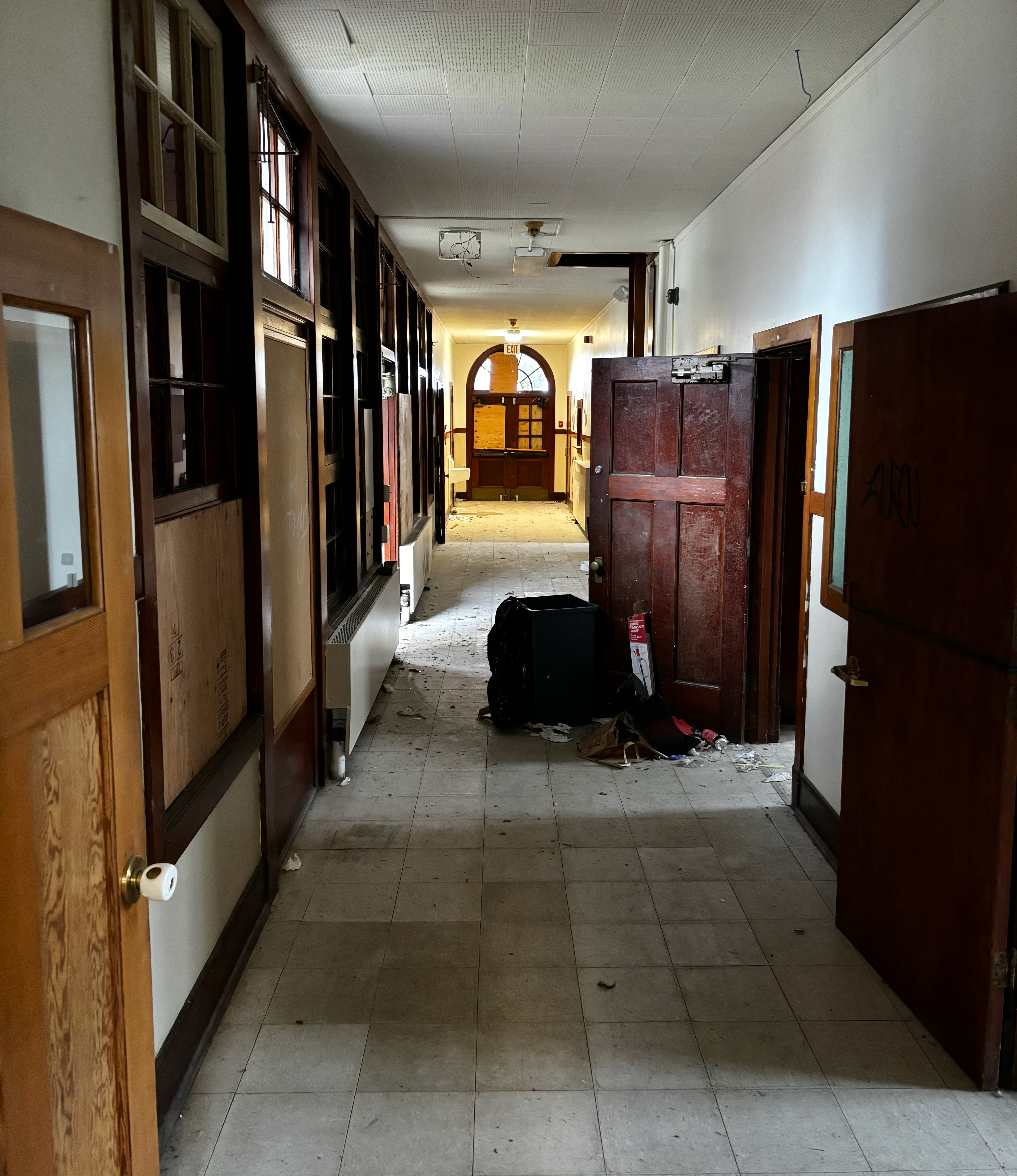
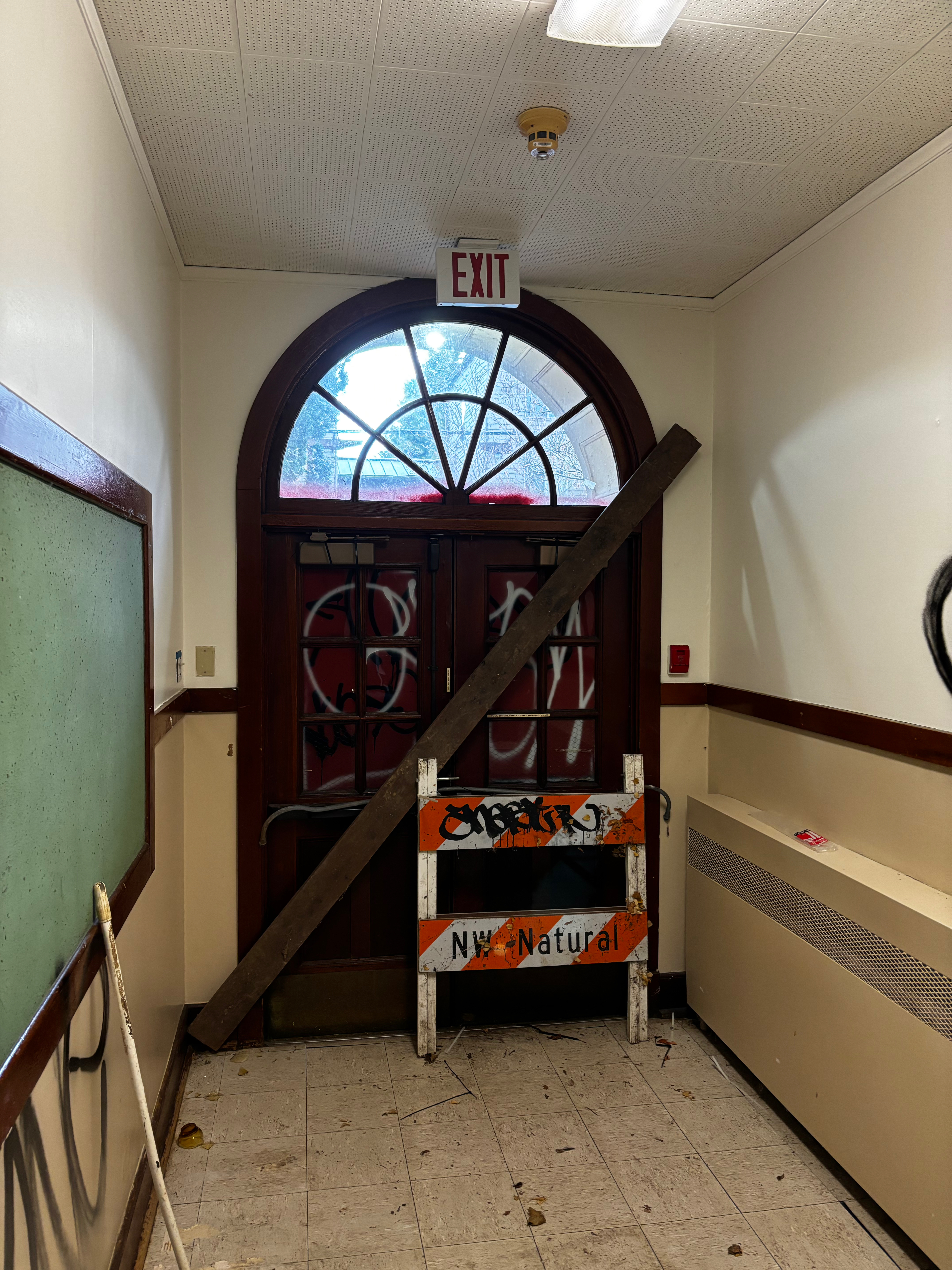
The empty long hallway at Open Air School, December 2024. The building has been empty since 2019.

The former school building, built in 1918-1919, will soon be deconstructed by the Portland Housing Bureau (PHB) to make way for an affordable housing development. For the last six weeks, we’ve been working with the Bureau and the Mt. Tabor Neighborhood Association to share stories of the building with neighbors and anyone interested in having a last look.

Some came because they’ve watched the old school’s recent decline, seen the graffiti and cyclone fence sprout and wondered what was inside. Others came because they’ve had connections to one of the four chapters of its earlier life. Everyone wanted to know what would come next.

A.L. Mills Open Air School first of its kind

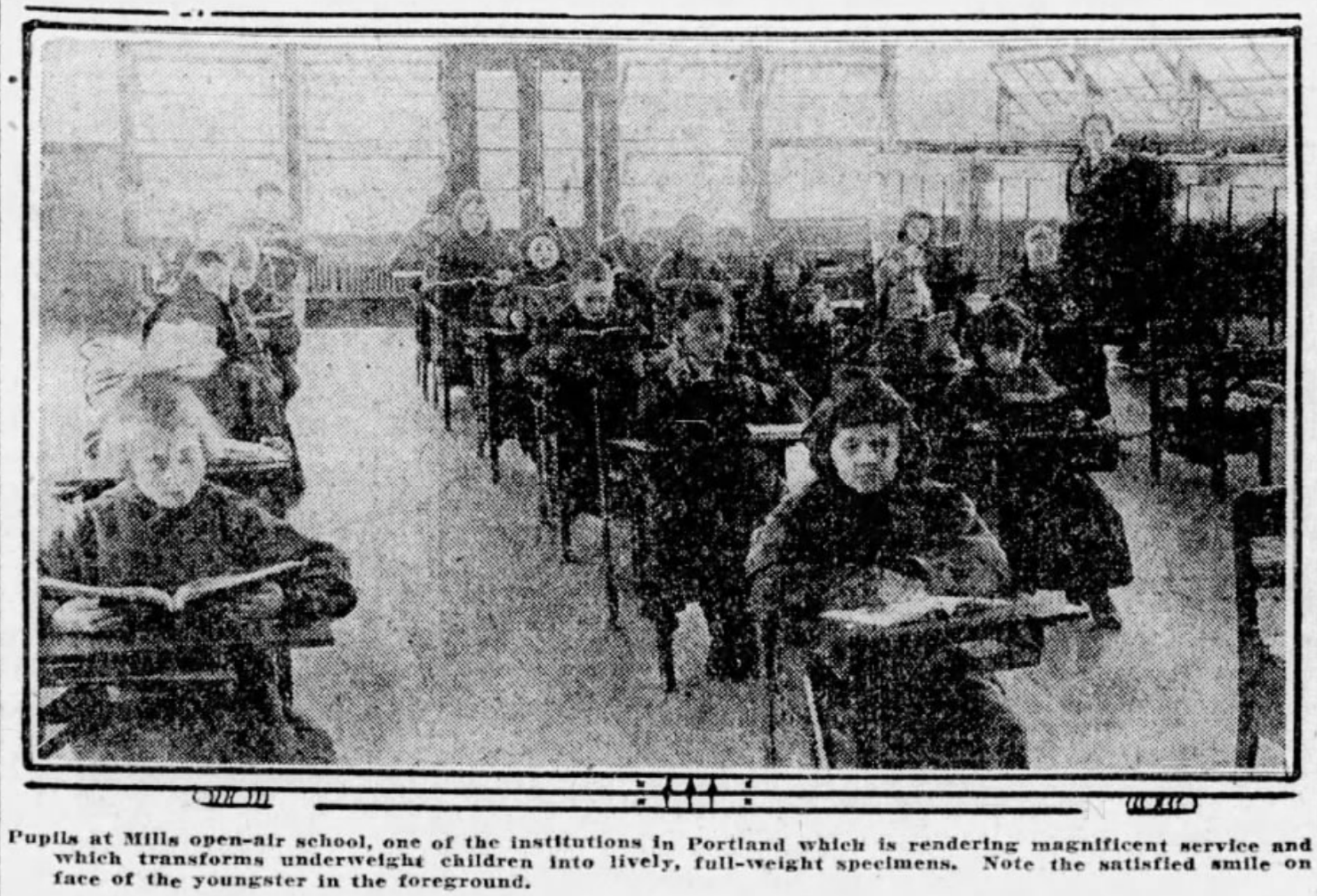
When it opened in 1919, the Abbott L. Mills Open Air School put Portland on the map nationally and internationally as the nation’s first entirely purpose-built open-air school, meaning that students and teachers spent their entire school day surrounded by fresh air. A handful of other communities across the country had experimented with a classroom here or there in an existing school. In Portland, the original Irvington School featured one open air classroom where the windows were open all day, all school year.

But with financial help and encouragement from the Oregon Tuberculosis Association, Portland Public Schools was able to build an entire school dedicated to helping “low vitality children” improve their health and therefore their resiliency to tuberculosis, which was a serious health threat of that era killing hundreds of thousands of people of all ages in the U.S. during the 1920s.
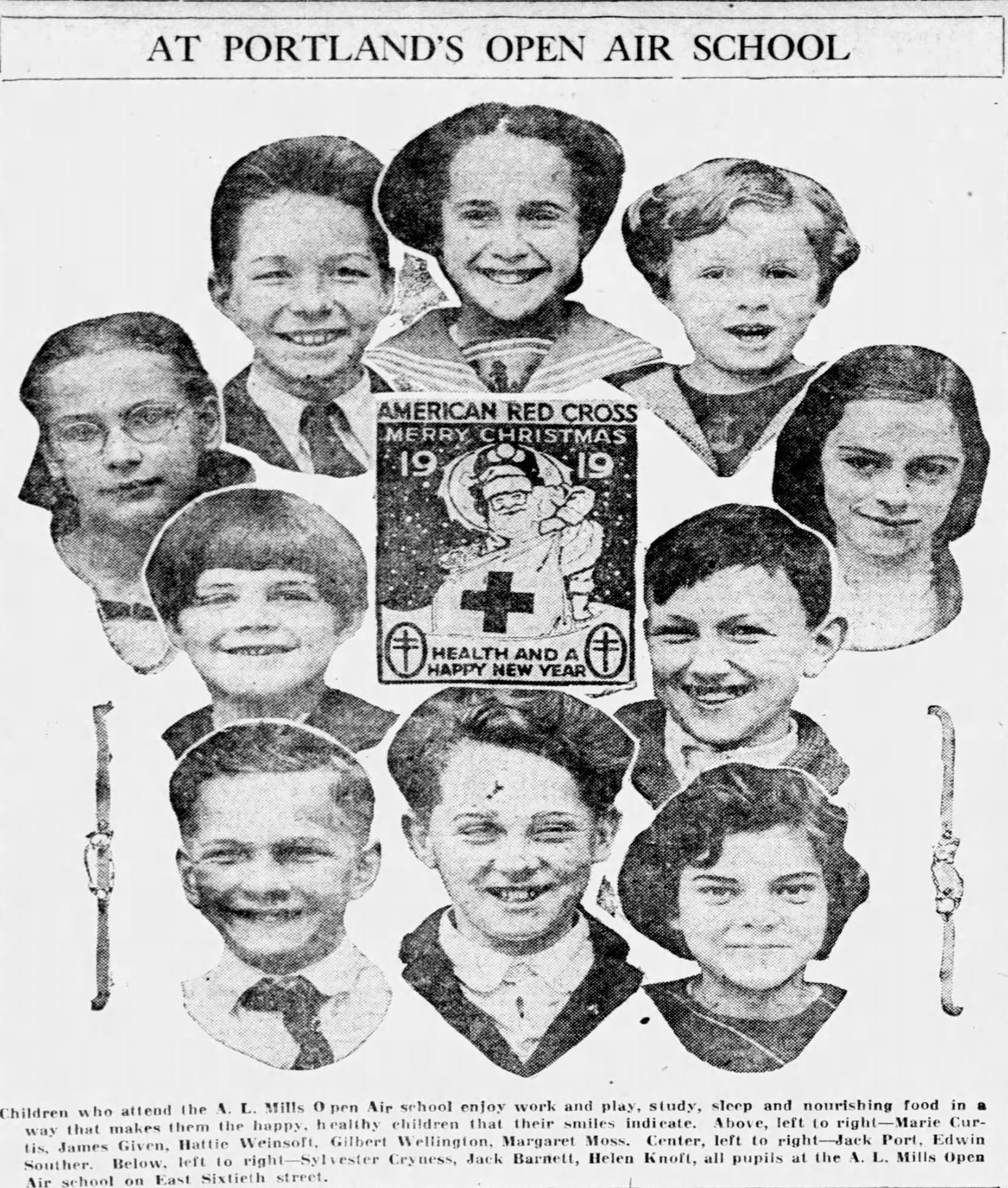
From the Oregon Journal, November 30, 1919

The Oregon Tuberculosis Association was led by Abbot L. Mills, former Oregon Speaker of the House, philanthropist, president of the First National Bank of Portland, and chief organizer of the Portland Open Air Sanatorium for Consumptives. Mills, who earlier served as vice president of the 1905 Lewis and Clark Exposition, was a tireless public health advocate around tuberculosis, and the chief push on funding for the school, so it’s entirely appropriate the building bears his name.

The open-air movement was an international public health philosophy based on the notion that being exposed to fresh, circulating air kept children, and people of all ages, healthier.

60th and Stark: Epicenter of Mt. Tabor community and Portland’s health spas

That’s why school and health officials selected the western slopes of Mt. Tabor, then a rural and bucolic elevated place distant from the churn of downtown Portland (Mt. Tabor was annexed into Portland in 1905). In 1902, the Portland Sanitarium opened just a block away at 60th and Belmont (site of the former Adventist Hospital). Another private sanitarium operated at 60th and Yamhill.

60th and Stark was also the crossroads and heart of the Mt. Tabor community. From 1880 until 1911 a former school operated on the site. Before that, a frontier school operated out of a log building in the same place.
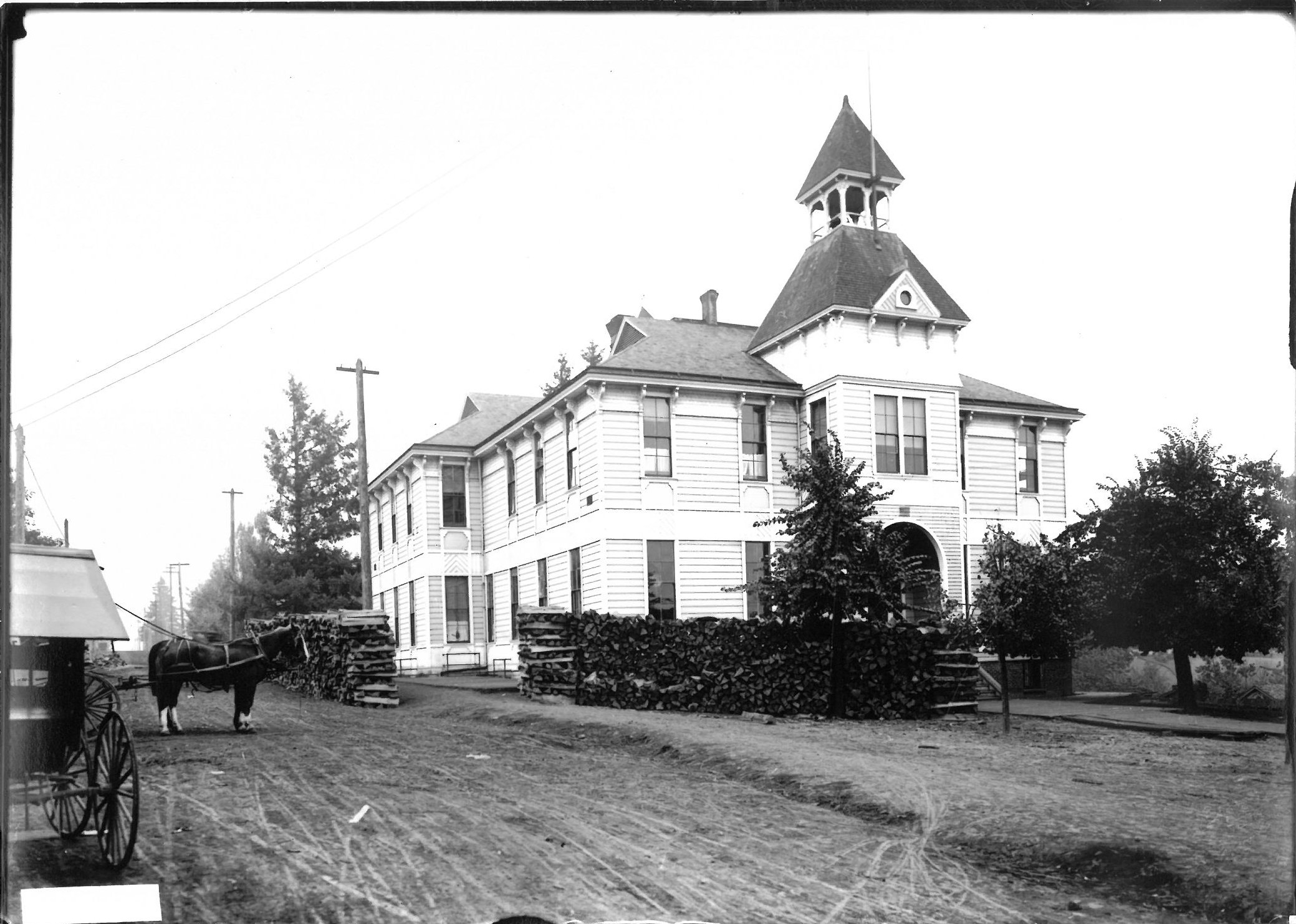
Looking south on 60th at the corner with Stark (then known as Baseline Road), about 1907, four years before this school burned, clearing the site that has hosted the Open Air School since 1918. Drying cordwood is stacked for the furnace in the old school. Courtesy of the Oregon Historical Society, image Org-Lot-982, Box 8 Folder 6.

The two-room A.L. Mills Open Air School opened on January 27, 1919 with its full capacity of 50 students ages 5-15, two teachers and care team.
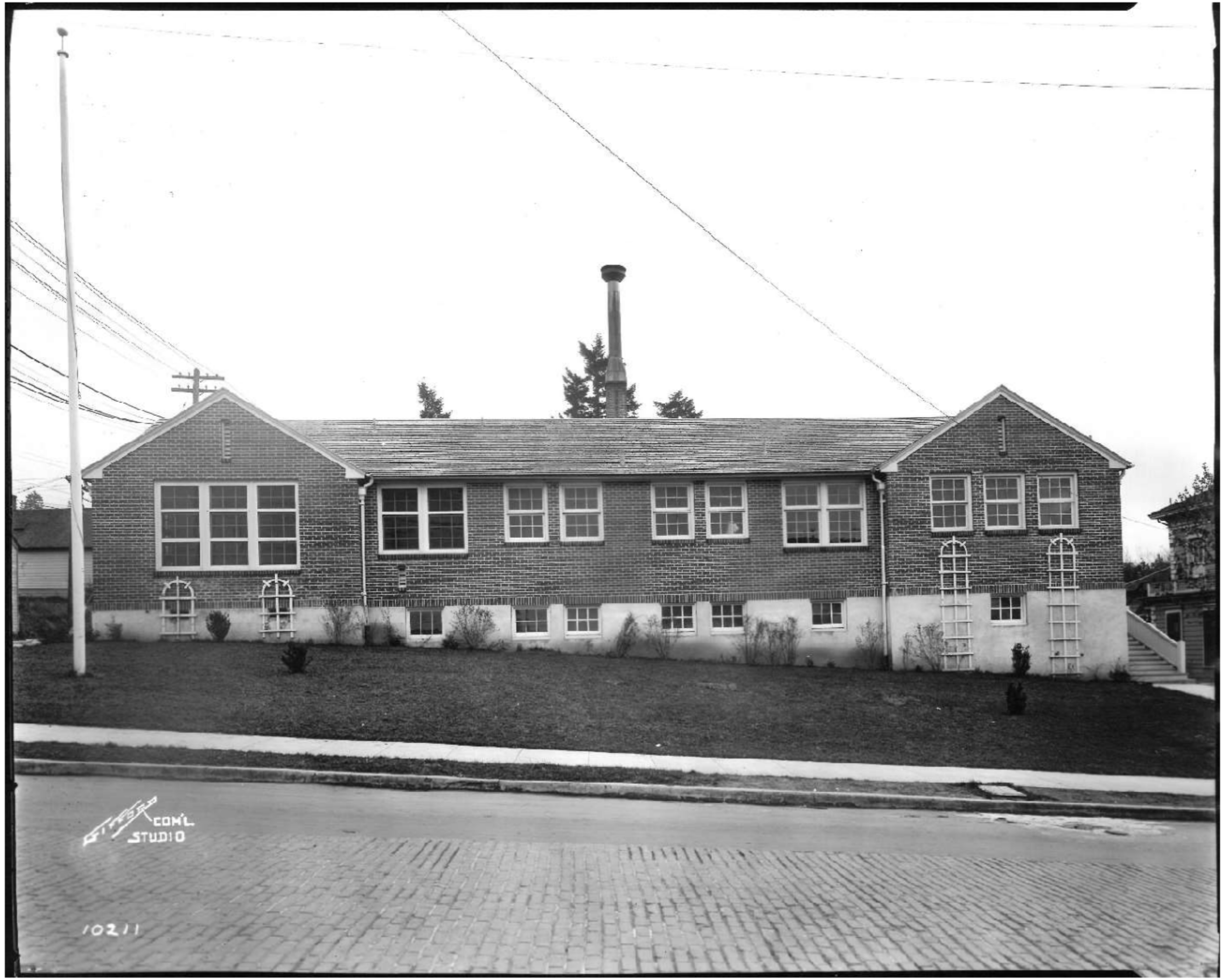
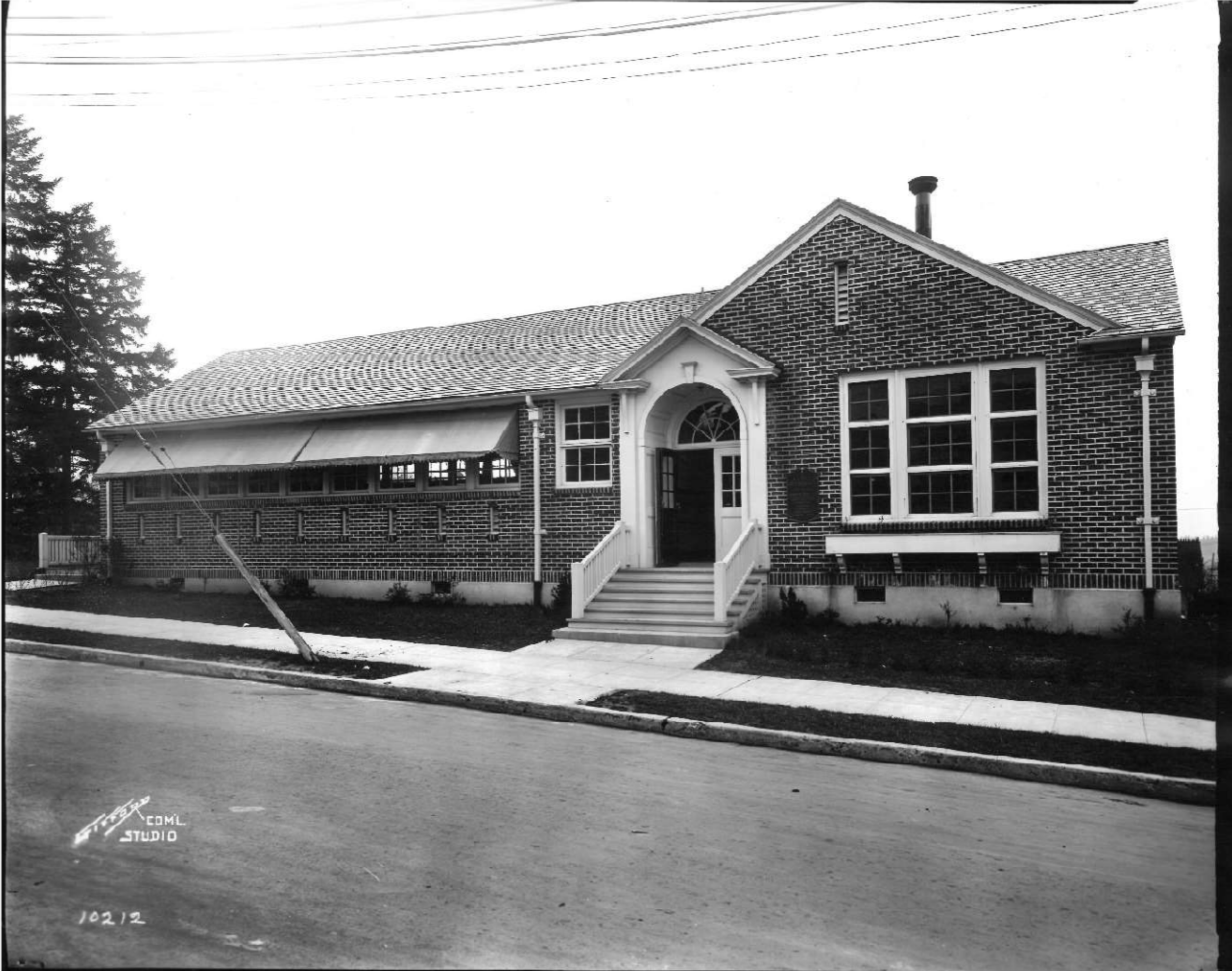
The Stark Street side of Open Air. Photograph Courtesy of the Oregon Historical Society, from the Ben Gifford Collection Box 8, Folder 5. Gifford photographed the school not long after its opening on January 27, 1919.

Miss Anna Thompson was principal of “Open Air,” its often-used nickname, and she never missed an opportunity to let everyone know her students were not tuberculous: they were children with health infirmities that made them vulnerable to TB.

Here’s an essay by Principal Thompson that appeared in The Oregonian on May 14, 1925:

Because of the ardent interest and material support given by the Oregon Tuberculosis Association in the early history of the school, many people believe ‘Open Air’ to be a school for tuberculous children. This is a very grave mistake. Children who are tuberculous or infections from any cause whatsoever are not admitted. I want this fact impressed on parents and others. We are trying to prevent these children from growing into defective conditions–the purpose is preventative not remedial.

Got that? Not a place for sick children: Miss Thompson and her colleagues were trying to keep them from getting sick.
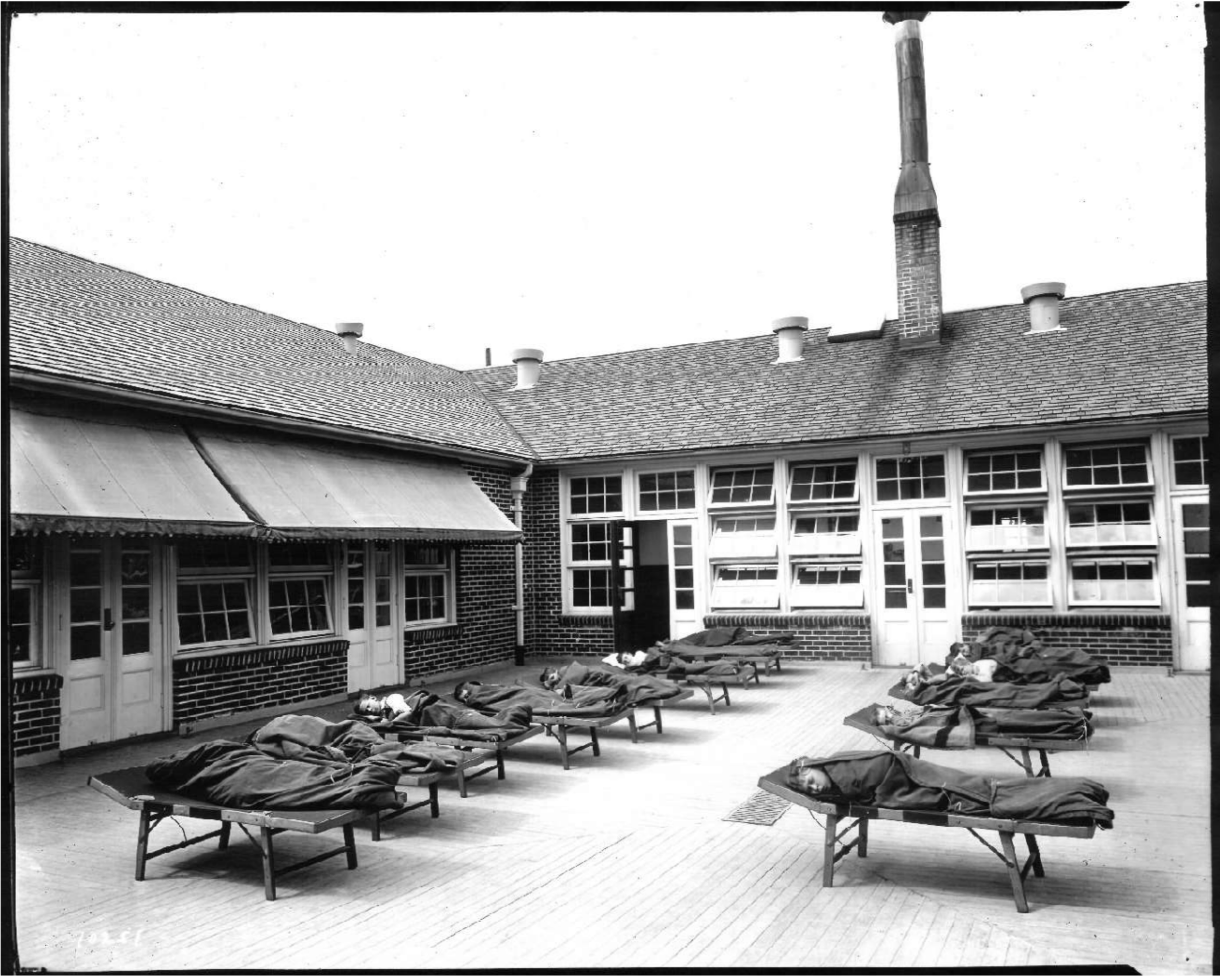
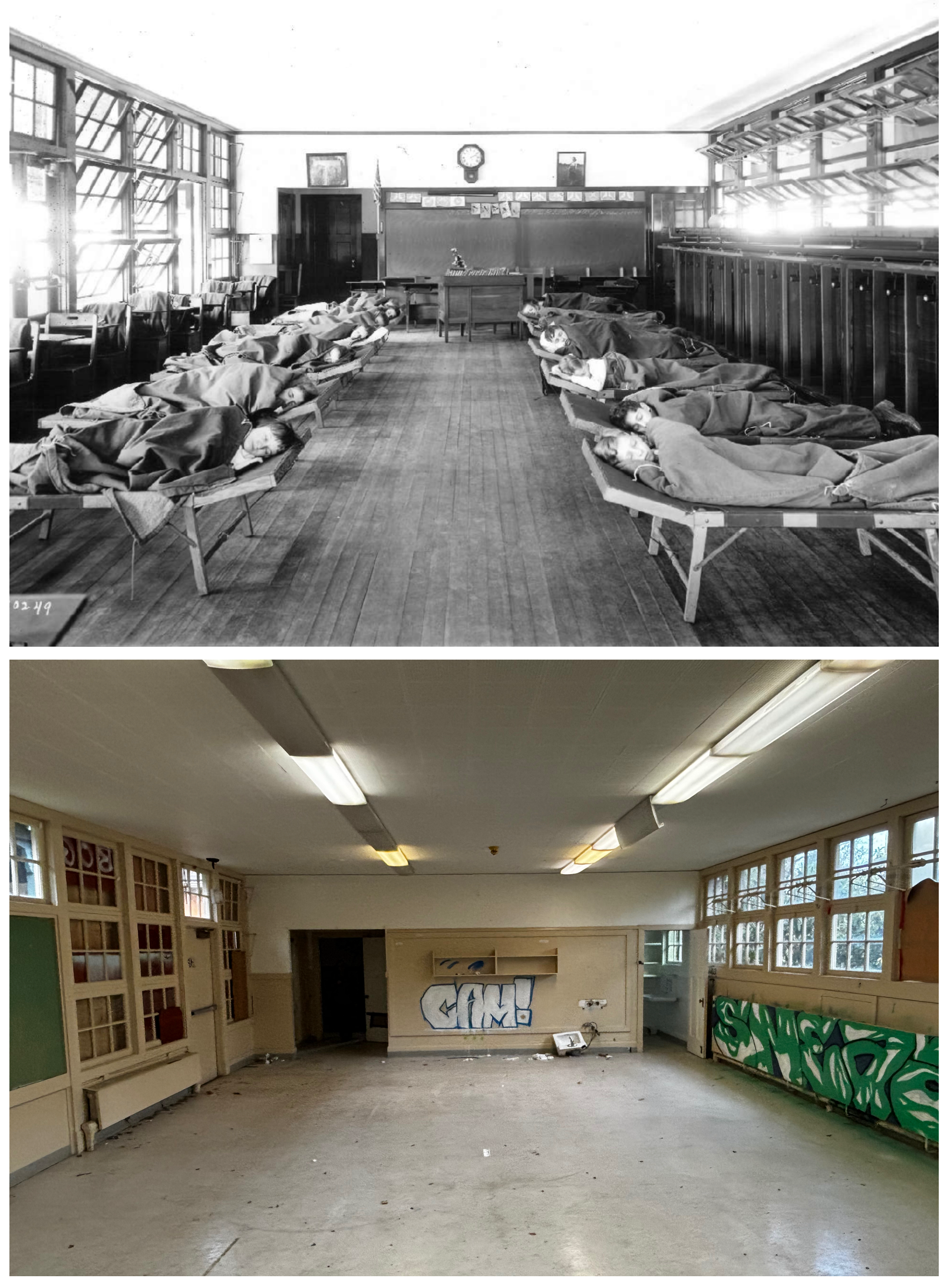
Afternoon nap time at Open Air. Photograph Courtesy of the Oregon Historical Society, from the Ben Gifford Collection Box 8, Folder 5.

Staff at Open Air included Principal Thompson, who also taught in one of the two rooms; a physician who was on site every Wednesday to examine each child; a full-time nurse; a matron who helped with showers, hygiene and meals; and a second teacher. The nurse visited each student’s home multiple times to make a plan with parents about how to work together and to keep tabs on progress.

There were places for 50 students, drawn from all walks of life across the city. Their families applied and the children had to be examined by the doctor and nurse to be admitted, and to stay enrolled. Students could stay up to three terms to rebuild their weight and improve their health before going back to their neighborhood schools, so the composition of the student body shifted each term.
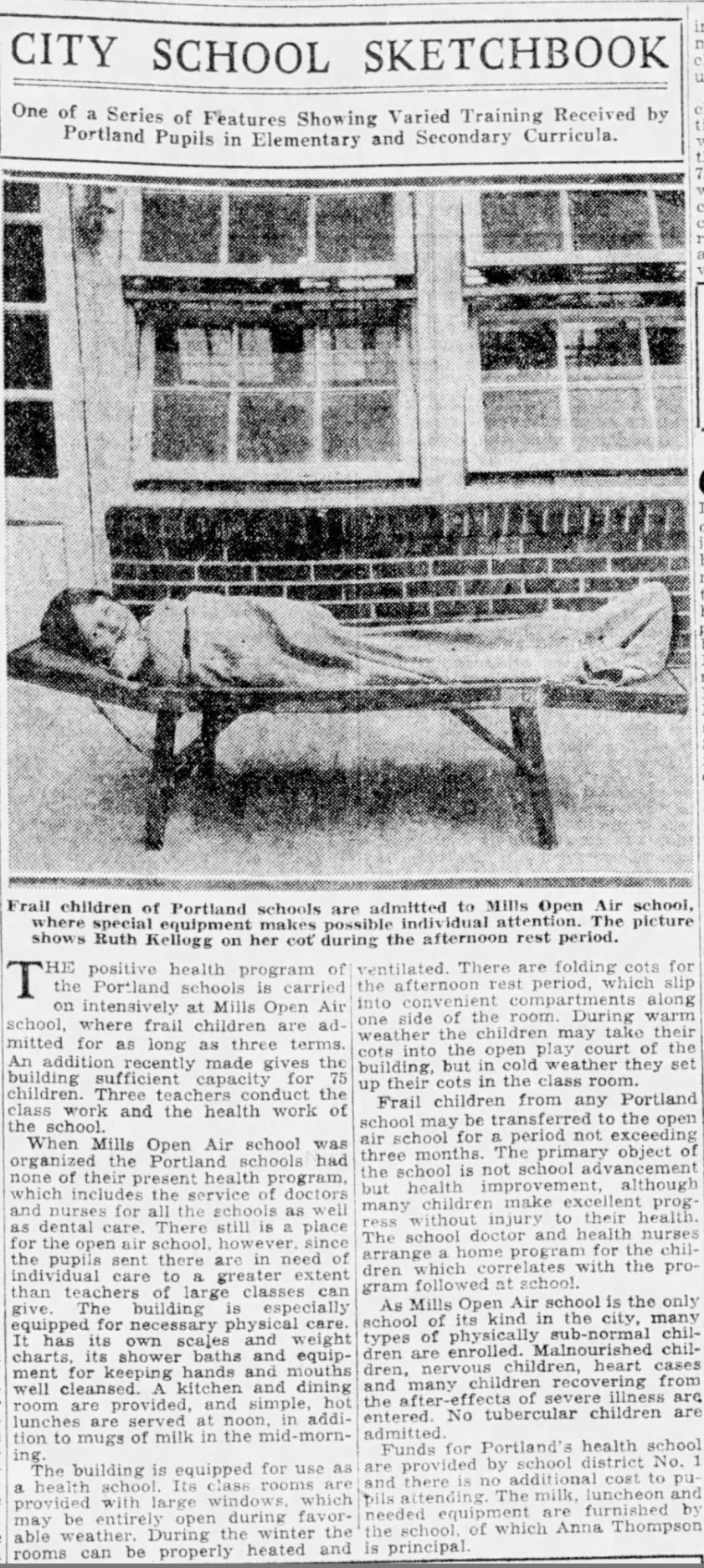
From The Oregonian, February 10, 1931.

In the 1920 school year, 77 total students were in attendance, which means 27 of them were “restored to health” and transferred back to their neighborhood schools, allowing other children to be admitted. The Oregonian in 1920 reported that at one point 15 of the 50 children were “only children,” who theoretically had the undivided attention of their parents–no siblings–a point that Principal Thompson liked to make, perhaps to bolster the fact that unhealthiness was not necessarily related to a lack of resources or attention.

A great description of a day in the life of Open Air ran in The Oregonian on December 10, 1922:

“Shower baths are the first order of the day at 8:00 and during this period once a week the pupils are weighed and inspected for symptoms of physical defects. After baths the pupils put on their sitting robes of heavy blanket material and enter the open window classrooms where they attend their studies until 10:25 at which time half a pint of milk is served in the lunch room to each pupil. This is followed by a period of supervised recreation. When the weather permits games are played on the court or lawn.

The entire noon hour is given up in preparation for lunch, eating lunch, and preparation for rest. Getting ready for lunch requires washing face and hands, cleaning fingernails, combing hair.

A copy of the menu of hot dishes for the following week’s lunches is sent home each Friday, so that the mothers will know how to supplement them with the right kind of sandwiches and other foods. For the past week, the menu has been: Monday, hot milk toast; Tuesday, apple tapioca; Wednesday, lamb stew with vegetables;  Thursday, hot cocoa; Friday, hot rice”

After the midday meal, the teeth are brushed and pupils returned to classroom where preparation for rest is made. Cots are spread with warm blankets and after a few vigorous breathing exercises, the rest period begins.  At 2:00, the children rise from the cots, faces are washed and hair is combed and studies are resumed until 3:25 when milk is again served and the pupils are dismissed.

From The Oregonian, December 10, 1922

In cold weather, the children wore heavy robes (pictured above) which were called “Eskimaux suits,” described like this in that same story:

“The brownie coveralls with hood provided by the school to be worn on chilly days are like a fraternity emblem among the pupils and are decidedly popular as their insignia of privileged rank. Sleeping robes are also provided, made of canvas lined with gray woolen blankets that launder well.

An observation of impact and results were noted in this story from The Oregonian on April 20, 1919, just a few months after the school opened:
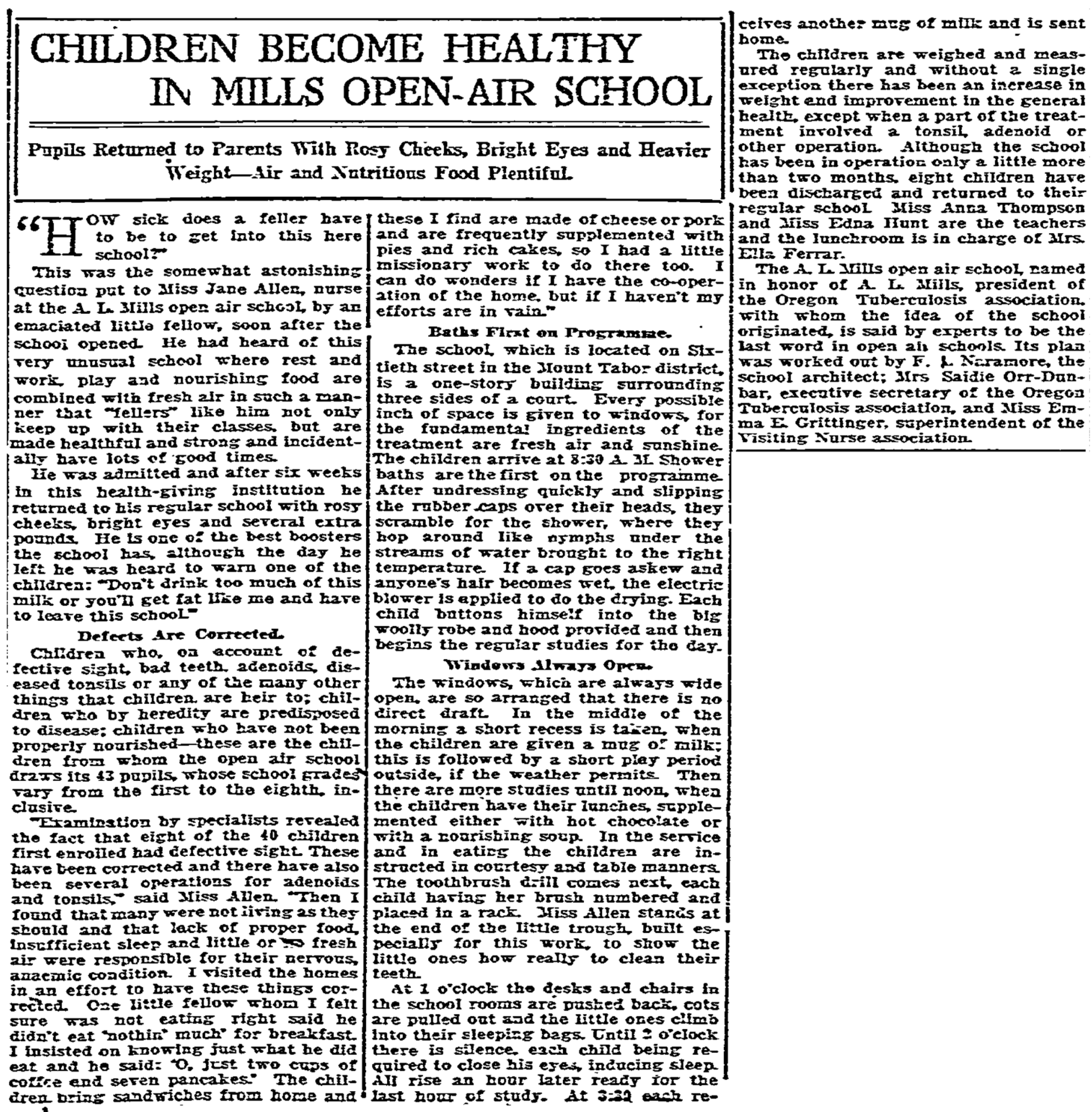
From The Oregonian, April 20, 1919

Repurposed to meet current needs

By the late 1940s, the baby boom of Portland’s school-age children brought neighborhood schools to full capacity. With tuberculosis receding as a health threat and the need to make more space, the school board chose to close Open Air, sending students back to their neighborhood schools, and reconfiguring the building as Mt. Tabor Annex, the venue for all kindergarten and first-grade children from Mt. Tabor. A third classroom was built and the converted annex operated as a regular school until 1973.

When the population of school-age children receded, the building was surplussed, ending up in the portfolio of Portland Parks and Recreation, where it was once again repurposed, operating from 1974-1990 as the Mt. Tabor Community Arts Program and Community Theater Workshop.

Budget cuts in the 1990s ended the community arts and theater programs and the building was fallow for several years and on track to be sold to a private school operator, which ended up not happening. In 1994, Parks and Recreation leased the building to the YMCA, which operated it as a daycare for 25 years, until 2019. Operating costs and deferred maintenance ended that chapter just as the pandemic descended, and the old school was once again surplussed, eventually acquired by the Portland Housing Bureau. It’s been vacant since as the Housing Bureau has considered its options.

What’s Next

On each of the recent tours, PHB Capital Projects Manager Kate Piper explained to neighbors that the bureau will soon be deconstructing the old school and salvaging as much of the building material as possible. Redevelopment plans are not yet clear on what happens after that, or when, but removing the existing building from the site is a high priority to manage liability and to set the stage for future development.

This fall’s public tours of the building have helped resurrect and appreciate the stories of Open Air’s past. This time traveler will be going away, but the site has always been a place of change and evolution, meeting the community’s most pressing needs.

No one on the tours questioned the importance of housing, though most couldn’t help but be moved by the stories that have played out there: of Principal Anna Thompson and her team, the children—each on their own pathway to vitality—and the will of a community investing hope and energy in its most vulnerable.

With thanks to colleagues Paul Leistner, President of the Mt. Tabor Neighborhood Association; Kristen Minor, Architectural Historian who completed a detailed survey of the property; and Kate Piper at PHB for recognizing the importance of sharing the Open Air story and connecting with the neighborhood.

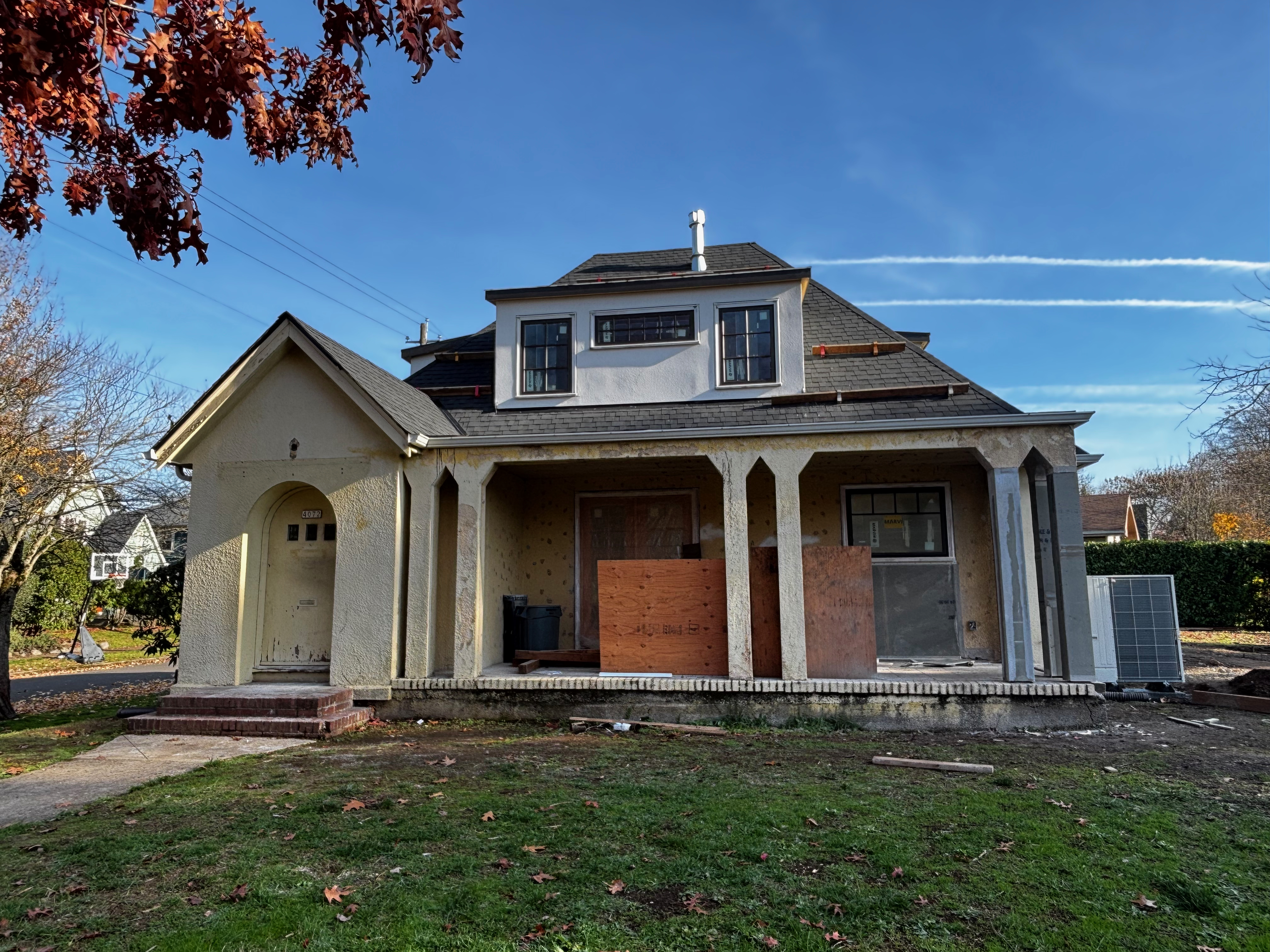
Construction Update: 24th and Mason

Neighbors interested in adaptive reuse of old buildings have had a front row seat this summer and fall as the von Homeyer house at NE 24th and Mason has been brought back from the brink of being a candidate for tear-down. Today, it’s on the cusp of its new life, with all of its systems transformed, spaces rearranged and upgraded, and virtually every interior and exterior surface either new or restored.

It’s as if the house is brand new: every window (the old ones were salvaged), all the doors, roof, heating (and now air conditioning), electrical, plumbing, floors, all wall surfaces, fireplace (the original mantel and built-in bookshelves are still there). Repaired and waterproofed foundation, new sanitary sewer line, fiber optics. Everything about the kitchen. It’s been a busy place.

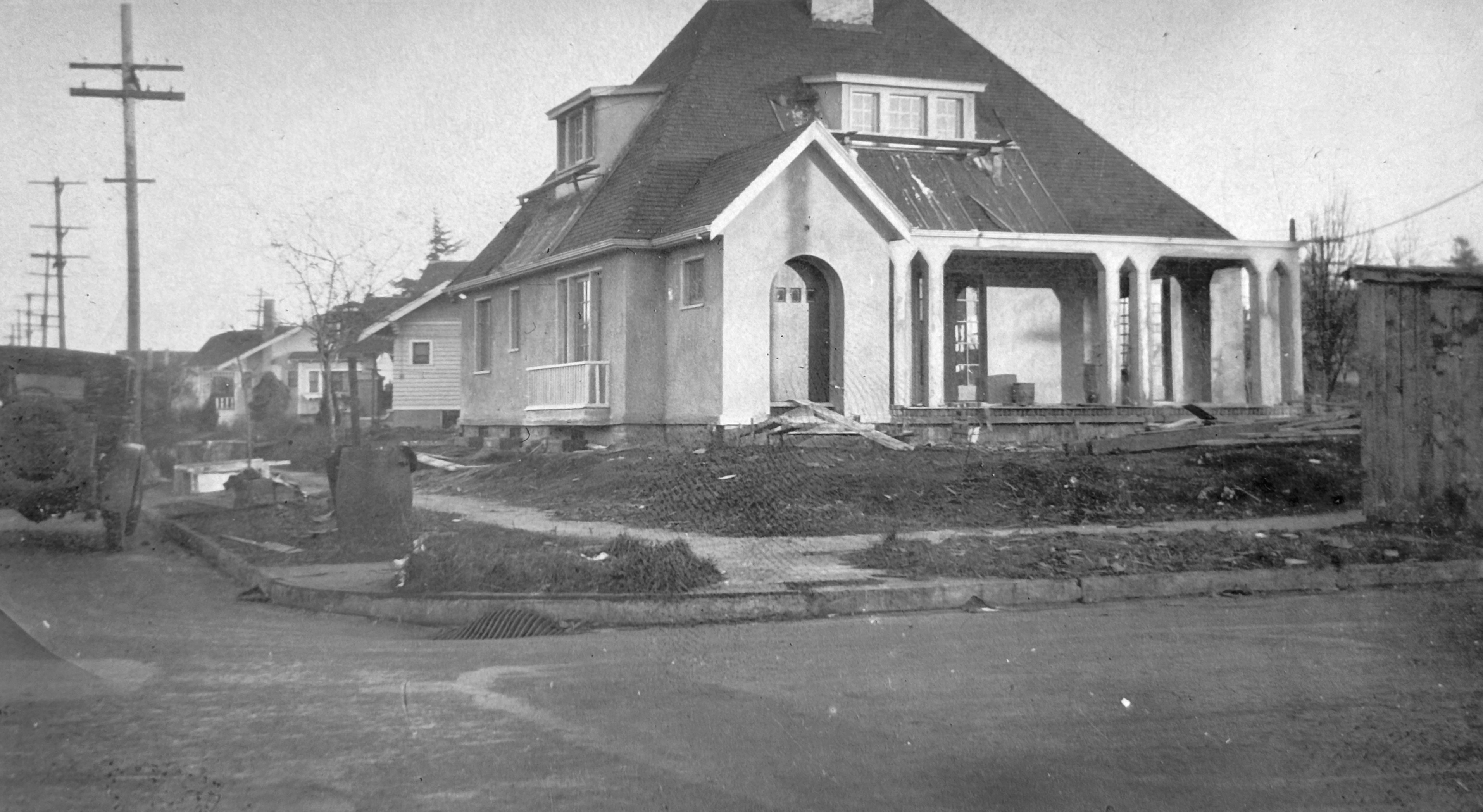
NE 24th and Mason, photographed in December 2024. Note repaired front porch columns at far right.

But still, when you see the “then” picture from 1925 when the house was built, and a recent photo from this December, it’s definitely the same time traveler, just transformed for its next 100 years.

AH readers will recall that neighbors Jaylen and Michael Schmitt bought the house earlier this year after the youngest son of the von Homeyer family, now in his 90s, moved to a care facility. The house had been in the same family for almost 100 years, and the brothers lived there their entire lives.

The Schmitts, like many in the neighborhood, were concerned the house would eventually be a tear-down and that something else built there could be an eyesore or worse. When they bought it, the house was jammed to the ceilings with boxes, papers and an incredible collection of items from several lifetimes. They reached out to us for help sorting through a trove of documents and curating some of the items. We re-homed 30 pounds of precious photos to far-flung family.

Four months of thinning and organizing led to a well-attended estate sale in May and gradually as the house was emptied, the Schmitts worked with architect Mary Hogue of MkM Architecture to plan for adapting the house.

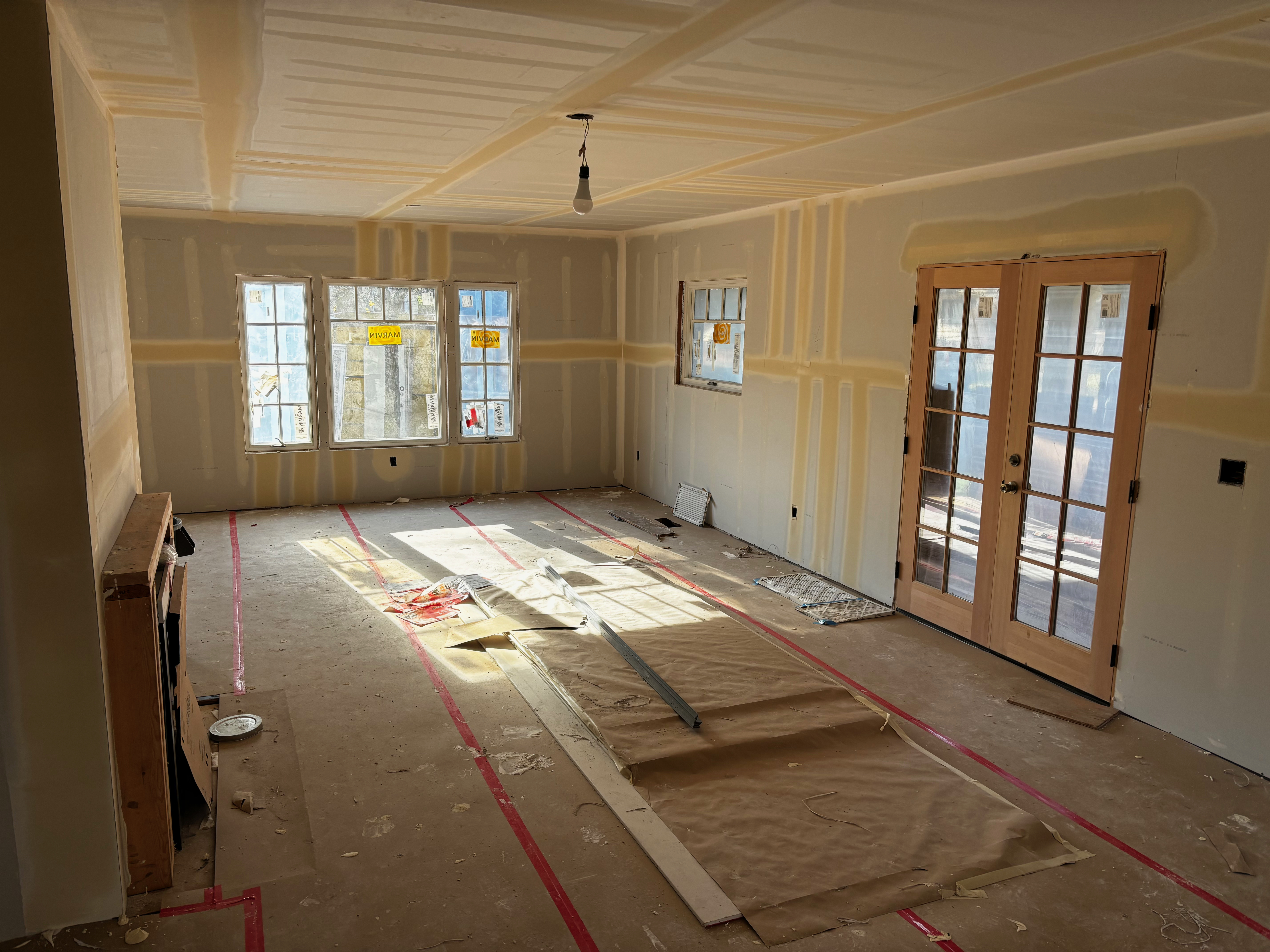
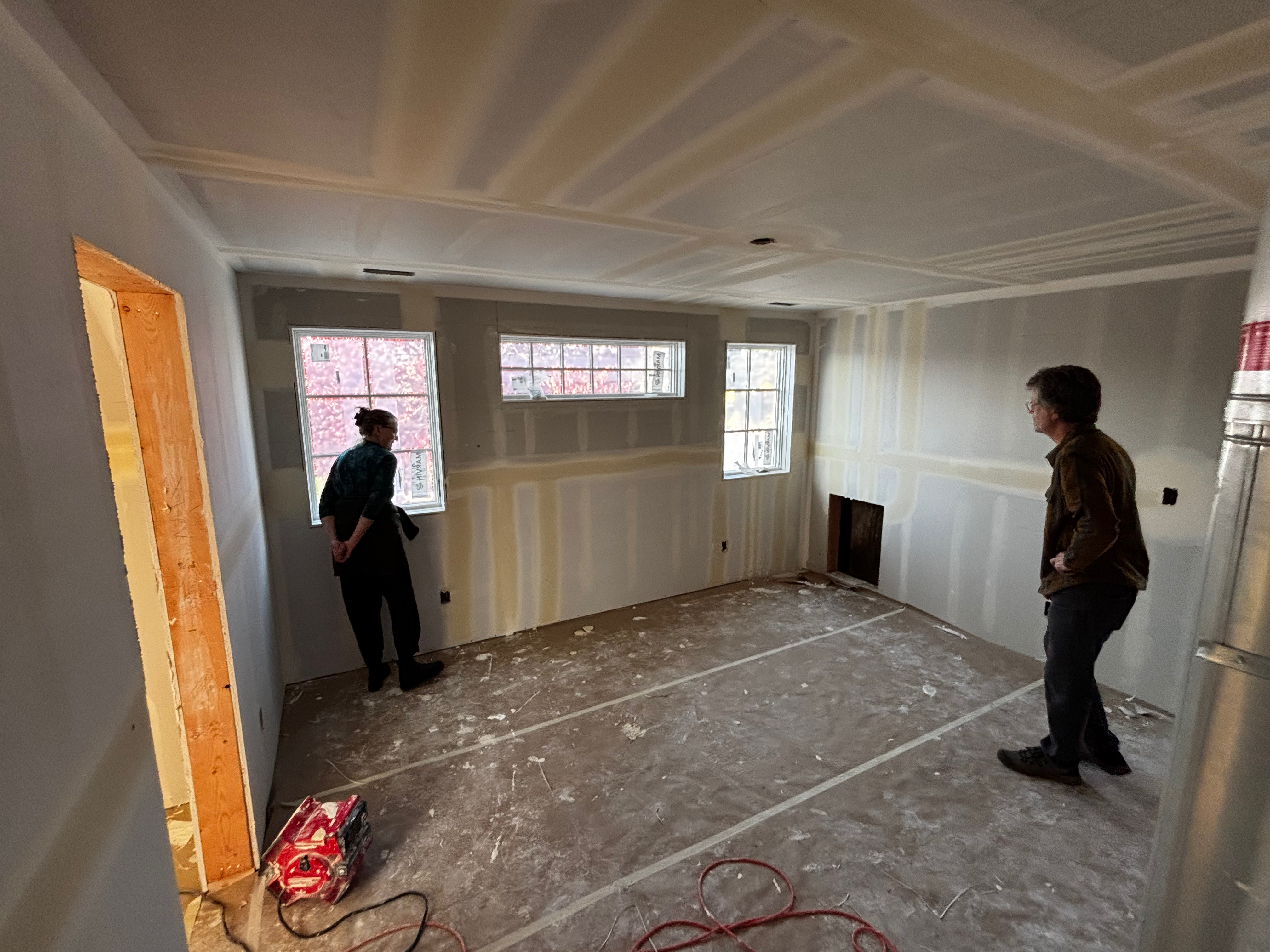
On the first floor, the existing bedroom and bathroom remain (all the plaster throughout the house has been replaced with drywall). The kitchen has been enlarged and will feature an island, two sinks and all the latest appliances. A newly re-opened and restored front porch is accessed by new french doors leading from the living room.

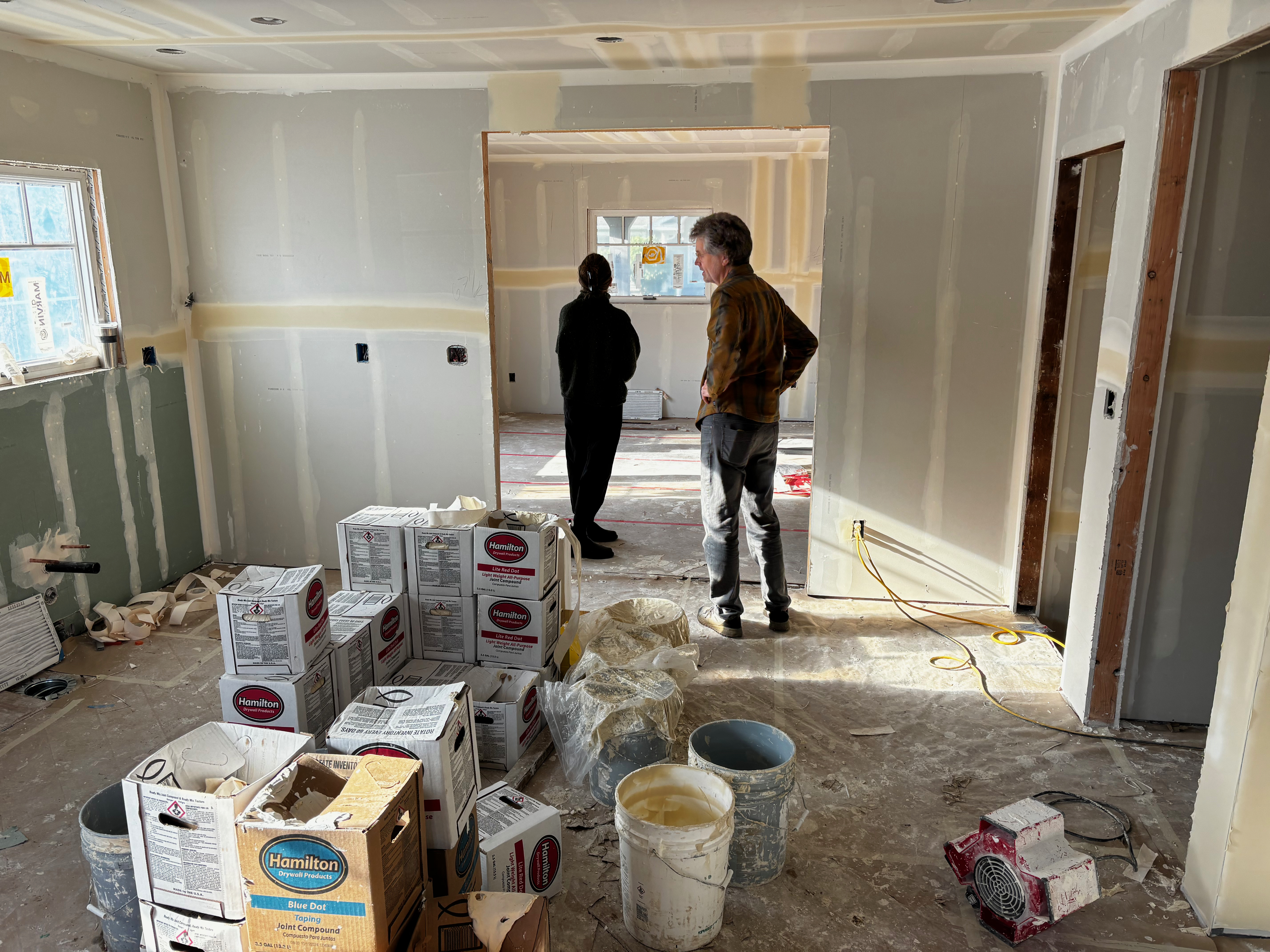
Looking into the living room / dining room. New French doors lead out onto the newly restored front porch. Framing is in, at left, for the fireplace.

The large kitchen features two sinks, will have a central island with cabinets, wall-hung cabinets all around, and a door out into the large backyard.

Upstairs, there are now two full bedrooms, each with its own bathroom, and a giant walk-in closet and dressing area with a huge bank of windows, and a combo washing machine/dryer.

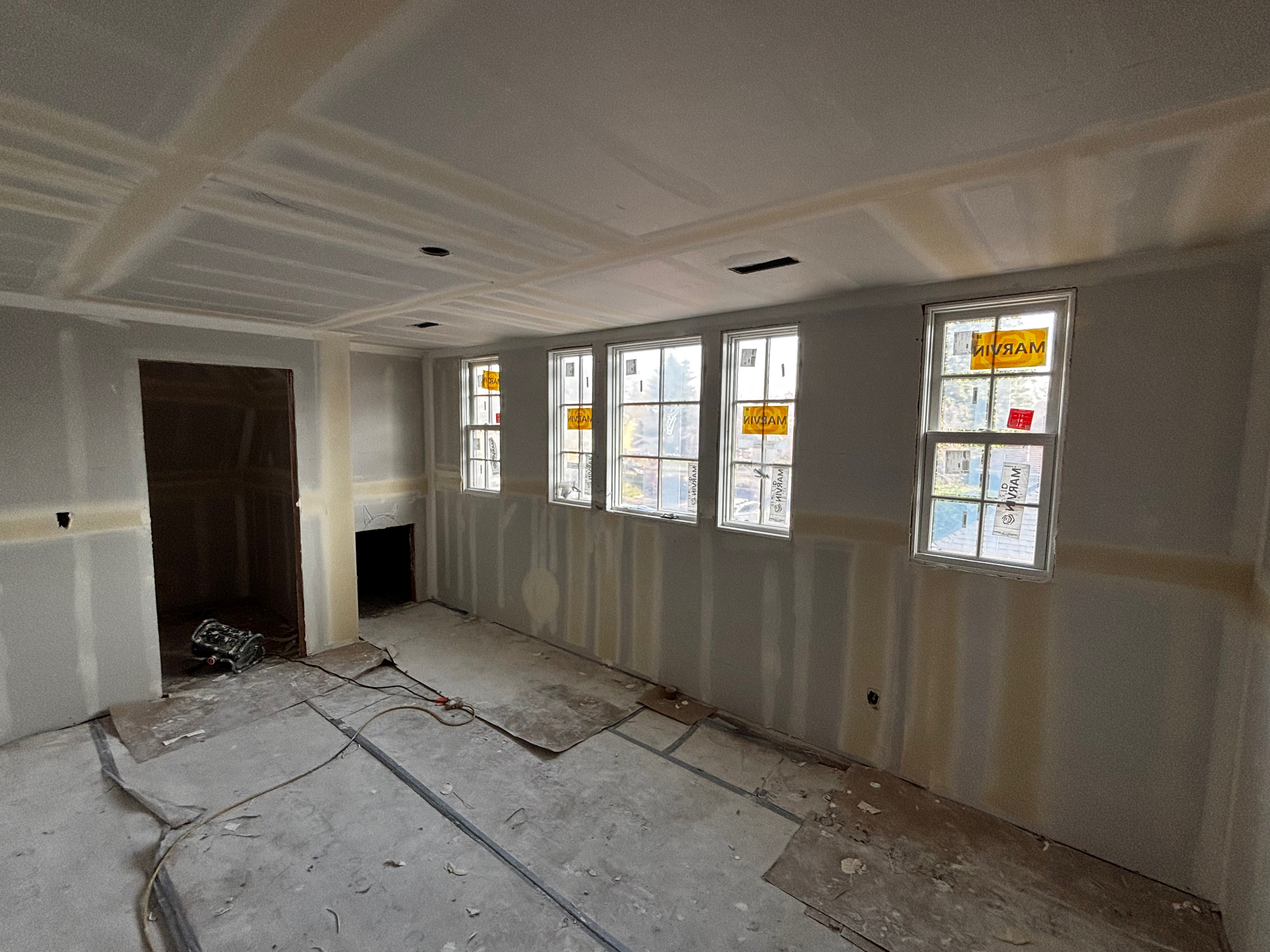
This bedroom upstairs features lots of light and a large closet.

Upstairs, the primary bedroom features large windows and a giant walk-in closet to the left. An en suite bathroom is to the right.

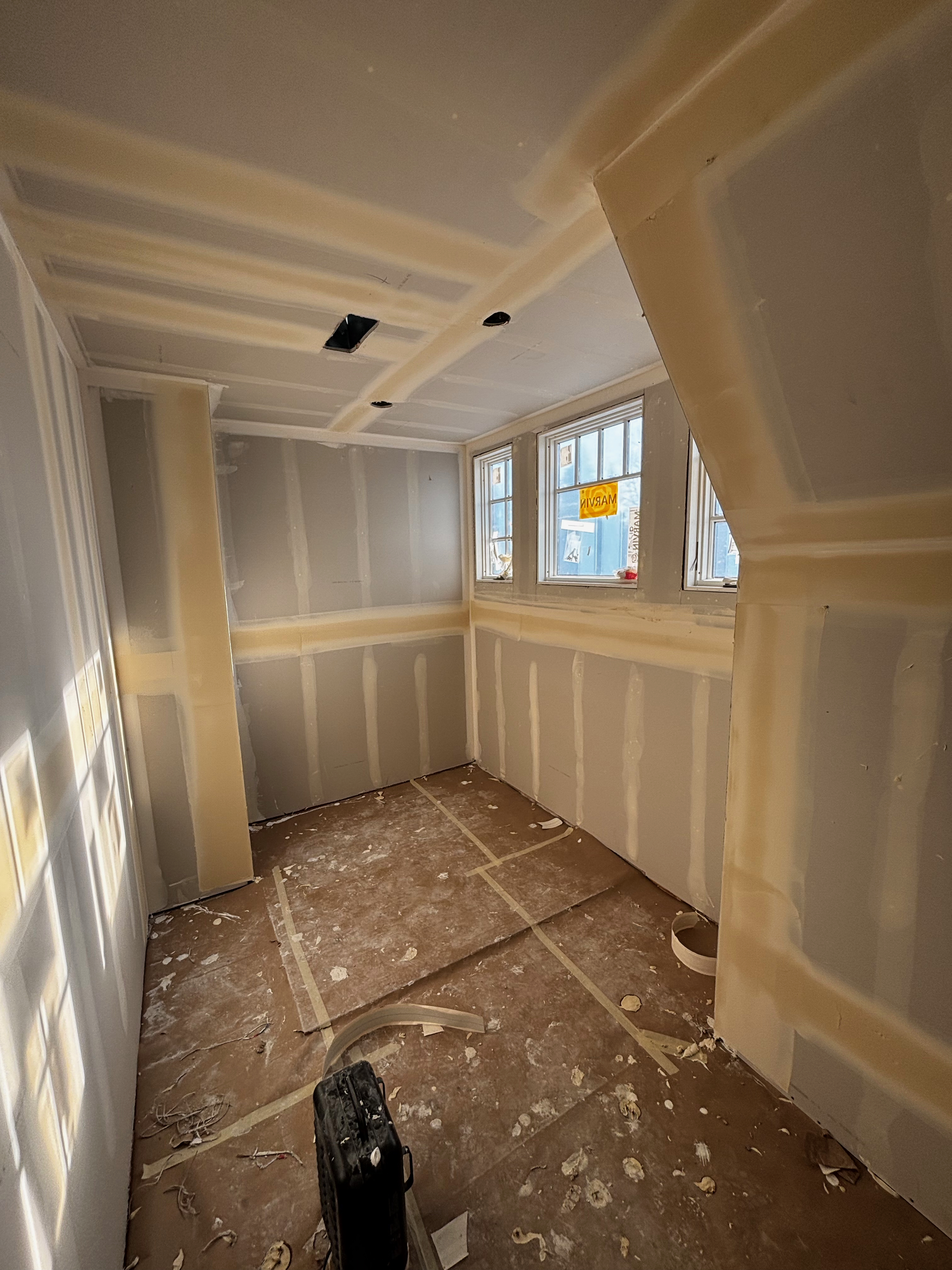
The walk-in closet off the primary bedroom is filled with light.

In the basement: another bedroom and bathroom; a giant family room and entertainment area wired for surround-sound; and a utility room with washer/dryer and sink.

Michael Schmitt, who lives nearby, has been on site almost every single day. Michael is using a builder and subs to do most of the work, and calls himself a “heavily involved owner.” He says he’s become a very good “cleaner-upper.”

“I want to make sure this house is put together as expertly as possible,” Michael explains. So, he has had a parade of tradespeople helping: framers, plumbers, electricians, stucco experts, drywallers, HVAC experts.

It’s been stressful. Michael reckons he hasn’t had a good night’s sleep this year between worrying about what might be the next surprise, and trying to figure out the puzzle of transforming almost every aspect of the house.

“If I were to offer my earlier self some advice based on this year, I’d have to say ‘you’ve got to be 100 percent crazy to do this.’”

While it has been stressful, it’s also been rewarding in so many ways. First, the Schmitts saved the house and property from what surely would have been a much larger building (or buildings). That alone makes it worth all the work. But Michael has enjoyed working with a great team of experienced tradespeople, getting to know his neighbors better and saying hello to the daily stream of passersby, many of whom offer thanks and encouragement.

This week, work on the house is at about the 60-70 percent level. Last week was drywall installation and mudding. Yet to come: painting, trim and finish carpentry, plumbing fixtures, floors, kitchen cabinets (and everything about the kitchen). So many details. And then there is the landscaping, driveway, fencing. Still plenty of work to do.

Michael is hoping the house will be ready to put on the market in the spring. When that time comes, he’ll be ready to cross the finish line and welcome new neighbors. “This will end up being a year and half of my life,” he muses when reflecting on all the stages of the work so far. And while it’s been a journey of ups and downs, all the learning, progress, transformations and new friendships have helped make it worthwhile.

We’ll check back with Michael in the new year.

One last look at Open Air School

This month we’ve been working with the Portland Housing Bureau and the Mt. Tabor Neighborhood Association to research and to share the remarkable story of the A.L. Mills Open Air School located at the southwest corner of SE 60th and Stark.

SE 60th elevation of the A.L. Mills Open Air School, built for “low vitality” children in 1919. Photograph Courtesy of the Oregon Historical Society, from the Ben Gifford Collection Box 8, Folder 5.

You’ve driven by this little jog in 60th and maybe looked at the 106-year-old building—now surrounded by cyclone fencing—and wondered about its history. Empty now since 2019 and owned by the Portland Housing Bureau, the building will soon be deconstructed and the site repurposed for affordable housing.

In the meantime before the building is gone, both the Housing Bureau and the Mt. Tabor Neighborhood Association wanted to collect and share stories about the role the old school has played in neighborhood life, and to offer neighbors a chance to come take one last look. They reached out to us for help, which has allowed our customary deep dive for stories and insights that bring the building to life, at least in our imaginations.

The east classroom at the A.L. Mills Open Air School in the early 1920s and today. Early photo courtesy of the Oregon Historical Society, from the Ben Gifford Collection Box 8, File 5. Current photo by author.

These last three weekends, we’ve led tours to share these stories, which will culminate in a final open house and tour on Saturday morning, December 7th from 10:00-Noon. Here’s a link to more information.

Later in December here on the blog, we’ll devote a full post to the stories and photos we’ve uncovered about the school and the site, but for now a short summary would go like this:

Built in 1918-1919 as Oregon’s only school entirely devoted to being “open air” throughout the school year, which was thought to be healthful during the rise of tuberculosis and other diseases. Children studied, played, ate and napped in the open-air classrooms, which were defined by their large banks of windows. The students were issued special warm clothing and monitored closely by a school nurse who also coordinated one-on-one with families on menu planning and other behaviors to help children return to vitality.

In 1949, after 30 years as an open-air school, the building was repurposed as an annex to the burgeoning nearby Mt. Tabor School. An additional classroom was built and until the early 1970s, the site hosted baby boomer kindergarten and first grade students who went on to Mt. Tabor School.

After the school function ended in 1973, the building was repurposed again as the home of a community arts and theater program run by Portland Parks and Recreation. Budget cuts in the early 1990s ended those programs and the property was on track to be sold to a private owner before being repurposed again and leased by Portland Parks to the YMCA which operated it as a daycare until 2019.

Portland Parks surplused the property in 2016 to the Portland Housing Bureau. The YMCA daycare operation ended in 2019 and the building has been vacant since then. Today, the Housing Bureau is readying the site for redevelopment as affordable housing.

Just to add a little more depth, before the Open Air School, the site hosted an imposing two-story bell-towered wood-frame elementary school between 1880-1911 but it burned in January 1911. Before that the site hosted the area’s first school, conducted in a frontier log structure. Plus, that corner of SE 60th and Stark was the center of the vibrant Mt. Tabor community before being annexed into Portland in 1905.

So many stories.

In Passing: NE 30th and Ainsworth

The former 101-year-old Hinrich’s Grocery building, at the northeast corner of NE 30th and Ainsworth, has been demolished recently to make way for a 14-unit townhouse on the lot.

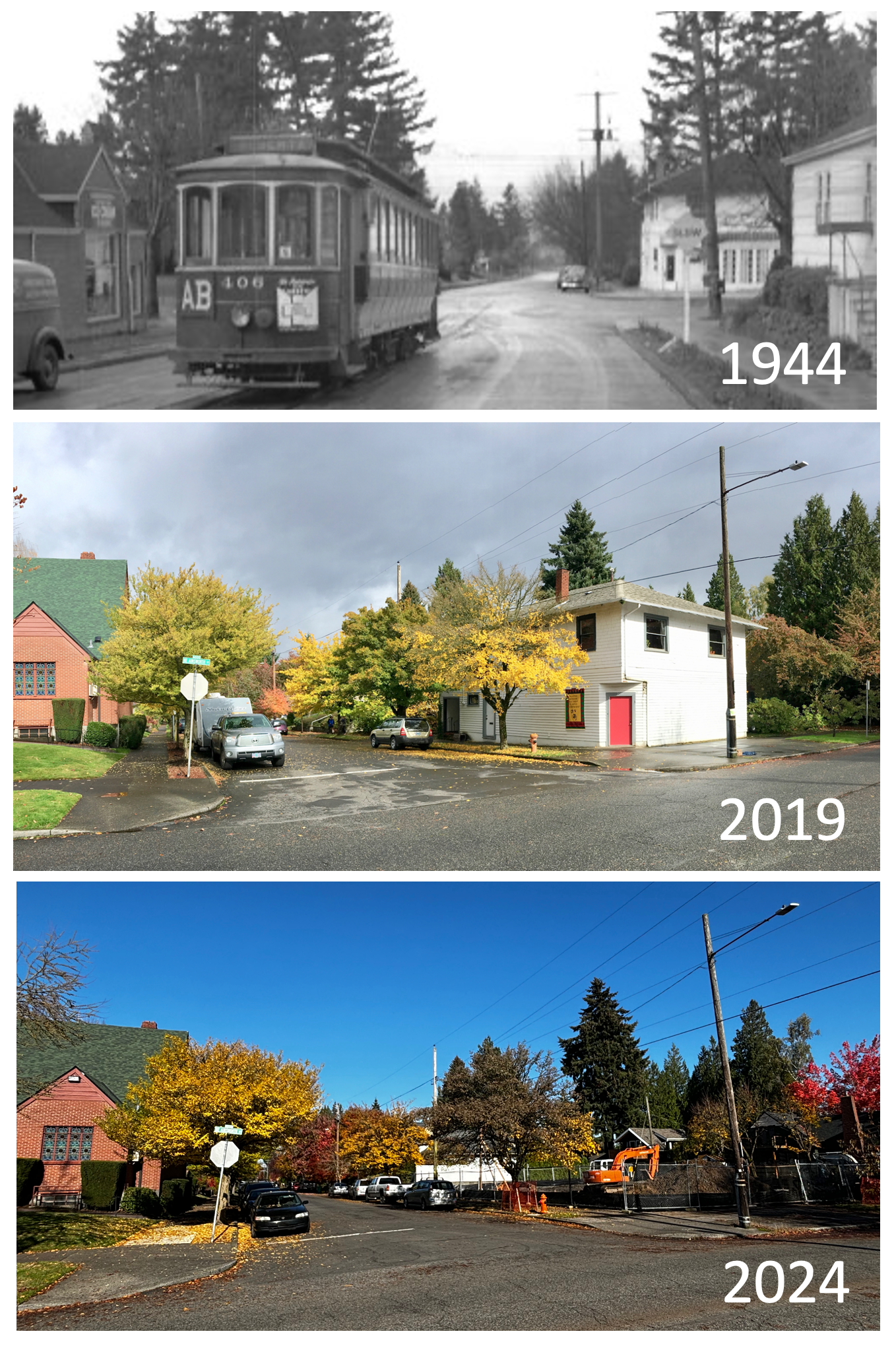
We came upon the change while walking, and were reminded of photos we’ve taken at the corner before, and a photo from 1944 that shows the building and the north terminus of the Alberta Streetcar.

We’ve written about this corner before, which was dubbed “the finest corner in Concordia” back in 1915, following a summer evening’s soiree of dance, music and trees sparkling with electric lights.

The 1944 photo shows a corner entry and what looks like French doors that open out onto Ainsworth. We’ve been in the neighborhood since the late 1980s and that south wall of French doors during our time has always been covered over with siding.

Over the years, the building has housed many businesses, including the Mauser-Lamont Insurance Agency, Town Mart Cleaners, Emerson’s Grocery (1930s), and Hinrich’s Grocery (1920s).

Development permits on file suggest the now-vacant lot will be developed as a new 14-unit townhouse in two buildings with no garage.

Portland’s largest traffic circle nearly became a commercial hub

We had been focused on the work of John W. McFadden, a homebuilder operating in the Laurelhurst neighborhood of the 19-teens and 1920s, when we bumped into an interesting thread of newspaper stories related to the big traffic roundabout known today as Coe Circle, at the intersection of NE Cesar Chavez Boulevard and NE Glisan. The circle exists at the core of the 392-acre Laurelhurst subdivision, platted in 1909, which before the turn of the last century had been prime agricultural land known as Hazel Fern Farm.

You know this place, which features the gold-leaf statue of Joan of Arc given to the City of Portland in 1925 by Portland resident Dr. Henry Waldo Coe, Oregon State Senator, personal friend of Teddy Roosevelt and advocate for WW1 soldiers. Coe chose this statute because Joan of Arc, by way of a song (Joan of Arc, They Are Calling you), spurred the courage and devotion of soldiers singing and fighting in France in 1917-1918. But that’s another story. Plus, the statue didn’t come along until Memorial Day 1925, 16 years after the circle was first platted.

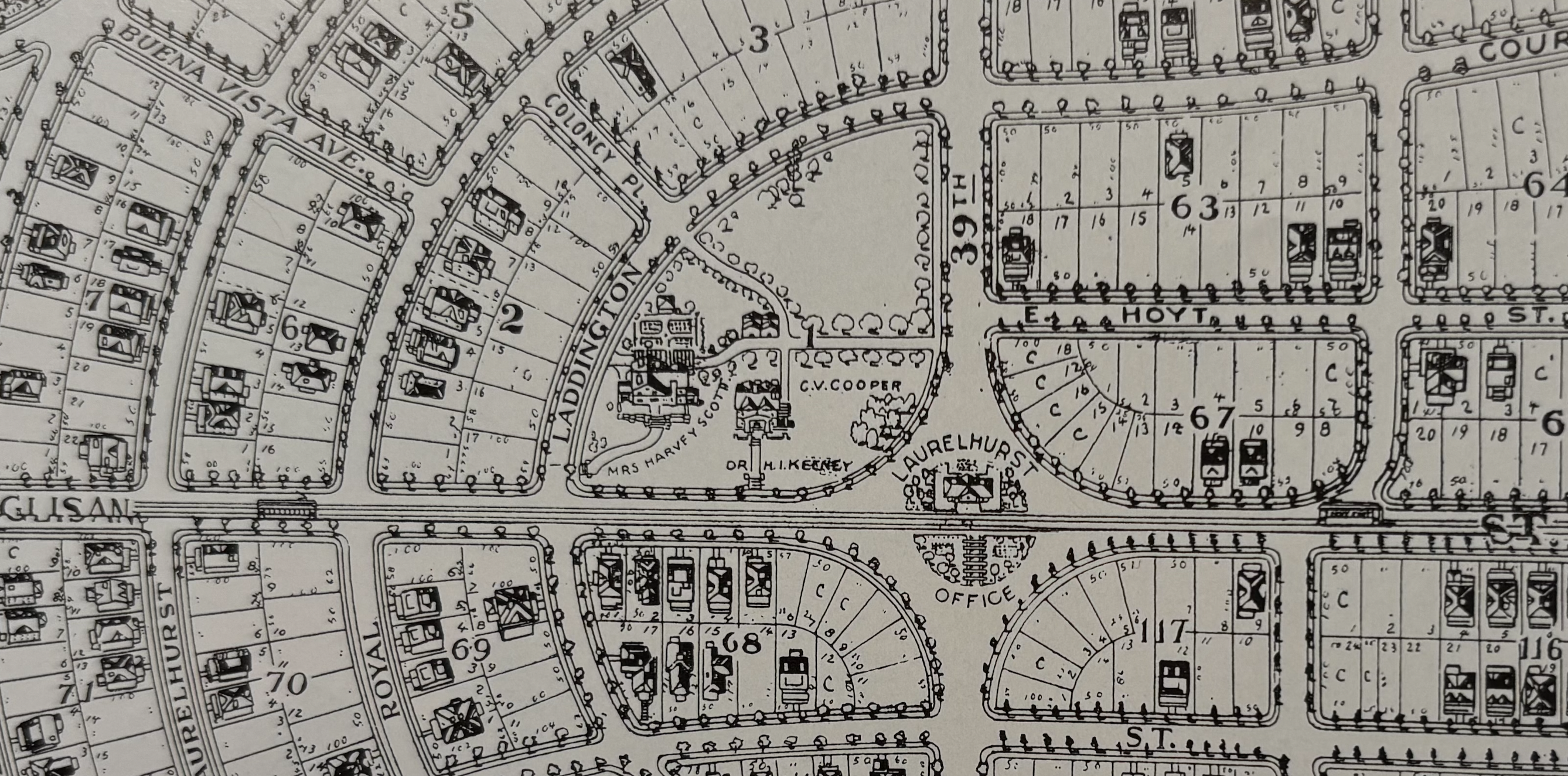
Coe Circle / “Block A” and the location of the Laurelhurst Company Tract Office, from “Laurelhurst & Its Park,” published in 1912.

The 80’ radius circle in the middle of the intersection had a few incarnations before it became the roundabout we know today, and in 1923 it narrowly avoided being turned into a retail hub, launching a dispute that shook the neighborhood. Add the traffic circle—today officially a city park—to the long list of places that nearly turned out very differently, including several of our favorite Northeast Portland parks which barely missed becoming subdivisions.

Up until the early 1920s, the Laurelhurst Company operated a real estate sales office on the north side of the circle, which was then divided north-south by the Montavilla Streetcar that traveled east-west on Glisan between Montavilla and downtown. A streetcar stop / real estate office was the perfect combination. During those years, most Portlanders traveled by streetcar, which was the ideal way to access the new eastside subdivisions to peruse vacant lots and dream about building a new house.

But by 1921, surrounding neighborhood lots had been bought up and it seemed to at least one builder/developer that what Laurelhurst needed more than a real estate office at that location was a place to buy groceries.

The Laurelhurst Company closed the real estate office in November 1921 and auctioned off the property, often referred to as “Block A,” to the highest bidder: builder/developer J.W. McFadden who knew the neighborhood well from building dozens of homes there.

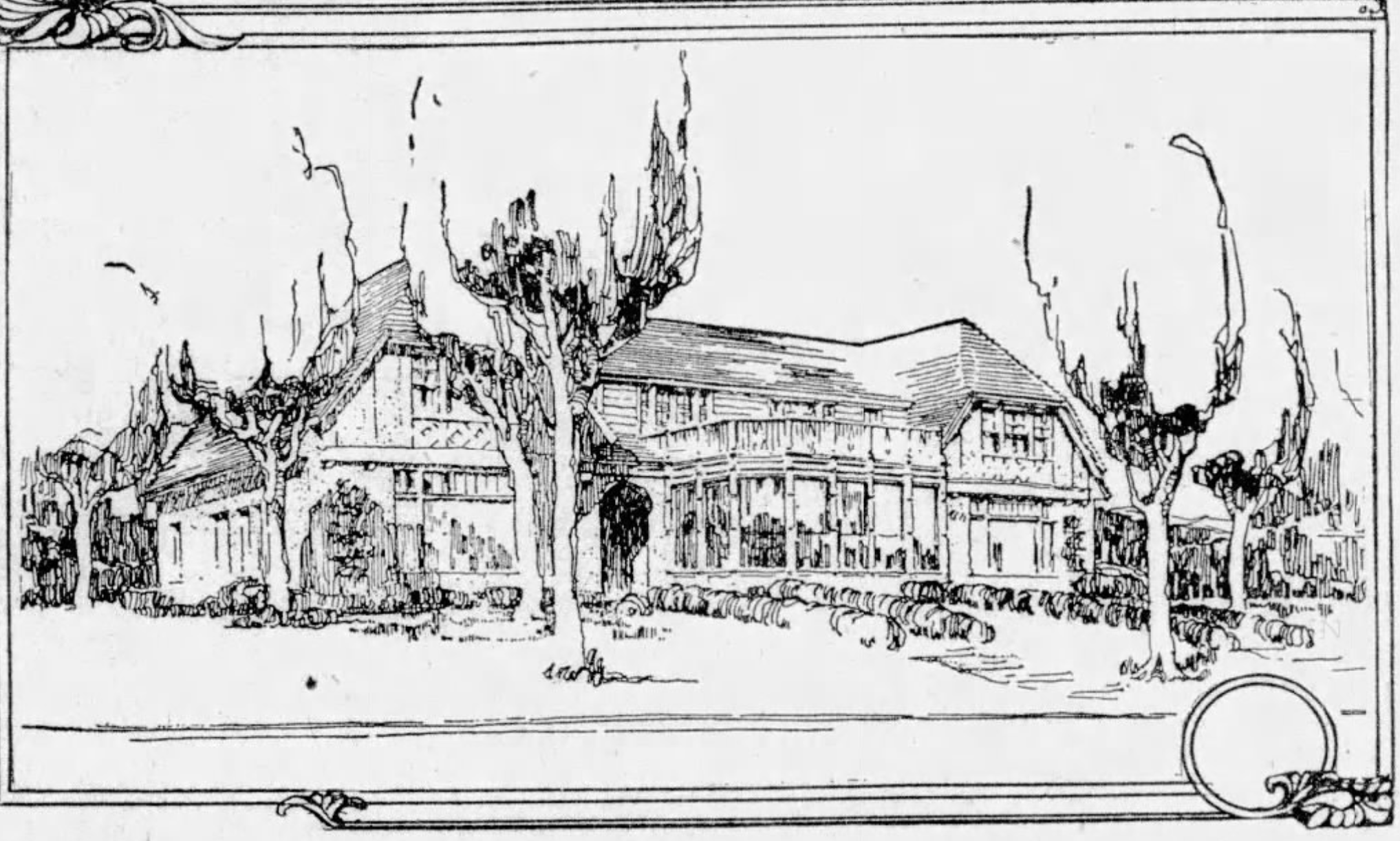
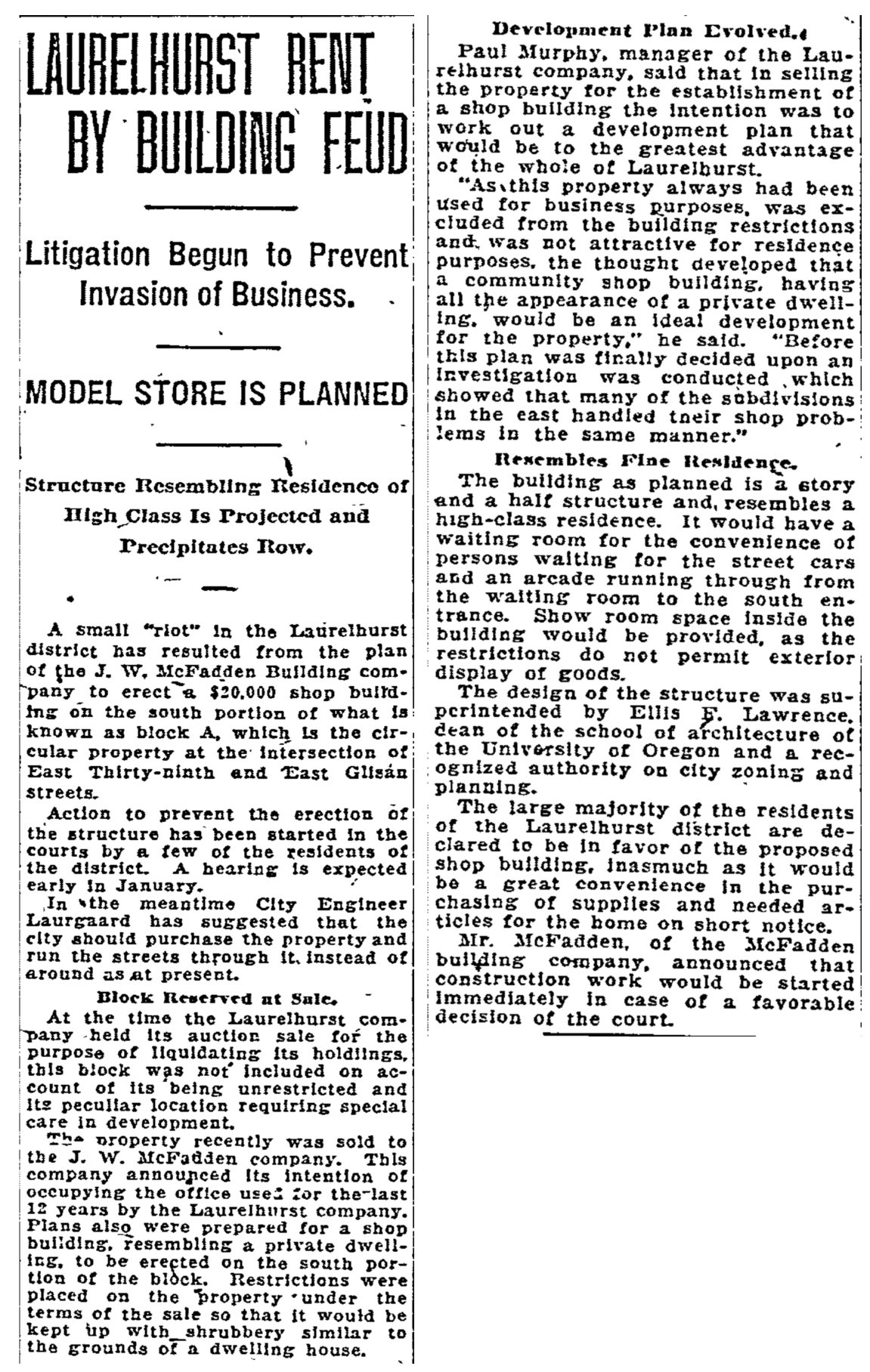
By Christmas 1921, McFadden’s plans to build a combined grocery, meat market and drug store on the south side of the circle with second-story apartments above, plus a filling station on the north side of the circle, ignited a battle in the neighborhood between those who liked the idea, and those who felt it compromised the residential feel of the place. McFadden hired talented local architect Ellis Lawrence, co-founder of the University of Oregon School of Architecture, to produce designs that would make the market a “handsome structure.”

Rendering of J.W. McFadden’s planned commercial hub to be located on the south side of today’s Coe Circle at NE Cesar Chavez and Glisan. From The Oregonian, December 25, 1921. The building was designed by Ellis Lawrence.

At issue was the interpretation of prohibitions on commercial buildings. Laurelhurst, like many eastside neighborhoods had racial deed restrictions and prohibitions against commercial buildings. But Block A seemed to be exempt.

From The Oregonian, December 25, 1921

A “riot” might be a bit of an overstatement, but things did get heated, with adjacent homeowners who were attorneys filing an injunction against McFadden’s plans. Even Olaf Laurgaard, Portland’s City Engineer who lived in Laurelhurst on Royal Court, came out against the proposal and suggested a fix.

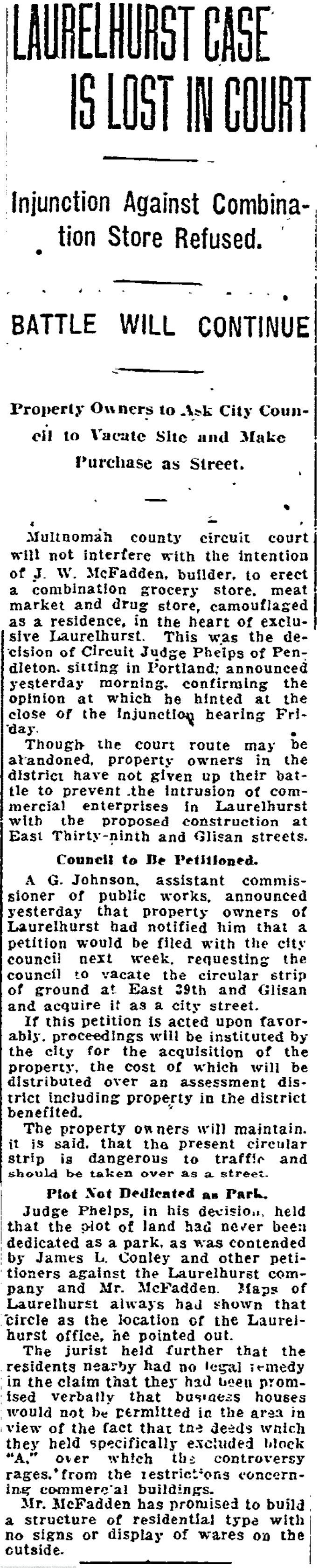
The case moved through Multnomah County Circuit Court in early 1922 and eventually the opponents lost: McFadden won the case that the commercial prohibitions did not apply to Block A. After all, the Laurelhurst Company had operated its commercial real estate office there for at least a dozen years.

From The Oregonian, March 5, 1922

The day after the circuit court decision, attorney-homeowners petitioned Portland City Council to seek other means by eliminating the circle altogether and turning it into a city street thus scuttling McFadden’s development plans. City Engineer Laurgaard’s fingerprints begin to show in this approach. Must have been a fine line to walk both as concerned neighbor and city official in charge of street engineering.

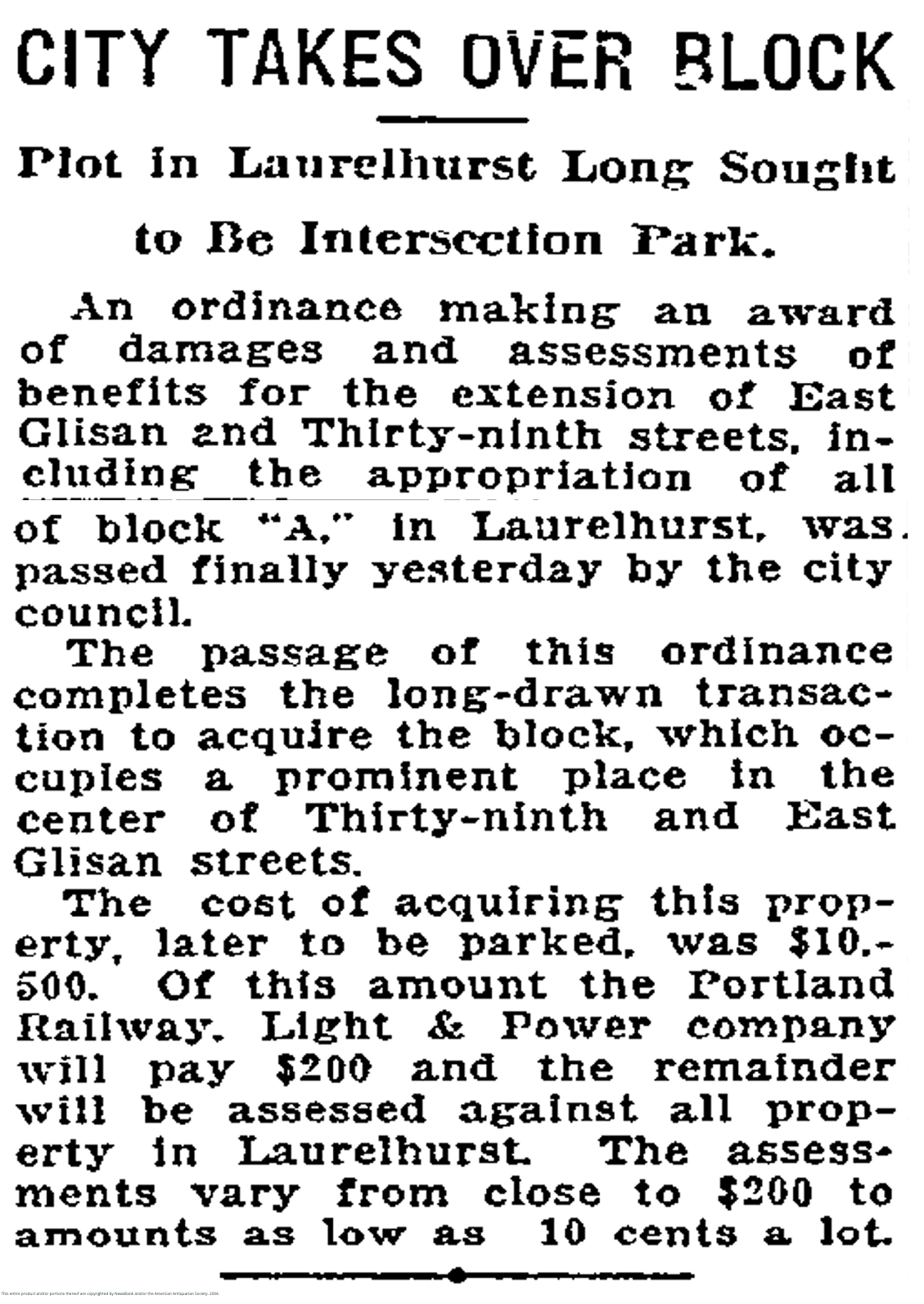
The case percolated through city politics that spring and summer, but by August 1922, Laurgaard and development opponents had figured out a course of action that involved the city buying out McFadden’s interest using mostly one-time special assessment funds paid by Laurelhurst residents and a token amount paid by the streetcar company. In August, City Council passed an ordinance codifying the “compromise.” McFadden dropped his plans, Laurelhurst neighbors paid their one-time special assessment to buy Block A, and the city added its latest city park.

From The Oregonian, August 24, 1922.

The Joan of Arc statue came along in 1925. Next time you pass by, note that it’s not in the middle of the circle, but slightly to the south because at the time, the streetcar still passed directly through the middle as it traveled along Glisan Street. As you make the round, tip your hat to City Engineer Laurgaard and the neighbors who pushed for the park, and the early generation of Laurelhurst residents who paid their special assessment to make it happen.

For the record, builder John Wesley McFadden went on to become one of Portland’s more prolific and respected residential builders in Laurelhurst, Alameda and other northeast neighborhoods. During Portland’s building boom period of the 1920s, in addition to high-profile homes, apartment buildings and movie theaters, the J.W. McFadden Company built dozens of middle market and entry level bungalows on Portland’s eastside, mostly using designs and blueprints produced by the Universal Plans Service.

In 1931, McFadden built “Bobbie’s Castle,” a scaled-down bungalow memorial to the famous Silverton-area collie dog that walked 2,800 miles from Indiana back to its owners in Oregon. Bobbie was buried at the Oregon Humane Society in Northeast Portland, and McFadden’s memorial to him—a small house—was located at the dog’s grave there.

In 1937—at age 56—McFadden joined with financial backers to create Modern Builders, Inc. to build multiple apartment buildings in southeast and southwest Portland. He died in Portland at age 68 on February 3, 1950.
Saturday, September 21 program at AHC: The Builders

Next Saturday morning, September 21st, we’ll be at the Architectural Heritage Center in Portland to present a new program called The Builders. Illustrated with photos, newspaper clippings, maps, interviews and stories–and drawing on our growing collection of builder biographies–we’ll share a sense of the people and the process of building, marketing and buying the houses that are now entering their second century. Tickets are still available, register online or contact AHC for more information.

Builders working on an eastside bungalow in the early 1900s. Courtesy of Oregon Historical Society, Negative 37092.

When the Columbia River froze

This summer we’ve been sharing some of the interesting photos from the von Homeyer collection: a big batch mostly of family photos from the late 1890s through the 1950s. Everything from glass plate negatives to Brownie snapshots. The von Homeyers liked to take pictures!

Mingled in the collection are images of interesting places or moments that piqued our curiosity and got us wondering: when – where – what?

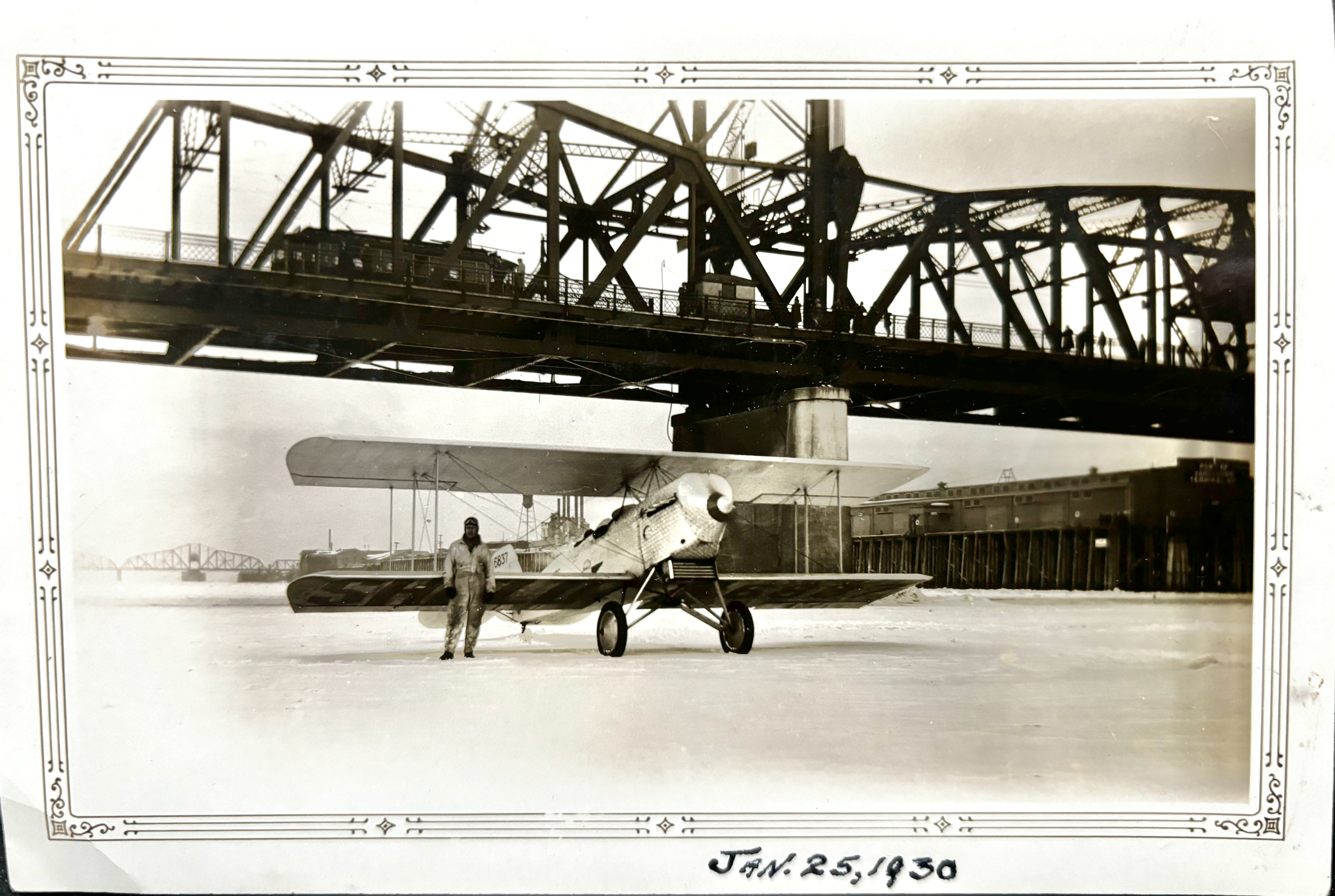
Here’s couple of winter images that led to a bit of old newspaper sleuthing. When we first saw this we thought: Broadway Bridge? But on second look, the setting and the structure didn’t seem right. Of note: the streetcar passing on the decks overhead. The date seemed important to the photographer and it turned out to be a helpful clue.


From the Oregon Journal, January 26, 1930.

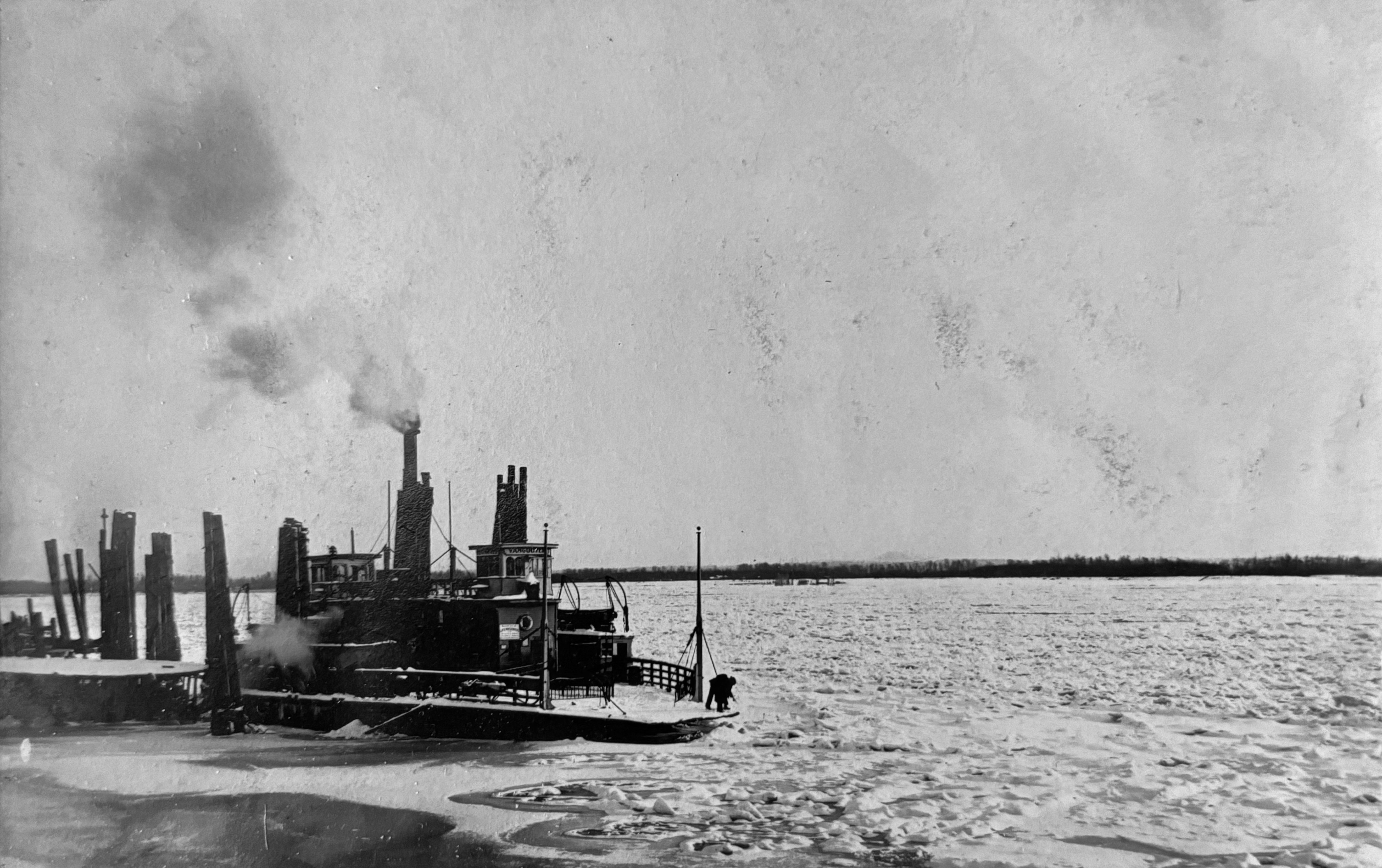
According to the Vancouver Columbian newspaper, it wasn’t so unusual for the Columbia River to freeze over completely, including the “Big Freeze” of 1909 that halted commerce, mail delivery and ferry traffic across the Columbia between Vancouver and Portland.

Hans von Homeyer captured this view of the ferry Vancouver and the frozen Columbia River in January 1909. With no bridge (it came along in 1917), and no ferry service to towns both upstream and downstream, frigid winter weather in January 1909 caused hardship throughout the frozen region.

Here’s a deeper history of ferry service between Vancouver and Portland, from the Clark County Historical Society.

Hard to imagine from the sunshine and warmth of this t-shirt summer, but snow and ice will return.

Old glass negatives allow glimpse of lost time and place in Northeast Portland

Six glass plate negatives from 1908 retrieved from the basement of the von Homeyer house in Northeast Portland tell a story about a setting, home and family life that have become extinct but not forgotten.

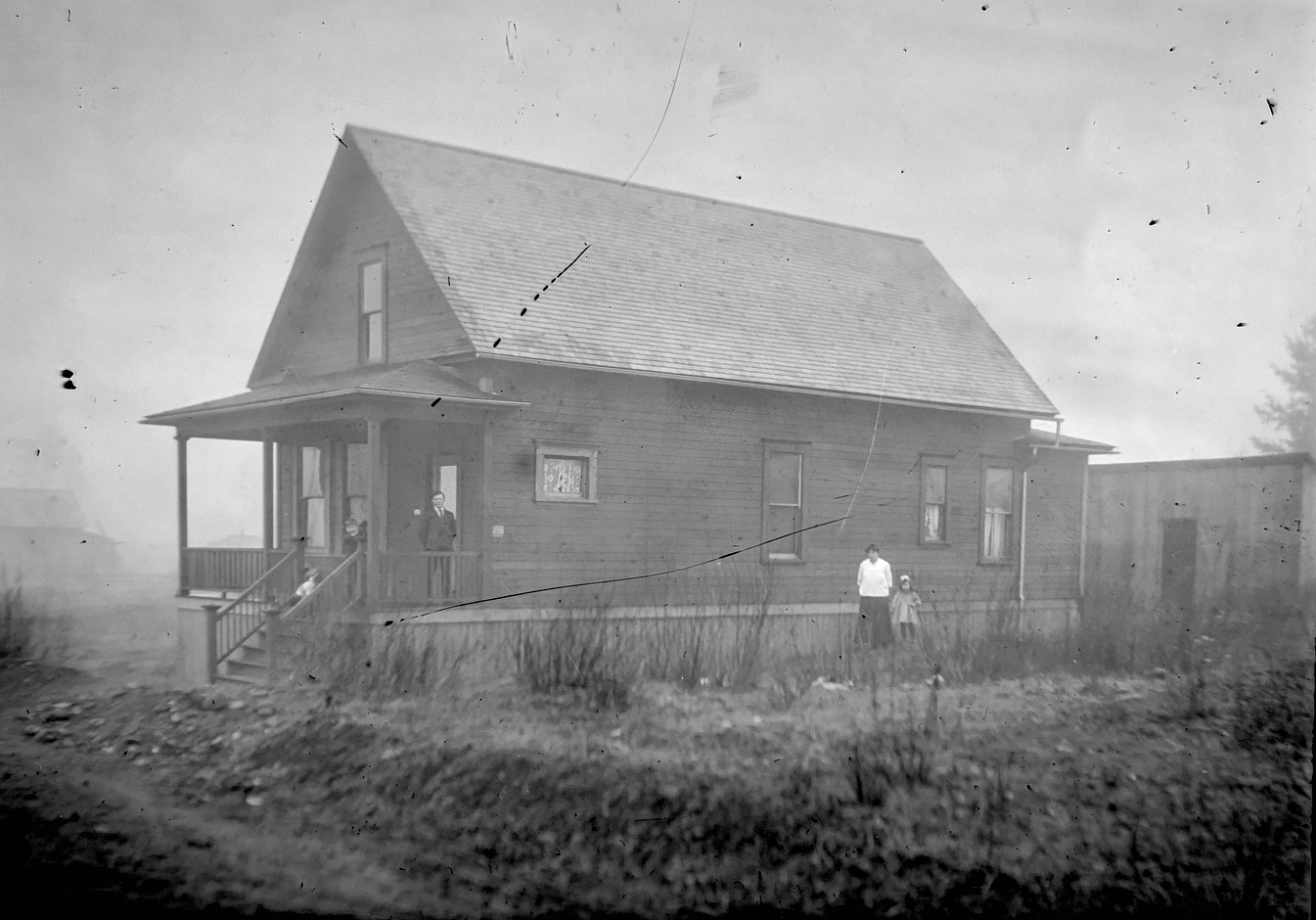
The first von Homeyer house in northeast Portland at 850 Going Street (today’s NE 27th and Going), from a glass plate negative. Hans O.S. von Homeyer on the roof with sons Hans W.S., and Irvin Erwin Frederick. At the back steps: Minnie and daughter Gretchen. View looking toward the northwest, about 1908.

The glass plates are some of the thousands of photos unearthed by new owners Michael and Jaylen Schmitt earlier this year as they prepared the house for overhaul and adaptive reuse. This winter and spring, we helped the Schmitts sort, organize and add context to the mountain of photos and documents that had accumulated in the house over the last century.

In May after careful review of each image, we sent more than 30 pounds of old photos “home” to the next generation of family members who had never seen many of these long-passed great aunts, uncles, grandparents and family scenes. Duplicates and some others (including the glass plates) went to an estate sale that helped clear out the house in May. A select few of the photos and documents will remain behind with the house going forward.

But these six are special, because they are so old and fragile, and because after some detective work, we now know what they depict.

The first time we saw them this winter, we knew they might be some of the most interesting images in the entire collection: they showed a young family’s connection with an old house–something always near to our hearts.

The von Homeyers at 850 Going: Erwin and Hans at left; Hans, Minnie and Gretchen on the front porch. Looking southwest about 1908.

They showed wide open spaces around the house, hinting at things to come.

The von Homeyers at 850 Going: Hans, Hans and Erwin on the porch; Minnie and Gretchen at the side. No sidewalks, dirt streets and wide open lots all around. Looking east-southeast about 1908.

They showed the home’s interior, three children in the foreground, columns and windows behind.

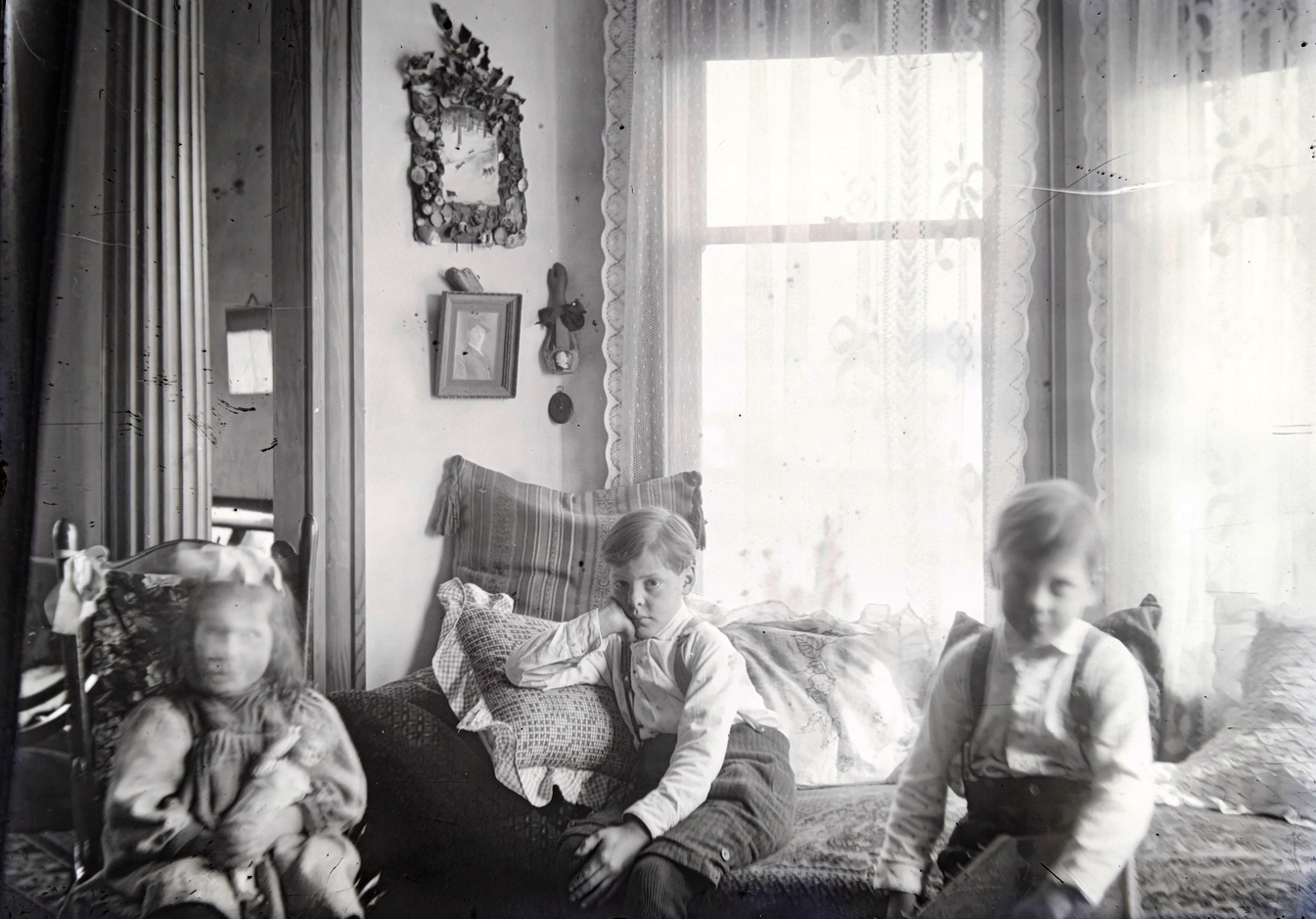
Gretchen, Hans and Erwin at the bay window, 850 Going Street, about 1908.

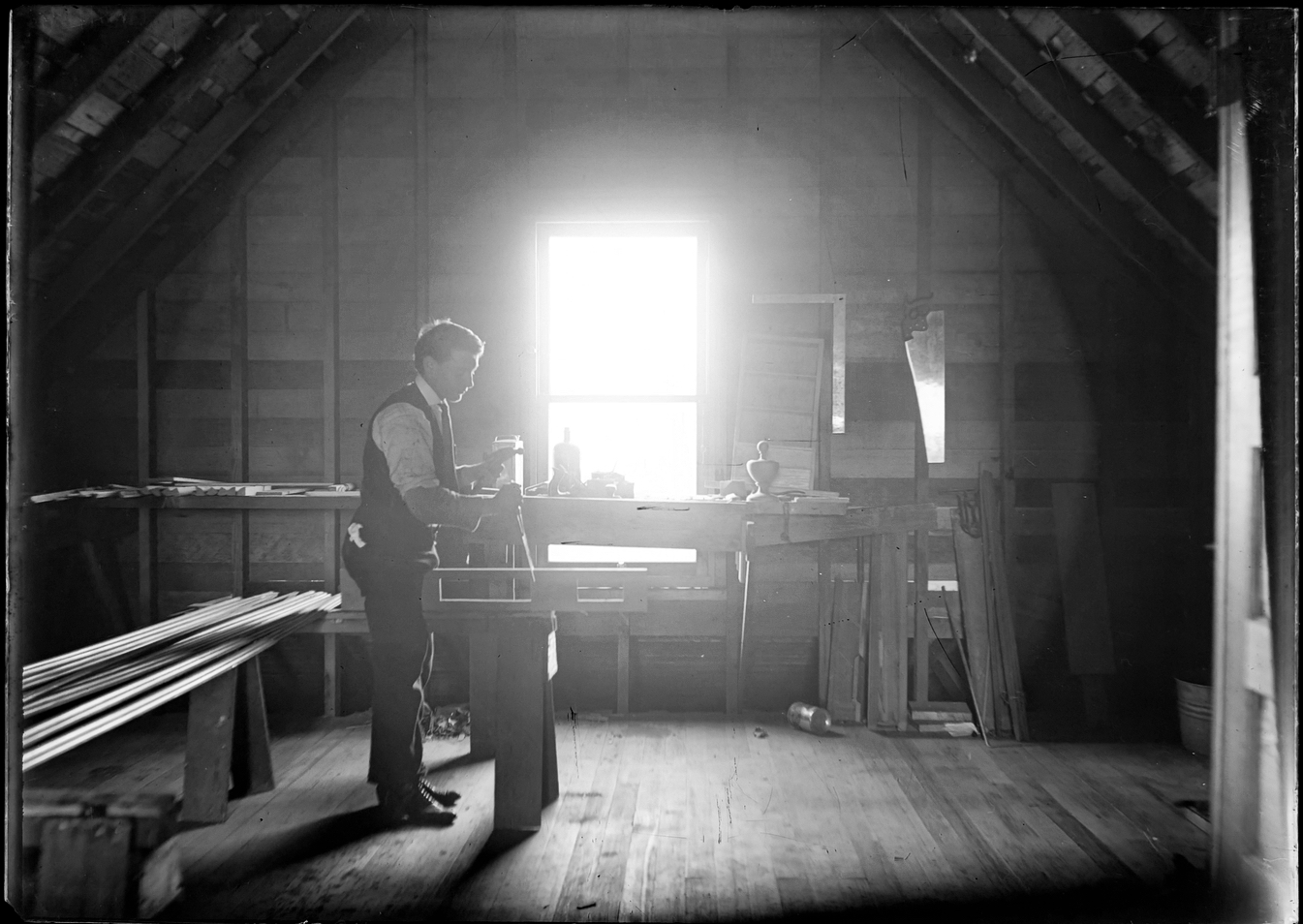
And they showed a builder at work upstairs. The backlighting from the second floor window makes it difficult to see, but the carpenter’s square, saw and plane behind him, hammer in hand, and the at-work stance of the human subject, come through clearly.

Hans von Homeyer at work, upstairs at 850 Going, about 1908.

As glass plate negatives go, they are a tad hard to read if you just pick them up for a quick look. Thick with emulsion, it takes a lot of light to reveal the negative image. Which might be one of the reasons why they survived the estate sale: people couldn’t tell what they were seeing.

We made prints and stared at them for a long time. Where is this place, we wondered.

Over the winter, as we continued looking at hundreds of family photos and began to recognize particular people and places, and as we researched the von Homeyer family story, a common thread began to tie some pieces together: this house.

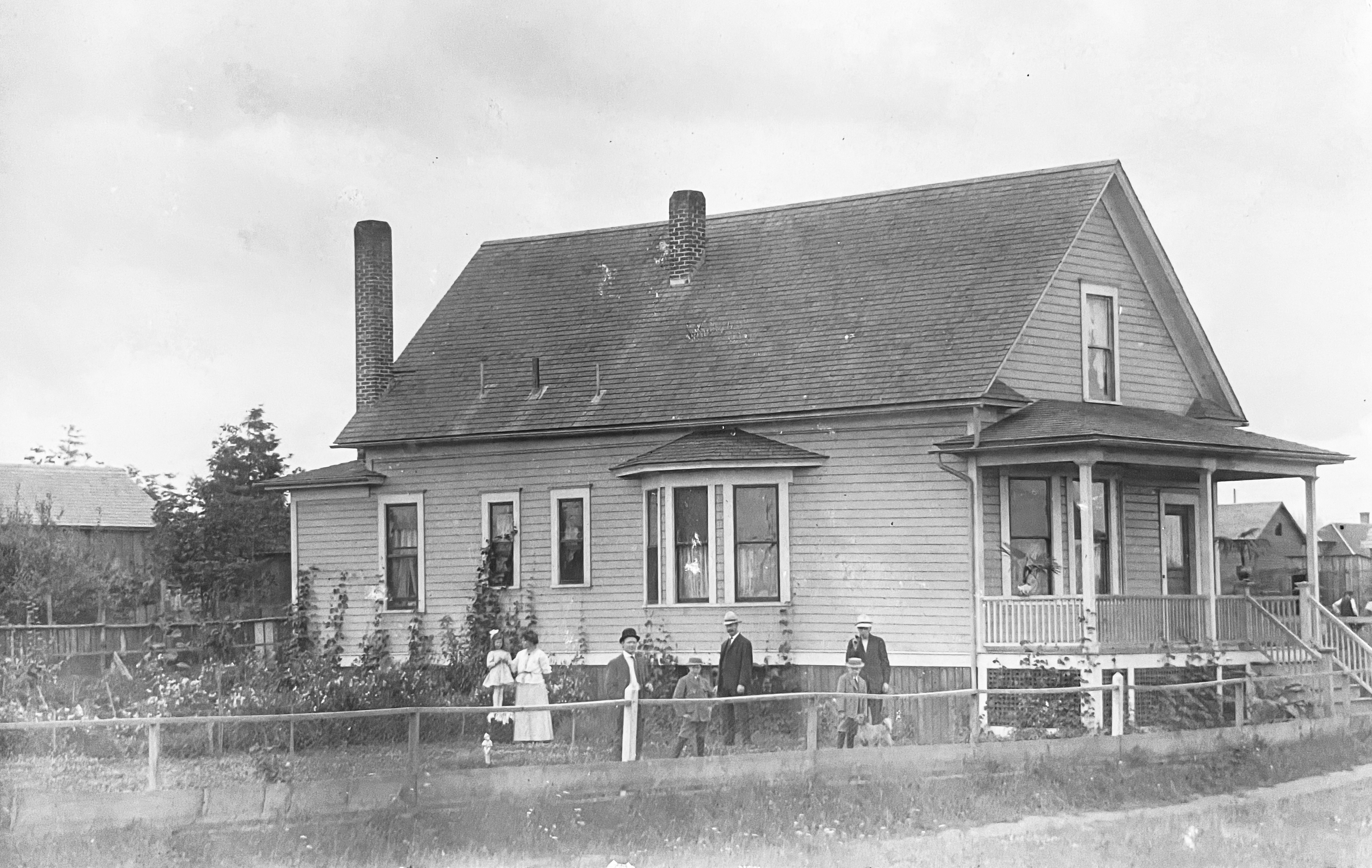
First, we found this paper image in one of the old photo albums. It’s a “Real Photo” postcard showing two generations of a family out front of a tidy house.

This Real Photo postcard was sent from Hans to brother-in-law Karl Tripp about 1909, looking southwest. Minnie and Gretchen at left; Hans center with Hans and Erwin; two unknown visitors. A few more nearby houses and a new coat of paint.

The glass negatives show a slightly earlier version of the house, before paint, less landscaped, a little rough around the edges, but definitely the same place. By 1909 and the postcard to Karl, the von Homeyer home at 850 Going was looking pretty tidy.

Do-it-yourself cards like this were first offered by Kodak in 1903 and almost immediately blew up in popularity as friends and families exchanged their own photos and brief greetings through the postal mail. An early and s l o w version of sharing photos and a few well chosen words across distance. Something families still like to do today. Here’s more about how Real Photo postcards transformed photography between 1905-1915.

This one was sent by the first Hans O.S. von Homeyer (1871-1942), father of Hans W.S. von Homeyer (1898-1969) who built the house at NE 24th and Mason, grandfather of the brothers Karl and Hans E. von Homeyer (1927-2002) who lived in the Mason Street house all their lives. Hans the elder sent the card to his brother-in-law Karl in Chicago, Minnie’s brother. The message on the back was in German which we can’t read, so we sent a picture of the almost undecipherable longhand script to our friends Christiane and Roland in Germany for quick translation. They wrote back immediately with the 110-plus year-old postcard greeting that made us smile:

Dear Karl, we are all still alive and frisky. How are you? With best greetings from all of us to all of you.”

The card was signed “H. von Homeyer, 850 Going Street, Portland, Ore.” which of course also piqued our interest, knowing that Going Street makes its long east-west transit through today’s King, Vernon, Concordia and Cully neighborhoods. We’ve looked at enough old east-west addresses to know 850 was going to be about 27 blocks east of Martin Luther King Jr. Boulevard and would probably end up in the Elberta Addition.

If you search for that address in pastportland.com (which is one of the very best tools for converting between pre-address change addresses and today) it comes up empty. Plenty of numbers either side, but no 850.

We looked for 850 in the 1909 Sanborn Maps, but this block and several others nearby were still unbuilt brushy vacant lots with dirt roads scratched into the ground. Sanborns were used by fire insurance underwriters to gauge fire risk based on the presence of fire hydrants, distance from fire stations and types of construction materials and heating systems used by various buildings. But out near 27th and Going in 1909, there weren’t any buildings that needed insurance underwriting. So, it wasn’t mapped.

Next we began nosing around The Oregonian and the Oregon Journal, both of which are searchable by word going way back if you have a library card. News stories, letters to the editor from Hans and other mentions began turning up, confirming the von Homeyer’s presence there.

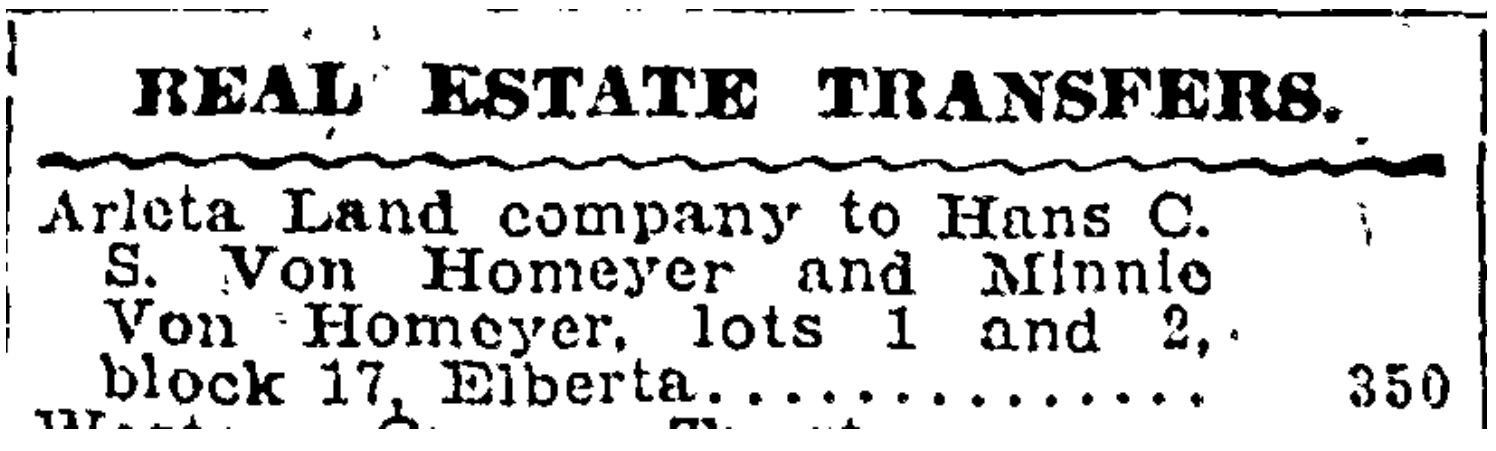
Then we found this buried in the real estate transaction list: Hans and Minnie buying a vacant lot in the Elberta Addition for $350 in late July 1907.

From The Oregonian, July 29, 1907

That gave us a lot and block number and a place to look. So we downloaded the Elberta plat from the Multnomah County Surveyor’s office, and began trial-and-error looking on Portlandmaps.com for block and lot details in that vicinity. We quickly found lots 1 & 2 of Block 17 today–the northeast corner of 27th and Going–but the pre-address-change address for that place says 848 and what’s there today doesn’t look anything like the postcard.

We began to note that after 1910, all references to 850 Going stop. Going, going gone. So how come 850 shows up in some news stories and on the postcard, but then disappears? We had a hunch.

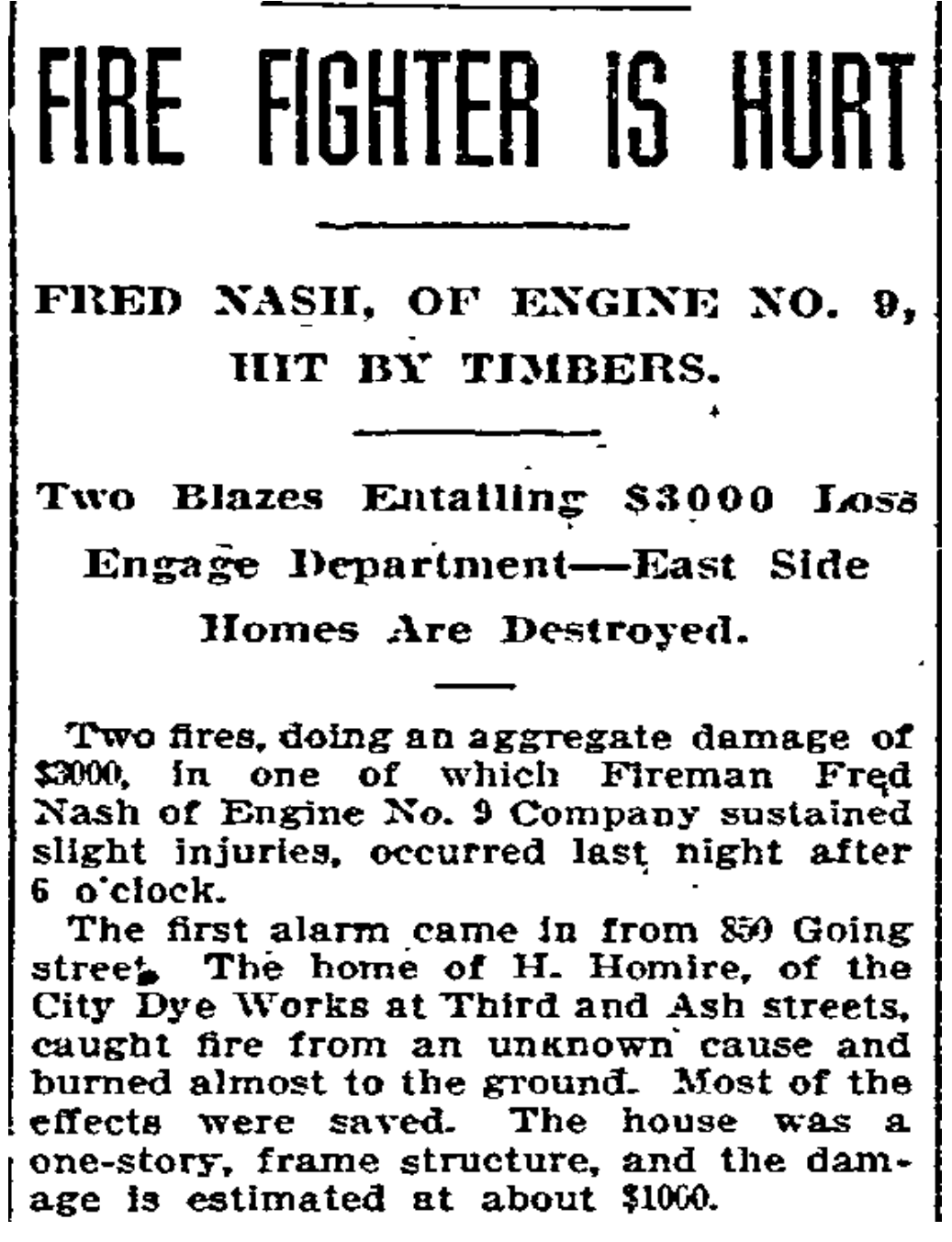
The next newspaper story we found made it clear:

From The Oregonian, September 20, 1909. Creative spelling.

Glancing back and forth between the post card picture and the glass plates, with the fire story in mind, the realization struck: the images on the old glass and the postcard print were showing the same house: the first von Homeyer home, built in 1907 after they arrived in Portland from Chicago. In September 1909, it burned to the ground.

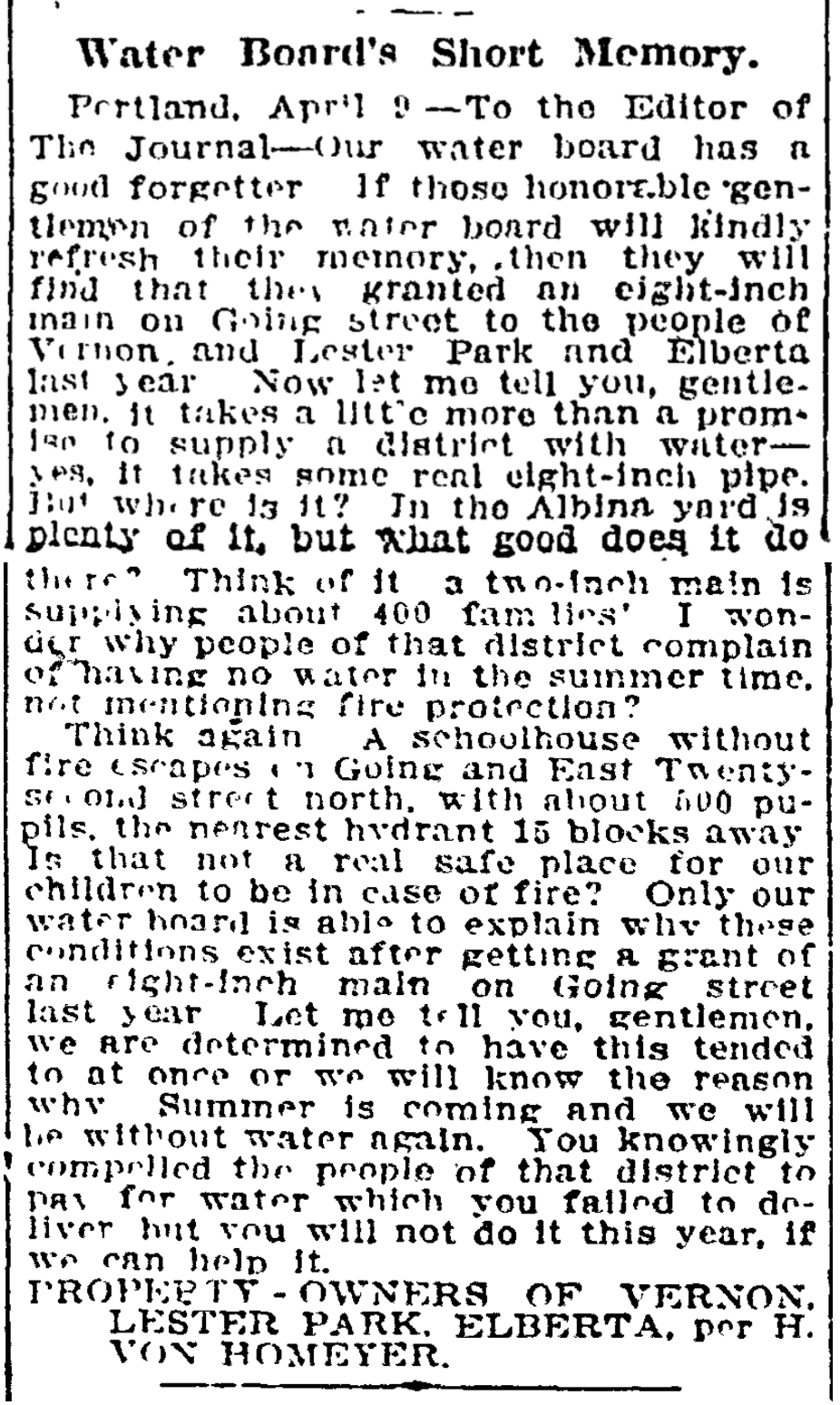
Eerily, Hans von Homeyer foreshadowed what might happen to their new home on Going Street. In a letter to the editor of the Oregon Journal the year before, signed on behalf of area residents, Hans gave voice to frustrations with the city about lack of water pressure in their part of the neighborhood, and worries about the fire safety of the huge wood-frame Vernon School just up the street, where their children attended.

From the Oregon Journal, April 13, 1908

In June 1911, Hans and Minnie sold Going Street and took up residence in a spacious Craftsman-style house on NE San Rafael just east of today’s Martin Luther King Jr. Boulevard. The kids were growing and so was their business. Later, the von Homeyers moved to Vancouver where their story continued.

Have a good look at the 1908 surroundings as you think about the corner of NE 27th and Going today. Just across the street is the former dry goods store. The streets were unpaved gravel, no curbs or sidewalks until 1913. On the property where the von Homeyer house stood, a new home was built: the late Queen Anne Victorian that stands today, known as the Going Queen. Today, that intersection is all concrete streets and sidewalks, topography leveled off, no vacant lots in sight.

Aside from the small miracle of their basic survival all these years is the reality these glass plate negatives somehow made it through the fire or were carried out of the burning house they depict: the news story reported “most of the effects were saved.”

For extra credit, the six glass plates also made it through the estate sale in May. No one was interested in them, so after the sale they made it to the dregs pile that Michael was going to have to deal with one way or another. When we learned this, we very happily rescued them from the dregs. Now they’re in a safe place.

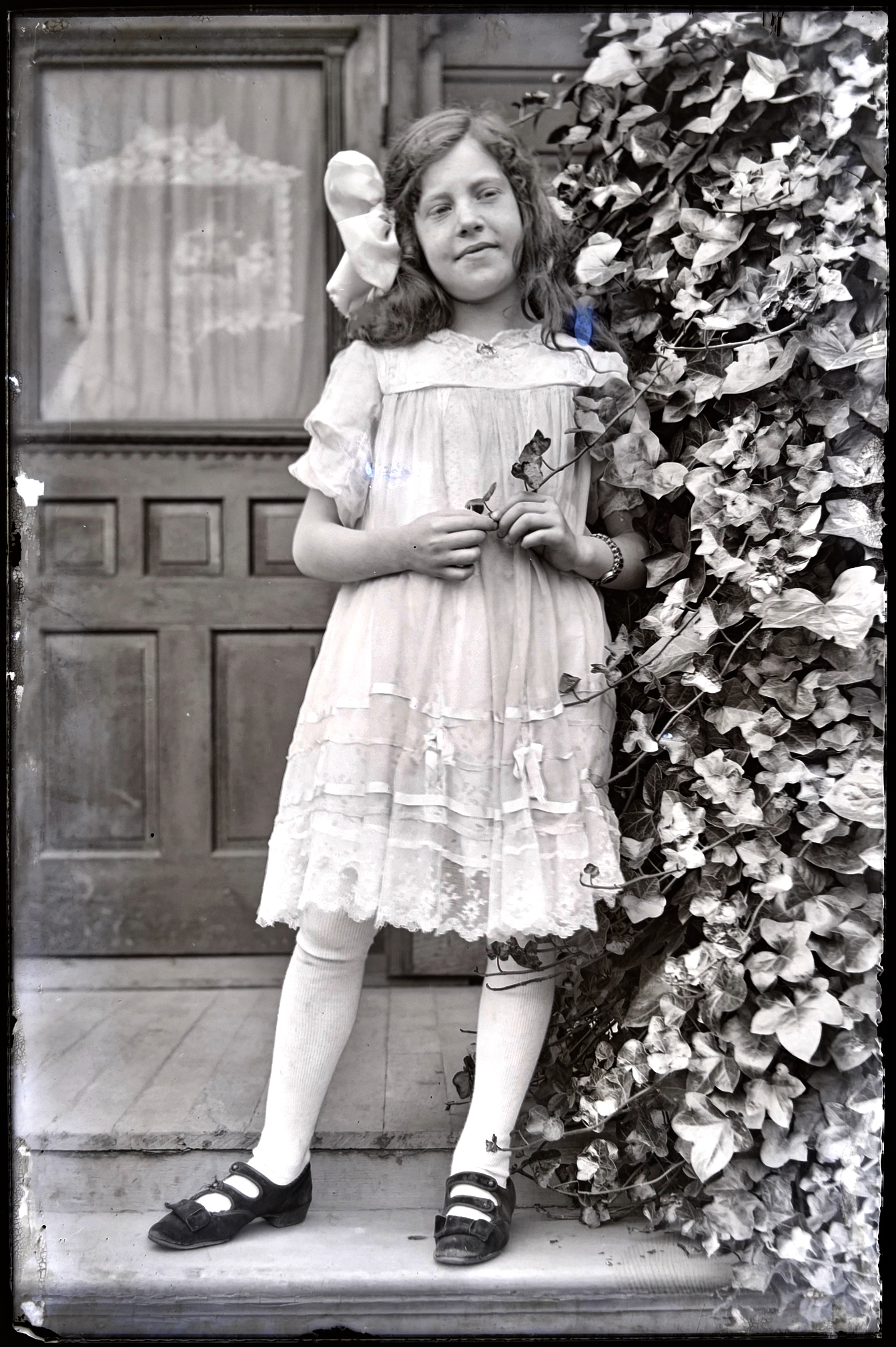
The last of the six glass plates–smaller in size, made a little bit later in a different location–may be the most wonderful, showing youngest sister Marguerita Anna “Gretchen” von Homeyer on a porch, bow in her hair, standing near an ivy-covered column, looking off toward the future. Probably taken in about 1913. She was eight years old.

Marguerita Anna “Gretchen” von Homeyer about 1913.

The end of Willamette River Swimming: An infamous 100th anniversary

It’s been over a year since we’ve written about Willamette River swimming at Windemuth and at Bundy’s Baths on the eastbank in the vicinity of Ross Island. There’s an important anniversary coming up for Windemuth, plus we’ve learned a few more things (and found some more photos), so it’s time to say a bit more.

If you don’t yet know about Windemuth and Bundy’s Baths, be sure to follow those links and while you’re doing that, check out this great set of old photos and memories about canoeing the Willamette downtown during the summer of 1919. We’ve been haunting these places and the archives this summer to learn more about the hold they had on Portland’s soul, which was something.

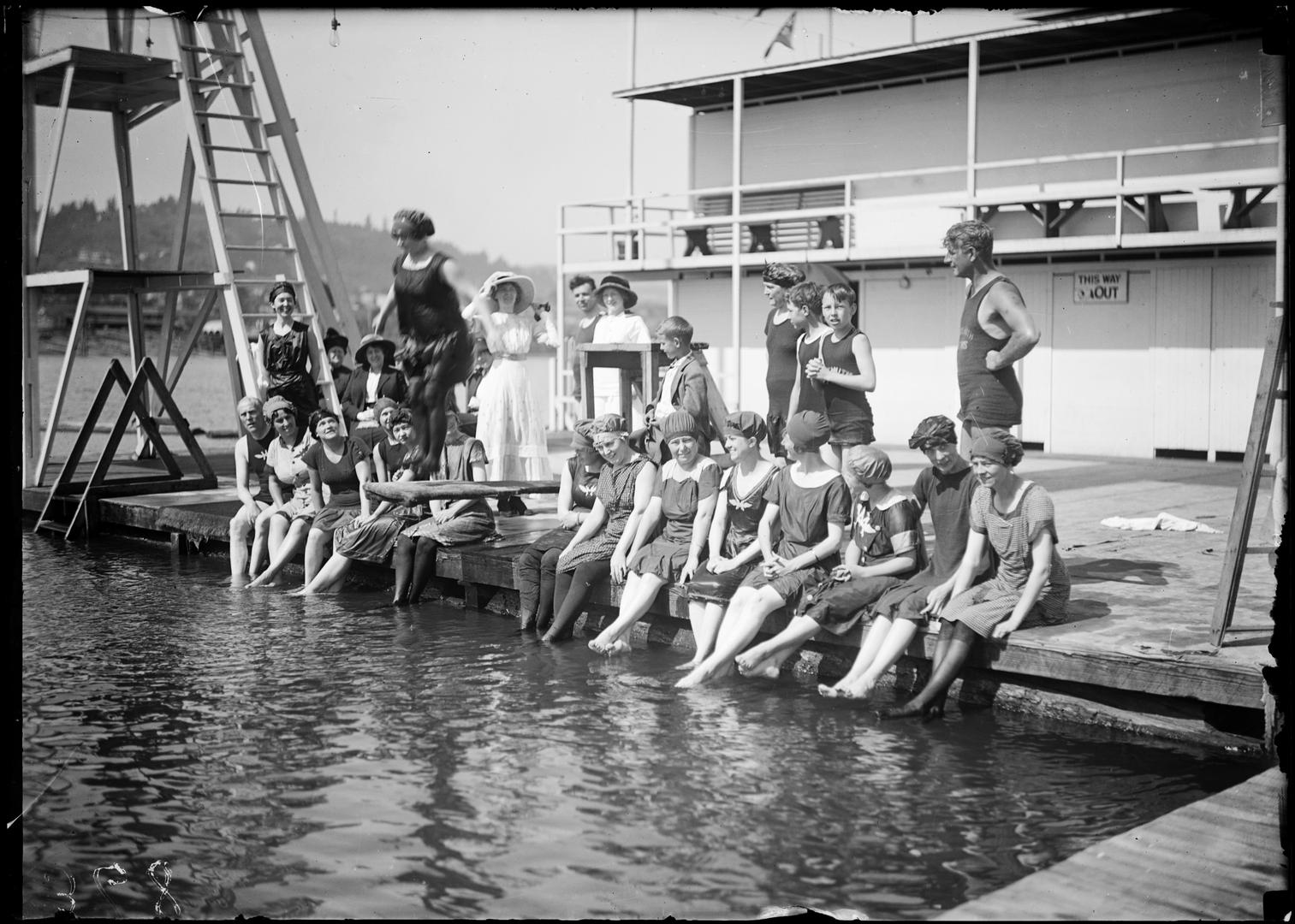
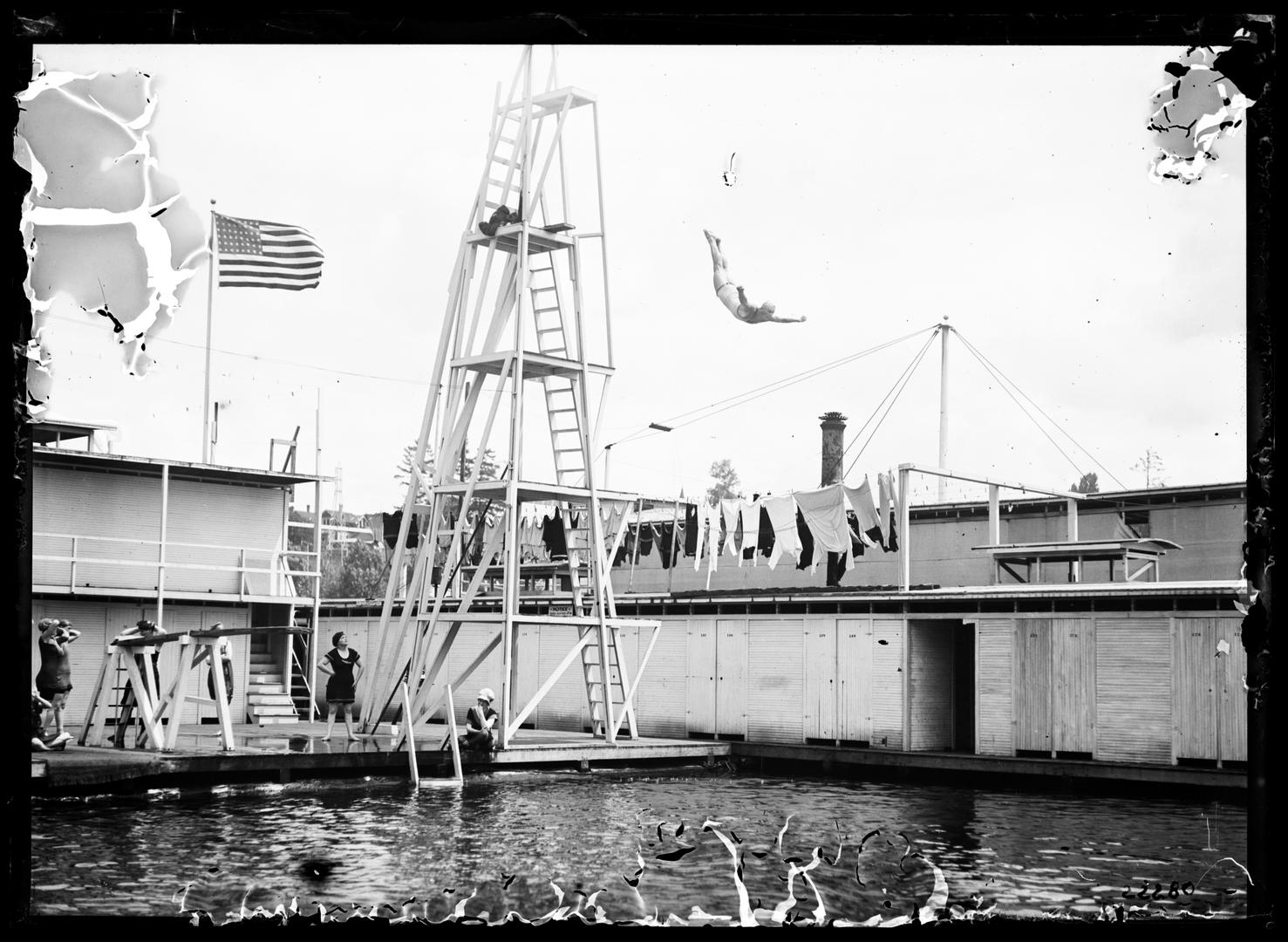
Briefly: Windemuth was a huge two-story floating swimming tank, diving venue and dance floor anchored off the north end of Ross Island (before the bridge, which was built in 1926) that held more than 500 people. It was so popular in the 19-teens and 1920s there were times it rode low in the water, packed with so many people.

Swimmers at Windemuth. Angelus Studio photographs, 1880s-1940s, University of Oregon, Oregon Digital.  PH037_b012_AG00052

Earlier–dating back into the 1890s–Bundy’s Baths was the place to meet your friends, rent your swimming togs, and play in the water at river’s edge.

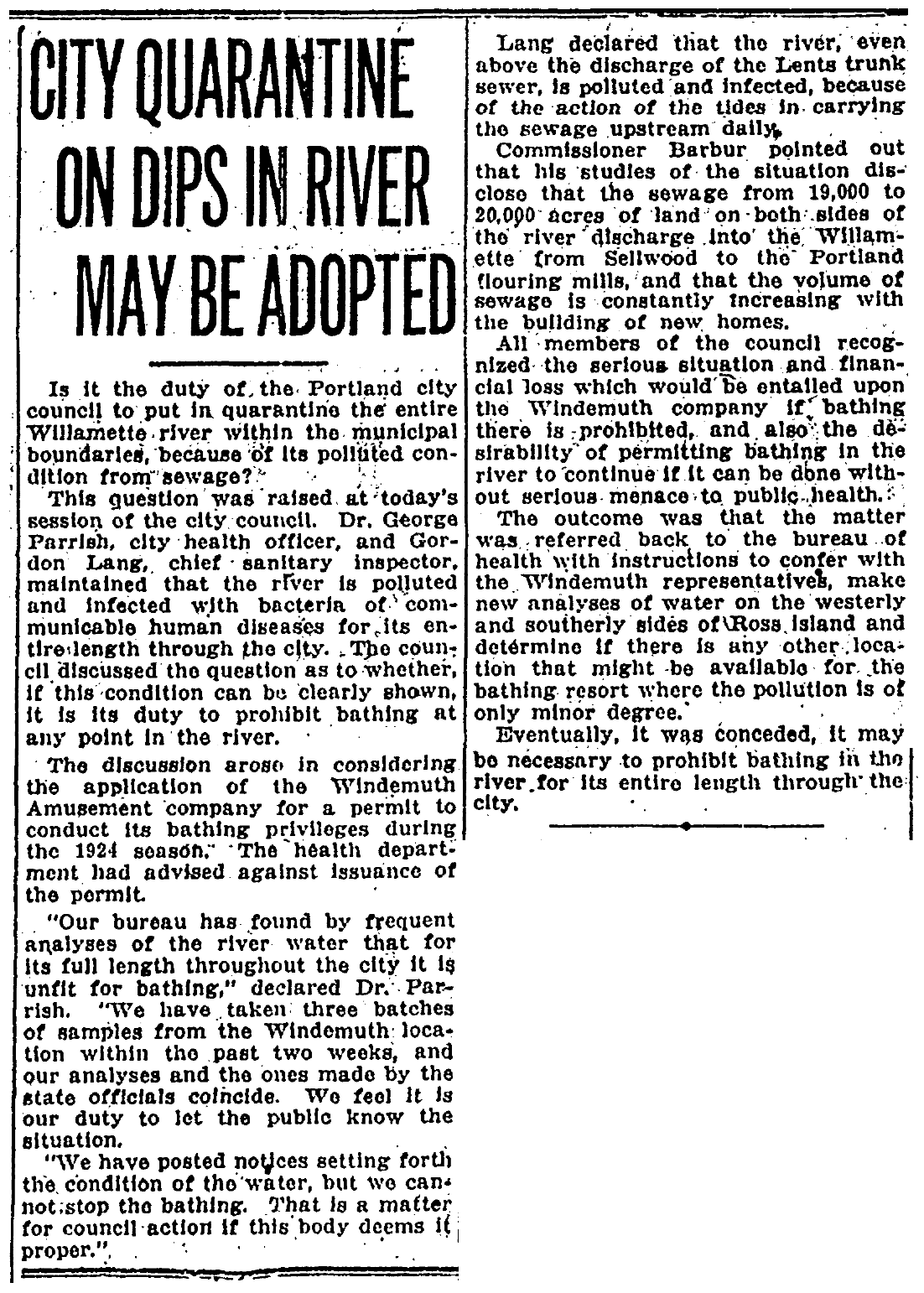
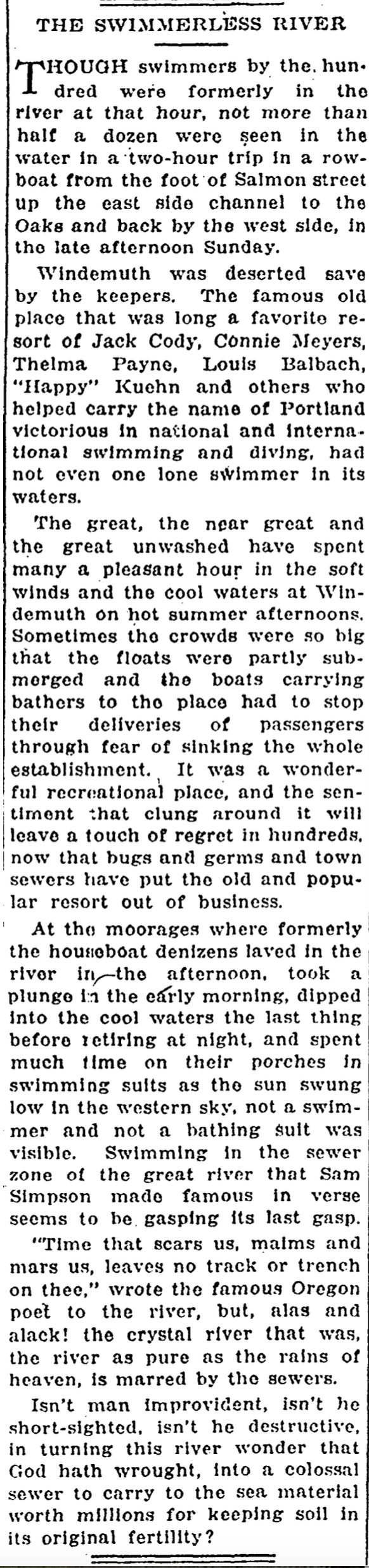
To the infamous anniversary: 100 years ago this month, Willamette River water was so polluted with sewage and human waste that City Health Officer George Parrish recommended Portland City Council pass an ordinance banning all Willamette River swimming in Portland. At the time (and up until 1952) all of the city’s raw sewage poured directly into the Willamette from nine major sewer outfalls. By 1924 it was a serious human health problem, as well as a wider environmental menace.

The topic came before council in mid-July 1924 because Windemuth was required to be relicensed in order to open to the public, a process that involved gaining an endorsement from the City Health Officer. The giant floating swimming platform had already opened that June to much fanfare, with relicensing just a bureaucratic box to check.

The place had become an institution: when Portlanders thought about being in the water (which in those days they did frequently) their first thought was the Willamette and Windemuth. It was the premier swimming venue in the city, the place for diving competitions, as well as being a top-flight social scene (think dancing at night to a live orchestra on a floating dance floor in the middle of the river).

Diving at Windemuth. Angelus Studio Photographs, 1880s-1940s, University of Oregon, Oregon Digital. PH037_P362

City Health Officer Parrish and Chief Sanitary Inspector Gordon Lang brought their findings into council on the day of the relicensing hearing: record-breaking levels of fecal coliform bacteria and low levels of dissolved oxygen. Beyond just not endorsing Windemuth, Parrish recommended council craft an ordinance prohibiting all river swimming.

Of course, banning swimming in the Willamette in Portland would mean the end of Windemuth, and as The Oregonian reported “None of the members of the council felt inclined to rob the Windemuth company of its business…” So council punted, ordering Parrish and Lang to take another set of samples to verify the earlier readings.

Nine days later, the relicensing question was back before council, with Parrish and Lang reporting levels hadn’t gotten any better. Between a rock and hard place now, council deferred action on relicensing Windemuth and directed Parrish and Lang to confer with Windemuth owner John Jennings to see what could be worked out regarding finding an alternative location. Council also raised the existential question of whether or not it even had the authority or the duty to ban swimming.

From the Oregon Journal, July 24, 1924

But Jennings saw the writing on the wall. People had lost confidence in the river. Record-breaking levels of bacteria in the Willamette were in the news every day. Parents told their kids not to swim in the river. And as water levels dropped in late July and temperatures rose, the Willamette didn’t look or smell very enticing.

On Sunday, July 27, 1924, Jennings announced he was voluntarily closing Windemuth. It was the end of an era. Portlanders got out of the river in the summer of 1924, mourned the loss, and stayed out until not so long ago.

From the Oregon Journal, August 5, 1924

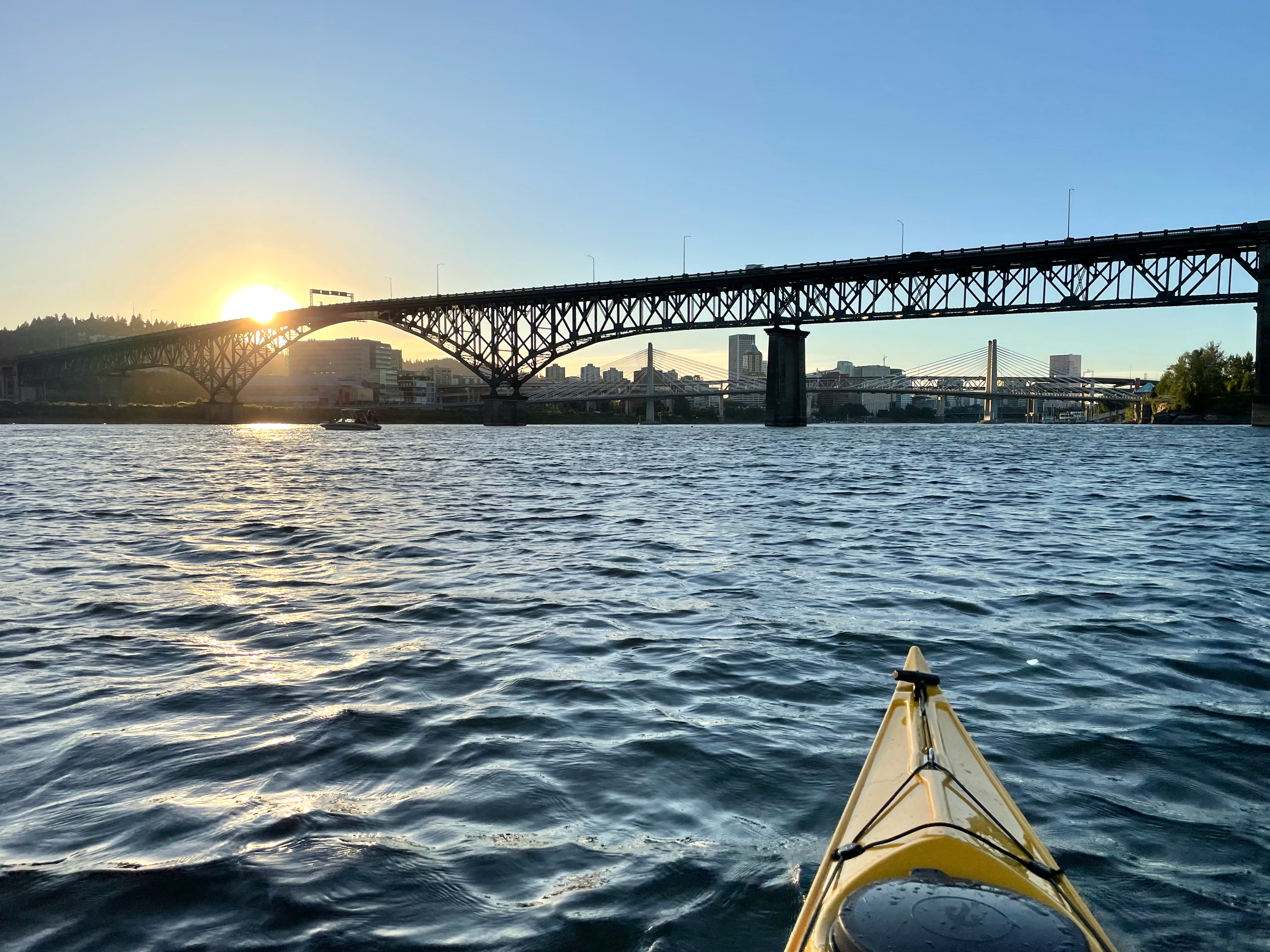
100 years later, a resurgence of interest in Willamette River swimming and much healthier and desirable conditions now beckon Portlanders back into the water, reminding us about what was lost, what has been gained back, and how we must never again take our river for granted.

Willamette River sunset near the former location of Windemuth.

2,000 gallons of ice cream

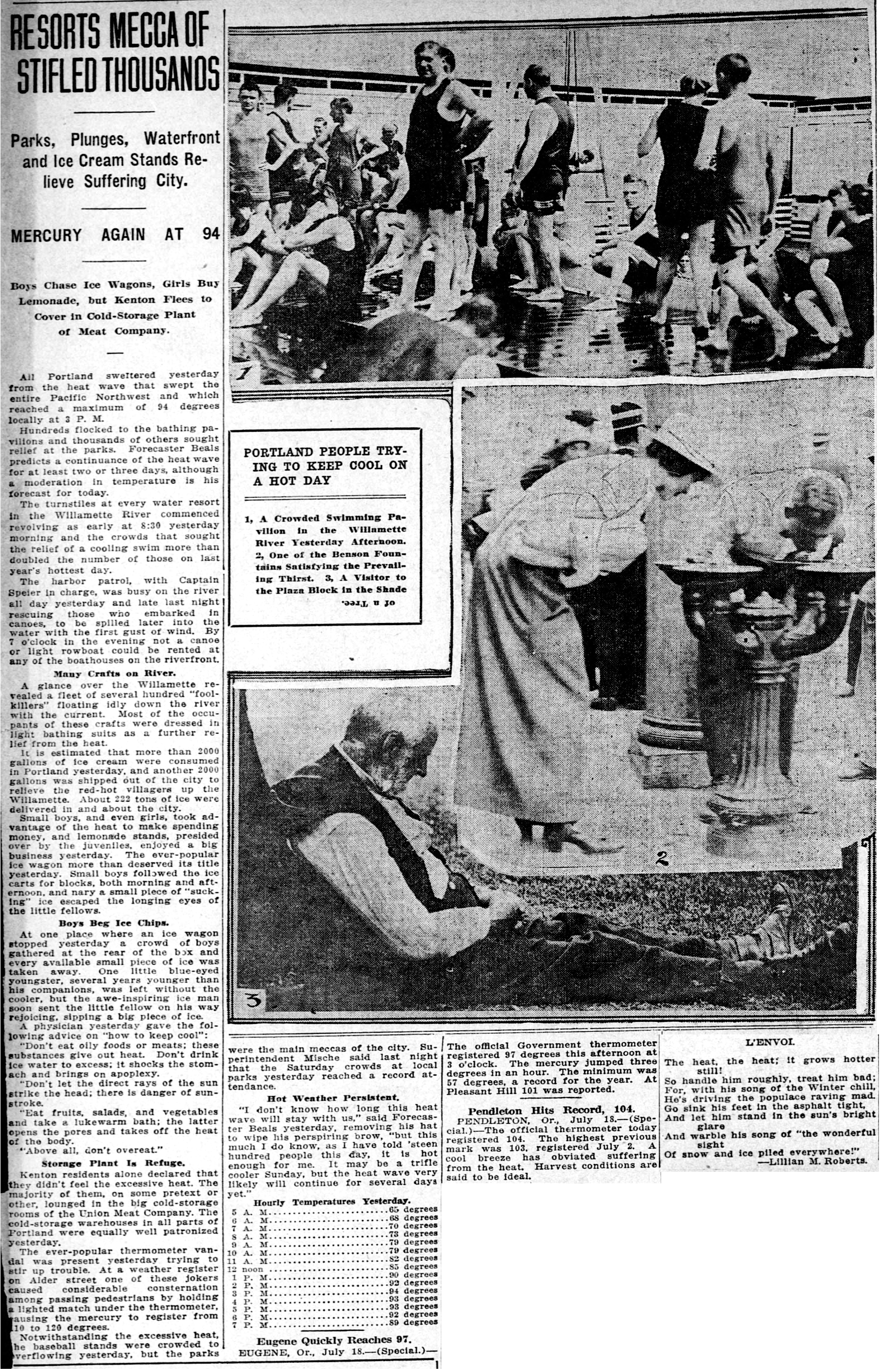
The current heat wave sent us looking for insight about Portlanders’ response to hot summers in history. We know temperatures are hotter than 100 years ago, but hot is still hot, and the community wilts a bit during these intense days. Noticed how much quieter the neighborhoods are these afternoons? We’d gladly exchange this week’s 100s for 94 degrees.

From 105 years ago, here’s how Portlanders managed their hot days, along with advice about what to eat and drink (click to enlarge). We smile at the precision from The Oregonian reporter about what it takes to cool the city. Be sure to appreciate the Lillian B. Roberts poem at bottom right.

And remember these other extremes from not so long ago…

From The Oregonian, July 19, 1914