Epilogue: Gravel Hill 25 years later

It’s been like time travel, studying the discovered photos from 1913 that take us back to the intersection of NE 33rd and Fremont, the giant gravel pit that once defined that hillside, the stairs leading up Alameda Ridge, and the unstable cutbank above Fremont.

Here are two more views of the general vicinity taken 25 years later that show us how the slope was settling after being filled with garbage and soil. Photographed by the Public Works Department on November 21, 1938, these views look uphill and downhill on 33rd from just below the top of the hill. Click in for a good look and then we’ll discuss:
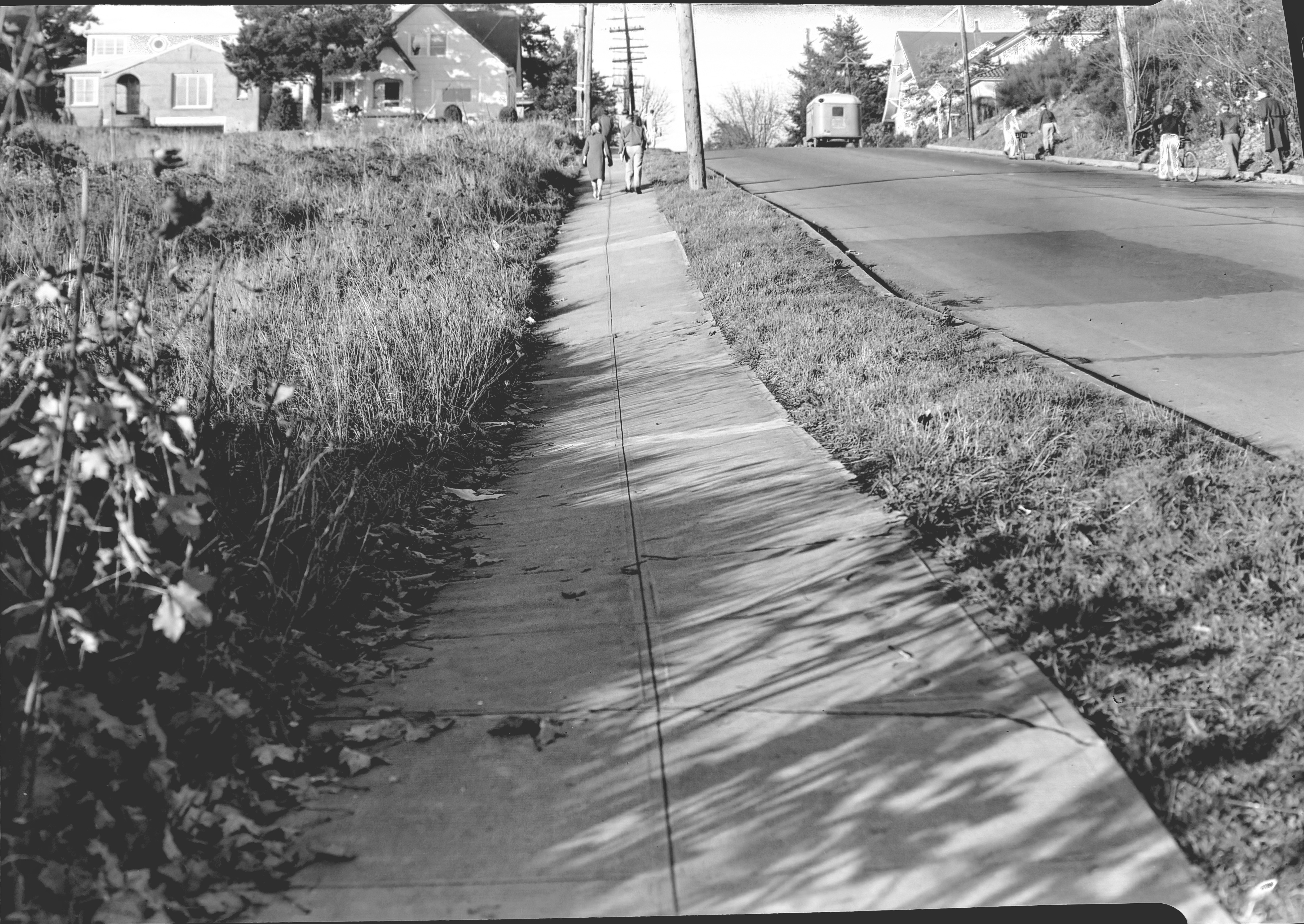
Looking north along the west side of NE 33rd, just downslope from NE Fremont. Image A2009.009.1272, courtesy of City Archives.
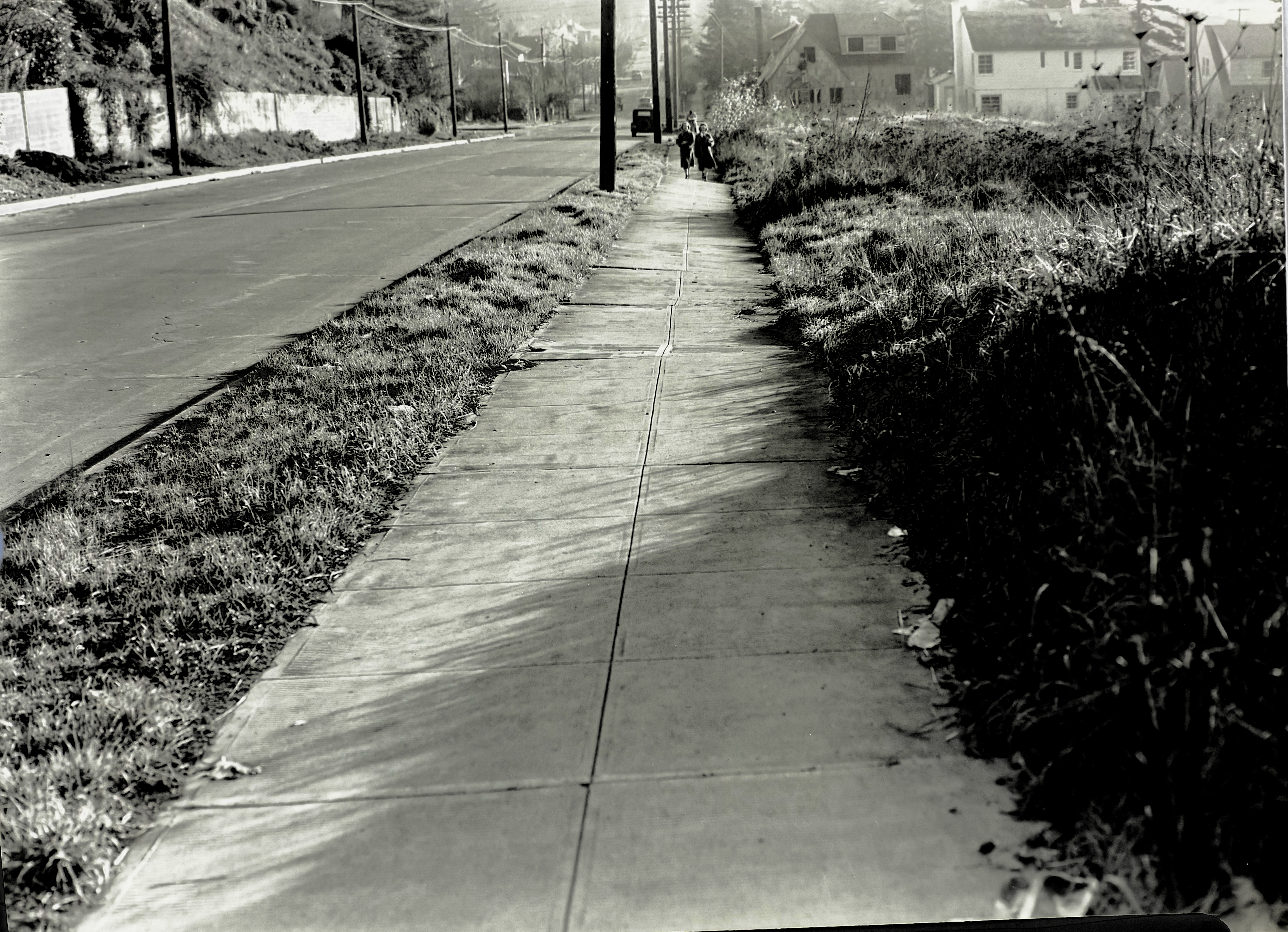
Looking south along the west side of NE 33rd, just downslope from NE Fremont. Image A2009.009.1271, courtesy of City Archives.

Judging by the sunlight and shadows–and what looks like an exodus from Grant High School–these photos were taken in the afternoon of that November day. The uphill photo shows just how much the mid-slope has settled, with the curb and street surface buckling and the entire sidewalk heaving to the west. Nothing has been built on these vacant lots, probably because they were still settling.

Look a bit farther up the hill and you can see two brand-new Ken Birkemeier houses at far left (3279 NE Fremont), perched on what had been the cutbank, and the bungalow to its east at the corner (3289 NE Fremont). Across the street farther east you can see the high-peaked roof of the home at 3304 NE Alameda, and the distinctive tile roof of the Mediterranean-style house at 3301 NE Fremont.

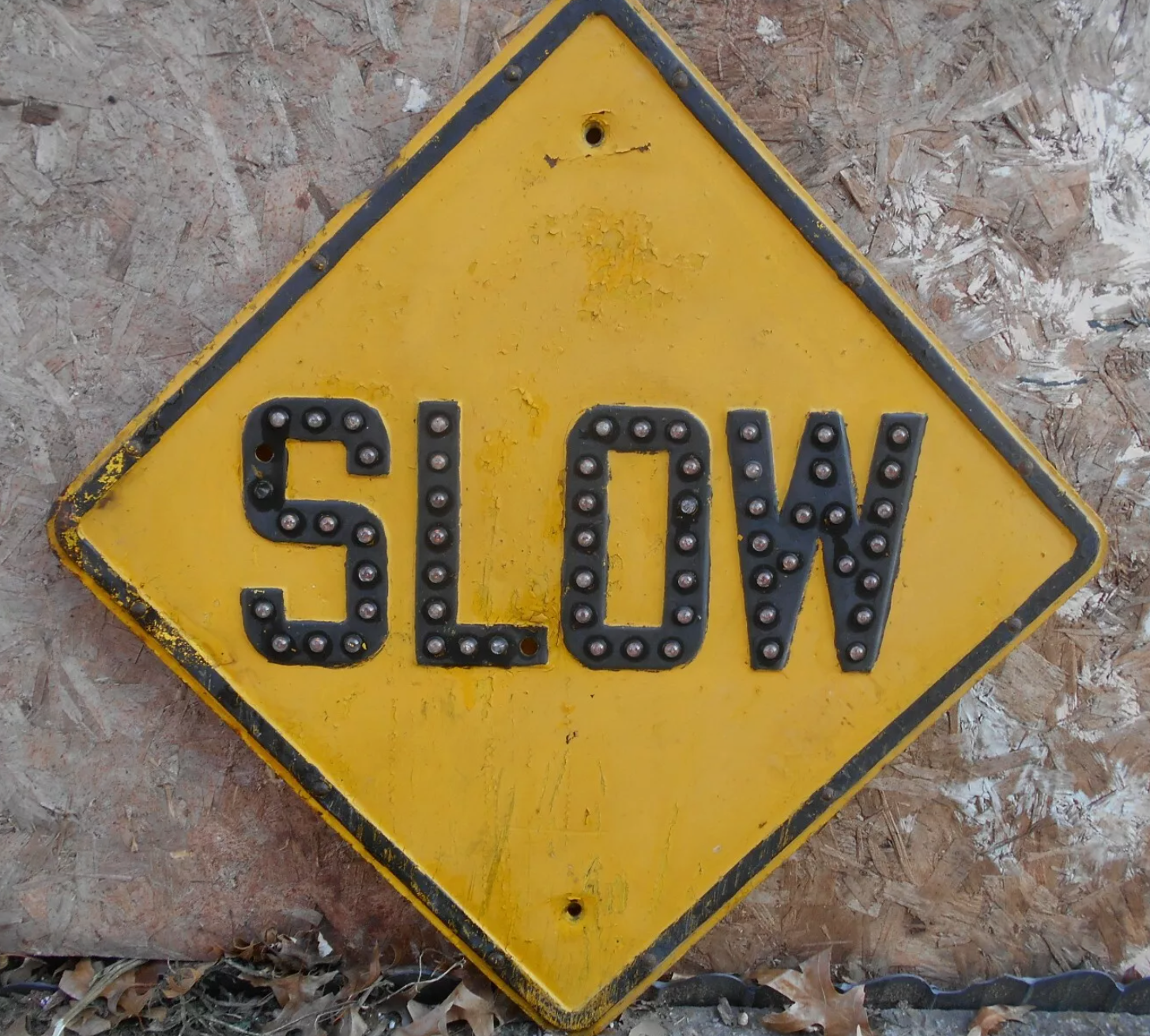
Also interesting to note: no signal light controlling the intersection, nor is there a stop sign facing 33rd (can’t read what is on that sign, but it’s not the standard octagonal STOP sign we know today, which was in common use by 1938). Perhaps Fremont had the stop sign and 33rd had the right of way.

Yet to be built at the top of the hill on the southwest corner was a mid-century home and swimming pool that would eventually collapse into the old pit area and be replaced in the 1990s by a much larger house (and geotechnical engineering). We wrote about it here: The lost house at 33rd and Fremont.

The downhill photo looking south shows just how much the sidewalk wants to fall off into the old pit. Below the pedestrians you can see a house under construction–3289 NE Klickitat, also by Ken Birkemeier who was very busy in this part of the neighborhood during those years.

Today we have Google streetview to document so many aspects of our neighborhood, but it’s been a treat to turn back the clock with these and the 1913 photos. We’re always on the lookout for early photos of our Northeast neighborhoods. Stay tuned for more findings. The promised Columbia Slough photo from 1913 is next.

Post Script: Attentive Reader John Golightly adds his observations that the sign at the intersection probably was a “SLOW” sign, which we agree with. Here’s a photo of a 1930s-era slow sign in its characteristic diamond shape:
In the footprint of Old Vernon

In the spirit of knowing that pretty much everything is connected, we were intrigued to learn of the ties between mid-century modern builder Kenny Birkemeier (1905-1996) and the old Vernon School block south of Alberta between NE 22nd and NE 23rd.

Frequent AH readers will recall the story of Old Vernon (which is one of our favorites), the giant wood frame structure that once occupied much of the block bounded by Wygant, Going, NE 22nd and NE 23rd. It’s a fascinating story of Portland’s early school building challenges, the growth of a neighborhood and the all-too-frequent fate of Portland’s early all-wood institutions. And there’s virtually no trace left even though its impact on the neighborhood during its heyday cannot be overstated. Learning about Old Vernon was a bit like a curtain going up to reveal an entirely different neighborhood that once was.

Readers will also recall that Ken Birkemeier was one of Portland’s most prolific and resourceful builders between the mid-1930s and the 1950s. Dozens of his homes, most with a distinct family resemblance of Roman brick, ornamented brick facades and whimsically placed oval windows, can be found in nearby northeast Portland neighborhoods.

So–you’re wondering–how do these stories connect?

(Spoiler alert if you haven’t already read our piece about Old Vernon…maybe you should go do that first.)

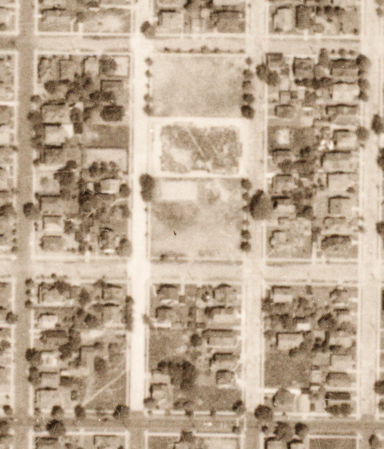
In the aftermath of the big fire, the school district contracted with Rose City Wrecking in March 1933 to haul off the burned remains and to demolish and remove anything else still standing on Block 54, which they did. An aerial photo from 1936 shows the footprint of the burned building and lots of open land.

Detail of an aerial photo from 1936 showing vacant Block 54 and the burn scar / footprint of old Vernon School. NE Prescott runs east-west along the bottom of the frame.

The mid-1930s were not a great time for homebuilding in Portland, so Block 54 sat vacant for a few years. The Great Depression killed the real estate market and tightened down on much of the available money to build or to buy. But gradually the market returned and our resourceful Mr. Birkemeier acquired the entirety of Block 54: all 18 lots.

Our review of city permits, prompted by eagle-eyed AH reader Michael Johnson, shows Birkemeier began building in October 1940 on the south end of Block 54 (2225 NE Going and 4621 NE 23rd, to be exact) and worked his way north. He finished the last of the 18 houses on that block in the winter of 1944 with a pair of duplexes at 2210 and 2232 NE Wygant.

Ken Birkemeier was a talented builder, and an effective marketer as well. Many of his homes from that era were featured in The Oregonian, including photos of the houses and occasionally of him too. But a careful review of past issues from those construction years didn’t turn up anything from Block 54.

So here’s an opportunity for you to go walk along the invisible fault lines of the past, from the long-ago schoolyard, to the brand new block of the 1940s, to the changing neighborhood of today. Make no mistake, change is our constant companion. That’s how it always has been and how it should be.  How we change will explain a lot to the future about what we value today.


Birkemeier always remembered his first house

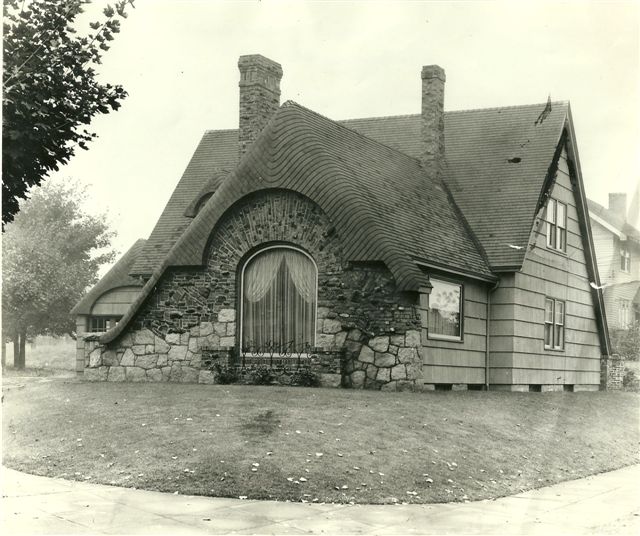
Ken Birkemeier, the prolific Alameda neighborhood designer and homebuilder, always remembered the first house he ever built: a cute little English storybook style home at 829 NE 41st.


Scan (3) (1)

829 NE 41st Avenue. Ken Birkemeier’s first homebuilding project. Photograph is from a 1932 story in The Oregonian about the sale of unused public property. The lot, located on a small peninsula just across the street from Laurelhurst School, had been kept in reserve in case the city needed it for school purposes, but was eventually purchased and developed by Birkemeier.

Birkemeier, whose work has come to signify the best of the Mid-Century Modern movement in Portland, built more than two dozen homes here in Alameda alone, often on steep or challenging lots.

According to homeowner and AH reader Gary Groce, Birkemeier dropped by one day during his later life, sometime in the late 1980s or early 1990s, like a salmon returning back to where it all began. Groce wrote us recently with this account of his impromptu visit with the Mid-century Master.

As I recall, I was outside the house working on something when this largish car pulled up with an older couple inside. They were looking at the house. I walked over to the car and he introduced himself. My impression was that he had recently married this charming woman and wanted to show her the first house that he built. We invited them in and showed them things we had done to restore the house as close to original as possible including the re-acquisition of original art-deco slipper shade lights, etc.

I vividly remember him telling me as he looked at the mahogany beamed ceiling… “when we got the garage up, I used that as a shop and I remember cutting those brackets for the beams on my band saw in the garage.”

I remember him saying, “I used the best materials I could find because I wanted it to be right.”

I lamented to him that the original fireplace façade in the living room had been changed at least twice and that someday, I hoped to restore it to original. He very graciously invited me to his home in the west hills as he thought he might have blue prints, and sketches of the fireplace. I took him up on his offer.  I remember his home being this unbelievable, sprawling mid century modern with a fantastic view.  In retrospect, that home was undoubtedly of his own design and build. Unfortunately, he couldn’t seem to find anything of interest on our house so we just spent our time visiting.

I came away with the impression that this was a very successful, intelligent man who never lost the common touch. Very warm and personable.

In the years following the passing of his wife of 50 years (Marge), Birkemeier married Ramona, who he evidently wanted to see where all the homebuilding work began. Birkemeier died in 1996. The last house he built in Alameda is at 2830 NE Regents Drive (1952).

To read more about Birkemeier’s life and work, check out the profile here on the blog.

With thanks to Gary for sharing this memory.

Ken Birkemeier, Prolific Alameda Builder

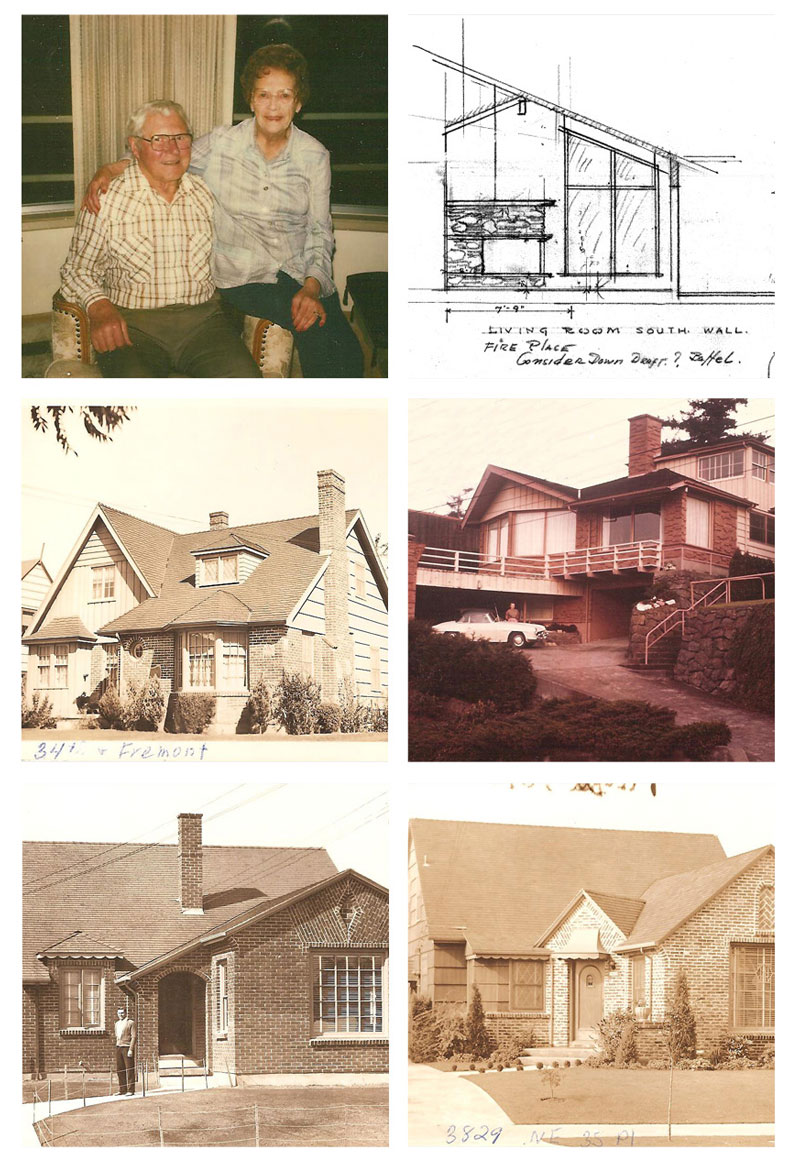
A collection of images relating to Ken Birkemeier. Top left, Ken and his wife of 50 years Marge. Photos and drawings courtesy of Dan Birkemeier.

A collection of images relating to Ken Birkemeier. Top left, Ken and his wife of 50 years Marge. Below, homes he built in the neighborhood. More pictures in The Builders section. Photos and drawings courtesy of Dan Birkemeier.

After a very interesting few weeks of research, correspondence with the Birkemeier family, and lots of walking around the neighborhood looking at dozens of houses he built, I’ve posted some background on local architect and builder Kenneth L. Birkemeier. You’ll find the details (and some more photos) over in the new section called The Builders (click here). It was great to hear memories from various family members, particularly the story from his grandson Dan, who is today an architect in Seattle.

You’ll note that I’m inviting your stories or photos of Birkemeier homes, so let me hear from you and I’ll share them here on the blog.

The new section is up to four major builders now, with dozens more to go. One thought that occurred as I walked around the neighborhood this week is that Irwin, Read and Berkemeier must have known each other. Between the three of them, they designed and built dozens of houses here in the neighborhood…they must have been bumping into each other along the way.

Next on my list is Harry Phillips, who designed and built many of the homes along Ridgewood and Gile Terrace in the late 1920s. I also want to delve into the history behind the reference to the “Town of Wayne,” which is a small plat south of Fremont and between 32nd and 29th.

Inquiring minds want to know: Who was Wayne?