Alameda History Program Scheduled: Saturday October 23

If you’re like us as we turn the corner into fall, we’re mapping out the next few months and trying to fit in all the family goings on, important programs and events we want to be sure to take in.

Here’s one for your calendar: We’re presenting a program on the history of the Alameda neighborhood at the Architectural Heritage Center on the morning of Saturday, October 23rd. It’s an encore presentation of a sold-out program we gave in January of this year, but with some added new research from the last nine months.

The program is entitled “The Alameda Neighborhood: It’s Founding and Early Life.” We believe all who attended enjoyed it, and we certainly enjoyed the many conversations it spawned afterwards.

The Architectural Heritage Center hasn’t posted their fall listing of programs yet, but when they do, you’ll be able to register for the Alameda program on-line. Stay tuned for that. In the meantime, save the date.

Hope you can join us for a trip back through time…

Window Inspiration

We’ve always enjoyed walking the neighborhood and contemplating the many layers of history here in Alameda. It’s also always interesting to see how past and current homeowners have responded—or not—to the history of their homes. Sometimes inspiring; sometimes perplexing.

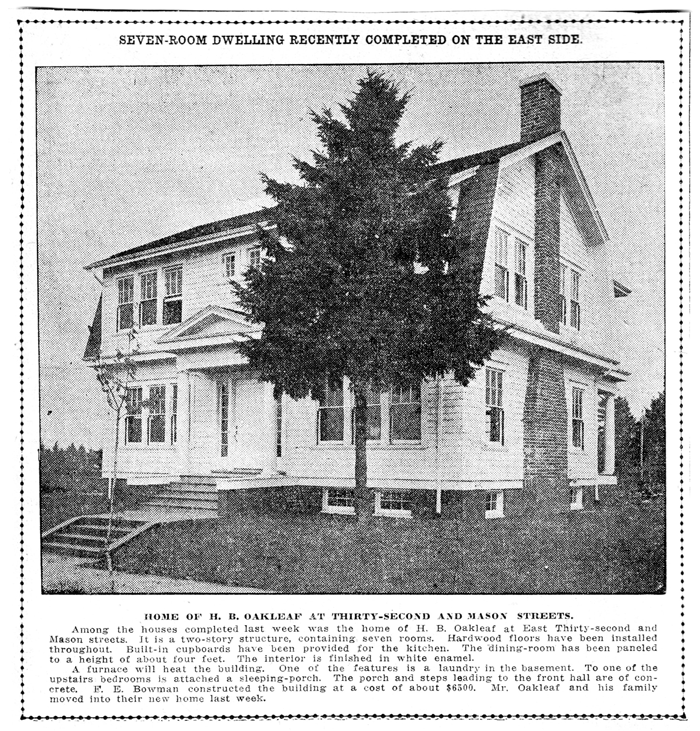
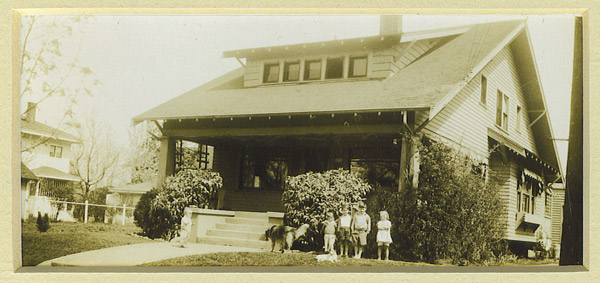
One neighbor at the corner of NE 32nd and Mason has been busy putting things back like they were almost 100 years ago when this Dutch colonial was built by Portland homebuilder Frank E. Bowman.

Constructed originally for $6,500 for H.B. Oakleaf and his family, the home changed hands across the generations and along the way stylistic “updates” and maintenance began to change the look of the home’s exterior. Aluminum siding was put up over the original cedar shake siding. Wooden windows were pulled out in favor of the dreaded aluminum slider windows. Wooden trim, sills and lentil molding were removed. Much of the original charm seen in this photograph — which ran in The Oregonian on September 6, 1914 — was slowly drained away.

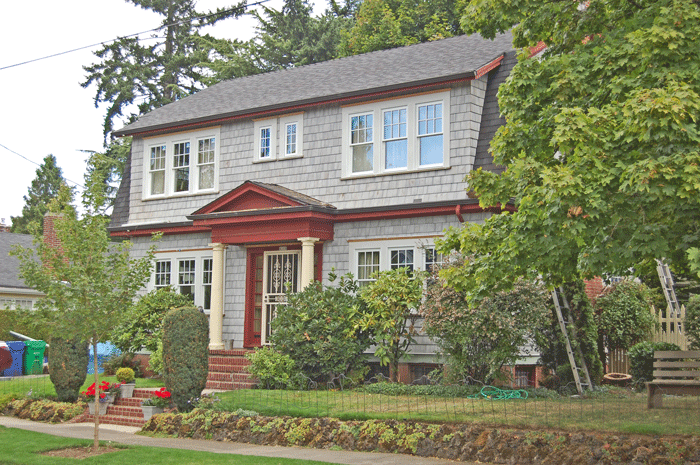
Fast forward to this summer, when Alamedans Steve and Teresa Goodman made good on a long-time goal: replace the aluminum windows with traditional wood windows; remove the 1960s siding and restore the exterior to more traditional cedar shakes.

That’s 36 windows to be exact (wood clad, low-E, double-hung, double glazed and argon filled windows) and if you look closely, complete with lintel molding up top and wooden sills below. Steve and Teresa have been thinking about this since the 1980s, and as Steve says, “better late than never.”

So, if you are looking for a little inspiration about the value of restoring your home to its more traditional roots, walk by 32nd and Mason and take stock. Nice work, Steve and Teresa.

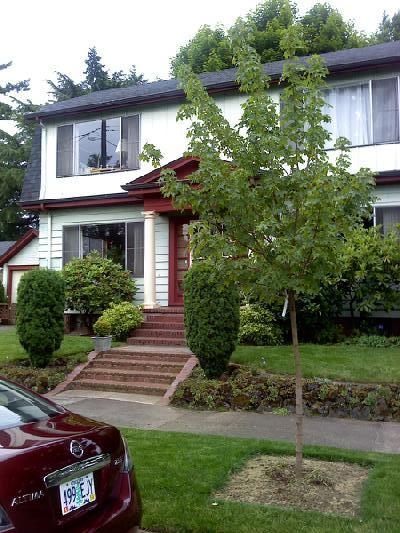
September 10th Post Script: An interested reader wanted to see what it looked like before. I’m sure Steve won’t mind if I share this picture, which he took…

Irvington and Alameda: What’s in a name?

We’ve been listening to a fairly heated conversation this last week about the location of the western boundary of what people think of as the Alameda neighborhood. The debate has been spawned by a pending proposal to create the Irvington National Historic District. The proposal has been in the works for several years and is about to be submitted to the federal list keeper back in Washington DC for final decision. But just recently, some residents in one portion of the neighborhood—known as the “Alameda-Irvington overlap” – have learned their blocks are to be included. Problem is—from the standpoint of some who live there—they aren’t part of Irvington, and they’re concerned about permit review fees and other constraints if they want to undertake exterior house projects. Reasonable concerns.

We won’t focus on the complexities of historic district status, building codes and permit review costs because that’s not our expertise or particular interest (we support the notion of historic districts and feel they are an important tool to conserve the historic integrity of a neighborhood), but we will explore the Alameda western boundary question. Some longtime residents of the neighborhood are more concerned about the historic identity of the area, which is also a reasonable concern. In their view, the proposal overreaches the more logical boundary at NE 24th, which we all know was the location of the Broadway Streetcar. The Irvington proposal would draw the eastern boundary to include the east side of NE 27th Avenue, directly across from Alameda Elementary School.

In the past, we’ve written about the difference between neighborhood boundaries (established by the Office of Neighborhood Involvement), and plats (established by the developer, typically many years ago). Sometimes plat names survive and are part of the identify of a place (as in Alameda). And sometimes they don’t. It’s not an exact science.

What does seem clear to us—and we think this is a compelling point—is that long-time residents we know who have lived in this overlap for 50 years or more have not thought of themselves as living in Irvington, but rather in Alameda.

Never mind that Alameda takes its name from the Alameda Park Addition, a whole other piece of real estate platted in 1909 and occupying the area north of Fremont, south of Prescott, west of 33rd and east of 21st (more or less…the western boundary squiggles around north of the ridge). The “Park” part of our name began to fade from usage in the 1950s (we’d like to see it revived, actually).

To get technical about it, as far as the city is concerned, the overlap area is part of the Alameda neighborhood. And it exists within several plats whose names have been lost to time: Edgemont, Pearson’s Addition, the Bowering Tract. Those plats have been around since the late 1800s, which would be more concurrent with development of Irvington than Alameda (platted 1909). On the other side of the coin, the vast majority of the houses in the overlap area weren’t built until the mid 1920s, much later than most of Irvington and more concurrent in style and feel with Alameda and other plats that people think of today as Alameda.

An hour spent browsing through real estate ads in The Oregonian from the early 1920s is less conclusive. The vast majority of advertisements for homes and lots in the overlap area actually do refer to the district as “Irvington.” Some refer to it as “Alameda Park” which is patently not correct. Some refer to “East Irvington.” Of course advertisements are designed to sell homes and both Irvington and Alameda had a certain cachet that any real estate agent might want to stand next to.

The upshot for us: pushing the eastern boundary of Irvington into an area that has been considered Alameda for generations, that has architectural similarities and patterns of life more connected with Alameda than with Irvington, and that claims a boundary directly across the street from Alameda School, does seem like a reach. Many of today’s residents of the overlap aren’t concerned with historical identity,  but are more focused on the costs and constraints of permit review, and about the public involvement process behind the proposal. Realistically, the proposal looks ready to sail through the final approval process.

Historic district status will help conserve the historic integrity of the neighborhood, no matter what it’s called. But a different neighborhood name that far into what most think of as Alameda does feel like pushing the envelope. Perhaps it could be the Alameda annex to the Irvington Historic District, or the first installment of an Alameda Historic District of its own.

Amazing, isn’t it: the power of a name, a place and a little history.

Vintage Portland Photographs

We’d like to recommend a great local website that will feed your curiosity about Portland history: www.vintageportland.wordpress.com

This excellent site, which launched last November, features a steady parade of high resolution photos that you’ll want to look at close-up for clues to the past and the present. We like to download the photos and then explore them in detail. Look closely and you might see the person in the upstairs window. Or the guy in the distance staring at the photographer from under his fedora. Or the amazing wolf’s head frieze on the cornice of the downtown building.

Taken together they offer a sense of just how much we’ve inherited from the past, how much has been lost, and the importance of recognizing the stewardship role we have at this moment in time to be a bridge between past, present and future.

Keep an eye out there and you might even see a shot or two from the Alameda Park neighborhood! For future reference, we’ve added a link to Vintage Portland on the links sidebar in the lower right side of this page.

Study of Alameda Building Permits Provides Insights

In 2010, we completed a survey through city building inspection cards, collecting information on every home built here in the Alameda Park addition. It’s taken two years and more than a dozen visits to the Bureau of Development Services (which has been very accommodating and helpful), but time well spent, given the insight it offers into the development of the early neighborhood. Everything from the date of construction—it’s interesting to see what parts of the neighborhood were built first—to identifying the most prolific builders, and all of it helps paint a picture of how Alameda Park developed.

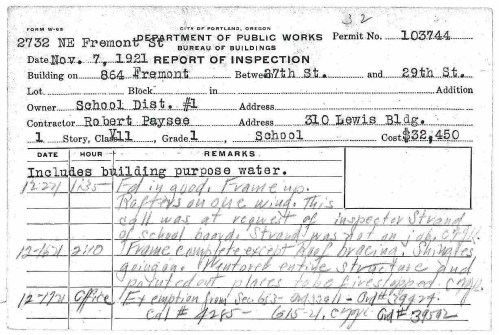
Original building record for Alameda School, taken out on November 7, 1921. Information from more than 1,025 Alameda Park building records were reviewed as part of the study.

When you aggregate the information from the permits, there are some trends and patterns that emerge:

The first observation has to do with the general timing of construction in Alameda Park, from just two homes built in 1909 to a peak of 139 built in 1922. One factor in the timing of this was the ebb and flow of the economy. Strong in 1910, but the infrastructure hadn’t yet caught up. Slow in 1918-1919. Explosive in the 1920s with both a strong economy and demand, and an infrastructure that was truly ready for development.

Building permits issued in the Alameda Park subdivision, by year, 1909-1934. From permit study by Doug Decker, 2010.

By 1934—the end of this graph—about 85 percent of the neighborhood had been built out (the late 1930s and 1940s are a mere trickle of a couple or three homes per year, if that). 1922 would have been an interesting time here in Alameda, with an influx of neighbors. If you haven’t read it, go back and look up our post about the Alameda Park Community Church and the pastor’s desire to bring together new neighbors who were strangers. That was 1922 here in Alameda.

Another observation from the permit study is to have a look at the spread of construction activity to see which portions of the neighborhood were built out first: the areas around 24th and Dunckley; 25th and 26th below the ridge; 29th and Mason; and 32nd Place (then called Glenn) from Mason to Hamblet. These highlighted areas below indicate in general the earliest construction from 1909 to 1912.

It’s also interesting to see who was doing the building during these years. A handful of builders built a large percentage of the homes. The list we’ve compiled below shows total homes constructed in Alameda Park by each of the most prolific builders. Many of these we’ve profiled here, others we’re still working on.

Builder Total Alameda Homes Built Building Activity
Oregon Home Builders 24 homes built 1914-1917
Ken Birkemeier 21 homes built 1932-1952
Harry Phillips 21 homes built 1921-1928
Matot Construction Co. 20 homes built 1921-1926
Frank Read 19 homes built 1923-1941
Nils O. Eklund 17 homes built 1916-1922
Grady Mahaffy 13 homes built 1922-1936
Wickman Building Co. 10 homes built 1921-1923

In addition to the general trends, there are specific sad stories: more houses than you might imagine have had fires (and fire repairs, hence the permit records). A couple of homes were actually struck by lightning. A fad of game rooms, recreation rooms and wet bars were put in during the 1950s, and even an exercise room way back when. Sadly, too frequent removal of trim, built-in shelves and other architectural details in a attempt at modernization (gasp). Interesting to note how many wooden front porches were rotting apart by the 1950s, and a spate of concrete porches and steps poured in replacement.

It’s also clear, when you look at the records, why Portland’s addressing system was changed in the early 1930s. Some of our homes here in Alameda have had three addresses prior to the Great Renumbering (particularly on NE Bryce Avenue) as numbers had to be skootched over to make room for new houses built on empty lots. Let’s just say the original numbering system was less than scientific. You can see this on the actual building permits themselves, where one address has been scratched out and the new one written in. History in the making. It wasn’t scratched out in the example above, but you can clearly see Alameda School’s pre-address change number: 864 Fremont.

Another observation as we completed the study was just how many homes do not have an original building permit. Over the years, for whatever reasons, the City has lost perhaps as many as 20 percent of the original building permits, particularly in the early years. For these homes, we have to rely on original plumbing permits which always give the construction date, but can be sketchy with owner and contractor information.

Regardless, as you handle these permits, some 1,025 in all, you feel time passing through your fingers. You see the clerk typists punching in the details. You sense the contractors standing in line, waiting at a counter wishing they could be back on the job site instead of in the permit office. You witness the many inspectors and their mostly neat observations, drawings, complaints and even sarcastic remarks in shorthand on the 4 x 6 manila cards.

And you can’t help but wonder what it will be like 100 years from now when someone wants to research the history of your house. What story will your house be able to tell?

Rochester’s Lost Neighborhood

If you are as captivated as we are about lining up clues from memory and the geography of the past as a way of understanding the present and thinking about the future, you need to read an excellent series of essays coming out of Rochester, New York in the last few weeks. At turns heartbreaking, insightful, maddening and maybe even hopeful, these posts by the architect and urbanist Howard Decker reveal what happens when a community loses its sense of itself, when it forgets its own stories. There is a cautionary tale here for all of us.

Check out the post on Franklin Square, but be sure to look around at the other posts. Howard’s message to us is that the form of our community tells a story about what’s important to us; that it reflects our values and the choices we make about who we are, what we want to be.

While we struggle with growth and change right here in our own neighborhood and city, a quick look elsewhere can remind us how lucky we are, and what’s at stake as we make choices about the future.

Full disclosure: along with being a terrific urban archaeologist and geographer, Howard is also my big brother. Nice work bro!

Broadway Streetcar Stick-up | A Memory

Here’s a neighborhood memory that brings together a couple of favorite topics we like to wonder about: The open spaces of the early unbuilt neighborhood, and the Broadway Streetcar.

Long-time Alameda Tuesday Club member Terry O’Hanlon checked in with us recently to share these memories. Part of her growing up years – and most of her adult life – has been spent right here in the Alameda neighborhood. During the late 1920s and early 1930s, she and her family lived in the bungalow at 4016 NE 28th.  Here’s a picture:

4016 NE 28th, taken about 1932. Photo Courtesy of Terry O’Hanlon.

The house, built in 1921 by the Wickman Building Company, looks much the same today. As a very young person, Terry remembers playing with the neighbor kids, romping out front with her little white dog, and adventuring around the open spaces and empty lots nearby.

She also has an enduring memory of the night her living room provided a convenient stake-out location for the Portland Police.

A spate of robberies had been plaguing the Broadway Streetcar. As AH readers know, 29th and Mason was the end of the streetcar line, where the conductor stepped outside to switch the overhead electrical connection, flipped the seats so they’d be facing forward, and then took a break before the inbound trip back downtown to Broadway and Jefferson. 29th and Mason was a quiet, somewhat out of the limelight spot – perfect for a motorman’s momentary pause. But also perfect for a stick up. The car, and its accumulated collected fares, was a sitting duck out there in the dark at the end of the line.

That’s where Terry’s living room came in handy: at the time, it provided a perfect view to the end of the line—about one block east—so the good guys could keep an eye out for the bad guys. Look back at the photo: See that empty lot to the left (north)? 20 years later, Kenny Birkemeier would build a house on that spot, filling up that open view to the end of the line.

Here’s something to think about: Watching out your window as all around you a neighborhood is being built up. Elder Alamedans remember this phenomenon well, and some have even lamented the loss of their favorite empty lot, hiding spot, or fort location. It was one of the defining experiences of growing up in Alameda up until the late 1940s. A topic for some future post. But back to the living room and the streetcar stick up…

Terry remembers coming downstairs to a darkened first floor, into a room filled with cops all craning their necks to watch the streetcar when it finally came to a stop. The shock of it all seared that image into Terry’s memory banks for these many years. But don’t ask if her if Portland’s Finest got their man…she’s never been sure about that. The image of her darkened house filled with police soaked up all available memory-making bandwidth for the very young person she was at the time.

We’ve seen news stories from 1920s editions of The Oregonian about a burglar operating in the neighborhood, but have never come across any official telling of the streetcar stick-up to help us know how it all turned out. Chances are the Portland Traction Company, which operated the Broadway car during those years, would have wanted to keep a lid on the whole thing anyway so as to not put every carline in jeopardy.

There are other memories about the end of our car line: about the old man and his German shepherd who used to nap on the lawn of the house at the southwest corner of 29th and Mason, watching streetcars come and go. And the enterprising teenager who “hijacked” a driver-less streetcar parked momentarily at 24th and Fremont. And, what it felt like for some on the last ride of the last day.

So many memories to explore, so little time…

Stuart Drive was once Rugby Drive


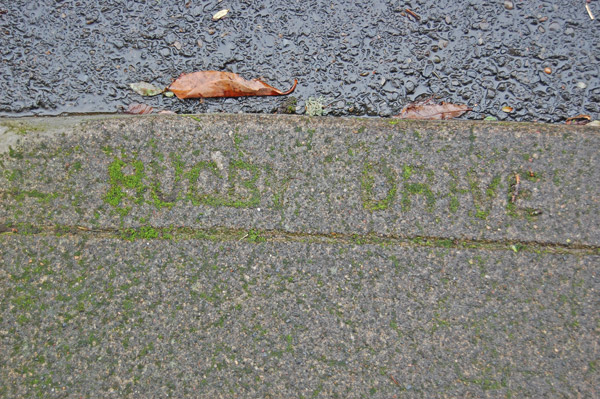
We came across this on a recent walk up Deadman’s Hill (Stuart Drive) from its base. It’s well cloaked in moss, but clearly visible, there on the south side of the street, at the base of the hill, just upslope from the stop sign. Take a look:

Right next to Rugby in the curb is our old friend Elwood Wiles, 1910, the ubiquitous curb stamp across much of Portland’s east side, made by the prolific concrete contractor and former Alameda resident.

We’re sensitive to names because they are signposts to history, but Rugby is a new one on us, not encountered on many trips through Polk City Directories, the Federal Censuses, old news articles, legal proceedings and other documents stemming from the Alameda Land Company. Elsewhere on this site, you’ll find a handy reference about other neighborhood street names. But no Rugbys encountered in pursuit of those stories either. Recently we sorted back through the city directories from 1900-1920 looking for any Rugby, but no luck.

And just for the record, Portland did have another Rugby Street–a short section of street located in Willamette Heights–which was renamed NW 34th Avenue during the Great Renumbering of the 1930s.

To be clear: the original plat for Alameda refers to this as Stuart Drive, even though there is no curb stamp that names it so (the original one may have been at the top of the hill on the north side of the street, perhaps obliterated from curb repairs). So Rugby joins Glenn and Laura as mysteries awaiting solution. Any ideas?

Always on the lookout for a little mystery like this. Seen any lately?

Thanks AHC

Our presentation this weekend at the Architectural Heritage Center turned up some helpful leads into Alameda stories.  We were there to offer a presentation about the development and early life of the neighborhood and were pleased to see some familiar faces, including Maryon Kinsey, who is featured here on the blog. Afterwards, several neighbors approached us to share suggestions and ideas for further research. Thanks!

Our sister Bonnie Hull, the talented Salem artist and art blogger (be sure to visit her blog, which often features detailed profiles of local artists, a feature she calls “Living the Creative Life“) was in attendance and provides a very nice glimpse into our AHC program. Check out her reporting here. Thanks Bon.

We’ll likely be offering the program again at AHC—perhaps in the summer or fall—and  who knows maybe other places too…open to suggestions or invites.

Davis Dairy Store Remembered

From time to time we like to plumb the depths of memory for stories about neighborhood businesses. This one is reaching a ways back, but we’re looking for a little help with any personal memories about this store, which operated out of the bustling commercial corner of NE 30th and Killingsworth.

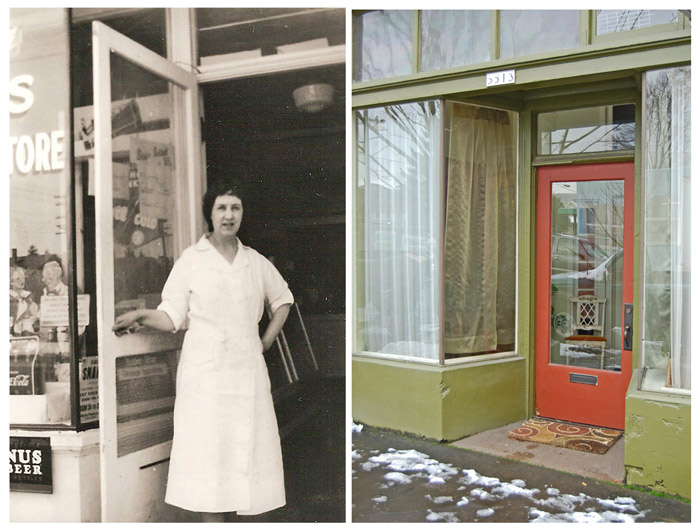
The Davis Dairy Store, located at 5513 NE 30th, was operated by three generations of women from the Davis family, who also built and lived in the home at 2427 NE Dunckley here in the Alameda Park addition. A recent visitor to the blog—Teresa Roth—sent us some shards of memory from her mother Lucille, and some photographs to ponder. Here is Lucille’s mother Irene Davis, the matriarch of the store, standing near the open door in 1938, and the same spot today:
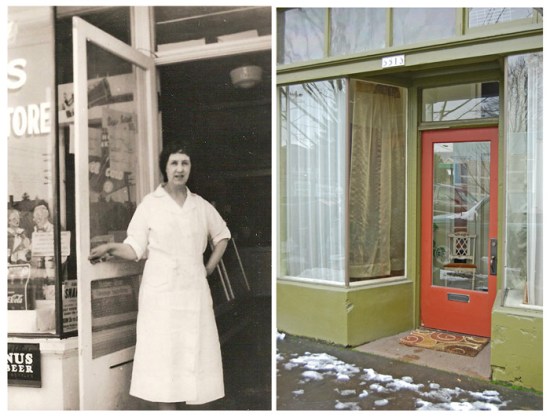
Left, Irene Davis at the Davis Dairy Store, 5513 NE 30th Ave., 1938. Right, the same doorway today. Historic photo courtesy of the Davis Family and Teresa Roth.
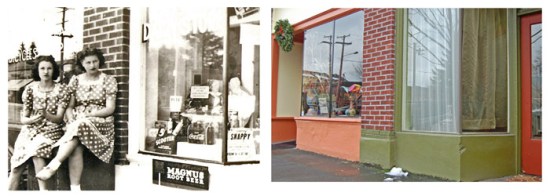
 

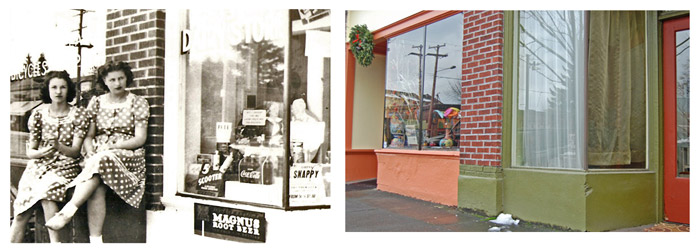
Irene’s daughter Lucille (far left) and cousin Isabel Buckendorf sitting out front in 1938. Note the words “bicycle shop” on the window behind them to the left, and the reflection of the power pole, which hasn’t moved much in 70 years. Historic photo courtesy of the Davis Family and Teresa Roth.

Irene and her husband Ernest built the Dunckley home and likely the business as well, though he was a machinist and she a stenographic secretary. The couple divorced in the mid 1920s. For as long as the couple’s daughter Lucille can remember, the store was just part of the family. Lucille, now in her mid 80s, and her daughter Teresa stroll through the neighborhood from time to time when they are in town together, remembering friends, cousins and happy moments.

After the divorce in the mid 1920s, Irene ran the store, with Lucille’s help during the summer, and likely with the help of her sister Mae, a piano teacher. Irene and Mae’s mother Martha LeFabre lived with them as well in the Dunckley Street house: three generations running the house and the business.

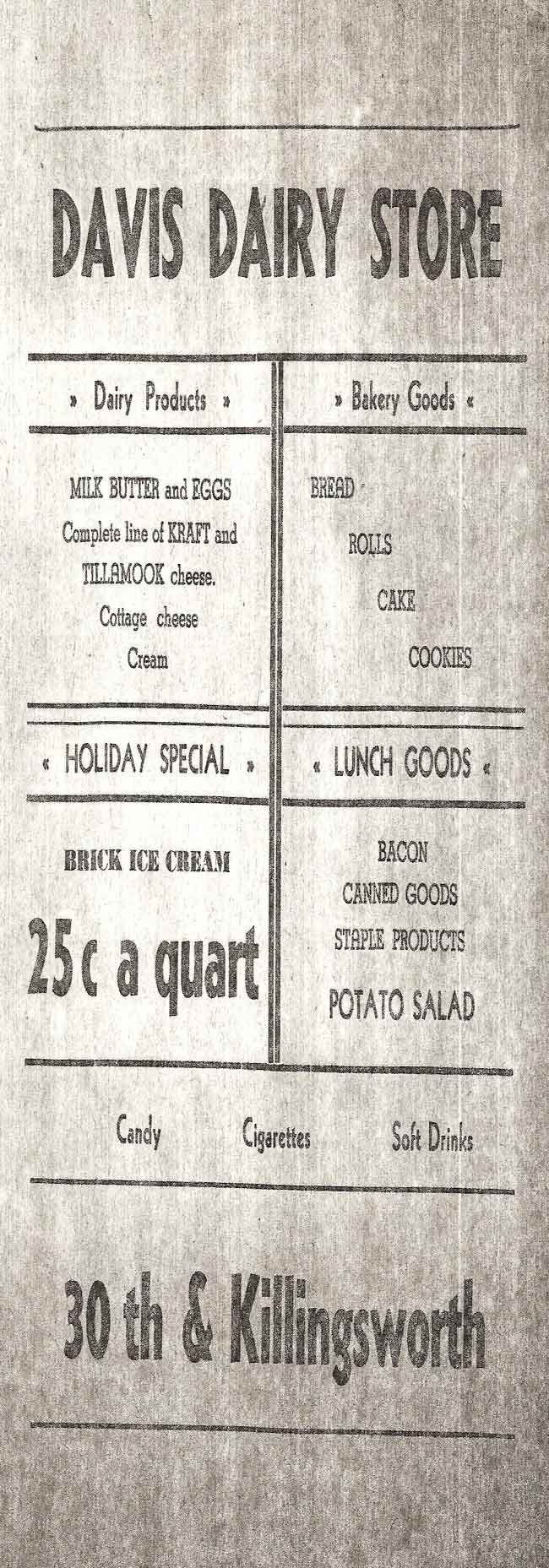
No one around today remembers exactly when the store opened or closed, but we do know it would have been popular with kids. Here’s an advertisement from 1938.
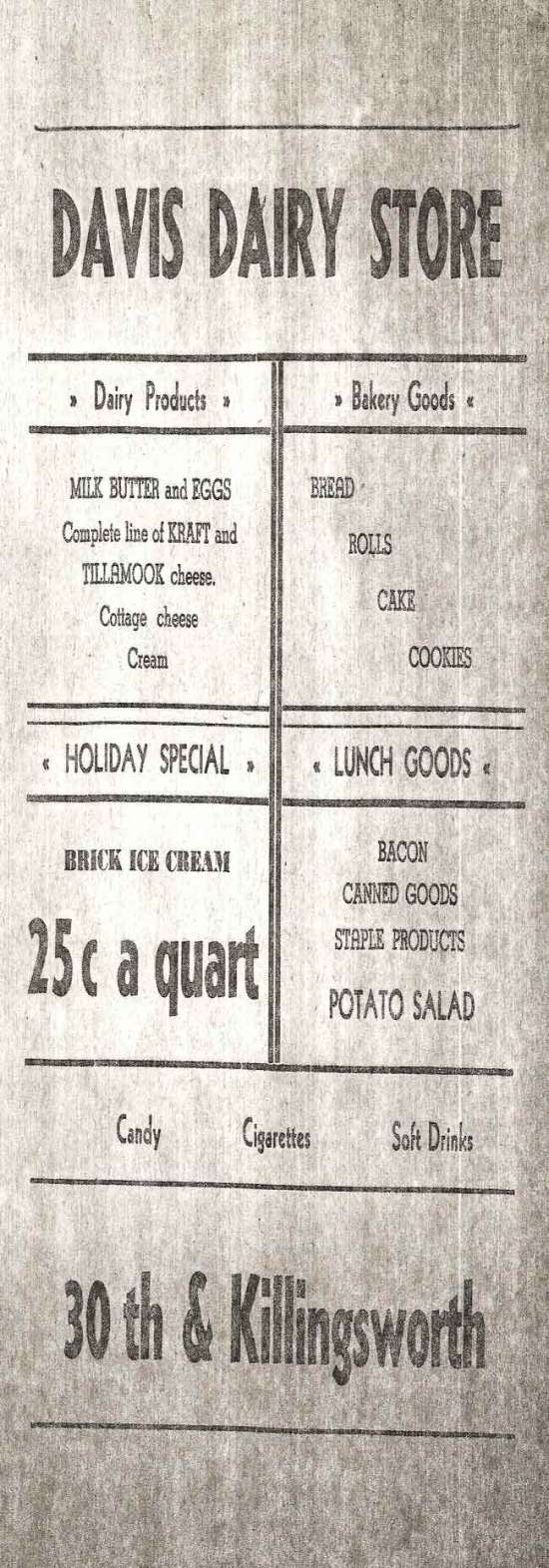
Flyer from Davis Dairy Store, 1938. Courtesy of the Davis Family and Teresa Roth.

The corner of NE 30th and Killingsworth has experienced a recent renaissance that echoes the vitality of the intersection in the 1920s and 1930s. Today, the area is officially known as the Concordia Neighborhood, though in those days it was known to both residents and customers as Irvington Park and many refer to it by its plat name: Foxchase. Just for context, here’s a shot of the overall commercial building today, which features some very tasty restaurants, including DOC, which we recommend.
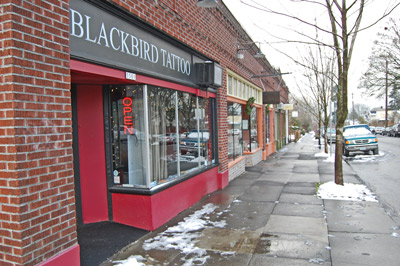
Any memories to share about the Davis Dairy Store or this bright and busy neighborhood corner?

According to the 1938 Polk City Directory, joining the Davis Dairy Store at 30th and Killingsworth were the following businesses:

5425 NE 30th             Serafino Boitano Shoe Repair

5425 NE 30th             Parrot Cleaners

5430 NE 30th              Jason Frost Grocer | Theo Larson Meats

5433 NE 30th             Anderson’s Food Market

5438 NE 30th              30th Avenue Pharmacy and Post Office

5501 NE 30th             The Ark Beer Parlor

5507 NE 30th             Irvington Park Variety Store (now Blackbird Tatoo)

5509 NE 30th             30th Avenue Bicycle and Hardware

5515-19 NE 30th        Twin Pines Barber and Beauty Shop