Needle in a haystack: Finding one old photo

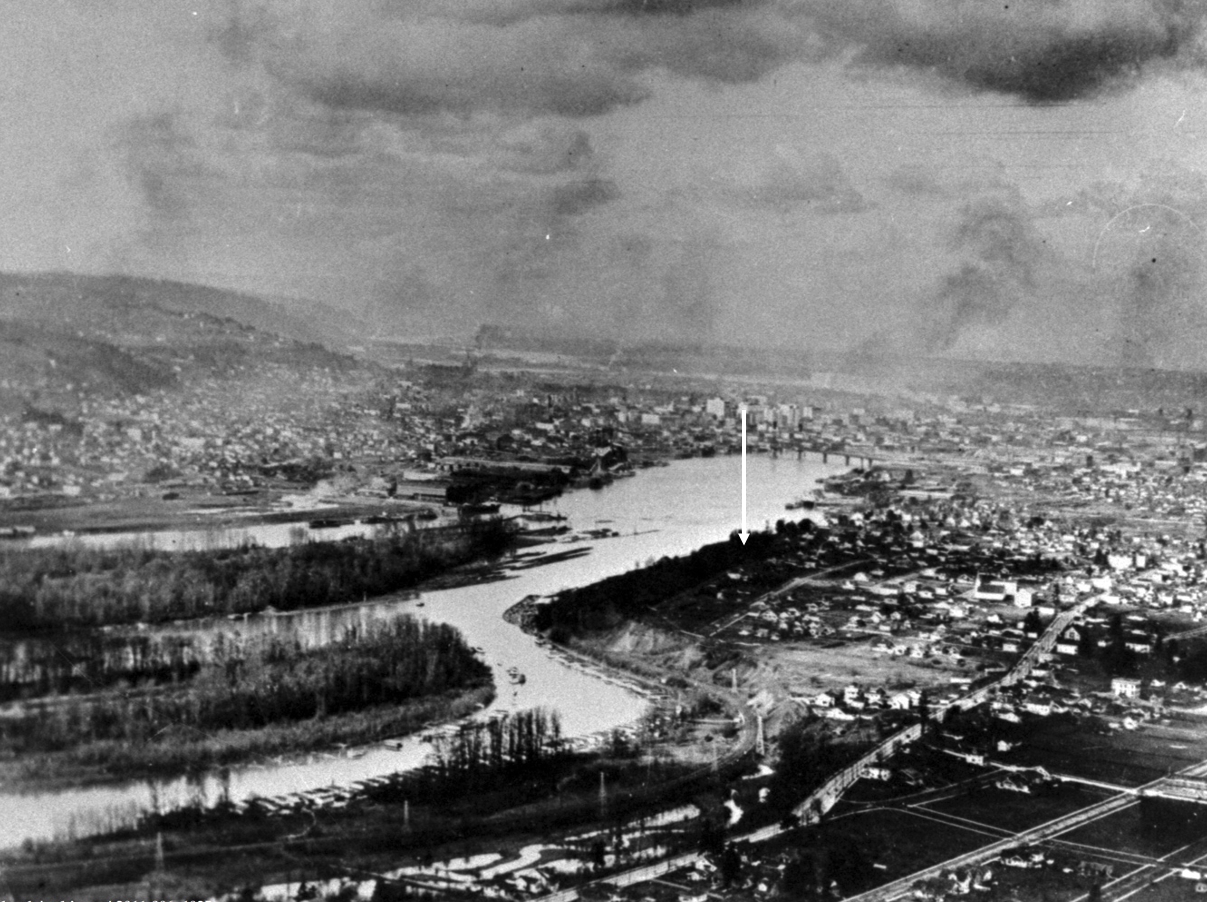
Looking north through southeast Portland and along the shoulder of Ross Island, about 1925. The arrow shows the approximate location of a house somewhere in the mist we wanted to know more about. Image courtesy Portland City Archives, A2011-006.

Sleuthing old photos to determine location, context and insights is a favorite thing to do; the Photo Detective category here on the blog is testament.

But sometimes, the biggest mystery is just finding the old photo.

Such was the case recently when a reader wrote seeking an assist in locating a photograph of a house fixed in childhood memory from the 1950s: his grandparents’ home on the bluff above Ross Island, torn down more than 50 years ago to make room for McLoughlin Boulevard. No known photos of the house had survived.

But in his memory, a version of the house was still there. Burnished over the years and important because it was a house that contained the full arc of life for people he cared about who were also gone. Maybe by having a photo of the house, he could call them to mind, and consider his own experience there as a small person.

When researching houses for clients, we’re always looking for old photos, but there is no single source or easy way to do this. In Portland, it’s worth following your address back through old copies of The Oregonian and the Oregon Journal to see if there is a photo from an advertisement or some random mention over the years. You’d be surprised, it does happen.

Another potential source is Portland City Archives, which has a deep collection of public works, traffic study, zoning study and “stub toe” photos that might include an incidental catch of a place or building of interest somewhere in the background. You can use the search tool called efiles to search by intersection or street.

The stub toe photos are an interesting subset, documenting sidewalk tripping hazards for liability reasons and occasionally catching a house of interest in the background.

The Oregon Historical Society Library has collections of neighborhood photos that are always worth looking through: you might find something you didn’t even know you were looking for.

There are aerial photos too, some of which are available through City Archives, and others through the University of Oregon Library’s Aerial Photography Collection. Dating back to 1925, these images are mostly low resolution and grainy, but good enough to help address larger-scale mysteries. Examining the same place from the air every 5-10 years back to 1925 is fascinating and always humbling to see all we’ve missed and don’t know about a place.

An advanced aerial photo function within the indispensable research tool Portland Maps allows a year-by-year look back to 2006 and then in some cases back to 1948. And of course there is Google Streetview.

But the best sources with the best pictures are always private collections, as in family photo albums and attic shoe boxes of photos, which are also the most challenging and rewarding to find. But that’s another blog post. 

Long before construction of McLoughlin Boulevard, the remembered house on the bluff had a Grand Avenue address, and stood on the east side of the street at the corner of Haig. Back in 1912, Grand Avenue was never intended to be a major thoroughfare connecting downtown and the central eastside with outer southeast Portland. Think: quiet, meandering neighborhood street.

Early on in the search, we used aerial photos and Sanborn maps to understand how Grand Avenue has changed. It once followed a slow, looping route along the high bluff to take in the views of the Willamette River to the west, calling to mind the way in which SE Sellwood Boulevard edges high above Oaks Bottom today. In the river just downslope from the house was the north end of Ross Island, with views straight at Bundy’s Baths and Windemuth.

It wasn’t until the late 1930s and early 1940s that Grand Avenue was widened and McLoughlin Boulevard first opened. Given growth in all parts of southeast Portland and northern Clackamas County—and the rise of the automobile in everyday life—traffic volumes began to increase and congestion followed. The Oregon Highway Commission was under pressure to “fix” the problem. By the mid 1960s, traffic engineers with the State Highway Division knew that widening of McLoughlin to six lanes—which had become Pacific Highway East, Route 99E—would be necessary, dooming the former neighborhood street.

By then, the remembered family in the remembered house were gone and the sense of that former neighborhood as a quiet place to look out over the river below was quickly slipping from living memory.

That’s when the studies began: land use studies, traffic flow studies, engineering studies. Surveyors out on the ground taking measurements, and–fortunately for us–taking pictures. And that’s where we were able to pull this house back to life from one sunny Wednesday afternoon in June 1965, through the lens of a traffic engineer. That’s it there on the right, the Craftsman bungalow, dormer facing west. Click in for a closer look.
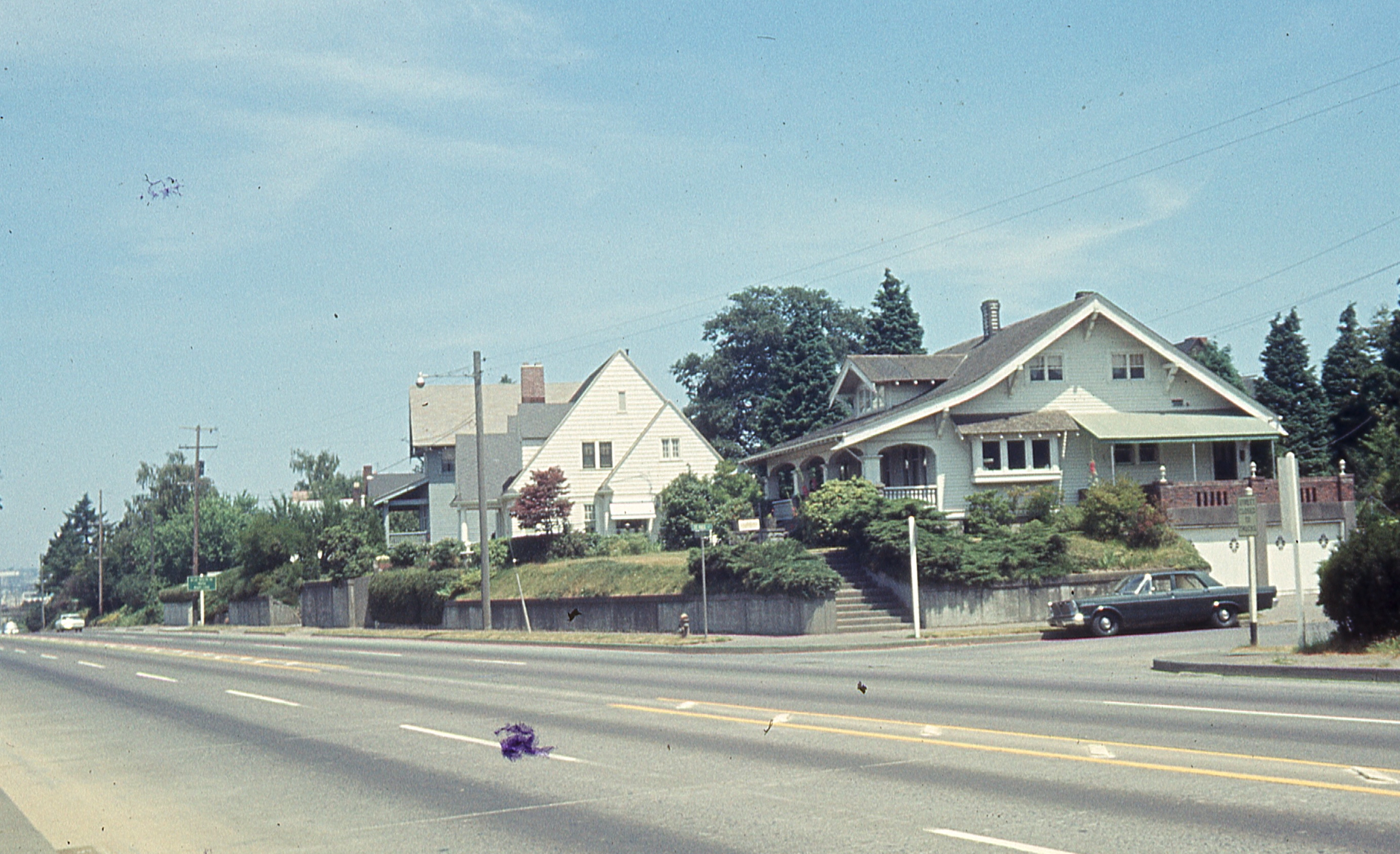
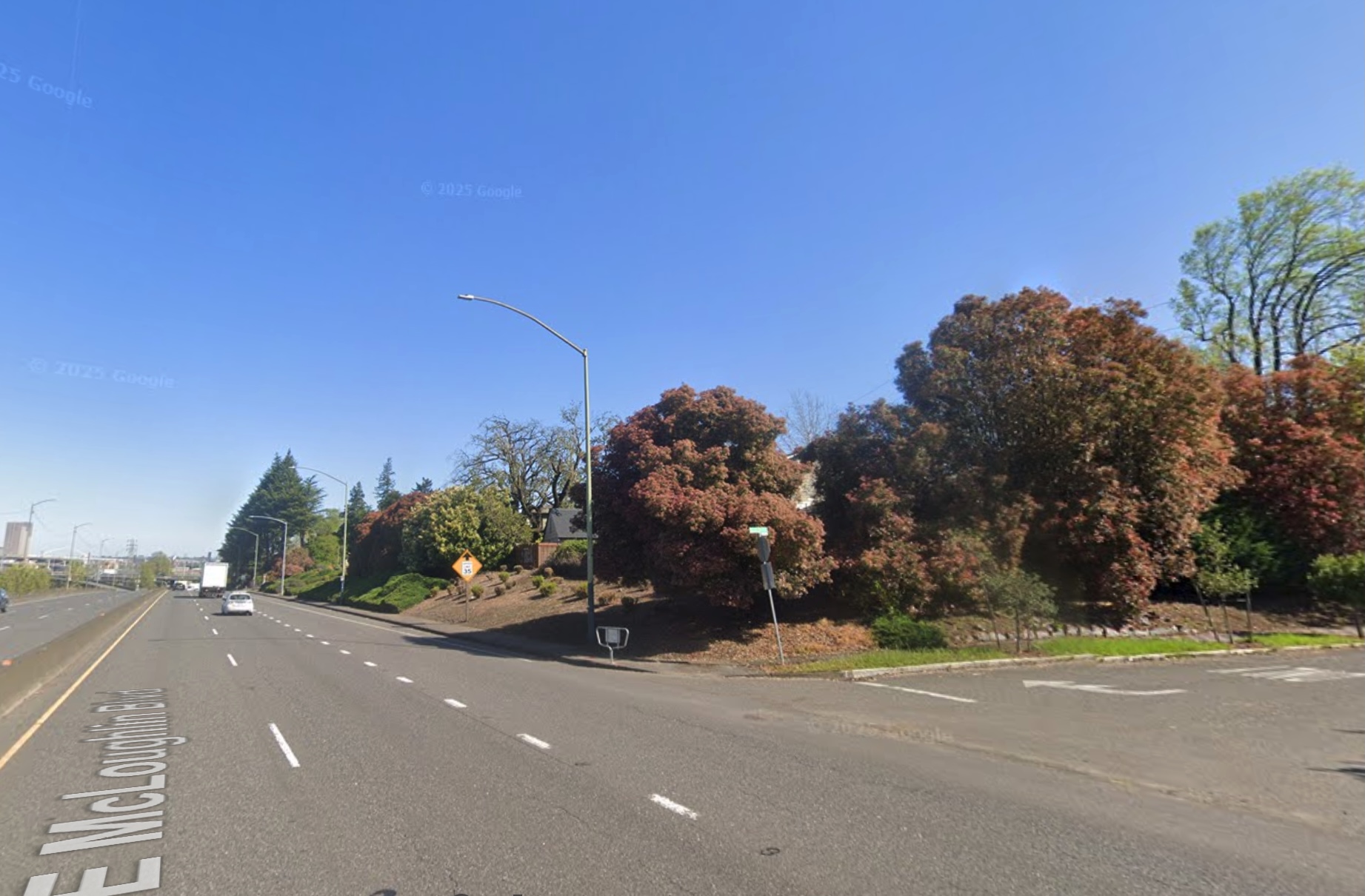
The former 670 Grand Avenue, a story-and-a-half bungalow built in the spring and summer of 1912 by Benjamin F. Doty, a well-known Portland homebuilding contractor and as it turned out father of the young newlywed who lived in this house for most of the rest of her life. This house and nine other adjacent homes from the old neighborhood were torn down in 1970 to make way for another lane of traffic on McLoughlin Boulevard. Below: the same view today (thanks to Google Streetview).

How does the photo compare with the memory? Maybe an unfair question since how does memory ever compare with anything, but we wanted to know. Certain things were familiar.

But just having the photo created a perch from which other memories and imaginings and questions could now rise. And for an old house researcher like us, it felt like finding the precious needle in the overwhelming haystack.

Walking to San Francisco

One of the nice things about a visit to Portland City Archives is the serendipity that comes from hanging around with lots of old documents.

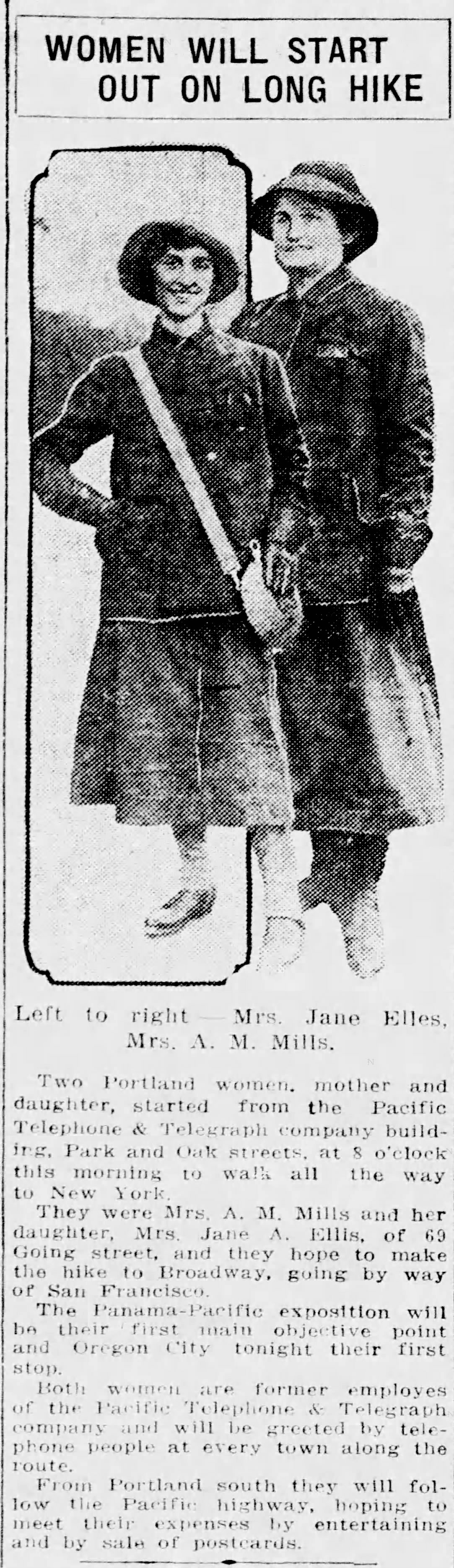
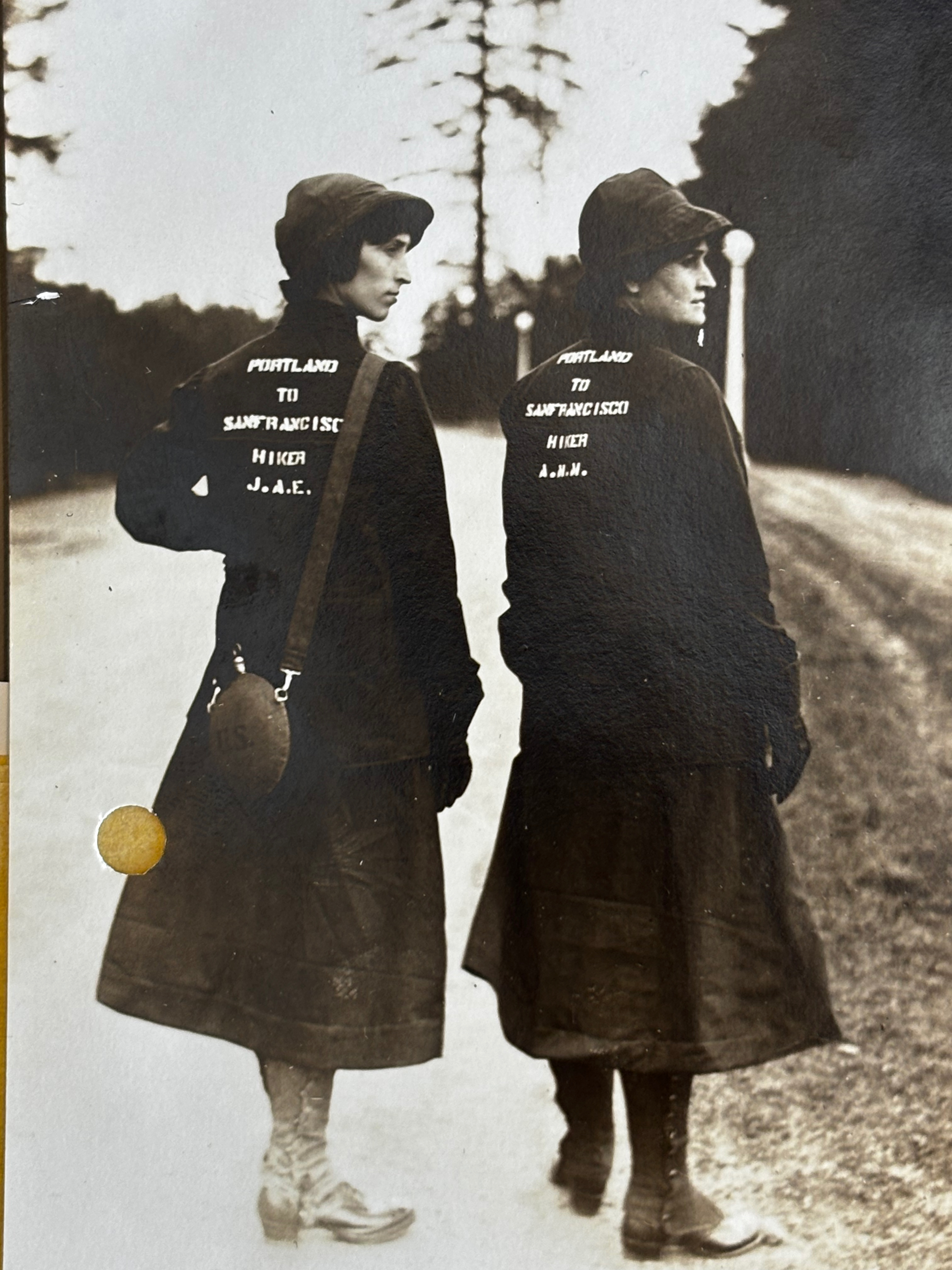
You go in looking for a report related to Willamette River water quality in the early 1900s (which you find), and you bump into a folder of 1914-1915 correspondence from Portland Mayor H. Russell Albee that includes a photo of a mother and daughter, eyes fixed on the horizon, starting out on a big walk from Portland to New York via San Francisco.

For us, serendipity often begins with a photo.

In March 1915, Jane A. Ellis (left, age 25) and her mother Anna Metkser Mills (age 47) prepare to walk from Portland to San Francisco in 40 days. Photo courtesy Portland City Archives, a2000-003.

Walking from Portland to San Francisco and then to New York?

We found carbon copies of eight letters in Mayor Albee’s “Walking Trips” file, all addressed to whom it may concern, as credentials for walkers setting out from Portland in twos and threes, each for different reasons, headed somewhere else: Helena, Montana, Los Angeles, San Diego, Phoenix, New York City. About the same time Jane and Anna set out, three Italian immigrant men left Portland to walk the entire borders of the United States. They too carried a letter from Mayor Albee.

Many of the West Coast walkers were bound for the Panama Pacific International Exposition, San Francisco’s turn at something like the Lewis and Clark Exposition Portland hosted in 1905. Plus, long distance adventure walking was definitely a thing in the middle 19-teens.

As is our custom, we wanted to know more, so we turned to genealogy and the newspapers for insight, where the plot thickened and we got to know this mother-daughter duo a little better. In addition to being walkers and experienced outdoorswomen, they were talented storytellers, musicians and dancers, and as we came to learn, Mother Anna was pretty good with a gun.

First, some basics: Anna Metsker Mills was born in Indiana in 1868 and came west with her husband John. They had three children in Portland: Veta, two years older than Jane, and John, two years younger. In a double tragedy of tuberculosis, Veta died at age 16 and John died at 17. Anna and John’s marriage soon ended, bonding mother and daughter, who both worked for Pacific Telephone and Telegraph Company in Portland.

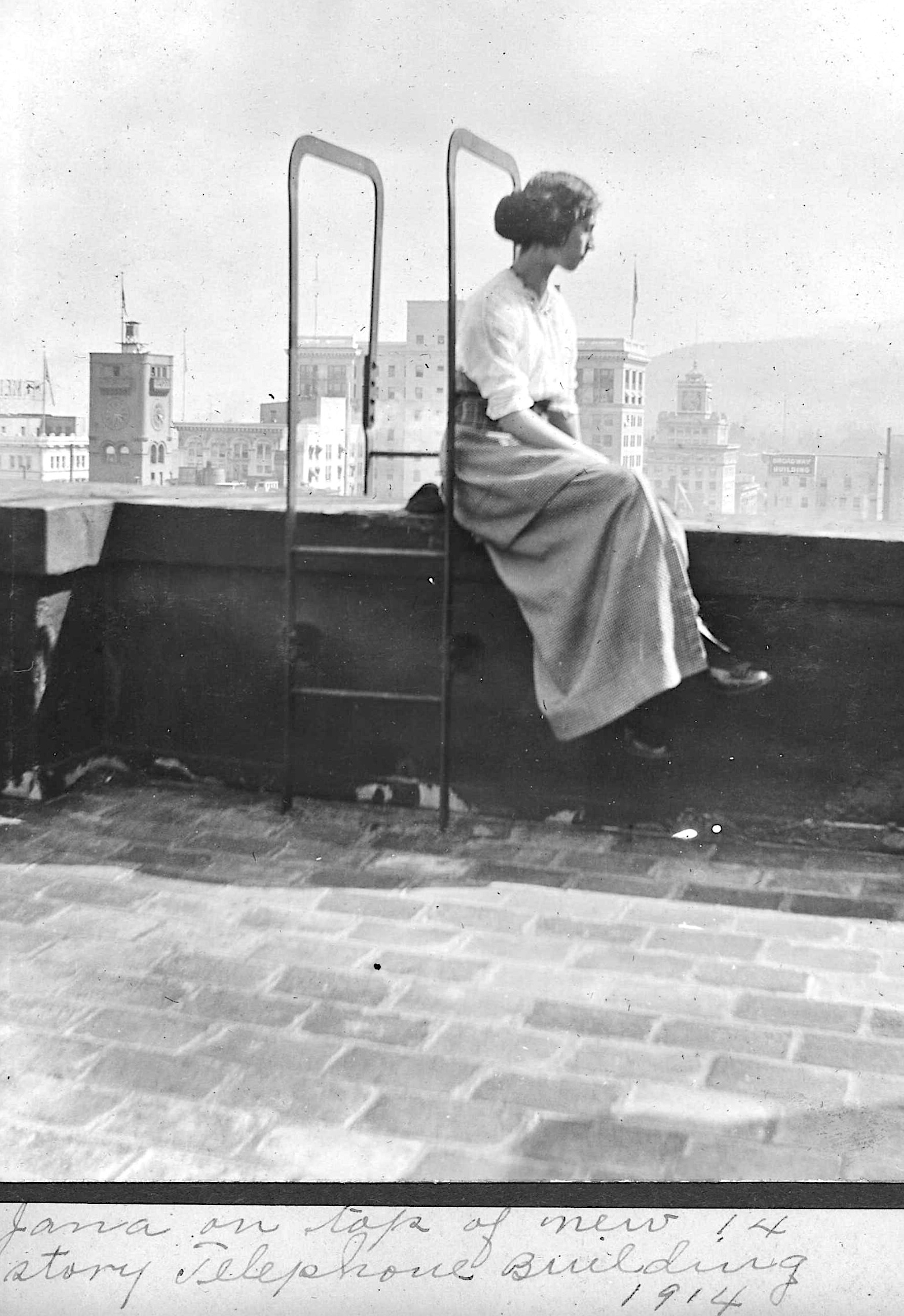
Here’s a photo we found in a genealogy database of Jane in 1914, the year before the walk, atop the brand new Pacific Telephone and Telegraph Building downtown at SW Park and Oak. She was 24.
Source: Ancestry.com

By the time Jane—who also sometimes went as Jana—joined her mother for their walk in the spring of 1915, she had lost both of her siblings to tuberculosis, seen her parents divorce, been married at age 17, divorced, and had borne two children, one died at birth and the other was seven years old during the spring of the big walk, living with his single father—a real estate broker—in  southeast Portland.

You get the picture: these were two resilient people who had known deep loss and sacrifice. You can sense the steel of them from that first photo.

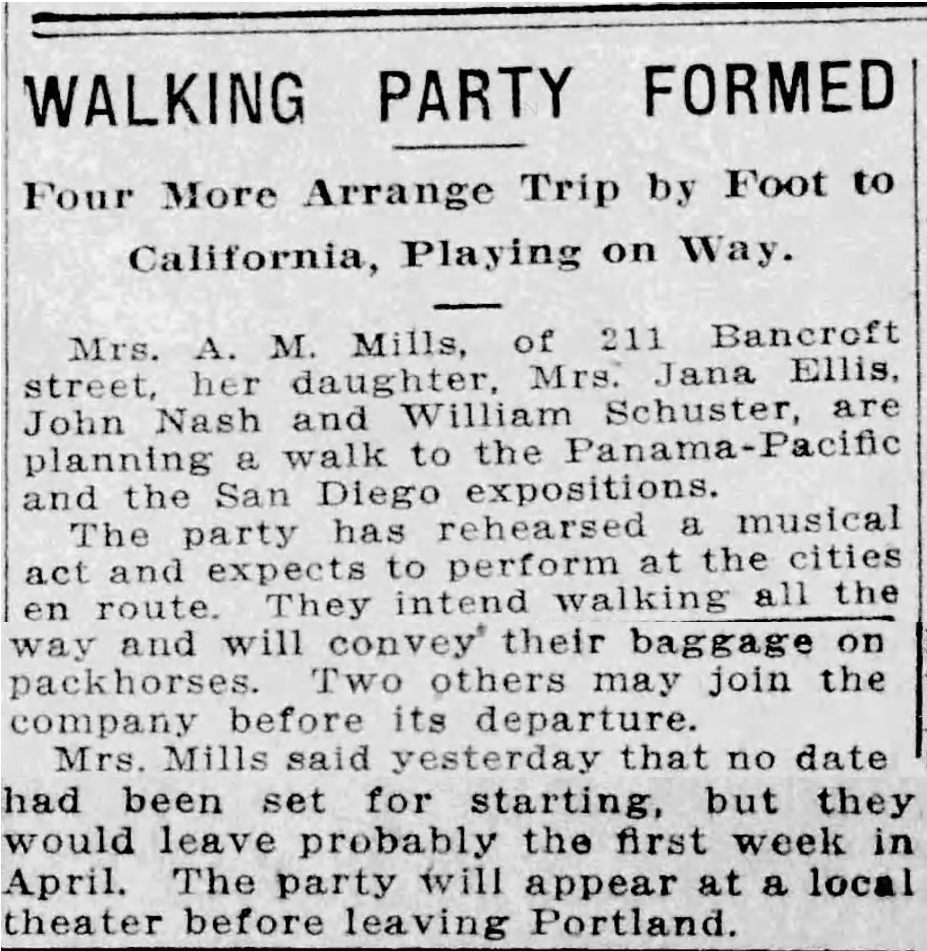
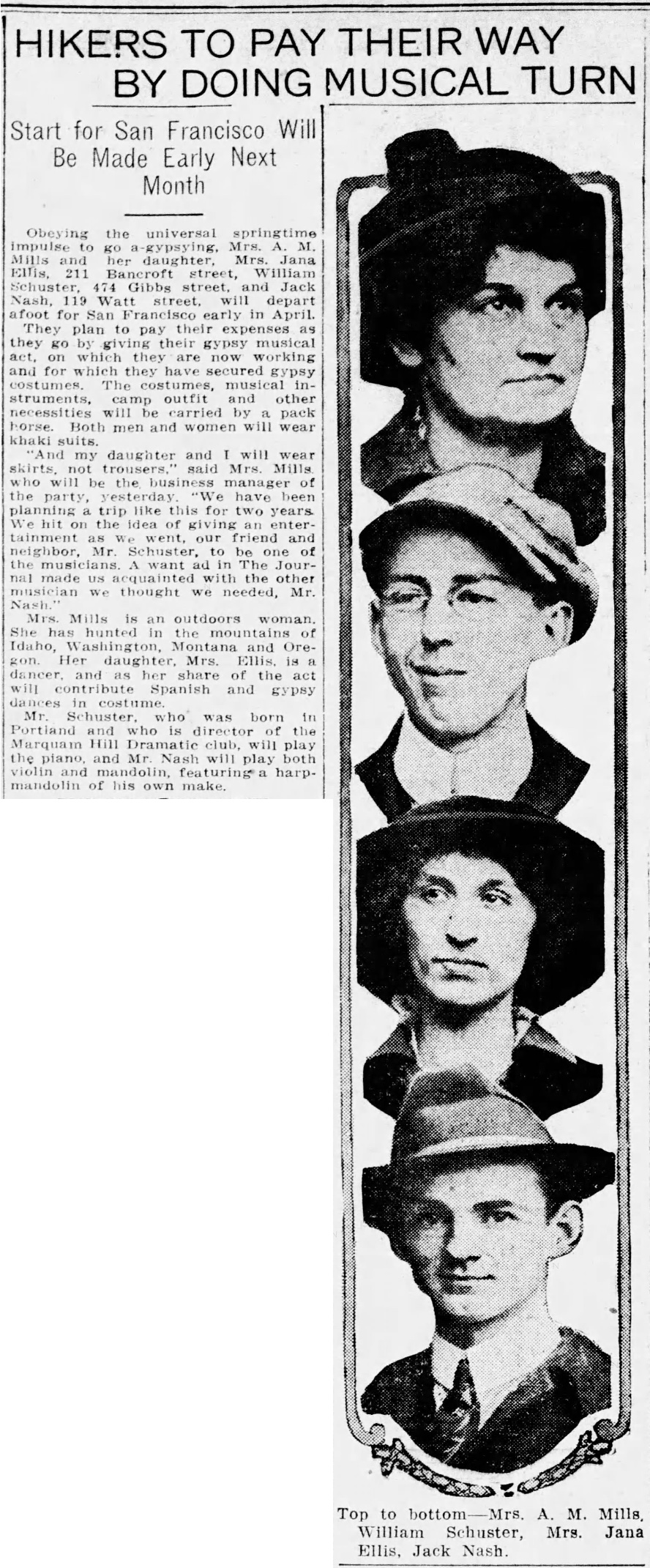
They were smart and planful as well, telling the Oregon Journal on March 22, 1915 they had been planning this journey for two years, and had even taken out a classified ad in the Journal to recruit another member of their party, a musician. All part of their strategy for making ends meet along the way.

Before leaving Portland (they were not the first group of walkers to head south that spring) the newspapers wanted a word. Or maybe these two wanted to make sure the newspapers knew.

Regardless, settle in for a good read and let’s follow along as their stories gain momentum the farther south they go.

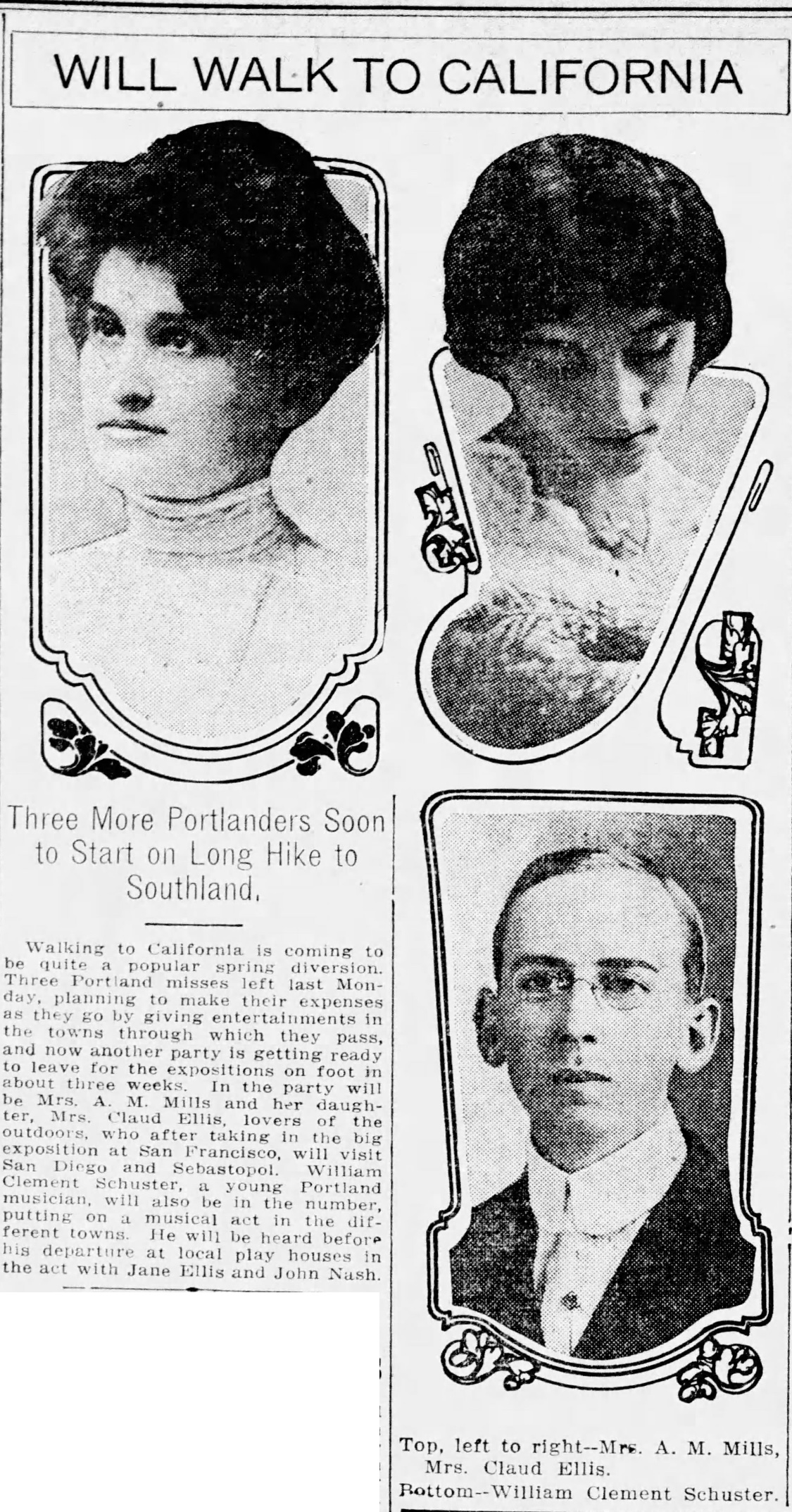
From The Oregonian, March 11, 1915

From Oregon Journal, March 14, 1915

From Oregon Journal, March 22, 1915

From Oregon Journal, April 29, 1915

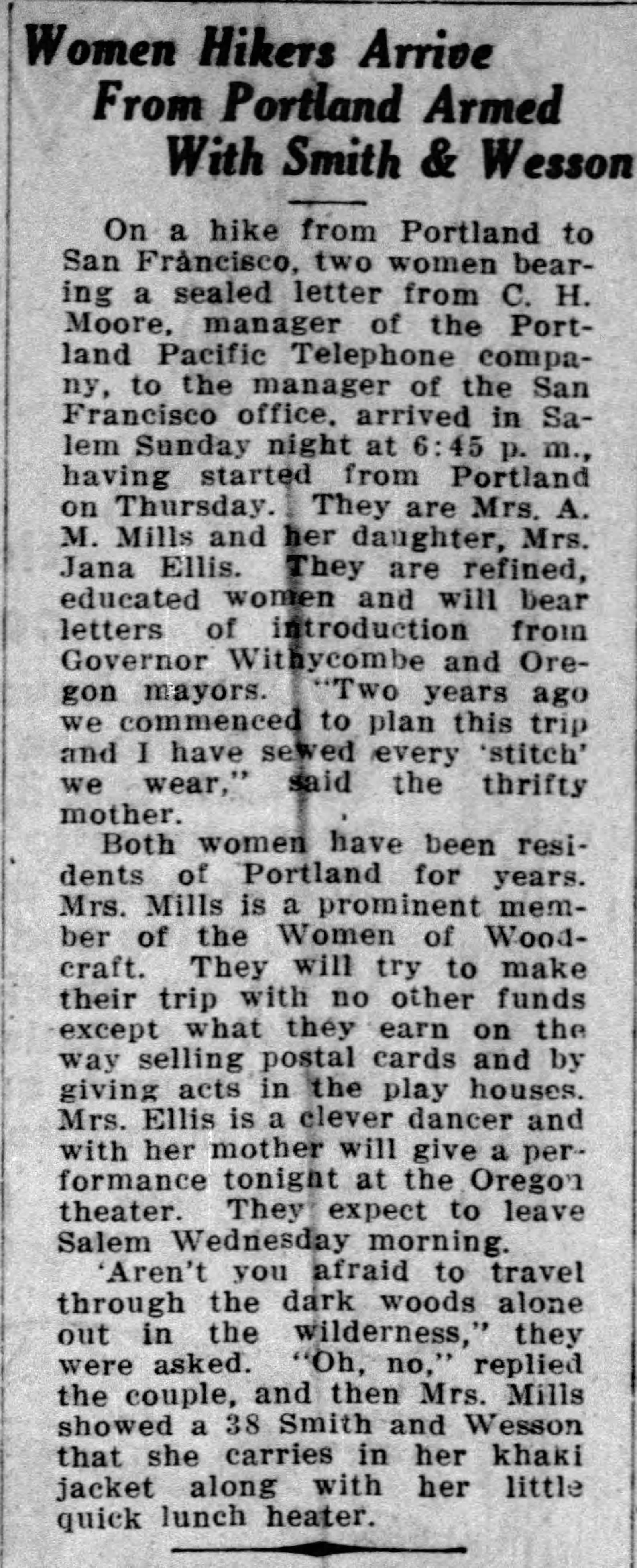
From the Statesman-Journal, May 4, 1915

The Albany Democrat Herald noted when the pair passed through there on May 8th “They left Portland without a cent and are making their expenses by appearing in theaters, etc. along the way.”

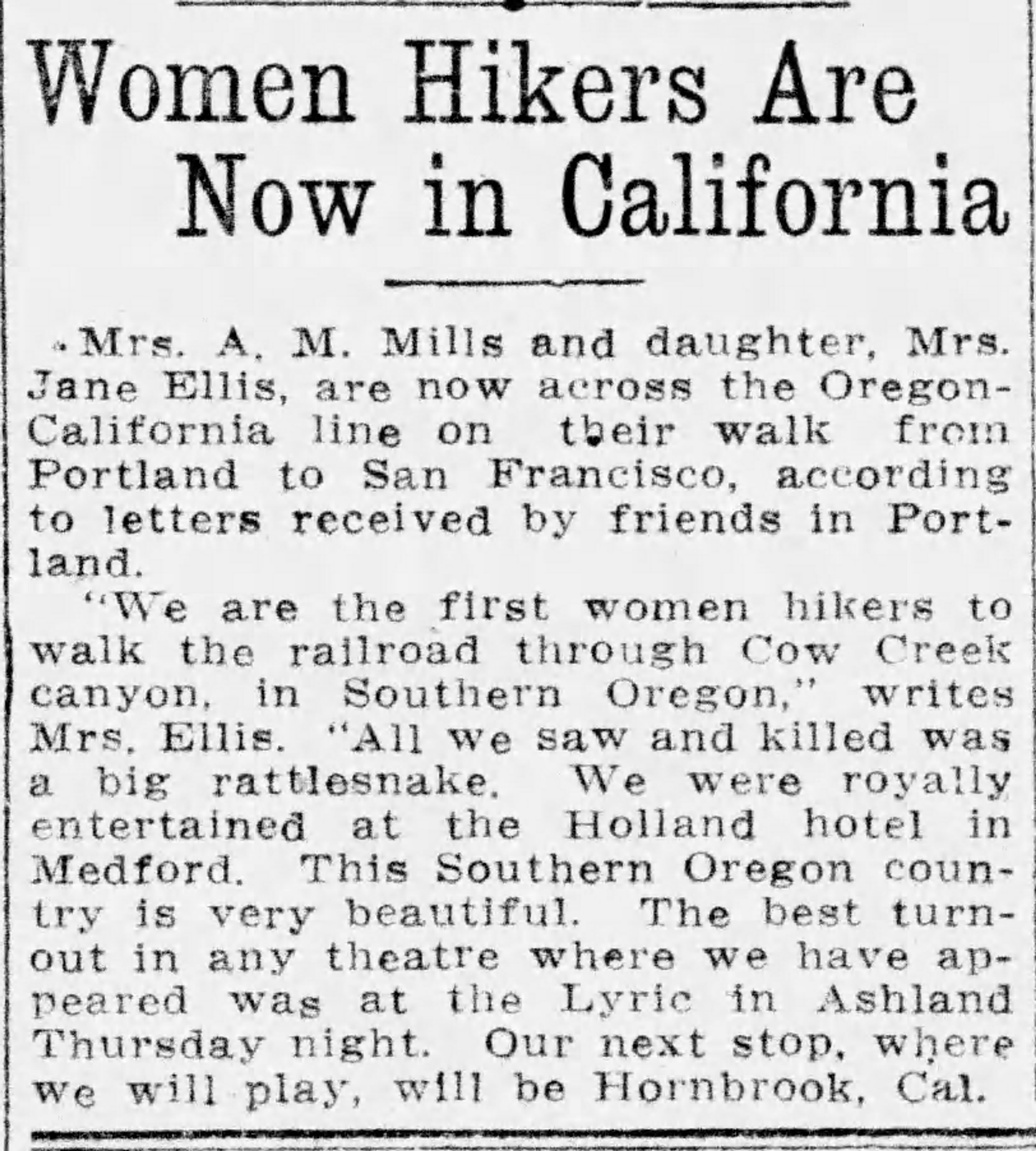
As they neared Douglas County, the Roseburg News-Review tracked their movements: on May 20th musician John Nash and singer Katherine Vernon joined them in Oakland, Oregon north of Roseburg. May 28th they were in Grants Pass. June 1st they passed through Medford, and the paper reported they were navigating by following the telephone lines, hauling their baggage on horseback, and staying in telephone offices whenever they stopped. They seemed to pause for a while in Ashland, giving multiple well-attended performances at the Lyric Theatre.

From Oregon Journal, June 5, 1915

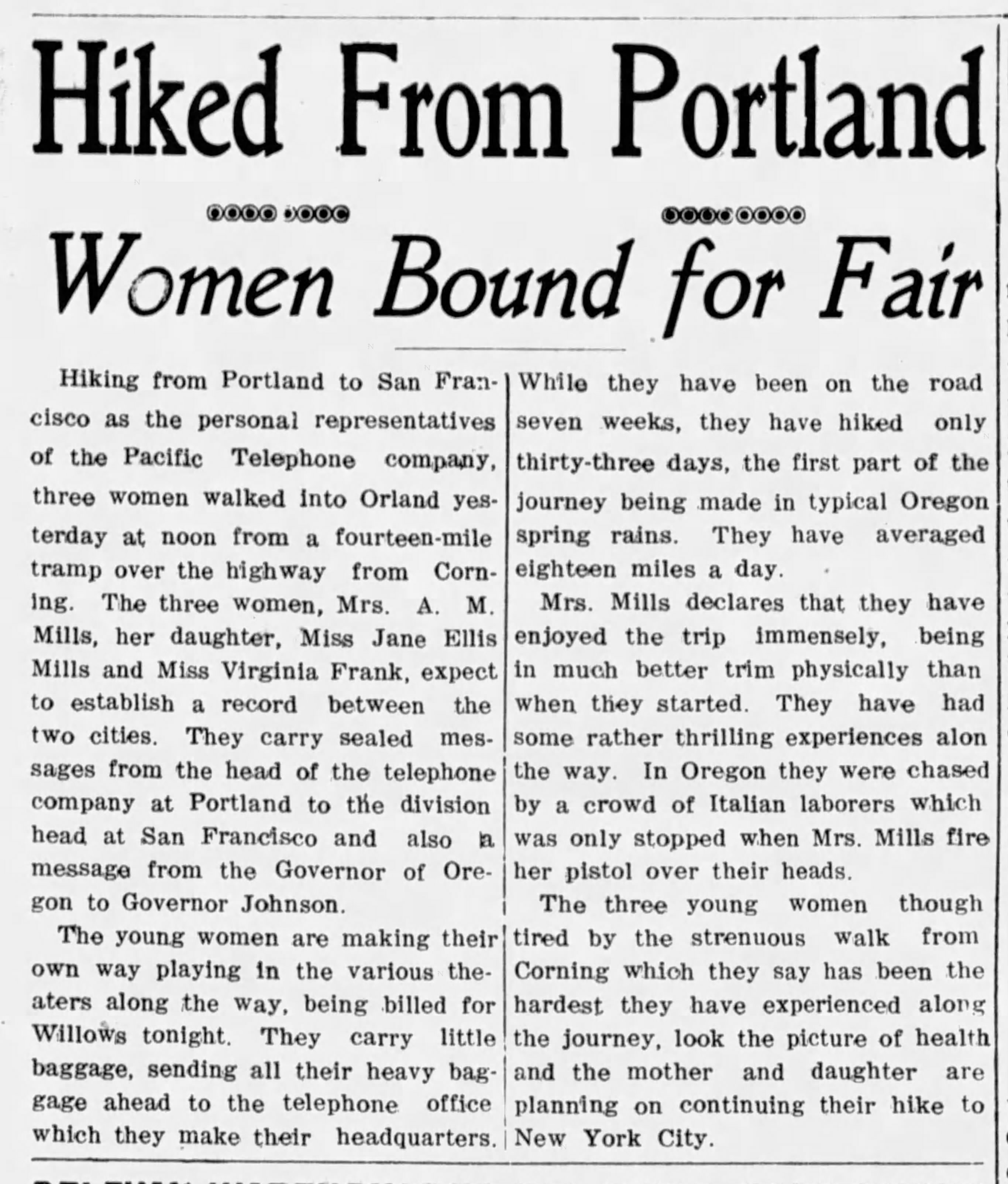
From the Orland, California Register, June 23, 1915

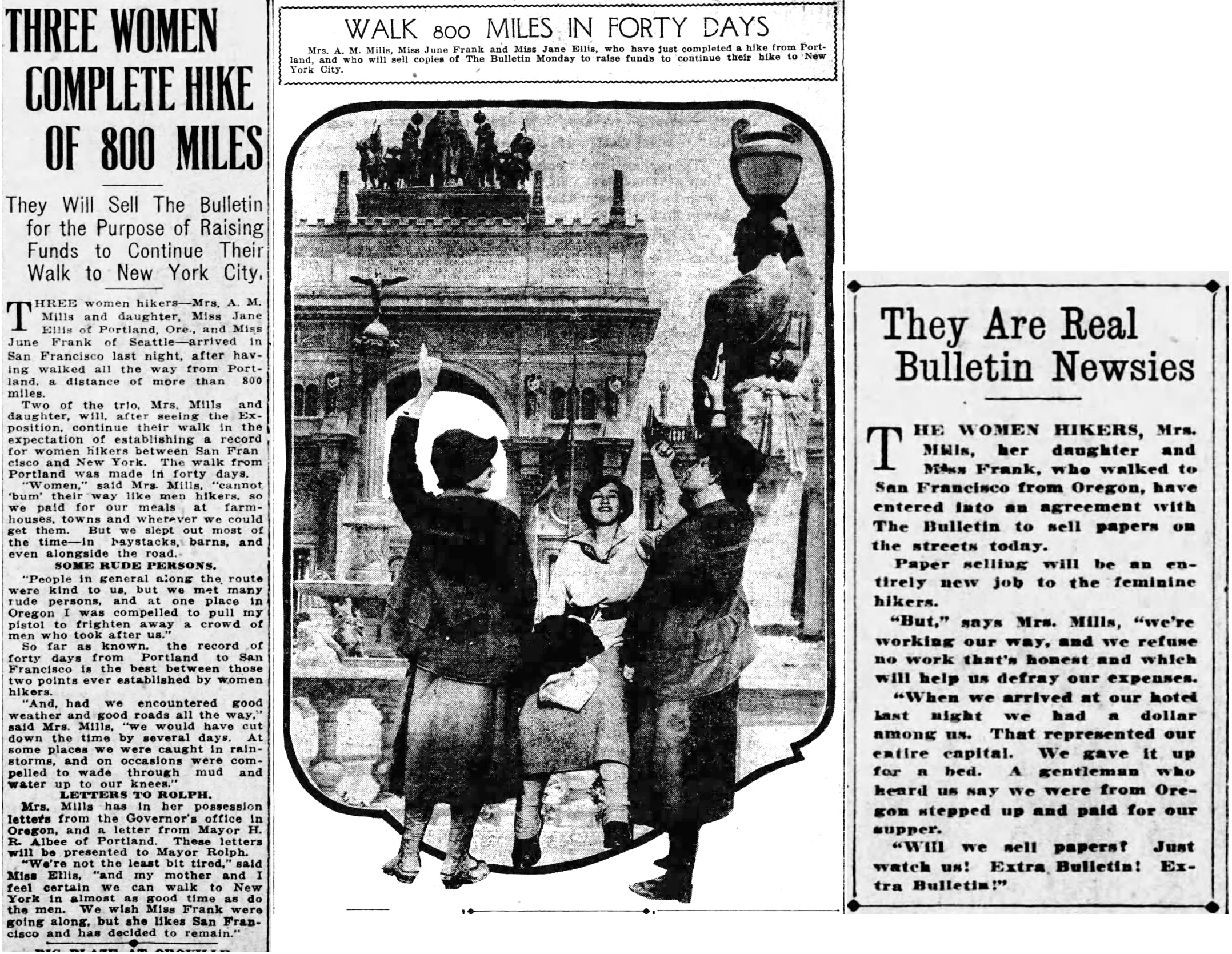
At last, on July 11th, the group—now down to three—arrived in San Francisco. Their stories and a photo—and a sidebar about selling newspapers on the street—appeared on page 4 of the July 12, 1915 San Francisco Bulletin. Click on this for a good read (and look for the Smith & Wesson).

But that’s the last we hear of them, nothing further about going on to San Diego or New York, or any points in between. We’ve had a good look around at newspapers along that way, and there’s nothing. We have to rely on genealogy to give us hints about how their stories end.

They both return to Portland, where daughter Jane marries in 1919, 1923 and 1930, regains custody of her son Wilbur and sets up house with new husband Oscar Severson on SE 17th Avenue, where we find her in the 1930 census working as a debt collector. Living in the house with them is mother Anna, who later dies at home on August 19, 1935 at age 67, and is buried at Lone Fir Cemetery.

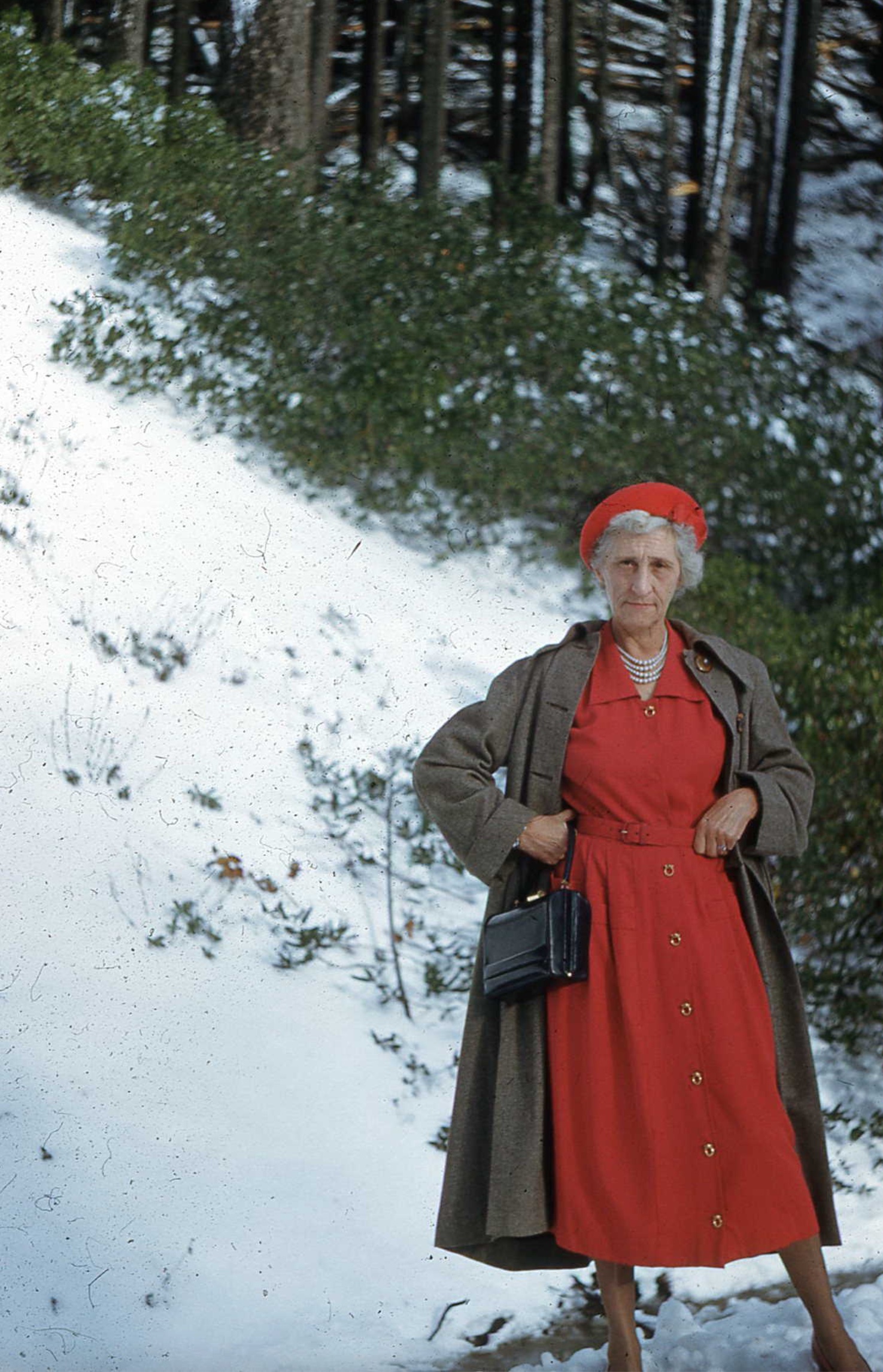
In the early 1950s, Jane and Oscar leave Portland to live near her adult son in Los Angeles. One photo of her from those years convey Jane’s character, showing her in red dress and pearls in some snowy pass. Was she retracing the walk?

Source: Ancestry.com

Oscar dies in January 1955 and Jane lives on in Van Nuys until July 6, 1967 when she dies at age 76. Death notices and obituaries don’t remark on the big walk of 1915. But now we know, thanks to a serendipitous morning in the archives, a letter from Mayor Albee, and a photograph of mother and daughter peering into the future.

Earliest span over mid-Sullivan’s Gulch: the 28th Street Trestle

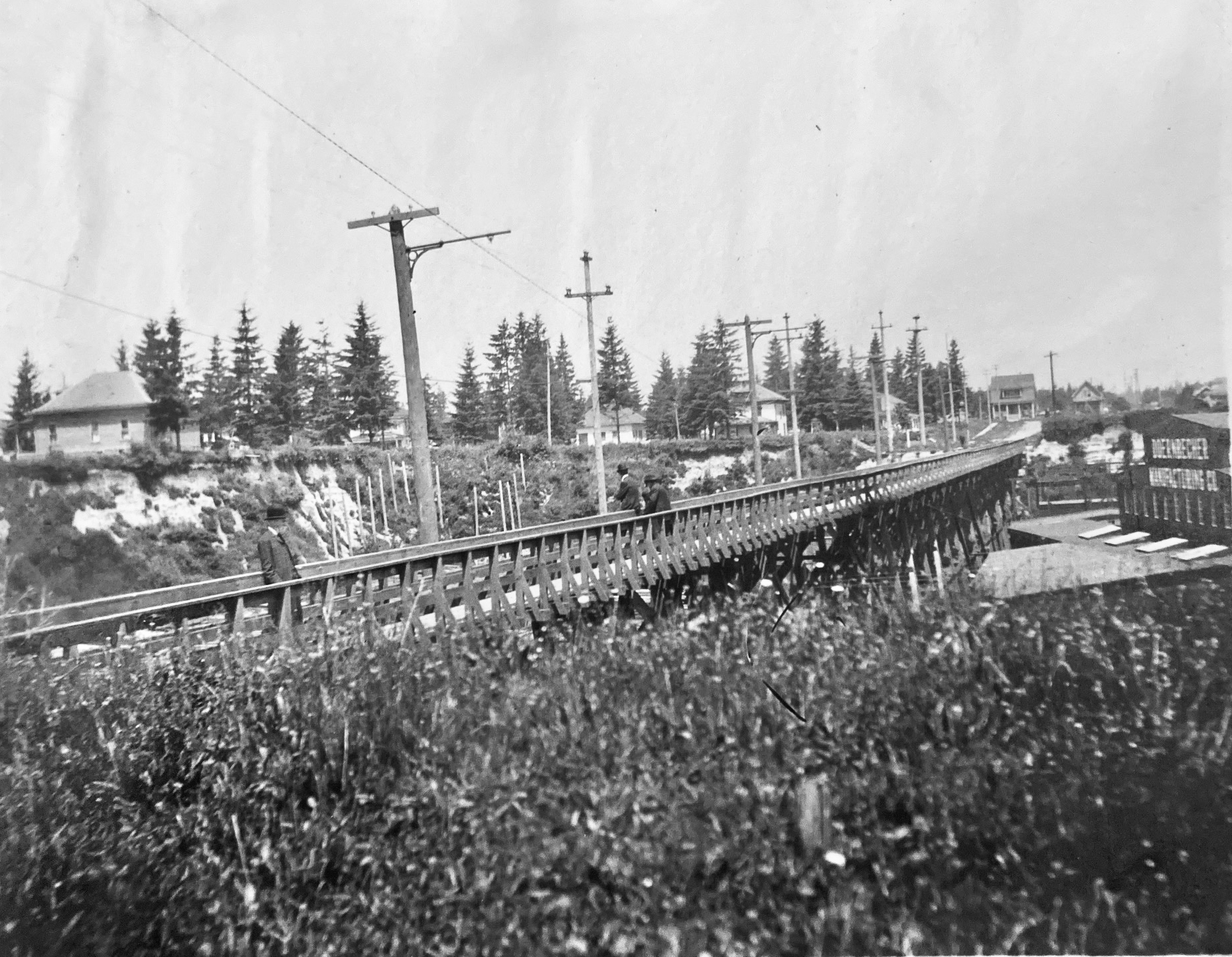
A friendly reader has shared a photograph from her great-grandparents’ photo album and wondered about where it was taken, when, and what it depicts. We love a good photo detective mystery like this, which enables a deep dive back into the landscape of the 1900s. Have a good look at it for detail, and then we’ll discuss:

Courtesy of Phillips Family Archive

You’re looking north at a newly-completed wooden streetcar and pedestrian trestle bridge over Sullivan’s Gulch (where today’s Banfield / I-84 runs) at about NE 28th Avenue, just south of today’s Hollywood West Fred Meyer. The trestle existed for only a short time–from 1903 to 1908–before pressures from a growing Portland replaced it with a concrete span, which was later echoed by new bridges at NE 21st and then at NE 33rd. Its short lifespan says so much about development about this part of the city during the years immediately after the Lewis and Clark Exposition, which ushered in waves of change for Portland.

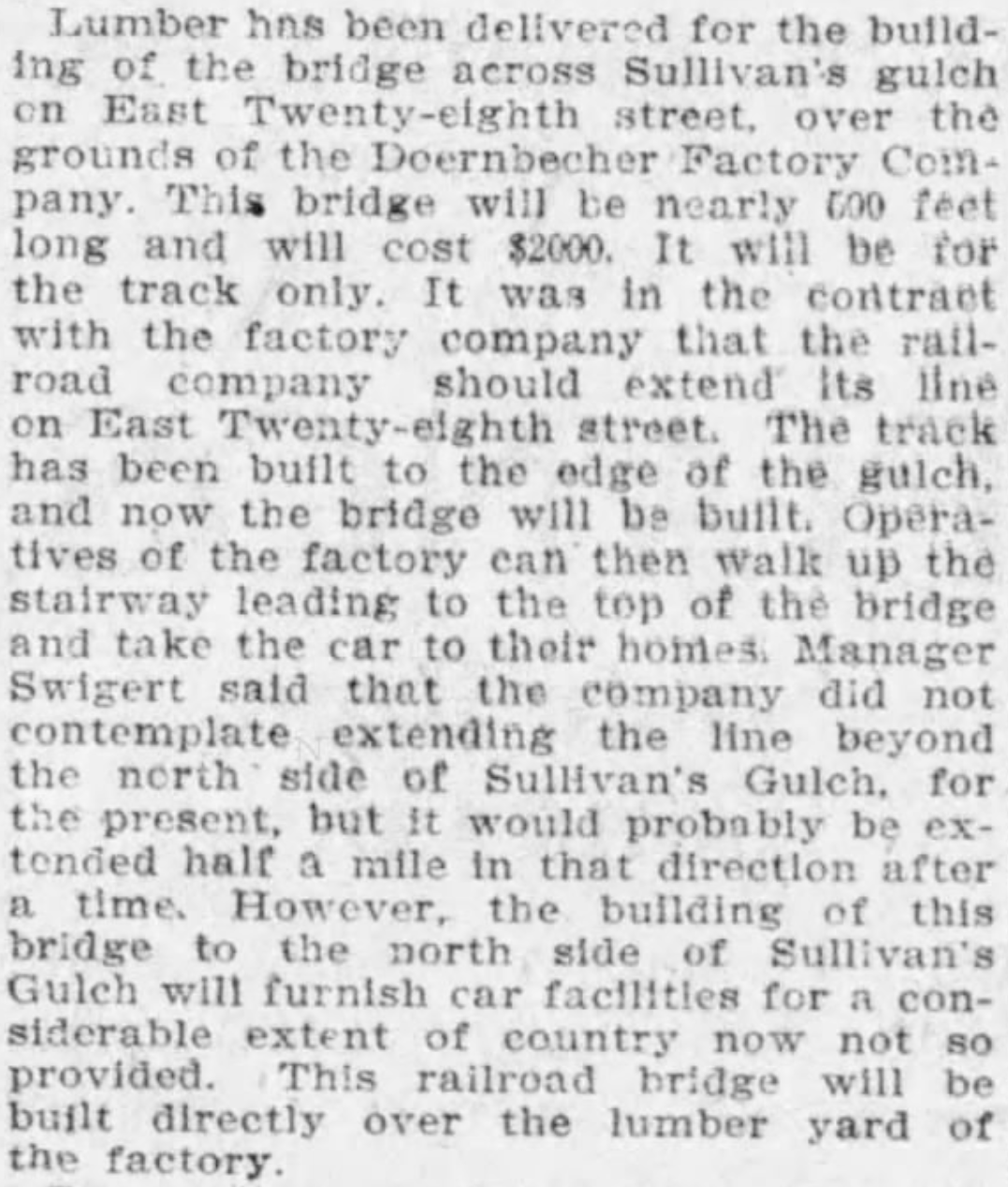
But first, the trestle: 800 feet long, an average height over the ground of 35 feet, costing $2,000 to build, including simply a rail line and a narrow sidewalk on the east side of the span. Built between November 1902 and January 1903 by the City & Suburban Railroad, one of the several streetcar companies that served Portland during those years, later subsumed into the Portland Railway Light and Power Company system.

And here’s where it gets interesting: City & Suburban built the trestle under contract to the Doernbecher Manufacturing Company, a furniture factory, which was Portland’s largest private employer at the time and which operated a sprawling five-acre factory site at the bottom of the gulch just beneath the trestle. Thousands of workers made the trip into and out of the gulch each day and having a means of easy access was helpful for the company, which had opened the factory just a few years earlier in 1899. If you haven’t heard about the factory, you can read more and see photos in this piece, which was the second installment of a series we’ve written on the history of Sullivan’s Gulch. Today’s giant U-Store storage complex is the skeleton of what once was Doernbecher Manufacturing.

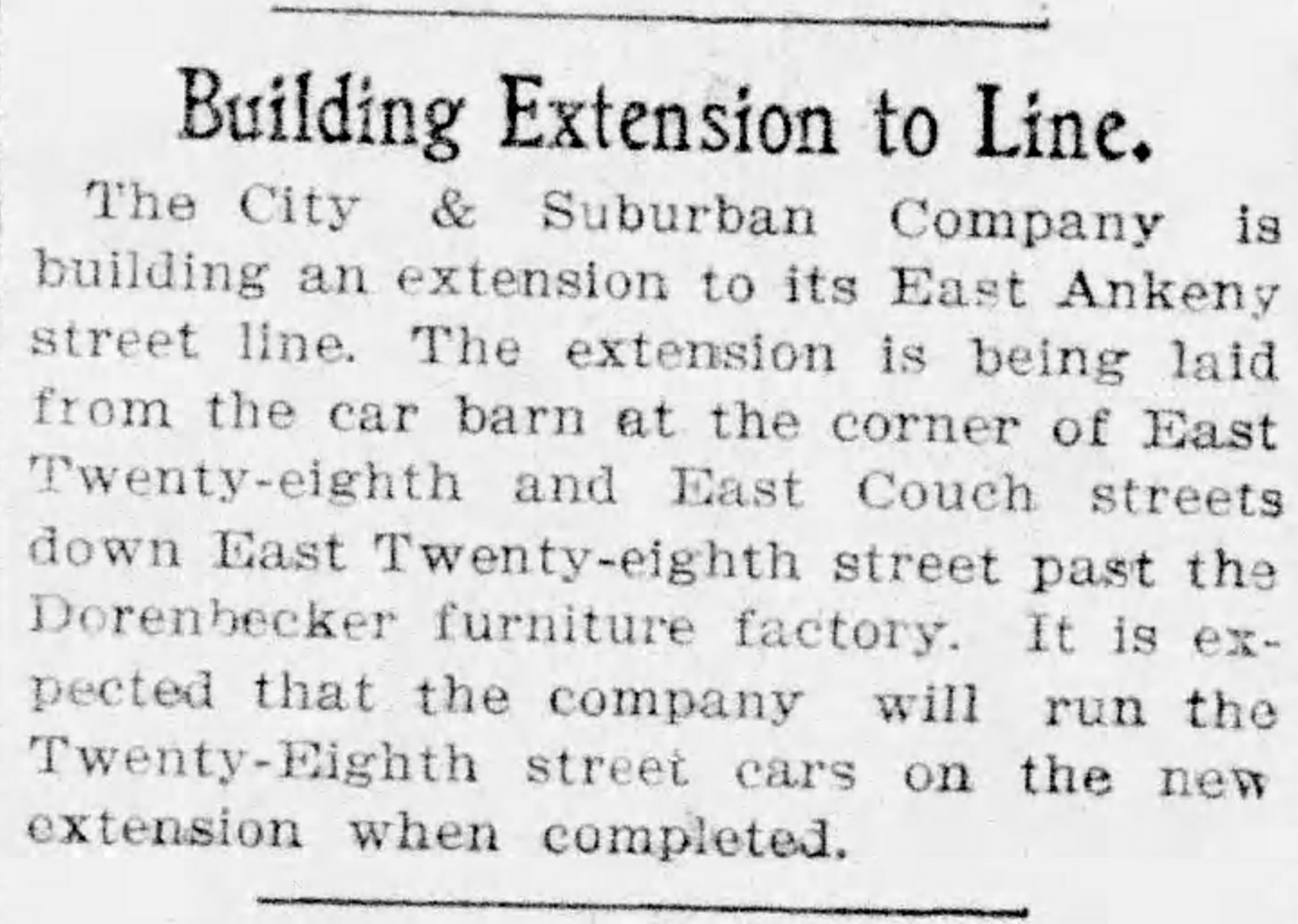
City & Suburban Railroad operated the East Ankeny Line, which terminated in the streetcar barns that once stood near NE 28th and Couch, about a mile due south. For the executives at Doernbecher, it was an obvious proposition to pay the railroad to extend its line north straight up 28th, build the trestle and two prominent stairways down, so workers could come and go conveniently. Meanwhile, City & Suburban was also eyeing service to the neighborhoods taking shape to the north of the gulch, and the possibility of a loop with the existing streetcar service that ran up Broadway into Irvington and later Alameda.

And so it was in August 1902 when construction of the line extension began:

From The Oregon Journal, August 19, 1902

By November, the extension was in and grading was underway at the lip of the gulch to prepare for the trestle. Wood was being stockpiled for construction:

From The Oregonian, November 12, 1902

Trestle construction began in earnest in December and was completed in January. Later that year, the East Ankeny Line was extended a bit farther north to an end-of-the-line stop at NE 28th and Halsey. The envisioned loop with the Broadway Streetcar never materialized.

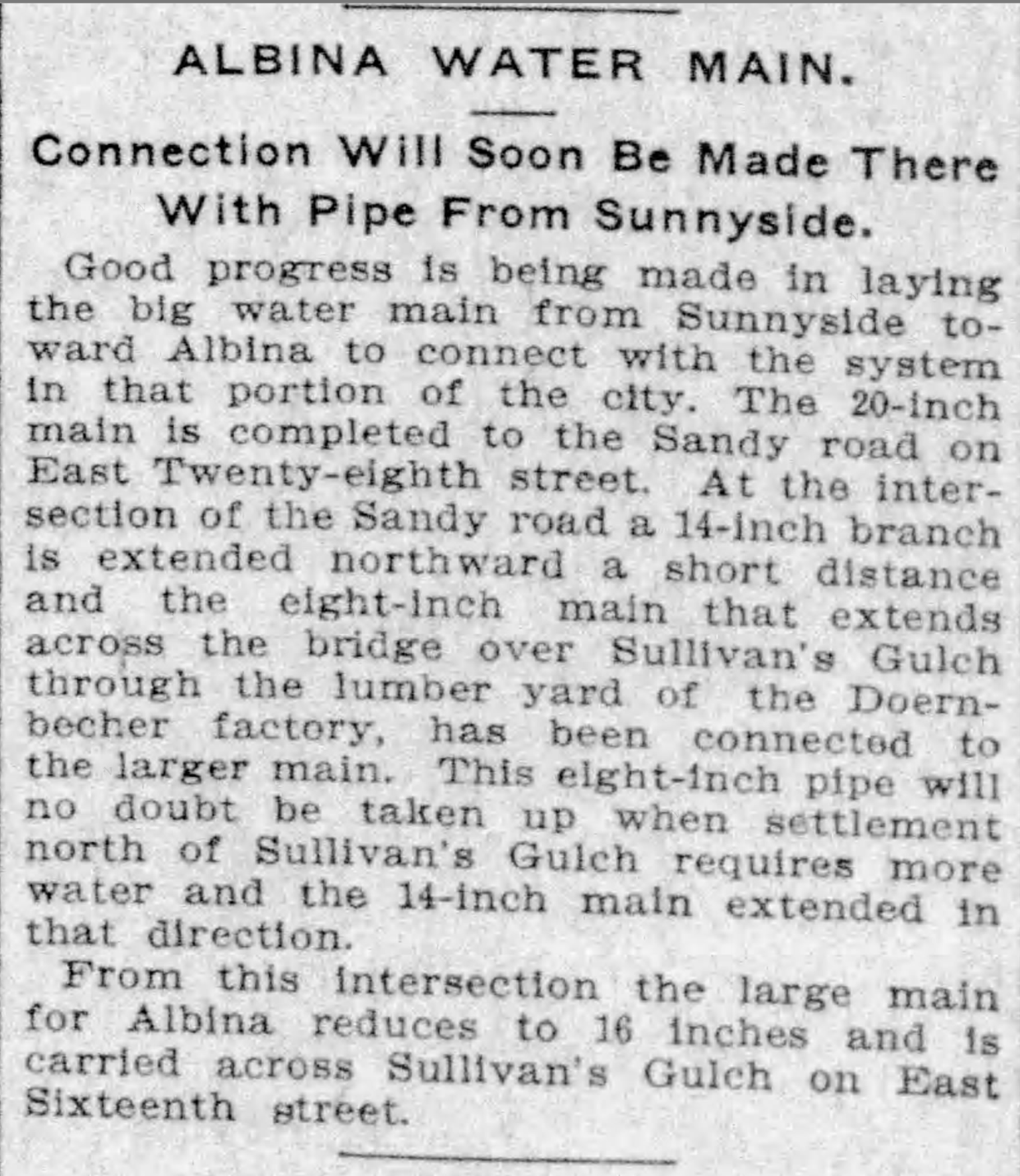
The trestle enabled a broader infrastructure that began to serve middle Northeast Portland. In November 1903, an 8-inch water main was secured to the wooden structure carrying public water for the first time into this part of the city:

From The Oregonian, November 5, 1903

In 1907, following the Lewis and Clark Exposition and with home construction and residential land speculation fever running high, residents of the area began to lobby for a wider multi-use crossing of the gulch in this area. The trestle was replaced in 1909 by construction of a concrete viaduct.

The story of sleuthing the photograph is interesting too:

  1. We knew the Doernbecher story in this location, and could see the “Doernbecher Manufacturing Company” painted on the side of the building in the photo. The alignment of the Doernbecher building, slightly angled to the crossing, is still evident today in what may well be the very same building.
  2. The homes pictured at the edge of the gulch, several of which are still standing today along NE Wasco and Multnomah streets, provide a tell-tale indicator this view looks north.
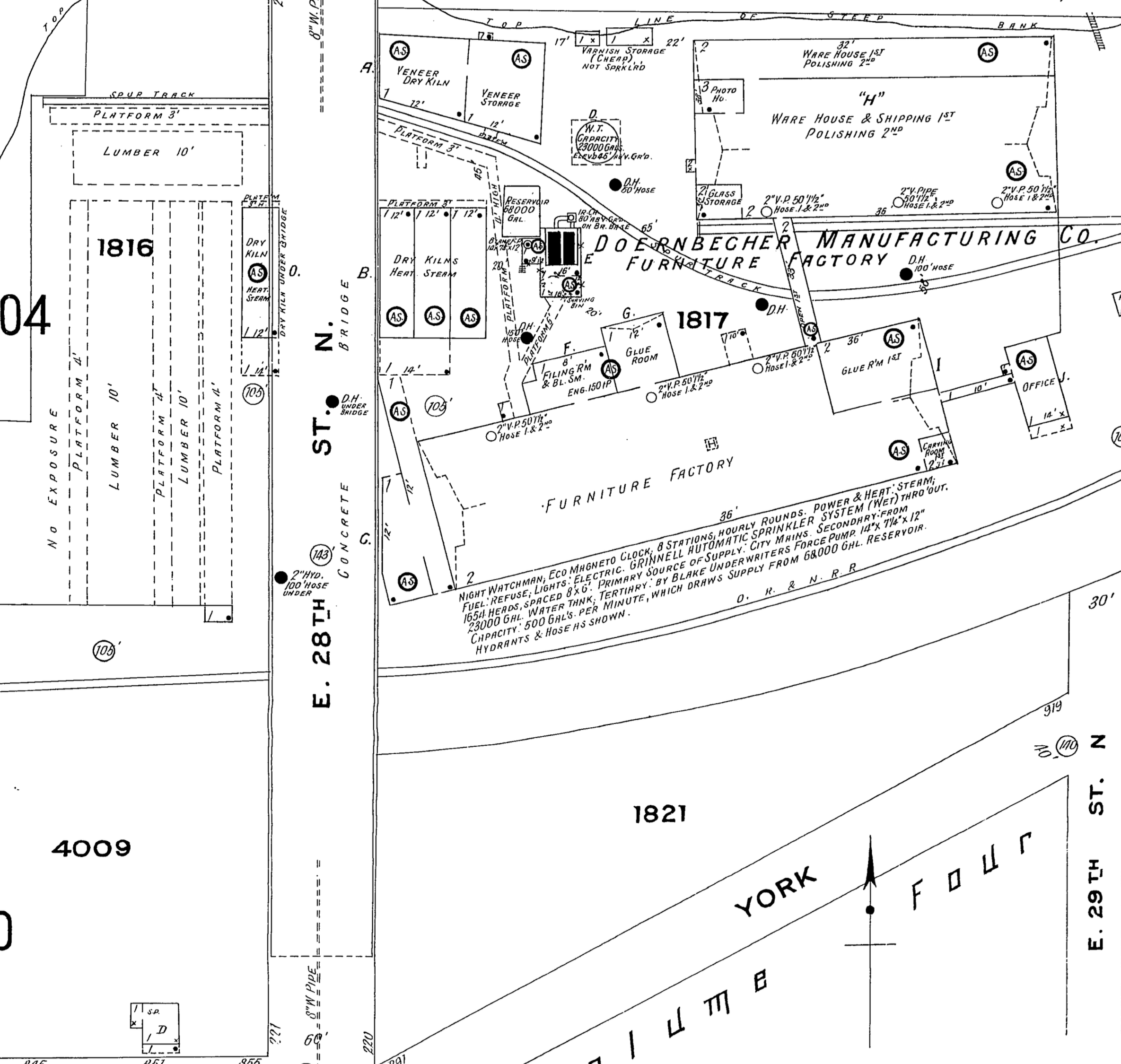
  3. The Sanborn Fire Insurance Map from 1909 also helped, lining up nicely with the Doernbecher lumberyard seen in the old photo through the rungs of the trestle railing and mentioned in the news stories. Knowing the buildings were to the right (upgulch) and the lumber yard was to the left (downgulch) also confirmed direction of the view.

Detail from 1909 Sanborn Fire Insurance map.

  1. The Sanborn also shows the Oregon Railway and Navigation mainline (much later the Union Pacific) which travels through the gulch and was the reason Doernbecher cited the factory there in the first place. The bowler-hatted gentlemen on the trestle walkway are probably looking down as a freight train passed by underneath. Look carefully and you can see the electric and telegraph lines that followed the tracks running perpendicular to the trestle in the mid-ground. The 1909 Sanborn shows the concrete bridge which replaced the trestle.

Do you have old photos you’re trying to make sense of? We’re always glad to help.

Columbia Slough 1913

In December we discovered and shared here a trove of glass plate negatives taken by a photographer from the Department of Public Works who was out to document the giant gravel pit at NE 33rd and Fremont.

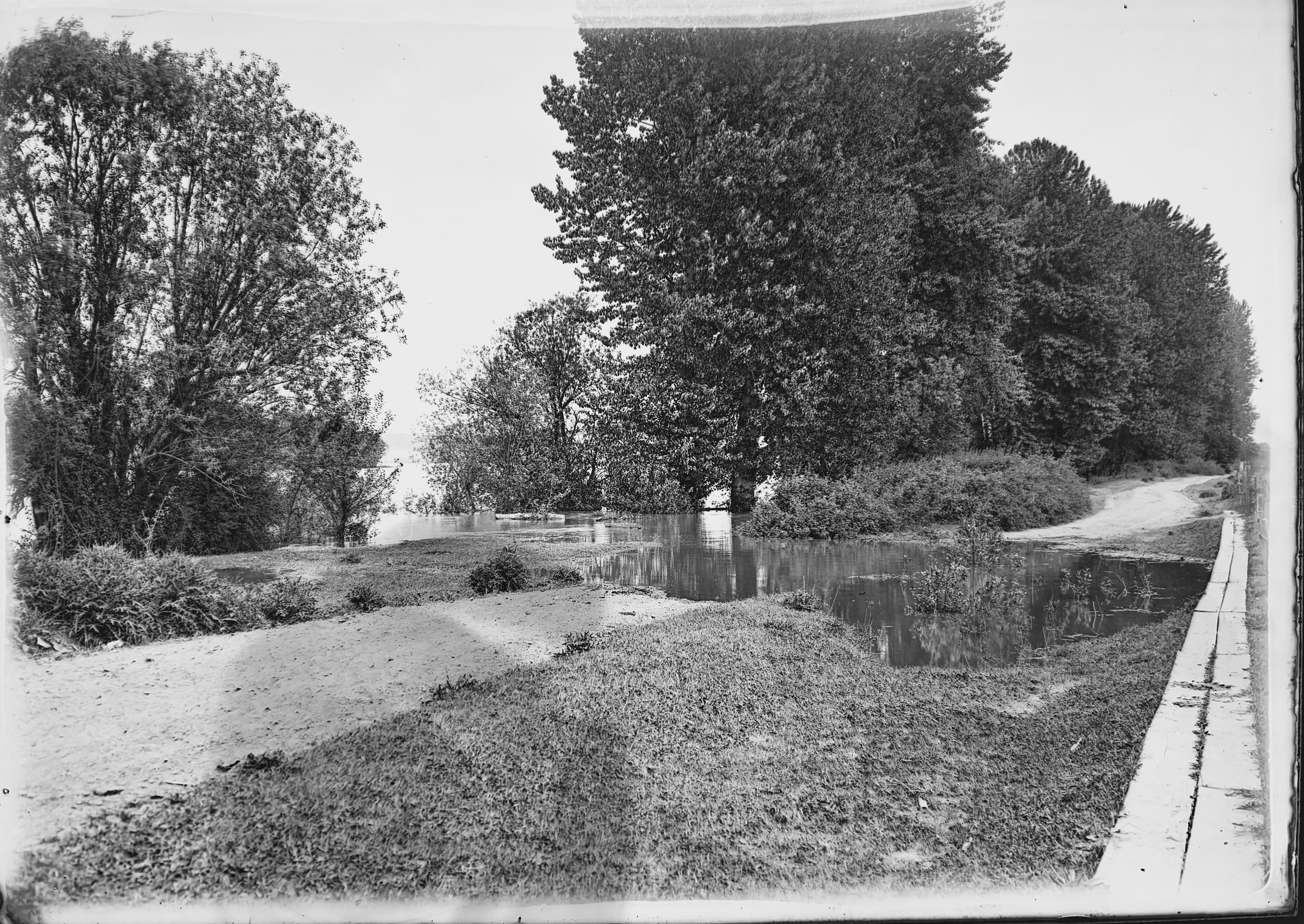
In that same series of glass negatives we found one labeled “High Water Columbia Slough,” clearly shot at a different time of year (the trees are leafed out), but contemporary with other images in that collection from 1911-1913, showing a finger of river overflowing its banks. Trees in the mid-ground are standing in water. A gravel road is inundated, but a plank walkway allows foot passage. Off behind through a curtain of brush is open water, an island in the distance, the far shore in the distance beyond that.

Columbia Slough High Water, courtesy of Portland City Archives. Image A2009.009.2791

We’ve been staring at this photo, like we enjoy doing with all old photos, trying to understand what it has to tell us, where it was taken and its overall context.

We’ve written about the slough here on the blog, also known as the Columbia Bayou on some maps and as “the bottoms” in surveyors notes from the 1850s, and shared some views taken about this time and a bit earlier. In other work, we’ve learned about the conversion of the slough for grazing and agriculture, and later for flood control and irrigation. When this picture was taken, big changes were on the horizon that would eventually lead to a transformation of the Columbia River’s south shore in this area bringing hundreds of thousands of cubic yards of fill, a levee system, construction of the Portland Air Base and later Portland International Airport.

But back in 1913 when this photo was taken there was still living memory of a very different time, of the first people who made their lives and livelihood on these banks, of a river that rose and fell, with waters regularly filling as far south as today’s Columbia Boulevard.

As to where this was taken? Starting with the easy assumptions, we believe it’s looking upstream to the east, the mainstem of the Columbia in the middle distance. The large-format camera used to make this glass negative would have been a heavy thing to lug around, so chances are it’s not too far from where the Public Works Department could drive.

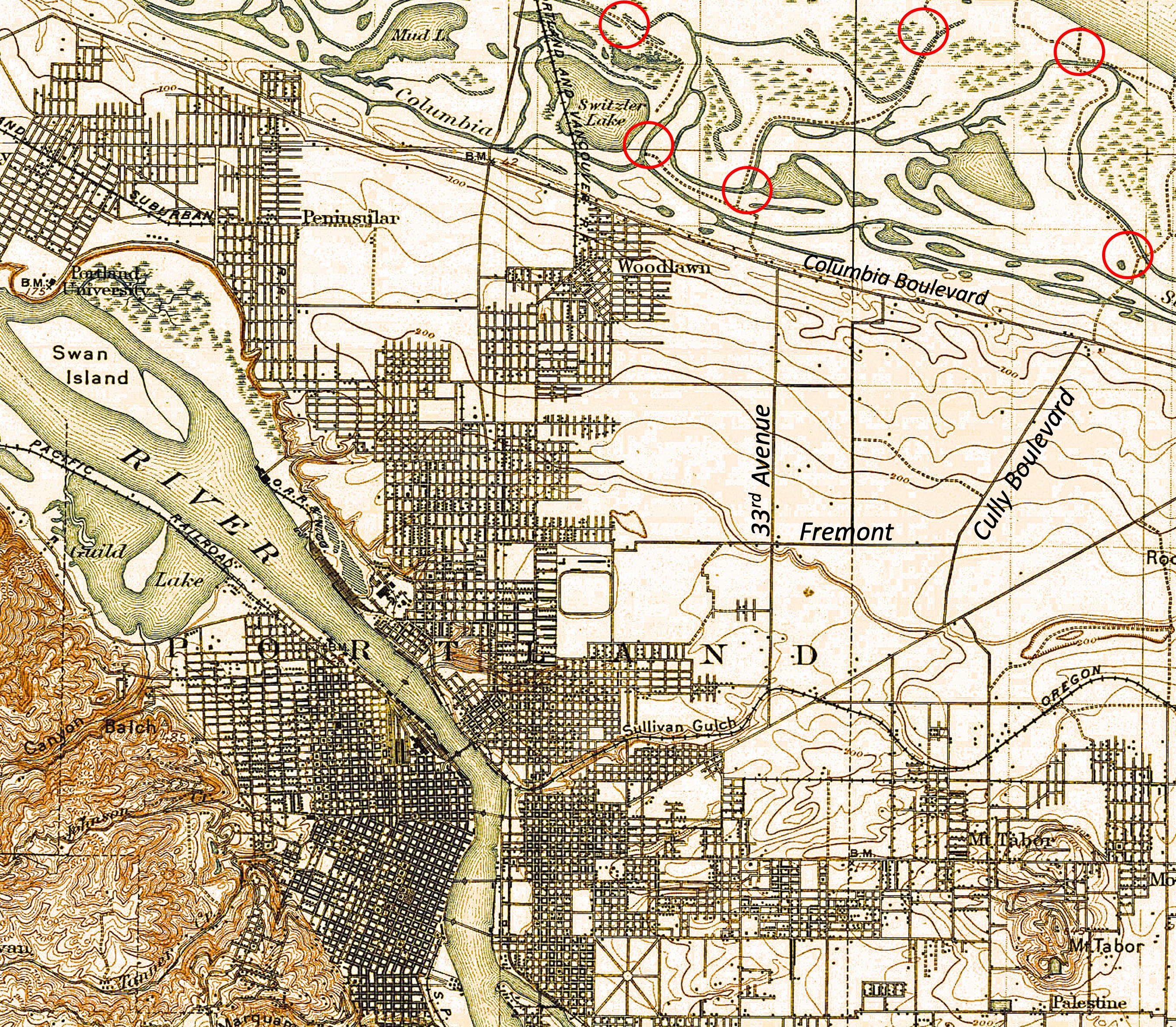
A look at the 1897 USGS Portland quadrangle map above, and the 1915 Hanson and Garrows Map of Portland, suggests it could have been at the far north end of NE 33rd (known in that area as Sunderland Road), or north of Cully Boulevard, both places where small networks of temporary gravel roads wove around slough waters. Check out the map, with some new labels added for orientation and a few possible photo locations circled in red, just for fun. While you’re looking around, appreciate just how complex and amazing the slough was. During high water on the Columbia, all those channels and ponds and the wet meadows in between were submerged.

Back to the 112-year-old photo: it’s a pretty interesting image of an extinct location reminding us of our short time here, and the changes we’ve wrought in just over 100 years.

Epilogue: Gravel Hill 25 years later

It’s been like time travel, studying the discovered photos from 1913 that take us back to the intersection of NE 33rd and Fremont, the giant gravel pit that once defined that hillside, the stairs leading up Alameda Ridge, and the unstable cutbank above Fremont.

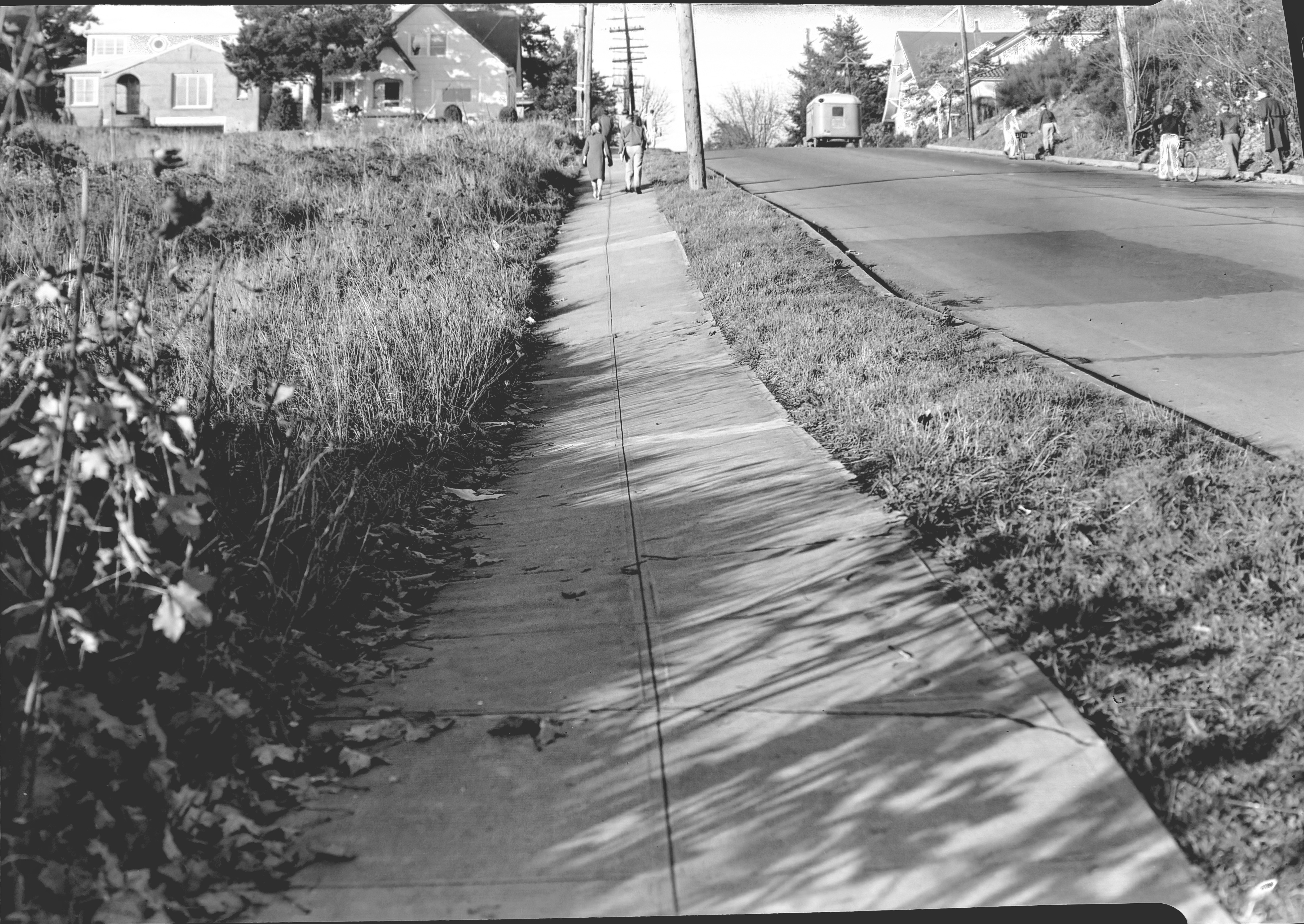
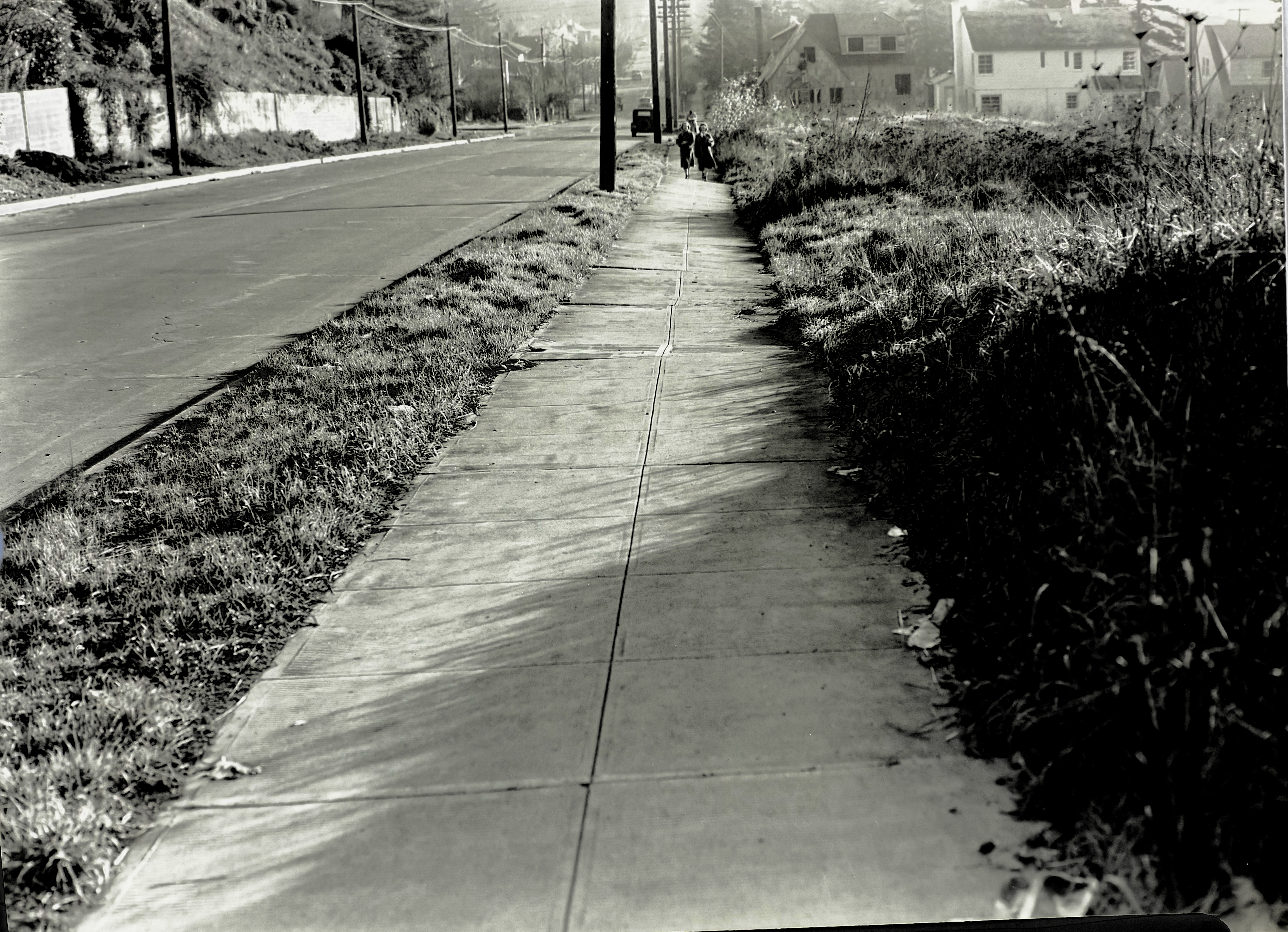
Here are two more views of the general vicinity taken 25 years later that show us how the slope was settling after being filled with garbage and soil. Photographed by the Public Works Department on November 21, 1938, these views look uphill and downhill on 33rd from just below the top of the hill. Click in for a good look and then we’ll discuss:

Looking north along the west side of NE 33rd, just downslope from NE Fremont. Image A2009.009.1272, courtesy of City Archives.

Looking south along the west side of NE 33rd, just downslope from NE Fremont. Image A2009.009.1271, courtesy of City Archives.

Judging by the sunlight and shadows–and what looks like an exodus from Grant High School–these photos were taken in the afternoon of that November day. The uphill photo shows just how much the mid-slope has settled, with the curb and street surface buckling and the entire sidewalk heaving to the west. Nothing has been built on these vacant lots, probably because they were still settling.

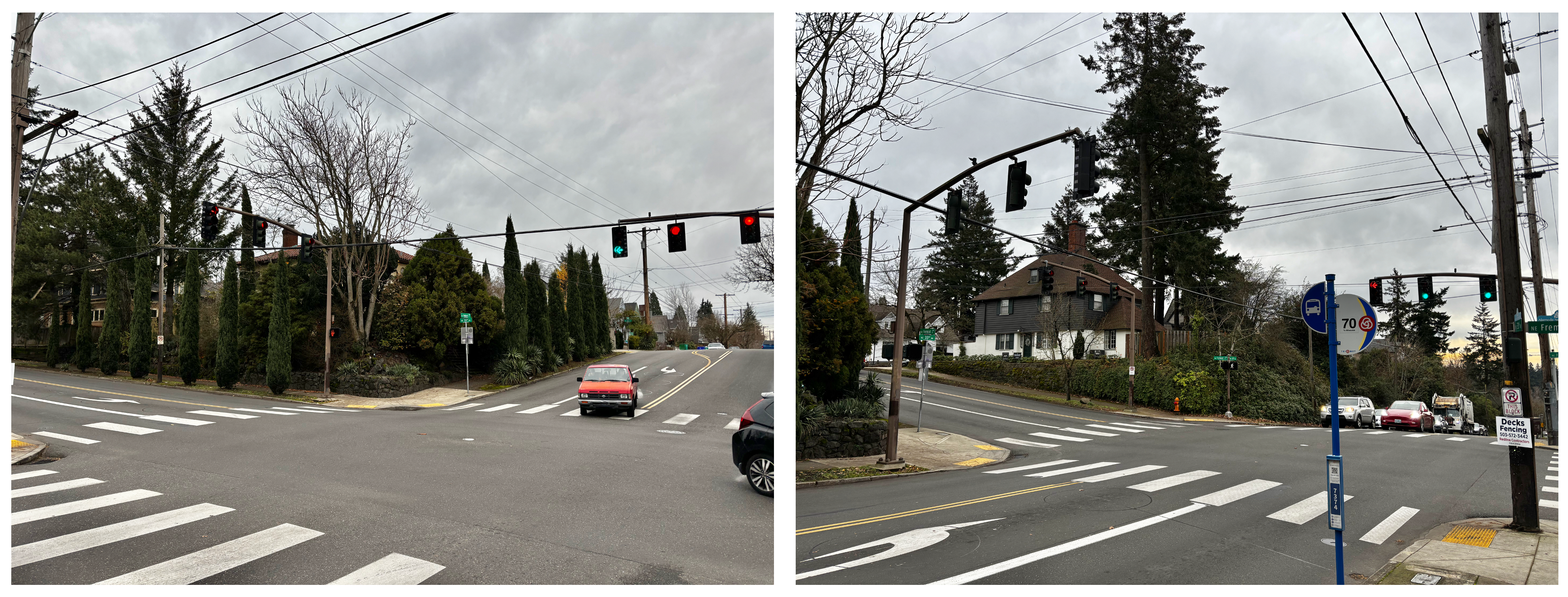
Look a bit farther up the hill and you can see two brand-new Ken Birkemeier houses at far left (3279 NE Fremont), perched on what had been the cutbank, and the bungalow to its east at the corner (3289 NE Fremont). Across the street farther east you can see the high-peaked roof of the home at 3304 NE Alameda, and the distinctive tile roof of the Mediterranean-style house at 3301 NE Fremont.

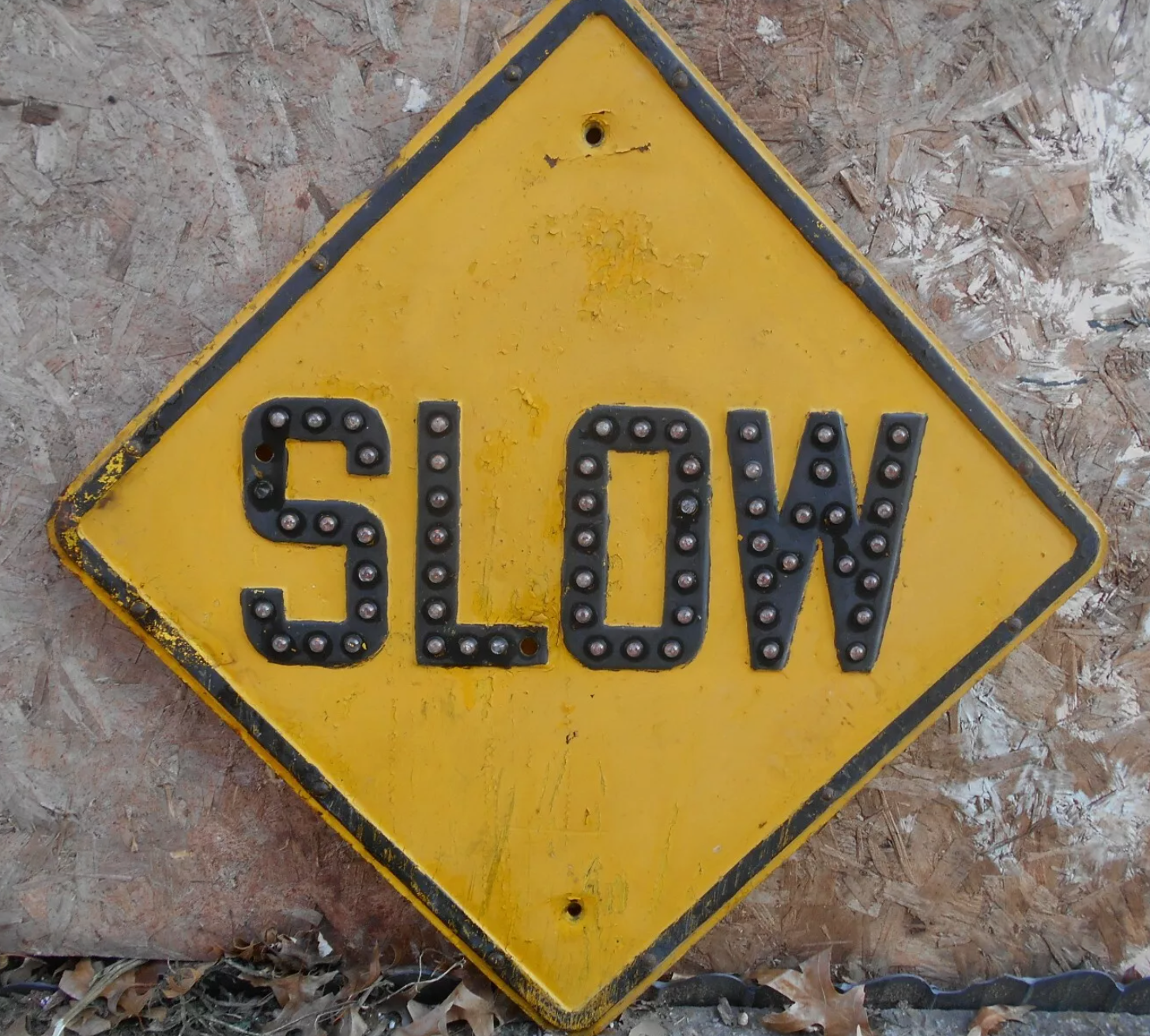
Also interesting to note: no signal light controlling the intersection, nor is there a stop sign facing 33rd (can’t read what is on that sign, but it’s not the standard octagonal STOP sign we know today, which was in common use by 1938). Perhaps Fremont had the stop sign and 33rd had the right of way.

Yet to be built at the top of the hill on the southwest corner was a mid-century home and swimming pool that would eventually collapse into the old pit area and be replaced in the 1990s by a much larger house (and geotechnical engineering). We wrote about it here: The lost house at 33rd and Fremont.

The downhill photo looking south shows just how much the sidewalk wants to fall off into the old pit. Below the pedestrians you can see a house under construction–3289 NE Klickitat, also by Ken Birkemeier who was very busy in this part of the neighborhood during those years.

Today we have Google streetview to document so many aspects of our neighborhood, but it’s been a treat to turn back the clock with these and the 1913 photos. We’re always on the lookout for early photos of our Northeast neighborhoods. Stay tuned for more findings. The promised Columbia Slough photo from 1913 is next.

Post Script: Attentive Reader John Golightly adds his observations that the sign at the intersection probably was a “SLOW” sign, which we agree with. Here’s a photo of a 1930s-era slow sign in its characteristic diamond shape:

1913: Hillside above Fremont on the move

In 1913, nearby property owners and the Department of Public Works were concerned about the stability of the slope above Fremont Street in the stretch between NE 30th and NE 33rd. Fremont itself was perched along the north edge of a giant gravel pit that had been mined for decades and would eventually be filled with garbage to build it back up to grade.

NE Fremont Street looking east near today’s 32nd Place, in 1913. Click in for a closer look. Gravel pit to the right (south) and cutbank above to the left (north). House in the center is 3415 NE Fremont. In the distance, sewer pipe is stacked down the hill along the east side of 33rd and a person faces the photographer at the intersection. A wooden plank sidewalk runs along the south side of Fremont. The gravel and dirt streets were paved the following year. Photo courtesy of City Archives, A2009.009.3615.

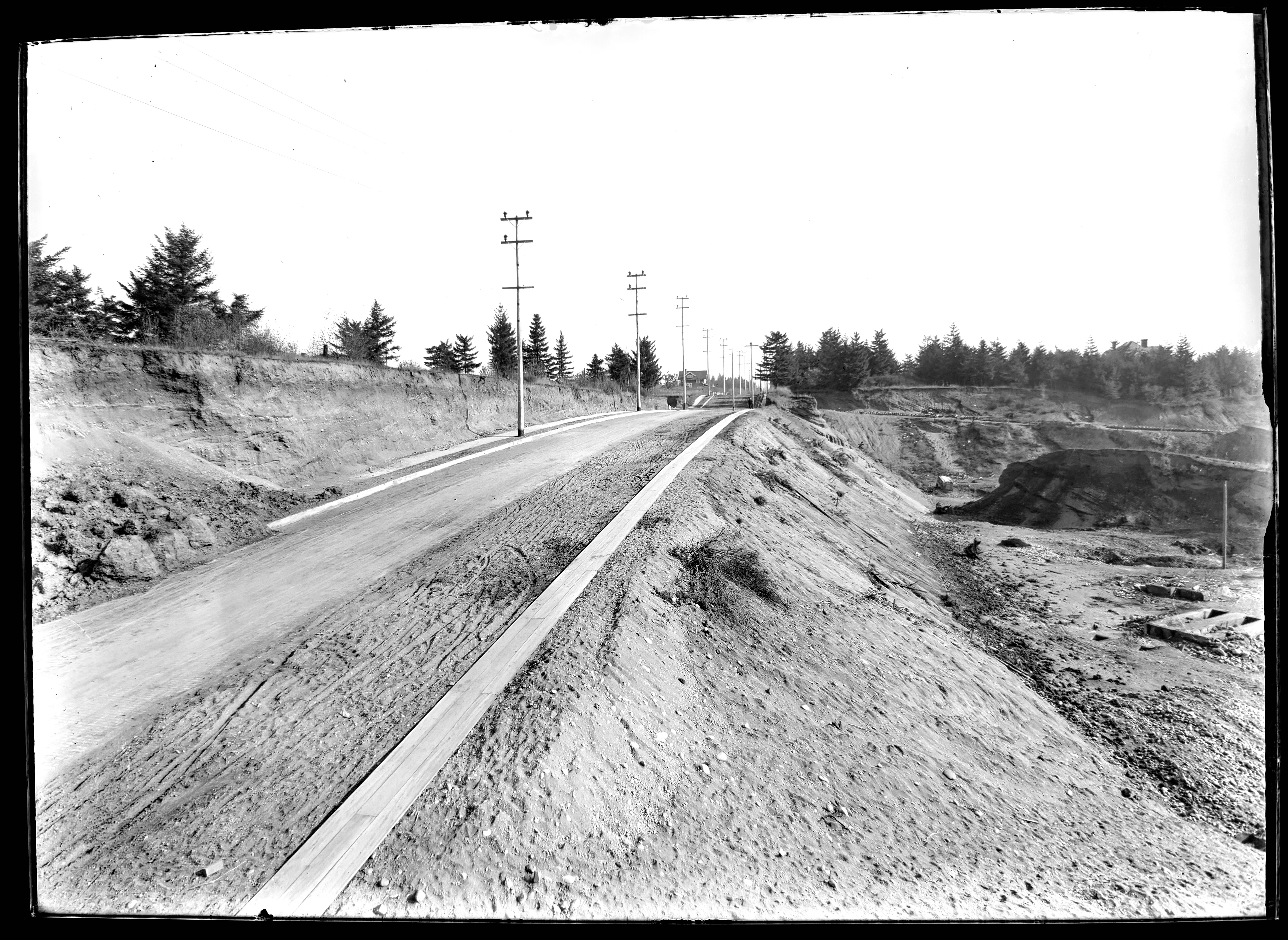
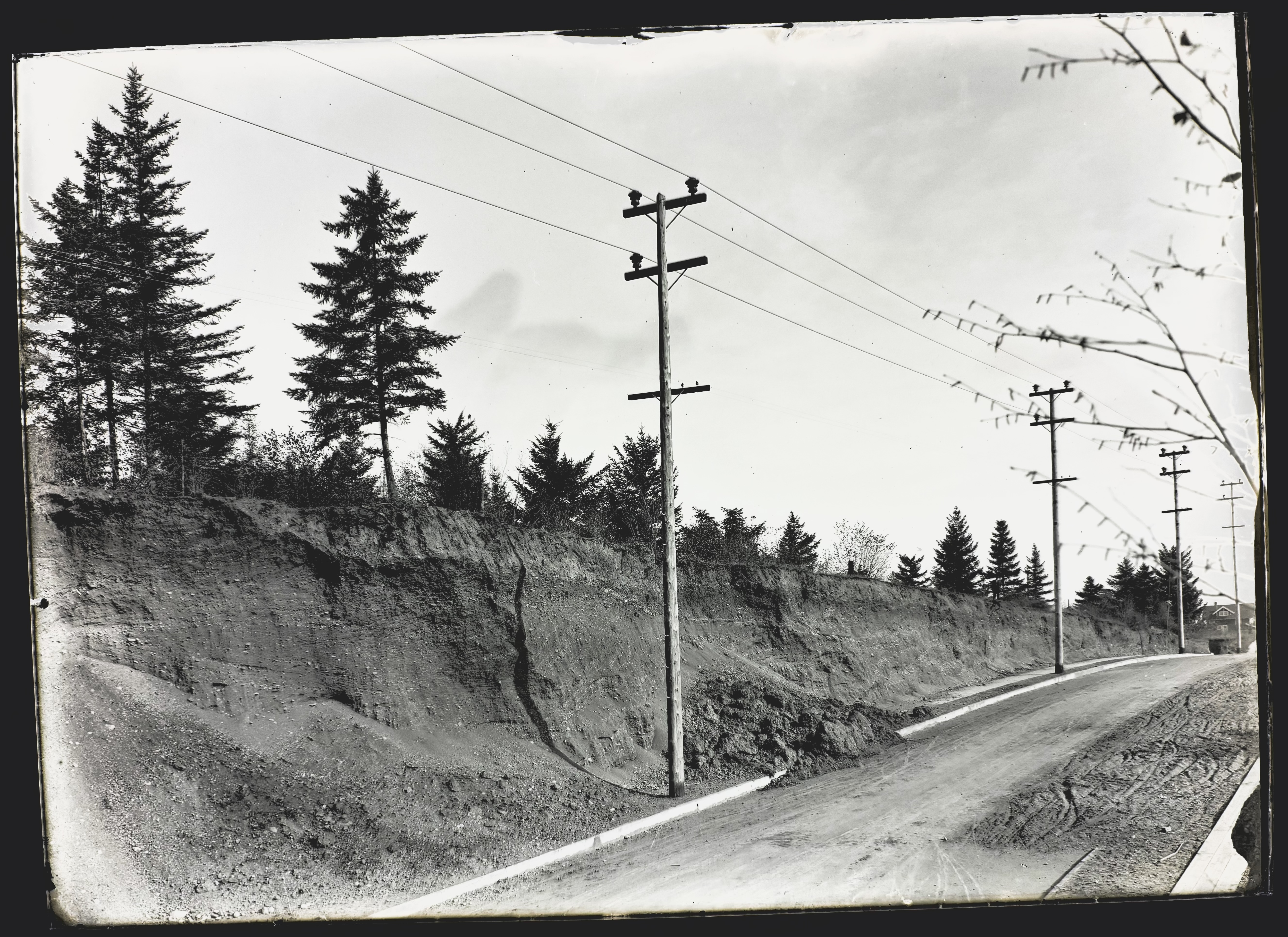
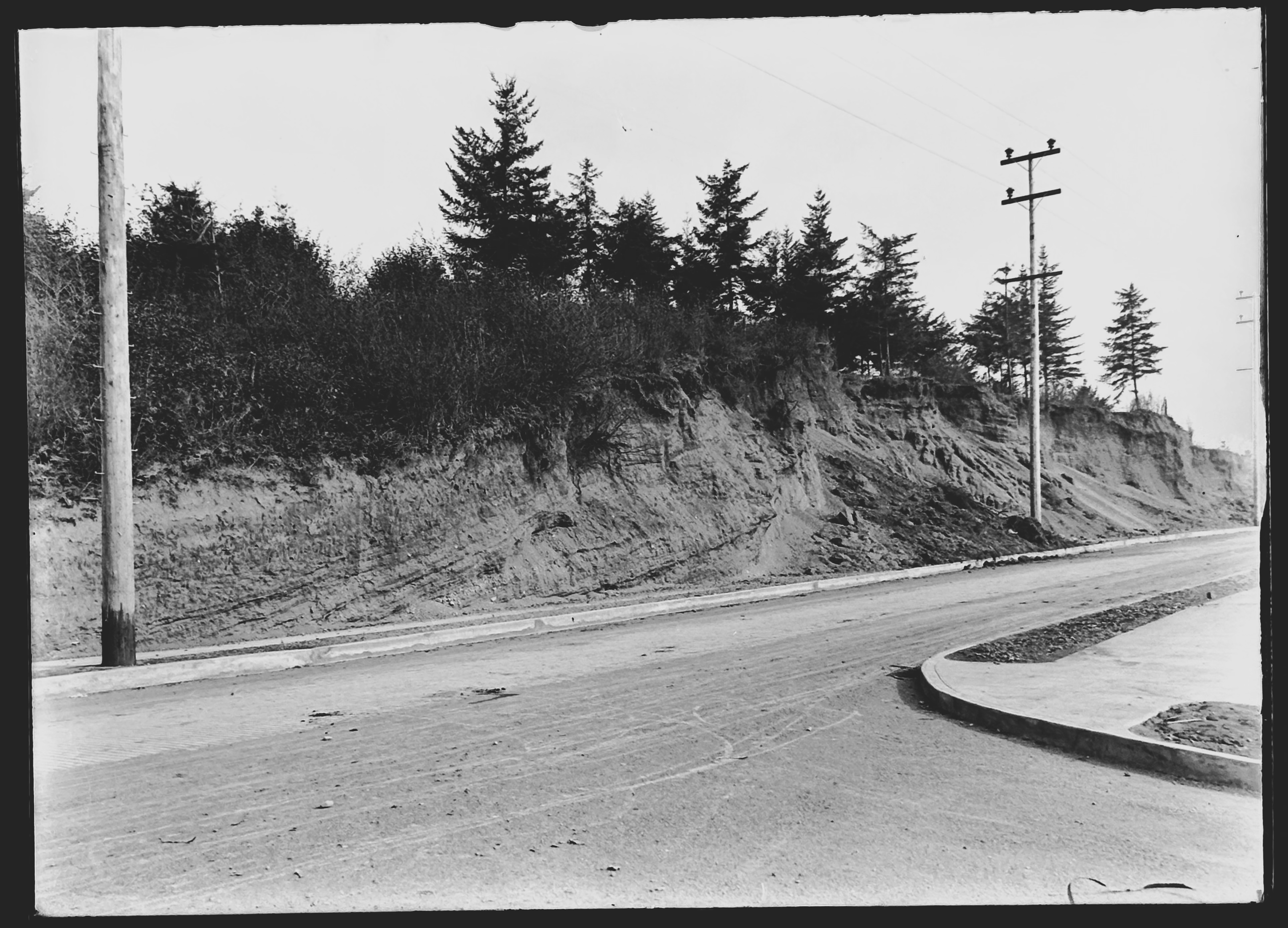
The cutbank slope above Fremont angled up 50-75 feet to the southern edges of the brand-new Alameda Park and Olmsted Park subdivisions, which flattened out to the north atop Alameda Ridge. With nothing to hold the cutbank in place, dirt and gravel would periodically slide down, covering sidewalks and curbs and spilling out onto Fremont Street.

A Department of Public Works photographer was there to document the slope. These are the last three in the series we’ve been sharing of re-discovered images at City Archives that are labeled as “Lombard Street.”

Moving farther west on Fremont, the photographer noted two other slides that had covered sidewalks and curbs.

NE Fremont Street. Looking east just below the crest of Alameda Ridge, seen from between today’s NE 32nd and NE 31st. Photo courtesy of City Archives, A2009.009.3616.

Fremont Street running left and right, seen from the corner of NE 31st, which leads downhill at bottom right. Looking northeast toward the top of Alameda Ridge. Photo courtesy of City Archives, A2009.009.3618.

Be sure to take a look at this view as well, a low-elevation oblique photo from 1930 that shows the cutbank, the slope below Fremont (now filled with garbage and grown over with brush) and lots of other neat things to look at.

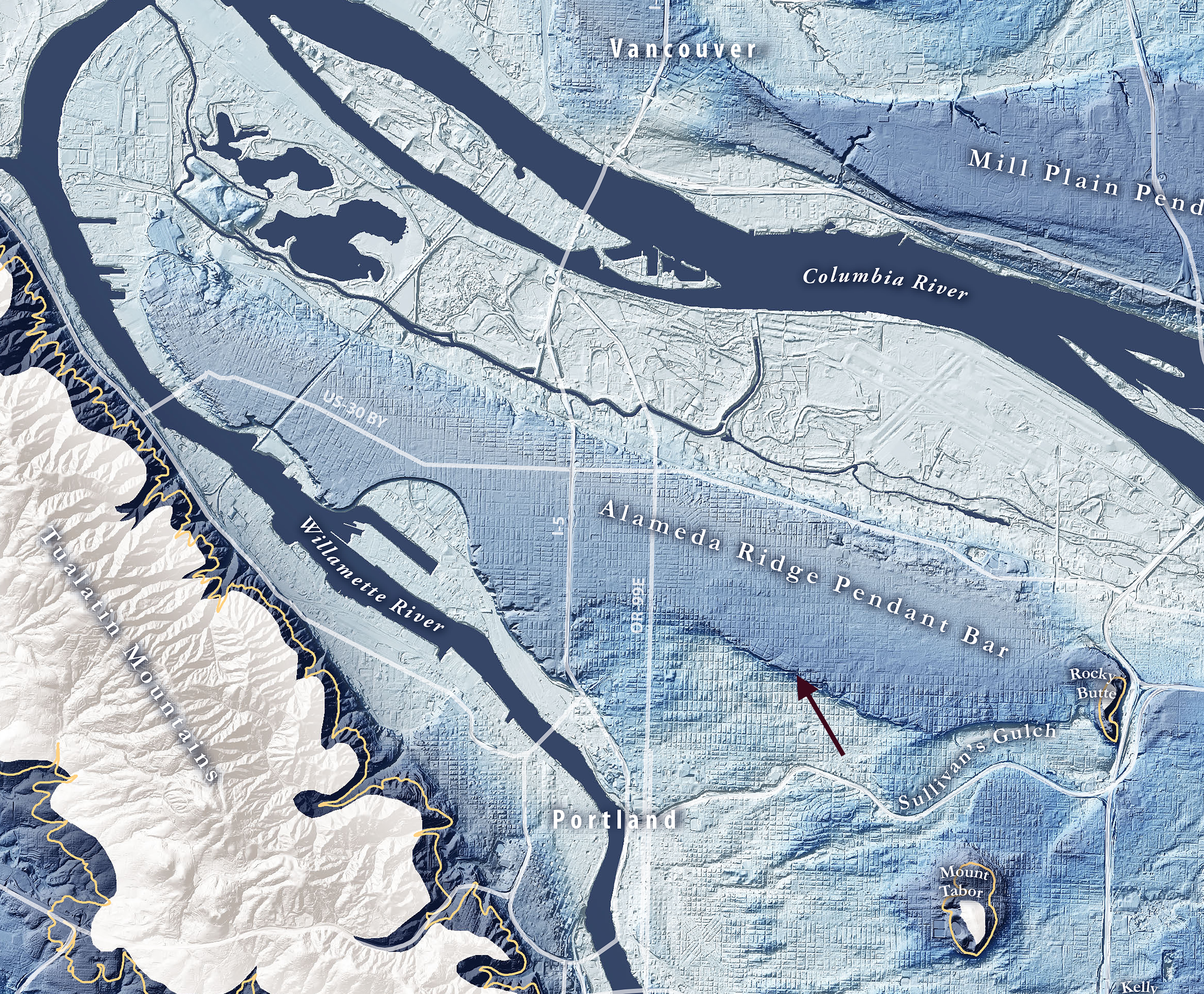
No big surprise both slopes were on the move. Geologists remind us Alameda Ridge is basically a giant gravel bar, deposited more than 15,000 years ago by the great Missoula floods that shaped our region. In the years after these photos were taken, vegetation returned to the cutbank slope and houses (and stairways) were built, increasing the surface stability.

Attentive reader and friend of Alameda Brian Rooney tracked down a great graphic that shows the east-west pendant gravel bar of Alameda Ridge that formed downstream (west) of Rocky Butte during the great floods. Helps visualize the old “Gravelly Hill” ridgeline. The arrow points out the intersection of 33rd and Fremont:

A detail from a comprehensive poster explaining the Missoula Floods by the Oregon Department of Geology and Mineral Industries. Thanks Brian!

Up Next – A bonus photo from Public Works: the Columbia Slough in 1913.

1913 Photos: The Alameda Stairs

Two 112-year-old public stairways, known today for their role in fitness regimes as well as shortcuts to and from Alameda Elementary School, were once frontrunners of change in what had been rural northeast Portland.

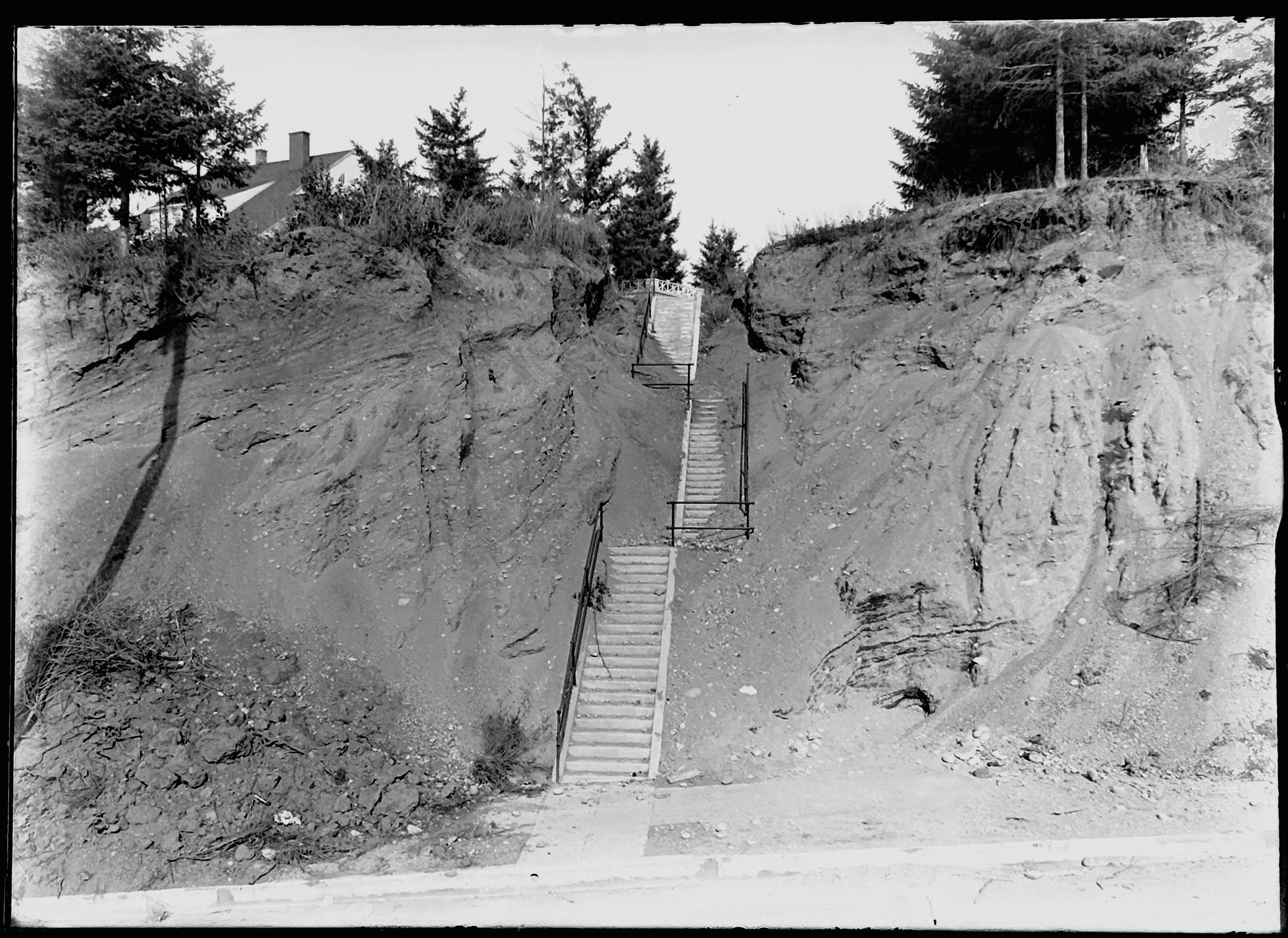
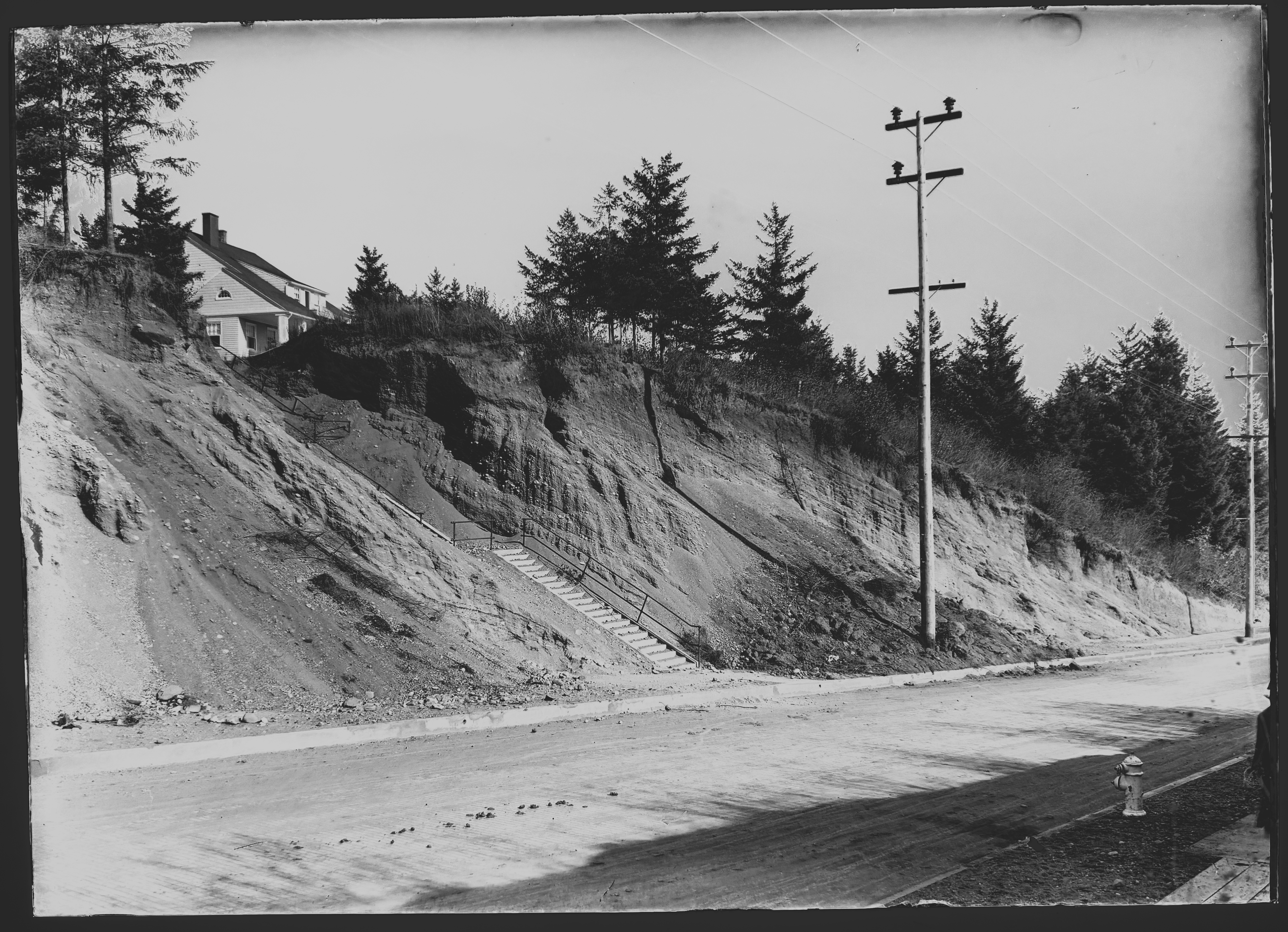
The stairways were built in 1912 by Warren Construction Company, concrete flights anchored into the slope of the ridge, connecting the brand-new Olmsted Park subdivision above with early Fremont Street and what developers hoped would eventually be new neighborhoods below. When built they seemed precarious and tentative, hanging out on rugged cliff-like hillsides above Fremont Street, a giant gravel pit just below. See for yourself:

Fremont Street looking due north showing steps leading down from Alameda Terrace, 1913. House at left is 3251 NE Alameda Terrace. Today these steps land just west of NE 32nd Avenue. Directly behind the photographer was a gravel pit that stretched downslope to the south beyond today’s Klickitat Street and spanned from NE 33rd to NE 31st. Photo courtesy of City Archives: A2009.009.3621.

Fremont Street looking northeast showing steps leading down from Alameda Terrace, 1913. Today these steps land just east of NE 30th and Fremont. House at left is 3251 NE Alameda Terrace. Photo courtesy of City Archives: A2009.009.3635.

A photographer from the Department of Public Works visited the area in December 1913 and may have been following up on concerns from developers and new homeowners about the stability of the slope above and below Fremont in the stretch between NE 30th and NE 33rd. The glass plate negatives he brought back have been at rest since, identified as “Lombard Street” at City Archives. The newly re-discovered stairway images join photos of the giant gravel pit at NE 33rd and Fremont, and photos of the actual intersection in its early development days that we’ve been sharing here, with a few more to come.

The house pictured in both photos still stands today. In 1912, it was one of just a few homes on what was then known as Woodworth Avenue, but is today known as Alameda Terrace, built that same year by Samuel J. and Dorrie Mae Claridge. Over the years, other adjacent houses were built, steadying the slope and giving the stairs purpose connecting neighbors with their neighborhood.

Despite a deep search of early newspapers, city contracting documents and city ordinances, little remains to tell the story of their early construction. When built in 1912, most Portlanders relied on walking and streetcars to get around, and horses to move freight. A dispersed system of public stairways just made sense, particularly up and down landscapes like Gravelly Hill (today’s Alameda Ridge).

The 30th Avenue stairs were noted in the May 1981 citywide Historic Resource Inventory, called out for their significance related to landscape architecture and their role in development of the neighborhood. In the inventory, they’re labeled as “Olmsted Park Public Right of Way.”

Today, these stairs, along with others that span the ridge as it transits northeast Portland, appear in many city exploration guides, including a notable book written by Laura O. Foster called appropriately Portland Stair Walks.

We recommend them as part of your regular history walk regime!

Up next: three 1913 views of mini-landslides on this same slope just above Fremont.

1913 Photos: Dueling Subdivisions at NE 33rd and Fremont

To really understand the next installment of photos from the 1913 collection, it helps to visualize what the middle part of Portland’s eastside looked like then, and what was going on in the economy and life of the city. Following the Lewis and Clark Exposition, which put Portland on the map in so many ways, our population exploded: from 90,426 people in the 1900 census, to 207,214 by 1910.

Like shock waves rippling out across what had been a mostly agricultural landscape, development pressures began to reshape the dirt roads, orchards, dairies and forested clumps of the middle eastside. Meanwhile the economy began to heat up in the early teens as speculators, home buyers and homebuilders jockeyed to take advantage of the growing marketplace. Maps and a few precious photos from the early 1900s show this place as mostly undeveloped open lands, dotted with barns, scattered farm houses and dirt roads.

By 1913, the fields and hills of the middle eastside had been platted out into subdivisions, and the infrastructure of sewer, water, electricity and roads was trying to catch up with the vision sold by developers. In some places, a grid of streets existed, and a sprinkling of single family homes was being built, making visible the conversion from agriculture to residential use. To the north closer to Alberta, construction had been underway since the middle of the 00’s. Eastside neighborhoods closer to the river–Albina, Irvington, Ladd’s Addition, Woodlawn, the Peninsula–had been platted and growing as early as the 1890s.

Back in the day, the intersection of NE 33rd and Fremont–the focal point of this 11-photo series of glass plate negatives from City Archives–was a north-south wagon road to the Columbia River, and access point for the giant gravel pit near the top of the ridge. Surrounded on all sides by planned development, the intersection was in transition from dirt path to thoroughfare.

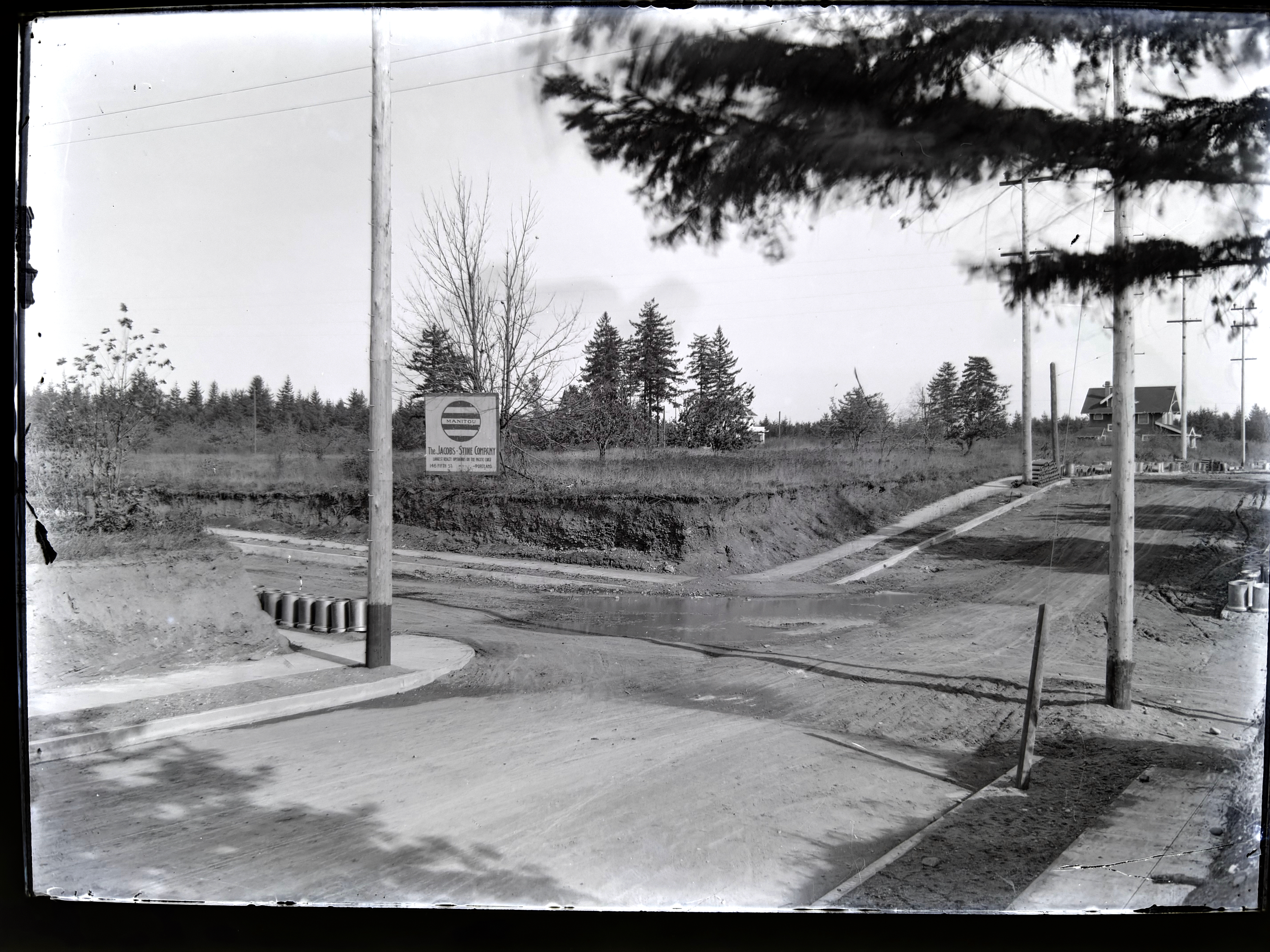
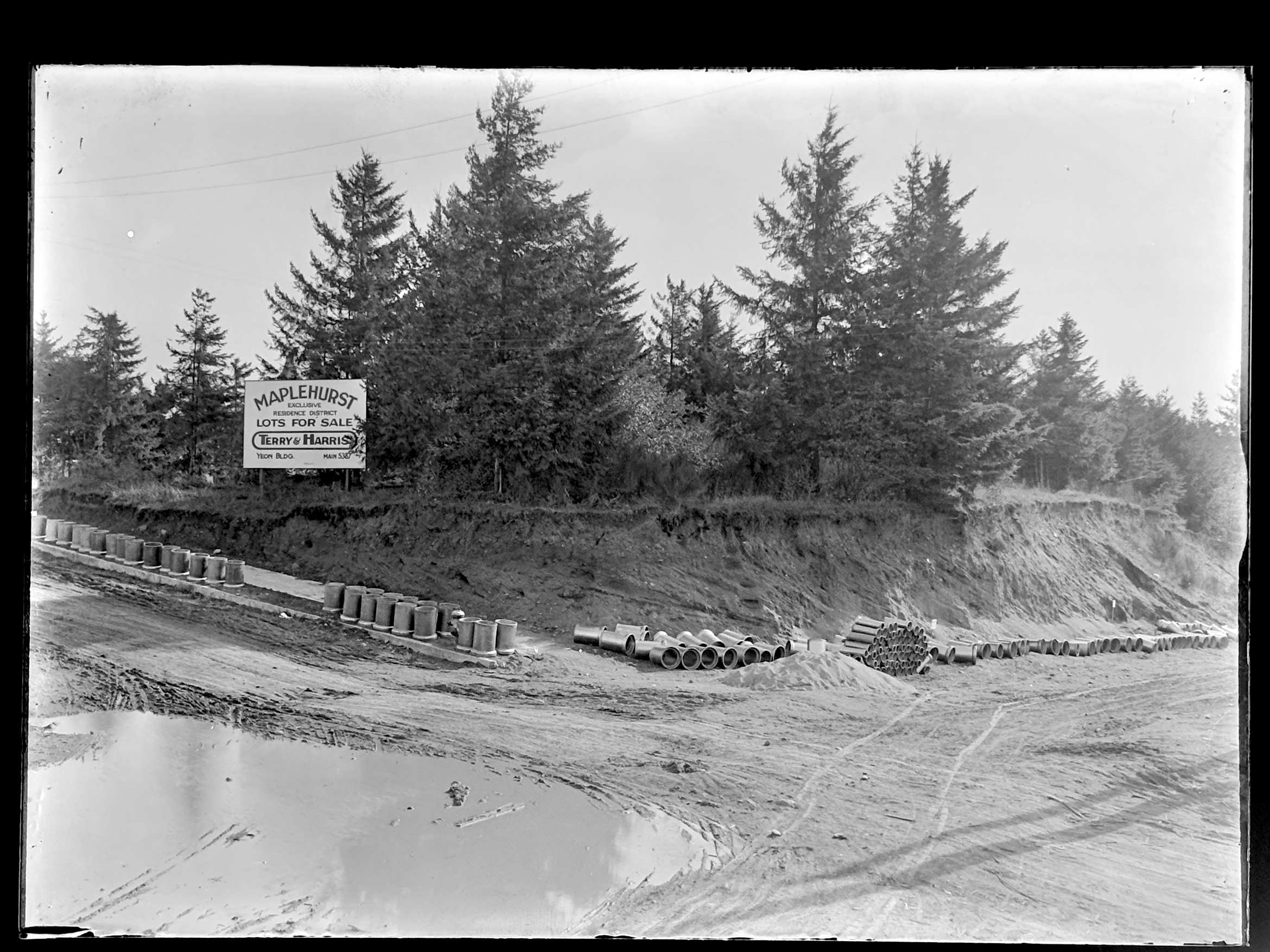
On the northeast side of the intersection, the Jacobs-Stine Company was ready to sell you a lot in the Manitou Subdivision. Just across Fremont to the southeast, the Terry & Harris Company wanted you to see the lots in Maplehurst. Our photographer from the Department of Public Works captured both views. Meanwhile, the mud puddle in the middle of the intersection reminded everyone the reality that for the moment, this was still a fairly rural place.

Looking to the northeast along Fremont from the southwest corner of NE 33rd and Fremont (33rd is passing from upper left to lower right). The house in the distance at right is today’s 3415 NE Fremont (built in 1912). Curbs and sidewalks are in (thanks to Elwood Wiles and Warren Construction), and ceramic sewer pipe is stacked near the curb awaiting installation. The Jacobs-Stine Company, boasting on its sign of being “The largest realty operators on the Pacific Coast,” was owned in part by Fred Jacobs, who would later die when his car tumbled off Stuart Drive in Alameda a few blocks from here, giving rise to the nick-name of that street as Deadman’s Hill. Photo courtesy of City Archives, image A2009.009.3613.

Looking to the southeast from the northwest corner of 33rd and Fremont. 33rd runs down the hill on the right. Fremont follows the slight rise to the left as it heads east. Sewer construction is evidently about to begin. Photo courtesy of City Archives, image A2009.009.3614.

Left photo is similar to top, looking northeast. Right photo is similar to bottom, looking southeast.

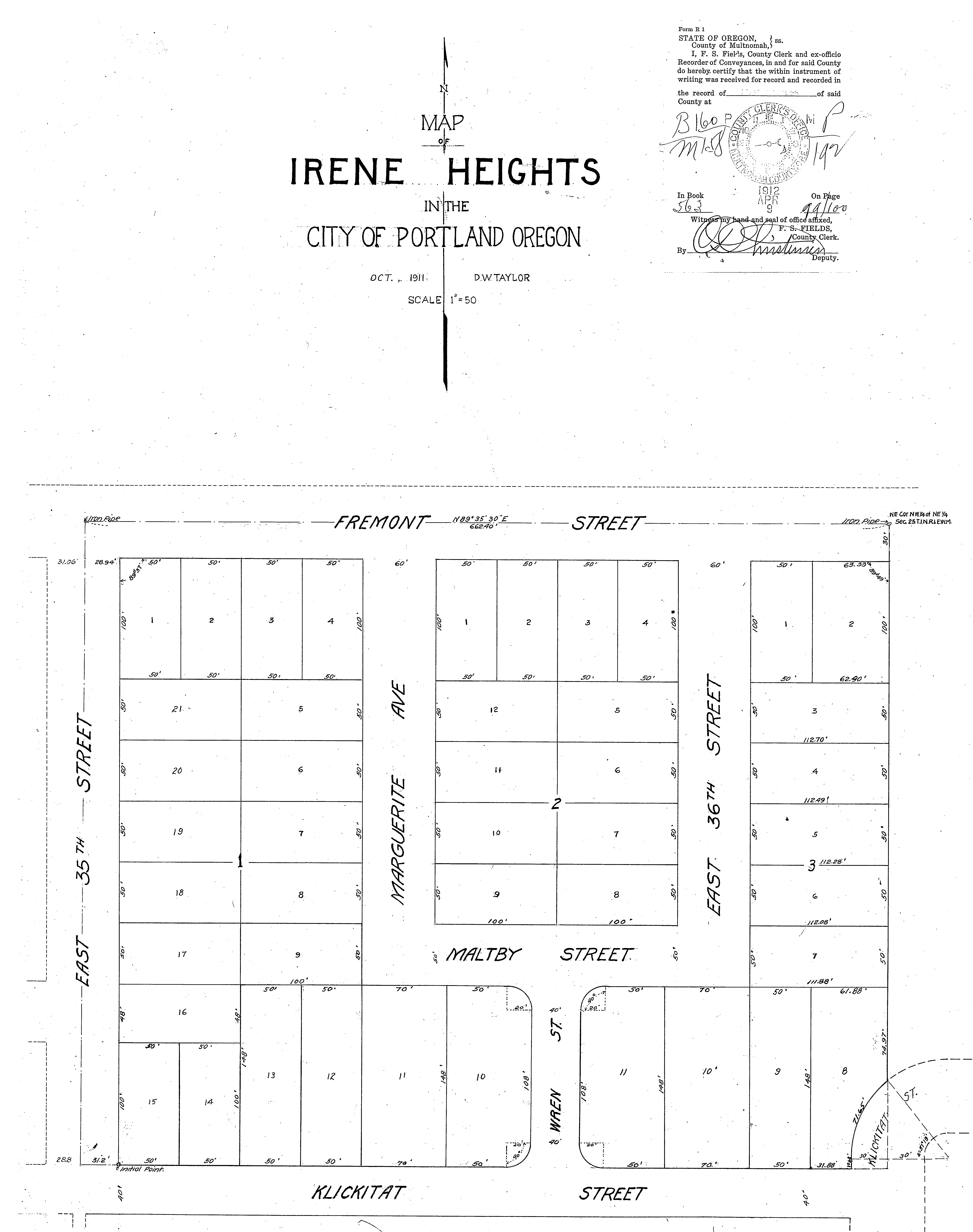
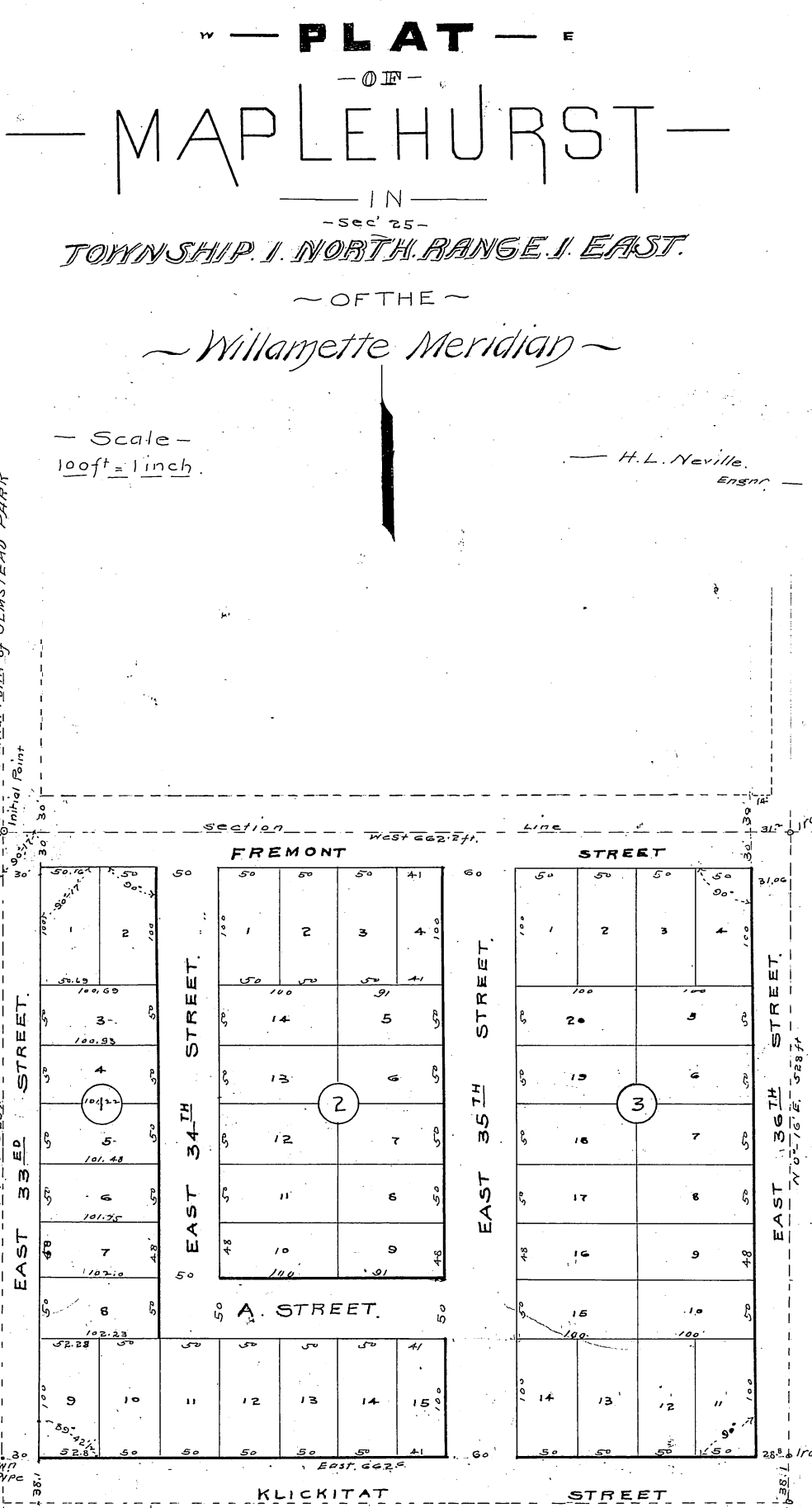
Maplehurst was platted in 1910 by Mary Beakey, who named a street for her family (labeled as A Street on the plat). It’s a relatively small subdivision–only three blocks and 43 lots, and exists up against a plat called Irene Heights, which was developed by the Barnes family, containing the Barnes mansion and multiple former Barnes family homes.

NE 33rd wasn’t the only north-south thoroughfare passing through a landscape in transition. One half section to the east (our landscape was gridded into sections, townships and ranges by surveyors in the 1850s), NE 42nd Avenue was experiencing its own growing pains.

Up next: The Alameda stairs. Our Department of Public Works photographer captured the brand-new stairways transiting the slope between Fremont and Alameda Terrace (known as Woodworth before the Great Renumbering of the early 1930s).

1913 photos reveal new perspective at Gravelly Hill – 33rd and Fremont

Every now and then in my research, I’ll find something—a memory, photograph, map or  document—that really sticks with me and defines the way I think about a place.

This month I found a batch of mis-identified photographs when searching at City of Portland Archives that resulted in an absolute jackpot from 1913, opening a fresh window into the past near NE 33rd and Fremont.

Once known as Gravelly Hill, the area was indeed a gravel pit for many years in the late 1800s, and later the repository for all of the eastside’s household garbage between 1923-1924, then known as the Fremont Sanitary Landfill.

But before the landfill, back in 1910 as subdivisions crowded in around the big pit, questions were raised about the basic stability of Fremont Street, which was just below the brow of the Alameda ridge and ran right along the north edge of the pit. Developer Benjamin Lombard, who platted the adjacent Olmsted Park about that time, even sued the city for violating its own ordinance about gravel pits.

So, no secret: that slope South of Fremont was a gravel pit.

But as it turns out, it wasn’t just a gravel pit. It was a GIANT gravel pit. See for yourself:

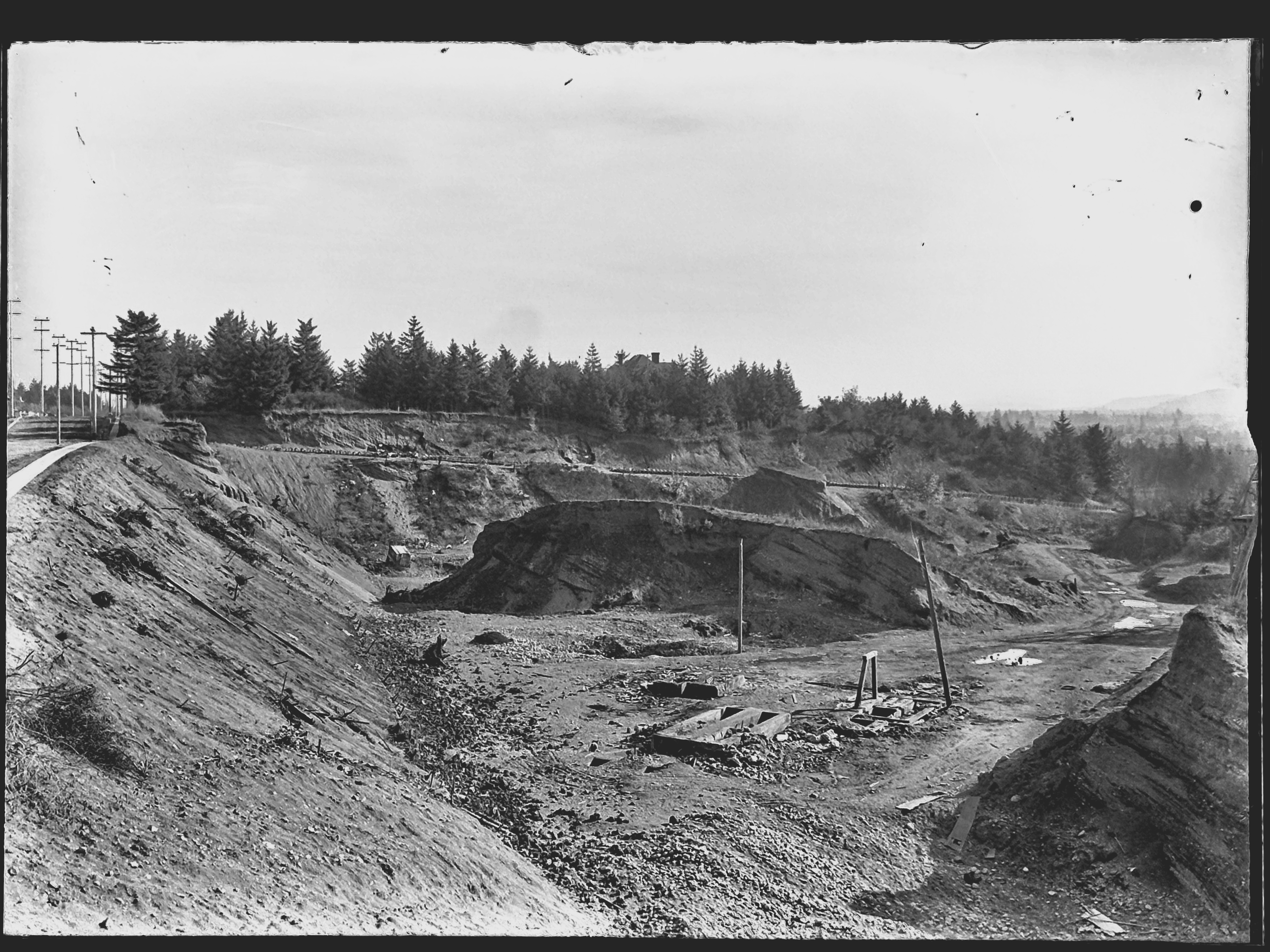
You’ll want to click into this for a good look. Looking east along Fremont toward NE 33rd from about today’s NE 32nd Avenue. Sewer pipe stacked along the eastern edge of NE 33rd, which slopes downhill left to right. The roof of the house visible at treeline in the center is the Barnes Mansion, 3533 NE Klickitat, which was then brand new. City Archives Photo: A2009.009-3611 (mislabeled as Lombard Street)

In 1913, a photographer for the Department of Public Works visited the pit and brought back 11 amazing images that got buried in the archives. They’re large-format glass plate negatives, not prints, and for years have been filed away in envelopes under “Lombard Street” at City Archives. I suspect few people have ever seen them. A few weeks back, something else I was looking for led me to these glass negatives.

I photographed each plate and made positive prints to be able to better visualize the scenes. And as I studied that first picture and figured out it wasn’t showing Lombard Street, but Fremont Street, I knew this would be a find to remember.

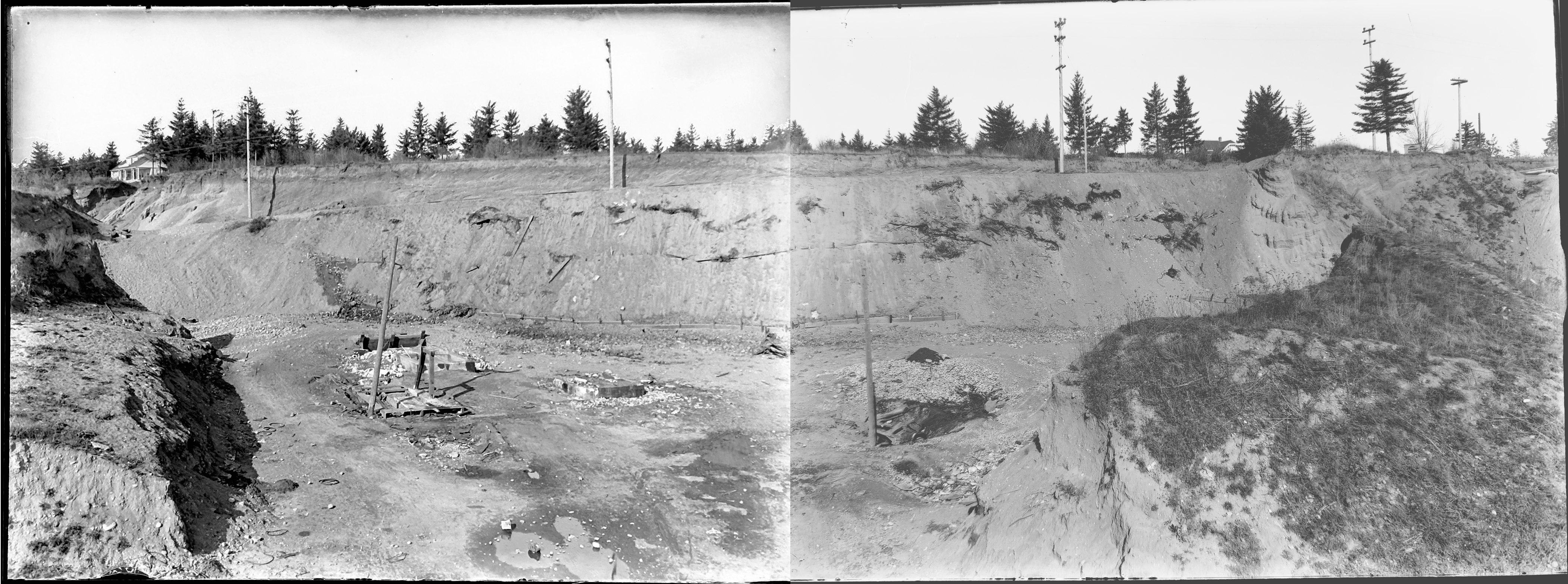
After that first photo, there were these next two, clearly taken as a pair, to illustrate the depth and breadth of the pit. Both are unquestionably tied to the Gravelly Hill landscape. Here I’ve melded them together to create a single image:

Looking north into the gravel pit at NE 33rd and Fremont, December 1913. Click to enlarge. View would be from between today’s Siskiyou and Klickitat streets, looking uphill. The house at far left is today’s 3251 NE Alameda Terrace. The house at far right is the top of today’s 3305 NE Alameda. A sign is visible at upper right for a new subdivision, placed in the cutbank on the northeast corner of 33rd and Fremont. Segments of sewer pipe are visible stacked there. Today, the pit is filled with three city blocks and more than 50 homes. City archives photos, left: A2009.009.3619; right: A2009.009.3620.

Here’s a bit more context from neighborhood historian R.A. Paulson, writing in The Community Press on October 1, 1975:

“From the earliest recollections of those familiar with the area, this was a worked out gravel pit, the excavation of which had been finished many years before but still showing the signs of one-time activity. As late as 1919 and 1920, the pit formed a precipice going down sharply from near Fremont possibly 100 feet or so to the level of Klickitat and extending between 32nd place and 33rd Ave. Coming from the west, Kllickitat Street was unpaved east of about 29th with the cement sidewalks ending there but even between 26th and 29th these sidewalks were impassable because of the overgrown bushes and small trees.


“The gravel pit had been a lush source of rock and gravel for someone way back and the solid bank of this material had originally sloped down from Fremont at the same grade as the present 33rd Ave. This had been scooped out over a period of perhaps 50 years or more and most likely went into improving the lanes, roadways and public highways for miles around, certainly for the country roads that became 33rd Ave. and Fremont Street.


“The bed of the pit showed evidence that work and even habitation had gone on there but at the time of World War 1, only a monolith of stone, too difficult to remove with pick and shovel, reared upward from the new level.”

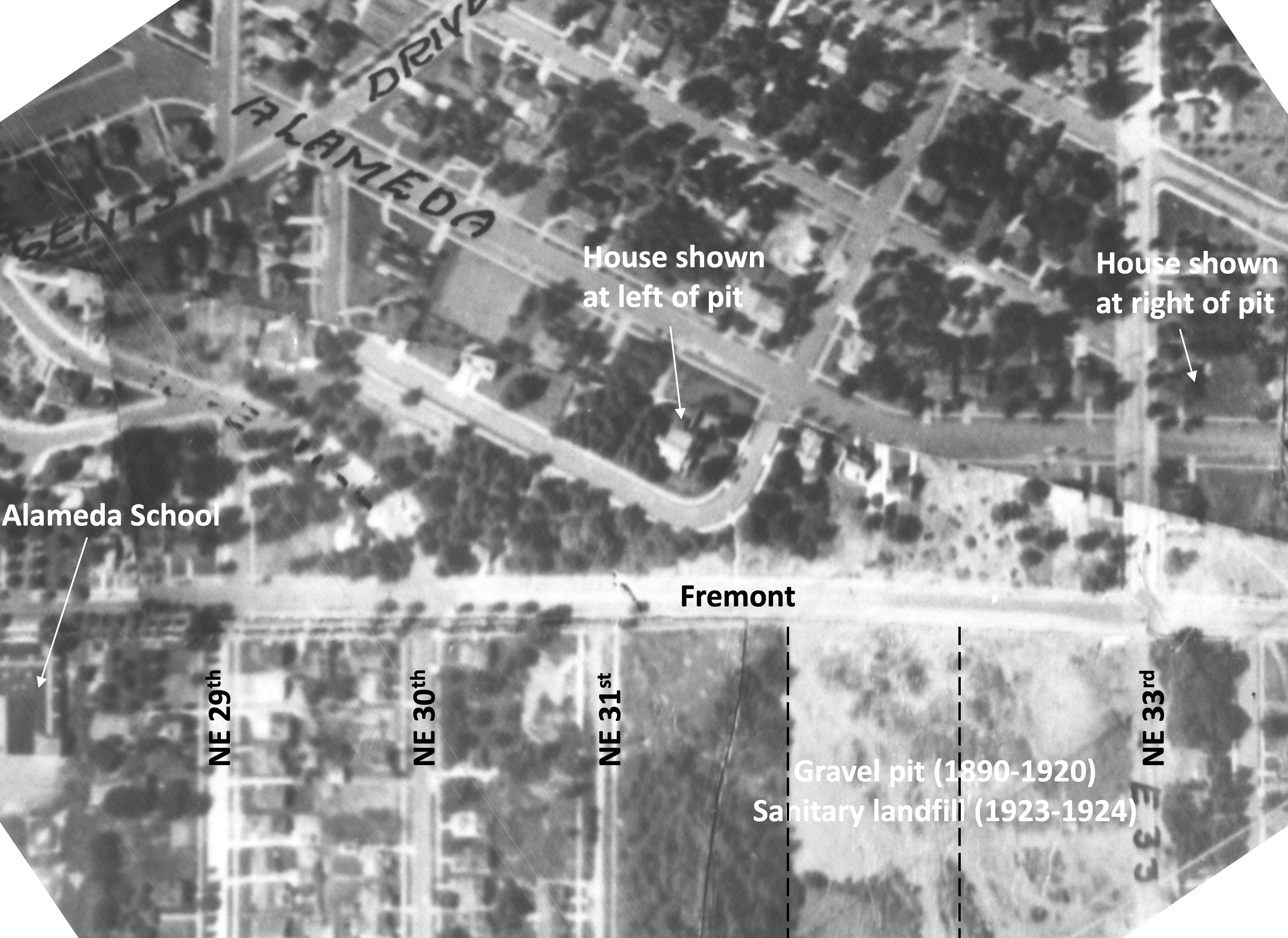
Here’s a detail from a 1925 aerial photo that shows the extent of the pit and the still-forming street infrastructure. The pit covered two-plus blocks, from NE 33rd to NE 31st, between Fremont and Klickitat.

Detail from a 1925 aerial photo showing the intersection of Fremont and 33rd, labels added for reference. Dashed lines indicate eventual location of NE 32nd Place and NE 32nd Avenue. Click to enlarge. Aerial photo courtesy of City of Portland Archives.

Stay tuned for eight other gems in this collection that are just as knock-your-socks-off amazing as these three. Next up: we’ll take a close look at the intersection of NE 33rd and Fremont 111 years ago, absolutely recognizable to today’s eye.

When the Columbia River froze

This summer we’ve been sharing some of the interesting photos from the von Homeyer collection: a big batch mostly of family photos from the late 1890s through the 1950s. Everything from glass plate negatives to Brownie snapshots. The von Homeyers liked to take pictures!

Mingled in the collection are images of interesting places or moments that piqued our curiosity and got us wondering: when – where – what?

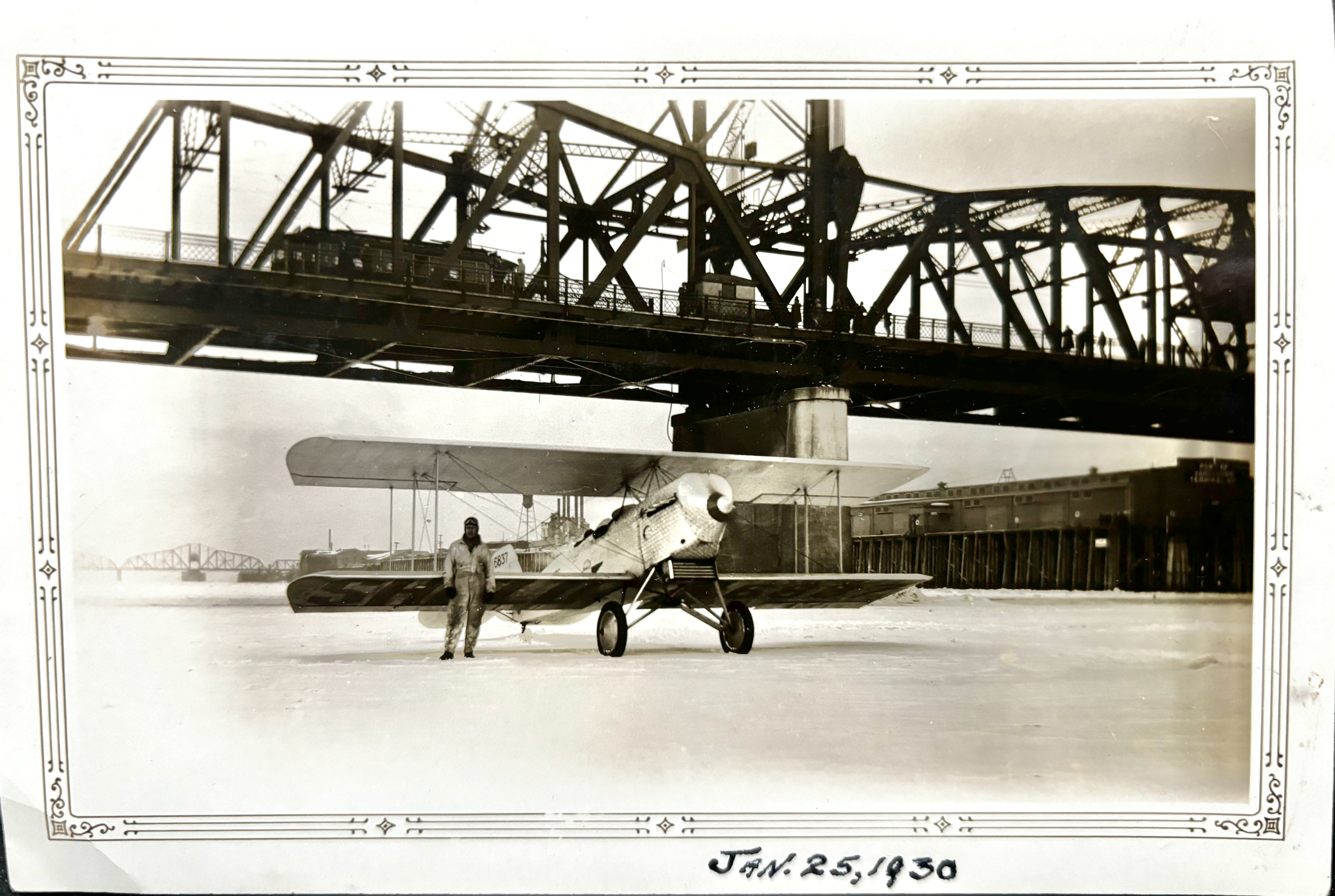
Here’s couple of winter images that led to a bit of old newspaper sleuthing. When we first saw this we thought: Broadway Bridge? But on second look, the setting and the structure didn’t seem right. Of note: the streetcar passing on the decks overhead. The date seemed important to the photographer and it turned out to be a helpful clue.


From the Oregon Journal, January 26, 1930.

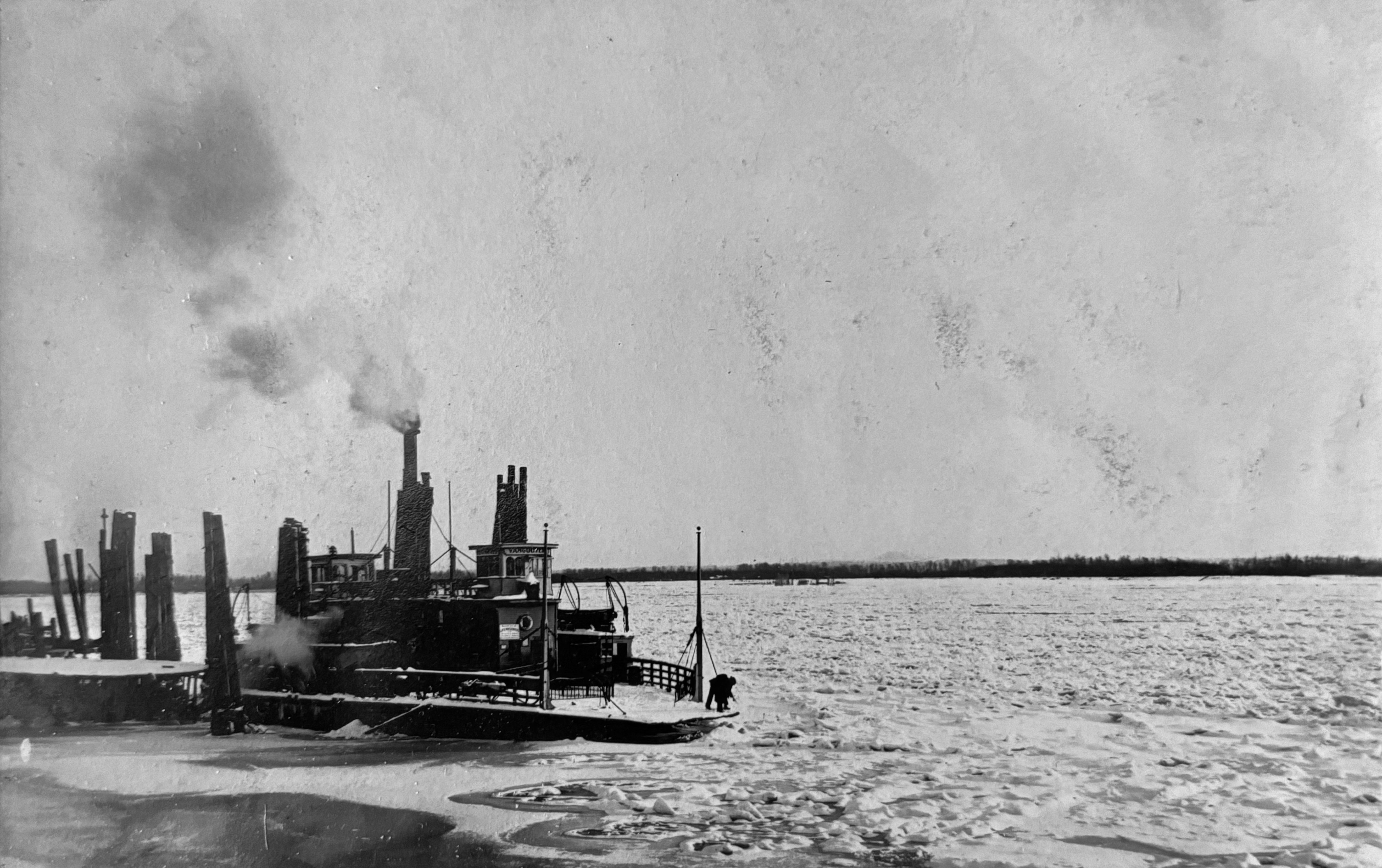
According to the Vancouver Columbian newspaper, it wasn’t so unusual for the Columbia River to freeze over completely, including the “Big Freeze” of 1909 that halted commerce, mail delivery and ferry traffic across the Columbia between Vancouver and Portland.

Hans von Homeyer captured this view of the ferry Vancouver and the frozen Columbia River in January 1909. With no bridge (it came along in 1917), and no ferry service to towns both upstream and downstream, frigid winter weather in January 1909 caused hardship throughout the frozen region.

Here’s a deeper history of ferry service between Vancouver and Portland, from the Clark County Historical Society.

Hard to imagine from the sunshine and warmth of this t-shirt summer, but snow and ice will return.