River History kicks off scheduled summer programs

It’s not too late to sign up for one of the programs we’re doing for the Architectural Heritage Center this summer, kicking off this Saturday morning with a program at AHC focused on Portlanders’ historic connection with the Willamette River.

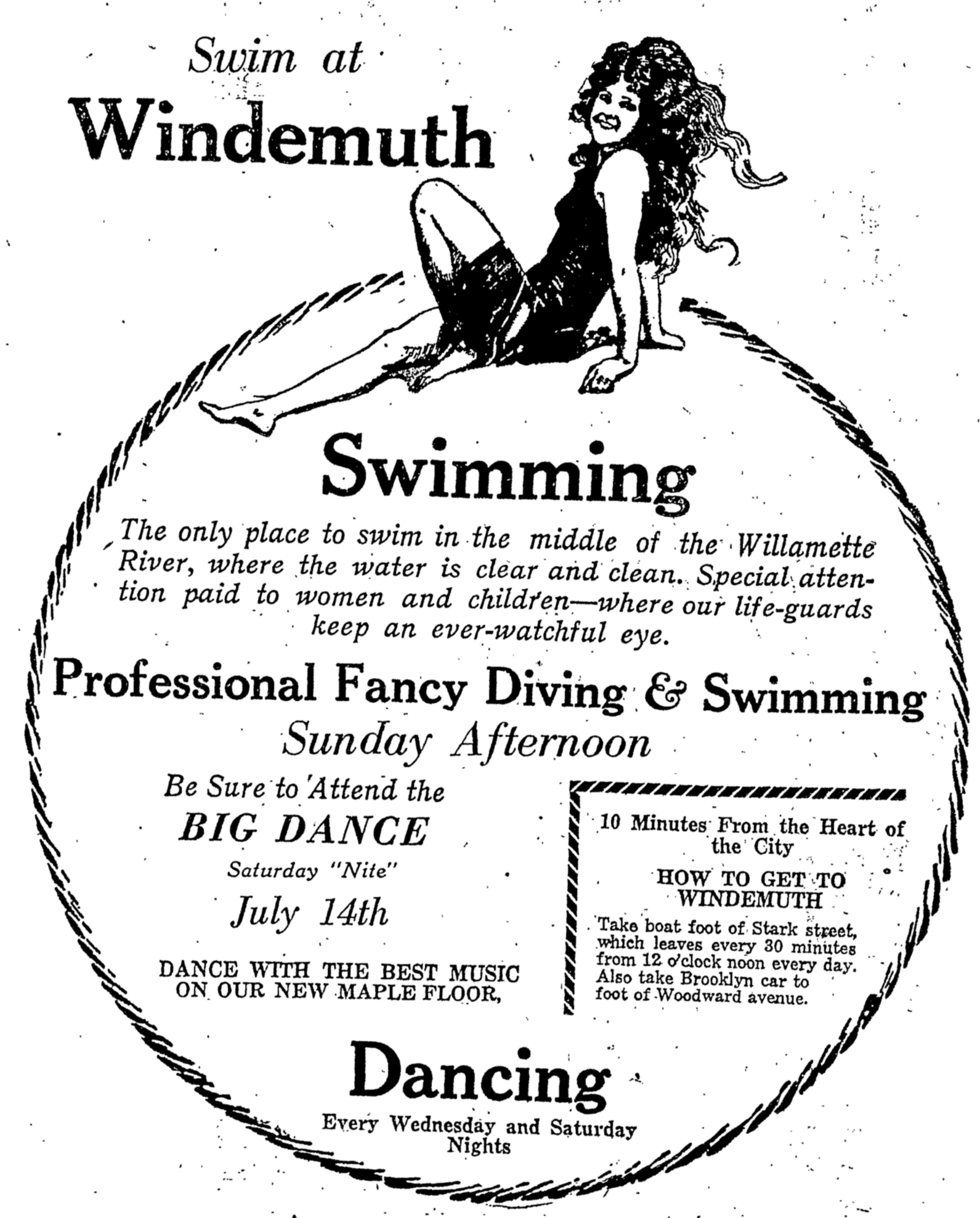
Saturday, May 10th from 10:00-11:30 we’ll explore the colorful history of Portland’s southeast waterfront in the vicinity of Ross Island, where Portlanders flocked to two hugely popular swimming and waterplay venues: Bundy’s Baths and Windemuth. We’ve written about these here on the blog and will be delivering a program with photos, maps and stories that help bring these former Portland water recreation mainstays back to life. Program based at AHC, 701 SE Grand, Portland.

Vernon Walk – Thursday, June 5th from 6:00-8:00 p.m. we’ll be leading a history walk that explores the Vernon neighborhood, from development of Alberta Park, to the fall and rise of neighborhood schools, to patterns of redlining from the 1930s-1950s, the presence of a dairy, a much-loved synagogue and a street full of small businesses.

Alameda Walk – Wednesday, June 11th from 10:00-Noon This walk through the Alameda neighborhood will include insights about pre-development conditions, planning and construction of the neighborhood, the Broadway Streetcar, home construction and architectural styles and points of local interest including the story behind Deadman’s Hill and the 1920s uproar over the former Alameda Park Community Church.

To register or for more information about these programs, visit the Architectural Heritage Center online.

1913: Hillside above Fremont on the move

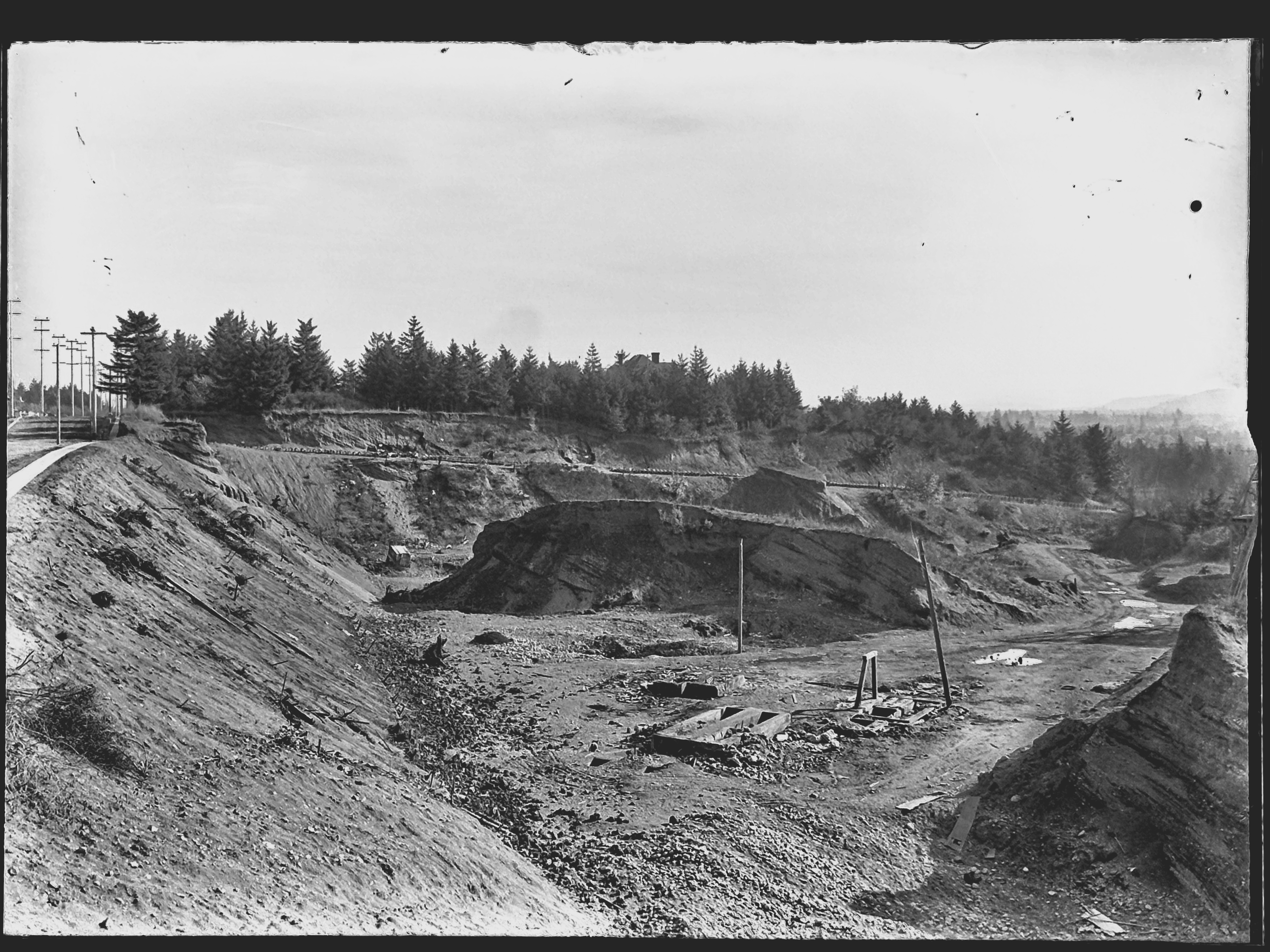
In 1913, nearby property owners and the Department of Public Works were concerned about the stability of the slope above Fremont Street in the stretch between NE 30th and NE 33rd. Fremont itself was perched along the north edge of a giant gravel pit that had been mined for decades and would eventually be filled with garbage to build it back up to grade.

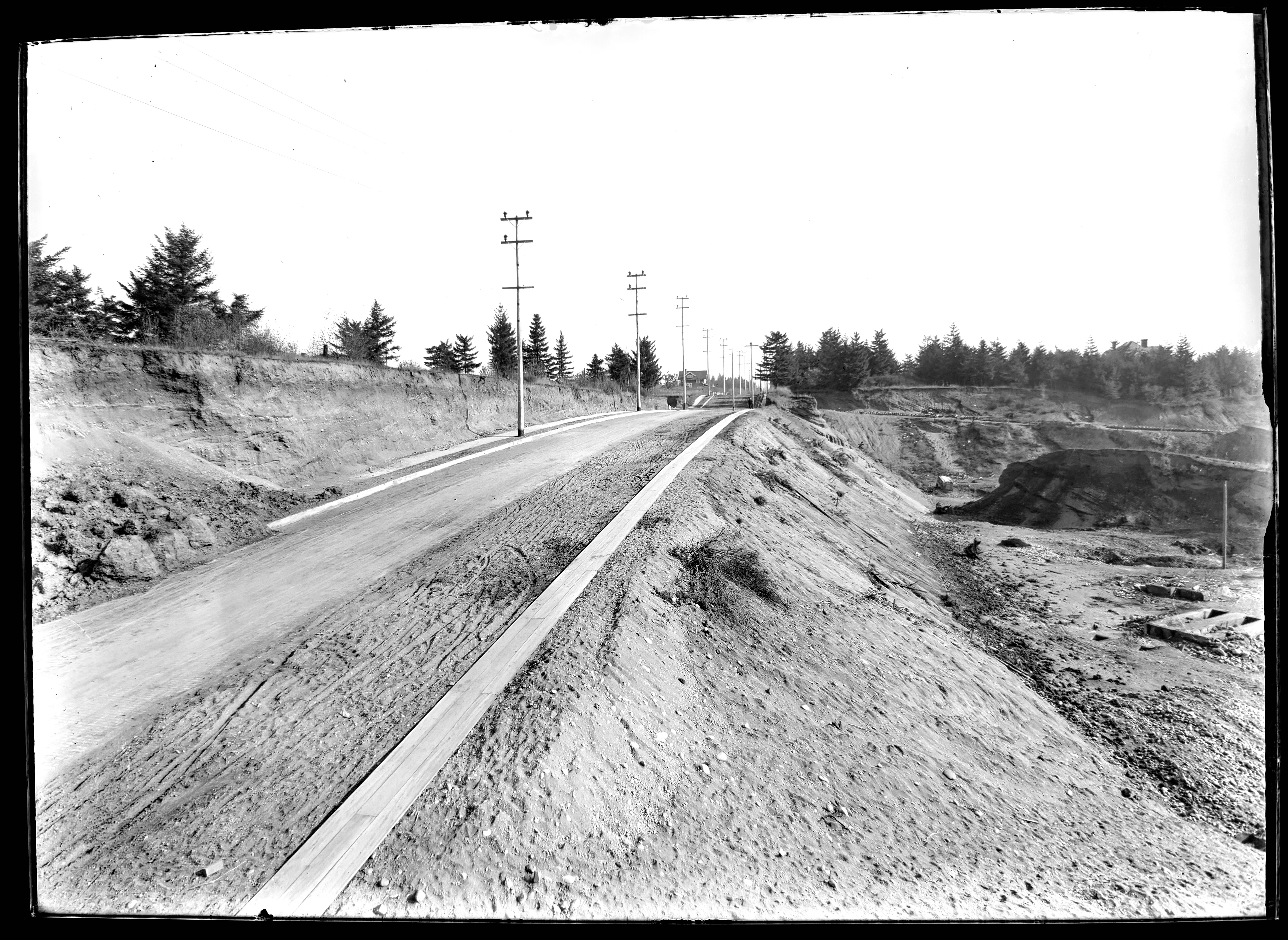
NE Fremont Street looking east near today’s 32nd Place, in 1913. Click in for a closer look. Gravel pit to the right (south) and cutbank above to the left (north). House in the center is 3415 NE Fremont. In the distance, sewer pipe is stacked down the hill along the east side of 33rd and a person faces the photographer at the intersection. A wooden plank sidewalk runs along the south side of Fremont. The gravel and dirt streets were paved the following year. Photo courtesy of City Archives, A2009.009.3615.

The cutbank slope above Fremont angled up 50-75 feet to the southern edges of the brand-new Alameda Park and Olmsted Park subdivisions, which flattened out to the north atop Alameda Ridge. With nothing to hold the cutbank in place, dirt and gravel would periodically slide down, covering sidewalks and curbs and spilling out onto Fremont Street.

A Department of Public Works photographer was there to document the slope. These are the last three in the series we’ve been sharing of re-discovered images at City Archives that are labeled as “Lombard Street.”

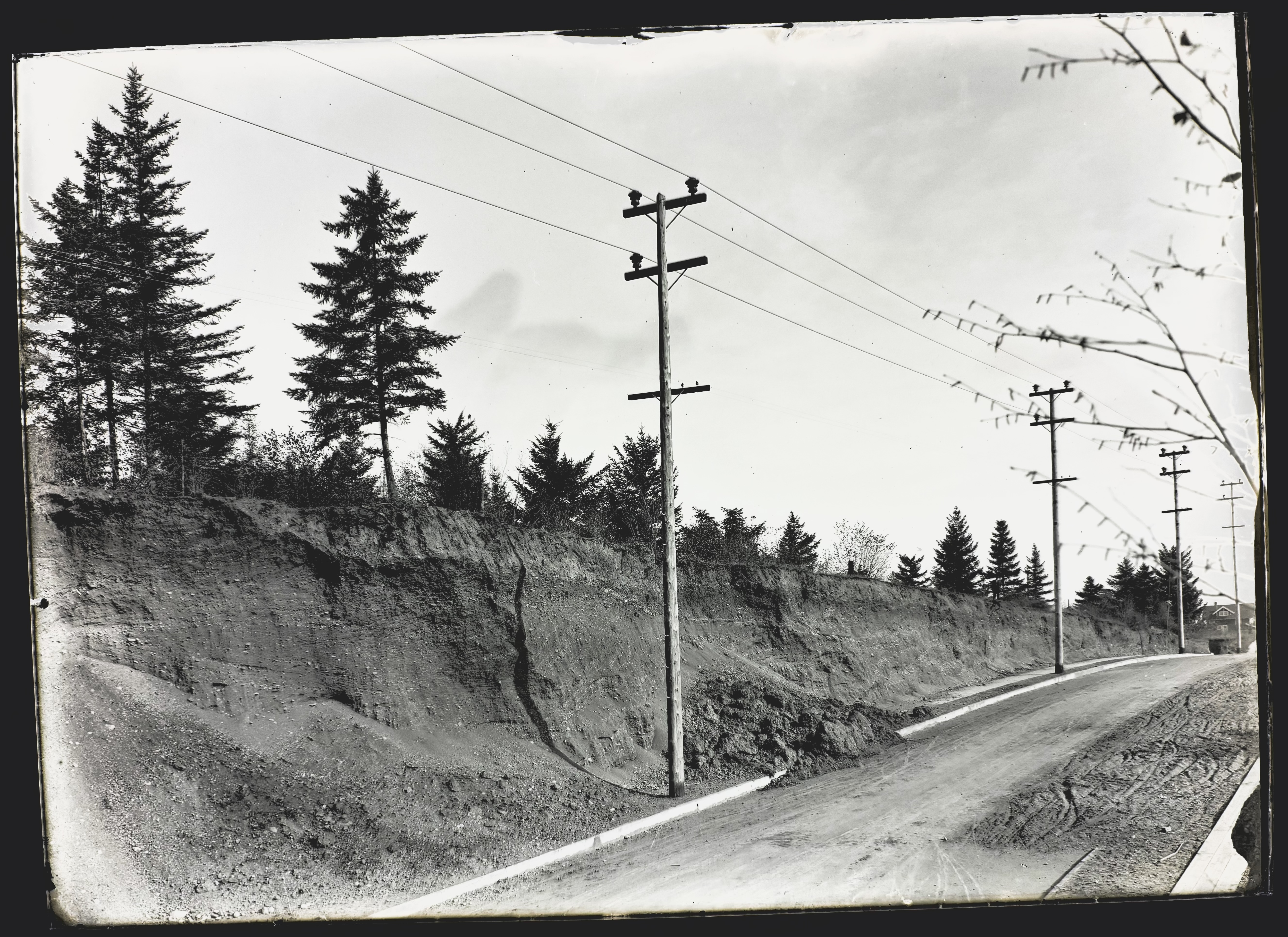
Moving farther west on Fremont, the photographer noted two other slides that had covered sidewalks and curbs.

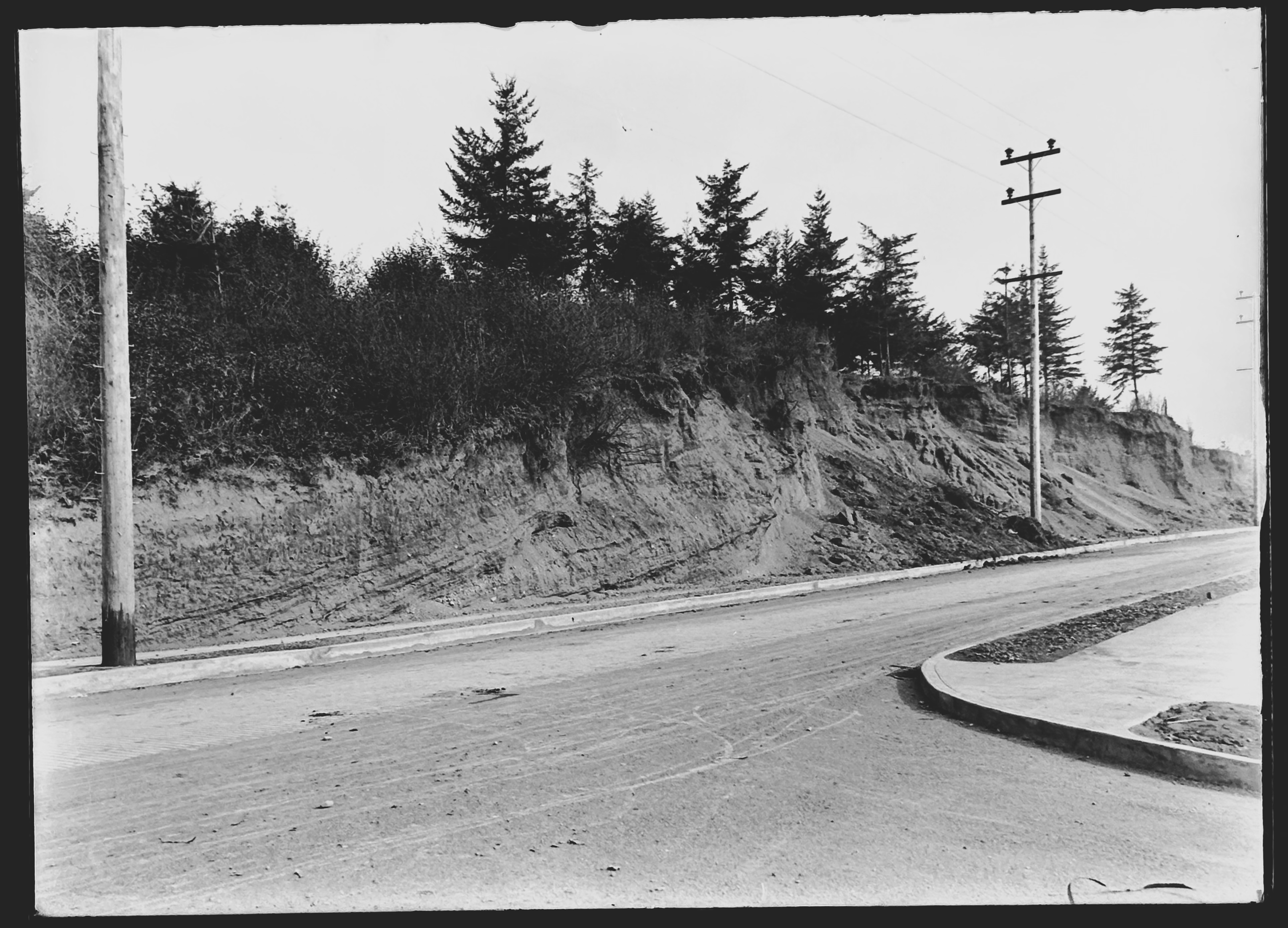
NE Fremont Street. Looking east just below the crest of Alameda Ridge, seen from between today’s NE 32nd and NE 31st. Photo courtesy of City Archives, A2009.009.3616.

Fremont Street running left and right, seen from the corner of NE 31st, which leads downhill at bottom right. Looking northeast toward the top of Alameda Ridge. Photo courtesy of City Archives, A2009.009.3618.

Be sure to take a look at this view as well, a low-elevation oblique photo from 1930 that shows the cutbank, the slope below Fremont (now filled with garbage and grown over with brush) and lots of other neat things to look at.

No big surprise both slopes were on the move. Geologists remind us Alameda Ridge is basically a giant gravel bar, deposited more than 15,000 years ago by the great Missoula floods that shaped our region. In the years after these photos were taken, vegetation returned to the cutbank slope and houses (and stairways) were built, increasing the surface stability.

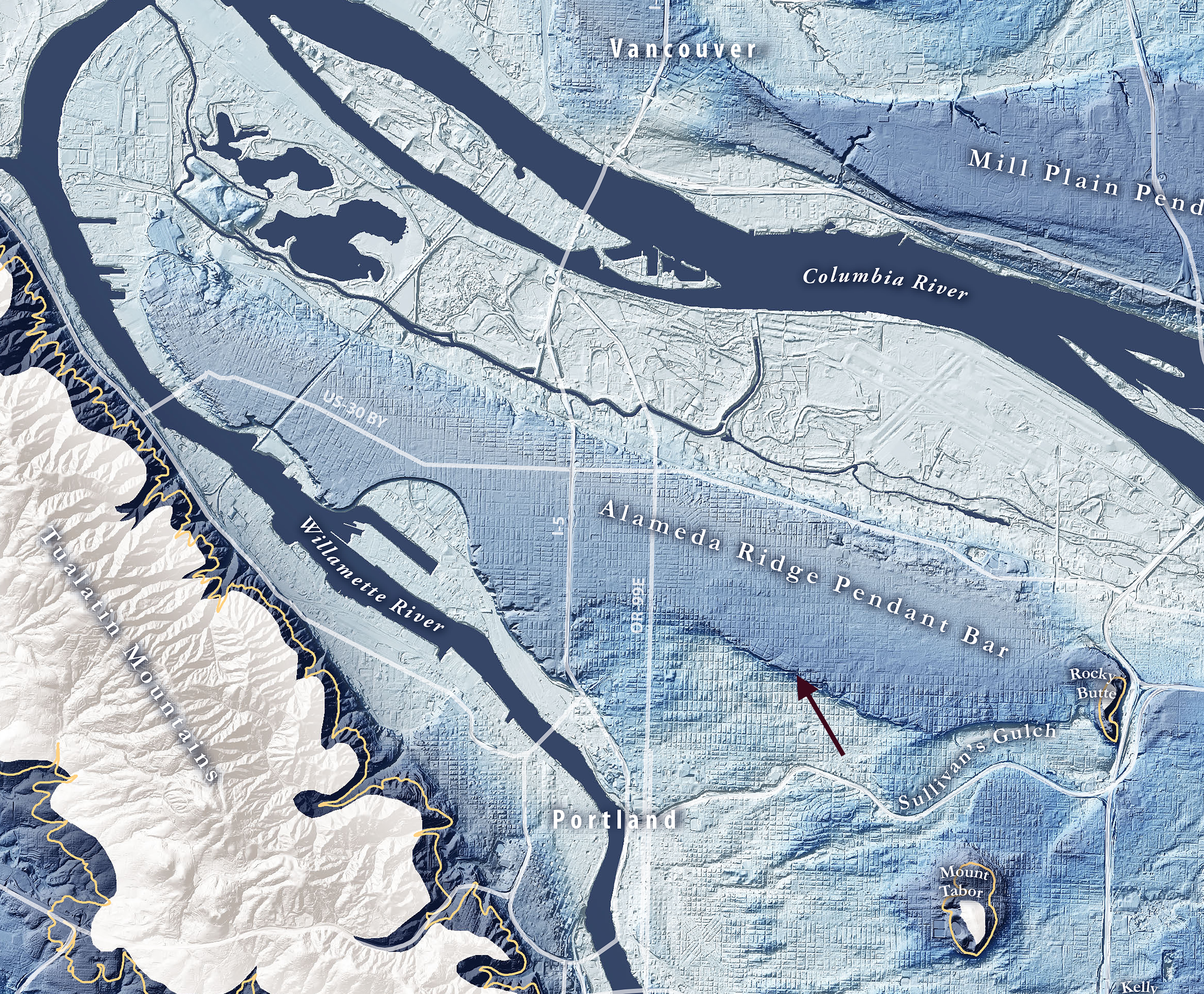
Attentive reader and friend of Alameda Brian Rooney tracked down a great graphic that shows the east-west pendant gravel bar of Alameda Ridge that formed downstream (west) of Rocky Butte during the great floods. Helps visualize the old “Gravelly Hill” ridgeline. The arrow points out the intersection of 33rd and Fremont:

A detail from a comprehensive poster explaining the Missoula Floods by the Oregon Department of Geology and Mineral Industries. Thanks Brian!

Up Next – A bonus photo from Public Works: the Columbia Slough in 1913.

1913 Photos: The Alameda Stairs

Two 112-year-old public stairways, known today for their role in fitness regimes as well as shortcuts to and from Alameda Elementary School, were once frontrunners of change in what had been rural northeast Portland.

The stairways were built in 1912 by Warren Construction Company, concrete flights anchored into the slope of the ridge, connecting the brand-new Olmsted Park subdivision above with early Fremont Street and what developers hoped would eventually be new neighborhoods below. When built they seemed precarious and tentative, hanging out on rugged cliff-like hillsides above Fremont Street, a giant gravel pit just below. See for yourself:

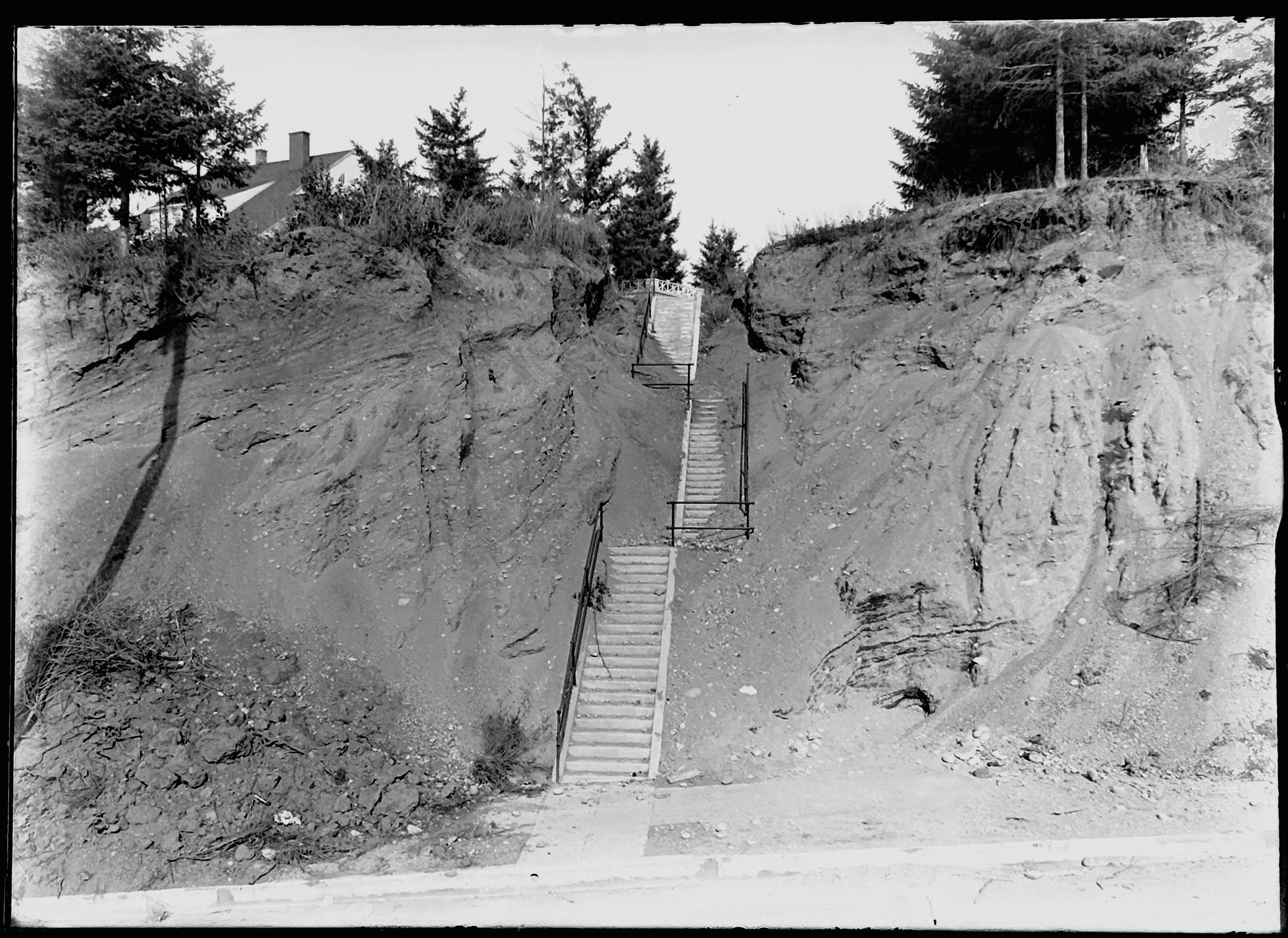
Fremont Street looking due north showing steps leading down from Alameda Terrace, 1913. House at left is 3251 NE Alameda Terrace. Today these steps land just west of NE 32nd Avenue. Directly behind the photographer was a gravel pit that stretched downslope to the south beyond today’s Klickitat Street and spanned from NE 33rd to NE 31st. Photo courtesy of City Archives: A2009.009.3621.

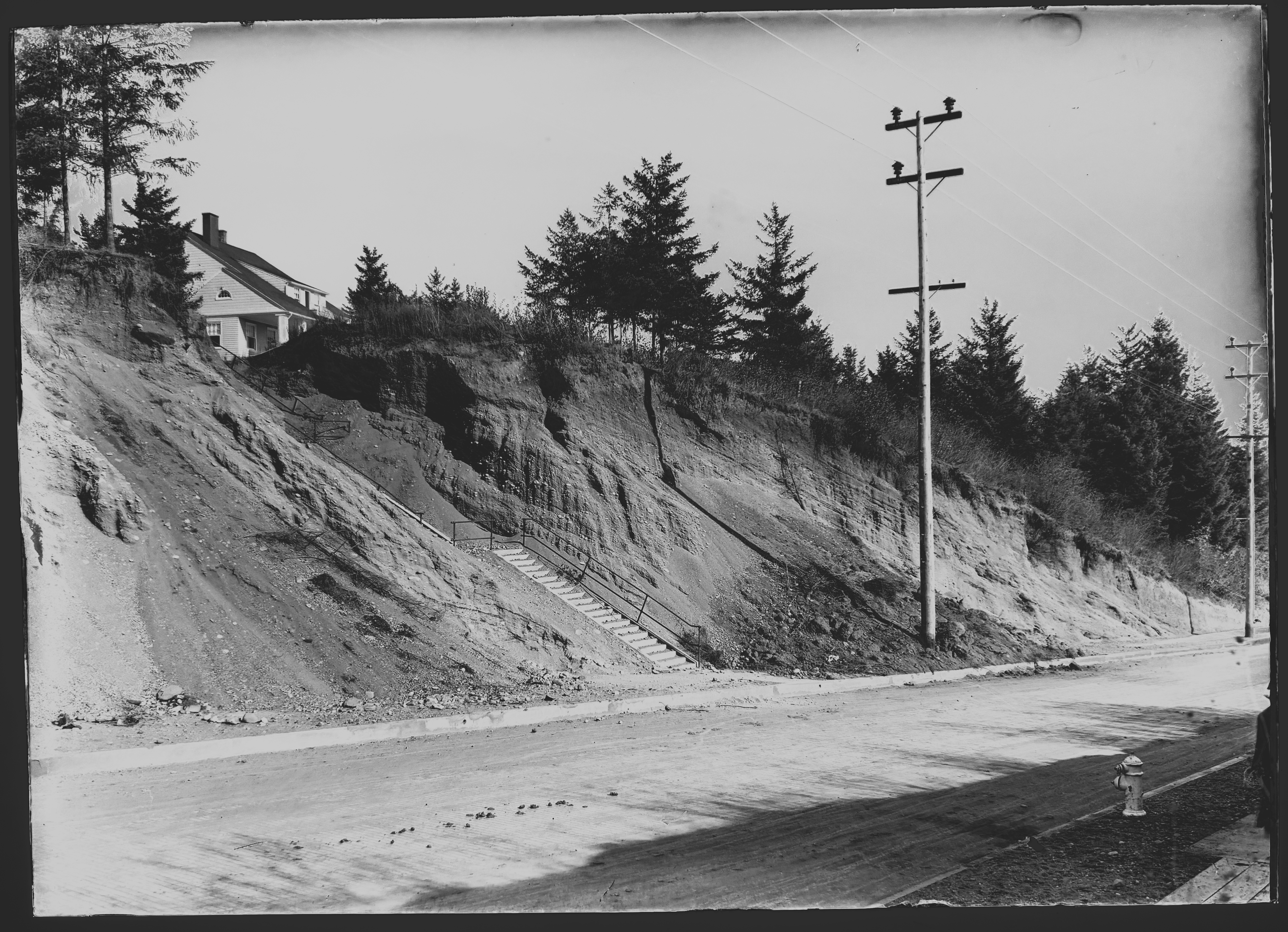
Fremont Street looking northeast showing steps leading down from Alameda Terrace, 1913. Today these steps land just east of NE 30th and Fremont. House at left is 3251 NE Alameda Terrace. Photo courtesy of City Archives: A2009.009.3635.

A photographer from the Department of Public Works visited the area in December 1913 and may have been following up on concerns from developers and new homeowners about the stability of the slope above and below Fremont in the stretch between NE 30th and NE 33rd. The glass plate negatives he brought back have been at rest since, identified as “Lombard Street” at City Archives. The newly re-discovered stairway images join photos of the giant gravel pit at NE 33rd and Fremont, and photos of the actual intersection in its early development days that we’ve been sharing here, with a few more to come.

The house pictured in both photos still stands today. In 1912, it was one of just a few homes on what was then known as Woodworth Avenue, but is today known as Alameda Terrace, built that same year by Samuel J. and Dorrie Mae Claridge. Over the years, other adjacent houses were built, steadying the slope and giving the stairs purpose connecting neighbors with their neighborhood.

Despite a deep search of early newspapers, city contracting documents and city ordinances, little remains to tell the story of their early construction. When built in 1912, most Portlanders relied on walking and streetcars to get around, and horses to move freight. A dispersed system of public stairways just made sense, particularly up and down landscapes like Gravelly Hill (today’s Alameda Ridge).

The 30th Avenue stairs were noted in the May 1981 citywide Historic Resource Inventory, called out for their significance related to landscape architecture and their role in development of the neighborhood. In the inventory, they’re labeled as “Olmsted Park Public Right of Way.”

Today, these stairs, along with others that span the ridge as it transits northeast Portland, appear in many city exploration guides, including a notable book written by Laura O. Foster called appropriately Portland Stair Walks.

We recommend them as part of your regular history walk regime!

Up next: three 1913 views of mini-landslides on this same slope just above Fremont.

1913 Photos: Dueling Subdivisions at NE 33rd and Fremont

To really understand the next installment of photos from the 1913 collection, it helps to visualize what the middle part of Portland’s eastside looked like then, and what was going on in the economy and life of the city. Following the Lewis and Clark Exposition, which put Portland on the map in so many ways, our population exploded: from 90,426 people in the 1900 census, to 207,214 by 1910.

Like shock waves rippling out across what had been a mostly agricultural landscape, development pressures began to reshape the dirt roads, orchards, dairies and forested clumps of the middle eastside. Meanwhile the economy began to heat up in the early teens as speculators, home buyers and homebuilders jockeyed to take advantage of the growing marketplace. Maps and a few precious photos from the early 1900s show this place as mostly undeveloped open lands, dotted with barns, scattered farm houses and dirt roads.

By 1913, the fields and hills of the middle eastside had been platted out into subdivisions, and the infrastructure of sewer, water, electricity and roads was trying to catch up with the vision sold by developers. In some places, a grid of streets existed, and a sprinkling of single family homes was being built, making visible the conversion from agriculture to residential use. To the north closer to Alberta, construction had been underway since the middle of the 00’s. Eastside neighborhoods closer to the river–Albina, Irvington, Ladd’s Addition, Woodlawn, the Peninsula–had been platted and growing as early as the 1890s.

Back in the day, the intersection of NE 33rd and Fremont–the focal point of this 11-photo series of glass plate negatives from City Archives–was a north-south wagon road to the Columbia River, and access point for the giant gravel pit near the top of the ridge. Surrounded on all sides by planned development, the intersection was in transition from dirt path to thoroughfare.

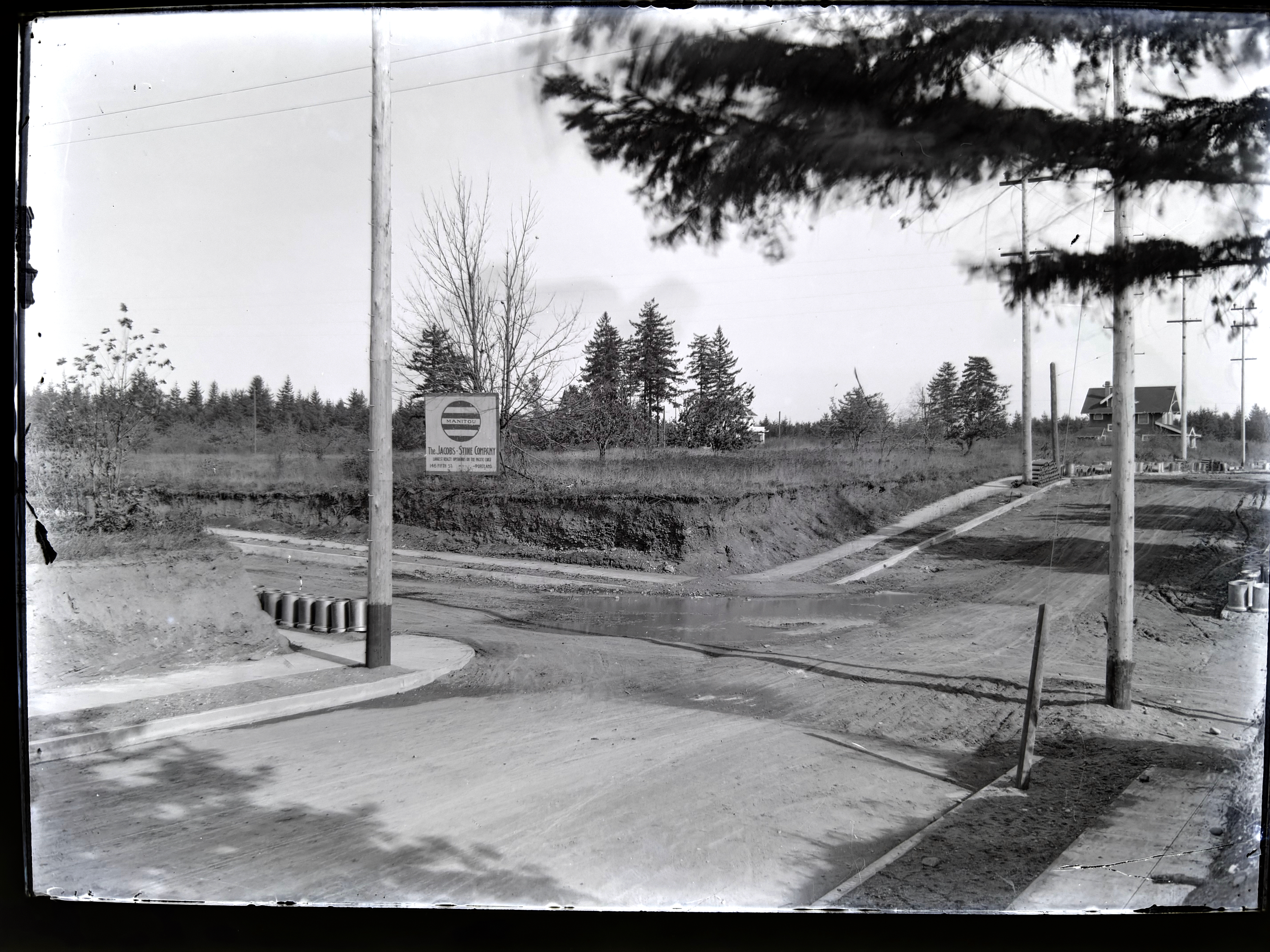
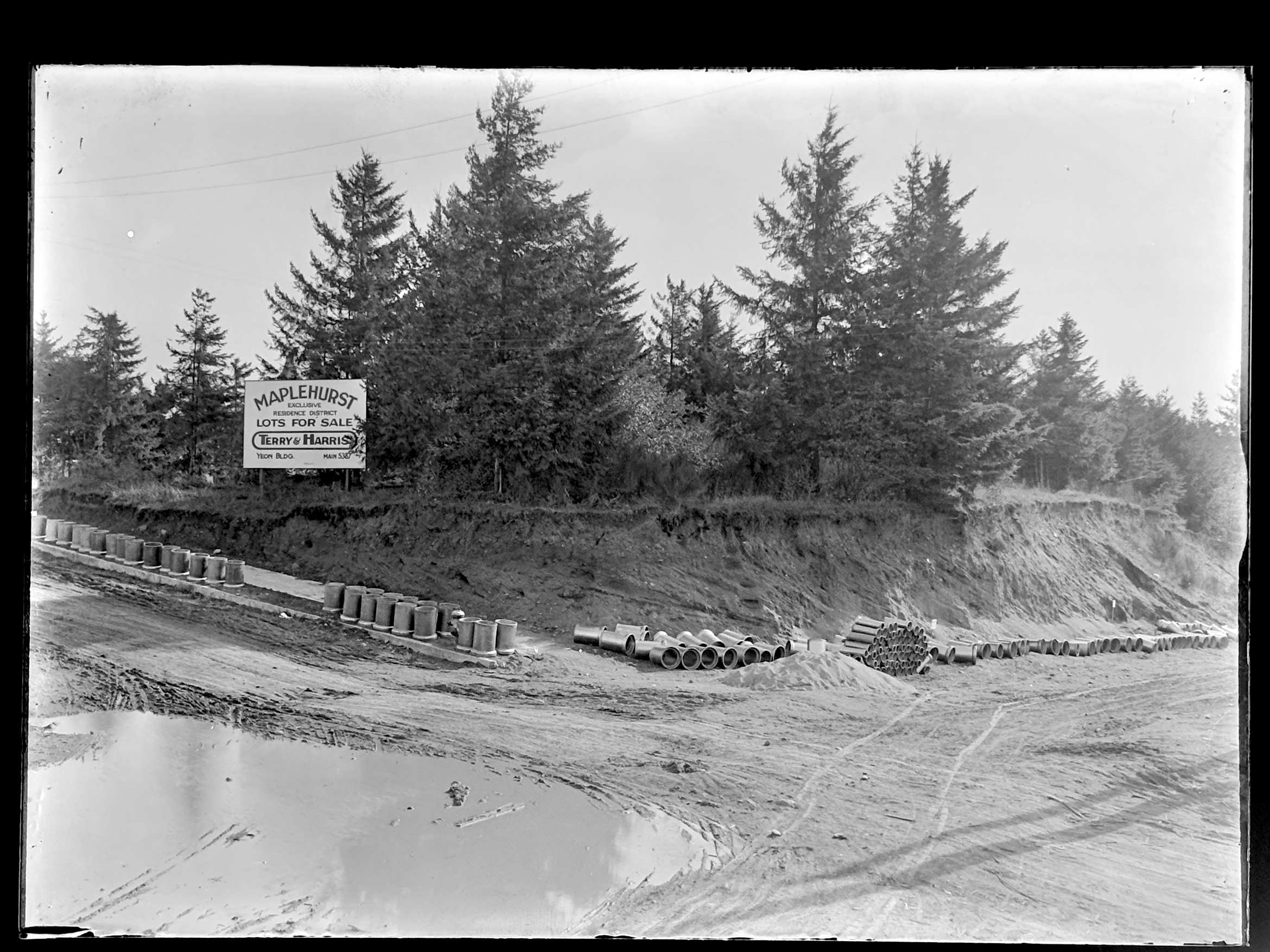
On the northeast side of the intersection, the Jacobs-Stine Company was ready to sell you a lot in the Manitou Subdivision. Just across Fremont to the southeast, the Terry & Harris Company wanted you to see the lots in Maplehurst. Our photographer from the Department of Public Works captured both views. Meanwhile, the mud puddle in the middle of the intersection reminded everyone the reality that for the moment, this was still a fairly rural place.

Looking to the northeast along Fremont from the southwest corner of NE 33rd and Fremont (33rd is passing from upper left to lower right). The house in the distance at right is today’s 3415 NE Fremont (built in 1912). Curbs and sidewalks are in (thanks to Elwood Wiles and Warren Construction), and ceramic sewer pipe is stacked near the curb awaiting installation. The Jacobs-Stine Company, boasting on its sign of being “The largest realty operators on the Pacific Coast,” was owned in part by Fred Jacobs, who would later die when his car tumbled off Stuart Drive in Alameda a few blocks from here, giving rise to the nick-name of that street as Deadman’s Hill. Photo courtesy of City Archives, image A2009.009.3613.

Looking to the southeast from the northwest corner of 33rd and Fremont. 33rd runs down the hill on the right. Fremont follows the slight rise to the left as it heads east. Sewer construction is evidently about to begin. Photo courtesy of City Archives, image A2009.009.3614.

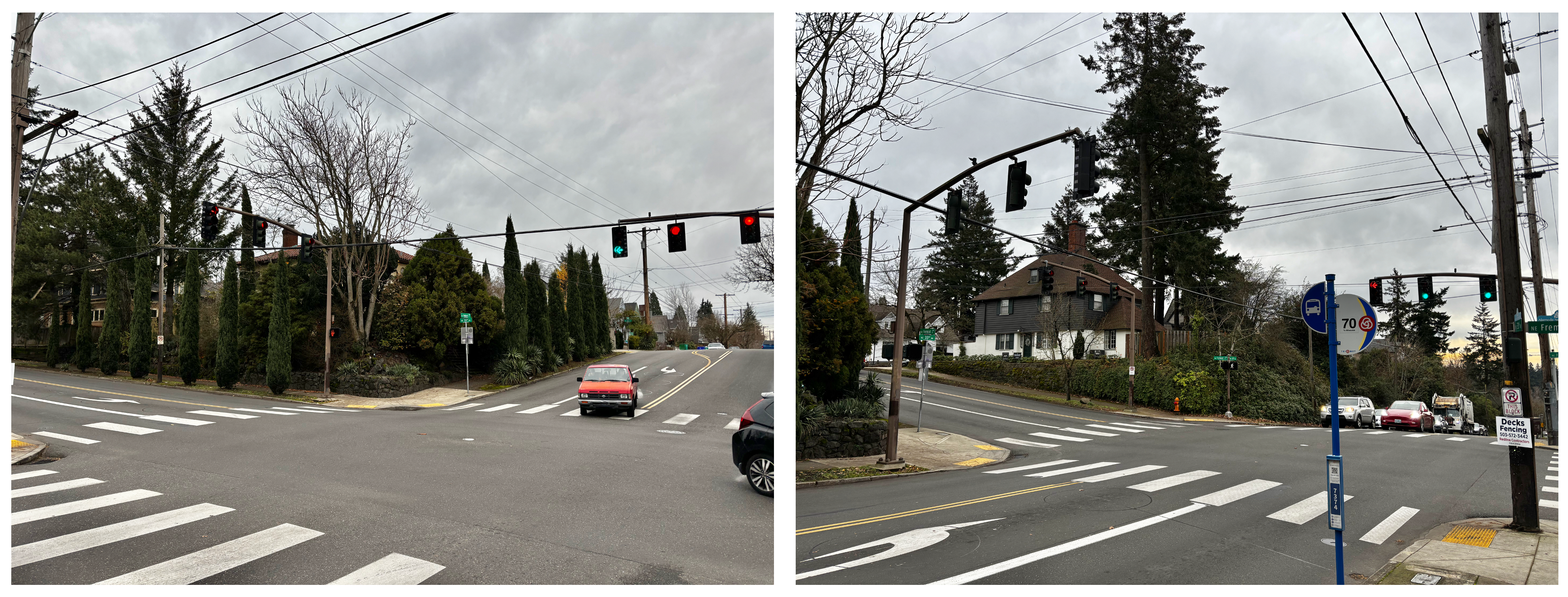
Left photo is similar to top, looking northeast. Right photo is similar to bottom, looking southeast.

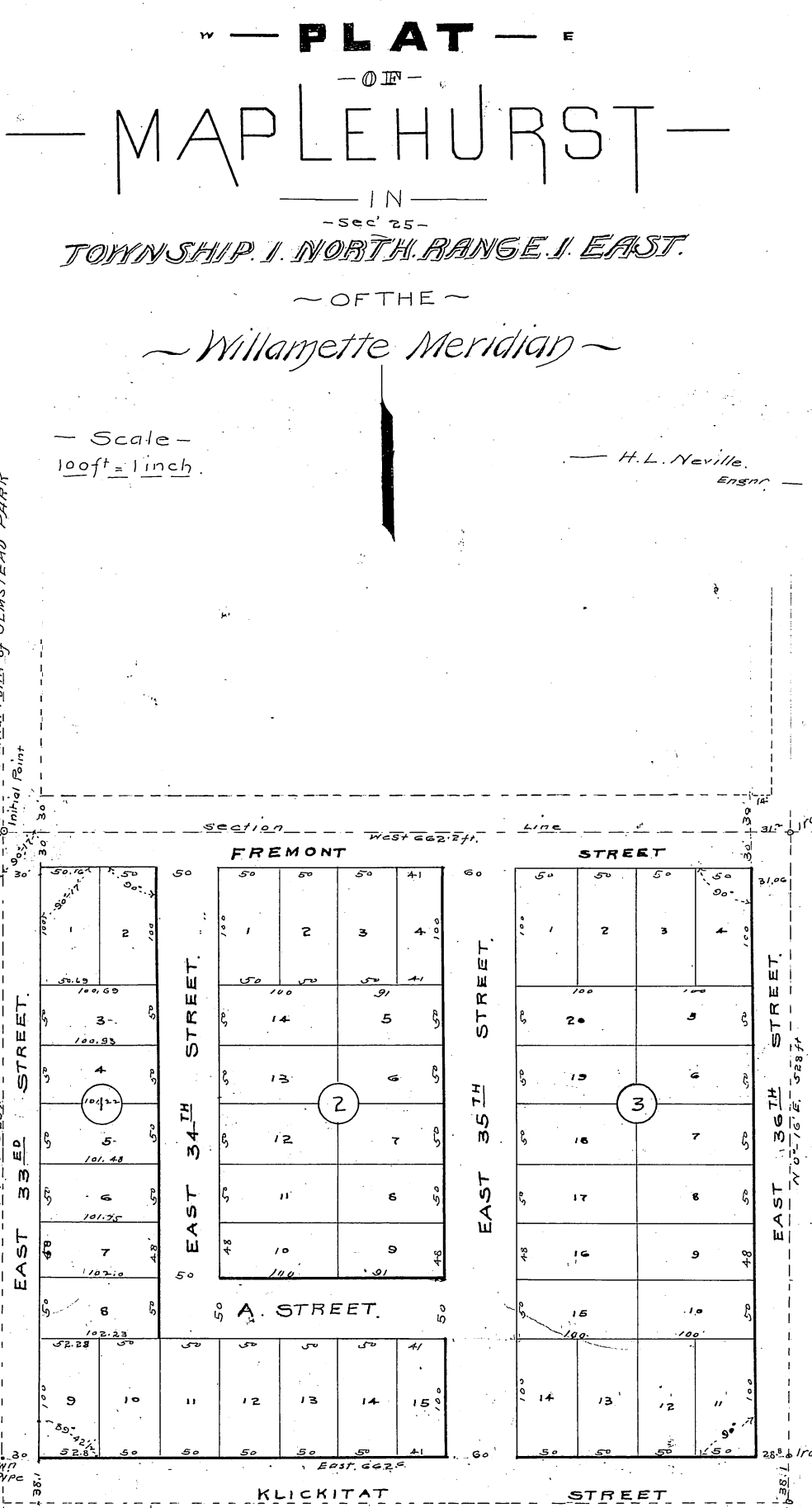
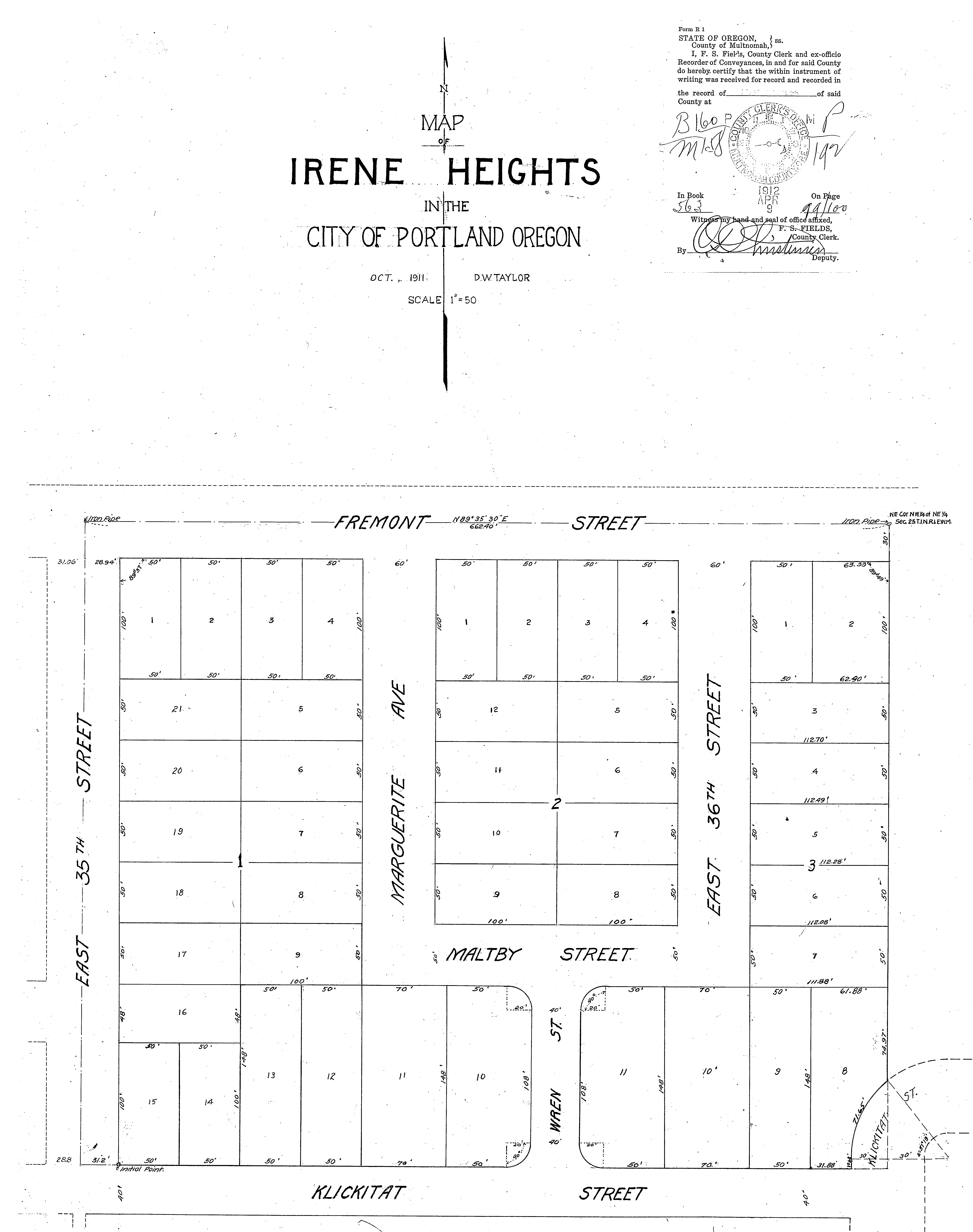
Maplehurst was platted in 1910 by Mary Beakey, who named a street for her family (labeled as A Street on the plat). It’s a relatively small subdivision–only three blocks and 43 lots, and exists up against a plat called Irene Heights, which was developed by the Barnes family, containing the Barnes mansion and multiple former Barnes family homes.

NE 33rd wasn’t the only north-south thoroughfare passing through a landscape in transition. One half section to the east (our landscape was gridded into sections, townships and ranges by surveyors in the 1850s), NE 42nd Avenue was experiencing its own growing pains.

Up next: The Alameda stairs. Our Department of Public Works photographer captured the brand-new stairways transiting the slope between Fremont and Alameda Terrace (known as Woodworth before the Great Renumbering of the early 1930s).

1913 photos reveal new perspective at Gravelly Hill – 33rd and Fremont

Every now and then in my research, I’ll find something—a memory, photograph, map or  document—that really sticks with me and defines the way I think about a place.

This month I found a batch of mis-identified photographs when searching at City of Portland Archives that resulted in an absolute jackpot from 1913, opening a fresh window into the past near NE 33rd and Fremont.

Once known as Gravelly Hill, the area was indeed a gravel pit for many years in the late 1800s, and later the repository for all of the eastside’s household garbage between 1923-1924, then known as the Fremont Sanitary Landfill.

But before the landfill, back in 1910 as subdivisions crowded in around the big pit, questions were raised about the basic stability of Fremont Street, which was just below the brow of the Alameda ridge and ran right along the north edge of the pit. Developer Benjamin Lombard, who platted the adjacent Olmsted Park about that time, even sued the city for violating its own ordinance about gravel pits.

So, no secret: that slope South of Fremont was a gravel pit.

But as it turns out, it wasn’t just a gravel pit. It was a GIANT gravel pit. See for yourself:

You’ll want to click into this for a good look. Looking east along Fremont toward NE 33rd from about today’s NE 32nd Avenue. Sewer pipe stacked along the eastern edge of NE 33rd, which slopes downhill left to right. The roof of the house visible at treeline in the center is the Barnes Mansion, 3533 NE Klickitat, which was then brand new. City Archives Photo: A2009.009-3611 (mislabeled as Lombard Street)

In 1913, a photographer for the Department of Public Works visited the pit and brought back 11 amazing images that got buried in the archives. They’re large-format glass plate negatives, not prints, and for years have been filed away in envelopes under “Lombard Street” at City Archives. I suspect few people have ever seen them. A few weeks back, something else I was looking for led me to these glass negatives.

I photographed each plate and made positive prints to be able to better visualize the scenes. And as I studied that first picture and figured out it wasn’t showing Lombard Street, but Fremont Street, I knew this would be a find to remember.

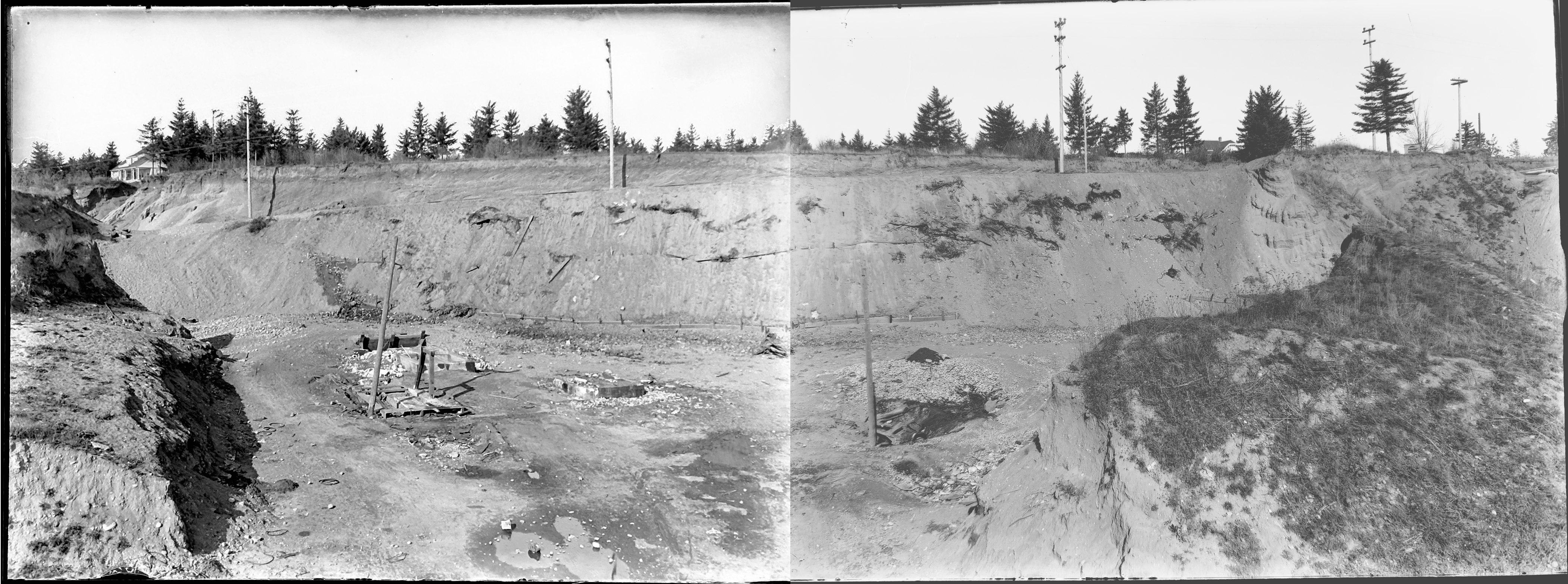
After that first photo, there were these next two, clearly taken as a pair, to illustrate the depth and breadth of the pit. Both are unquestionably tied to the Gravelly Hill landscape. Here I’ve melded them together to create a single image:

Looking north into the gravel pit at NE 33rd and Fremont, December 1913. Click to enlarge. View would be from between today’s Siskiyou and Klickitat streets, looking uphill. The house at far left is today’s 3251 NE Alameda Terrace. The house at far right is the top of today’s 3305 NE Alameda. A sign is visible at upper right for a new subdivision, placed in the cutbank on the northeast corner of 33rd and Fremont. Segments of sewer pipe are visible stacked there. Today, the pit is filled with three city blocks and more than 50 homes. City archives photos, left: A2009.009.3619; right: A2009.009.3620.

Here’s a bit more context from neighborhood historian R.A. Paulson, writing in The Community Press on October 1, 1975:

“From the earliest recollections of those familiar with the area, this was a worked out gravel pit, the excavation of which had been finished many years before but still showing the signs of one-time activity. As late as 1919 and 1920, the pit formed a precipice going down sharply from near Fremont possibly 100 feet or so to the level of Klickitat and extending between 32nd place and 33rd Ave. Coming from the west, Kllickitat Street was unpaved east of about 29th with the cement sidewalks ending there but even between 26th and 29th these sidewalks were impassable because of the overgrown bushes and small trees.


“The gravel pit had been a lush source of rock and gravel for someone way back and the solid bank of this material had originally sloped down from Fremont at the same grade as the present 33rd Ave. This had been scooped out over a period of perhaps 50 years or more and most likely went into improving the lanes, roadways and public highways for miles around, certainly for the country roads that became 33rd Ave. and Fremont Street.


“The bed of the pit showed evidence that work and even habitation had gone on there but at the time of World War 1, only a monolith of stone, too difficult to remove with pick and shovel, reared upward from the new level.”

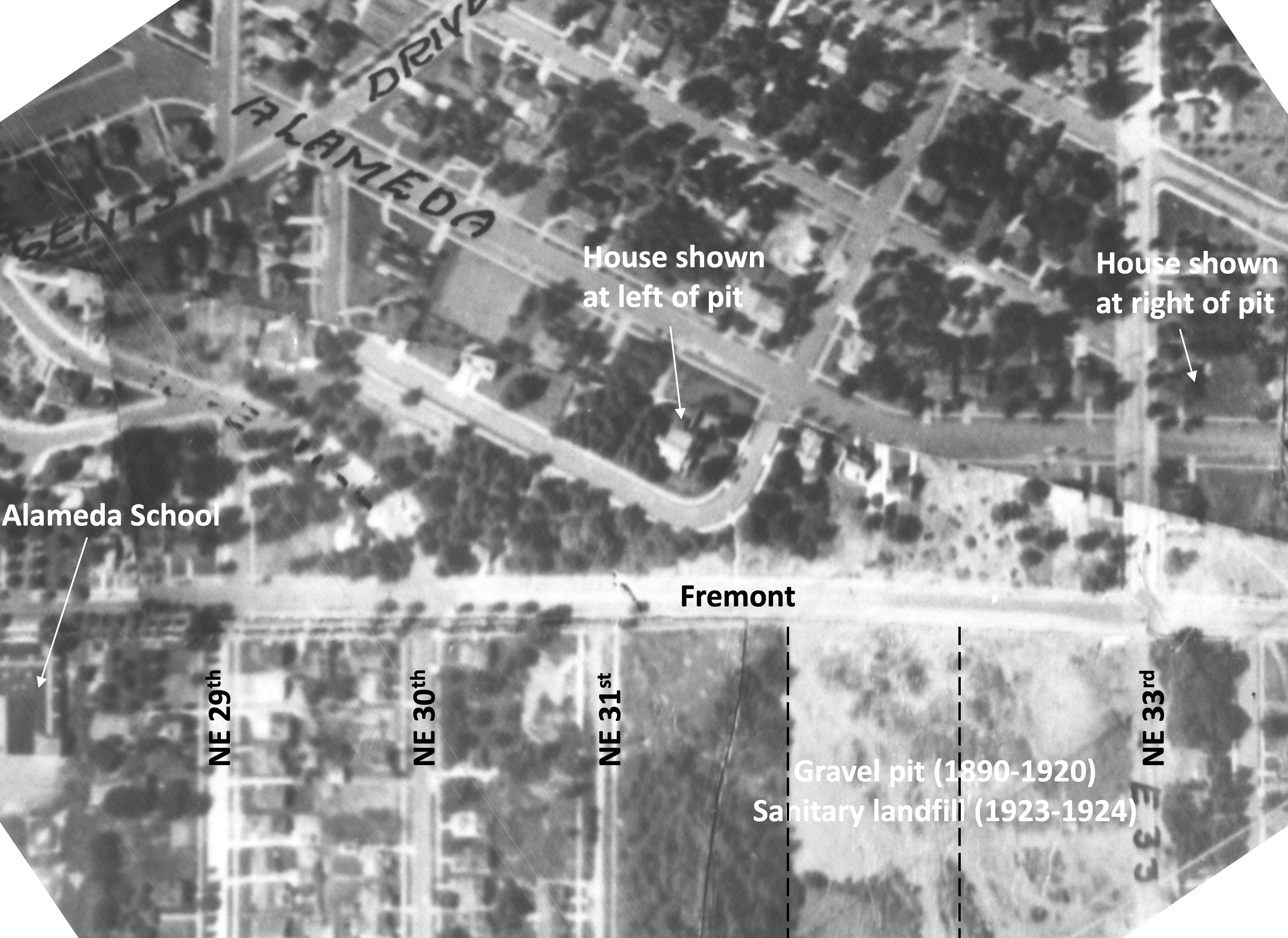
Here’s a detail from a 1925 aerial photo that shows the extent of the pit and the still-forming street infrastructure. The pit covered two-plus blocks, from NE 33rd to NE 31st, between Fremont and Klickitat.

Detail from a 1925 aerial photo showing the intersection of Fremont and 33rd, labels added for reference. Dashed lines indicate eventual location of NE 32nd Place and NE 32nd Avenue. Click to enlarge. Aerial photo courtesy of City of Portland Archives.

Stay tuned for eight other gems in this collection that are just as knock-your-socks-off amazing as these three. Next up: we’ll take a close look at the intersection of NE 33rd and Fremont 111 years ago, absolutely recognizable to today’s eye.

Trove of documents provide insight into 1920s von Homeyer House construction

Last month we began a series of stories about the prominent yellow stucco home in the Alameda neighborhood at the confluence of NE 24th, Mason and Dunckley streets. In our first installment, we met the house and its most recent residents–the von Homeyer brothers–at the close of almost a century of that family’s occupancy.

The home was built by their newlywed parents Hans and Frances in 1925-1926 and occupied until recently by the youngest son Karl, now in his 90s. Older brother Hans (referred to as “Hansey” to distinguish him from the father Hans and the grandfather Hans) lived in the house all his life too, and died in 2002.

Because both generations of the family saved so many things–particularly paper–we can gain a special insight into the homebuilding process of the 1920s that has been lost to time for most other homes of this vintage.

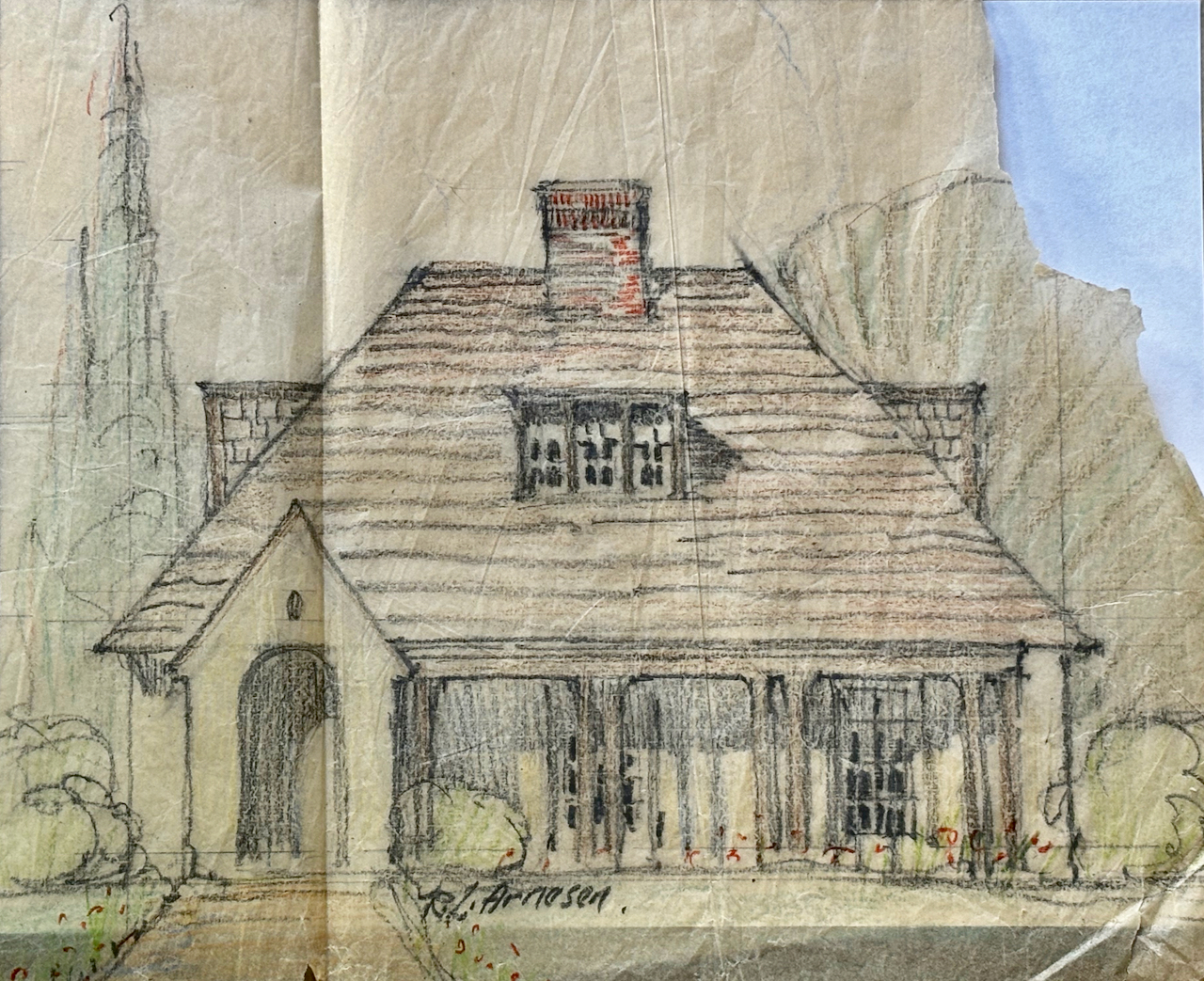
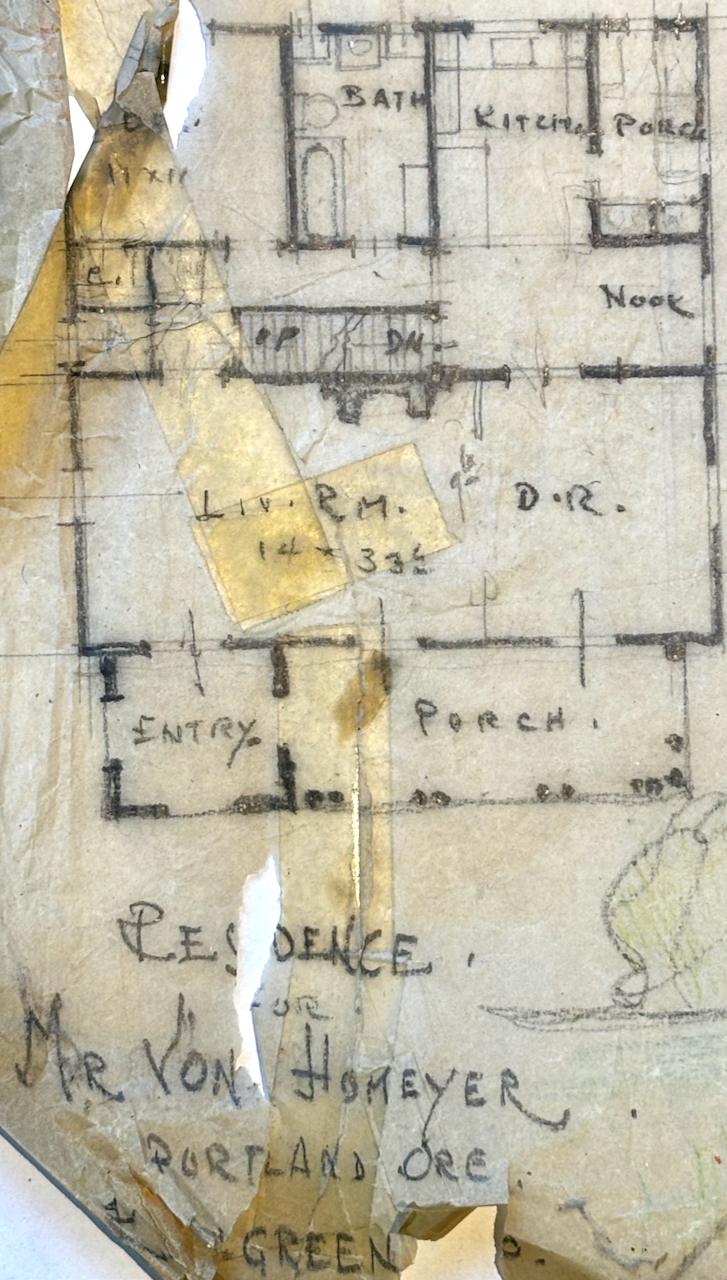
For instance, an early sketch of the house by architect Ragnar Lambert Arnesen, on onion skin paper, along with a floorplan.

Arnesen, then a 29-year-old immigrant from Stockholm, worked with Killgreen and Company, a design-build commercial and residential construction firm that started up in 1925 at the peak of Portland’s homebuilding business (by the way, the Swedish influence on Portland homebuilding is significant). By 1930, Arnesen had relocated to Dearborn, Michigan, and Killgreen and Co. had been shuttered by a collapsing economy. 

Hans von Homeyer was 27 years old in 1925 and busy establishing himself. He might have come across Arnesen and Killgreen from an advertisement in The Oregonian, like this one from April 19, 1925:

Hans was in business with his brother and his parents who owned multiple cleaning and dyeing shops in Portland and Vancouver, so his own network was wide…maybe that’s how he came across Killgreen. We’ll share more about the von Homeyer family business in future posts because it’s a very interesting story and the photos are fascinating as well.

Hans and Frances Westhoff, daughter of a Vancouver clothier family, were engaged to be married and looking to start their family and home in Northeast Portland. They found the lot in the Alameda neighborhood (which was then only about half built-up), engaged Killgreen and its architect Arnesen, took out a mortgage, and got down to the business of planning and construction.

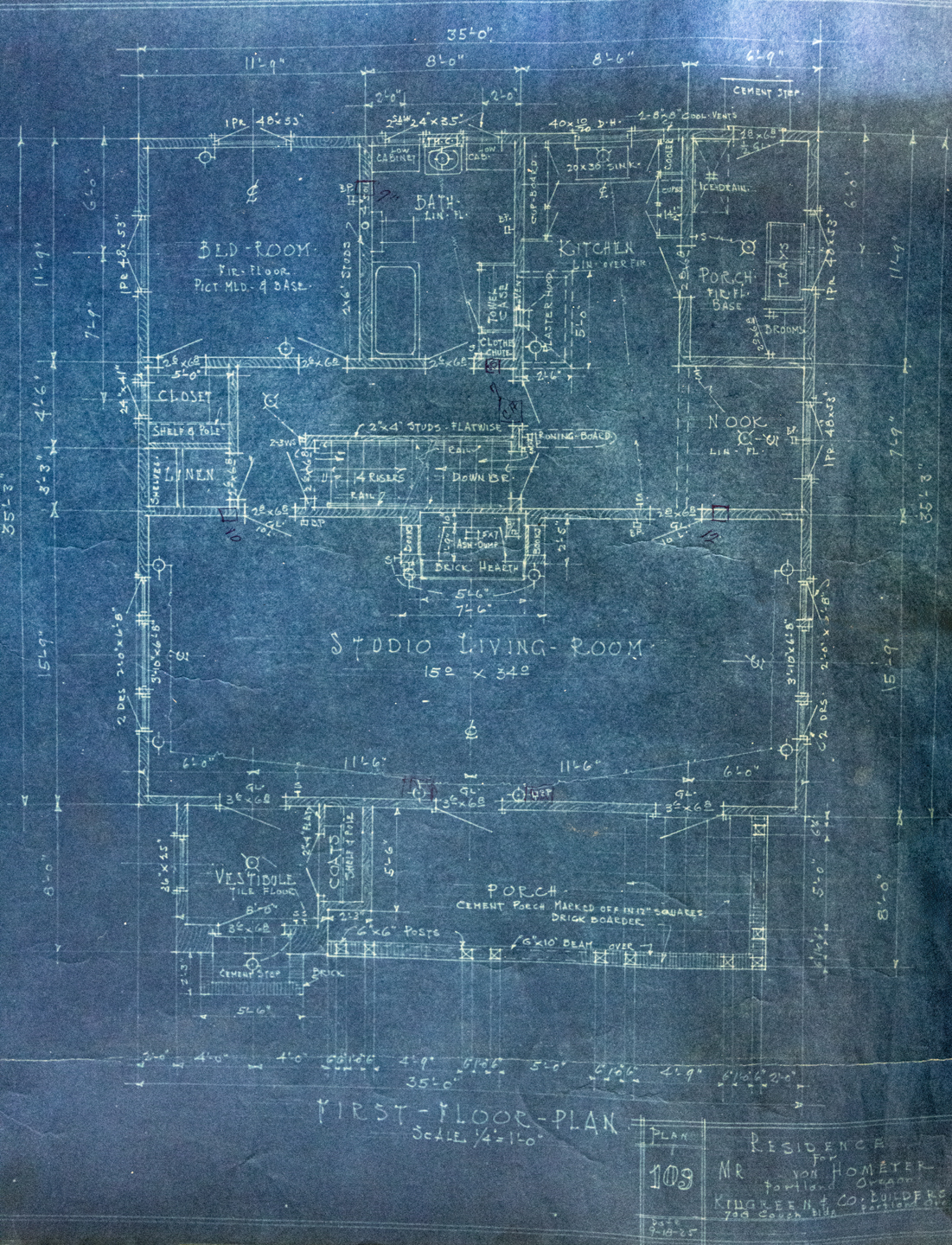
Arnesen’s early sketch led to the set of blueprints:

An important note: in the time between the first sketch and the blueprints, the primary shared living space in the home went from “Liv. Rm D.R.” to “Studio Living Room,” a hint of a much larger story.

Frances, then just 24, was an accomplished pianist building her own network as a well-known and respected piano teacher. She needed a studio to house her piano, two organs and teaching space. Ultimately, the house was designed to accommodate piano teaching and performance, which flourished in the years that followed. We’ll write more about Frances and her piano in future posts. Her gift for music touched hundreds of students–everyone in Alameda and surrounding neighborhoods knew her and plenty learned and played in that big room. Her music defined that space for so many years.

Back to the ad hoc archive of what the von Homeyers saved that allows us a view into the homebuilding process:

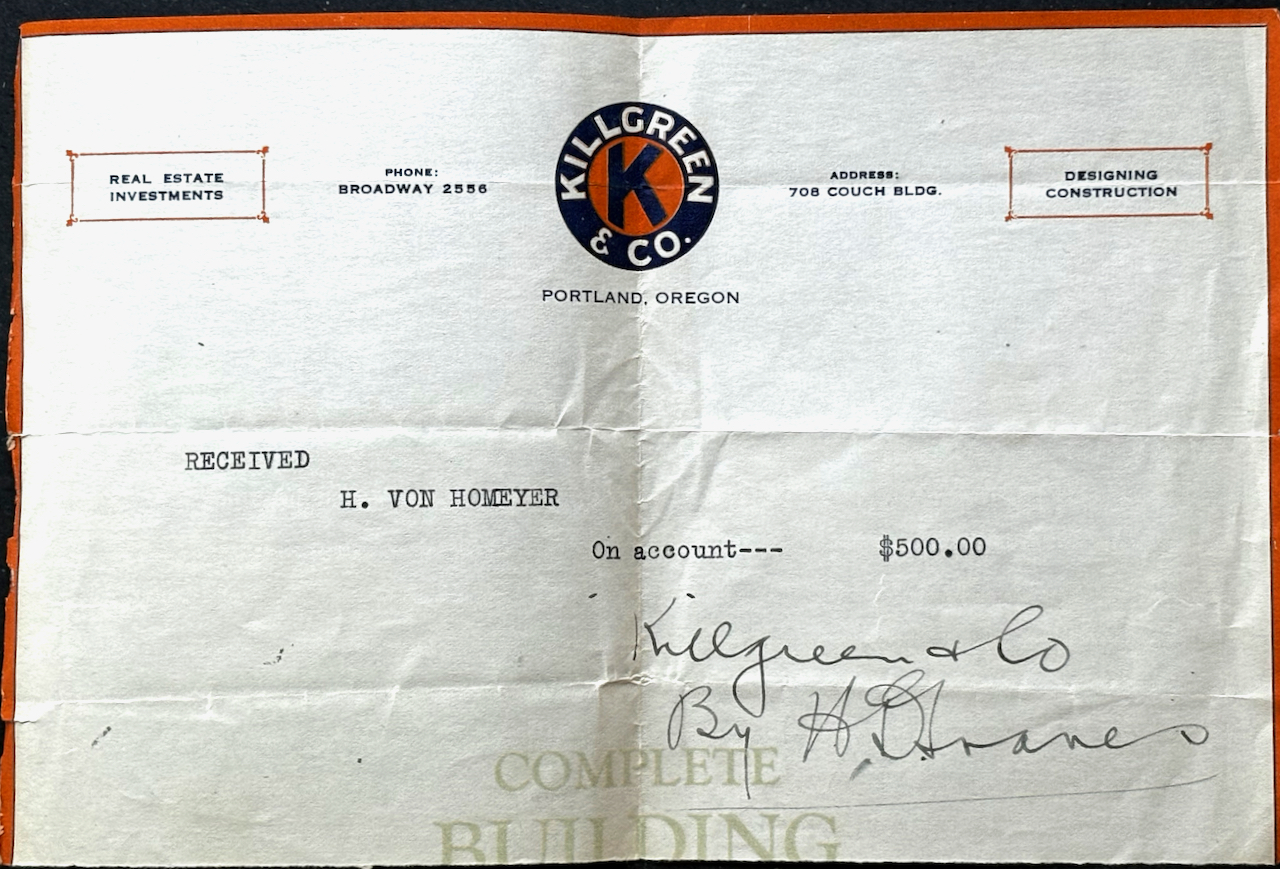
The contract–a signed agreement between Hans and Killgreen dated October 2, 1925 for the total cost of design and construction: $3,780, paid on completion of the house, with $500 at signing of the contract, $540 each week for five weeks and $500 upon completion of construction.

A copy of the receipts from Killgreen for each payment:

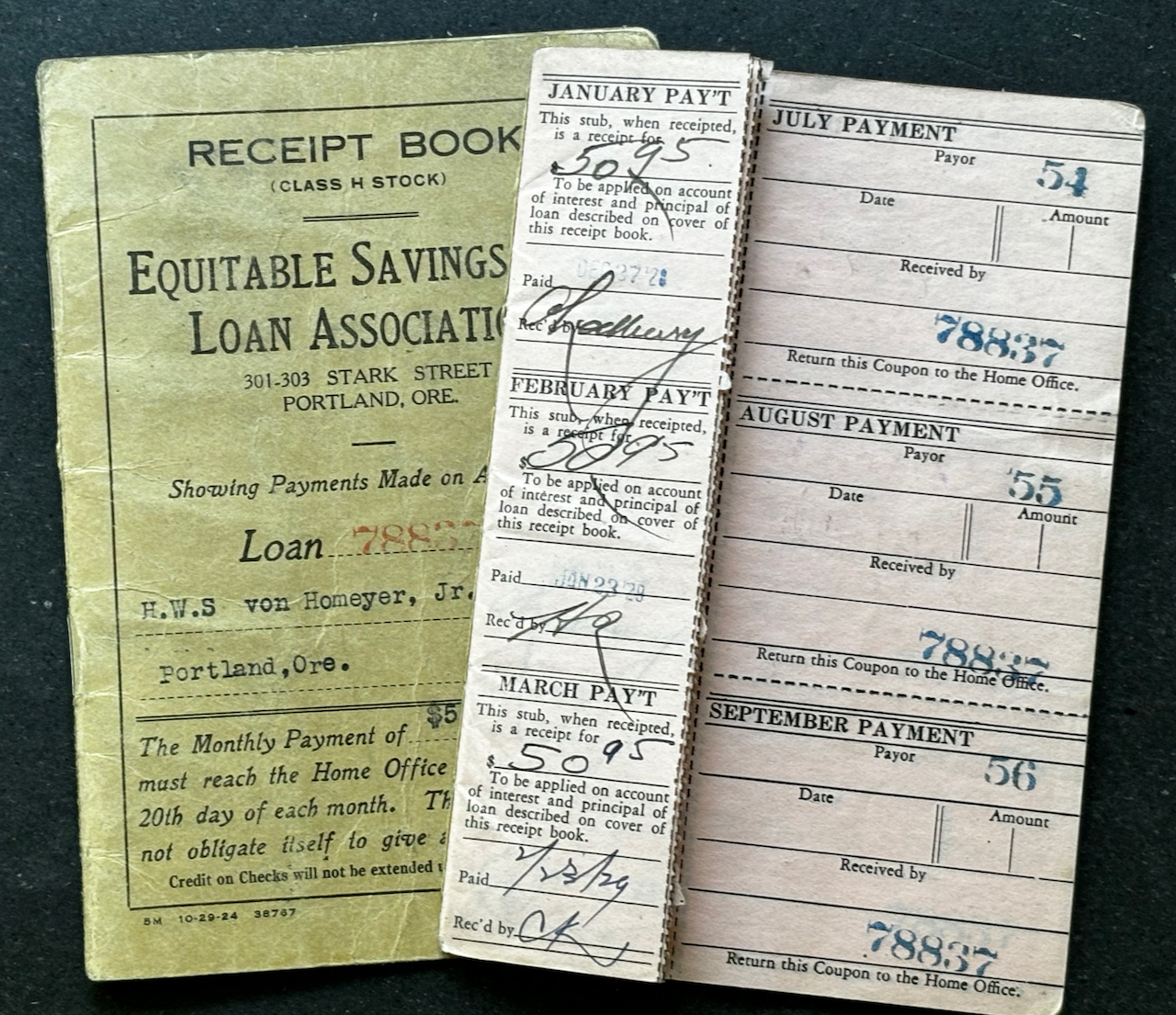
The bank receipt book from Equitable Savings and Loan with the monthly mortgage payment stubs for $50.95, paid through May of 1930:

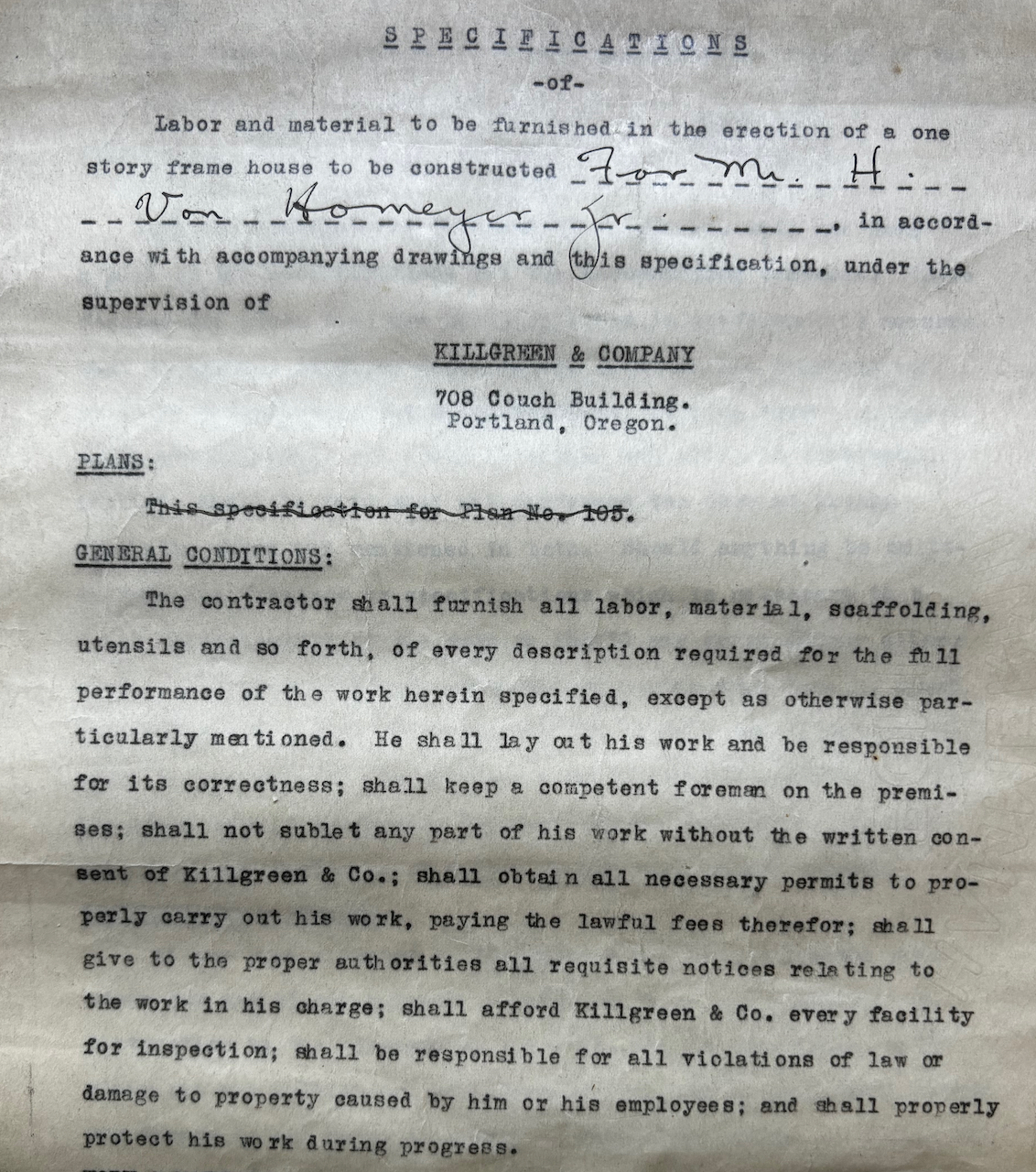
Thirteen pages of written specifications for construction of the house that accompanied the blueprints and pertained to every detail including the amounts and types of sand, mortar and lime that would be used for brickwork:

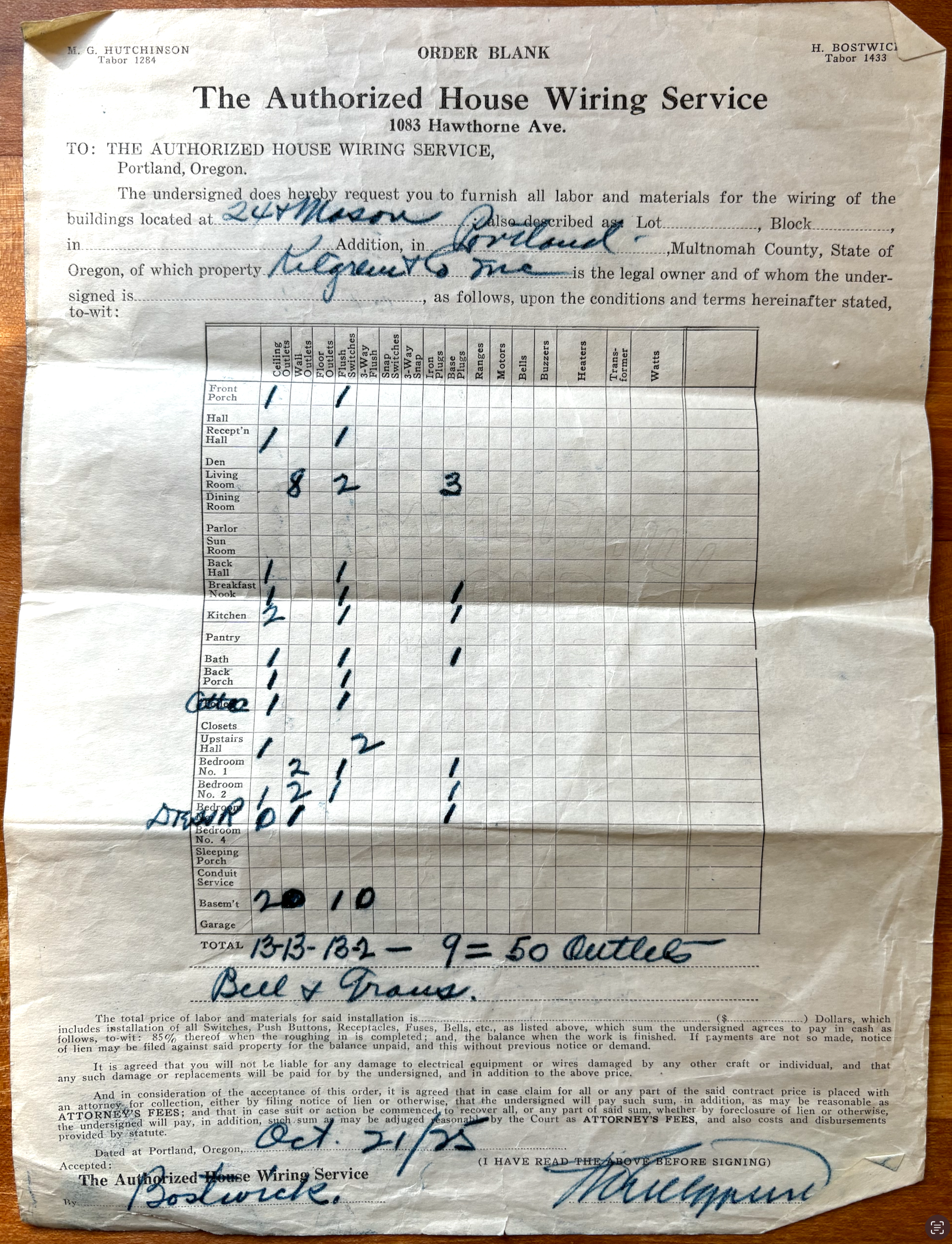
A detailed listing of all house wiring components installed by electricians (one of our favorites):

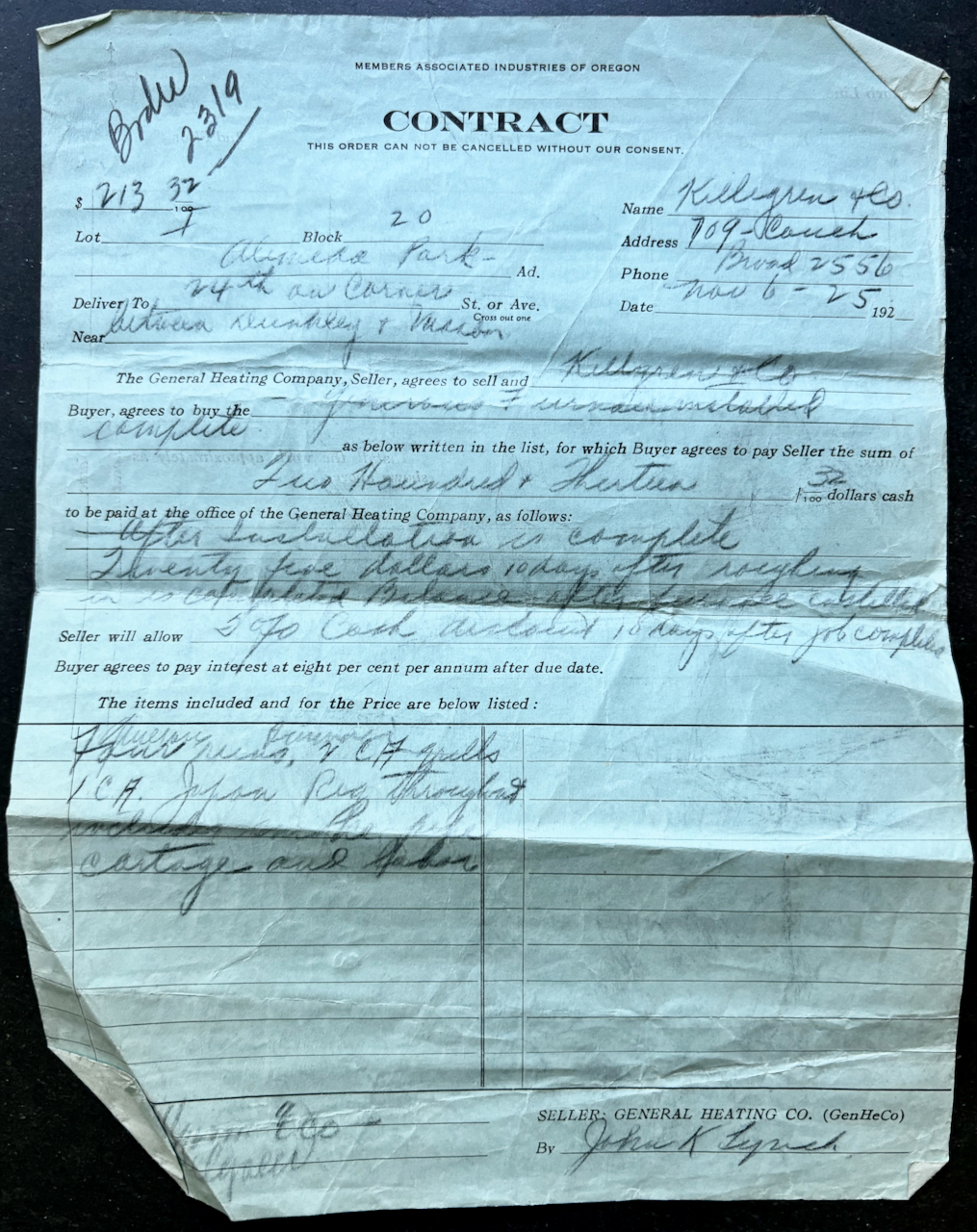
The contract with General Heating Company for installation of the furnace: $213.32:

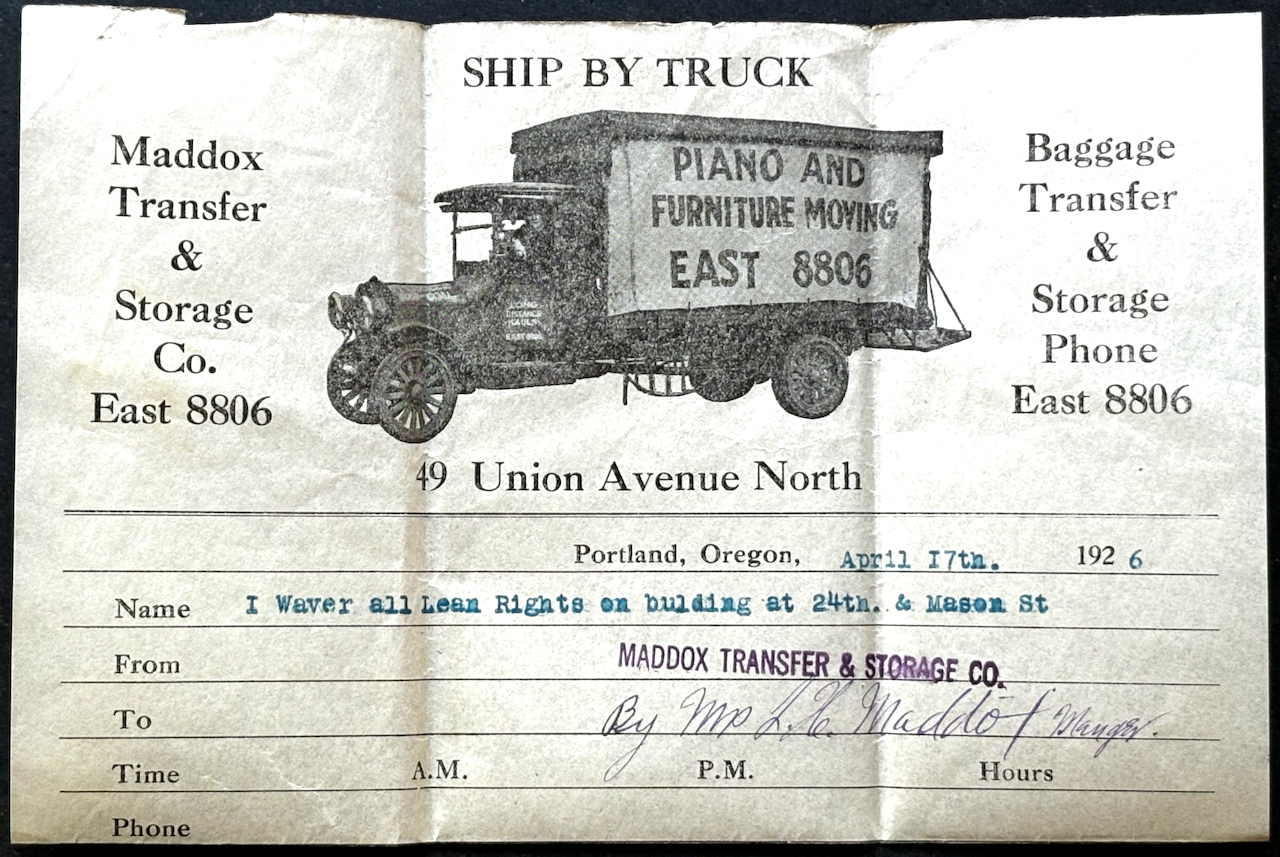
And perhaps the most important document, a receipt from piano mover Maddox Transfer dated April 17, 1926, which is a good indication of when the couple–and Frances’s piano–moved into the house:

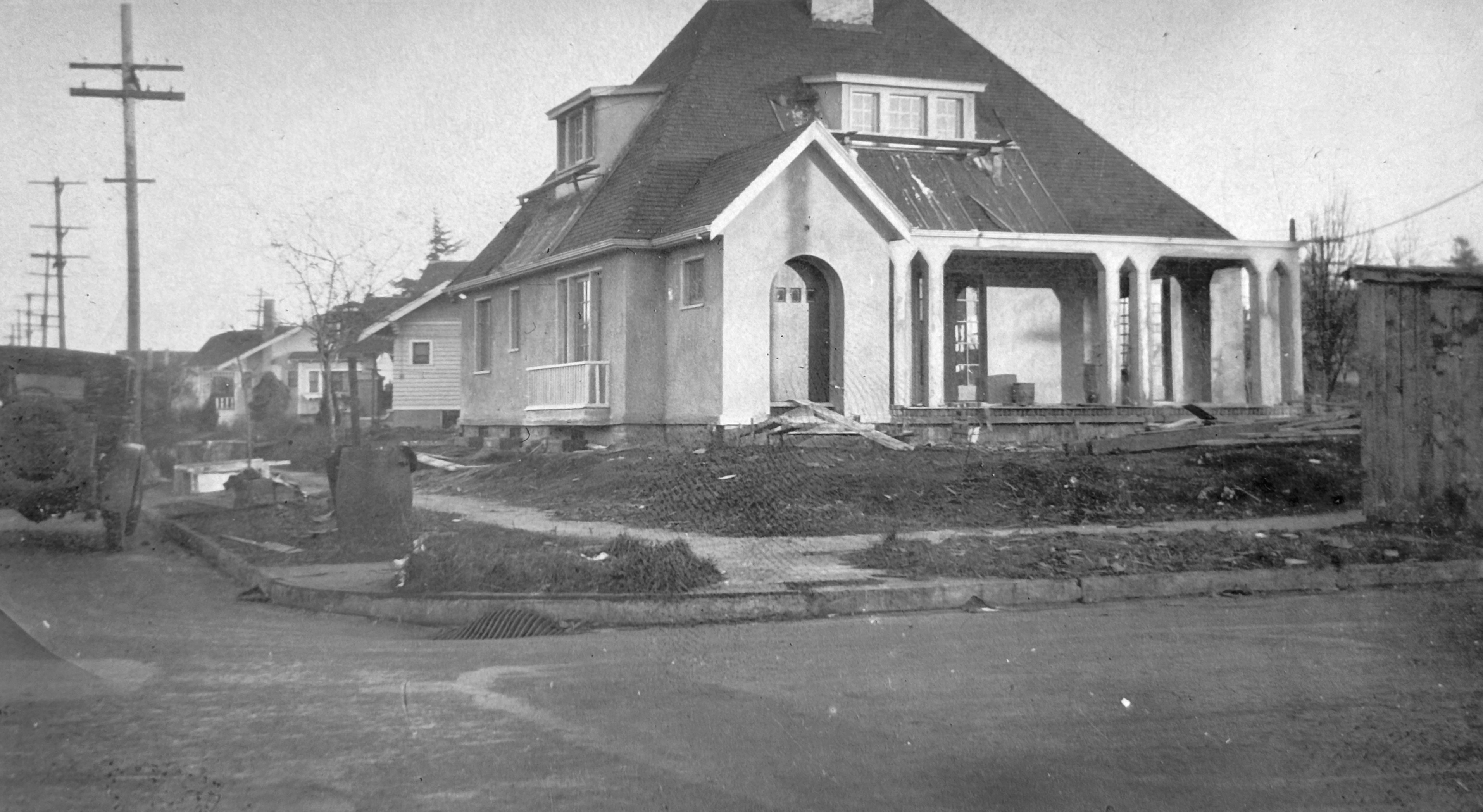
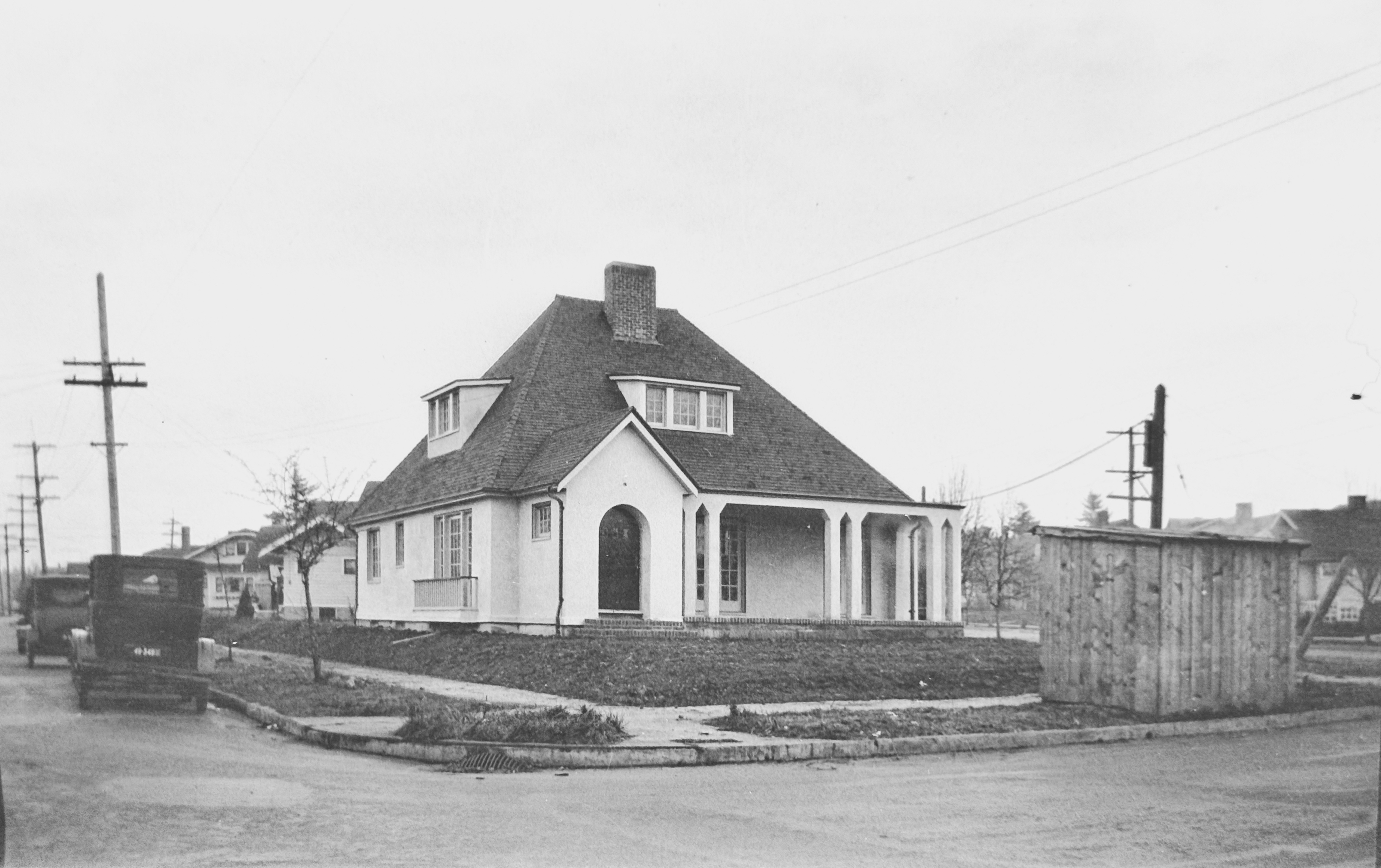
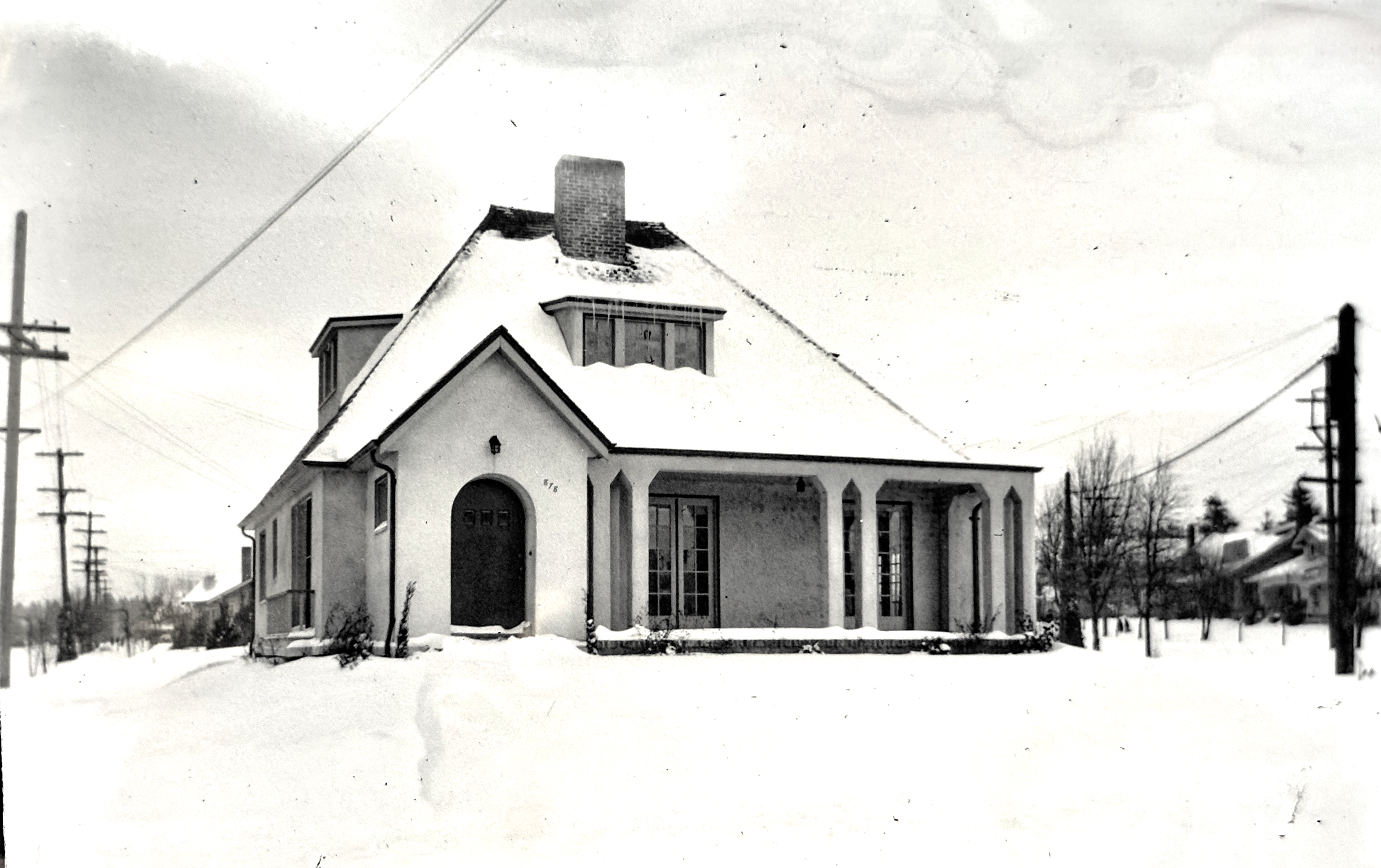
In addition to the many receipts, contracts, correspondence and other documents related to construction, several photographs from the winter and spring of 1926 document the process.

Construction clutter indicates work still underway

Almost done. The small building in the parking strip is a saw shed, which housed the builder’s tools and supplies. Saw sheds were common on residential construction sites.

The finished home, addressed as 878 East 24th Street North, before Portland’s Great Renumbering.

How unusual it is to be able to see all these moving parts associated with the homebuilding process from the 1920s. Not so different from business agreements, loans, waivers and releases today. But more personal, more detailed, more bespoke than the computer printouts of today.

That the family kept them together in a set of files all these years–along with the abstract of title, the deed and other documents–signifies their importance, a kind of family trove of sacred documents. Now, they’re all organized and safe and will be staying with the house going forward.

The von Homeyer House: New life after a century of wear and tear

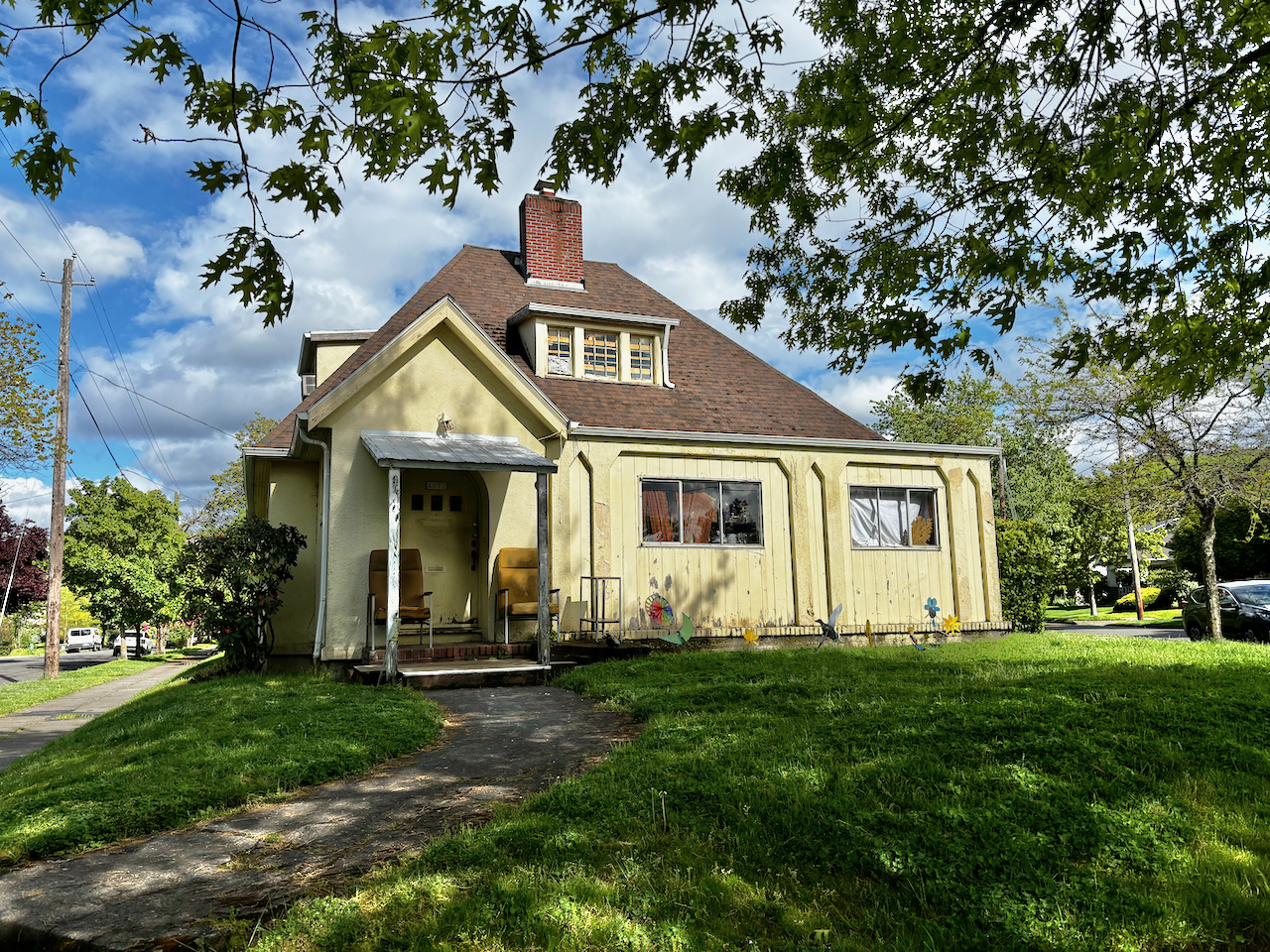
If you’ve spent time in the Alameda neighborhood, you’ve probably seen this house and wondered about its story:

The von Homeyer house, NE 24th and Mason, May 2024. Brothers Karl and Hans lived their entire lives in the house and on summer evenings greeted neighbors and watched the world go by from their front porch chairs.

It’s the steep-roofed, run-down yellow house on the prow of the intersection where NE 24th,  Mason and Dunckley streets come together, built and occupied for all of its life—since 1926—by a single family: the von Homeyers.

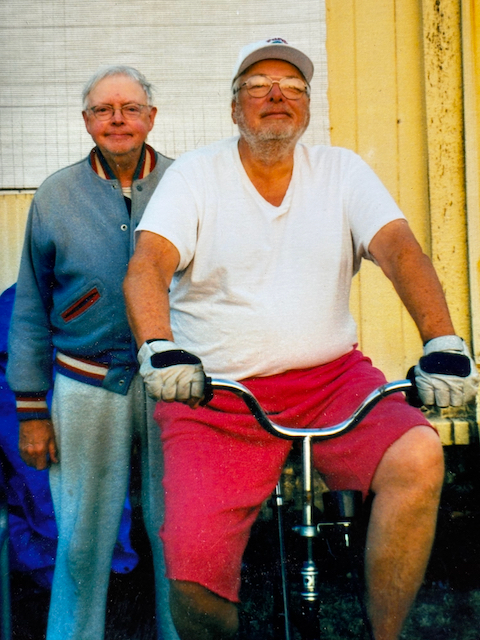
Older neighbors might remember the brothers—Hans and Karl—who on summer afternoons and evenings would sit on the front porch and visit with dog-walkers, runners, and anyone willing to say hello. We’ve lived in the neighborhood since the late 1980s and always enjoyed a brief chat with the idiosyncratic brothers who had tinfoil on their windows and seven cars in the backyard, but were always friendly and ready to visit or share a laugh.

Karl and Hans Homeyer, in the 1990s

Hans and Karl never married and lived in the house all their lives. Hans died in 2002. Younger brother Karl is now in his 90s and moved into a Portland care facility last year. The home was built in 1926 by their parents, Hans W.S. von Homeyer, who died in 1969, and Frances Westhoff von Homeyer, who died in 1990.

Earlier this year, after being unoccupied (but not empty) for almost a year, the house was purchased as-is by across-the-street neighbors Jaylen and Michael Schmitt, who knew “the boys” and couldn’t bear to see the place torn down, which is what most people probably thought was going to happen because it is in such tough shape. Inside, the house was jam packed with decades of papers and other items piled high leaving little room to walk or sit.

“We’ve always been worried that it would be demolished and replaced by something that wouldn’t be right for his iconic piece of property, ” says Michael, recalling the classic bungalow that was torn down in 2017 a few blocks east at NE 30th and Skidmore and replaced by a duplex, despite neighbors’ concerns. And another bungalow on NE Mason that was torn down last summer and replaced by a much larger house.

With help from a small army of friends and neighbors, the Schmitts have been sorting through boxes, bags, and containers that were stacked from floor to ceiling holding everything from video games to ammunition; from 1940s-era ice delivery receipts to vintage clothing. Michael reached out to me for help sorting, contextualizing and organizing hundreds of photographs and personal papers that tell the story of the families and the original design and construction of the house. It’s been a fascinating assignment.

This spring, I’m helping the Schmitts create an archive that documents the life of the house and its family that can travel forward in time, and that offers a narrative about the last 100 years here.

In future posts, we’ll write more about that, and about how we’ve been curating the photo archive. The insights are as amazing as the photos and go off on many different and fascinating tangents. We’ll also explore the design, construction and history of this house, its family, and the interesting role they played in the early neighborhood.

But for now, things are beginning to happen and the neighborhood will begin to see activity around the house. The Schmitts are hosting an estate sale starting today through this weekend and the list of items for sale is pretty remarkable: fabrics and sewing patterns from the 1940s-1960s; lot of tools; a pinball machine, magazines galore and an amazing selection of auto racing trophies from the 1960s. Even if you are not in the market for a vintage steamer chest or sewing machine, the estate sale is an opportunity to see this time capsule of a house.

This weekend’s sale is an early step toward restoring and adapting the house for the future. An architect is working with the Schmitts on subtle changes that add bedrooms and bathrooms, and update the kitchen which is still in original and very worn 1926 condition. Other less visible but crucial changes, like updates to all major building systems, are in the plans too.

“Whatever we do, we want to be in keeping with the spirit of the original design and with a sense of the neighborhood,” Michael says, recognizing the real estate market of today is much different than 100 years ago. To make it a marketable property going forward, they’ll be adding a bedroom and bathroom in the basement and also on the first or second floor. The steep rooflines and the shed-roof dormers on the second floor make fitting another bedroom up there a little tricky. More analysis and imagination required before they can answer that question.

One design change we’re looking forward to seeing: the signature west front columns and French doors–walled up long ago–finally set free, a kind of time travel return to the architect’s original vision.

NE 24th and Mason, early 1930s. Photo courtesy of the von Homeyer Collection.

For now as work gets rolling with this spring’s estate sale, it’s enough to acknowledge the significant amount of work required to bring this house back to life, the many stories this place has to tell, and the vision of neighbors committed to restoring and adapting a unique property for its second century.

Next: An ad hoc archive of construction documents

A hidden place called Gleneyrie

Today, we think of the Alameda neighborhood as one contiguous area with well-recognized boundaries: The city’s Office of Neighborhood Involvement identifies Alameda as that area from Prescott on the north to Knott on the south; from NE 21st on the west to NE 33rd on the East. One single named neighborhood today, containing about 2,400 dwellings and more than 5,000 people.

But hiding underneath today’s one single map is a treasure of 23 old maps—subdivision plats—all drawn at different times by different people as they transformed this landscape one small piece at a time from forests and fields to the grid of streets we know today. We’ve been taking a systematic look at these plats, some of which like one particularly chaotic collision just north of Knott, we’ve written about.

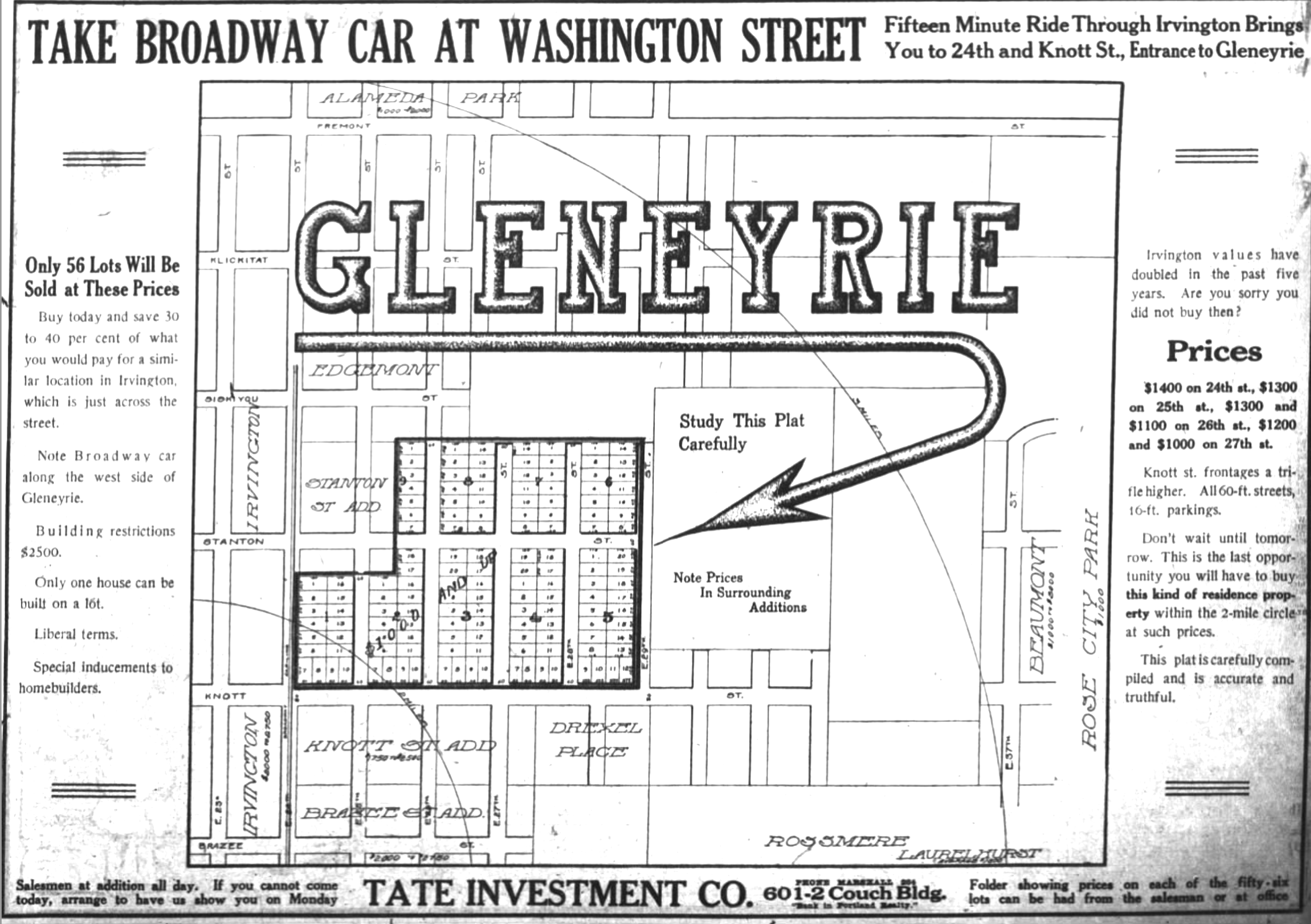
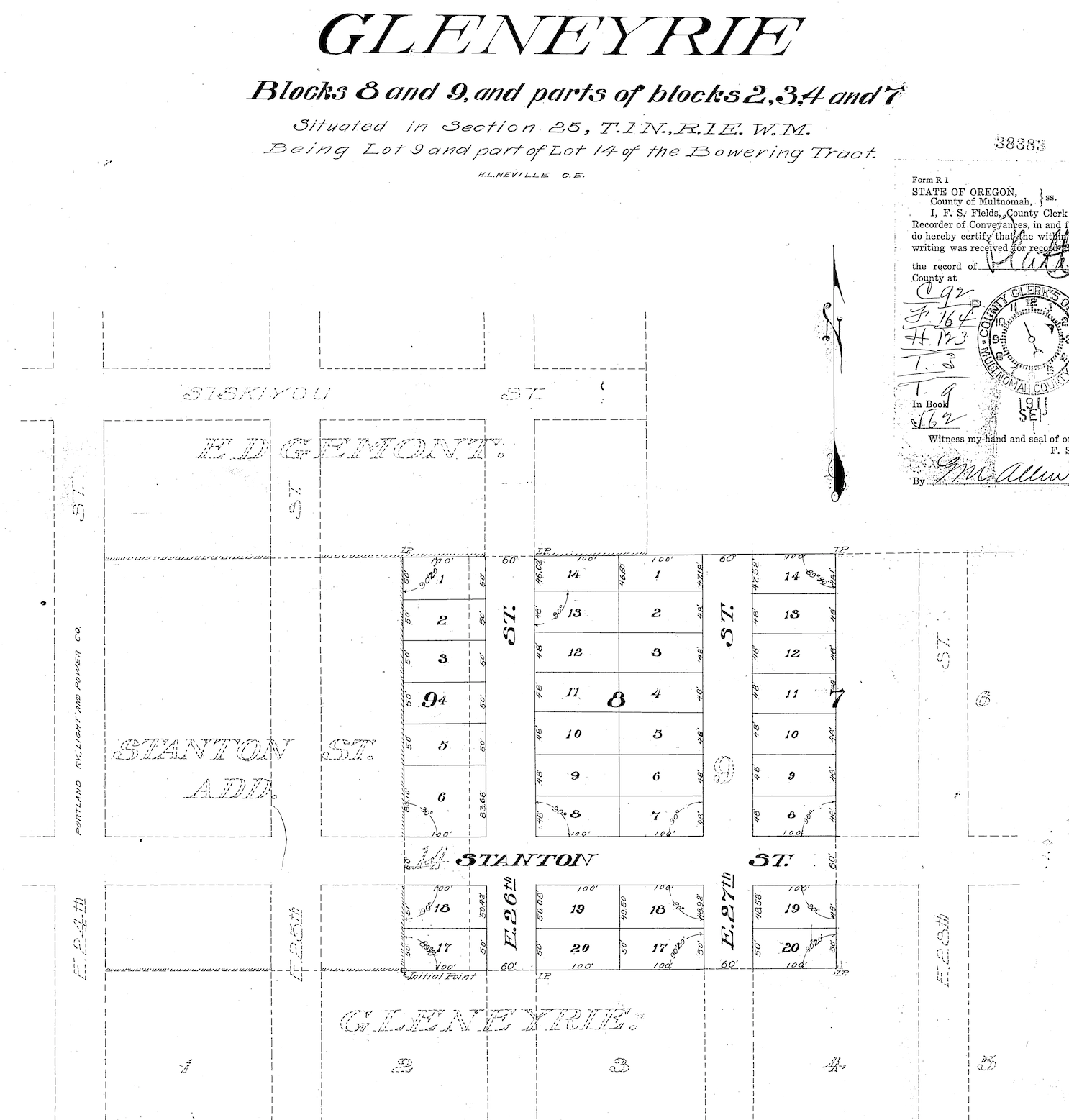
Here’s one we’ve been looking into recently: Gleneyrie, a subdivision plat filed in July 1911 by three couples who were the principals of the Tate Investment Company: Thomas and Inez Foster; Jost and Maria Held; and Robert and Nellie Tate. That fall, they placed their first ad for the property, below, which was then still just a concept (click in for a larger view).

From The Oregonian, October 22, 1911

The Tate Company investors purchased their 24 acres of the former Bowering Homestead Donation Land Claim in the years after the 1905 Lewis and Clark Exposition with an eye toward real estate development. The surrounding open fields, orchards and dairy property were rapidly being converted to residential use to keep up with Portland’s booming real estate market and population. And there was much money to be made by investors ready to speculate on a rising market. The Tate Investment Company also developed Dixon Place, another plat just north of Fremont between NE 15th and NE 21st avenues.

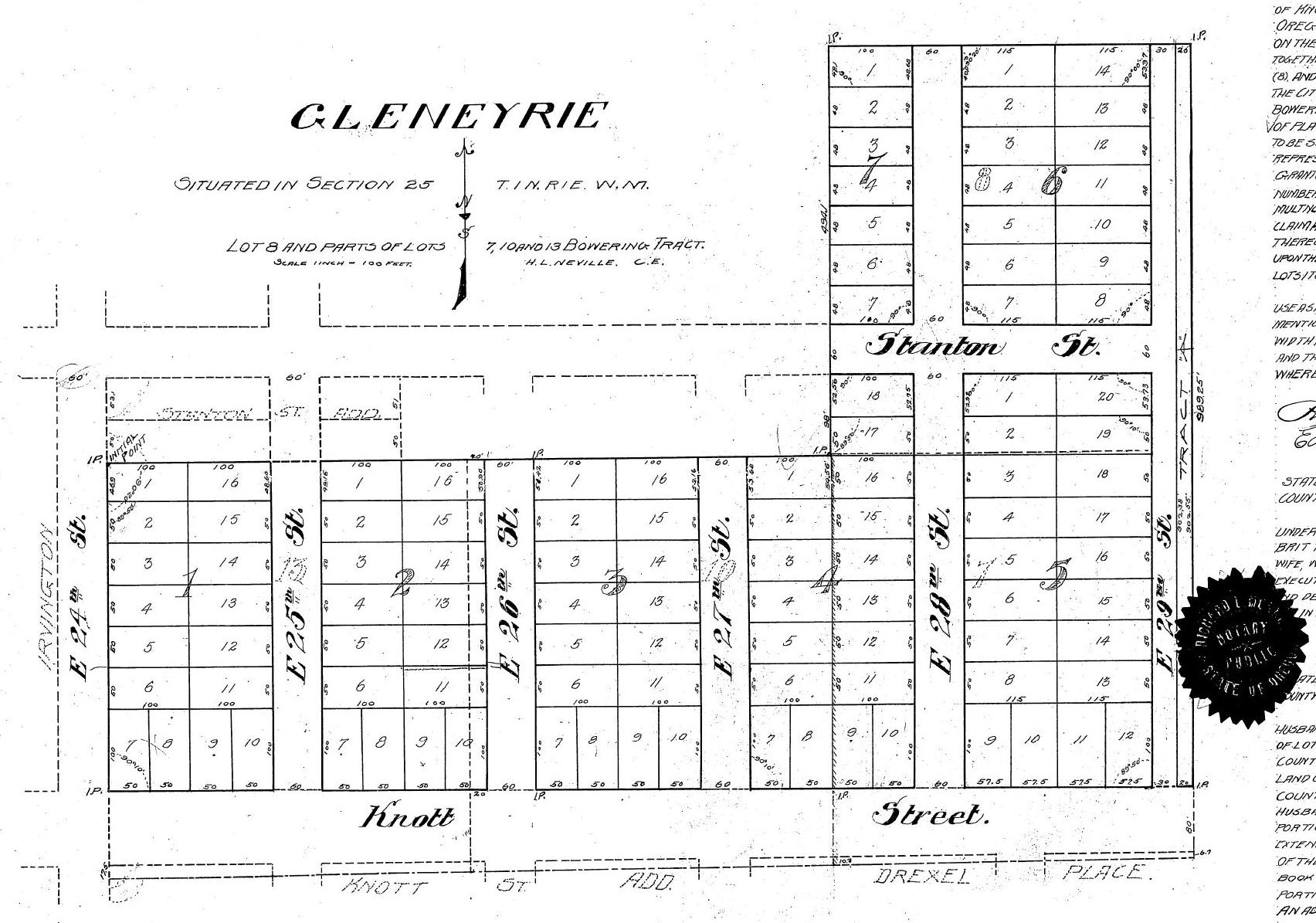
Here’s a look at the official Gleneyrie plat, filed with the Multnomah County Surveyor and County Clerk on July 25, 1911: from NE 24th to NE 29th, between Siskiyou and Knott.

One week later, Tate added additional area to Gleneyrie taking in East 26th and 27th north to the existing boundary on the eastern edge of the plat.

The namesake Gleneyrie was a Tudor-style castle in Colorado built in 1871 by William Jackson Palmer, founder of Colorado Springs: big, beautiful, fancy and well-known. And the name sounded good too, which was key. By 1915, Portland developers had filed more than 900 plats—development plans that divide an acreage into a subdivision of lots and streets—many of which were as small as one block or less, and all named by developers searching for an attractive sounding name.

Today’s Alameda neighborhood is made up of 23 separate plats, all filed at different times by different developers who were competing with each other and speculating on market conditions when they bought chunks of what had been old homesteads and farms claimed in the 1850s and 1860s.

In some areas the plats have retained their distinct personality and name. But here in Alameda—named for the 1909 Alameda Park Addition plat filed just to the north—the identity of the individual plats like Gleneyrie eventually dissolved into the commonly used neighborhood name we know today.

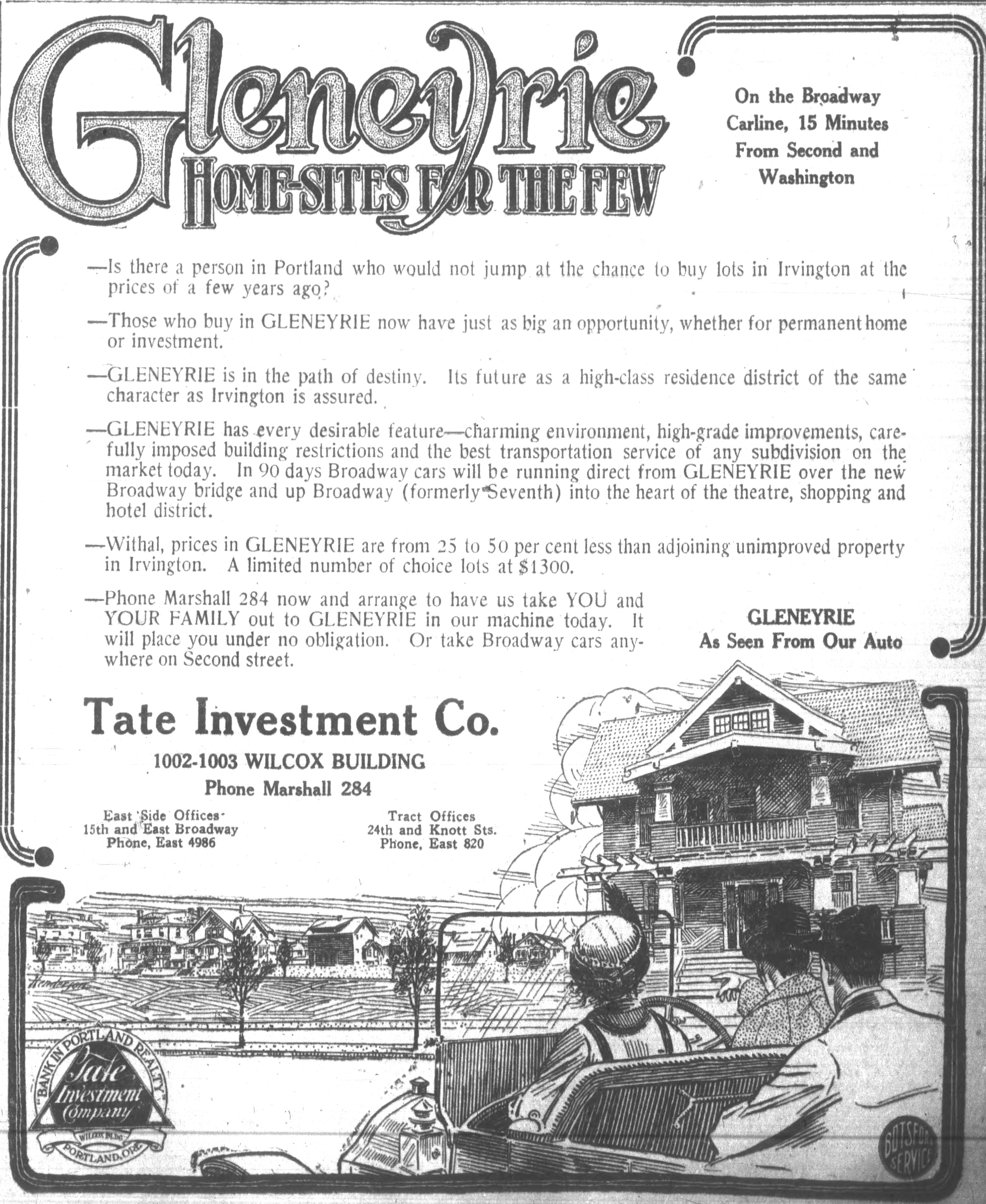
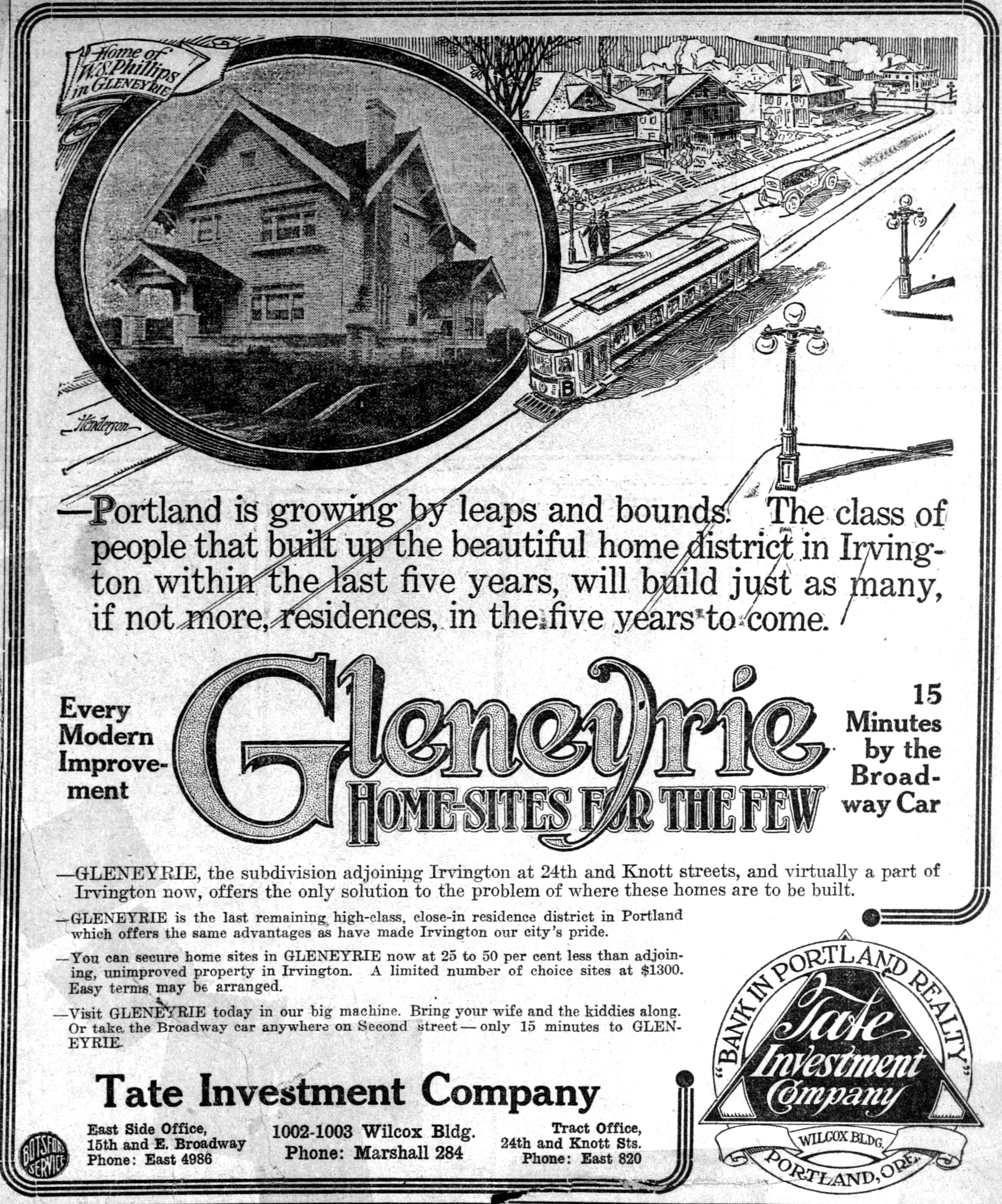
But in the Spring of 1913, when having a catchy name might help compete with all the other real estate advertising, the Tate Investment Company pushed out a series of full-page and half-page illustrated ads in The Oregonian and the Oregon Journal to market the attributes of their new subdivision. And they tied their marketing more closely to Irvington—a well established prestigious brand—than to Alameda, which had just been launched (and was trying to coattail on Irvington as well).

From The Oregonian, April 14, 1913

From The Oregonian, April 20, 1913

While all this advertising was underway, work out on the ground of what was Gleneyrie transformed the property from what were rolling fields into a mostly level subdivision. Significant grading work was done on the property to remove hills and fill in swales and ponds. Newspaper accounts from 1913 indicated 50,000 cubic yards of fill was removed: that’s more than 4,000 modern-day dump truck loads.

One of the leading early builders in Gleneyrie was Arnt Anderson, one of the two-dozen-plus builders we’ve written about on The Builders page. Anderson built some amazing homes that have passed the test of time…before he was arrested, convicted and imprisoned for grand larceny.

Today, ask anyone to tell you where Gleneyrie is and you’ll probably get a blank stare. But back in the day, the folks at the Tate Investment Company were trying hard to make it a household name. Literally.

Wondering about the other 22 plats in today’s Alameda? Here’s the full list: Alameda Park, Homedale, Olmsted Park, Irvington, Edgemont, Pearson’s Addition, Town of Wayne, Town of Wayne Replat, Waynewood, Irvingwood, Meadow Park, Dunsmeade, Irvindale, Hillside, George Place, Gile Addition, Bowering Donation Land Claim Tract, Norton’s Subdivision, Stanton Street Addition, Hudson’s Addition and Meadow Park.

Alameda’s C.J. and Lillian Smith House: Setting the record straight on C.C. Rich

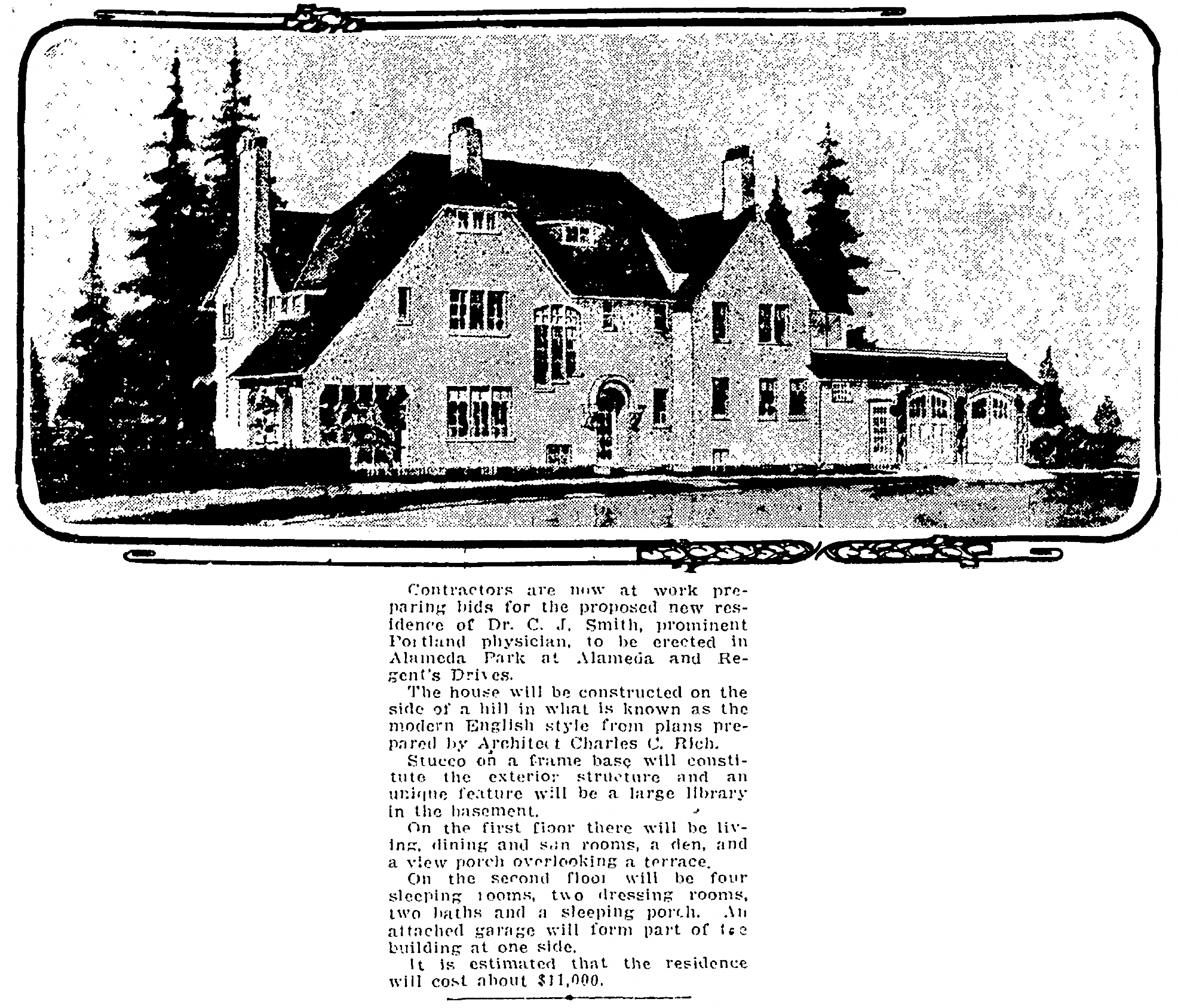
When Dr. Charles Johnson Smith and Lillian Belle Guillford Smith built their mansion on Alameda Ridge in 1915, they had just come off his unsuccessful campaign for Oregon Governor, losing by a convincing margin to Republican James Withycombe, but considering a run for some other office or public service. They were also launching a new chapter in their lives—relocating to Portland from a quarter-century of public life and Dr. Smith’s medical practice in Pendleton.

Their new home at 864 The Alameda (readdressed during the Great Renumbering as 2834 NE Alameda) symbolized that ascendency: a graceful blend of English country house and Arts and Crafts style; a commanding view of downtown with a presence on the ridge among neighbors who were the captains of industry and Portland society; plenty of room to entertain.

The relatively unformed Alameda Park addition spreading out around them was just six years old and less than 15 percent of the available lots had been bought or built when the Smiths acquired two lots at the bend of The Alameda—as the street was known until the early 1930s—and hired local architect Charles C. Rich to design their dream home. Because of Smith’s prominence in the public eye, and the growing interest in residential development in this area, his real estate choices made news:

From The Oregon Journal, August 1, 1915

Homebuilding was in a slowdown due to economic conditions, so any building news was good news, and local newspapers paid close attention to milestones in their construction process. As the summer of 1915 unfolded, a series of short news items documented issuance of the building permit to builder James L. Quinn; excavation on the ridge and framing of the foundation as well as advertising for plumbing and electrical bids on August 25th; and construction of the retaining wall above Regents Drive on October 3, 1915. Capping off all the construction news coverage was this final piece, which appeared in the Oregon Journal on March 19, 1916:

In the 1980s, design of the home was mistakenly credited to Portland architectural giant Ellis Lawrence, who was active at this same time and in the same style, and who was friends with architect Charles C. Rich and with Smith family daughter Gwendoline (who in a big society wedding in the family home in 1917 married Harry Ashley Ely, another member of that friend group). All three men were involved in formation of the City Club of Portland. Rich and Lawrence were also faculty colleagues at the University of Oregon School of Architecture.

The original building permit documents, multiple news stories from 1915-1916, and the actual blue prints (which still exist, against all odds) make it very clear this house was designed by Charles C. Rich, not Ellis Lawrence. Just wanted to set that record straight.

The Smiths lived in the home until 1927, followed by the Arthur and Louise Nicolai family until 1946; Emily and Earl Grove until 1961; and the Kuzmaak family until 2019. The house was recently completely renovated by the Arnal family.

Carl F. Ruef, Alameda florist and builder

Five homes in the Alameda neighborhood were built by a multi-talented “moonlighting” florist during the boom years of the 1920s.

During the Great Depression years of the late 1920s and early 1930s, Alameda florist and home builder Carl F. Ruef lost his fight with his Alameda neighbors and the City of Portland to open a greenhouse and flower shop at NE 24th and Fremont. But his local handiwork survives as a testament to the resourcefulness of that time, the chutzpah of his big mid-life move, and the boom times of homebuilding in the mid 1920s.

Ruef built and lived in the Mediterranean-style home at 2208 NE Regents from 1924-1930 before building and moving into the small Tudor revival style home at 2425 NE Fremont. Both homes survive today and were bookends of his Alameda experience.

​​From The Small Home: Financing, Planning Building, Monthly Service Bulletin No. 41, July 1925. Published by The Architects’ Small House Service Bureau of the United States, Inc. This was the home of Carl F. and Florence Nichols Ruef from 1924-1930. Prior to Portland’s Great Renumbering of 1930-1931, the home was originally addressed as 742 Regents. Today it is 2208 NE Regents.

Carl F. Ruef was a first-generation American from German immigrant parents who was born in Claremont County Iowa on May 20, 1879 and grew up in Salem, Oregon. With his brother Edward, Ruef established the largest floral greenhouse operation in Oregon outside of Portland near the intersection of 17th and Market Street in Salem, with a retail storefront in downtown Salem. In the 19-teens Ruef, built a reputation as Salem’s leading florist, knowledgeable about all aspects of flower growing, gardening, and the cultivation of fruits and berries.

From the Capital Journal, October 31, 1916.

Carl Ruef lived at home with his parents until age 39, when in a bold moment after their deaths he sold the Salem greenhouses and florist business, married Statesman-Journal newspaper social columnist Florence Elizabeth Nichols (ten years his junior), had a baby daughter Mary, and moved to Portland.

Once in Portland, Ruef first appears in city directories as a gardener, living with wife and daughter at 2328 SE Yamhill Street. Evidently, he was also preparing to launch a career as a homebuilder. In 1923, he built 1832 SE Hazel (where the family lived briefly), and two homes that share a back fence: 3527 NE 29th Avenue and 2816 NE Ridgewood. In 1924, Ruef is listed in city directories as a builder; the Ruef family was living in the home he built at 2208 NE Regents, which still stands today.

This third home known to be built by Ruef—located on the southeast corner of NE 22nd and Regents—appeared in several publications, including a catalog of building plans published by the Architects’ Small House Service Bureau. Accompanying the 1925 photo above is the following short story and a quote from Florence Ruef about the house and its landscaping:

1924 was a busy year for new homebuilder Ruef: he built the Regents, Ridgewood and NE 29th Avenue houses and the home at 3834 NE 23rd.

Starting in December 1925, the Ruefs attempted to sell the Regents house for $9,000, advertising it as follows: “Choice Spanish bungalow, a positive sacrifice by owner, tile roof, oversize grounds, gas fired hot water heater, illuminated at night.”

But the Regents house didn’t sell and the Ruef family continued to live there until 1930 when they moved into the final home he built, the tiny English Tudor at 2425 NE Fremont.

Meanwhile in the late 1920s, Ruef turned back toward the floral business, opening and then later selling the Irvington-Alameda Floral Company at 1631 NE Broadway.

The Great Depression years of the early 1930s were a challenging time for the Ruef family and for most families in Portland. They continued to live in the small English Tudor on Fremont where they rented out one of the three tiny bedrooms for $12 per month. On March 22, 1931 Ruef advertised the room for rent in one part of the classified ads, and in a different section sought a loan offering the house as collateral: “Want $2,750 on $8,000 new residence, 6 percent no brokerage fee.” He was evidently trying to capitalize a new floral business.

Working out of the small house on Fremont, Ruef attempted to turn his florist know-how into an income stream for his family, initially growing flowers in the backyard and eventually seeking city permission to put up a small sign advertising the business, and later to convert the garage into a greenhouse.

From The Oregonian, May 13, 1931

In May 1931 he requested a zone change and permission to put up a sign for his flower business facing Fremont: the lot to the west, location of today’s Childroots Daycare, was vacant during those years as was the residential lot to the east. But neighbors didn’t like the idea of businesses in the Alameda Park Addition period, stemming in part from the original deed restriction prohibiting businesses in the neighborhood, and complained to the city which in December shut down both the sign request and later the zone change which would have allowed Ruef to open a small flower shop.

From The Oregonian, December 31, 1931

This annotated photograph from a rainy day in 1935 (click to enlarge) shows the home Ruef built at 2425 NE Fremont where he wanted to establish a flower shop, and the home he built in 1924 at 2208 NE Regents in upper left. The vacant lots either side of the Fremont house would have been perfect for the greenhouse he had in mind. Note: the Broadway Streetcar waiting at the corner of Fremont and 24th in front of the Alameda Pharmacy; the gas station on the northwest corner; and the vacant lots on both the southeast and northeast corners. Original photo courtesy of Portland City Archives, A2005-005.1421.2. For more views of this intersection, click here.

Due to the strong neighborhood opposition, the Ruefs gave up on the home-based business idea and in 1932 rented space at 3125 East Burnside for a new business, Carl Ruef Floral. They continued to live at 2425 NE Fremont and grow some flowers under a revocable city permit. The 1940 census found all three there, listing Carl at age 60, proprietor of a florist shop; Florence, 48, was keeping house; and daughter Mary, then 20, was a model of ladies’ apparel.

From the Oregon Journal, August 29, 1939

When Carl died suddenly one year later in December 1941, the family was living at 1412 SE 25th. His death certificate notes he was a “retired florist and landscape architect.”

Florence and Mary continued to live together until 1943, when Mary moved to Chicago with her new husband Howard Fay, and Florence remarried Portland railroad dispatcher Olof Olsson. Mary was back in the Portland area in the mid 1970s, remarried after her first husband’s death, working as a real estate agent until her own passing in 1985. Florence lived briefly in the late 1950s with her new husband in a Las Vegas trailer park before returning to the Portland area where she died in 1989 at age 100.