The von Homeyer House: New life after a century of wear and tear

If you’ve spent time in the Alameda neighborhood, you’ve probably seen this house and wondered about its story:
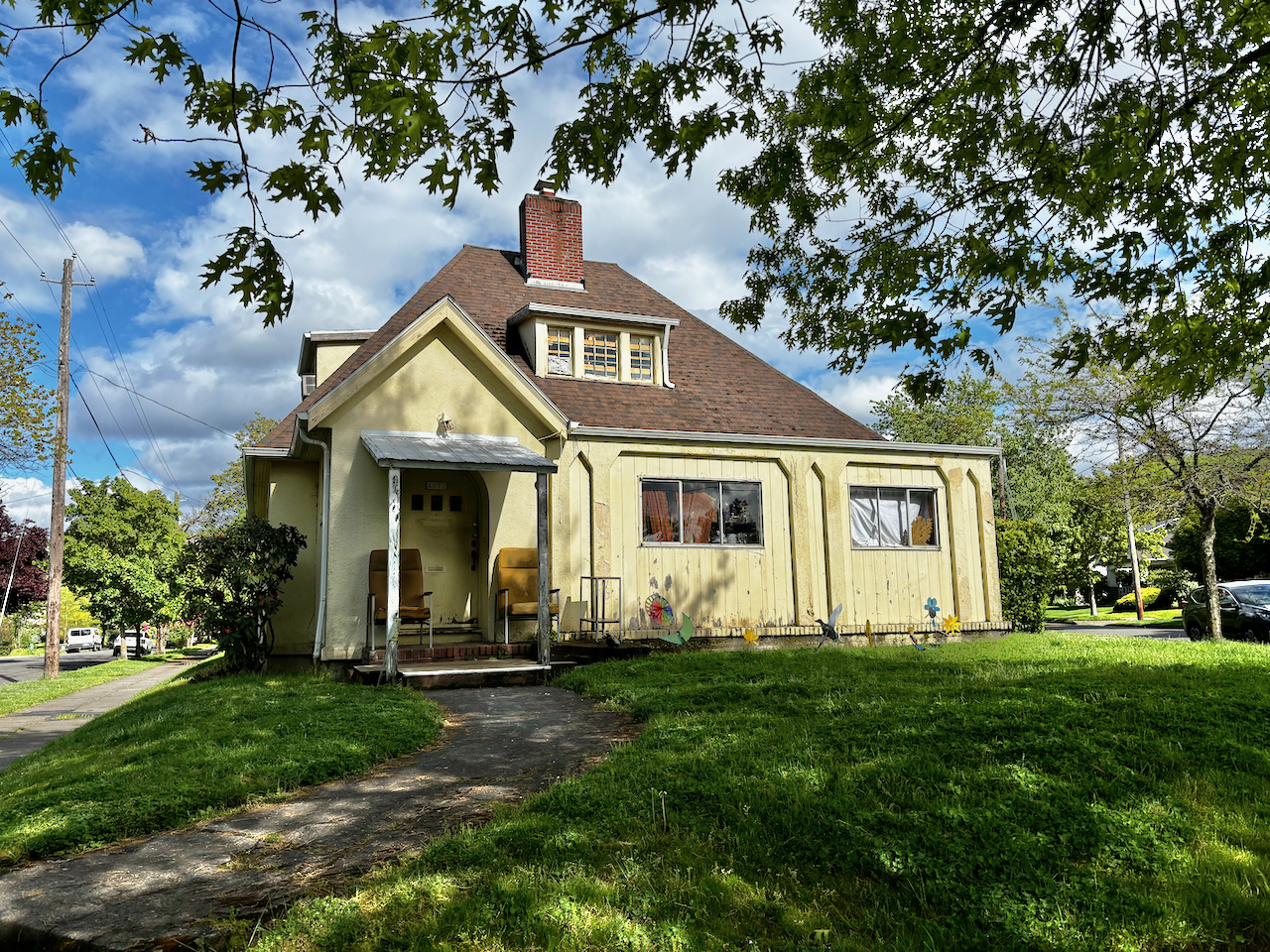
The von Homeyer house, NE 24th and Mason, May 2024. Brothers Karl and Hans lived their entire lives in the house and on summer evenings greeted neighbors and watched the world go by from their front porch chairs.

It’s the steep-roofed, run-down yellow house on the prow of the intersection where NE 24th,  Mason and Dunckley streets come together, built and occupied for all of its life—since 1926—by a single family: the von Homeyers.

Older neighbors might remember the brothers—Hans and Karl—who on summer afternoons and evenings would sit on the front porch and visit with dog-walkers, runners, and anyone willing to say hello. We’ve lived in the neighborhood since the late 1980s and always enjoyed a brief chat with the idiosyncratic brothers who had tinfoil on their windows and seven cars in the backyard, but were always friendly and ready to visit or share a laugh.
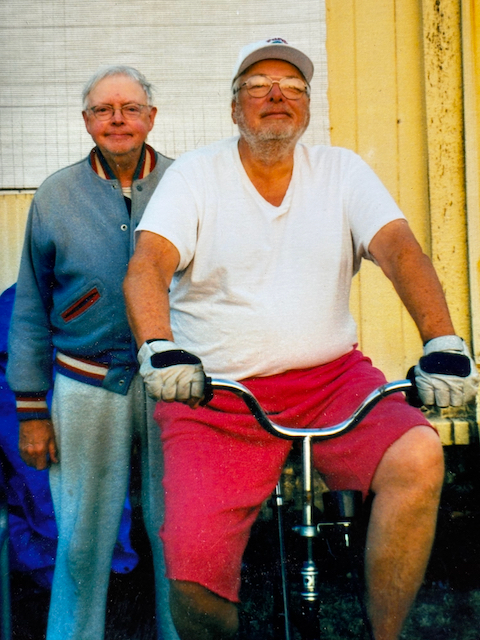
Karl and Hans Homeyer, in the 1990s

Hans and Karl never married and lived in the house all their lives. Hans died in 2002. Younger brother Karl is now in his 90s and moved into a Portland care facility last year. The home was built in 1926 by their parents, Hans W.S. von Homeyer, who died in 1969, and Frances Westhoff von Homeyer, who died in 1990.

Earlier this year, after being unoccupied (but not empty) for almost a year, the house was purchased as-is by across-the-street neighbors Jaylen and Michael Schmitt, who knew “the boys” and couldn’t bear to see the place torn down, which is what most people probably thought was going to happen because it is in such tough shape. Inside, the house was jam packed with decades of papers and other items piled high leaving little room to walk or sit.

“We’ve always been worried that it would be demolished and replaced by something that wouldn’t be right for his iconic piece of property, ” says Michael, recalling the classic bungalow that was torn down in 2017 a few blocks east at NE 30th and Skidmore and replaced by a duplex, despite neighbors’ concerns. And another bungalow on NE Mason that was torn down last summer and replaced by a much larger house.

With help from a small army of friends and neighbors, the Schmitts have been sorting through boxes, bags, and containers that were stacked from floor to ceiling holding everything from video games to ammunition; from 1940s-era ice delivery receipts to vintage clothing. Michael reached out to me for help sorting, contextualizing and organizing hundreds of photographs and personal papers that tell the story of the families and the original design and construction of the house. It’s been a fascinating assignment.

This spring, I’m helping the Schmitts create an archive that documents the life of the house and its family that can travel forward in time, and that offers a narrative about the last 100 years here.

In future posts, we’ll write more about that, and about how we’ve been curating the photo archive. The insights are as amazing as the photos and go off on many different and fascinating tangents. We’ll also explore the design, construction and history of this house, its family, and the interesting role they played in the early neighborhood.

But for now, things are beginning to happen and the neighborhood will begin to see activity around the house. The Schmitts are hosting an estate sale starting today through this weekend and the list of items for sale is pretty remarkable: fabrics and sewing patterns from the 1940s-1960s; lot of tools; a pinball machine, magazines galore and an amazing selection of auto racing trophies from the 1960s. Even if you are not in the market for a vintage steamer chest or sewing machine, the estate sale is an opportunity to see this time capsule of a house.

This weekend’s sale is an early step toward restoring and adapting the house for the future. An architect is working with the Schmitts on subtle changes that add bedrooms and bathrooms, and update the kitchen which is still in original and very worn 1926 condition. Other less visible but crucial changes, like updates to all major building systems, are in the plans too.

“Whatever we do, we want to be in keeping with the spirit of the original design and with a sense of the neighborhood,” Michael says, recognizing the real estate market of today is much different than 100 years ago. To make it a marketable property going forward, they’ll be adding a bedroom and bathroom in the basement and also on the first or second floor. The steep rooflines and the shed-roof dormers on the second floor make fitting another bedroom up there a little tricky. More analysis and imagination required before they can answer that question.

One design change we’re looking forward to seeing: the signature west front columns and French doors–walled up long ago–finally set free, a kind of time travel return to the architect’s original vision.

NE 24th and Mason, early 1930s. Photo courtesy of the von Homeyer Collection.

For now as work gets rolling with this spring’s estate sale, it’s enough to acknowledge the significant amount of work required to bring this house back to life, the many stories this place has to tell, and the vision of neighbors committed to restoring and adapting a unique property for its second century.

Next: An ad hoc archive of construction documents

Street scenes illustrate change at 42nd & Killingsworth

Third in a three-part series

As Portland slowly rebounded from the Great Depression of the early 1930s and interest rekindled in Portland residential real estate, the stage was set for a new era at NE 42nd and Killingsworth. Open lands were available for development, subdivisions were platted with buildable lots ready to go, and new infrastructure was on the way in the form of paved roads and big plans for the new Portland Airport. A small wood-frame general store had been built in the late 1920s at what was then the quiet rural crossroads, and other nearby mom-and-pop stores were opening to meet the needs of surrounding residents.

By 1951, the corner was home to multiple gas stations, a barber shop, a cleaners, an ice cream shop and a café. The small wood frame building on the northeast corner had become the Publix Market, operated by Cliff and Mary Tadakuma. Here’s a look:

1951 Looking Northwest

Looking to the northwest at the intersection of NE 42nd and Killingsworth about 1951. The Publix Market is at the northeast corner, on the right. The Lyle Sumner service station is on the Northwest corner. Note that the intersection is not signaled. Photo courtesy of Joyce Tadakuma Gee.

Before the war, Portland had a thriving population of immigrant and first-generation Japanese families who were integrated into all aspects of civic life. In early 1942, following the attack on Pearl Harbor and declaration of war, Japanese Americans were forcibly removed from most West Coast cities and relocated to internment camps in remote inland areas of the American West. The federal policy fractured families physically and emotionally, and resulted in significant economic losses for Japanese-Americans who owned businesses and property.

As families were loaded into buses and trains during the “evacuation,” heart-breaking decisions were made about the disposition of lands and businesses. Beginning in the 1930s, the Shiogi family had operated a market known as “Publix Market” at the corner of North Killingsworth and Gay Street in North Portland (the storefront that today houses Milk Glass Market, 2150 N. Killingsworth). When the Shiogis were removed to the Minidoka Internment Camp in Idaho, they “gave” their store to neighbors for safe-keeping.

In the fall of 1945, upon returning after the war, the family attempted to re-open the store but found anti-Japanese sentiment in Portland to be too strong. Younger members of the family—daughter Mary and her husband Cliff Tadakuma—who had endured the internment experience only to be discriminated against at home in Portland, moved to Hawaii for several years in search of a more hospitable environment. Mary found work as a housekeeper. Cliff became a gardener on a large estate.

In 1950, Mary and Cliff Tadakuma—with their young daughter Joyce who had been born at Minidoka—returned to Portland from Hawaii and decided to try again to reopen Publix Market, but this time in a different location farther out Killingsworth, in northeast Portland.

Mary had grown up in Portland, a first generation Japanese-American. Cliff had grown up in Maui and graduated from Oregon State University with a degree in chemical engineering (and where the two had met). While their interests and expertise were not necessarily in running a small grocery store, it was a better option than housekeeping and gardening when they returned to Portland.

The couple leased the old wood frame building at the northeast corner of NE 42nd and Killingsworth. The store was adjacent to a densely populated trailer court established during the booming war years, and the surrounding residential neighborhood was growing as well. With the help of Mary’s parents Lori and Hood Shiogi who had run the market when it was located in North Portland, Mary and Cliff set about re-establishing Publix Market.

Daughter Joyce Tadakuma Gee was six years old at the time and recalls that her family lived in the back of the store. Behind the shelves and retail area were two small bedrooms, a bathroom a living room and a small kitchen. Joyce—who is a long-time Portland resident—attended nearby Whitaker Elementary School, located on Columbia Boulevard. “I remember being so envious of classmates of mine who had ‘real’ homes to live in,” she recalled when interviewed in 2020.

Neighbor Doris Woolley grew up on Jarrett Street just north of Publix Market, and remembered that everyone referred to the store simply as “Cliff and Mary’s.” Doris—who passed away in 2020 at age 92—recalled that all of the residents of the trailer park and neighbors north of Killingsworth were loyal to Cliff and Mary and would only shop at Publix Market, even though there were two other small markets nearby.

“It was a great store and they had pretty much everything you wanted,” Woolley recalled.  “Plus, they would let you run an account. In those days a lot of people would charge their groceries during the week and pay for them once they got their paychecks at the end of each week.”

Asked about her recollections of Cliff and Mary’s Japanese American origins and any tensions during the post-war years, Woolley remembered only that everyone liked Cliff and Mary. “They were very kind to everyone.”

Mary Tadakuma died in 1954. Cliff remarried and moved with daughter Joyce to Hood River, where he ran a grocery market until his death in 1978.

1958 Looking North

This 1958 photo (courtesy of City of Portland Archives, a2005-001-984) looks north on NE 42nd just south of Killingsworth. Publix Market is gone, replaced by the Panarama, a liquidation store. The Chevron service station across 42nd to the west has changed hands since the earlier photo and was being operated by Rod Martin. Behind the Panarama Market was the parking lot and sign for the brand-new Safeway store. The intersection was controlled by stop signs facing NE 42nd Avenue.

The white clapboard market building was built about 1927 and was initially operated as a grocery store by Bill and Jennie Batson. Panrama survived the 1957 opening of Safeway, but by 1961 the building had been demolished and replaced by a parking lot and service station.

Safeway Opens in January 1957

A combination of changes in the grocery business—with tendencies to larger chain stores—and an increasing population and market made the corner a natural for the Safeway store, built on the site of what had been the trailer park and small grocery store in the 1940s-1950s.

The store opened in January 1957 as part of a three-store opening blitz in the Portland area, as described in this full page ad from The Oregonian on January 10 1957.


1964 siting of John Adams High School

Construction of John Adams High School just southeast of Fernhill Park in the mid-1960s caused quite a stir and protest from the neighborhood. More than 200 angry neighbors turned out at a Portland School Board meeting on September 14, 1964 to share their disbelief that the School Board would demolish and relocate more than two dozen homes, three duplexes, a local greenhouse/nursery known as Knapps and a PGE substation to make room for the school.

From The Oregonian, September 3, 1964. The homes and businesses inside the dotted line were demolished or relocated to make room for John Adams High School.

From the Oregon Journal, September 3, 1964. Greenhouses for Knapp’s Nursery on NE Simpson are visible in the photo to the left, which looks north on NE 42nd.

The emotion and sense of loss in the letters and petitions submitted to the school board make for tough reading. Despite this strenuous protest, demolition went ahead, construction followed, and John Adams High School opened in September 1969.

From the Oregon Journal, September 15, 1964

A dozen years later, when high school enrollment dropped in the early 1980s, the building was repurposed as a middle school and operated for another 18 years before being closed in 2000 due to health concerns about mold and radon gas. The building sat empty and was frequently vandalized until being torn down in 2006 leaving the large open space south of the track. Newcomers to the area today might not even know that vacant piece of ground south of the track was once a high school and middle school.

1965 Looking South

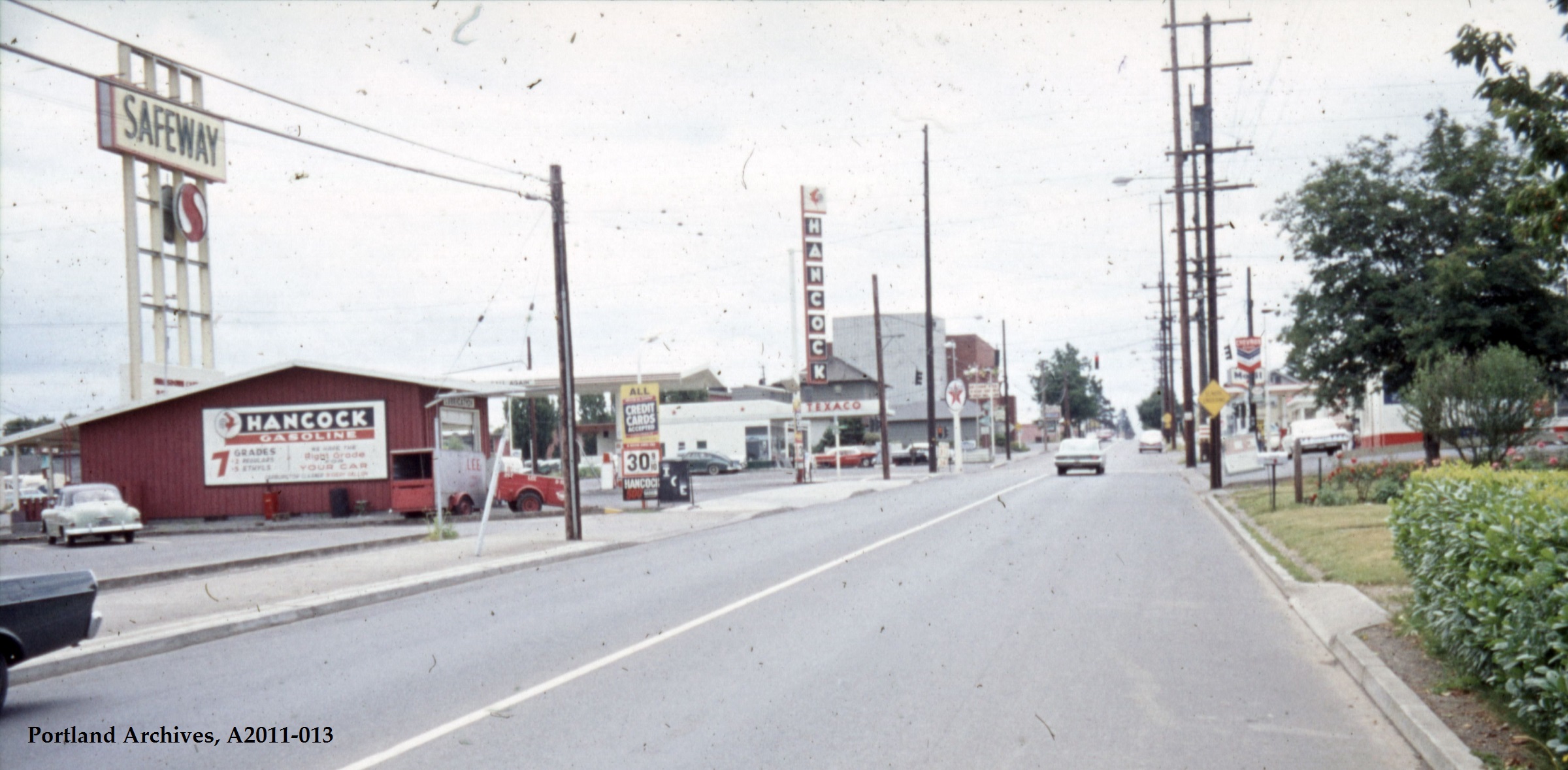
This view from 1965 looks south along NE 42nd Avenue. The tall buildings in the background are the relatively new St. Charles Church. The intersection has a traffic signal, and each corner features a different gas station: Texaco, Hancock, Mobil and Chevron. The Hancock building stands about where the Publix Market building once stood. The Safeway sign looms large over the intersection. Photo courtesy Portland City Archives, a2011-013.

Safeway operated in this location until about 1972, when the property was acquired by Portland Community College and the building remodeled to become a workforce training facility. In 2024, a completely new PCC building at the corner is now the Portland Metropolitan Workforce Training Center. And construction is underway just to the east on an affordable housing development managed by Home Forward that will include 84 units.

From open space that once provided wildlife habitat and material needs for Indigenous people; to homestead and farm fields that supplied a growing population of newcomers; to park land, school grounds, green houses, family homes and retail; and today affordable housing, workforce development and some great restaurants; this place has continued to evolve, layer upon layer of history and of life.

Lost Windemuth: “The Swimmerless River”

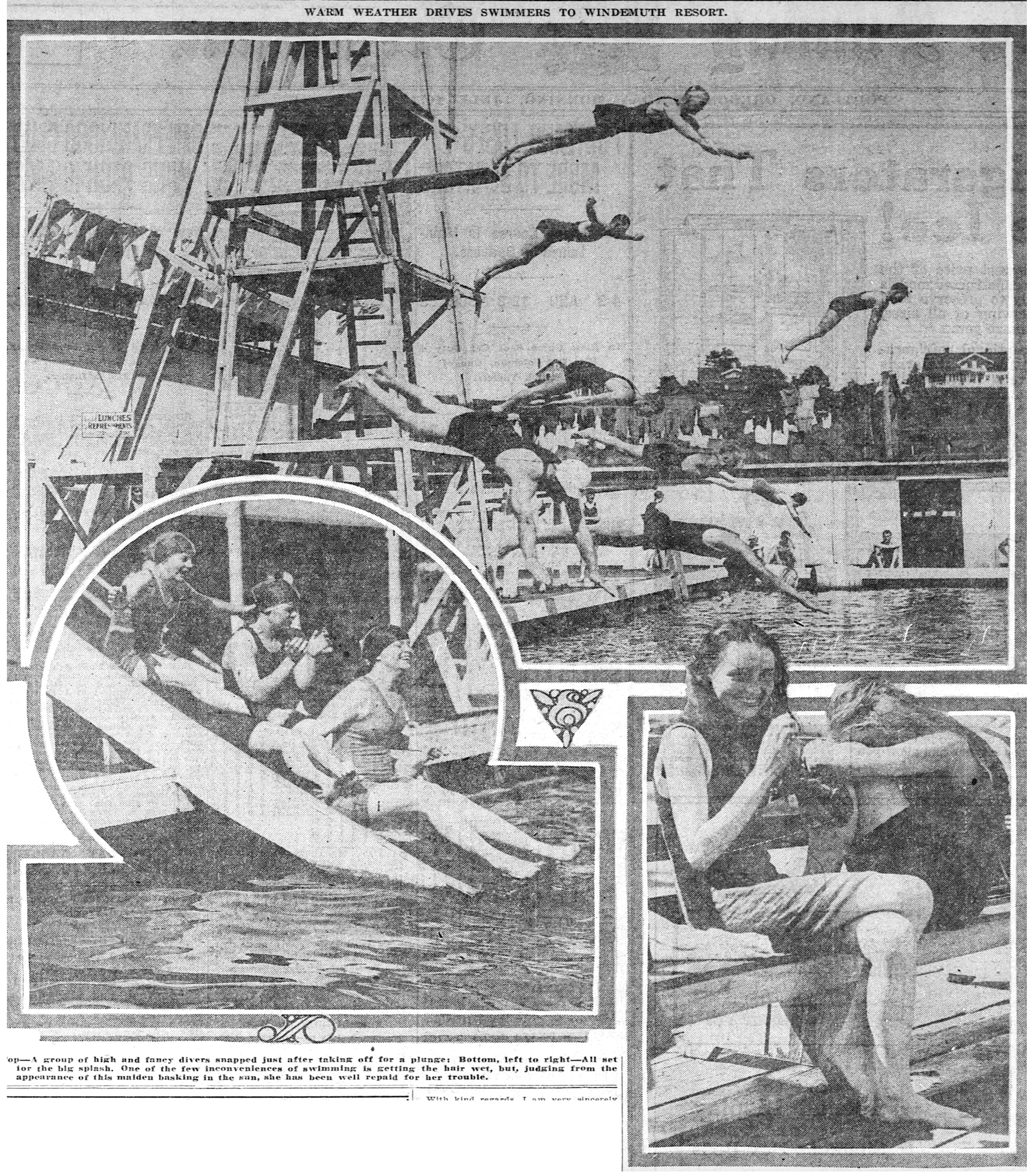
Last fall we shared amazing 100-year-old photos of the Willamette River. What a treat to be able to see and learn about river recreation in the early 1920s, including the rise of Windemuth, a popular swimming, diving and dancing resort that was afloat but anchored just downstream from the north tip of Ross Island.

From The Oregonian, July 10, 1921

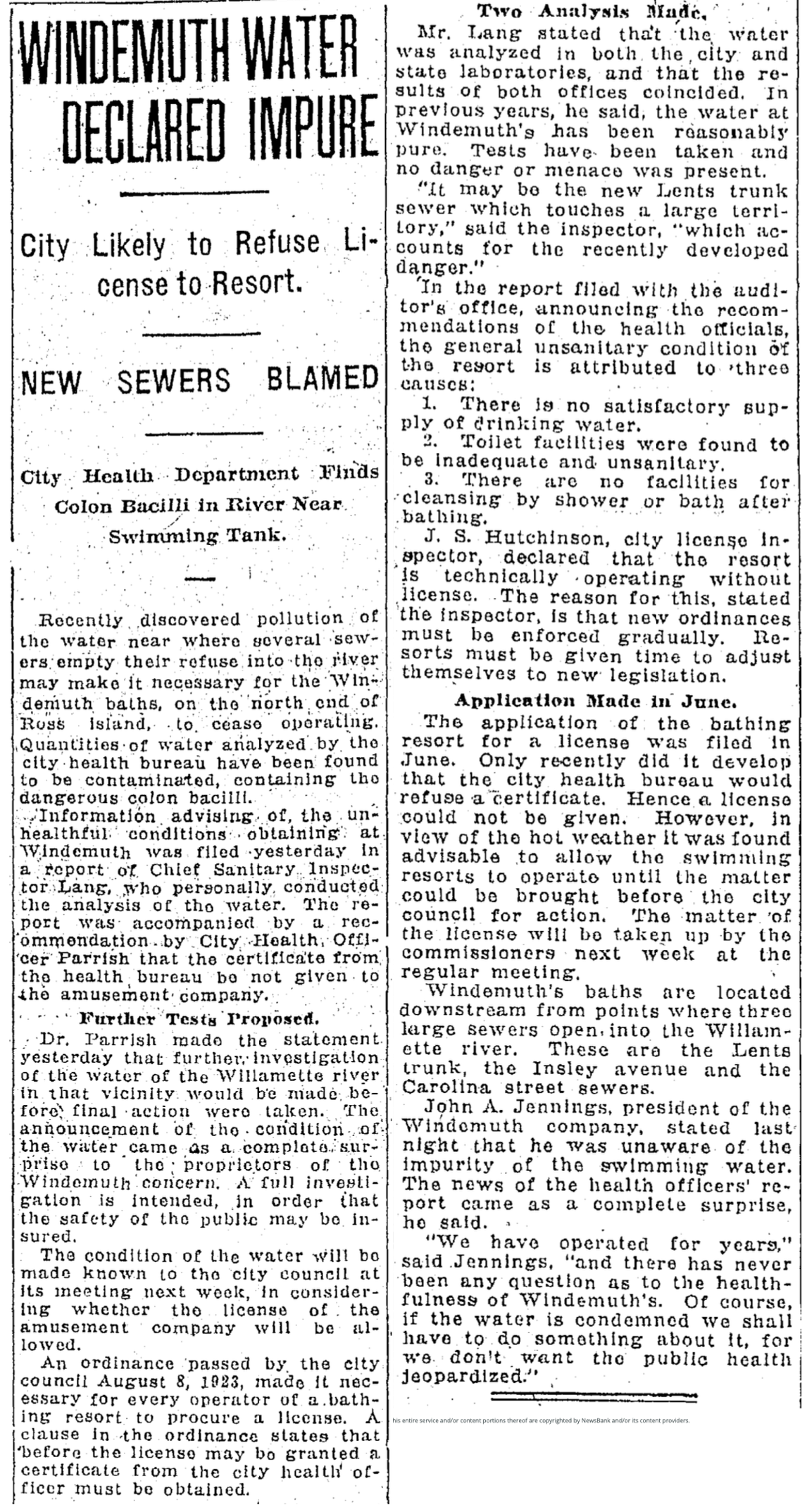
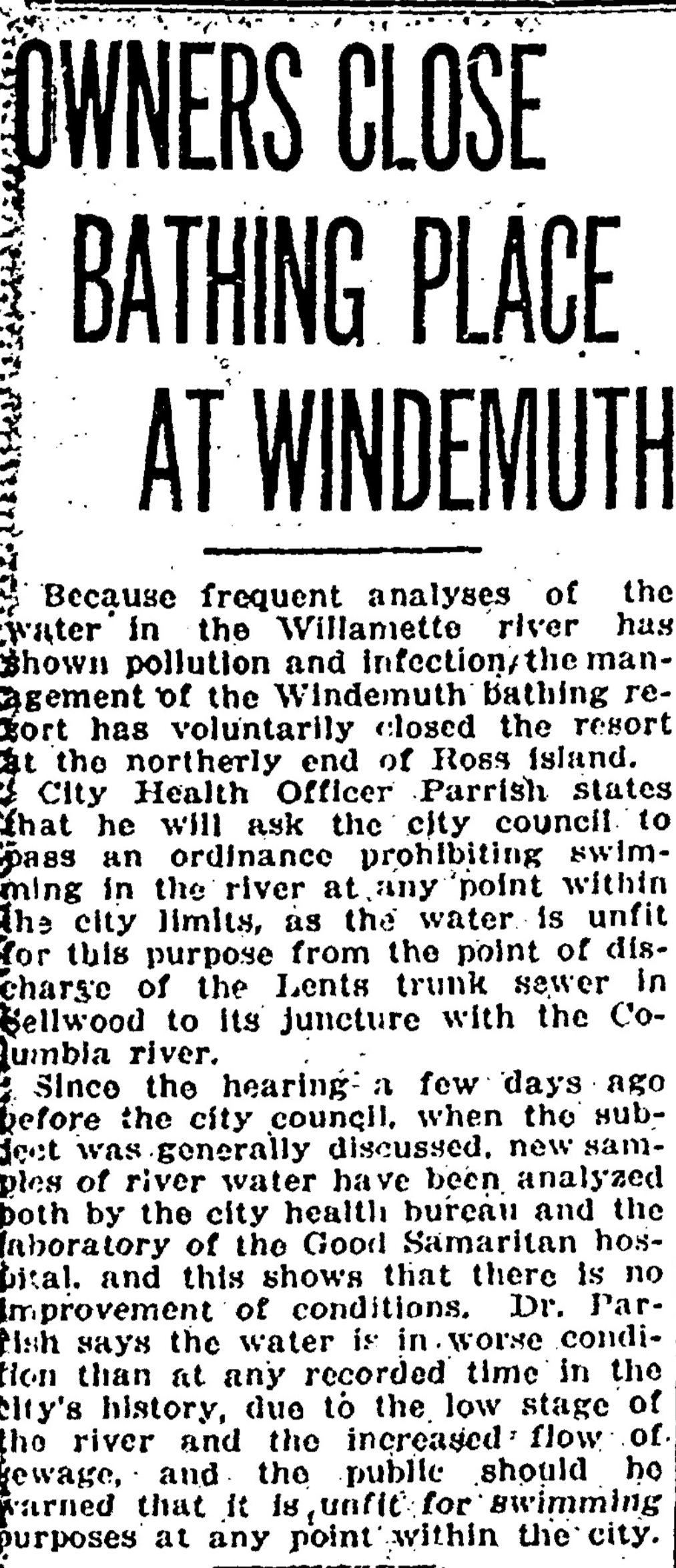
We left this story on July 31, 1924, with the owner of Windemuth deciding to close the resort due to water quality concerns. Anyone reading the news stories in the hot-dry, low-water summer of 1924 could see the handwriting on the wall. Not a big surprise: much of Portland’s raw sewage was piped straight into the river. In mid-July, water tests had noted the presence of Bacillus coli in the water and City Council hinted at a swimming closure.

From The Oregonian, July 16, 1924

Ten days later, during City Council’s hearing on the operating license for Windemuth, the focus was on the looming swimming ban and the presence of sewers. Windemuth operator John A. Jennings signaled he was ready to move the floating resort anywhere the water was clear, but with Portland’s sewage system relying almost entirely on the Willamette River, there was no central alternative. Maybe build intercepting sewers that would shunt sewage to the Columbia River, wondered City Health Officer George Parrish, who had suddenly been called on to deliver a solution to swimming in the Willamette (see the last paragraph below).

From The Oregonian, July 25, 1924

The primary culprit was the Lents Trunk Sewer, a 5.2 mile tunnel, 56 inches by 71 inches in size, that emptied into the river at Harney Street, a stone’s throw from the diving boards at Windemuth. When it opened in August 1923, the line received sewage from about 30,000 homes as far east as Foster Road. In addition to the Lents Trunk Sewer, two additional lines—the Insley Avenue Sewer and the Carolina Street Sewer—also discharged into the river directly across from Ross Island and upstream from Windemuth. We’ll remember the boom in home construction and population in the early 1920s. It all had to go somewhere.

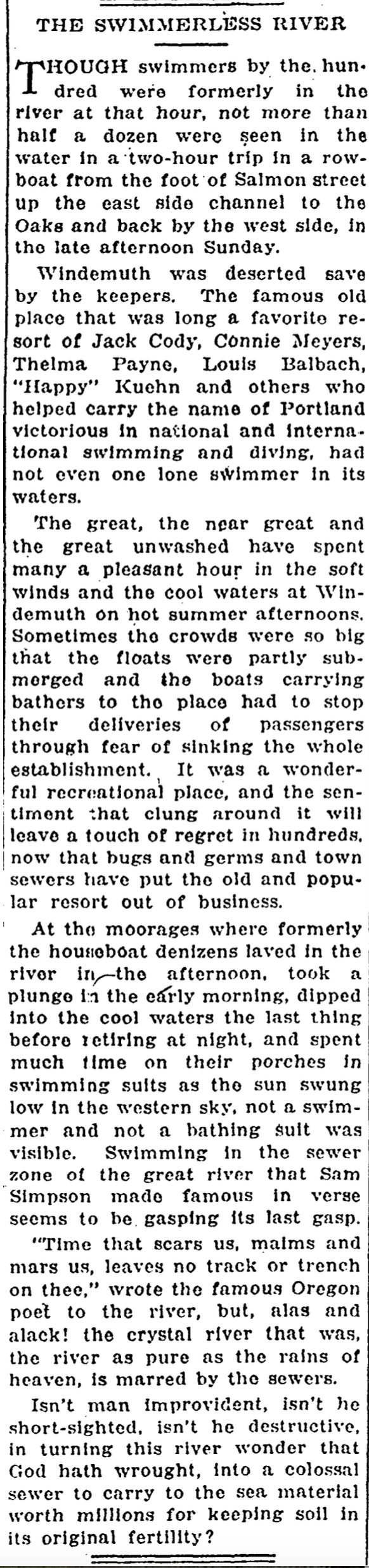
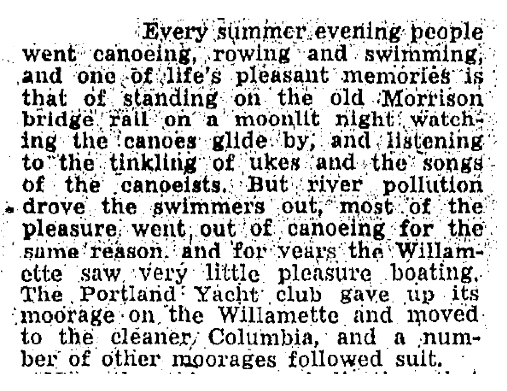
In early August after Windemuth was closed and swimming banned from the river, an editorial writer from the Oregon Journal spent Sunday afternoon rowing from downtown out and around Ross Island. The heartbreaking column on August 5, 1924 was an elegy for the river:

From the Oregon Journal, August 5, 1924

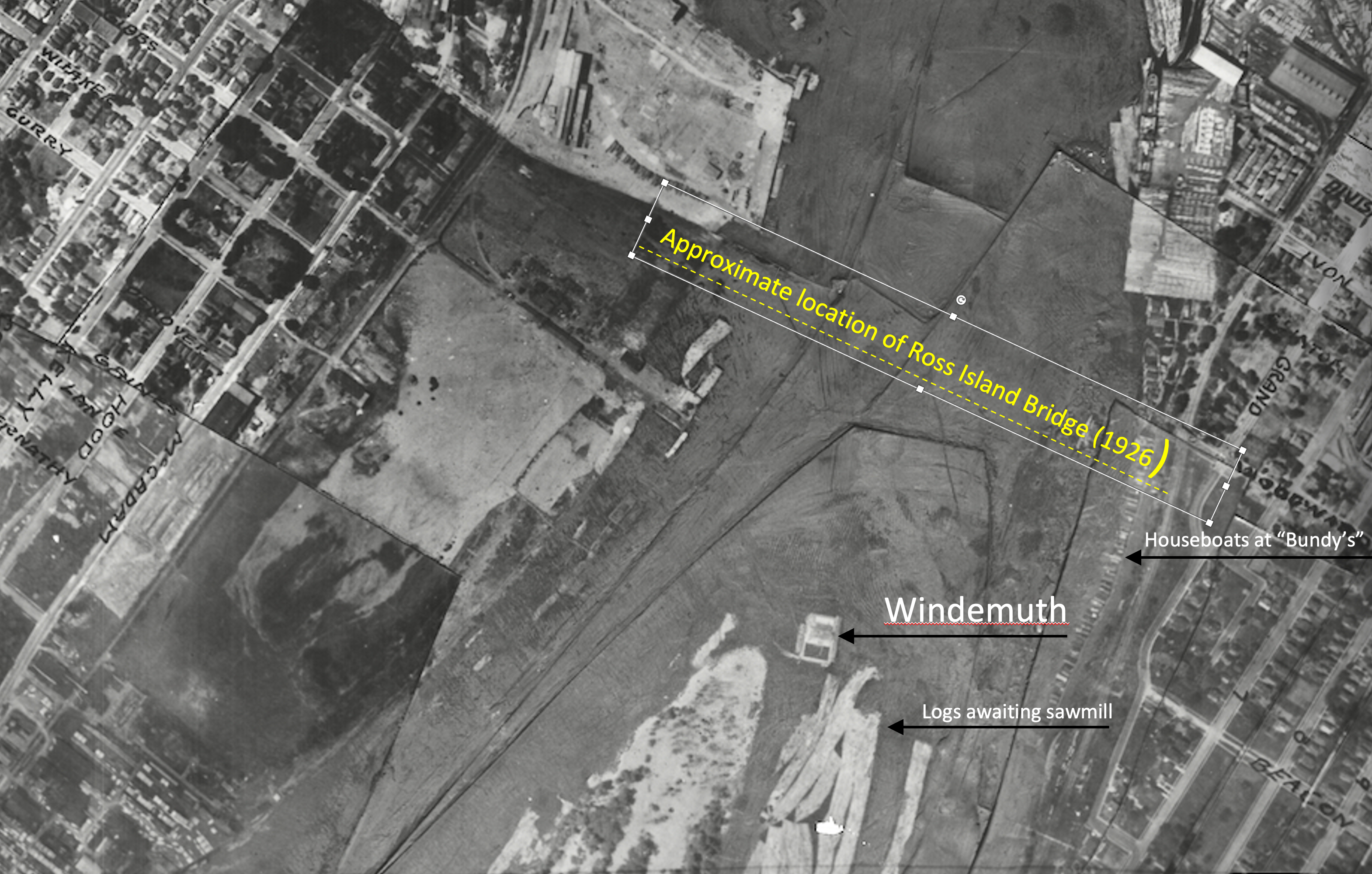
We actually catch a glimpse of the floating Windemuth in the center toward the bottom of this 1925 aerial photo, one year after its closure. There’s lots to look at here, so we’ve pointed out a few things including the houseboats that once lined the river in this location—a Bohemian community of artists, architects, writers and others; floating log rafts awaiting the saw at nearby mills; the location of the future Ross Island Bridge which would come along in 1926, and the floating rectangle that was Windemuth.

Detail of 1925 aerial photo with labels added. Click to enlarge.

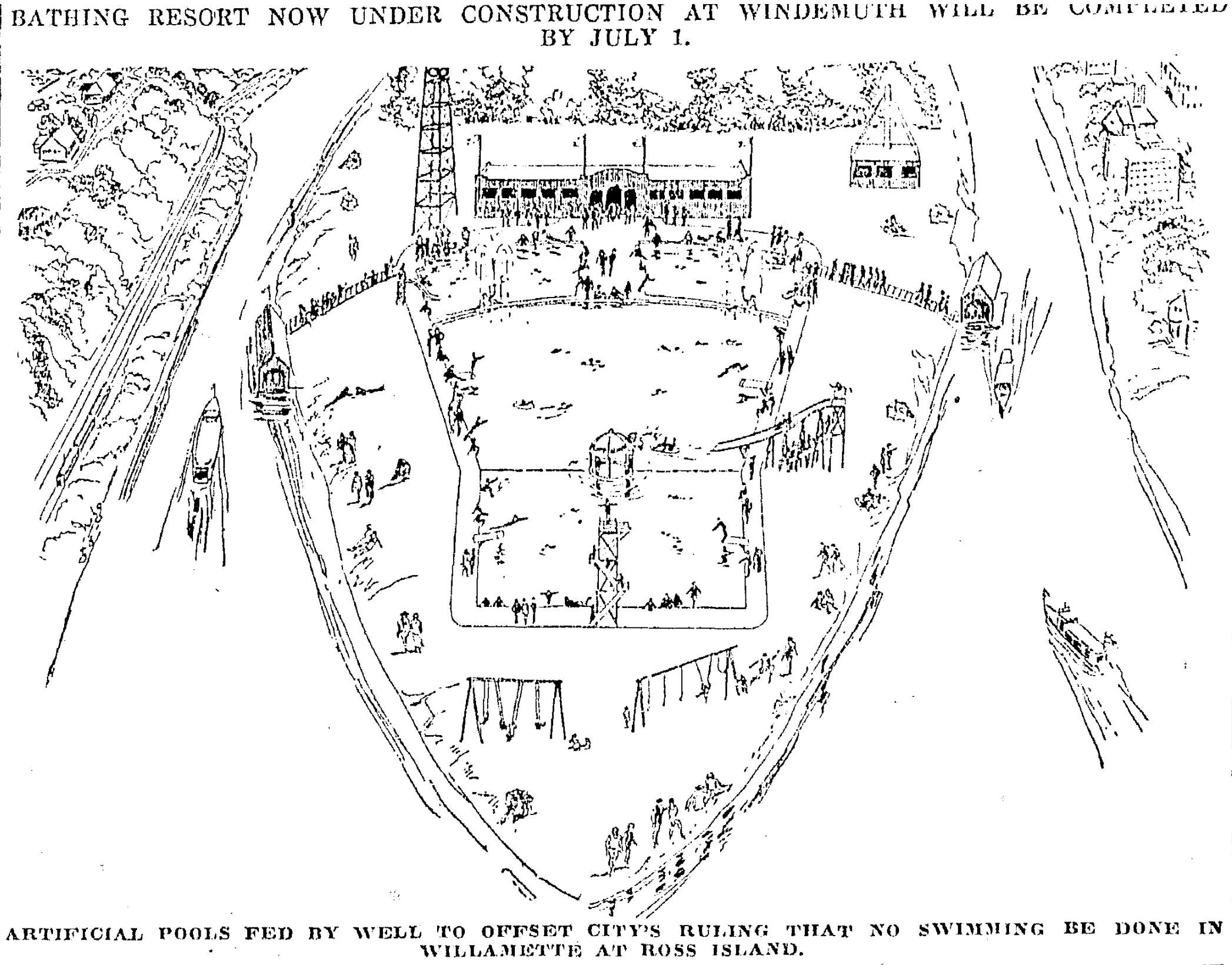
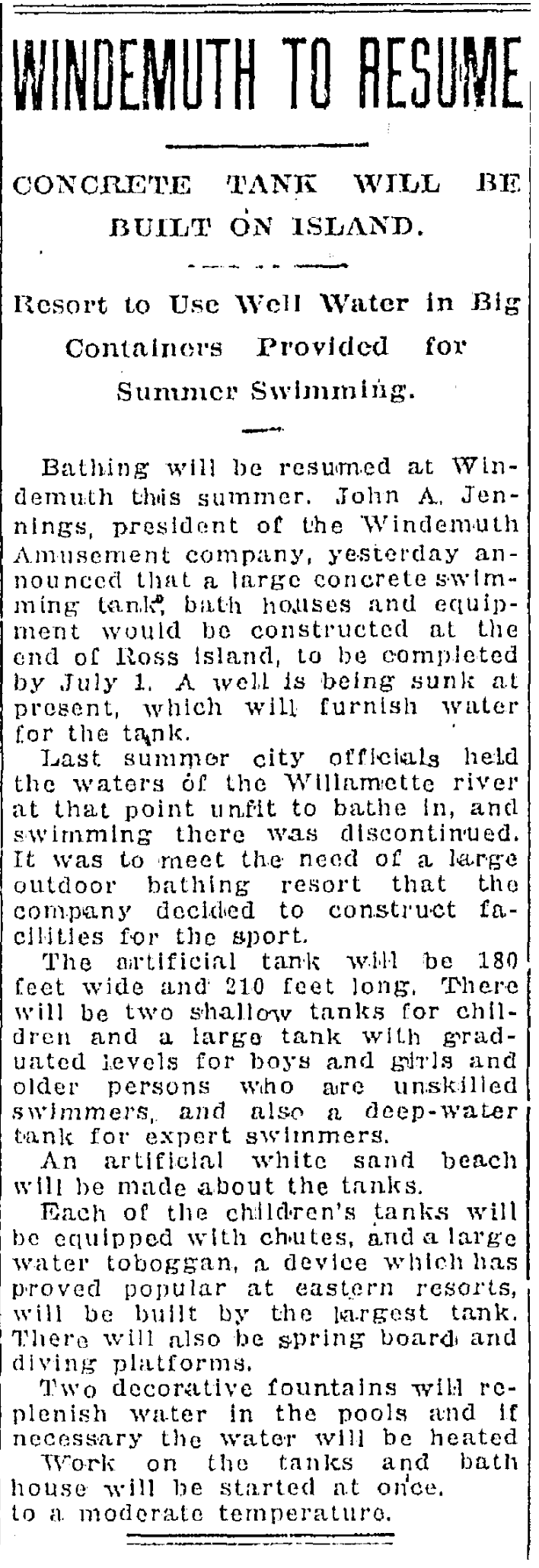
Meanwhile, John A. Jennings was busily trying to find a way to salvage some aspect of the Willamette River swimming tradition and the market niche he had created with Windemuth, announcing bold plans to build a giant swimming tank on the north end of the island.

From The Oregonian, May 24, 1925

But Jennings’ vision was never fully realized: he died of a heart attack in April 1927. Some small related buildings existed on the island then, and the new bridge loomed overhead just downstream. The fate of the actual structure of floating Windemuth was never reported on.

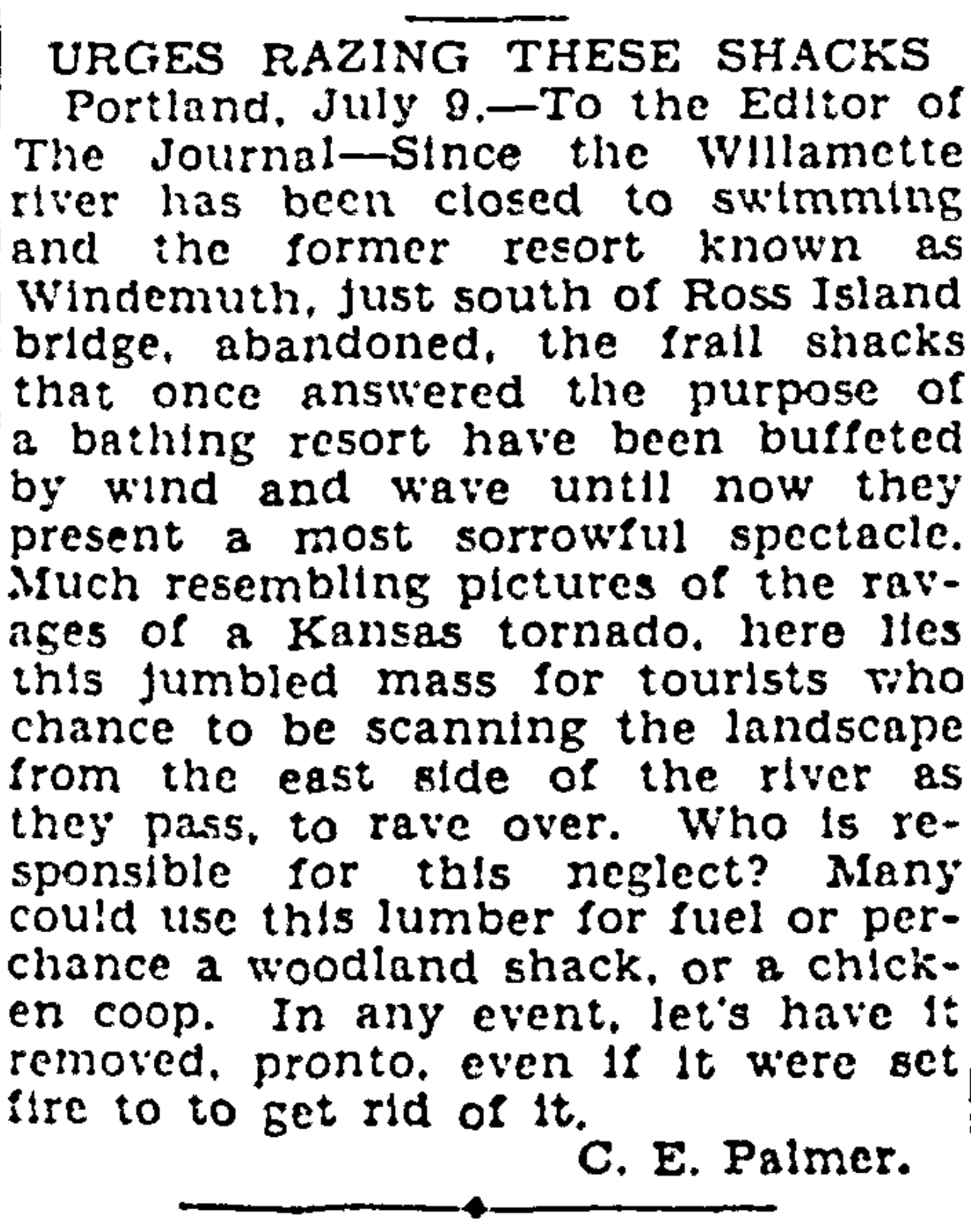
The view from the new bridge down to the former much-loved site of lost Windemuth was a painful a reminder of what had been. This letter writer to the Oregon Journal was tired of looking at it and ready to move on to the next chapter:

From the Oregon Journal, July 10, 1928

For more on how Windemuth’s final chapter came to a close, read our post from July 2024 about the 100th anniversary of its voluntary closure, and the relicensing process at Portland City Council.

100-year-old photos offer a fresh look at the Willamette River in downtown Portland

We’ve been helping a long-time Northeast Portland family sort through their 100-year-old photo albums to identify some mystery locations and develop context about important family places. We love working with old photos (there’s a whole category here on the blog called Photo Detective dedicated to the topic which we think makes interesting reading and looking).

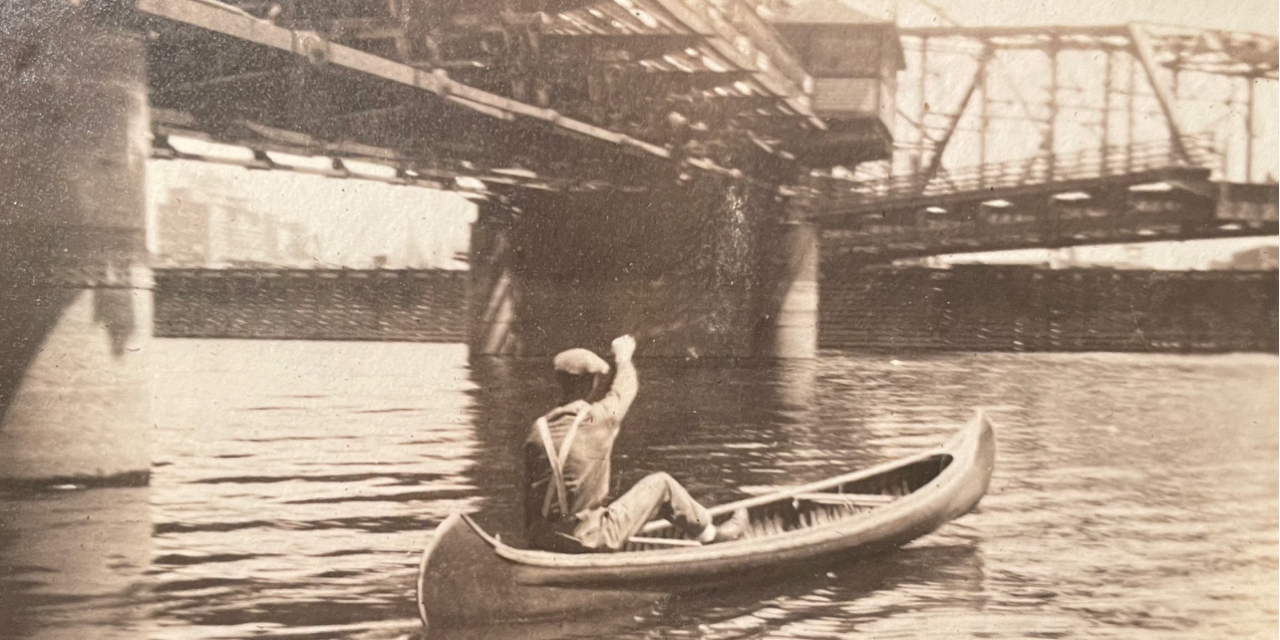
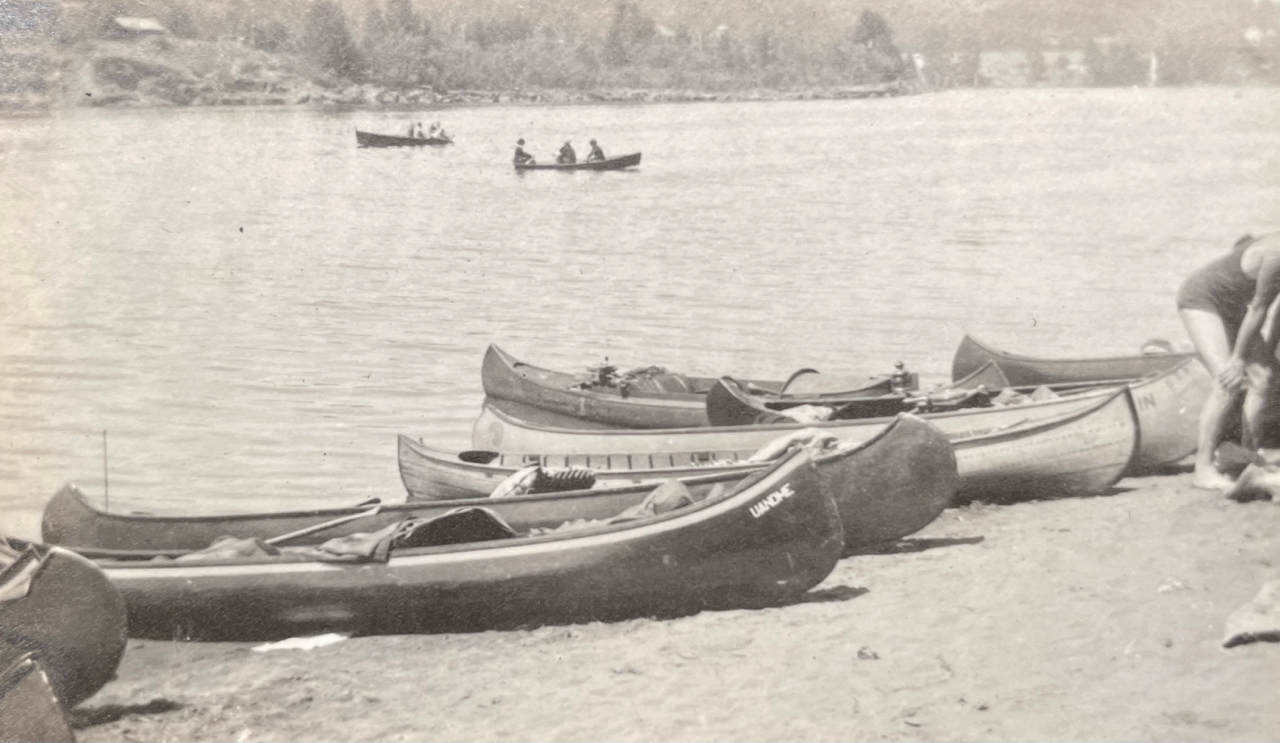
100 years ago, this family loved to play outside and one of their favorite places was the Willamette River between Swan Island and Oak Grove. Like so many young Portlanders of that era, their key to exploring these places was a canoe.

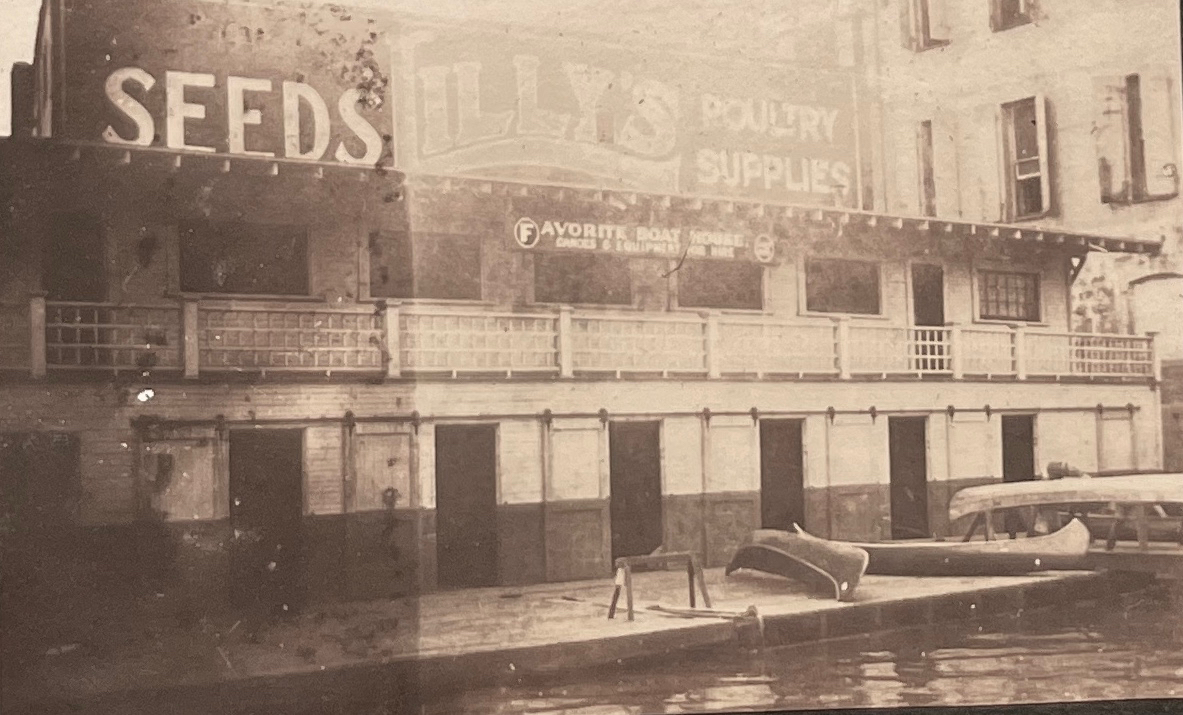
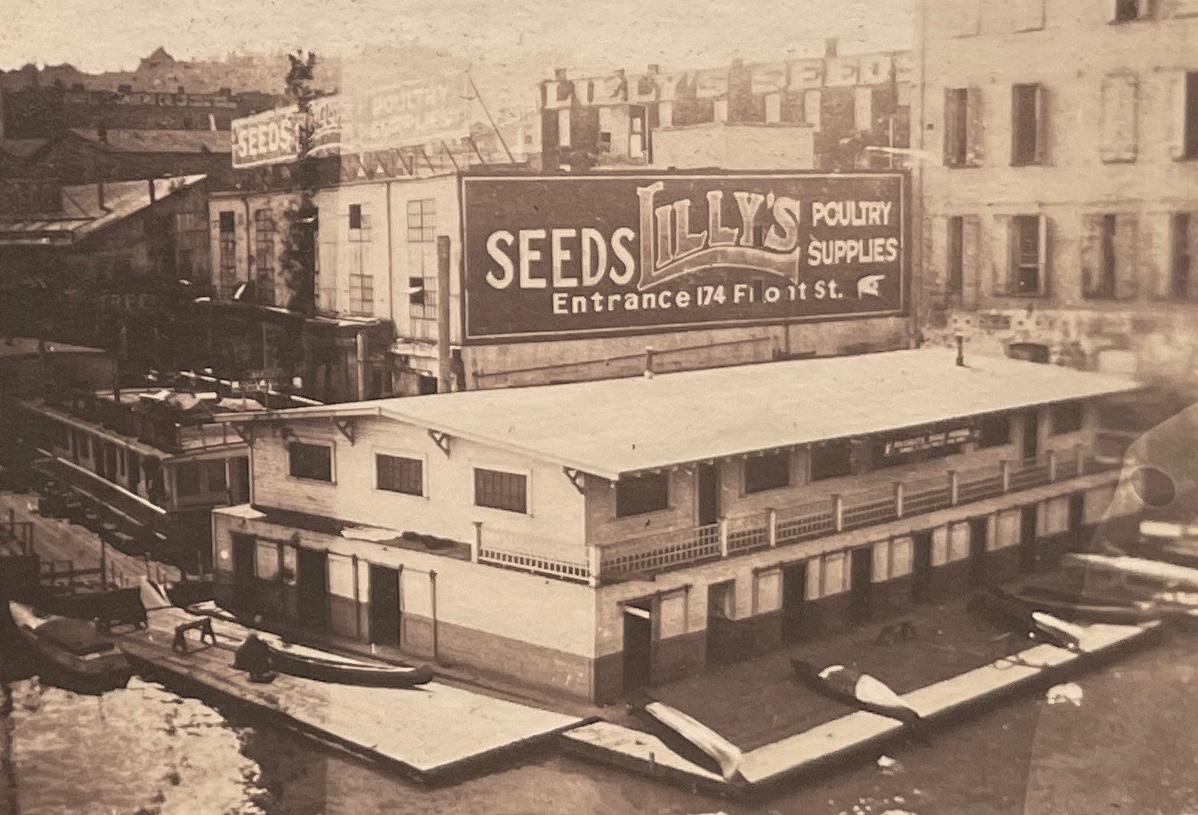
Departing from The Favorite Boathouse under the west end of the old Morrison Bridge, a swing bridge built in 1905 that was replaced in 1958 by the bridge we know today. In the photo above looking to the east, the eastern span of the old bridge is swung open to allow heavy river traffic to pass.

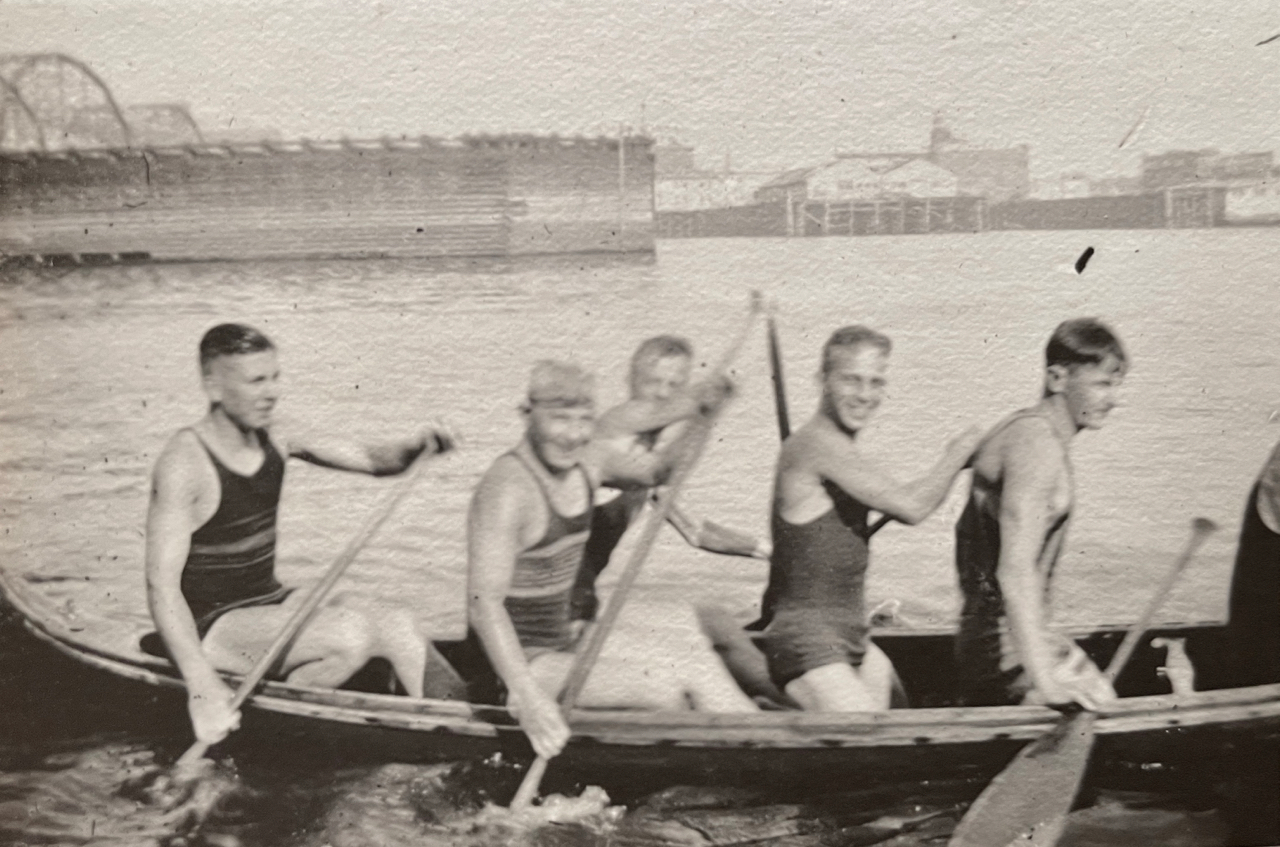
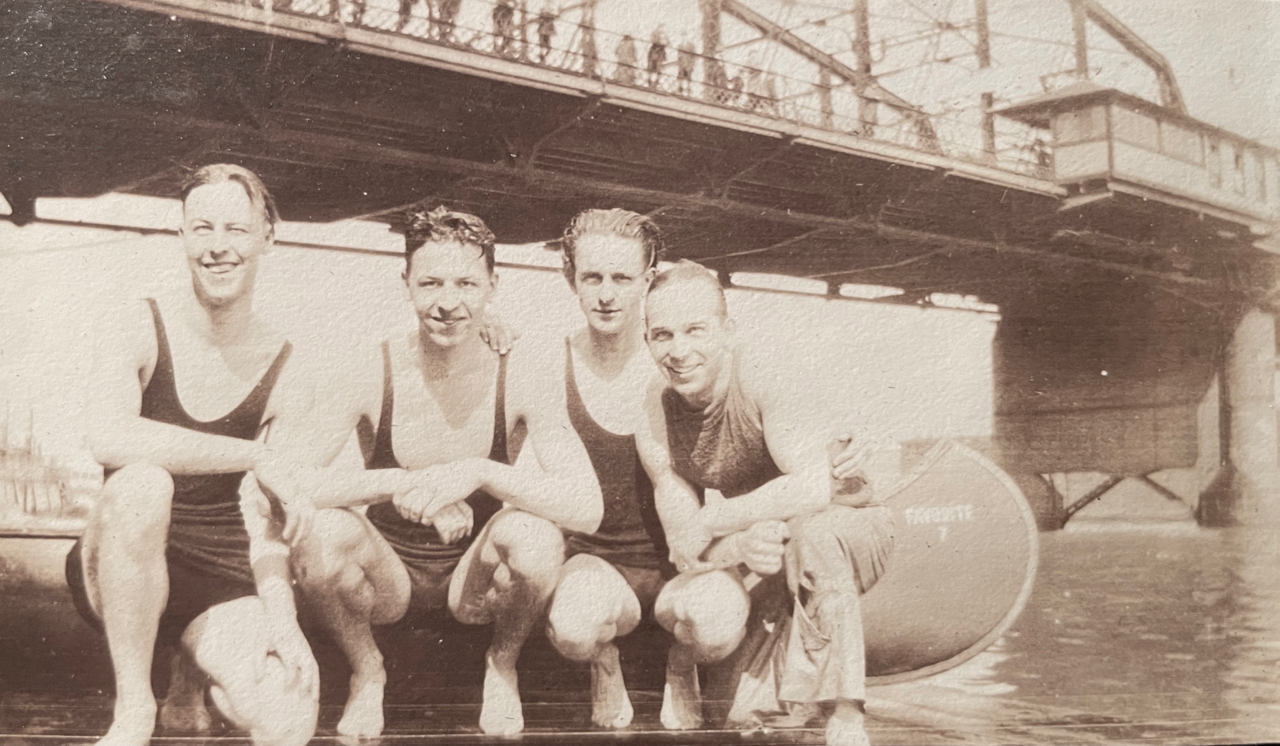
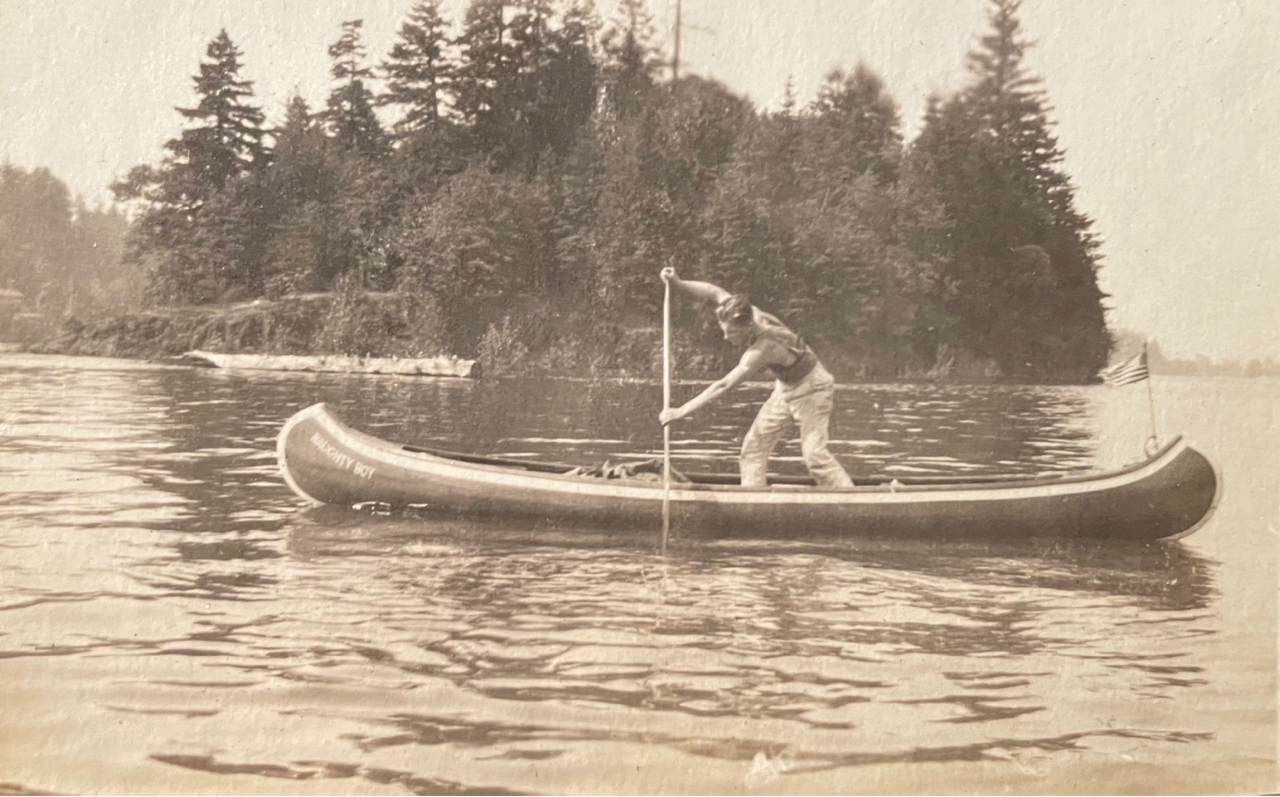
Along with front-porch moments of young families, babies and World War 1 soldiers returning home to Northeast Portland, the albums contain pages and pages of river adventures from the summer of 1919. Since we are frequently in the same waters by kayak and canoe, finding these glimpses struck close to home and got us wondering about the connection between Portlanders and the Willamette 100 years ago. These young people clearly were connected with their river, which looks to have connected them with each other in the special way that rivers do.
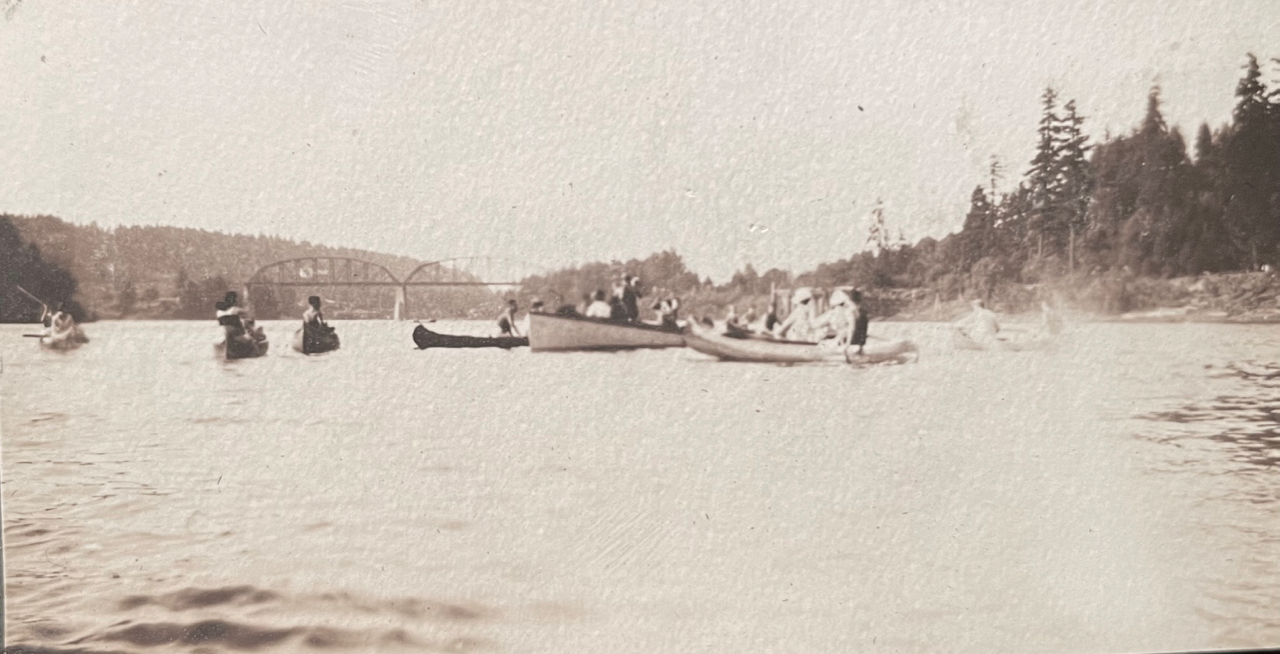
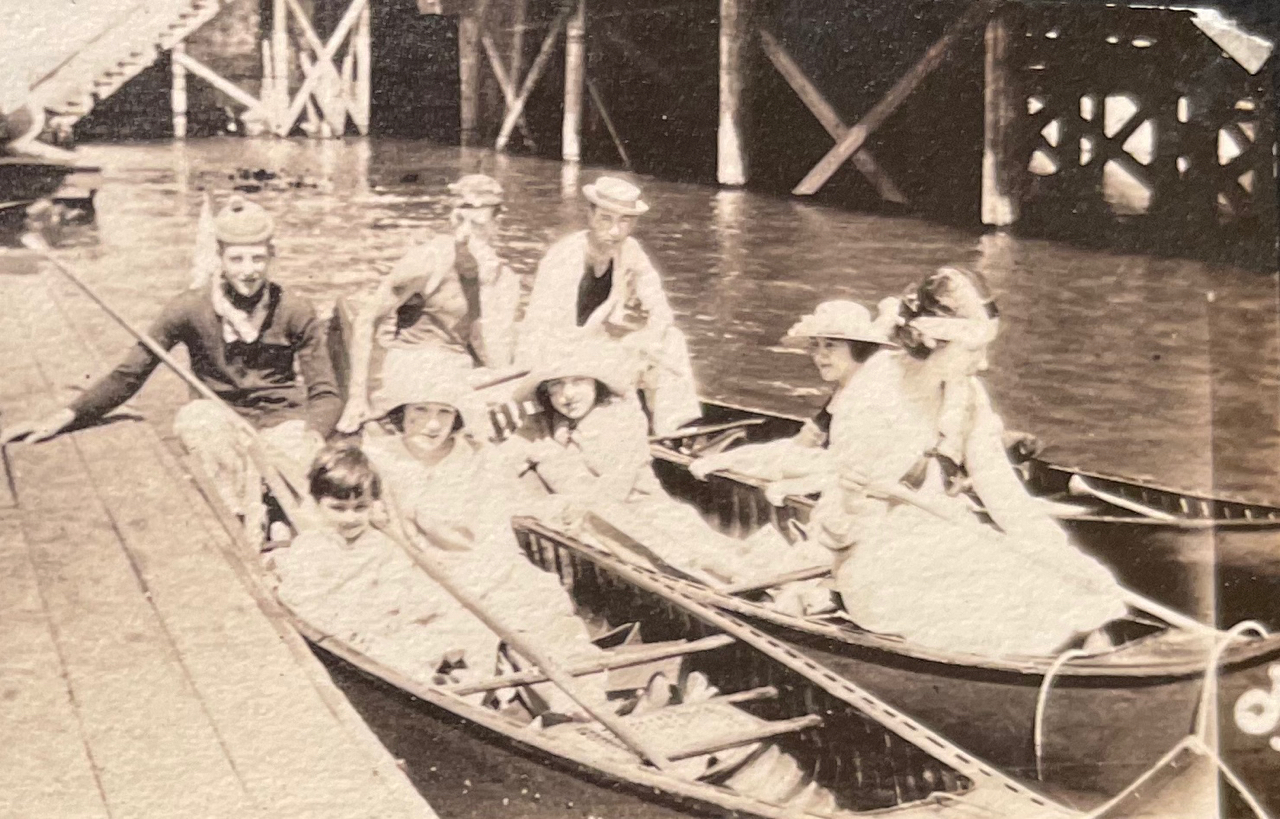
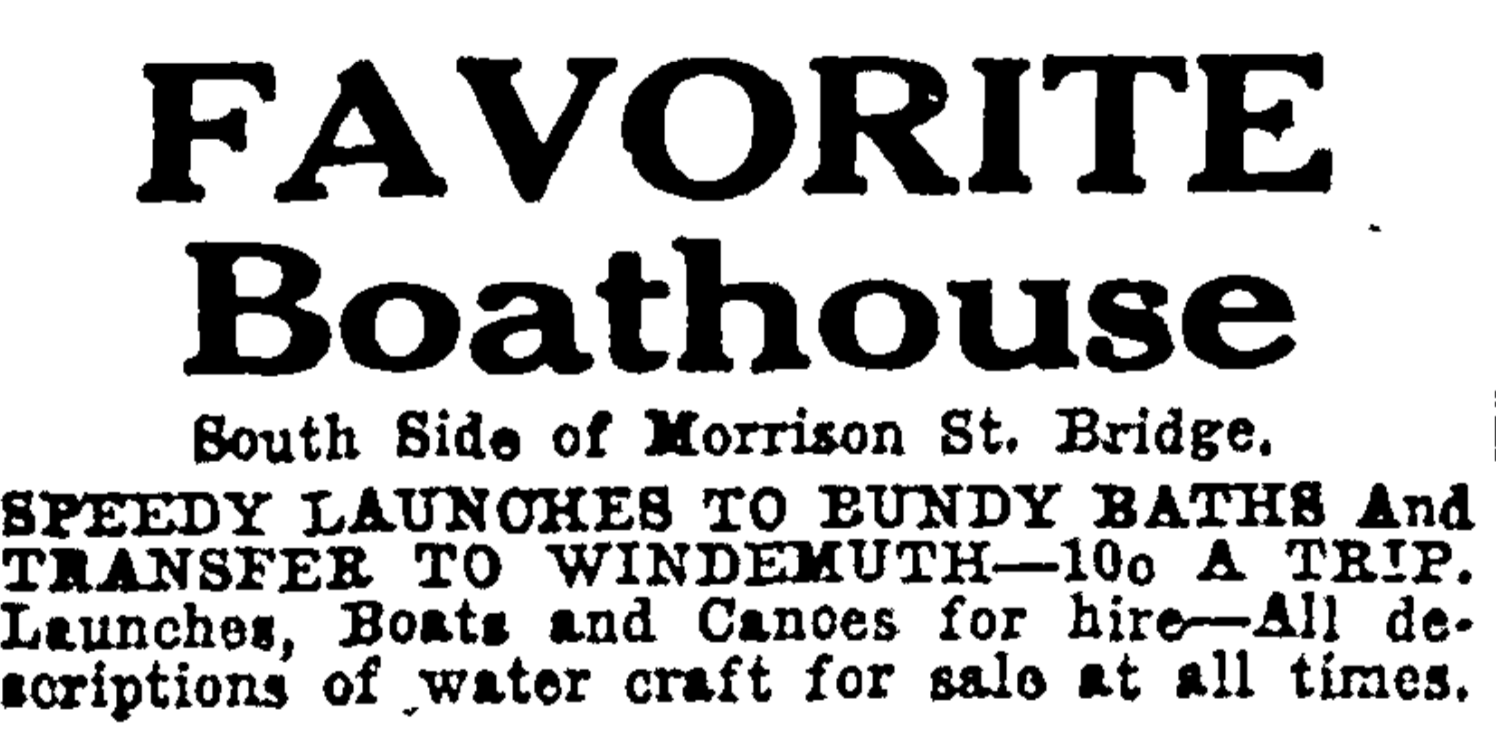
A boathouse on the west bank of the Willamette just south of the Morrison Bridge seemed to be at the heart of many adventures, a place appropriately called “The Favorite Boathouse.”

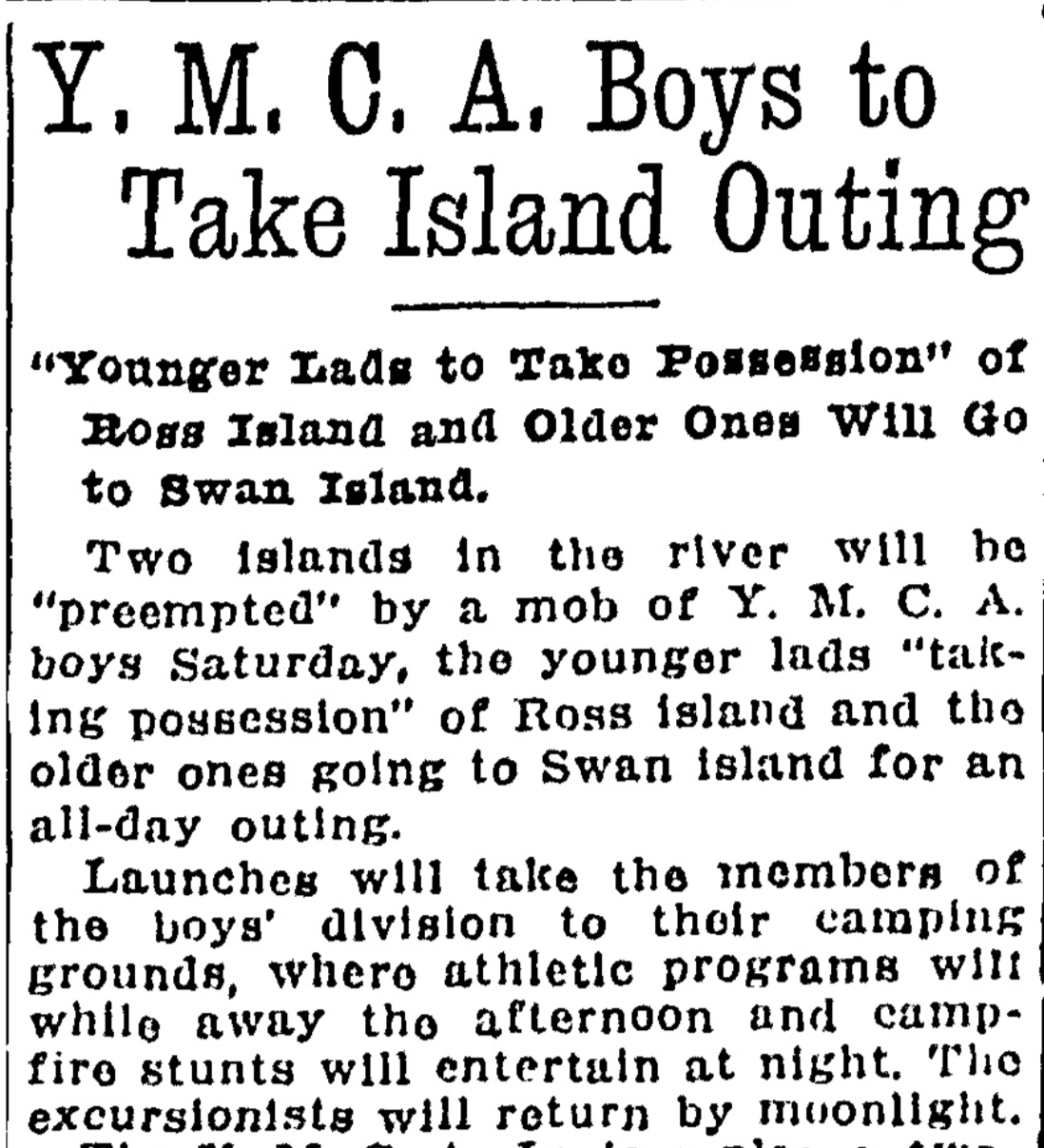
A look through the Oregon Journal and The Oregonian during these years opens a window into just how many young Portlanders took to local waters by canoe. At the time, Ross Island and Swan Island were outposts for recreation (and Swan Island was still very much an island). In 1916, both were destinations for organized outdoor recreation.

From the Oregon Journal, April 20, 1916.

From The Oregonian, April 25, 1921

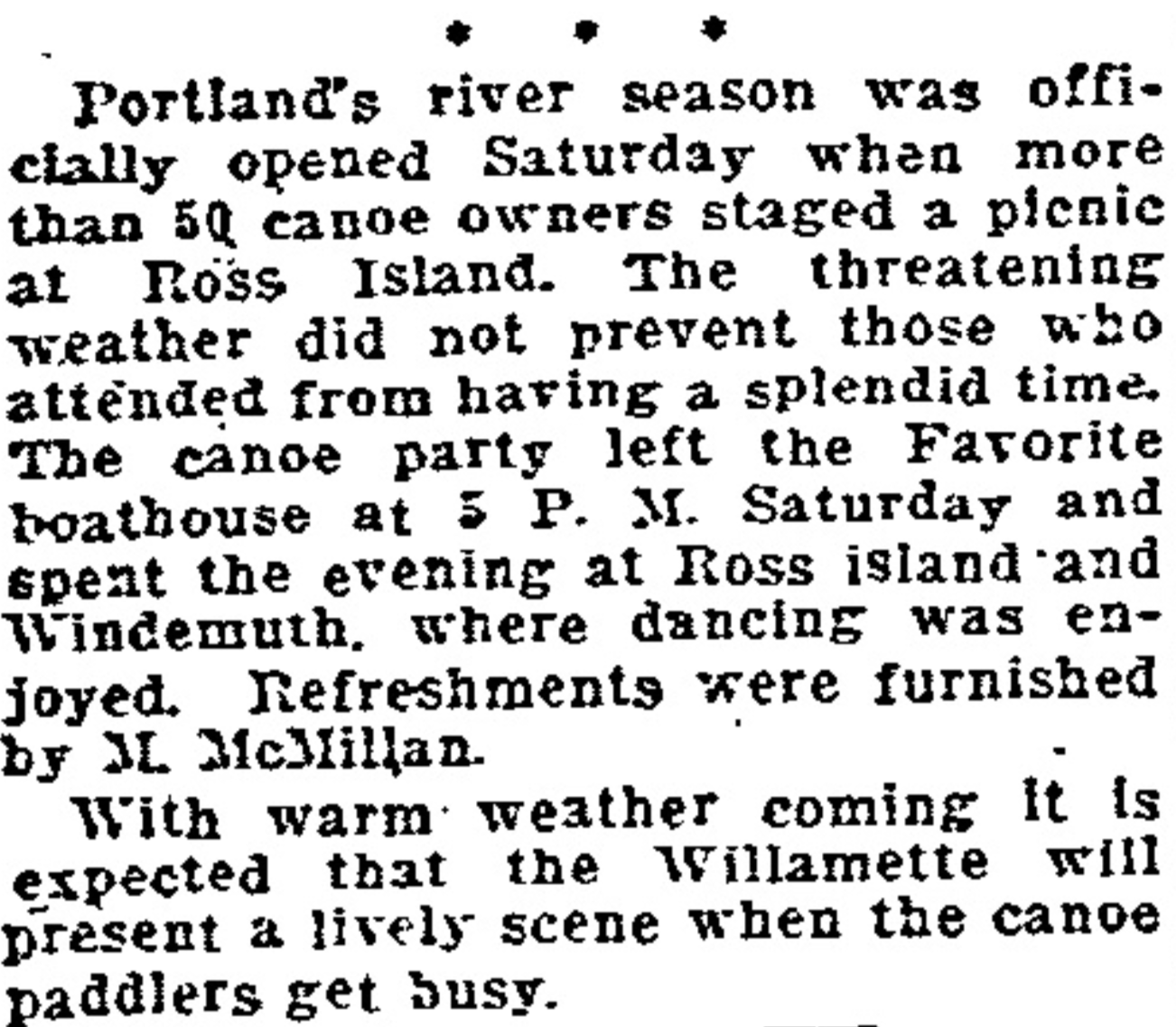
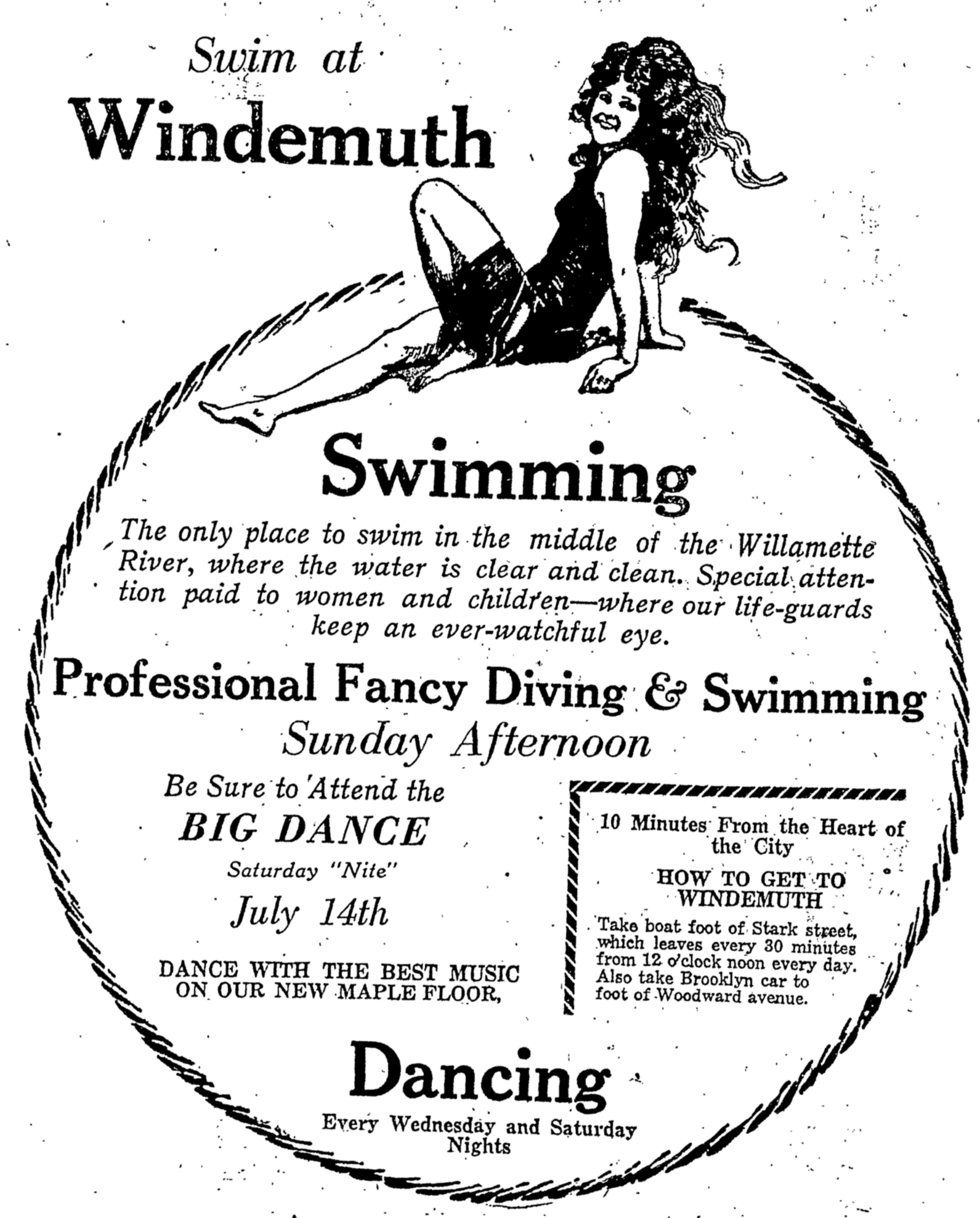
A popular destination for Willamette paddlers in the late 19-teens and early 1920s was Windemuth, a giant floating swimming pool and dance pavilion anchored in the river off the northern tip of Ross Island. By day, Windemuth featured swimming competitions and all manner of water play. By night, hundreds of paddlers arrived to dance on the floating dance floor.

From the Oregon Journal, July 14, 1923

The Favorite and other boathouses rented canoes for couples and groups to paddle upstream to Windemuth for the summer evening dances. If you didn’t want to paddle, you could pay to ride a scheduled “motor launch” from downtown. Or from the eastside, you could take the Brooklyn Streetcar to the foot of Woodward Street and catch a short boat ride across to the floating pavilion.

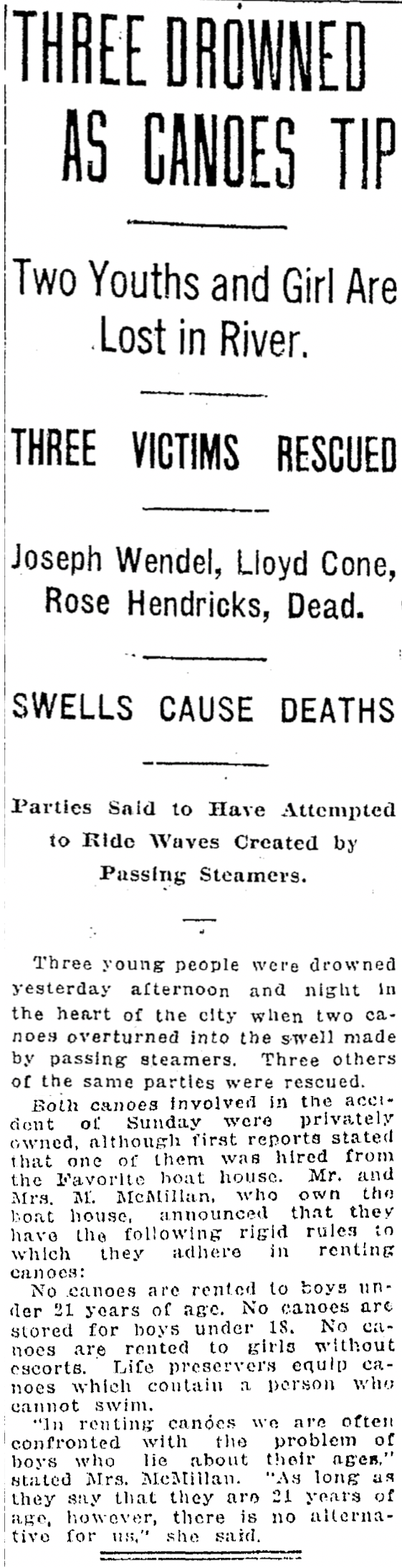
Unfortunately (and not surprisingly) there were frequent swampings of canoes from the wakes of the many steamships active in Portland harbor, and regular drownings, often at night, coming and going to the islands.

From The Oregonian, May 14, 1923

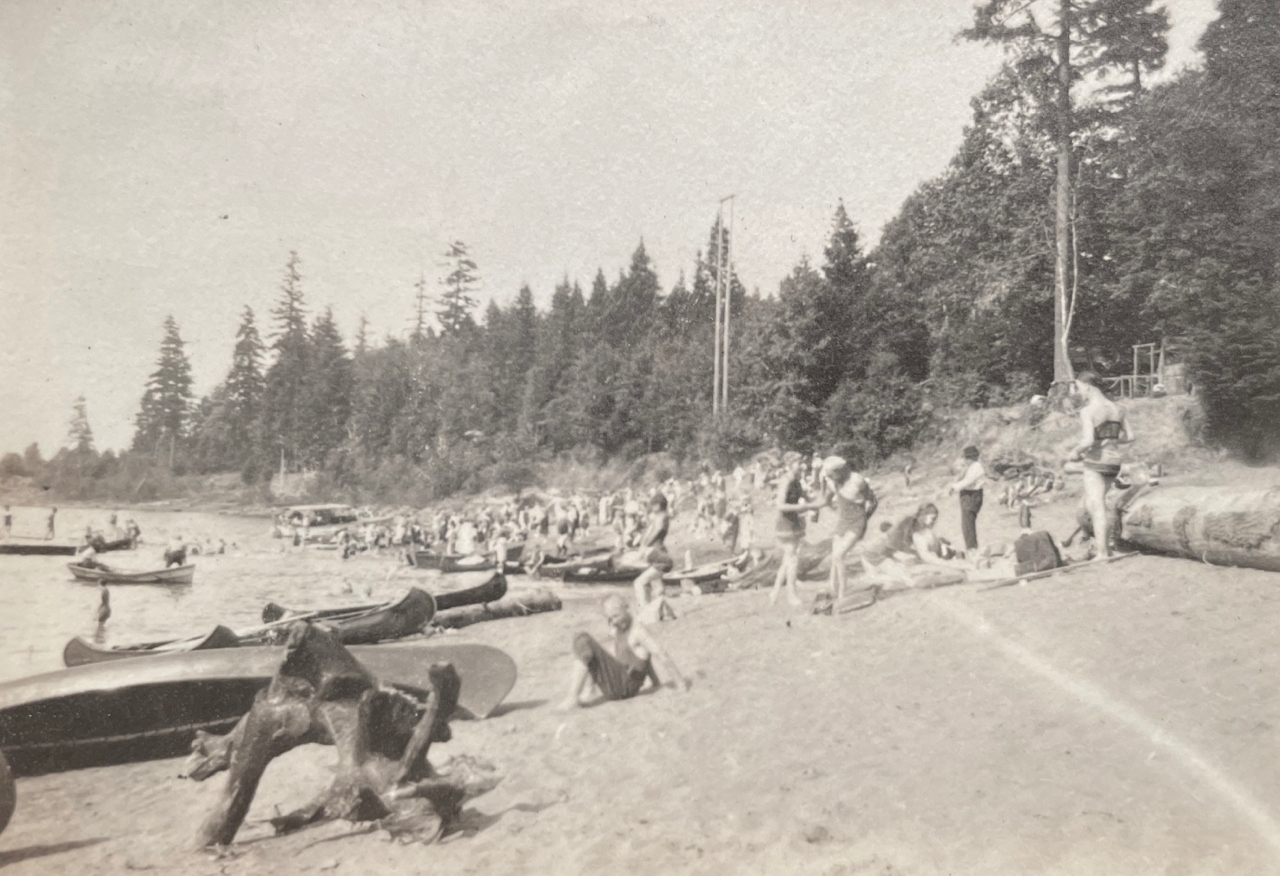
On Swan Island north of downtown, the beach in summer was filled with canoes that brought young Portlanders over the waters to sunbathe, picnic and camp.

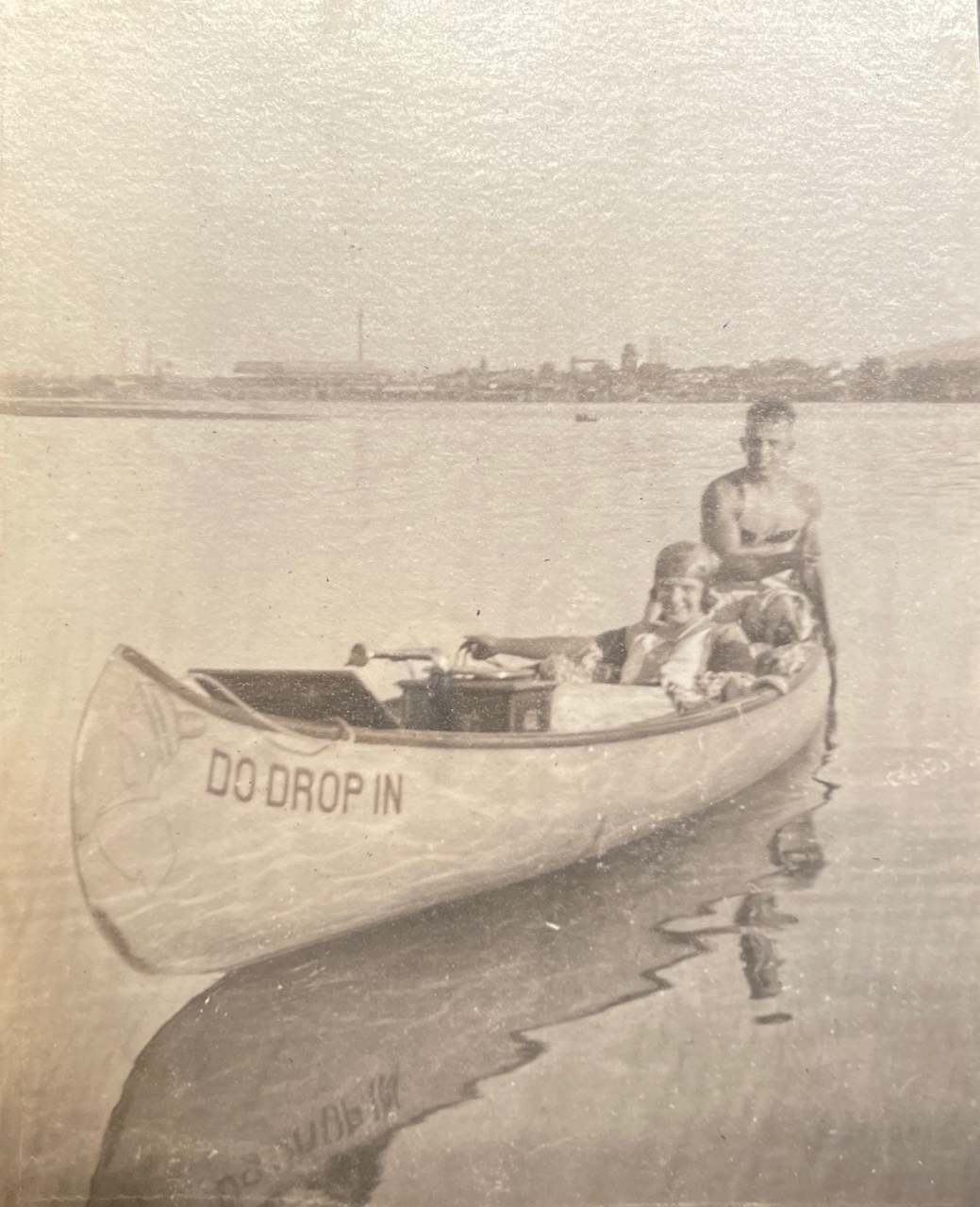
Looking toward downtown from near the beach on Swan Island. Note the Victrola record player in the front of the canoe. The Victrola and its records, picnic boxes, bags of clothes and camping gear show up as payload in multiple photos. Summer 1919.

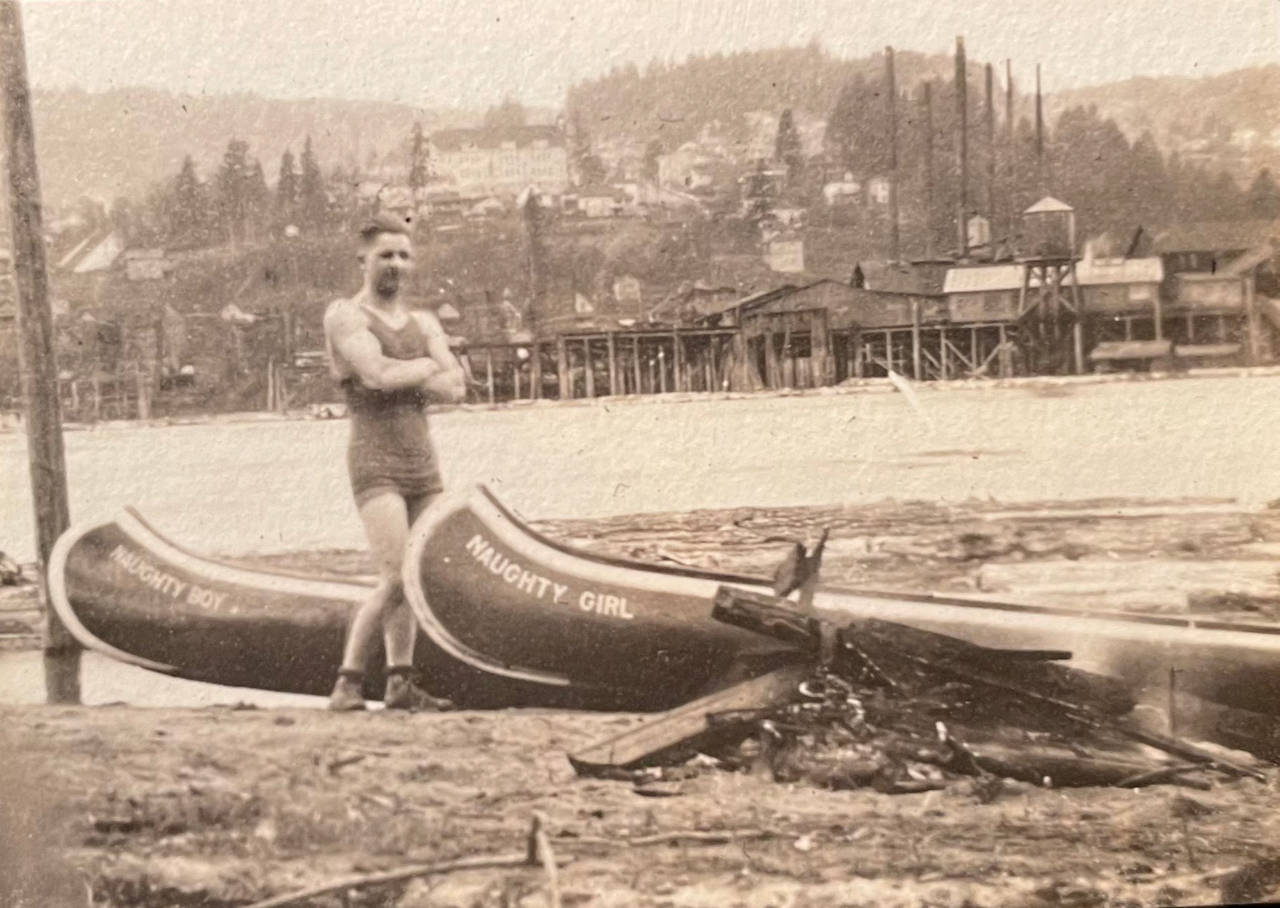
Handed down family stories describe young people swimming among and playing on the many rafts of logs that were tied up along the Willamette banks awaiting use by local sawmills. During these years, log rafts lined both shores from the Sellwood Bridge to St. Johns.

Taken on the western shore of Swan Island looking to Portland’s west side, with two canoes. The sawmill on the far side of the river is the Northern Pacific Lumber Company mill located in the vicinity of today’s Terminal 2 on NW Front Avenue. The very large building in the background is the old St. Vincent Hospital located on Northwest Westover. A log raft is visible anchored just off the near shore behind the canoes. Summer 1919.

Family members enjoyed paddling farther south, around the Milwaukie bend at Elk Rock Island and upstream under the Union Pacific Railroad Bridge at Lake Oswego to the vicinity of today’s River Villa Park, a nice six-mile paddle from the northern tip of Ross Island.

Elk Rock Island, Summer 1919

Looking north toward the Union Pacific Railroad Bridge at Lake Oswego (built in 1910), which is still in use and marks the northern edge of today’s River Villa Park in Oak Grove.

But by the mid 1920s, Portland’s recreational relationship with the river was about to take a major turn, due to health concerns resulting from the reality that the city’s raw sewage went straight into the river.

From the Oregon Journal, July 31, 1924

The shutdown relegated moonlight canoe trips to wistful memories a generation later. Below, from the Oregon Journal, May 5, 1946.

Next: More about Windemuth and Willamette River water quality in 1924. Special thanks to Steve Erickson and the Schaecher family for allowing us to share these amazing photos.

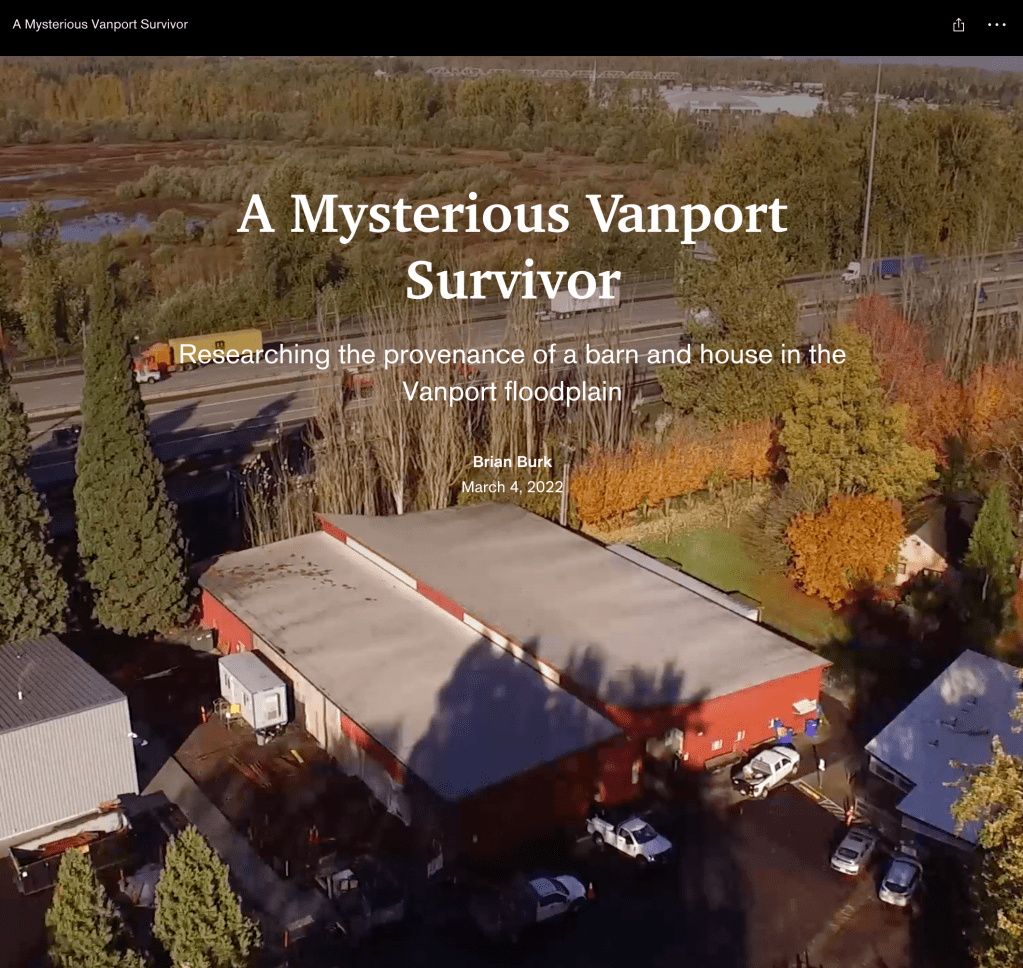
A worthy research rabbit hole: Brian’s Mysterious Vanport Survivor

We’ve been down enough amazing research rabbit holes to recognize a special gem when we see one.

This spring, AH friend Brian Burk completed a research odyssey that turned up fascinating clues about the Vanport flood, an extinct airfield, daredevil pilot Tex Rankin, and one particular old barn and house, all of it centered on North Portland’s Delta Park. He calls it A Mysterious Vanport Survivor. Truly worth 15 minutes of your time. Note that you have to scroll down from the main page to see all the good stuff.

Brian’s multi-media website weaves all these pieces together artfully—along with his history detective narrative —to provide a lens that will change the way you look at a local landscape and history you thought you knew.

Brian is a multi-media journalist, born and raised in Northeast Portland, who loves documenting the beauty of the world and its people through still and moving images. You can see more of his work here.

Homecoming for Time Traveling Windows

Our 1912 Arts and Crafts bungalow has been home to eight families in its 110 years and I’ve made a point of connecting with someone from almost all of them. Seeing the house through the eyes and experiences of others has allowed my family to know this place in a unique way during our 30-plus years here, to appreciate the changes in life, community and in the fabric of the house itself over that century.

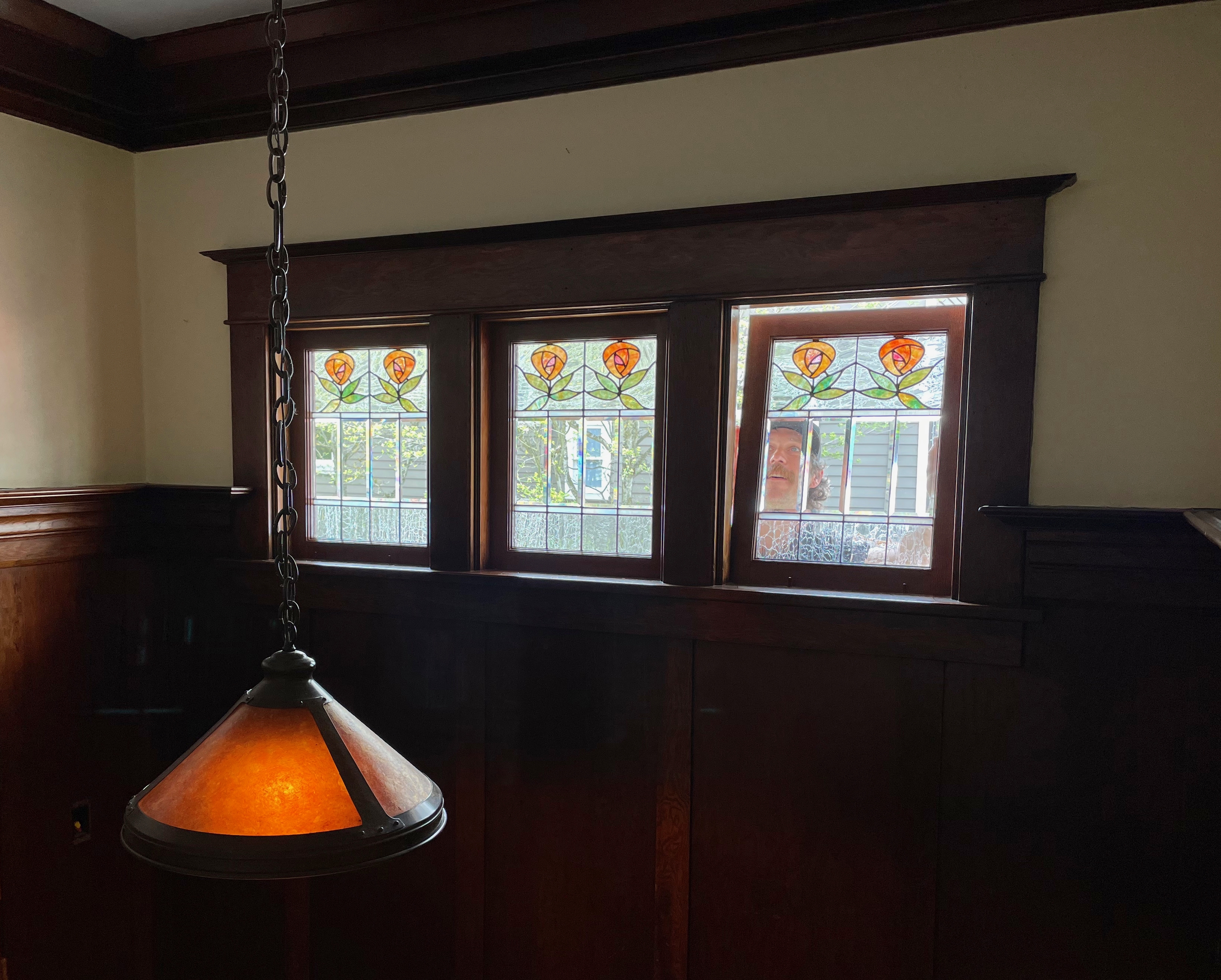
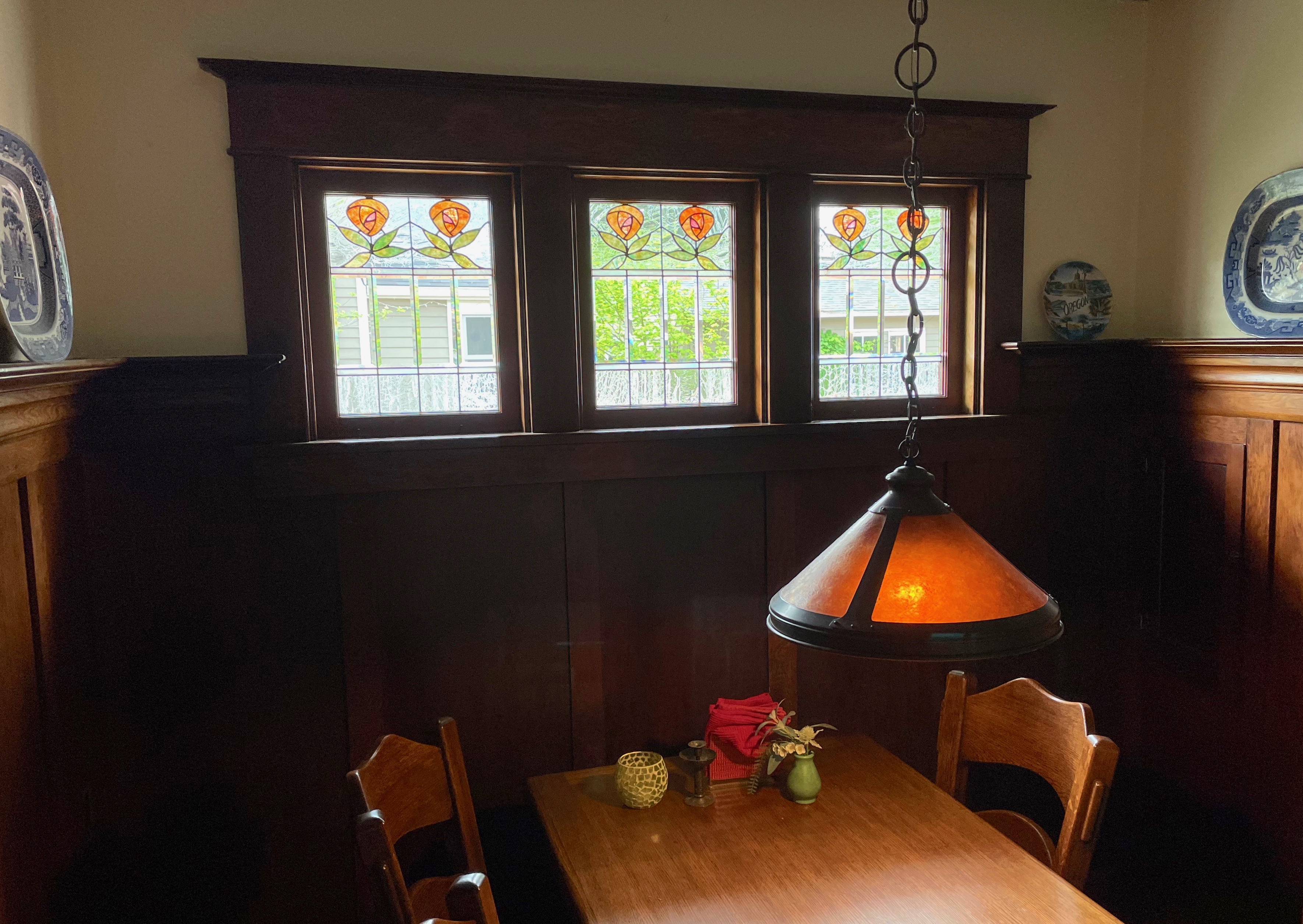
During these pandemic years I’ve been busy with a special project to connect past and present that’s both tangible and personal. This week it all came to fruition when modern-day craftsmen carefully reinstalled the three original stained-glass windows—now restored—that were removed from the house almost 50 years ago.

As a lover of old buildings and a person who appreciates homecomings, it was a take-your-breath-away moment when Carl put the last panel in place this week. Here, have a look:

Carl Klimt and the “golden spike” moment when the last wayward window was set into place, April 27, 2022.

Tracking down these three windows, understanding the circumstance of their removal and their subsequent travels, and getting them back in shape to be reunited with the house has been a story marked by chapters of kindness, generosity, good luck and persistence. At the heart of this labor of love, it’s been a story about putting pieces back together.

The setting

In late 1911 and early 1912, builder William B. Donahue completed a lone bungalow on NE 30th Avenue, the only house on the block at the time, located just a half block east from the end point of the Broadway Streetcar line, right next to the temporary “tract office” of the Alameda Land Company. Donahue knew the house would be a demonstration of sorts to show what he could build for potential homebuyers. So even though it was just a simple bungalow, he added some nice touches, including stained-glass and beveled-glass windows in all the right places inside and out.

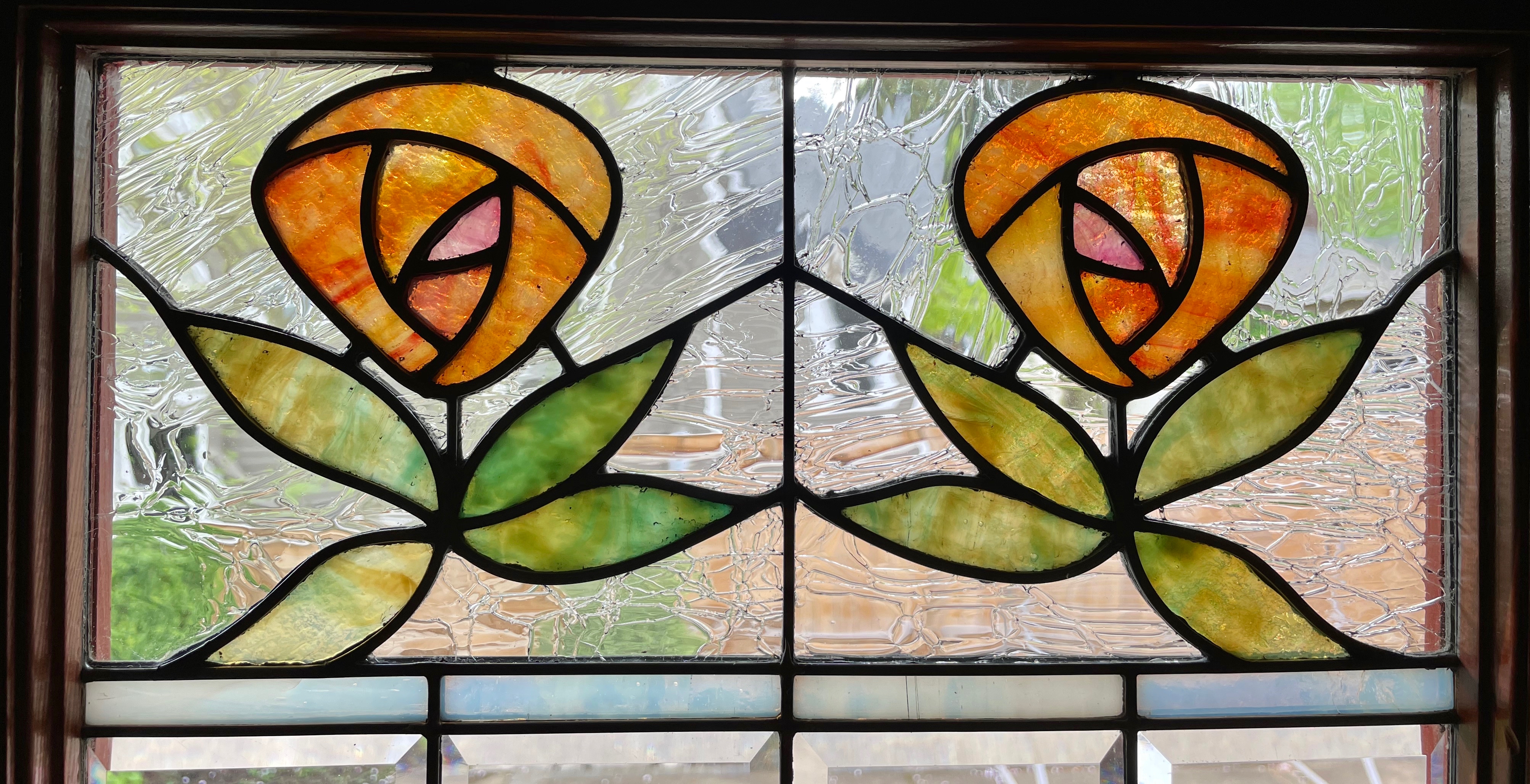
Detail of the restored windows.

Donahue’s floorplan included a breakfast nook between the formal dining room and the kitchen, with full wainscot paneling and a plate rail. For this welcoming, family-friendly room he chose a bank of high window openings to install three rose-patterned stained-glass windows.

Which is where the windows presided as four families cycled through the house: wars, pandemics, business ventures, children, dogs, birthdays and deaths, leavetakings, joys and losses. All discussed and decided at the nook table under those three beautiful windows.

The removal

The family who lived here from 1961 to 1975 loved this house. And when it came time for them to leave, they wanted to bring a piece of it with them, a keepsake and reminder of all their good memories here. The daughters were fledging and they agreed to each take a window, a gift from their father, who removed the sash and replaced them with three plain sheets of glass. The stained-glass was removed from the old window frames and put into new oak frames for display. One went to Arizona. One went to Spokane, and one stayed with the parents in Milwaukie. The windows continued to bring the comfort of family memories from their old home. Time passed as four more families cycled through under the blank window-eyes of the breakfast nook. No one here knew anything different.
The discovery

As I researched the story of this house, I sought out the families who lived here and I even found a relative of builder William B. Donahue. Through oral history interviews and letters, I learned about the view from the porch across empty lots clear to the 33rd Street Woods. Brothers playing on the roof. The goat and wagon that came for a visit. The upright piano that lived in the front hall. The life-long memory from the little boy sprawled out on the floor of the nook reading books while colored light streamed in around him, filtered through those stained glass windows. So many stories.

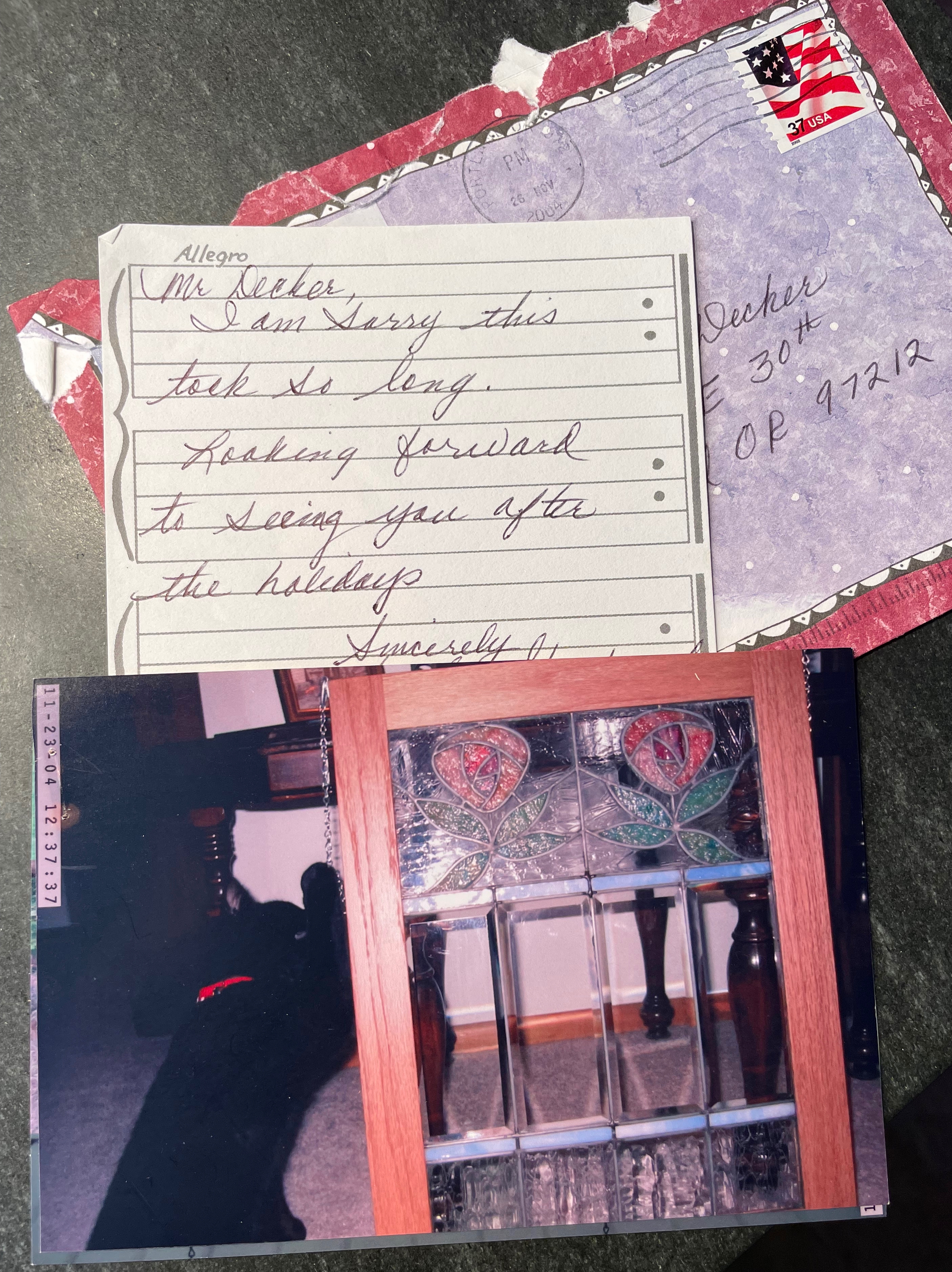
In November 2004, we hosted the Mom of the house from the 1960s on an impromptu visit when she dropped by the street to say hello to her old neighbors who still lived two doors down. When she walked through the house, wistfully, she mentioned the stained glass windows in the nook.

Because we had been dreaming about finding the old columns that were torn out of the living room in the 1940s by an earlier family (which we later faithfully rebuilt based on those I found still in existence in a similar Donahue-built house a few blocks away), her mention of stained glass windows in the nook was a very timely little bolt of lightning. Earlier that year we had restored the original front porch, which had also been demolished in the 1940s (a tough decade for old houses).

A few weeks after her visit, a photo and brief note arrived in the mail showing the old window she still had hanging in her kitchen. We almost couldn’t believe that rose-patterned window was once here.

When this photo and note arrived in the mail from a former resident we were ecstatic, but we also wondered, “Wait, what? That window was here?”

Through conversation over the months and years that followed, it emerged that her daughters still had the other two which had become sentimental companions from their growing up years. I began to imagine bringing the windows back here where they started. That was 18 years ago.

The return

In the last several years, with the thoughtful help of her son (now grown and with a family of his own), and through persistent friendly stories from me about the home’s history and our careful work of putting the pieces back together, a pathway began to emerge: when the family reached that point we all eventually reach of readiness to simplify our lives and possessions, the windows would be welcomed back home. Just as the family took solace in bringing them away when they left, we would find solace in their return.

Back and forth correspondence, phone calls, soul searching, acceptance and finally, readiness. Two of the windows came first: one of the daughters had passed away and the other was ready to release her window with her sister’s. Then a year later, the Mom of the house, now in her mid 80s, was ready to give us the third one. The day we met with her to receive it felt like an adoption.

The recovery

By then, I had fortunately found Jakub Kucharczyk, the art glass master who runs The Glaziery based here in Northeast Portland. Jakub and his team are one of a handful of knowledgeable and capable artists and craftspeople nationally who know old glass like ours and more importantly have the expertise to restore it using old ways and original materials.

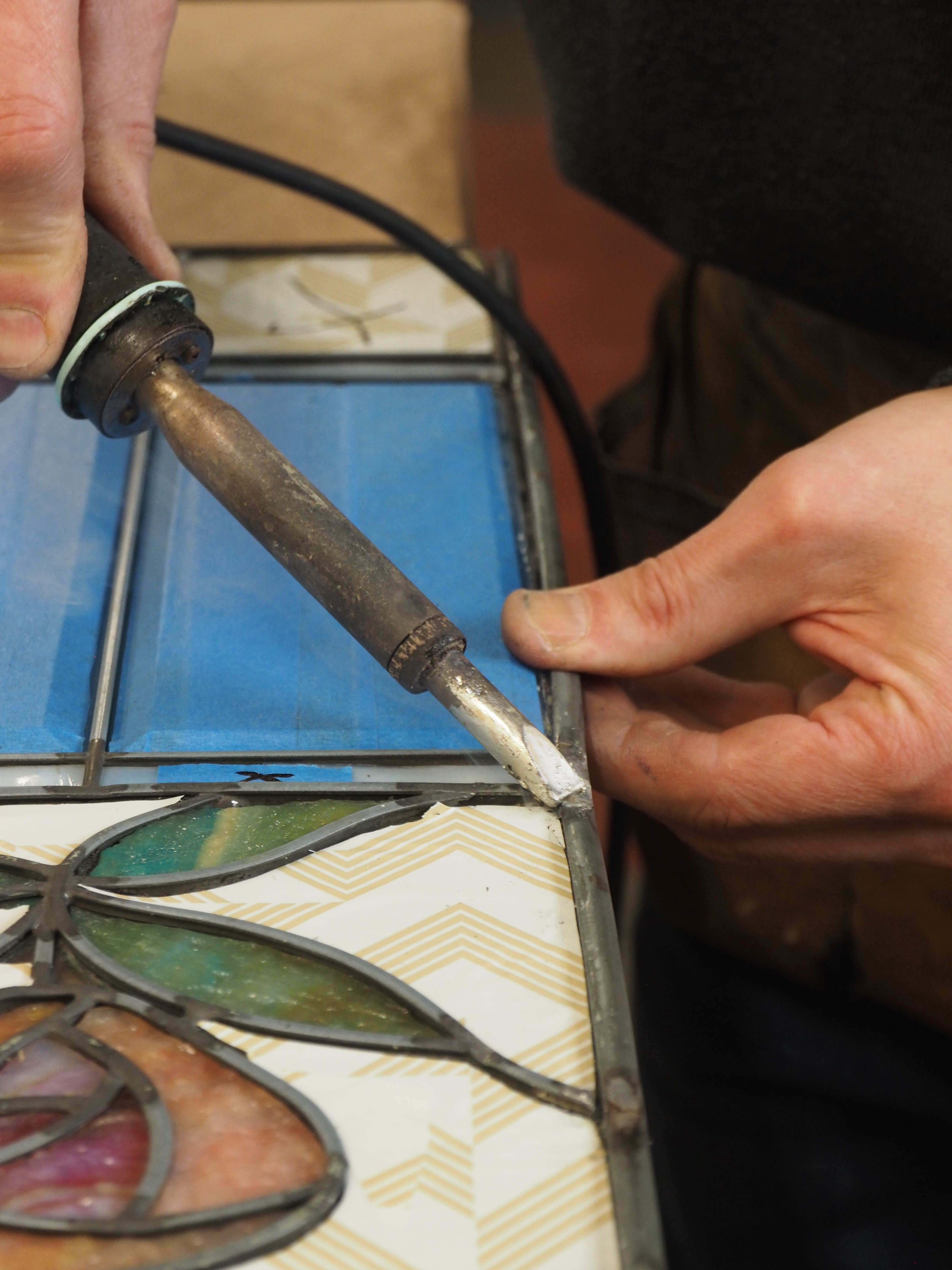
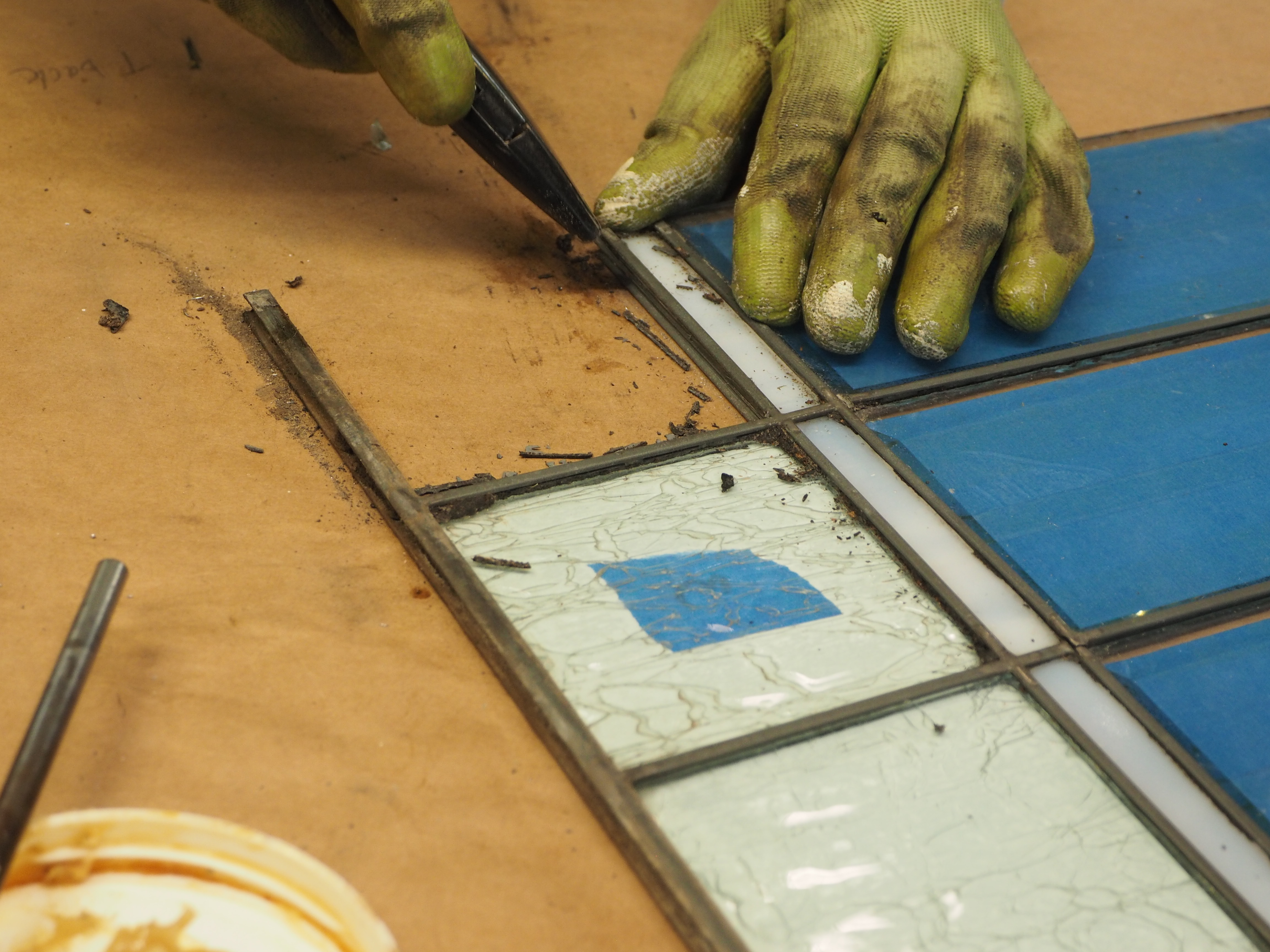
Resoldering one of the zinc channel borders. Zinc is more rigid than lead and perfect for art glass windows like these that need to stand up to wind, gravity and time. Photo courtesy of Jakub Kucharczyk, The Glaziery.

When Jakub examined our well-traveled windows he pointed out the hand-blown crackle glass from Germany that make up the tiles across the bottom, the subtle peach and rose colored Kokomo catspaw granite glass of the flower petals, the zinc channel borders that outline the shapes.

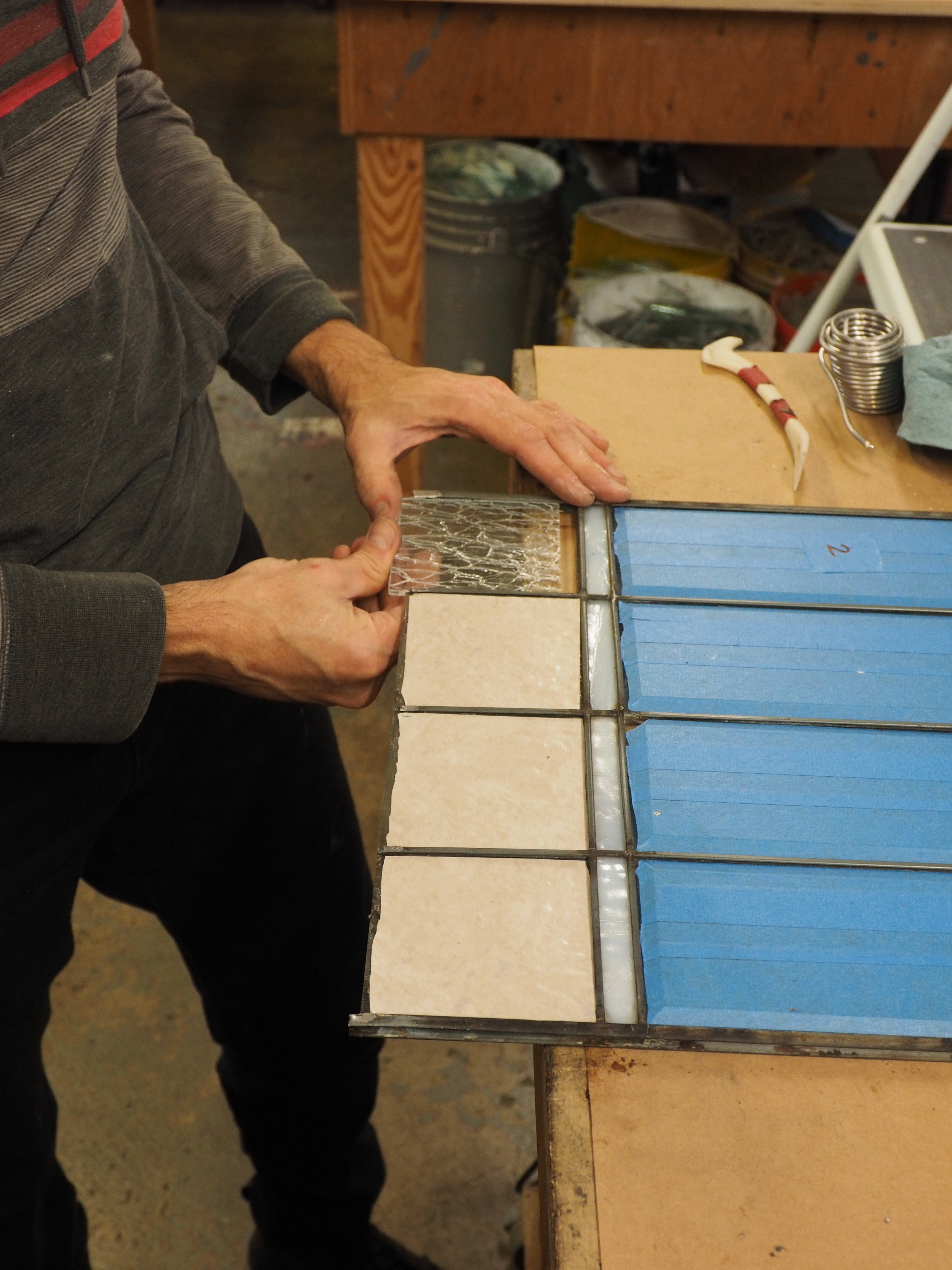
Most of the zinc joints were in pretty good shape but a few needed new flux and solder. One of the crackle glass panels needed to be replaced and Jakub had just the right old piece that looked like it came from the same batch. Even though a few pieces of the art glass were broken, we left them in favor of preserving the original materials, and Jakub made them as steady as could be. All the glass needed a good clean up, and all three panels were reputtied.
Removing the zinc border to replace one of the broken crackle glass panes. The blue masking material was placed over all the glass at the beginning of restoration as a protection.

Working with glass like this has become a lost art. 110 years ago, most cities had a competitive art glass workforce and marketplace. Today, Jakub and his team service an international marketplace looking to them to restore worn out windows and to build fine new art glass. This winter, he and his team removed the oak display frames built in the 1970s and made our panels ready for the next 100 years.

The new crackle glass panel is sized and inserted into the channel.

Meanwhile Stephen Colvin and Carl Klimt at The Sashwright Co. came out to measure the openings and teach us about window stops, reveals and hardware. Dale Farley at Wooddale Windows (also here in northeast Portland) took those dimensions and built new Douglas-fir sash for our old glass just the way the old-timers would, another lost art.

Back and forth we shuttled, dropping off the windows with Jakub for restoration, retrieving the new sash from Dale and delivering it back so Jakub could install the restored windows. Once we had them home, we matched the stain to the existing interior window trim in the nook and Marie painstakingly painted and stained them. Marie is very good at painstaking work.

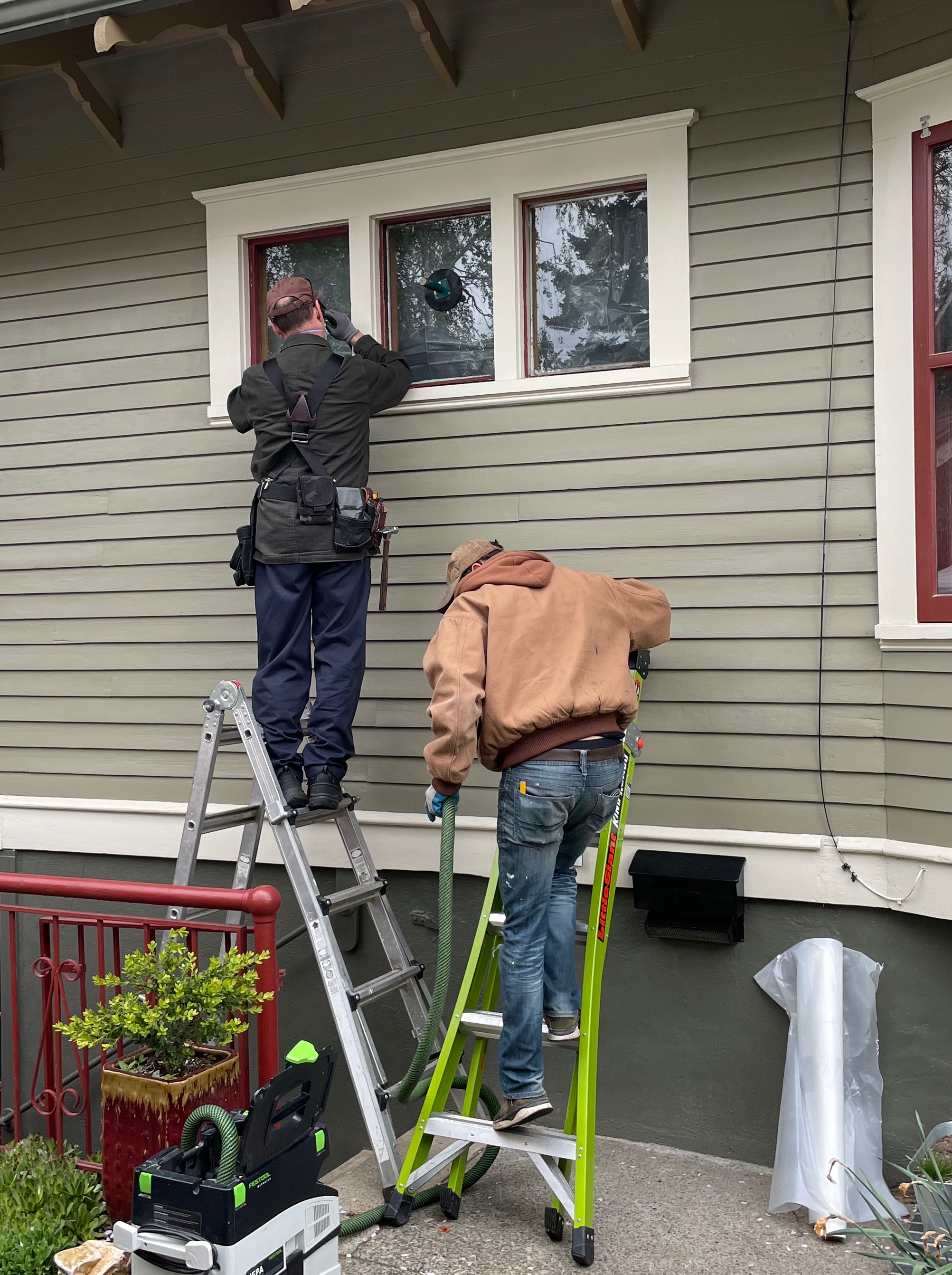
Fast forward to this week. Carl and his crew returned for the install. I believe they were as excited as we were to make this reunion possible. Out came the empty-eyed single panes. And very carefully one at a time the old windows, newly sashed, were fit and snugged back into the openings they once knew.

The Sashwright Co. team prepares to remove the clear glass panes that were put in place when the original windows were removed in the 1970s.

I still can’t quite believe they’re back. Every time we pass by, we stand and admire how these windows re-dignify that space, how they bring even more color and life back into the room. It’s still the place you want to sit in the morning with a cup of tea to contemplate the day ahead, or for friendly conversation at dinner.

But these time traveling windows now-come-home have made this space something more, a kind of shrine to the house itself, its builder, the craftspeople who have helped repair and restore it, and more than a century of friends and family who have passed through.
A winter return to Deadman’s Hill

For more than 100 years, young people of the neighborhood have brought their sleds, toboggans, skis, chunks of cardboard, plastic bags and pretty much everything else that slides to the top of slippery, snowy Stuart Drive for a run downhill.

This weekend’s snow-ice event brought out the crowds and a strange sense of pre-pandemic normalcy. These kids still can’t be together in the classroom. Judging from the spirit and smiles visible on the hill today, gravity and speed weren’t the only joys bringing people out. Kids laughed. Parents stood and talked. Plenty of masks were in evidence. “The kids really deserve this,” said one Mom.

Of course, whenever we’re on Deadman’s Hill we’re thinking of the dead man and the auto accident that claimed his life. Fred Jacobs was killed here on the morning of June 5, 1917. You should read the whole sad story of this freak accident. And while you’re here, you might want to read about the beautiful Craftsman house at the top of the hill that is as much of a landmark as the hill itself, designed and built in 1912 by George Asa Eastman, who was principal architect for the Oregon Home Builders Company, which built hundreds of local homes.

This weekend’s weather is memorable for many reasons, but lest we think this was a big-time snow event, you might want to check out this history of snow, including some interesting photos from the neighborhood during the big snow of 1936.

Searching for the 1920s Alameda woodcutter

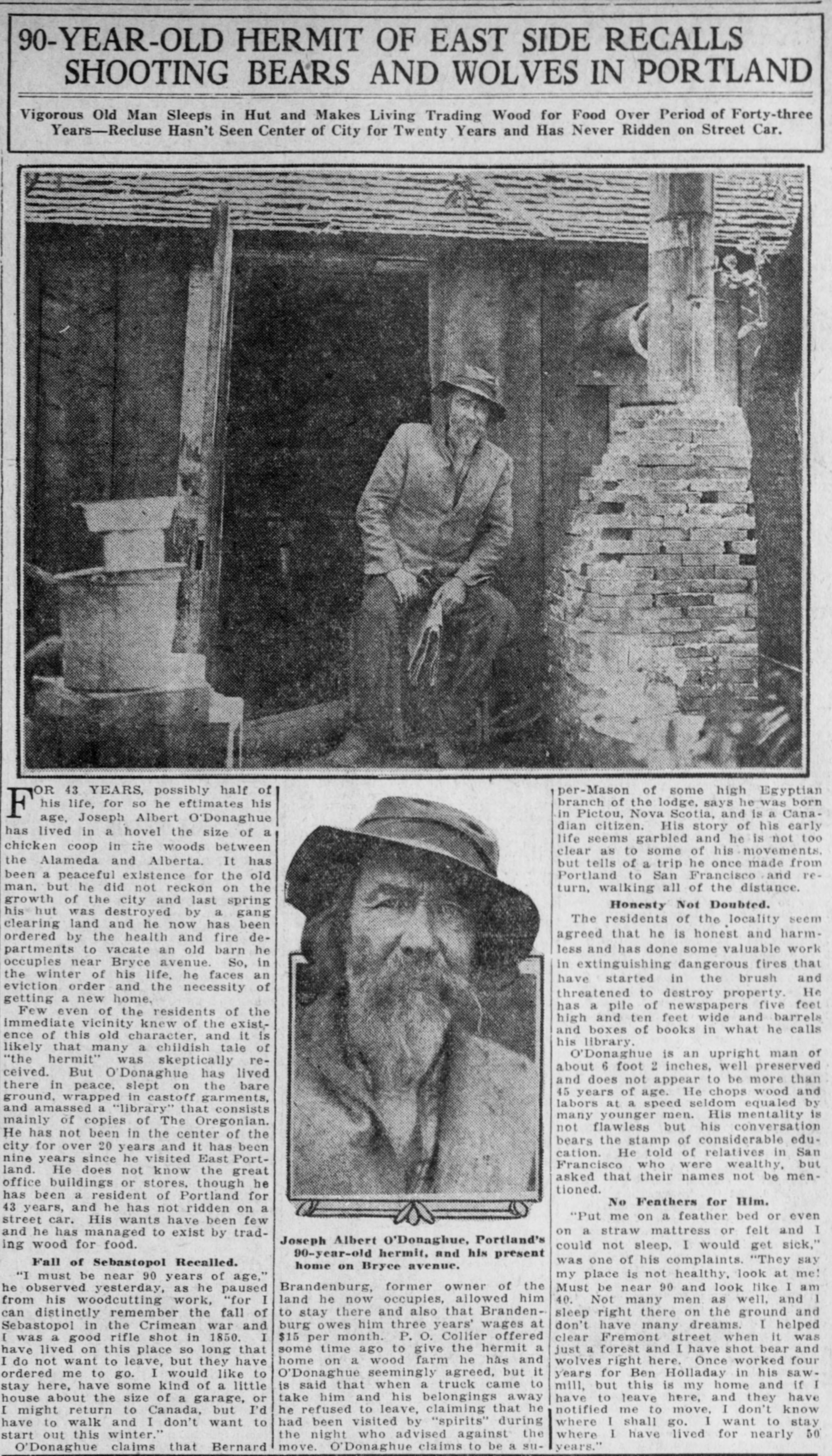
A few years back, about this time of the year, we found a story in The Oregonian from the fall of 1921 that caught our attention. It was about a so-called hermit, a woodcutter who had lived much of his life in a one-room shack near Bryce Street, before Bryce was even a street and before the neighborhoods were built.

The newspaper story was trying to be one of novelty, but underneath it was actually a story of displacement. O’Donaghue was being moved on from the shack in the woods where he lived because land was being cleared and houses built.

Joseph Albert O’Donaghue told of helping clear forests to make the roads we know today, and of wolves and bears he’d killed right here on Alameda Ridge.

Some of it sounded a little fantastical. Like his memories of being a rifleman in the Crimean war 70 years earlier. Of being at least 90 years old. Of walking from Portland to San Francisco and back again.

But a bunch of it had a ring of truth and carried enough information that 100 years later, we could do a little diligence on his stories.

So before we apply some research tools to Mr. O’Donaghue’s story, read the piece below that ran in The Oregonian back on September 18, 1921. And if you want to get in the right frame of mind, you might also read our post Time Passes In Alameda from December 30, 2010, reminding us of so many layers of history here in these neighborhoods.

A careful read of the 1921 story helps us identify certain things to fuel our inquiry:

  • Researchers like a name like Joseph Albert O’Donaghue. Distinctive and traceable.
  • He was from Pictou, Nova Scotia, Canada.
  • He worked for Bernard Brandenburg, and his Bryce Street shack was on property Brandenburg owned.
  • He knew P.O. Collier (who offered him a new place to live).
  • He was a Mason.
  • He was a firewood cutter.
  • He had family in San Francisco.
  • He was a reader.

That’s enough to get us going. Here’s what we found:

The 1910 federal census shows O’Donaghue at age 67, single, living as a “hired man” with two other boarders and a cook in an unaddressed building near 37th and Fremont. It lists his birth year as 1843, from Canada, his father from Ireland, mother from Scotland, and that he arrived in the US in 1878. He reported himself as working full time as a farm laborer. We couldn’t find him in the 1920 census.

The annual Polk city directories track O’Donaghue’s presence like this:

  • 1888 listed as a laborer, boarding somewhere in East Portland (that was us before we became part of Portland proper in 1891).
  • 1906 listed as a laborer, boarding near Fremont and 36th.
  • 1916-1917 listed as a laborer, living near NE 35th and The Alameda.
  • 1921 still working as a laborer, living near NE 35th and Fremont.

His trail goes cold after the 1921 newspaper story, no city directory listings. Nothing. Then in March 1927, a death notice in Esson, British Columbia for Joseph A. O’Donaghue, age 80. Is this our man? Hard to know.

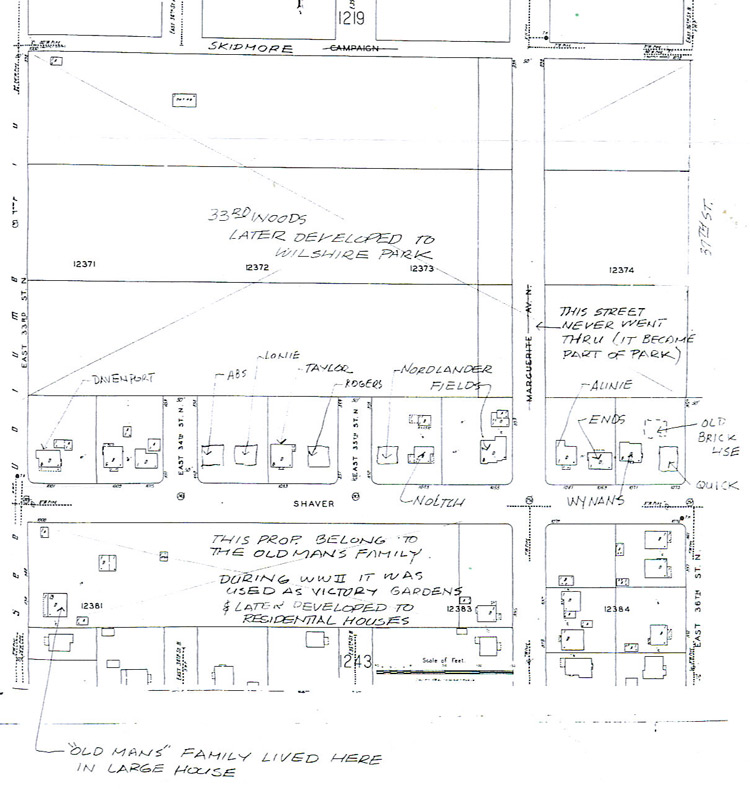
So to the next question: where was O’Donaghue’s shack? We know the property where he lived was owned by Bernard Brandenburg, who owned quite a few lots in the Spring Valley Addition, east of NE 33rd.

Spring Valley is one of the oldest plats in the area, filed on November 6, 1882 by “Clara L. Files, Spinster,” and encompassing the area east-west between 33rd and 37th and north-south between Skidmore and Bryce, including today’s Wilshire Park.

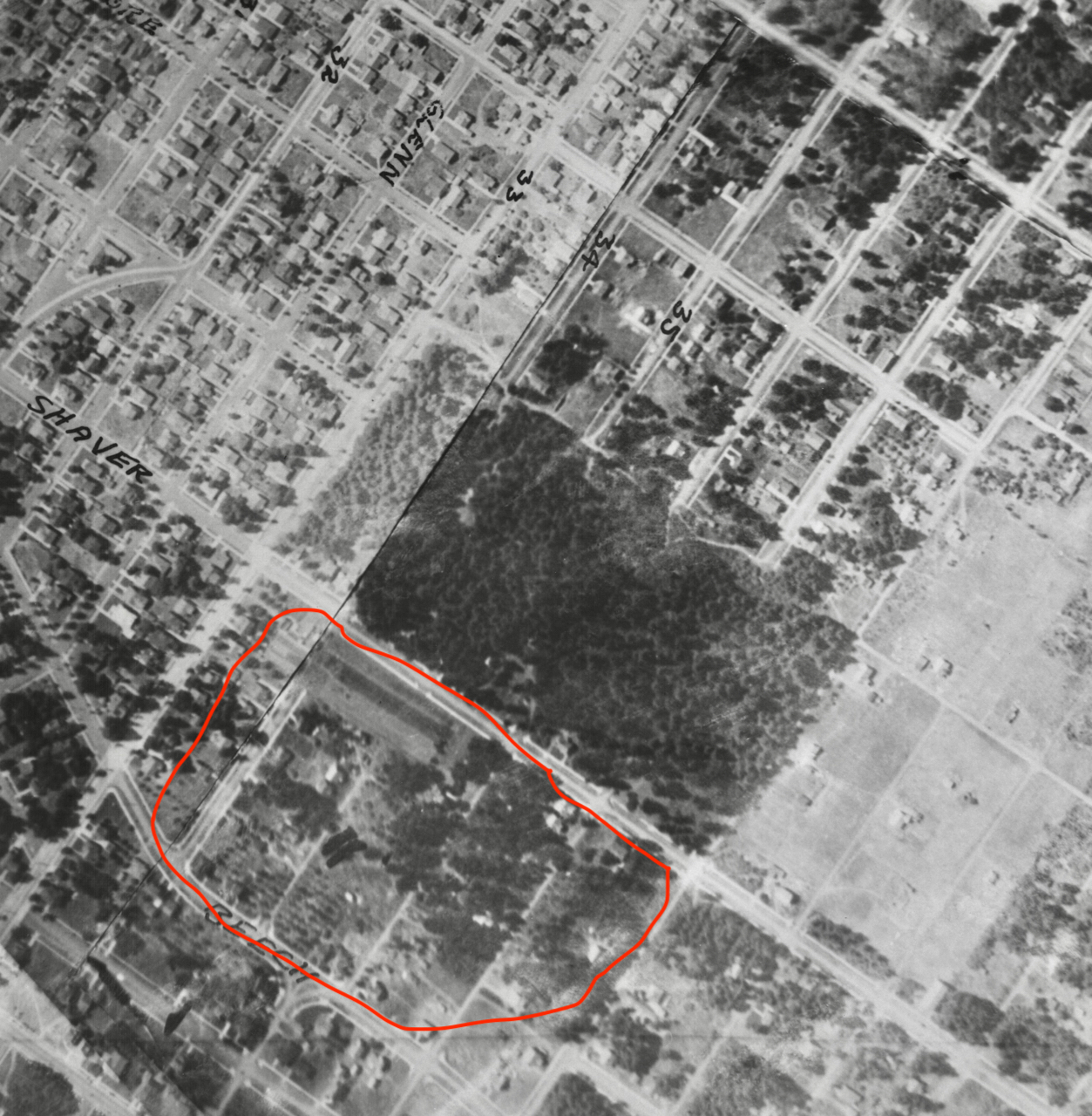
Brandenburg owned six lots which today make up the north end of the two blocks just south of Shaver between NE 33rd and 35th (when 33rd was the only road out here, the numbered streets in this vicinity didn’t exist). We’ve circled them below in red. If he lived on property Brandenburg owned, we’d guess that could be the location of O’Donaghue’s old shack.

Here’s a look at the 1925 aerial photo, with the Spring Valley Addition circled in red. Was the shack somewhere out there?

1925 aerial photo over the Spring Valley Addition. Bryce is incorrectly labeled as Beech. The dense stand of trees is today’s Wilshire Park. Aerial photo courtesy of City of Portland Archives.

Perry O. Collier was a popular and successful local real estate salesman who worked these properties as they came on the market. He may have been the one who handled the Spring Valley property deal with John L. Hartman, the big-time Portland attorney-banker-developer behind Rose City Park and other major subdivisions. Hartman bought the Spring Valley Addition property and replatted it for subdivision in June 1921. Those plans are probably what was leading to O’Donaghue’s ouster in September 1921.

This is where the story might bump into something we already know.

Not long after starting the blog—way back in 2007—we met three of the “boys” who grew up in this part of the neighborhood in the 1930s and 1940s. As often happens, our conversations led to questions, maps in hand, that would help turn back the clock. The boys told us about an old man who lived in this area, and we wrote about it in the post Memory Fragments | An old man and his dog, and a follow-up post Memory Map, which featured handwritten notes made on an old Sanborn map from one of the boys—Dick Taylor—about that exact property…that it was owned by the old man’s family. Hmm.

Is this our man? We’ll never know.

But the trip back in time is enough to reset our mental picture of the neighborhood we think we know today, and to feed our imagination. Think about that the next time you’re out on an evening stroll up Bryce on a cold night at the end of the year.

Another neighborhood goodbye: Food King Market

We know change is the only real constant in our neighborhood life, but it seems we’ve been saying goodbye to businesses and buildings more frequently than usual these days.

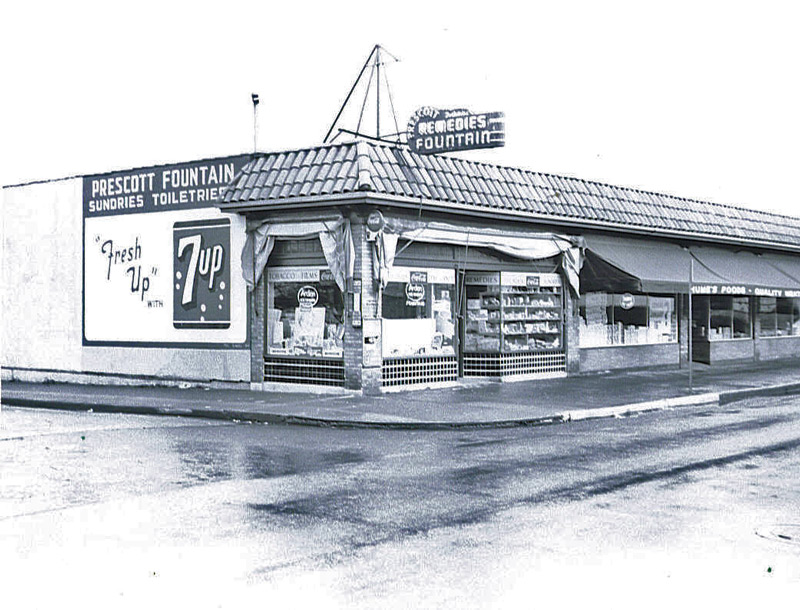
Today is the last day of business for Food King Market, located at 2909 NE Prescott. The building has recently sold and the family that has met the neighborhood’s convenience store needs for the last 20-plus years is closing up shop. There most certainly is a story here about owners David and Kaybee and their own history in the place and where their path leads from here. The neighborhood will miss them and the convenience of having a small market nearby for last-minute needs.

For the building, it’s unclear where the path will lead. The new owner is in conversation with the city regarding permitting and here’s what the official status of remodeling plans says:

“Remodel and change the use of the existing structure (which is now consisting of three units: a grocery store, a residence, and a current vacant unit), to either 100% office or a combination of office and retail sales and service. Also proposed is to convert approximately 500-800 sq ft of existing footprint into covered or partially-covered outdoor areas.”

The silver lining at this point for the neighborhood appears that this is not a multi-story Airbnb hotel or condominium. It seems the new owners are considering repurposing aspects of the original building.

Which leads us to this photo, which accompanied this post we wrote 11 years ago describing the history of the stores that have operated on the site, and shared memories of some of the “kids” who dropped by for iced cokes on credit.

1955, looking northeast from the corner of NE 29th and Prescott. Photo courtesy of Tom Robinson.

Thanks David and Kaybee. We’ll miss being able to zip over for the missing ingredient at the last moment, and we wish you well. And we’ll continue to follow remodel plans for this building which has been a neighborhood institution of sorts for almost 100 years.

The Finest Corner in Concordia

We’ve just finished researching a home in the Irvington Park addition, one of the many underlying plats that make up today’s Concordia Neighborhood. It’s been a fascinating look back at what was once the far edge of Portland. Not Irvington, mind you, but Irvington Park: the 175-acre parcel bounded by NE 25th, NE 33rd, Rosa Parks and Killingsworth, first platted back in 1890.

We’ve written about this neck of the woods before, and it keeps drawing us back. Partly because we like to take the dog out on walks in the alleys that criss-cross the neighborhood, but also because we can imagine these lands as the forests they once were, sloping down to the Columbia Slough.

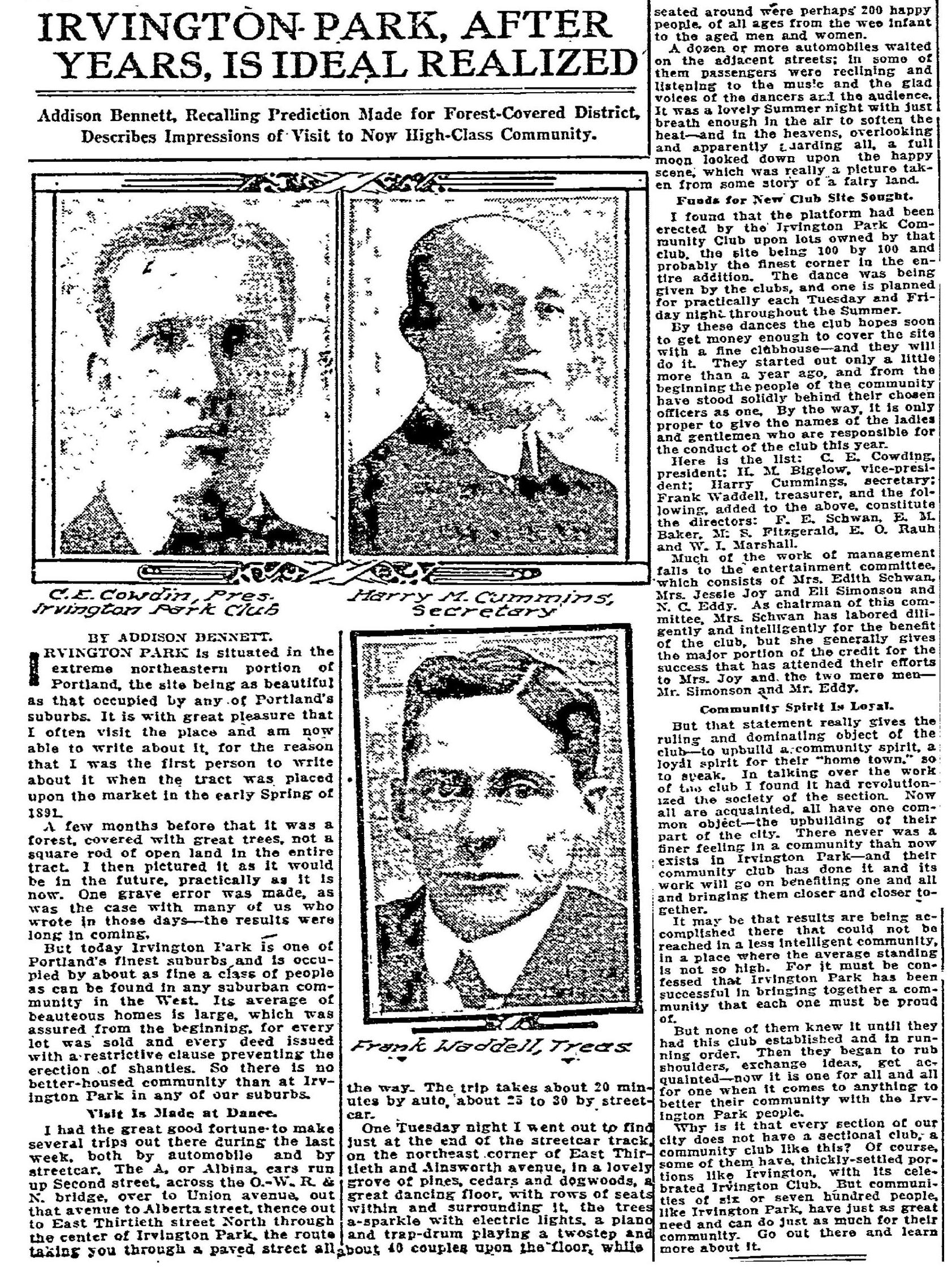
Addison Bennett, a long-time reporter for The Oregonian, visited Irvington Park in July 1915, when things began to finally gel for the young neighborhood. He had been one of the first newspaper reporters to write about the area 25 years earlier, so he knew the wild landscape in its pre-development days.

The narrative of Bennett’s 1915 trip to Irvington Park is worth a read: He called the corner of NE 30th and Ainsworth the finest corner in the entire addition, and for good reason. In part, it was the end of the Alberta Streetcar line. But apparently it was also the heart of community spirit.

NE 30th and Ainsworth, looking north. October 2019.

If you have time, read the whole article (at the bottom of this post), but here’s the part that jumps out at us, and something we like to imagine every time we walk through that intersection:

“One Tuesday night I went out to find just at the end of the streetcar track on the northeast corner of East Thirtieth and Ainsworth Avenue, in a lovely grove of pines, cedars and dogwoods, a great dancing floor, with rows of seats within and surrounding it, the trees a-sparkle with electric lights, a piano and trap-drum playing a twostep and about 40 couples upon the floor while seated around were perhaps 200 happy people of all ages from the wee infant to the aged men and women.

“A dozen or more automobiles waited on the adjacent streets; in some of them passengers were reclining and listening to the music and the glad voices of the dancers and the audience. It was a lovely summer night with just breath enough in the air to soften the heat—and in the heavens, overlooking and apparently guarding all, a full moon looked down upon the happy scene, which was really a picture taken from some story of a fairy land.”

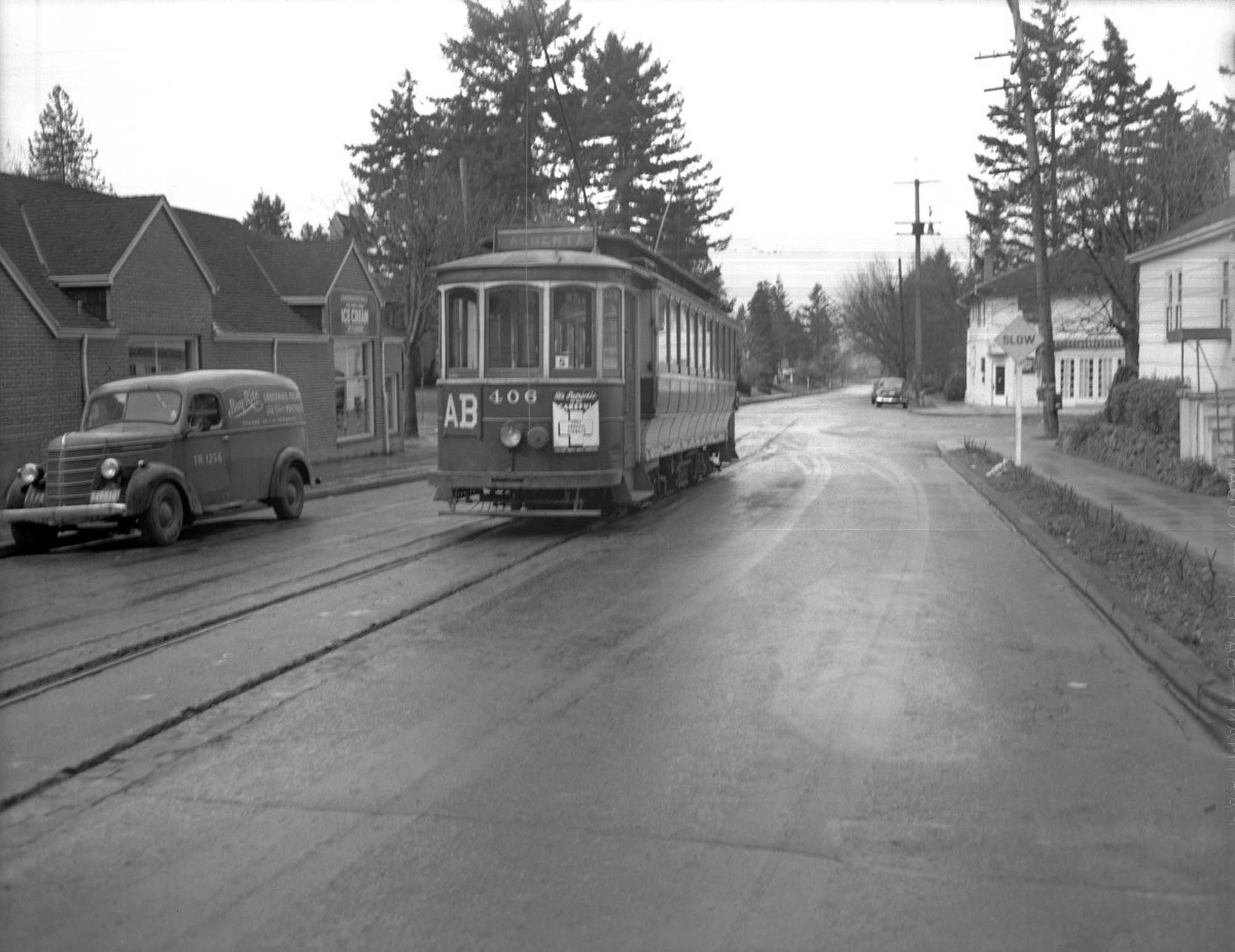
The old frame structure standing on the northeast corner today dates to 1923, a few years after the days of the big dance platform and the dogwoods. That time traveler of a building started out as Hinrich’s Grocery—one of the neighborhood’s many mom and pop stores—and once had large windows facing Ainsworth, which you can see in this photo from 1944 looking north of the Alberta Streetcar parked at that intersection.

Looking north at NE 30th and Ainsworth, 1944. Courtesy City of Portland Archives, image a2009-009-4152.

Here’s Bennett’s full story from 1915 about Irvington Park (click to enlarge). Enjoy.

From The Oregonian, July 25, 1915