The First Alameda School

When most Alamedans think about our lovely old Alameda Elementary School, we are probably thinking about the beautiful and classic building that stands today on NE Fremont between 27th and 29th. Built in 1921, this school has been the neighborhood hearth for generations.

But did you know there was an even earlier Alameda School? I came upon this tidbit while reviewing 1914 articles from The Oregonian, but never dreamed I’d find a photo of the place. You can imagine how pleased I was to find this remarkable shot of the first school in the neighborhood, built in 1915. Check it out:
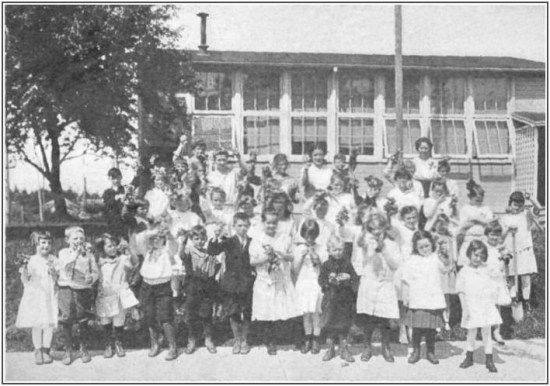
"First crop of radishes and lettuce at the Alameda Park School, Portland, Oregon, June, 1916. Even in the primary grades children may learn much about the science of growing things. Courtesy L.A. Alderman"

The original caption reads: "First crop of radishes and lettuce at the Alameda Park School, Portland, Oregon, June, 1916. Even in the primary grades children may learn much about the science of growing things. Courtesy L.A. Alderman"

The photo is from a book published in 1919 by Rand McNally called “Vocational Guidance for Girls,” by Marguerite Stockman Dickson. You can have a look at this book (a remarkable story all on its own), thanks to Project Gutenberg, by clicking here.  The Alameda photo is in Chapter V, where you’ll find some other interesting photos from Northeast Portland.

The caption clearly identifies this as the Alameda Park School in Portland, Oregon. That’s us. Pair this up with the news story from The Oregonian on September 18th, 1914 and we can begin to fit some pieces together. Take a look:
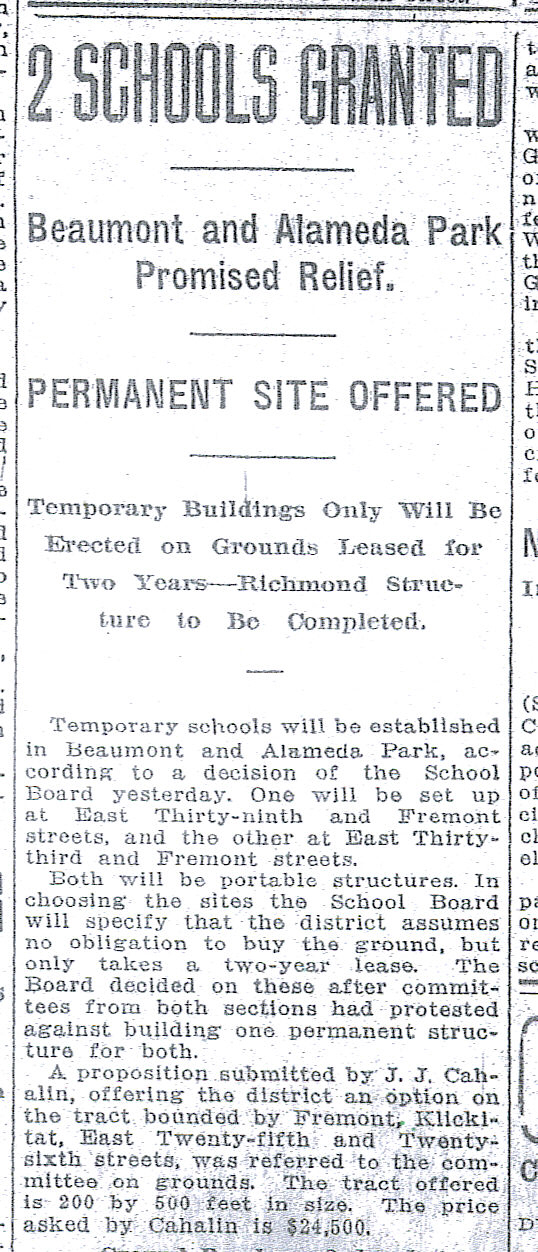
From The Oregonian, September 18, 1914.

From The Oregonian, September 18, 1914.

Things to ponder:

  • This original small school building was viewed as temporary when it was first built. Only a relatively small percentage of homes had been built in the neighborhood by then, so it was clear there would one day be a real need. Not so much in 1915, but local kids still needed a local school.
  • It was first imagined in context with a school up the road in the Beaumont neighborhood, which was also to be temporary. Like Alameda, that neighborhood was just starting out in 1915.
  • The newspaper indicates that one site for the school was at the top of Gravelly Hill, NE 33rd and Fremont. It also says the site being offered by J.J. Cahalin was on Fremont between 25th and 26th, the next block west from the current site of the Fremont United Methodist Church. I didn’t find a follow-up story, nor have I looked at the property records, but my hunch just from looking at the photo is that the Cahalin site was selected over the one at the top of the hill. I’ll run that down next time I’m looking at property records, but that just seems likely.
  • Interesting to note the tall windows, lattice-work porch and woodstove chimney. And the fact that the kids had a busy and productive garden.

Where did it sit exactly? Who built it? Who was headmaster? Mysteries yet to solve.

A History of Snow

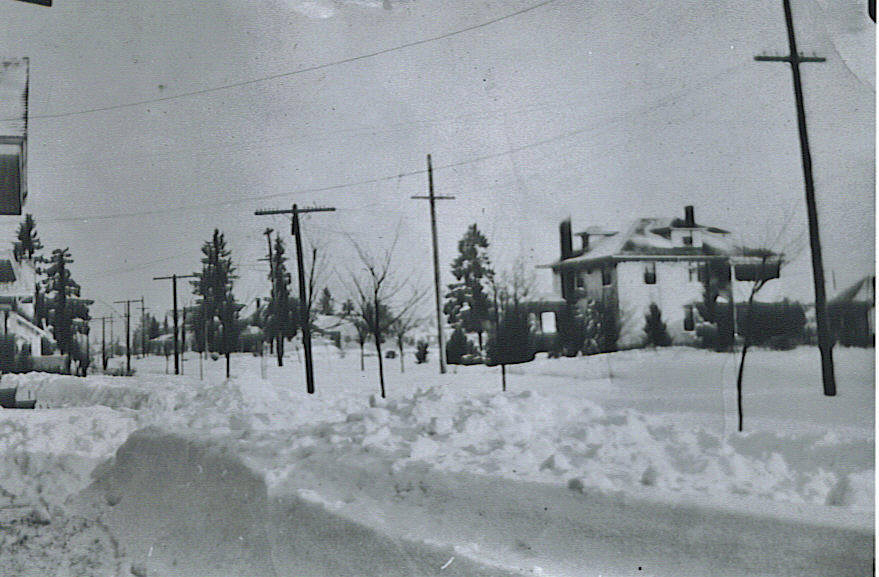
Winter 1936

Winter 1936, looking north on NE 30th toward intersection with Mason.

Winter 1936, looking north on NE 30th toward intersection with Mason. Click for a larger size image.

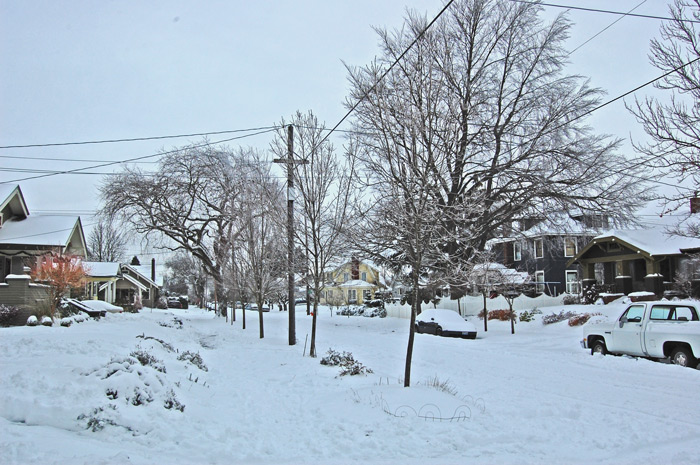
Winter 2008

Winter 2008. Looking north on Northeast 30th toward Mason.

Winter 2008, looking north on NE 30th toward Mason. Click for a larger size image.

There’s a great Billy Collins poem called “A History of Weather” that I’ve been thinking about all week. We’ve had a lot of snow here in Portland, not record-breaking, but still more than anyone has seen around these parts for 40 years. Right now we have about 15 inches on the ground and the city has been at a virtual stop for the last couple days. We started to thaw today, but another 4-8 inches of snow are in the forecast for the next couple days.

In the poem, Collins creates a funny, wistful elegy for atmospheres of the past, and contemplates weather as a common human bond across the ages. Contemplating what a weather history poem should include, Collins writes, “There will be a section on the frozen nights of antiquity…” I’ve been thinking about the frozen days and nights of the past, the transforming quiet and joy visited on the kids of this street and neighborhood over the years.

So after shoveling the front walk yesterday, I dug into my Alameda archive and found a picture taken a few doors south of my house in 1936, the year Portland received about 35 inches of snow. The photo has been passed down to me by the family of the little boy who grew up here in the teens and twenties. He was fledged by 1936 (family members were in the house til the late 1950s), but the photo stayed in his family because it depicted remarkable conditions.

Being obsessed with lining up past and present for clues, I prowled around this morning hunting — camera in one hand, old photo in the other — for the original photographer’s footprints, which are not entirely available today due to some landscaping changes down the block.

The big house on the corner (white in 1936, blue today) is the Copenhagen House, built in 1912 by the family of Les Copenhagen. Today’s big beech in the sideyard is just a start of a tree in 1936. Power poles have thinned out a bit, though still an eyesore. The gable end of the house facing the camera up the block can be seen in both images. A little closer in, if you squint at the 1936 image, you can see Walter Morrison out shoveling the front walk of my house. Farther up the block and across the street, today’s yellow Dutch colonial was just a vacant lot. Other vacant lots allow a view off into the distance.

Families in 1936 probably took pictures of their unusual winter weather event, just like we have this week. Unfortunately, most of those images are lost to time. We’re lucky to have this one, 71 years old. Makes you think about the pictures you take, the pictures you save, the pictures you decide to throw. I’m always on the lookout for old pictures of Alameda…

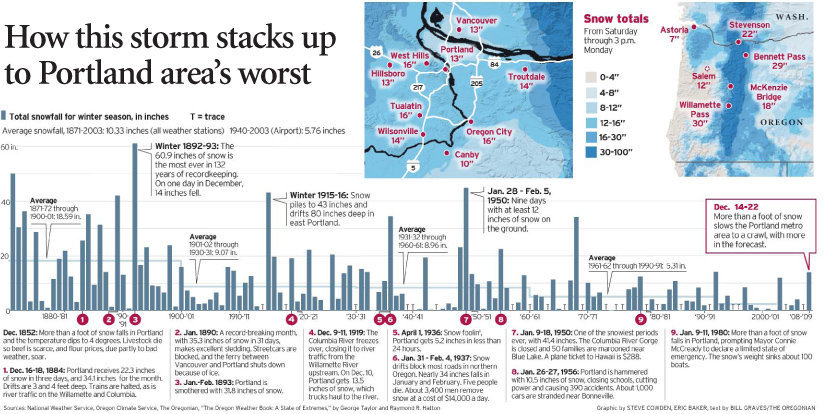
To cap off this entry about the history of snow, thought I’d share a very interesting info-graphic from The Oregonian today that clearly indicates that our predecessors knew a lot more about snow than we do. Check it out:

From The Oregonian, Page 1, 12-23-08

From The Oregonian, Page 1, 12-23-2008. Click for a larger size image.

For more insight and photos on Portland’s winter weather history, check out this post from February 2021 which turns back the clock on ice storms and river ice well into the 1850s.

Remember Manitou?

It’s OK if you’ve not heard of the Manitou Addition, a small chunk of neighborhood that once had its own identity, now lost to time. In my research on Alameda-Beaumont-Wilshire, I’ve kept running into references to Manitou-this and Manitou-that and wondered where it was. While reviewing plat maps recently, I found it: the long block between 33rd and 35th that includes the north side of Fremont and both sides of Alameda.

Manitou Plat Detail, March 3, 1910

Manitou Plat Detail, March 3, 1910

The plat for Manitou was incorporated by Fred and Gussie Jacobs, who were partners in the Jacobs-Stine Company, which platted many Portland subdivisions with fancy sounding names, only two of which are in circulation today-Errol Heights and Argyle. Fred Jacobs told a reporter in April 1910 that Manitou was named for Manitou Springs, a picturesque mountain community about 65 miles south of Denver. (Incidentally, Fred Jacobs was the Portland real estate man who died in the crash on Stuart Drive that resulted in it being known as “Deadman’s Hill.“)

Of course, when I found Manitou, it begged another question because that plat is a subdivision of the Spring Valley Addition. Now there’s another name that has fallen out of use. Spring Valley is easily one of the oldest plats in the area, filed on November 6, 1882 by one “Clara L. Files, Spinster,” and encompassing the area east-west between 33rd and 37th and north-south between The Alameda and Skidmore (including Wilshire Park). Interesting to note that until 1941 (when development really came to that part of the neighborhood) the Spring Valley plat showed a major planned north-south thoroughfare called Broadway, located about where NE 35th is today.

The cumulative mushroom effect of historical research guarantees that you can’t look into the history of the Spring Valley Addition (or Manitou) without bumping into other nearby mysteries, including plats for Maplehurst (south of Fremont), Irene Heights, Fullerton, Whiterose, Rossdale, Rosyln, Calman, Wilshire and Railroad Heights (nope, no railroads ever ran up here, but you might have been able to hear a train or two).

History Walk | Alameda Park Perimeter

These fall evenings are great for a brisk walk. Leaves everywhere, woodsmoke in the air, raindrops. And local history ripe for the imagination.

Alameda Park Plat Map, c. 1912

Click on the map for a larger file you can print

The northwest corner of “The Park” (as in the Alameda Park subdivision) is a little confusing, particularly around Crane Street, which has been significantly changed over time (and is actually part of the Vernon plat). Rather than trying to follow the zig-zag of the property boundary, I just walked Prescott to NE 20th to the shadow of the big water tower. Then south to Alameda Drive and around the corner to 21st, then west on Ridgewood to 20th, and then left down the hill. When you are on 20th above the ridge, from Prescott to Alameda, you can see the difference in the neighborhood plats, with Sabin to the west on one side of the street with smaller homes on smaller lots.

Turning left (east) on Fremont, you have the long straight south edge of The Park to walk, passing by where the streetcar ran up 24th and the busy commercial hub that included the Alameda Pharmacy, the old Safeway (now the bank) and what used to be two gas stations. I think of the northeast and northwest corners of NE 24th and Fremont as the gateway to The Park because that’s where the streetcar ran, and because of the business district here.

Next, you pass east by the school, built in 1921 after much lobbying by the locals and a few protests that the construction contract was awarded through some favoritism (future blog post, stay tuned). The plats off to your right are Waynewood, the Town of Wayne and Edgemont, names long forgotten.

Tip your hat to the Pearson Pine, the big old ponderosa pine tree on the southeast corner of NE 29th and Fremont. It’s been there since at least 1885.

Up the hill you go. As you pass the staircases that head up to the top of the ridge, keep in mind there are old water mains under those steps, placed when they were built in the teens. At one point, maybe in the 1920s and early 1930s, women from the Alameda Tuesday Club acted as ushers for young children passing up and down these stairs on their way to and from school.

The crest of the hill at Fremont and 33rd is Gravelly Hill, which was both a gravel pit and garbage dump for many years. The dump was under the southwest corner, where a fine house sits today.

As you walk north on 33rd, think about the 33rd street woods (today’s Wilshire Park), originally part of the Kamm Estate, which was a dense forest that played a large part in the memories of youngsters who grew up there in the 1930s and 1940s. While you’re enjoying the evening, you can also tip your hat to the home guard, made up of Alameda dads, who patrolled the neighborhood at night during the World War II years, enforcing blackout rules and making sure families kept blankets and light dampers up on their windows.

And then there are the thousands of stories that rise up from the generations who have lived in the homes you’ll pass. Lots to wonder about as you and the dog push on around the corner at Prescott and head into the home stretch (being sure to have a look up the alleys north of Prescott as you scope your next walk). So nice to be out on a history walk on a brisk November night.

Next: Walking the route of the Broadway Streetcar.

Beaumont, not to be outdone

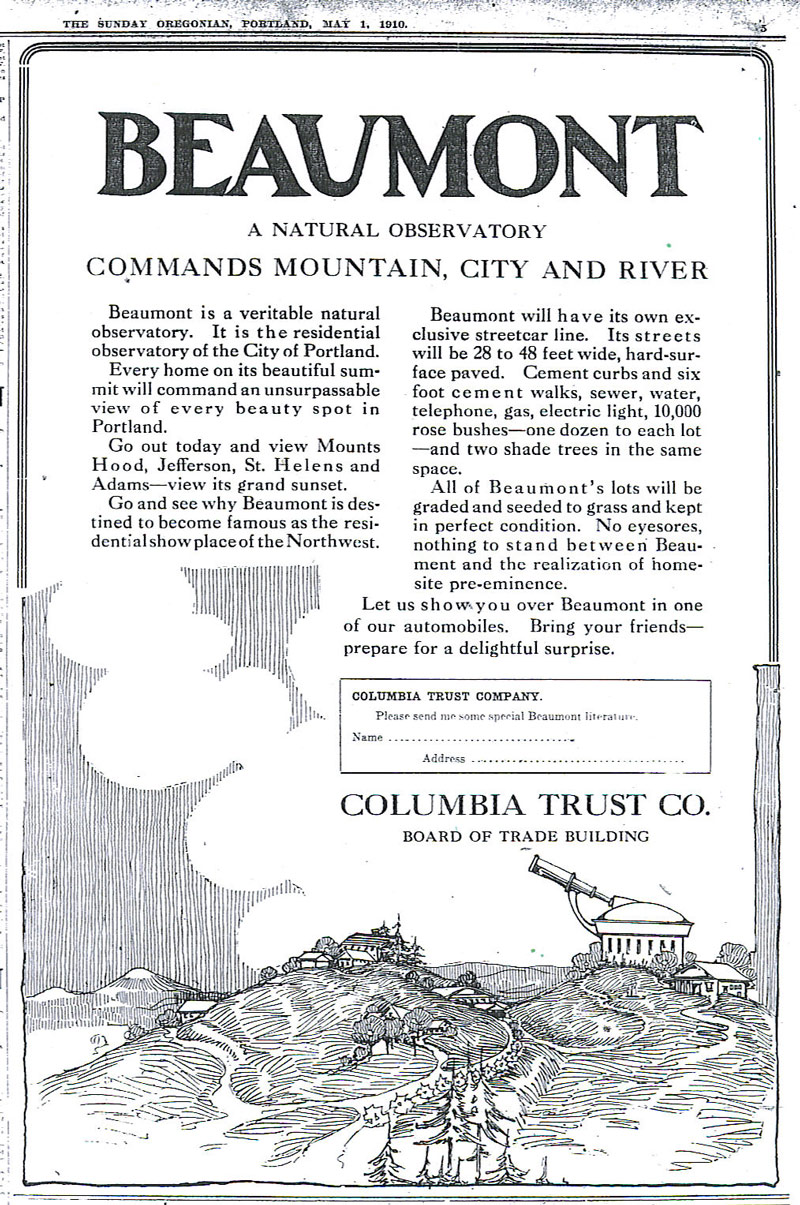
Not to be outdone by Alameda Park or Olmsted Park or any of the dozen-plus subdivisions beginning to spring up about this time, the Columbia Trust Company commissioned their own artwork (and copywriter) to sing the praises of their development. Take a look:

Beaumont Ad, The Oregonian, May 1, 1910

Beaumont Ad, The Oregonian, May 1, 1910

If you squint just right at their ad, you can imagine Wisteria or NE 42nd Avenue curling down from the ridge. But when this ad ran in the spring of 1910, the big improvements in Beaumont–paved streets, sidewalks and graded lots–were still more than a year away. In fact, real estate folks in existing developments like Irvington went out of their way to point out that places like Beaumont and Alameda Park were just pipe dreams, and only they were able to sell actual houses on actual lots in neighborhoods with actual paved streets. Competition for buyers was as fierce as the pace of homebuilding, which was faster and more ambitious than anything before or since.

The Tuxedo of Portland | Looking Back 99 Years

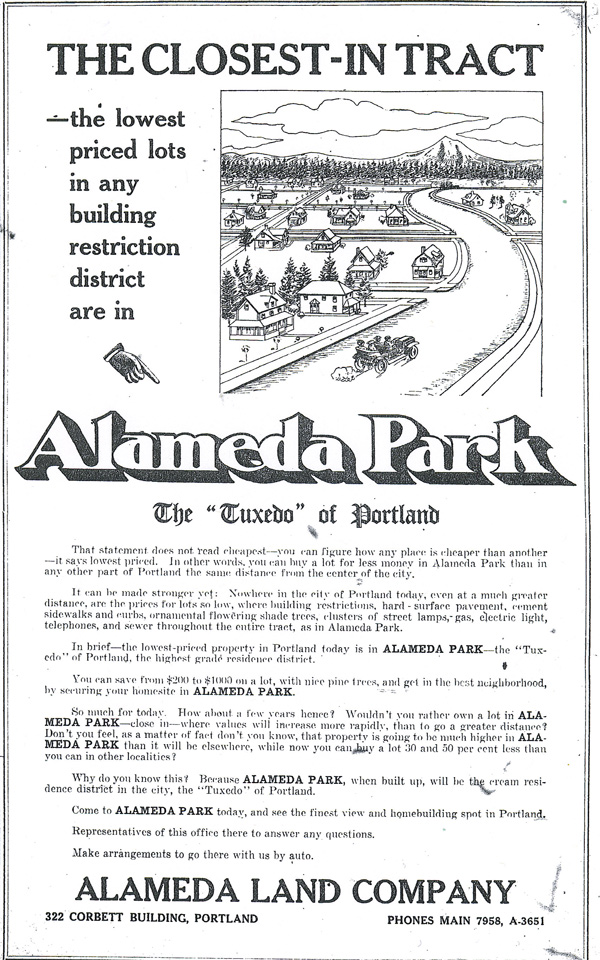
As the Alameda Neighborhood approaches its 100th anniversary, I thought it might be of interest to turn the clock back for a sense of what people were thinking about this part of the city in those days. I’ve done a comprehensive review of The Oregonian from 1909 to 1929 and have hundreds of articles and advertisements that shed light on the life of Alameda, Beaumont, Rose City Park and other Northeast Portland neighborhoods. Here’s one, an advertisement from 99 years ago: Sunday, October 24, 1909:


10-24-09 Advertisement for Alameda Park Neighborhood, from The Oregonian

10-24-09 Advertisement for Alameda Park Neighborhood, from The Oregonian


Plenty of food for thought here. The cartoon-like drawing showing a few houses (note the front porches) scattered on open blocks; the serpentine Alameda leading off toward Mt. Hood; street trees planted in orderly fashion. And the car. The text extols the affordable nature of the lots here in Alameda Park, the amenities, including flowering shade trees, telephone, electricity and sewer. The “Tuxedo” of Portland. Hmm.

Ninety-nine years ago this month, the streets were in, but not yet hard-surfaced (that was still almost three years off, completed in the spring of 1912). Curbs and sidewalks had not yet been framed and poured, nor was there any gas or electric installed. The only sounds of home construction were coming from Concordia and Vernon–neighborhoods to the north–where building was fast and furious. But here in Alameda, despite what the ad might have you think, it was a quiet place at the far northeast edge of the city limits. The first boom of Alameda construction was still a year or more away.

As we enter the 100th anniversary phase, in 2009-2011, I’ll be sharing clippings on a “real-time” basis. You can read all the Alameda news that was fit to print on the day it ran, exactly 100 years ago. What better way to learn about our history…no such thing as old news.

Memory Map

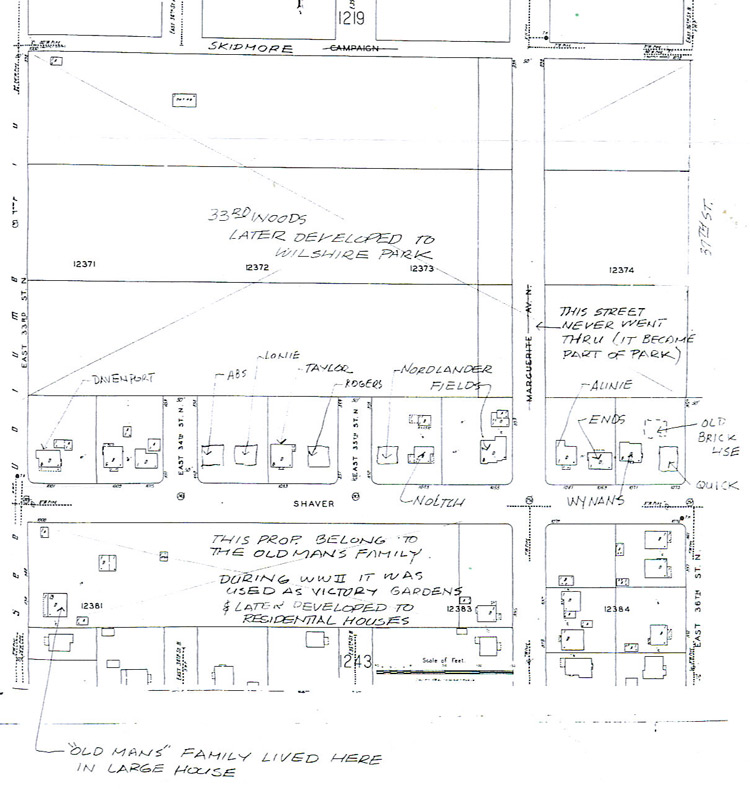
I’ve been in touch with Dick Taylor, who grew up in Alameda during the 1930s. He’s one of the men whose brain I’ve been picking for details on the “old man” who I’ve heard stories about. Dick grew up on Shaver between NE 34th and NE 35th.

A few weeks back I sent him a copy of the Sanborn map of that vicinity from 1924. He kindly added some detail showing who lived where in the 1930s, and where the “old man” lived. Check out the annotated version of the map he sent me back, drawn from memory.

A couple of observations here: Note that the property on the south side of Shaver Street was a victory garden during the 1940s. Interesting too to point out there was an old brick house in the far southeast corner of Wilshire Park that Dick says was torn down. Have a look at his annotated map:

Click on the map for a larger image.

Here’s what Dick says about the “old man:”

He was the neighborhood character and had a reputation for starting fires. Almost everytime we would hear a fire engine, we knew the old man was up to starting a fire. He would always help extinguish it with a large gunny sack he always carried draped over his shoulder. As kids we used to play a game he taught us called “duck on the rock.”

Interesting to ponder the many interesting souls who have walked these streets.

Could that “old man” be this old man? Hmm.

Of Purple Boxes

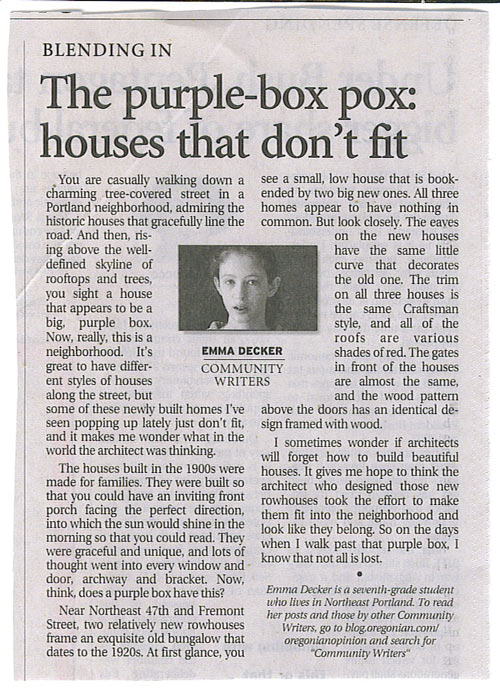
A great observation about old houses and their sometimes brash new neighbors. This column appeared in The Sunday Oregonian on March 16, 2008.

 purple-box-column-3-16-08.jpg

One thoughtful reader, responding to Emma’s column, writes:

Don’t you wonder what story the purple box is telling us? If the older homes were about family, and a love of making things that are handsomely decorated, or about sitting in the sun on our porches, maybe the purple box is about amnesia, or something like it.

What do you think the purple box is telling us?

Alameda Library? Unlikely.

If you live in Alameda above the ridge, you’ve walked, ridden or driven past this very nice home many times. It’s on the wide sweep of Regents Drive, just north of the intersection with The Alameda, on the east side of the street.

 3032-regents.jpg

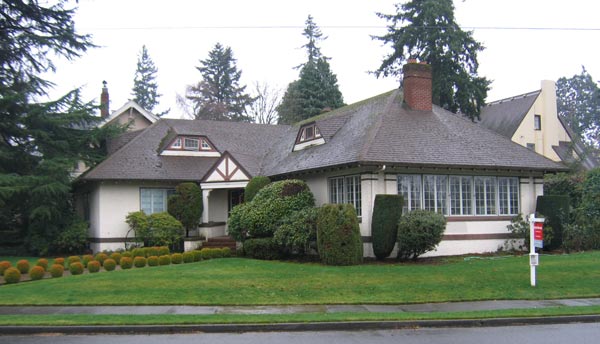
3032 NE Regents Drive, Portland, Oregon. Built 1923 by C.O. Waller at a cost of $12,000, which was a lot of money in 1923. This was on the high end for construction costs of other houses built in the neighborhood at the same time. Some families who have lived here over the years have used the west wing of the house (with all the windows you can see above) as a place for their books.

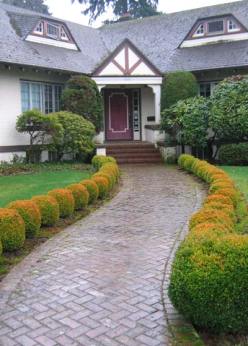
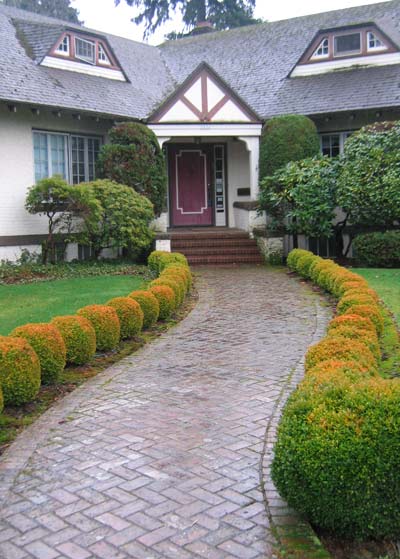
It’s been a favorite of ours, particularly all the casement windows; the curved approach walk with the formal shrubbery, the welcoming way in which the building is sited at the corner with Regents and Dunckley; the brick, the tile roof and all the Tudor details. It’s a nice place.

So we were intrigued recently when picking up the real estate flyer advertising this as the former Alameda Library. Hmm. Really?

As a historian who loves a good mystery, I dug into the resources to see what I could find. And despite the realtor’s listing citing this as a “local legend,” I can report the following, to the contrary:

  • The construction permit for this house was taken out on May 18, 1923 by Mr. C.O. Waller. Presumably, the house was completed in late 1923 or early 1924. That period was during the second boom of construction in the neighborhood, following the first wave from 1910-1914. There is no record of public bidding process about any buildings in the neighborhood (except for Alameda School, built in 1921 at a cost of about $40,000…and there was a flap about that bid which ended up in The Oregonian, another future post…stay tuned).
  • The house sits on two lots in the Olmsted Park Addition: lots 25 and 26. Interesting to note that it’s actually had three addresses during it’s lifetime. The first one was 924 Dunckley, which was changed to 3054 NE Dunckley during the great renumbering of the early 1930s (click here to learn more about that and about Alameda Street Names). And sometime — not sure when — it was changed to its current Regents Drive address, 3032.
  • The two subdivisions across the street from each other in this location — Alameda Park Addition to the west and the Olmsted Park Addition to the east — had strict building covenants and restrictions that prohibited the construction of anything except houses. That goes for commercial buildings, community buildings, even churches (as we know from the lawsuit and protests associated with the Alameda Park Community Church just up the block, built about the same time…more on that story soon). A public library would never have been permitted, or tolerated, in this spot. The most likely library that would have served the needs of this community were either in Albina on NE Knott (just west of MLK in what is today’s Tidal Wave used book store) or in the Hollywood area (that branch has moved around over the years).
  • I’ve met with a former resident who grew up across the street from 3032 and he recalls that it was not a library, but home to the Johnson family. Mr. Johnson was the contract carrier for The Oregonian (as in the chief distribution guru).

3032-entry.jpg

Perhaps the urban myth of “Alameda library” arose from the fact that several homeowners at that address have used that west facing wing — with all those windows — to place their bookshelves. Or from the fact that if you squint your eyes just right, the architecture and the layout of the building on the site does indeed feel like a welcoming, friendly public building.

-Doug Decker