A History of Snow

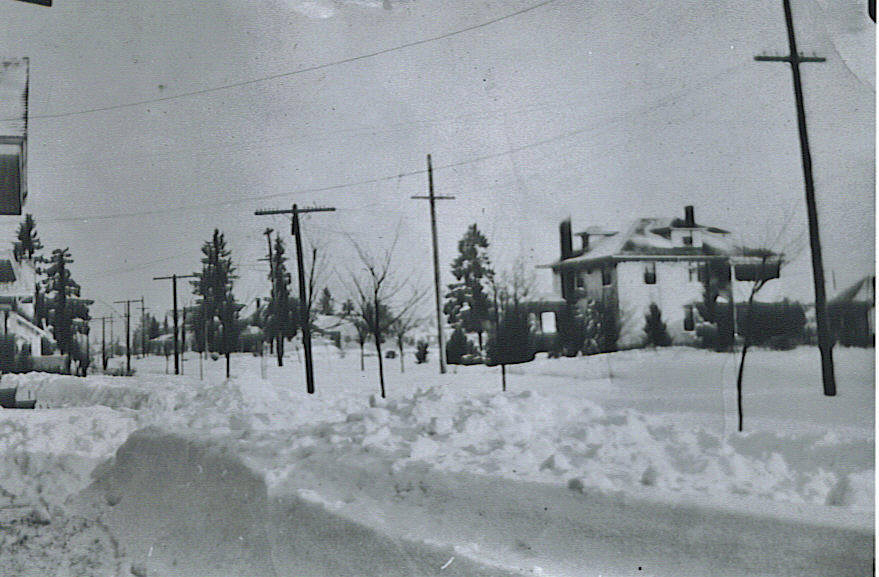
Winter 1936

Winter 1936, looking north on NE 30th toward intersection with Mason.

Winter 1936, looking north on NE 30th toward intersection with Mason. Click for a larger size image.

Winter 2008
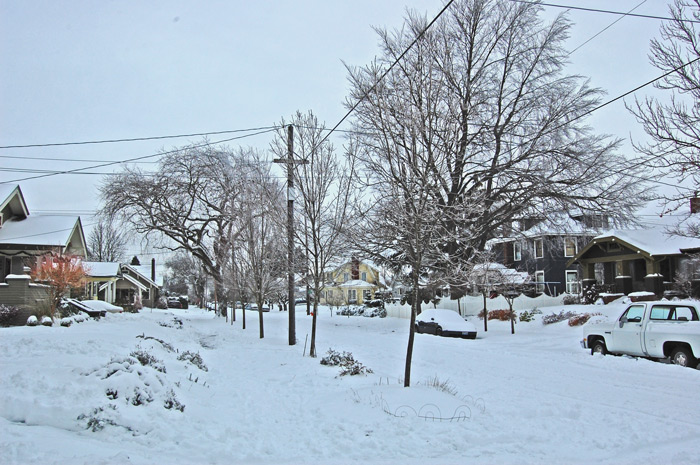
Winter 2008. Looking north on Northeast 30th toward Mason.

Winter 2008, looking north on NE 30th toward Mason. Click for a larger size image.

There’s a great Billy Collins poem called “A History of Weather” that I’ve been thinking about all week. We’ve had a lot of snow here in Portland, not record-breaking, but still more than anyone has seen around these parts for 40 years. Right now we have about 15 inches on the ground and the city has been at a virtual stop for the last couple days. We started to thaw today, but another 4-8 inches of snow are in the forecast for the next couple days.

In the poem, Collins creates a funny, wistful elegy for atmospheres of the past, and contemplates weather as a common human bond across the ages. Contemplating what a weather history poem should include, Collins writes, “There will be a section on the frozen nights of antiquity…” I’ve been thinking about the frozen days and nights of the past, the transforming quiet and joy visited on the kids of this street and neighborhood over the years.

So after shoveling the front walk yesterday, I dug into my Alameda archive and found a picture taken a few doors south of my house in 1936, the year Portland received about 35 inches of snow. The photo has been passed down to me by the family of the little boy who grew up here in the teens and twenties. He was fledged by 1936 (family members were in the house til the late 1950s), but the photo stayed in his family because it depicted remarkable conditions.

Being obsessed with lining up past and present for clues, I prowled around this morning hunting — camera in one hand, old photo in the other — for the original photographer’s footprints, which are not entirely available today due to some landscaping changes down the block.

The big house on the corner (white in 1936, blue today) is the Copenhagen House, built in 1912 by the family of Les Copenhagen. Today’s big beech in the sideyard is just a start of a tree in 1936. Power poles have thinned out a bit, though still an eyesore. The gable end of the house facing the camera up the block can be seen in both images. A little closer in, if you squint at the 1936 image, you can see Walter Morrison out shoveling the front walk of my house. Farther up the block and across the street, today’s yellow Dutch colonial was just a vacant lot. Other vacant lots allow a view off into the distance.

Families in 1936 probably took pictures of their unusual winter weather event, just like we have this week. Unfortunately, most of those images are lost to time. We’re lucky to have this one, 71 years old. Makes you think about the pictures you take, the pictures you save, the pictures you decide to throw. I’m always on the lookout for old pictures of Alameda…

To cap off this entry about the history of snow, thought I’d share a very interesting info-graphic from The Oregonian today that clearly indicates that our predecessors knew a lot more about snow than we do. Check it out:
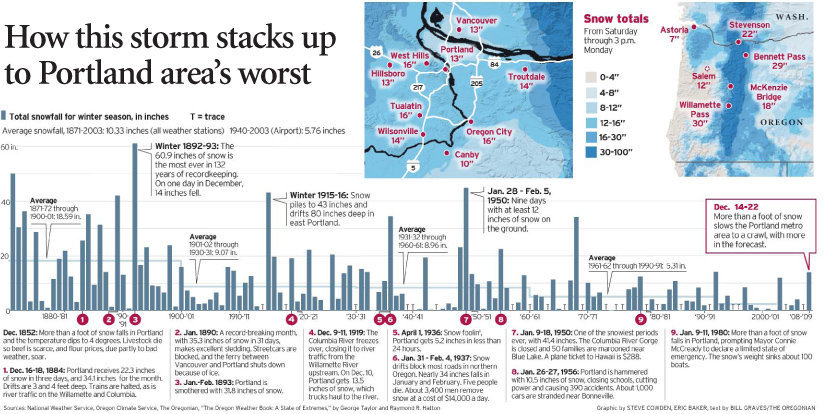
From The Oregonian, Page 1, 12-23-08

From The Oregonian, Page 1, 12-23-2008. Click for a larger size image.

For more insight and photos on Portland’s winter weather history, check out this post from February 2021 which turns back the clock on ice storms and river ice well into the 1850s.

History Walk | A Spin Around the Farm

Here’s another history walk–a short one this time at .6 of a mile–that will take you around the perimeter of the Pearson Farm, one of the earliest settlements in this area, dating to 1875.

The starting point for this one is easy: the Pearson Pine at NE 29th and Fremont. Go stand under its broad branches and be prepared for time travel back through our neighborhood’s past. Before you walk the farm, though, there are a few things you need to know.

The Pearson Ponderosa Pine presides over the corner of NE 29th and Fremont.

The Pearson Ponderosa Pine presides over the corner of NE 29th and Fremont.

About the Tree: This old timer has seen it all-the farms and orchards south of Fremont; the deep forest on the ridge to the north and the flats beyond that give way to the Columbia; the slow but steady reach of the street grid; an explosion of home building; construction of nearby Alameda School; the steady tide of young families moving in, and older people moving out. Like a sentinel, this tree has watched our corner of Portland grow up.

Planted in 1885 by Samuel Pearson to mark the northeast corner of his 20-acre farm, this Ponderosa pine has had plenty of room to grow to its noteworthy circumference of 15 feet, and estimated height of more than 100 feet. According to a family story handed down the years, Samuel salvaged the young seedling from an area burned by wildfire and brought it home to his farm. We nominated this as a Heritage Tree back in 2008.

About the Farm: The land was originally part of a Donation Land Claim granted by the U.S. Government in 1859 to William and Isabelle Bowering. Pearson bought the land in 1875 after it had gone through a quick succession of owners, and began to establish his farm. He was born in England, his wife Adeline in France, and together for the next 25-plus years, they tried to make a go of it milking cows on the edge of Portland. But it was not an easy existence. Cows grazed, were born, milked and died, right where today’s Alameda Elementary School sits. Contained elsewhere in the early Pearson landscape was a pond at the lowest part of the property, in the vicinity of today’s Northeast 29th and Siskiyou, with an operating sawmill nearby; pastures for the dairy cows; a large old locust tree (now gone) on Fremont at 27th and what the Pearsons described as “deep forest to the north.”

pearson-detail

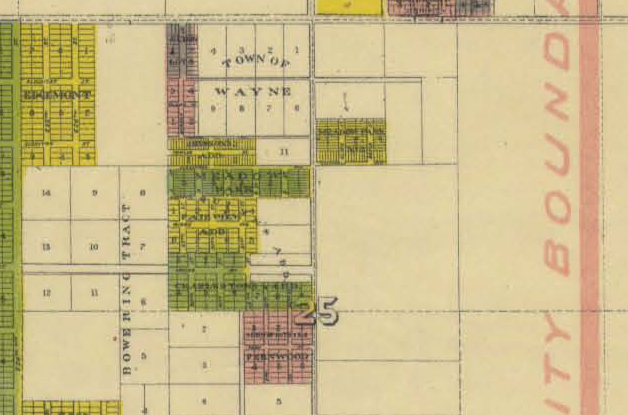
This detail from a much larger map shows the area of the Pearson farm in 1906. NE Fremont runs across the top of the frame. NE 33rd is the main road running vertically through the middle. NE 24th runs vertically on the far left side, along the edge of Edgemont. Look carefully and you can see Klickitat and Siskiyou streets. Note the Bowering Tract. The Pearson Farm is the empty lot east of Edgemont and west of the Town of Wayne. Note our proximity to the city limits: the pink vertical line on the far right shows the boundary. The large number “25” is section 25 in Township 1 North, Range 1 East of the Willamette Meridian. Click the map for a large image.

Do you have that mental picture in mind now? OK, let’s walk.

  1. Start on Northeast 29th and Fremont, under the Pearson Pine, and head south on 29th for two blocks to Siskiyou. Along the way, you’ll note an empty lot on the right a few houses south on 29th…until two years ago, this held an original Pearson house.
  2. Turn right (west) on Siskiyou. You are now walking through what was a major wetland feature and pond, maybe a seasonal creek. If you look carefully, you can see what looks like a low spot in the pavement. Where they drained the swamp. You can also see the streets don’t line up just right here…a clue to the meeting of two developments.
  3. Continue on Siskiyou to Northeast 27th. You’ve just walked past a sawmill and small log yard. Can you hear the cows?
  4. Turn right (north) on 27th and appreciate the nice plaza and grounds at Alameda Elementary School. The pasture was off to your right where the playground is today. Check out the red farmhouse on your left as you approach Fremont. The third generation of Pearsons were born here and played on the porch. One of the Pearsons once said that porch was built extra large so the kids had a place to play outside that wasn’t in the cow pasture. In that day–1908–there was no school yet, no street, no sidewalk. Just a view of Mt. Hood and their pasture off the front porch to the east, and 20 acres of Scotch broom and dogwood out the back door.
  5. Turn right (east) on Fremont and set your sights on that big Ponderosa pine, back to where you started.

Much has changed in this place since the Pearsons first shaped the landscape. But the power of memory, and the silent witness of that tall pine, remind us all about our neighborhood’s connection to those early years.

20,000 Visits

20,000 visits.

I’m pleased and a little amazed to note that the Alameda Old House History Blog has just made it to 20,000 visits. I’ve been running the blog for about a year now and have enjoyed the comments and the conversation this forum has produced. It’s also nice to have an outlet for research, and to imagine a small but loyal readership that cares about this stuff too. Thanks for being along on the journey. I hope this work has stoked your imagination and curiosity about house history.

Here are some thoughts on the past year and visitation to this site:

  • The number one most viewed page is the style points piece on the Tudor Cottage. I guess that means there are lots of Tudor cottages out there in the world. The second most popular spot on the blog is the story on Alameda Life 1920-1930 which tries to imagine life here based on what the Federal Censuses offer.
  • The busiest day for traffic on the site was December 8, 2007. On that day, the blog was mentioned by Jack Bogdanski at www.bojack.org (which is an interesting blog, by the way).
  • Typically, the site sees about 70-100 visits a day. Daily visits tend to peak up into the hundreds immediately after the Alameda Newsletter is distributed (I write a history column in that newsletter and pick up some readers from there).
  • The two quietest days of the year: Christmas and election day!

Plans for the next year include:

  • I’ve just changed the domain name to make life a little simpler. Maybe you noticed: it’s www.alamedahistory.org The former URL works too, but it’s a mouthful to say.
  • I’ll continue to share some of the material I’ve gleaned from reading all the old newspapers. I’ll upload stories, graphics, photos, advertisements and other tidbits.
  • I’ve just started the process of nominating my home for listing on the National Register of Historic Places. I’ll write about that process and offer insight into its twists and turns as they unfold.
  • I’m going to try to focus on interpretation that you can use. Places where I can point you in the neighborhoods as entry points for learning about history. I’ve tried to do this with the history walks, but will continue to seek ways to do this. Open to ideas.

To those who have commented or pointed me in search of history, I say “thank you.” To all visitors, I invite you to contribute your thoughts, ideas and questions.

Remember Manitou?

It’s OK if you’ve not heard of the Manitou Addition, a small chunk of neighborhood that once had its own identity, now lost to time. In my research on Alameda-Beaumont-Wilshire, I’ve kept running into references to Manitou-this and Manitou-that and wondered where it was. While reviewing plat maps recently, I found it: the long block between 33rd and 35th that includes the north side of Fremont and both sides of Alameda.

Manitou Plat Detail, March 3, 1910

Manitou Plat Detail, March 3, 1910

The plat for Manitou was incorporated by Fred and Gussie Jacobs, who were partners in the Jacobs-Stine Company, which platted many Portland subdivisions with fancy sounding names, only two of which are in circulation today-Errol Heights and Argyle. Fred Jacobs told a reporter in April 1910 that Manitou was named for Manitou Springs, a picturesque mountain community about 65 miles south of Denver. (Incidentally, Fred Jacobs was the Portland real estate man who died in the crash on Stuart Drive that resulted in it being known as “Deadman’s Hill.“)

Of course, when I found Manitou, it begged another question because that plat is a subdivision of the Spring Valley Addition. Now there’s another name that has fallen out of use. Spring Valley is easily one of the oldest plats in the area, filed on November 6, 1882 by one “Clara L. Files, Spinster,” and encompassing the area east-west between 33rd and 37th and north-south between The Alameda and Skidmore (including Wilshire Park). Interesting to note that until 1941 (when development really came to that part of the neighborhood) the Spring Valley plat showed a major planned north-south thoroughfare called Broadway, located about where NE 35th is today.

The cumulative mushroom effect of historical research guarantees that you can’t look into the history of the Spring Valley Addition (or Manitou) without bumping into other nearby mysteries, including plats for Maplehurst (south of Fremont), Irene Heights, Fullerton, Whiterose, Rossdale, Rosyln, Calman, Wilshire and Railroad Heights (nope, no railroads ever ran up here, but you might have been able to hear a train or two).

History Walk | Alameda Park Perimeter

These fall evenings are great for a brisk walk. Leaves everywhere, woodsmoke in the air, raindrops. And local history ripe for the imagination.

Alameda Park Plat Map, c. 1912

Click on the map for a larger file you can print

The northwest corner of “The Park” (as in the Alameda Park subdivision) is a little confusing, particularly around Crane Street, which has been significantly changed over time (and is actually part of the Vernon plat). Rather than trying to follow the zig-zag of the property boundary, I just walked Prescott to NE 20th to the shadow of the big water tower. Then south to Alameda Drive and around the corner to 21st, then west on Ridgewood to 20th, and then left down the hill. When you are on 20th above the ridge, from Prescott to Alameda, you can see the difference in the neighborhood plats, with Sabin to the west on one side of the street with smaller homes on smaller lots.

Turning left (east) on Fremont, you have the long straight south edge of The Park to walk, passing by where the streetcar ran up 24th and the busy commercial hub that included the Alameda Pharmacy, the old Safeway (now the bank) and what used to be two gas stations. I think of the northeast and northwest corners of NE 24th and Fremont as the gateway to The Park because that’s where the streetcar ran, and because of the business district here.

Next, you pass east by the school, built in 1921 after much lobbying by the locals and a few protests that the construction contract was awarded through some favoritism (future blog post, stay tuned). The plats off to your right are Waynewood, the Town of Wayne and Edgemont, names long forgotten.

Tip your hat to the Pearson Pine, the big old ponderosa pine tree on the southeast corner of NE 29th and Fremont. It’s been there since at least 1885.

Up the hill you go. As you pass the staircases that head up to the top of the ridge, keep in mind there are old water mains under those steps, placed when they were built in the teens. At one point, maybe in the 1920s and early 1930s, women from the Alameda Tuesday Club acted as ushers for young children passing up and down these stairs on their way to and from school.

The crest of the hill at Fremont and 33rd is Gravelly Hill, which was both a gravel pit and garbage dump for many years. The dump was under the southwest corner, where a fine house sits today.

As you walk north on 33rd, think about the 33rd street woods (today’s Wilshire Park), originally part of the Kamm Estate, which was a dense forest that played a large part in the memories of youngsters who grew up there in the 1930s and 1940s. While you’re enjoying the evening, you can also tip your hat to the home guard, made up of Alameda dads, who patrolled the neighborhood at night during the World War II years, enforcing blackout rules and making sure families kept blankets and light dampers up on their windows.

And then there are the thousands of stories that rise up from the generations who have lived in the homes you’ll pass. Lots to wonder about as you and the dog push on around the corner at Prescott and head into the home stretch (being sure to have a look up the alleys north of Prescott as you scope your next walk). So nice to be out on a history walk on a brisk November night.

Next: Walking the route of the Broadway Streetcar.

Beaumont, not to be outdone

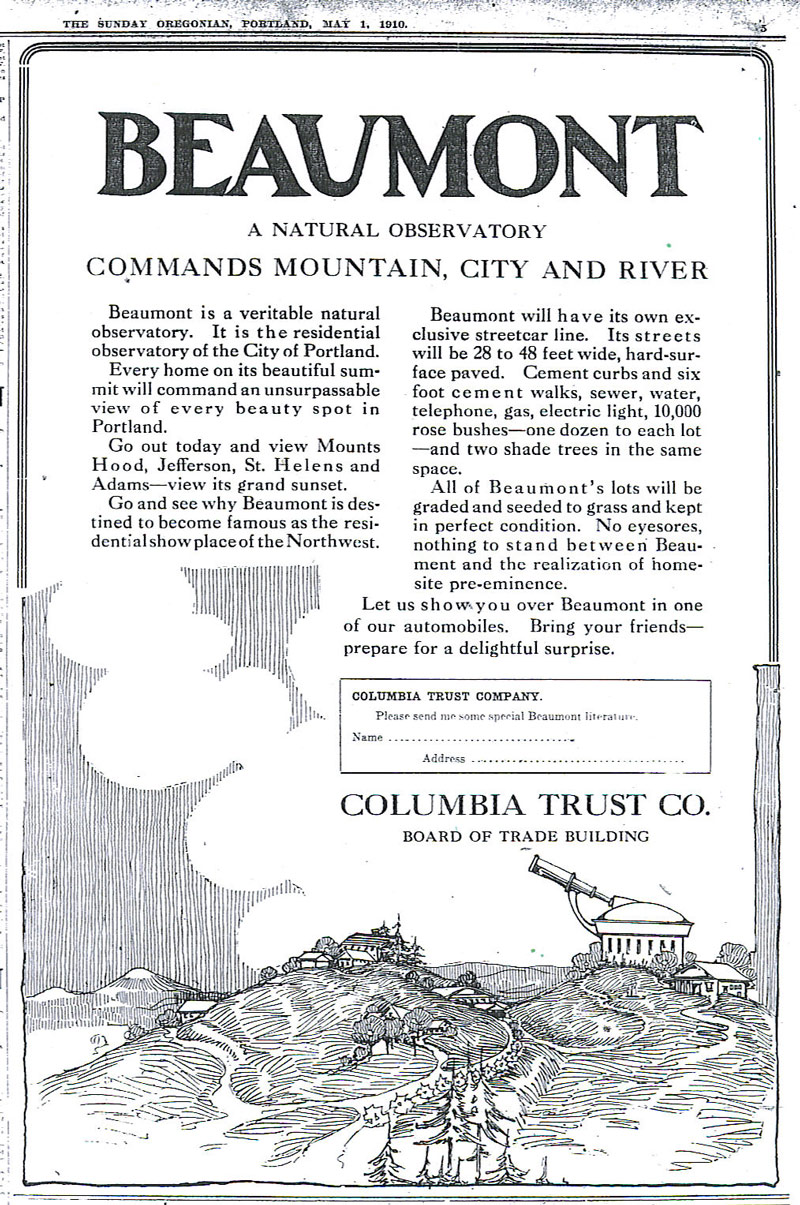
Not to be outdone by Alameda Park or Olmsted Park or any of the dozen-plus subdivisions beginning to spring up about this time, the Columbia Trust Company commissioned their own artwork (and copywriter) to sing the praises of their development. Take a look:

Beaumont Ad, The Oregonian, May 1, 1910

Beaumont Ad, The Oregonian, May 1, 1910

If you squint just right at their ad, you can imagine Wisteria or NE 42nd Avenue curling down from the ridge. But when this ad ran in the spring of 1910, the big improvements in Beaumont–paved streets, sidewalks and graded lots–were still more than a year away. In fact, real estate folks in existing developments like Irvington went out of their way to point out that places like Beaumont and Alameda Park were just pipe dreams, and only they were able to sell actual houses on actual lots in neighborhoods with actual paved streets. Competition for buyers was as fierce as the pace of homebuilding, which was faster and more ambitious than anything before or since.

The Tuxedo of Portland | Looking Back 99 Years

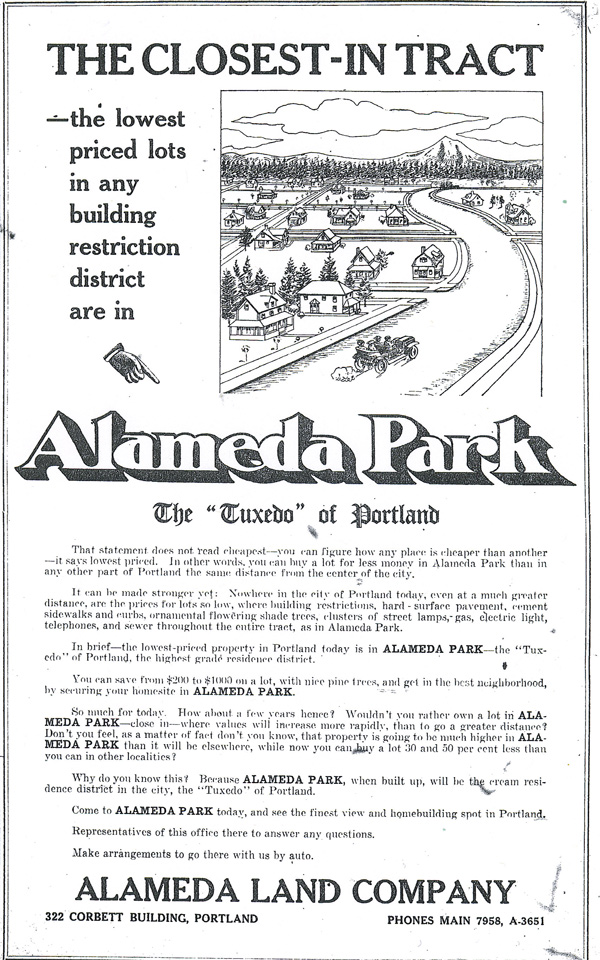
As the Alameda Neighborhood approaches its 100th anniversary, I thought it might be of interest to turn the clock back for a sense of what people were thinking about this part of the city in those days. I’ve done a comprehensive review of The Oregonian from 1909 to 1929 and have hundreds of articles and advertisements that shed light on the life of Alameda, Beaumont, Rose City Park and other Northeast Portland neighborhoods. Here’s one, an advertisement from 99 years ago: Sunday, October 24, 1909:


10-24-09 Advertisement for Alameda Park Neighborhood, from The Oregonian

10-24-09 Advertisement for Alameda Park Neighborhood, from The Oregonian


Plenty of food for thought here. The cartoon-like drawing showing a few houses (note the front porches) scattered on open blocks; the serpentine Alameda leading off toward Mt. Hood; street trees planted in orderly fashion. And the car. The text extols the affordable nature of the lots here in Alameda Park, the amenities, including flowering shade trees, telephone, electricity and sewer. The “Tuxedo” of Portland. Hmm.

Ninety-nine years ago this month, the streets were in, but not yet hard-surfaced (that was still almost three years off, completed in the spring of 1912). Curbs and sidewalks had not yet been framed and poured, nor was there any gas or electric installed. The only sounds of home construction were coming from Concordia and Vernon–neighborhoods to the north–where building was fast and furious. But here in Alameda, despite what the ad might have you think, it was a quiet place at the far northeast edge of the city limits. The first boom of Alameda construction was still a year or more away.

As we enter the 100th anniversary phase, in 2009-2011, I’ll be sharing clippings on a “real-time” basis. You can read all the Alameda news that was fit to print on the day it ran, exactly 100 years ago. What better way to learn about our history…no such thing as old news.

Style Points | The Colonials

Rooted in American history and tradition, the Colonial Revival style and its popular angled-roof cousin, the Dutch Colonial Revival, were some of the Alameda neighborhood’s earliest and sturdiest looking homes. The style takes it primary influence from New England homes of the 1700s and 1800s and is intended to call to mind the traditional American virtues of civility, practicality, and patriotism. Alameda’s early builders were searching for designs that would appeal to the aesthetic interests of well-to-do buyers. The Colonial, and its variations, were an important part of the style palette for builders of that era.

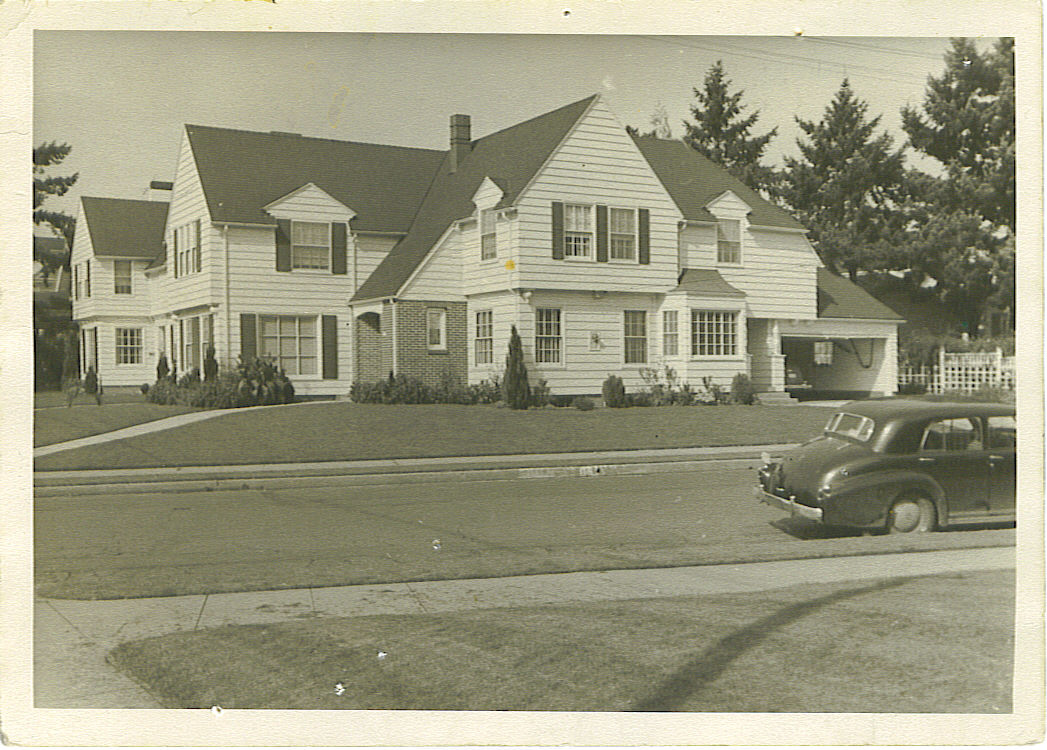
This Colonial Revival home at the corner of NE Regents and Dunckley was built in 1939 by Frank A. Read, a prolific Alameda builder of the 1930s and early 1940s. Use of brick around the entry door brings a modernizing touch to the traditional clapboard exterior. The plunging roofline from the roof peak to above the entry traces a link to early 17th Century New England homes. The use of a garrison style overhang between the first and second floor, and pendant drops at the corners, clearly ties the design to its colonial influences. Other Frank Read homes of this period use many of the same building materials and design references. Photo courtesy of John Haleston.

While not the most common house style in Alameda, the Colonial and Dutch Colonial are notable because they mark both the earliest wave of building in the neighborhood during 1911-1912, as well as some of the last houses built on the dwindling supply of vacant lots in the 1950s. The early Colonial Revivals (such as the Harold Prince house at 2815 NE Alameda) are classic examples of the style, while the later homes more freely interpret the Colonial style and add in other influences like the bungalow or the Norman farmhouse.

Here are some telltale signs of the Colonial Revival and Dutch Colonial Revival:

Colonial Revival

  • Rectangular shape;
  • Typically symmetrical form and placement of double-hung windows, often with decorative shutters;
  • Front door placed at the center, often with ornate portico;
  • Second floor dormers with double-hung windows and decorative shutters, placed symmetrically on the building face;
  • Clapboard exteriors, typically painted white;
  • Sometimes featuring a slightly overhanging second floor, known as a “garrison style;”
  • Decorative pendants, drops or spheres.
  • Central (and sometime grand) staircases that lead direct from the entryway to the second floor.

Dutch Colonial Revival

The Dutch Colonials often feature some or all of the features noted above, but have the distinctive angled roof, called a gambrel style (a barn-like roof) and are typically smaller than the Colonial Revivals.

The most prolific designer and builder of the Colonial Revival in Alameda was Frank A. Read. Between 1926 and 1941, Read built 15 homes in the neighborhood, most of them Colonial Revivals, many of them clustered together in locations north of the Alameda Ridge.

In addition to Read’s sense for design, he had good business sense for real estate development and for construction economies of scale. Located within 100 yards of each other in this portion of the neighborhood are a dozen other homes built by Read. The places where he chose to build were a quick walk from a stop on the Broadway streetcar which ran to 29th and Mason. Read was born in Portland in 1885 and lived on the east side most of his life. He died in June 1950, survived by his wife Mae and three brothers. His obituary in the Oregon Journal described him as a builder and contractor for more than 40 years.

Grant Park Grocery & Market

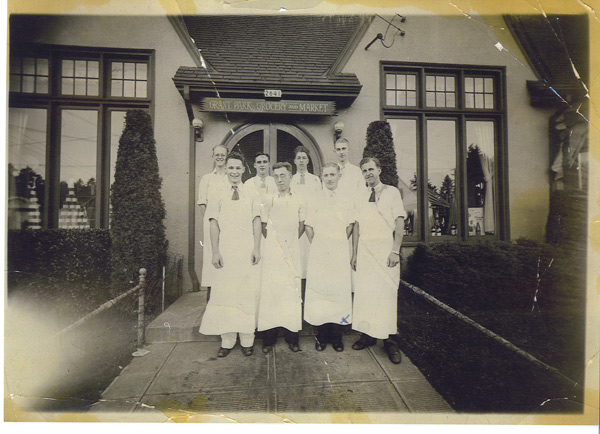
Grant Park Grocery and Market, about 1933. Photo courtesy of Jerry Hoffelner

Grant Park Grocery and Market, NE 33rd and Knott, about 1933. Photo courtesy of Jerry Hoffelner. The man in the first row, second from the right with the blue “x” penned onto his apron, is Jerry’s dad, George Hoffelner. The other men have yet to be identified. Can you help?

I’m researching a very old house near 29th and Knott. One of the many people who lived in the house over the years worked for a while at the Grant Park Grocery and Market, which we know today as the Family Medical Group office on the southwest corner of NE 33rd and Knott.

The image above, taken about 1933, shows the grocery staff decked out in their white aprons ready for action. Like many small stores, these guys often delivered the groceries direct to your door…an idea recently picked up on by some of the modern mega-grocery stores.

This image is taken on the east face of the building (facing 33rd). The original entrance for the market was not on the diagonal at the corner like it is today, though it seems there was always an entry there. My hunch is that was the entry to the pharmacy and fountain that used to be there. The grocery business was owned and operated by Ernest Bjorklund. Next time you are stopped at the light there, have a good look at this interesting building and tip your hat to Mr. Bjorklund and his squad of helpful grocery clerks.

I’m looking for any help with memories, stories, photos or information about either the Grant Park Market or the pharmacy and fountain.

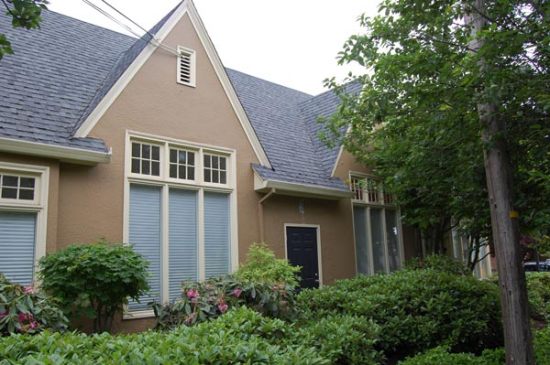
Here’s a shot of that same spot today. The door appears to be an “emergency exit” today. The graceful lights are gone, as is the cool curved doorway and the sidewalk ramp leading to the door (it’s now just part of the garden bed).

Grant Park Grocery and Market building, June 2008

Stories of Success by Homebuilders

I’ve been going through early issues of The Oregonian in search of stories and photos about homes and neighborhoods. It’s been a fascinating journey marked with some real jackpots of information about Alameda, Olmsted Park and Beaumont. Photos, catchy advertisements, stories about who was building what, and where. The Portland of 1909-1915 feels definitely more boastful, a little rowdier than today, with the challenge of meeting day-to-day necessities a little closer to the top.

When you get to reading these papers, you can just feel time flowing through your hands. Each news story or photo is a small thread in the fabric of time. Important at that moment, but entirely forgotten or unobserved today. 

I happened on a great series of stories that grew out of the boastfulness of new neighborhood development. The Portland Realty Board got together with The Oregonian to launch and run a series of columns that invited new Portland homeowners to tell their own stories about how they built (and financed) their new houses. Their modest houses, in most cases. This was not a focus on the big Craftsman or Dutch colonials being built (they had their own limelight on the pages of the Sunday Oregonian). These were grass roots stories about saving money under your mattress, living out of the tent on your new lot, and building your bungalow with your own two hands. Inspiring, really.

Called Stories of Success by Homebuilders, this column was the outgrowth of a weekly contest for the best story. Cash prizes were given, and winning essays were printed in the Sunday Oregonian. The unstated purpose was to help motivate first-time home buyers. In setting up the first essay, the Portland Realty Board wrote:

It was a difficult problem for the committee on awards to decide which of the number were the three best stories, as each contained features deemed of great value in emphasizing the purposes for which the contest is being held. The spirit which underlies the authorship of the essays is wholesome, cheery and inspiring.

So I’m going to pick out of a few of the best and share them, along with a translation of the address for the house today, in case you want to ride by on your bike for an informed look (and a tip of the hat to the first homeowners who made it happen).

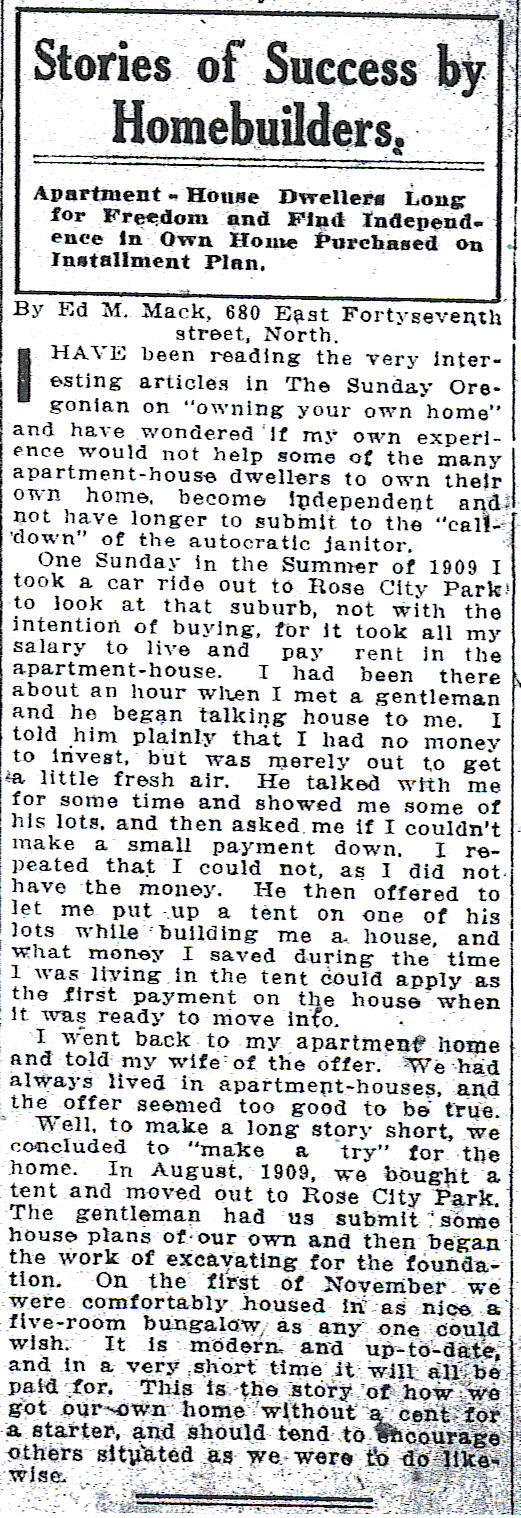
Here’s Ed Mack’s submission from April 7, 1912. The home he and his wife built is at 3122 NE 47th Avenue. It appears there have been some significant changes made to the house since the Macks knew it.

 680 East Fortyseventh Street, North is today's 3122 NE 47th Avenue.