Exploring layers of history in the Vernon neighborhood

We’ve enjoyed re-exploring the Vernon neighborhood this week, preparing for and leading a walking tour to make visible the many invisible layers of history there. Which reminded us of stories we’ve shared here. If you are a newcomer to this blog and haven’t seen these stories, you have some layers of history to sort through.

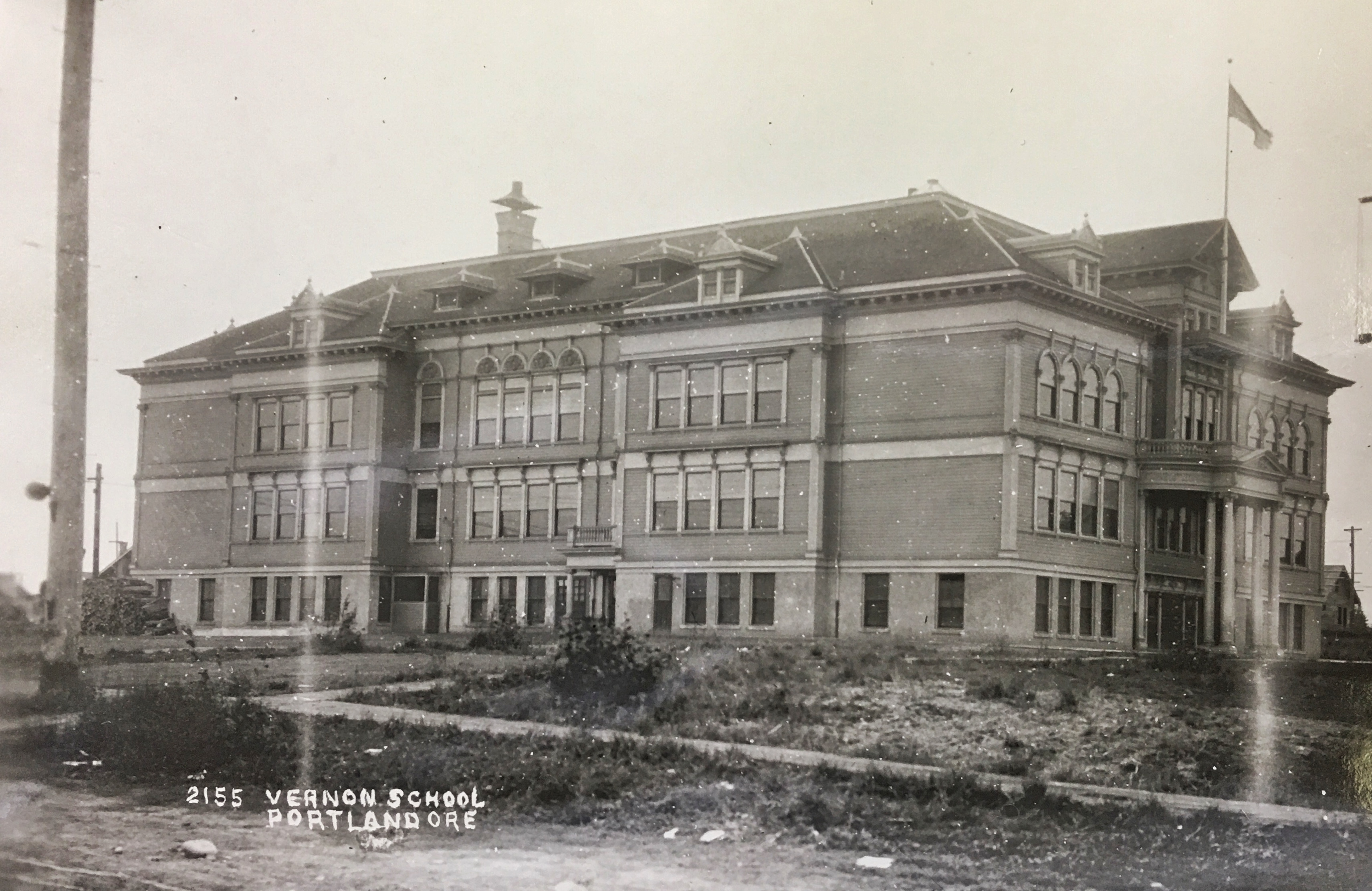
The original Vernon School occupied the entire block from Going to Wygant between NE 22nd and NE 23rd. This view of the school’s south side is looking north-northwest about 1912. The main entrance was on the north side in the center. Photo courtesy of the Oregon Historical Society.

The beautiful ghost of Old Vernon school, which took up the entire block between Wygant, Going, 22nd and 23rd. And the nearby Practice House which literally brought home economics home.

The amazing story of how the city pursued condemnation of property that is today’s Alberta Park.

The neighborhood outcry and organized protest effort in 1958 regarding construction of Fire Station 14 at NE 19th and Killingsworth. Today, we’re glad it’s there, but it wasn’t always that way.

The storefronts of Alberta Street and the tale of the 208 small businesses operating in 1930 between MLK and NE 33rd.

The beautiful little Mildred Hall at NE 23rd and Sumner (formerly the Norwegian Danish Congregational Church).

Lizzie Goldstein and her award-winning dairy of six cows, and the 80 neighbors who supported her when the city wanted to shut her down.

The Alberta Shul and later the Mt. Sinai Community Church.

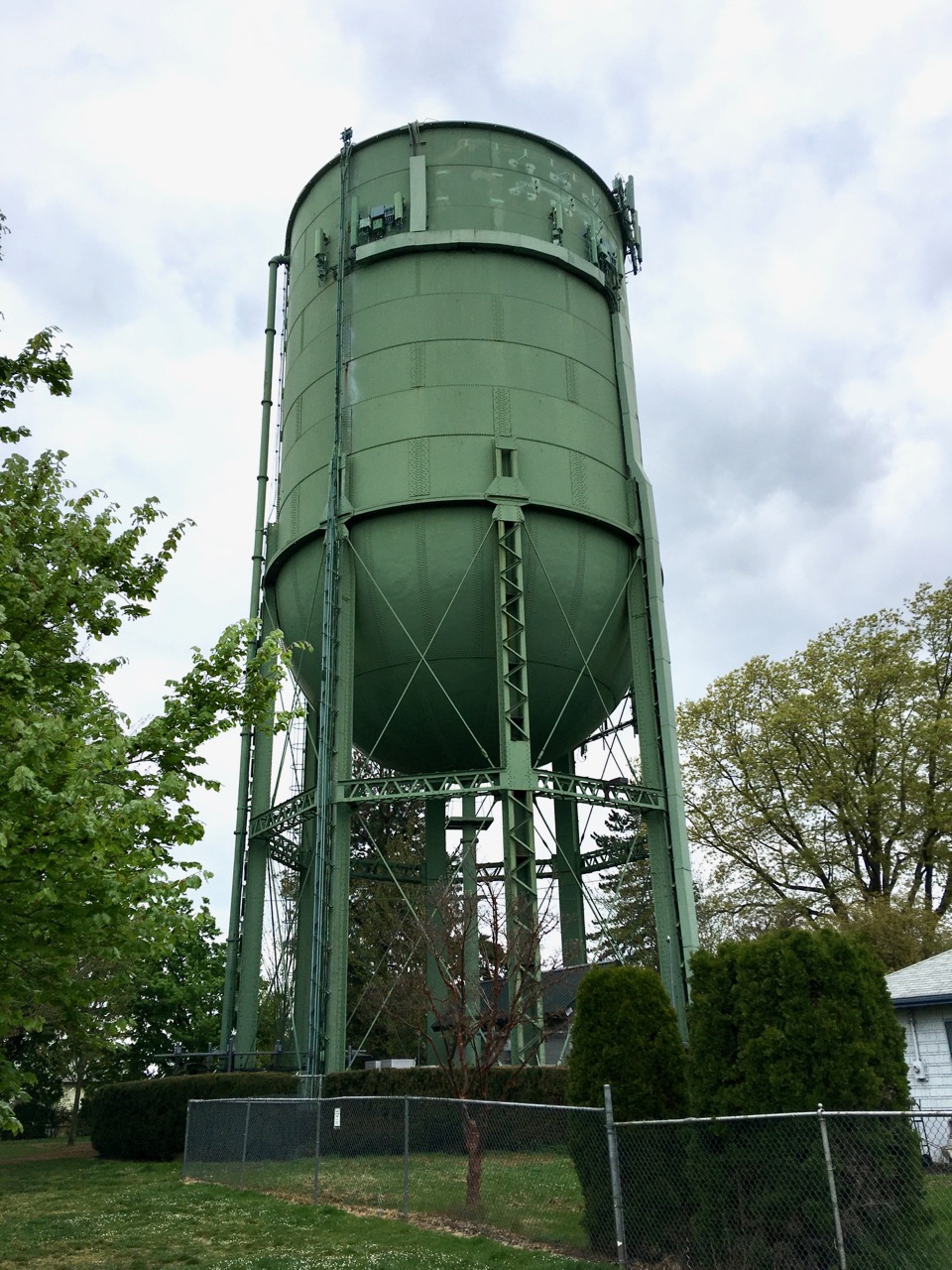
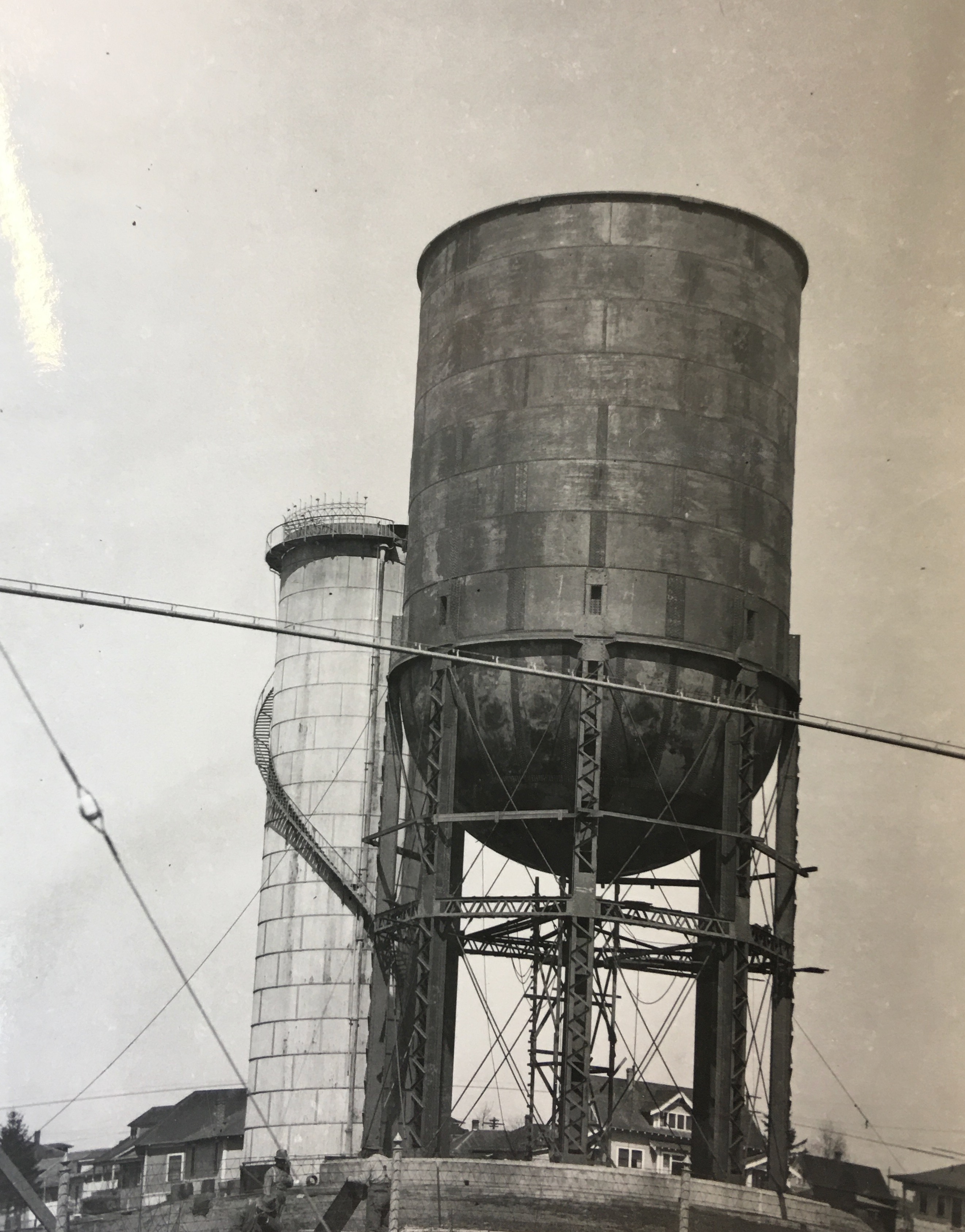
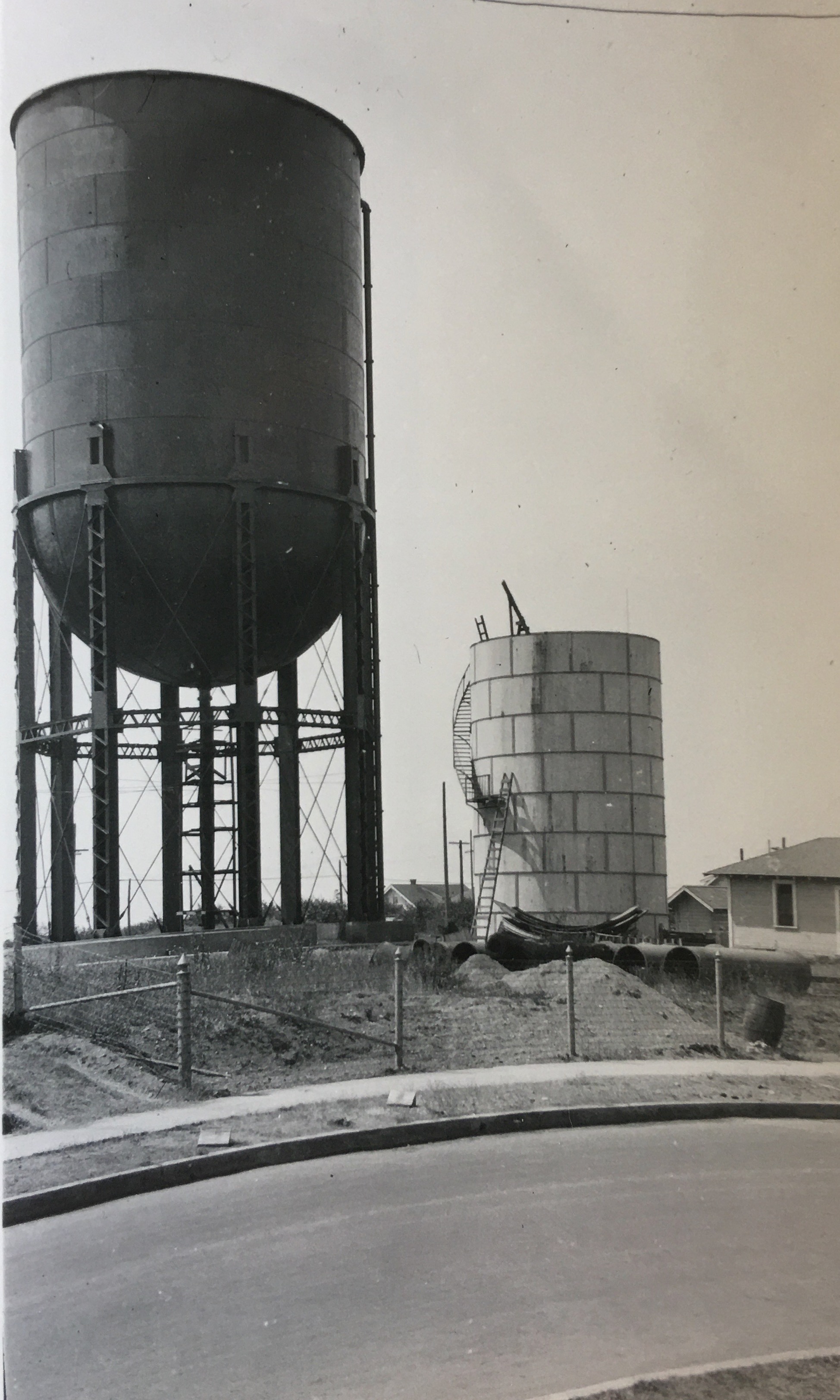
The big green water tanks just south of Prescott.

We also bumped into an anniversary: setting of the cornerstone at the (new) Vernon School, 93 years ago today.

So many stories. Here’s to Vernon!

The Elberta Additon – Not a Typo

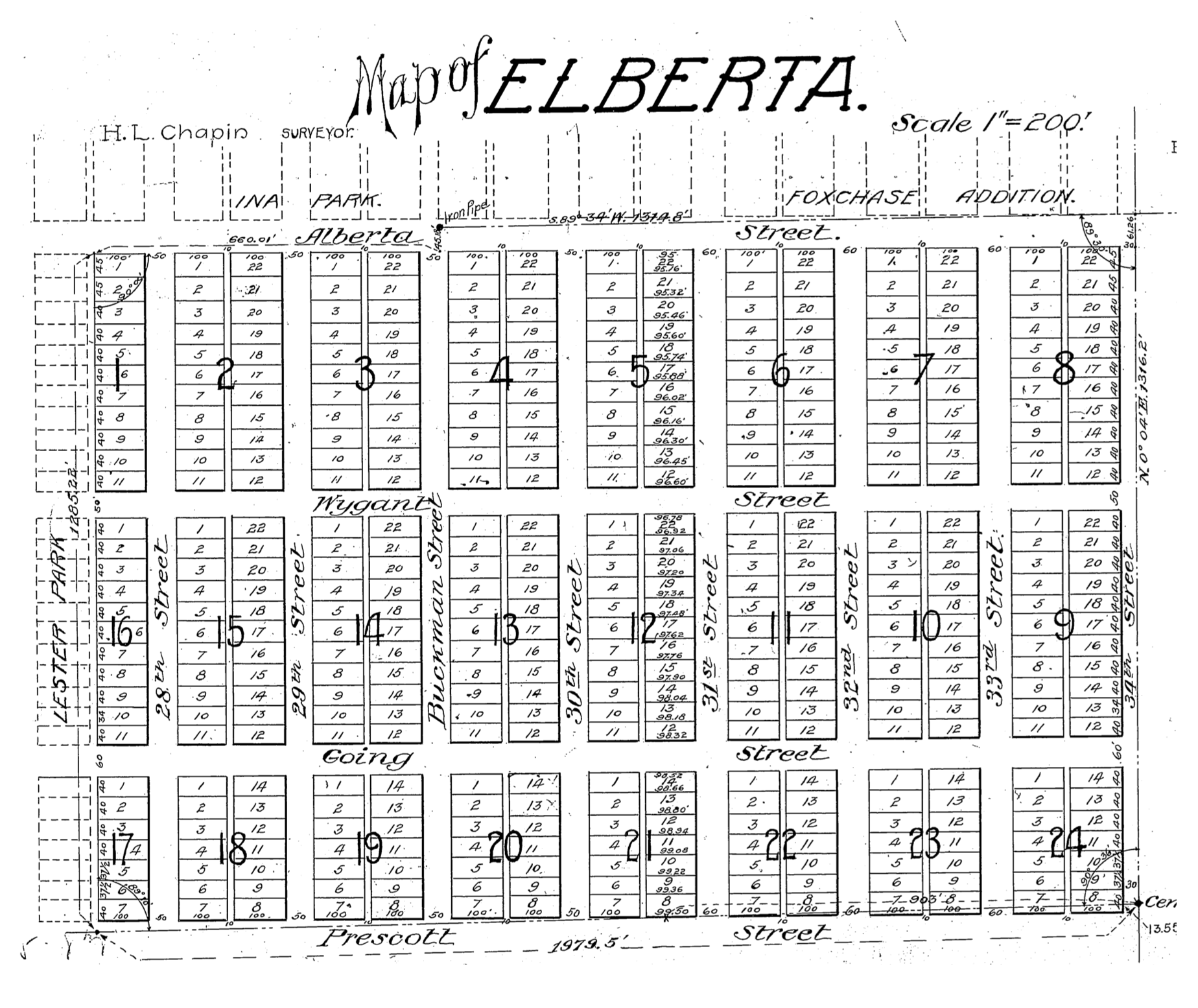
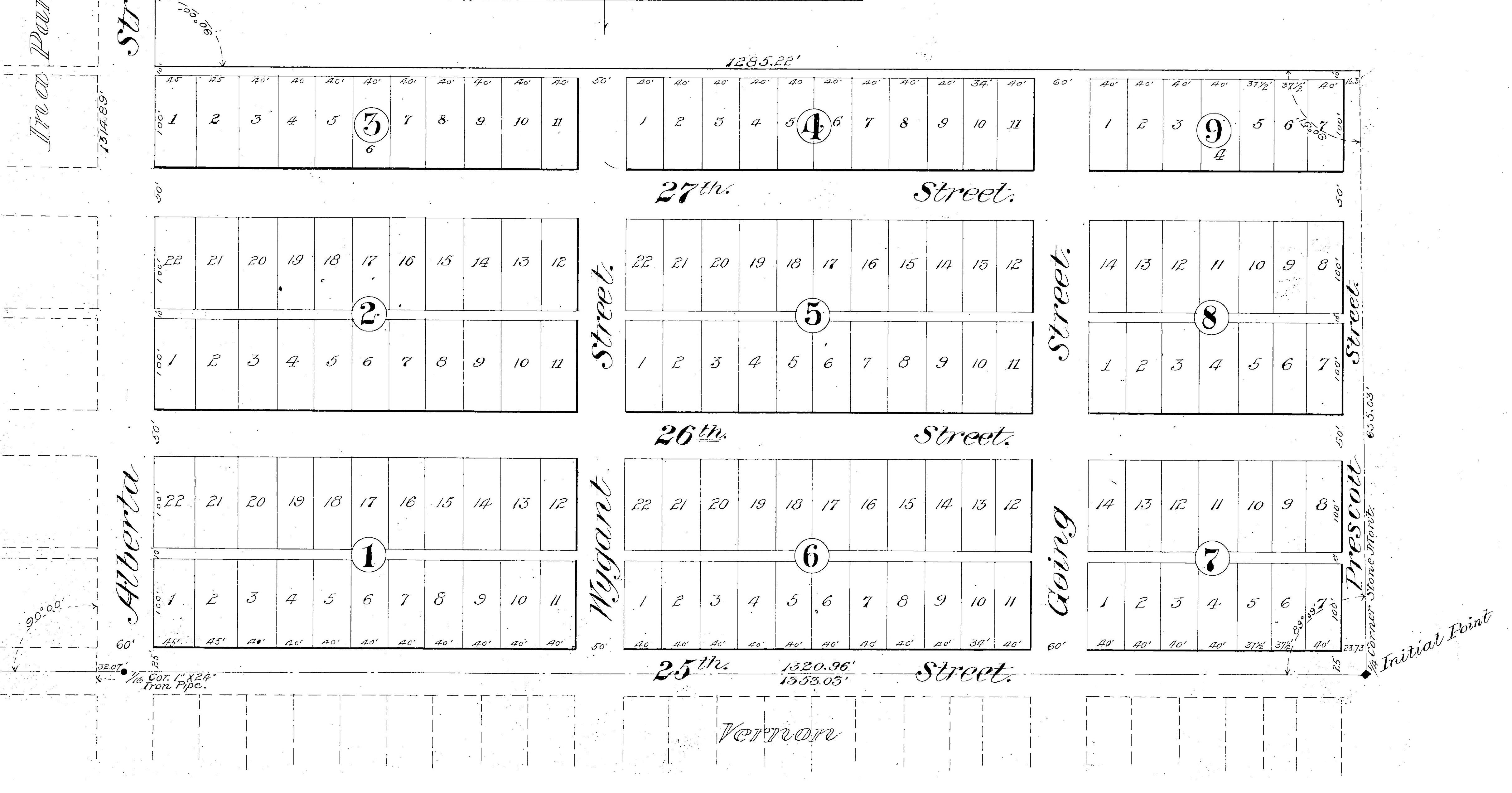
We’ve been looking into the Elberta Addition this week, a 24-block subdivision platted in August 1906 bounded by Northeast 33rd and 28th on the east and west, and by Northeast Alberta and Prescott on the north and south.

It’s a name that has caused some confusion in the past given its proximity to Alberta Street. Readers will recall that name stems from the fourth daughter of Queen Victoria, Princess Louise Caroline Alberta, an honorific street name bestowed in the 1880s. Not to be confused with Elberta.

Elberta was once the most popular variety of peach, named for the wife of the Georgia peach grower who established the hybrid in the 1800s. It’s rich, tart flavor eventually fell out of favor to sweeter varieties, and what had been tens of thousands of acres of peach orchards all across the country were uprooted. Our peach sources tell us that finding an Elberta peach today can be challenging.

This 50-acre subdivision, part of today’s Concordia neighborhood, was once forests, orchards and fields, part of the Buckman Estate and may well have known its own share of Elberta peaches. But when real estate speculation boomed in Portland after the 1905 Lewis and Clark Exposition, properties like this became valuable for conversion to residential use.

Angeline B. Richardson, sister of Isaac Buckman, owned the property (and many other properties on Portland’s eastside) and when she saw the writing on the wall for the rapidly increasing development value, she platted the fields into 479 lots, each 40 x 100, and began selling them off, with the help of her friends Thomas Benton Potter and H.L. Chapin.

From the Oregon Journal, August 5, 1906

Potter and Chapin were the principals of a much larger real estate syndicate that developed rural properties in Kansas City, San Francisco and even on the Oregon Coast: Potter was the driving force behind the ill-fated Bayocean community west of Tillamook that was eventually washed away by the Pacific Ocean. They also initially sold most of the lots in the adjacent Ina Park, Lester Park and Vernon subdivisions here in Northeast Portland.

About 1906, the Potter & Chapin firm changed its name to the Arleta Land Company (which just to keep things interesting, The Oregonian sometimes confused with the Alameda Land Company), named for Thomas Potter’s youngest daughter Arleta. The firm continued to develop and sell properties across Portland’s eastside, including in the Mt. Scott – Arleta neighborhood which it platted in 1903. The Arleta Land Company kept a fairly low profile, unlike other developers who paid for robust advertising campaigns in local newspapers. Arleta Land Company’s presence was almost entirely focused on classified advertising where business was brisk in 1906-1908 with news of properties being bought and resold, and homes built.

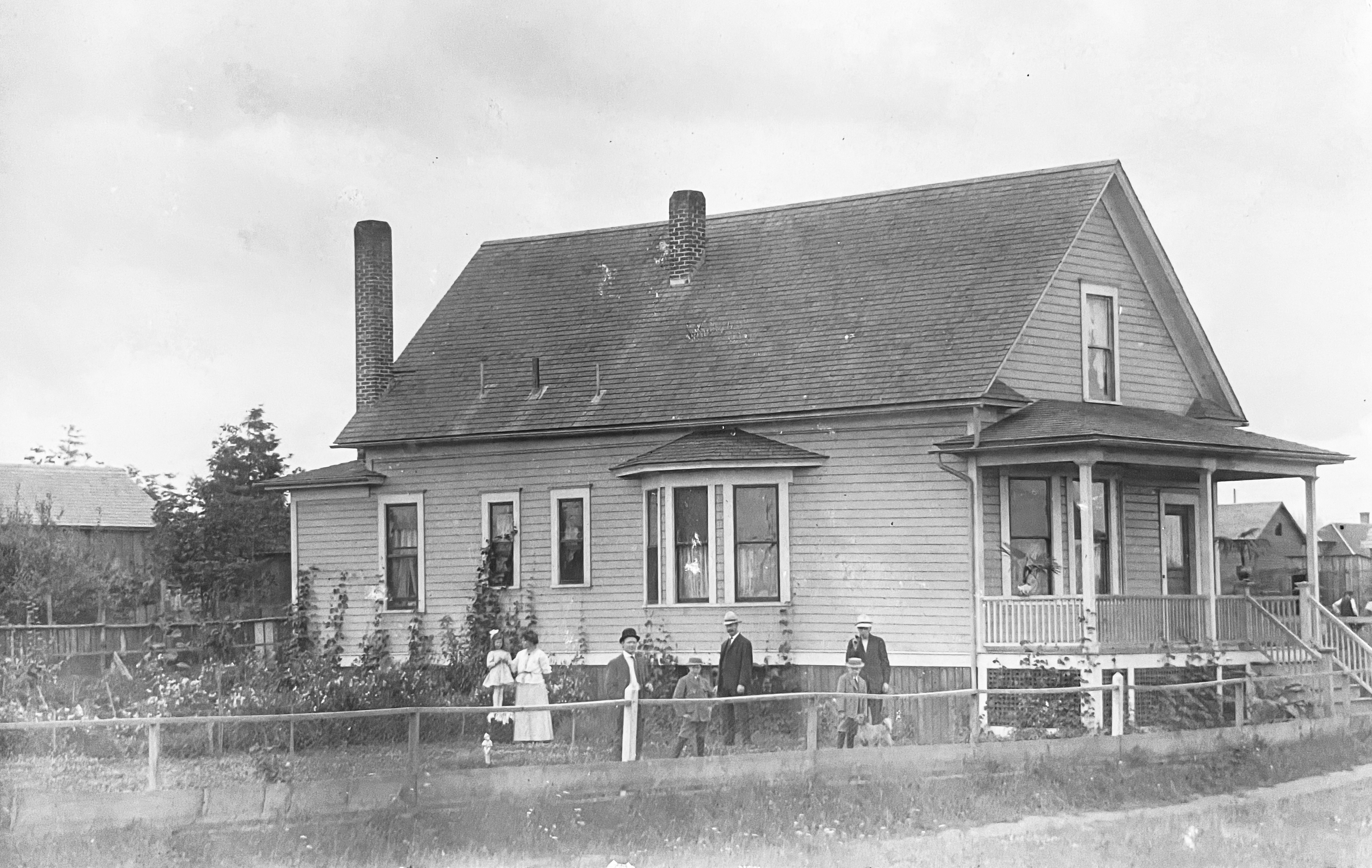
In other research, we’ve come across an interesting photo of the young Elberta Addition, showing the former home of the Hans C.S. and Minnie von Homeyer family, located at the southwest corner of NE 27th and Going. Click into this photo for a good look, it’s a beauty.

Southwest corner of NE 27th and Going, known as 850 Going Street prior to the Great Renumbering. Courtesy von Homeyer Collection

Today a 1910 Victorian-style home known as the “Going Queen” is on that property. But back in 1907, the von Homeyers bought the two lots from the Arleta Land Company for $350 and built this house. Unfortunately for them, fire destroyed their home on July 28, 1907. This rich photo has many stories to tell, and reminds us of the rural nature of the area.

Today, Elberta is a great place for a walk to appreciate residential design and construction from the first decade of the 20th Century. We’ve enjoyed exploring Elberta in this post about its alleys, which are like a built-in trail system for many of us dog-walkers. And in this bit of photo sleuthing.

One More for the Vernon Tank

The reality, of course, is that research is never really done. That’s what makes it fun. Sometimes after you think you’ve found enough to be able to understand a thing, you come across another nugget that adds perspective.

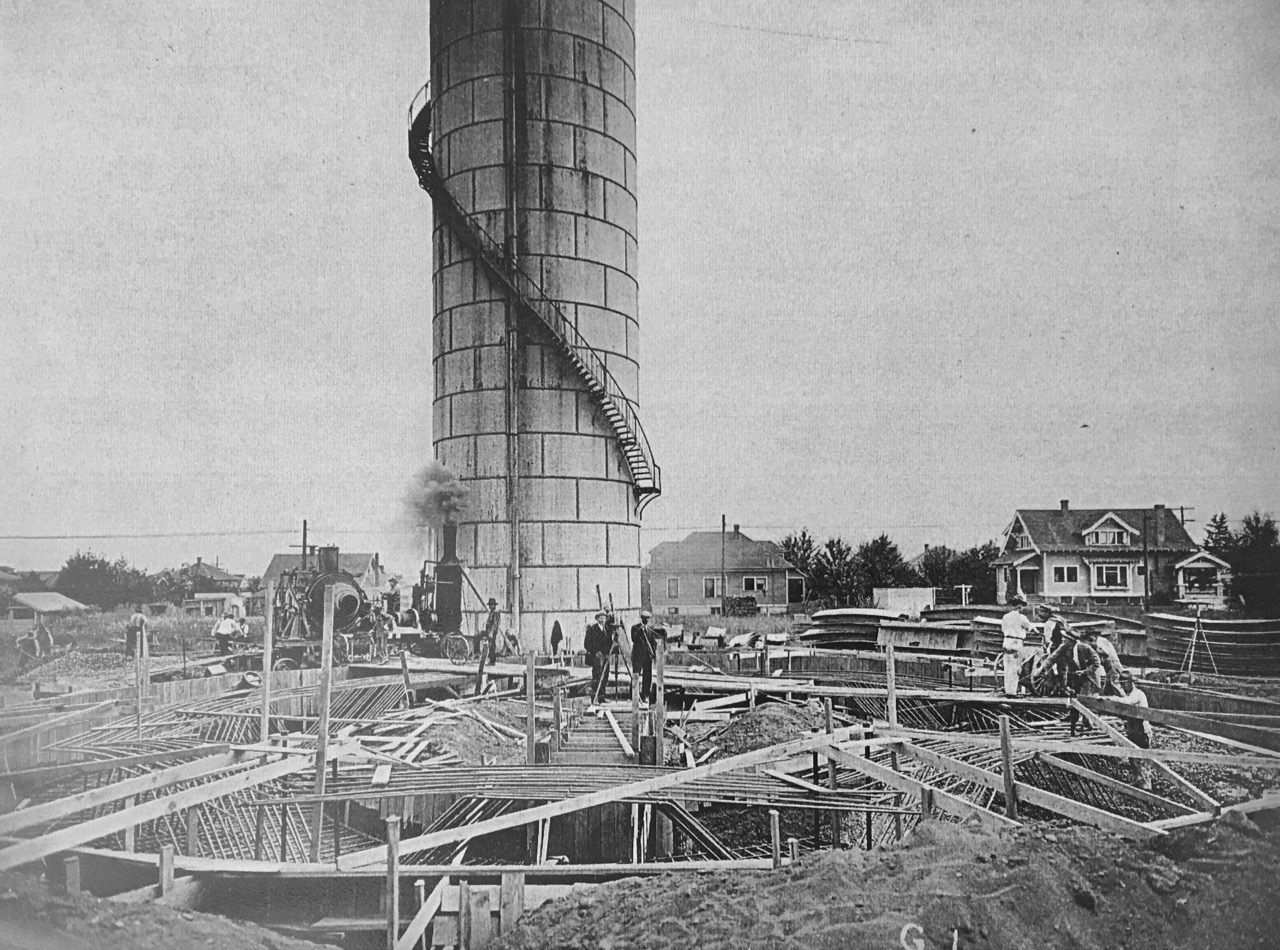
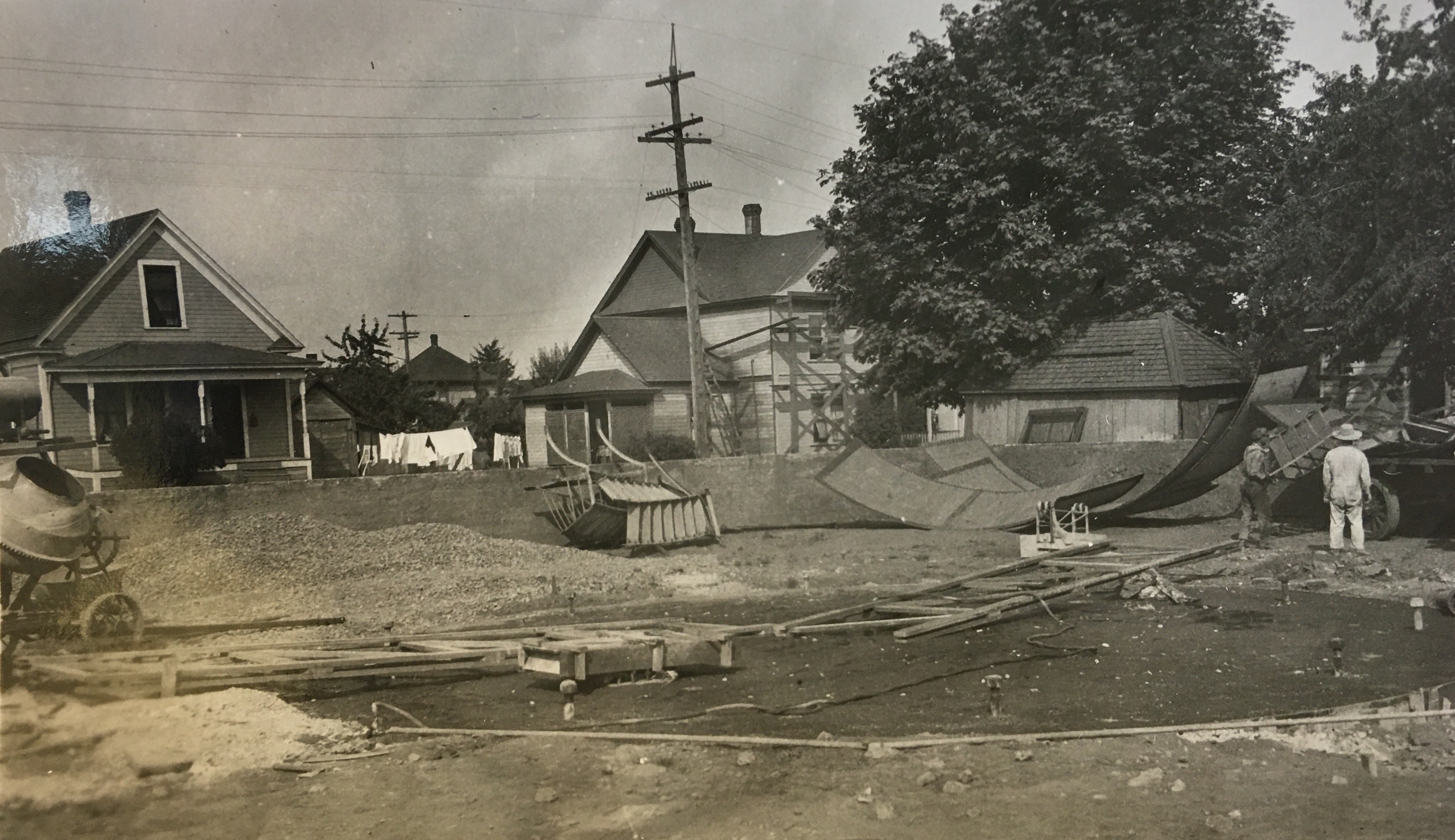
Such is the case today: It’s a photo from the summer of 1920 showing construction of the concrete base for the one-million gallon Vernon tank that replaced the old standpipe, which is looming over the whole scene at NE 19th and Prescott. Have a good look:

Courtesy of City of Portland Archives, A2008-009

This was undoubtedly a big day on the job:

  • The concrete forms for the new tower foundation have been intricately prepared;
  • The engineers are there in their coats and ties with their instrument and tripod to keep everything on the level and in the right place;
  • The steam donkey is belching dark smoke, meaning it’s working hard to turn the mixer;
  • The men on the far left are shoveling from a pile of rock into the mixer to make the concrete;
  • The men with the two-wheeled wheelbarrows (called Jersey buckets) are wheeling the fresh concrete across the plank ramps as the pour begins;
  • Sections of the new tank are carefully stacked in readiness at the edge of the site;

This view looks north; the houses in the center and on the right are still there on the north side of Prescott. If you know these neighbors, pass along this photo…they might enjoy seeing their houses 100 years ago.

Vernon Tanks: Water arrives, but more storage capacity needed

We’ve been thinking these days about the history of the big green giants that anchor the block at NE 19th and Prescott. In our last post we learned about the “Vernon Standpipe” as it was called, and the challenge in the 19-teens of keeping it filled with enough water to supply the neighborhood that grew up around it. That is, until this tank came along almost exactly 100 years ago.

The senior of the two tanks at NE 19th and Prescott, constructed in the fall and winter of 1920-1921 for $100,000 by the Chicago Bridge and Iron Company, holding 1 million gallons. Photographed April 21, 2020.


In our first installment, we left our expectant City Commissioners at the corner of NE 57th and Fremont with a shovel in their hands ready to dig a 14,280-foot long trench for a big new pipeline that would push more water from the Mt. Tabor reservoirs into our thirsty neighborhoods.

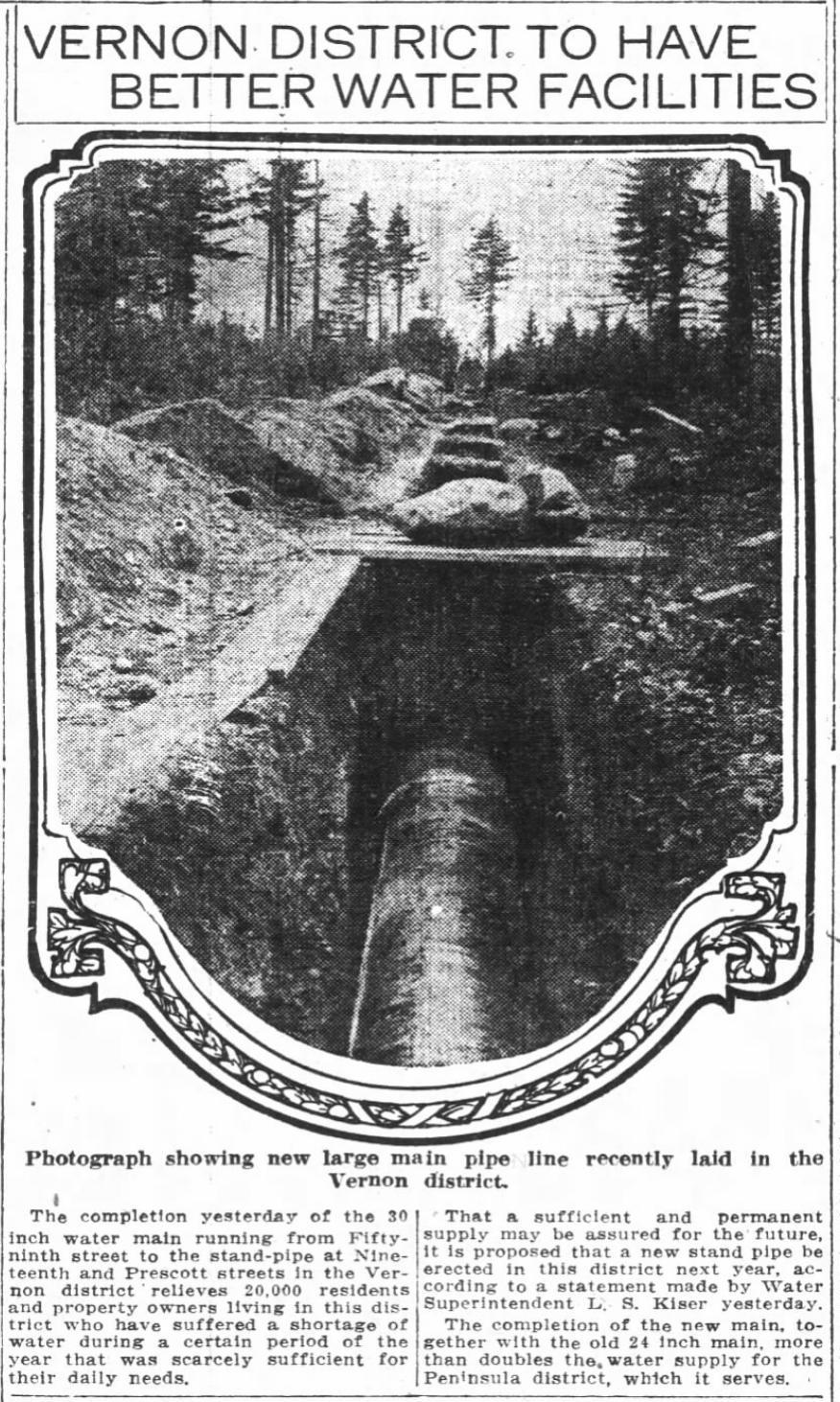
From The Daily Oregon Journal, August 8, 1915. This wooded street scene is likely somewhere along NE Skidmore before the residential neighborhood we know today had taken shape.


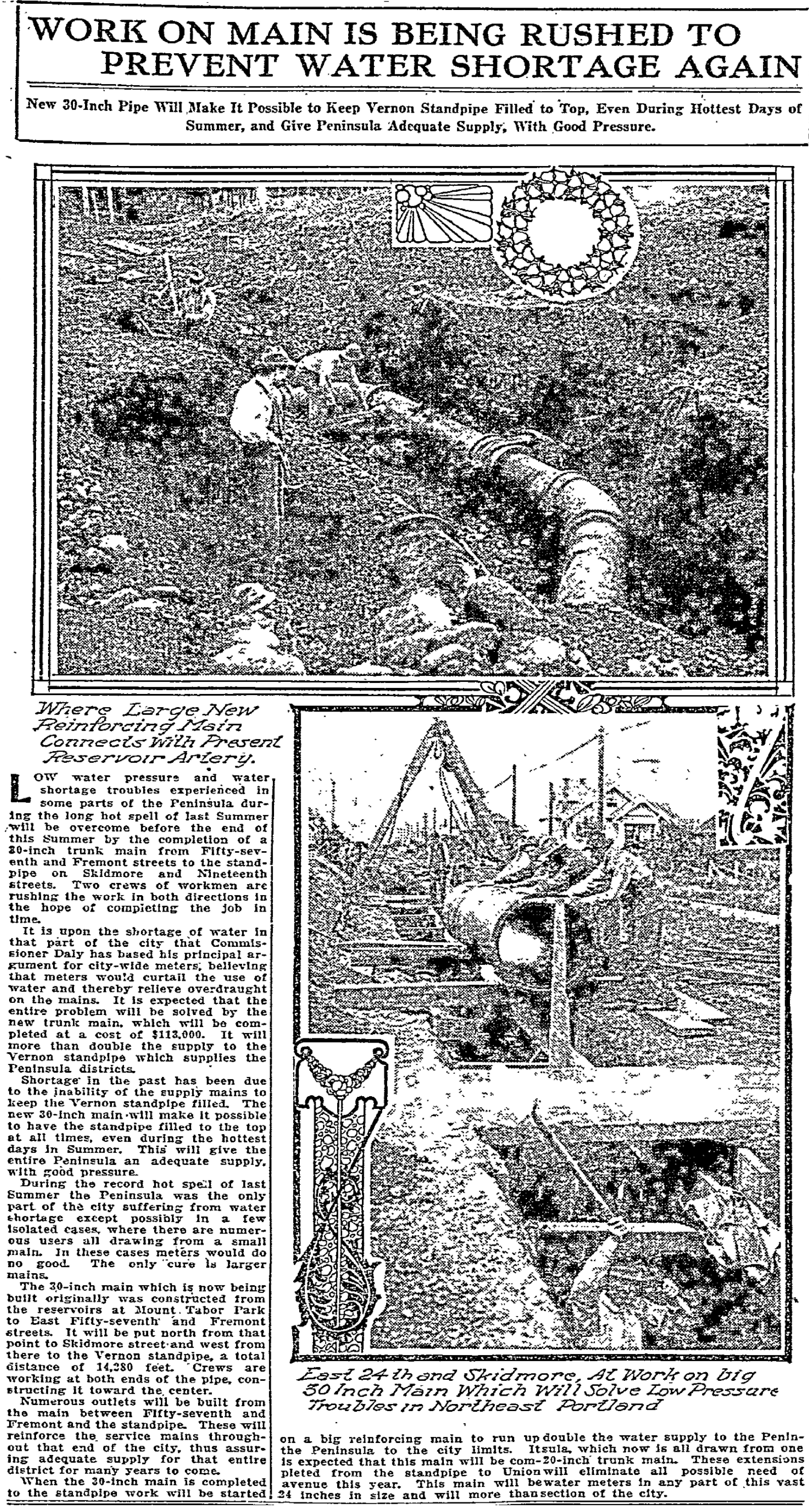
The pipeline dig began on April 16, 1915 powered by 59 unemployed men hired from the city’s standing civil service list. By May, workers at both ends of the project were working toward each other. Promises had been made to alleviate the water shortage by summer, so momentum was important and the newspapers took note.

From The Oregonian, May 16, 1915. Interesting to note that the picture in the lower right shows the intersection of NE 24th and Skidmore, the spot where this water main broke in March 2019 flooding homes and local businesses.


By July 1915, crews had met in the middle and the golden spike moment seemed close at hand:

From The Oregonian, July 20, 1915.

These were the headlines everyone wanted to see and even though the big pipeline job was done, Water Board engineers knew volume and supply were only part of the equation. The hand-me-down Vernon Standpipe just didn’t have sufficient storage capacity to keep up with the growing need here and on the Peninsula. But the new main bought time for more thinking and engineering.

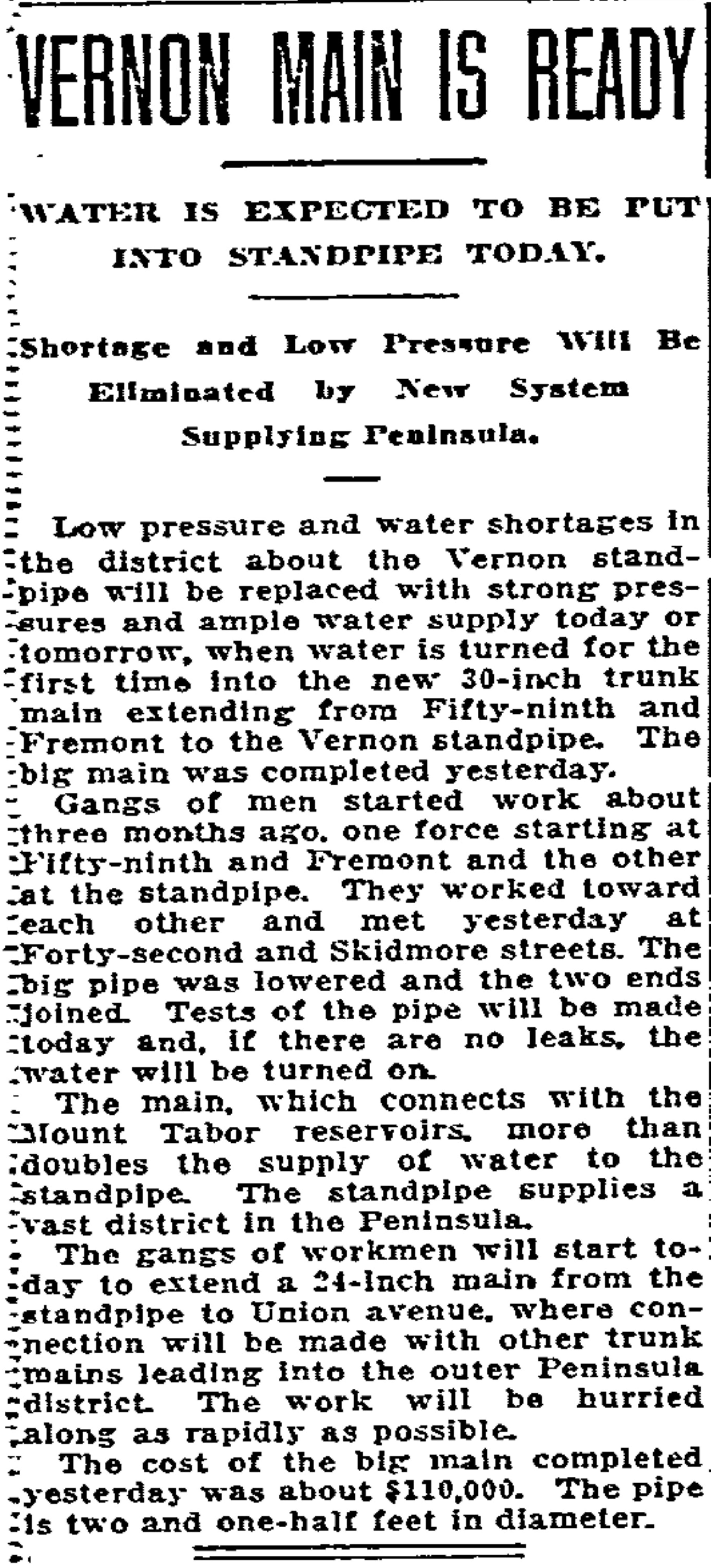
Water officials must have been relieved that the most pressing problem over the next few years seemed to be finding someone to paint the 100-foot-tall, 25-foot-diameter Vernon Standpipe, expressed in this September 19, 1917 headline: LOFTY PAINTING JOB GOES BEGGING. No bidders, so the standpipe’s bare panels became its trademark.

By August 1920, the city announced plans for construction of a new 1 million gallon storage tank for the site that would replace the 350,000 gallon Vernon Standpipe. And fortunately for us, a city photographer documented the progress, which went like this (double click into any of these for a closer look…there’s lots to see):

By late summer 1920, workers were busy on the plumbing for the new tank and establishing a concrete foundation that would support the tower and the million-gallon tank above. The water alone weighed 8.3 million pounds. This view is looking north from the tank site; the houses are on the north side of Prescott.


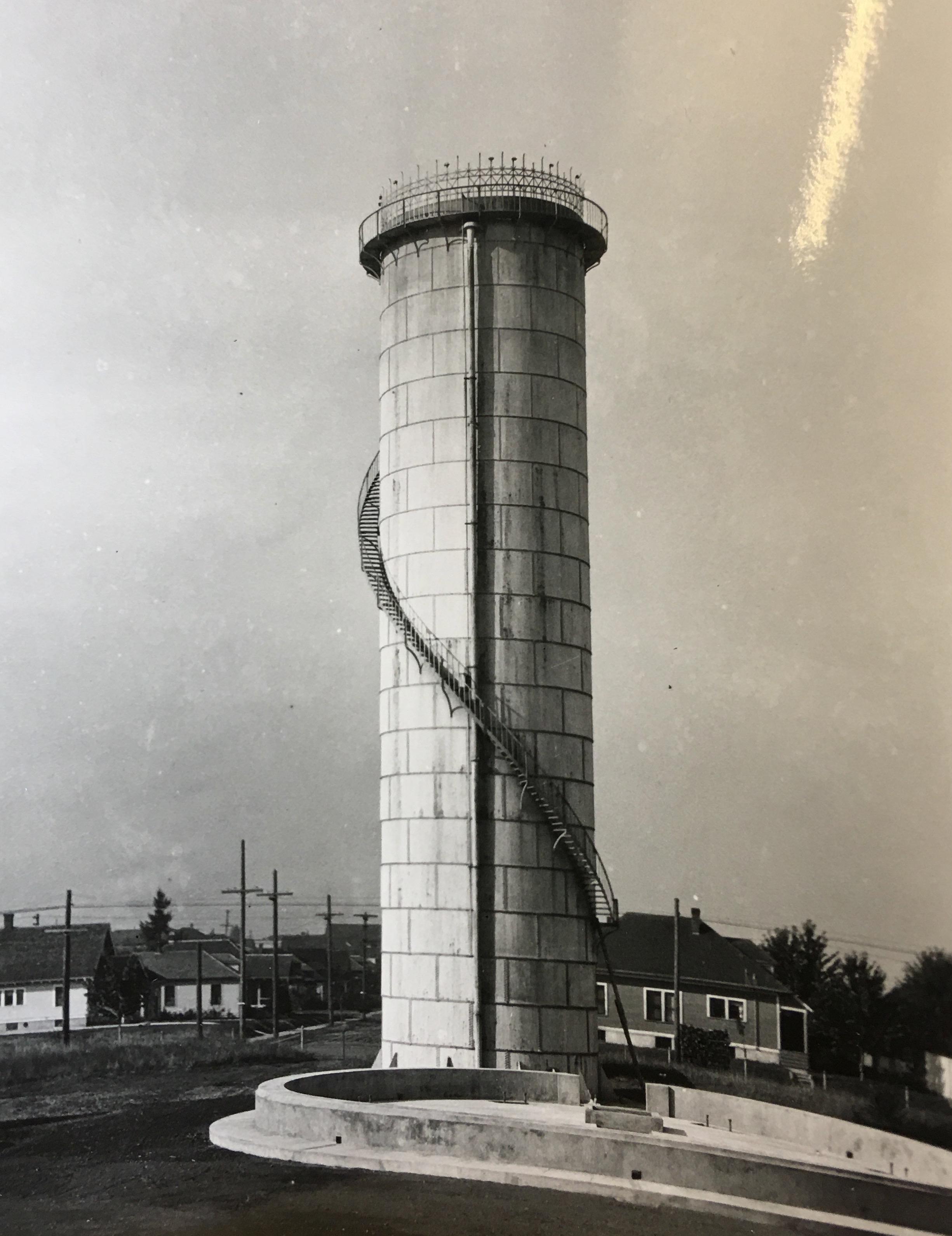
By the fall of 1920, the round base had been poured (foreground) and was ready for tower construction. This view is looking north showing the standpipe behind (nice stairway and railing, eh?), and the T intersection of NE 19th and Prescott.


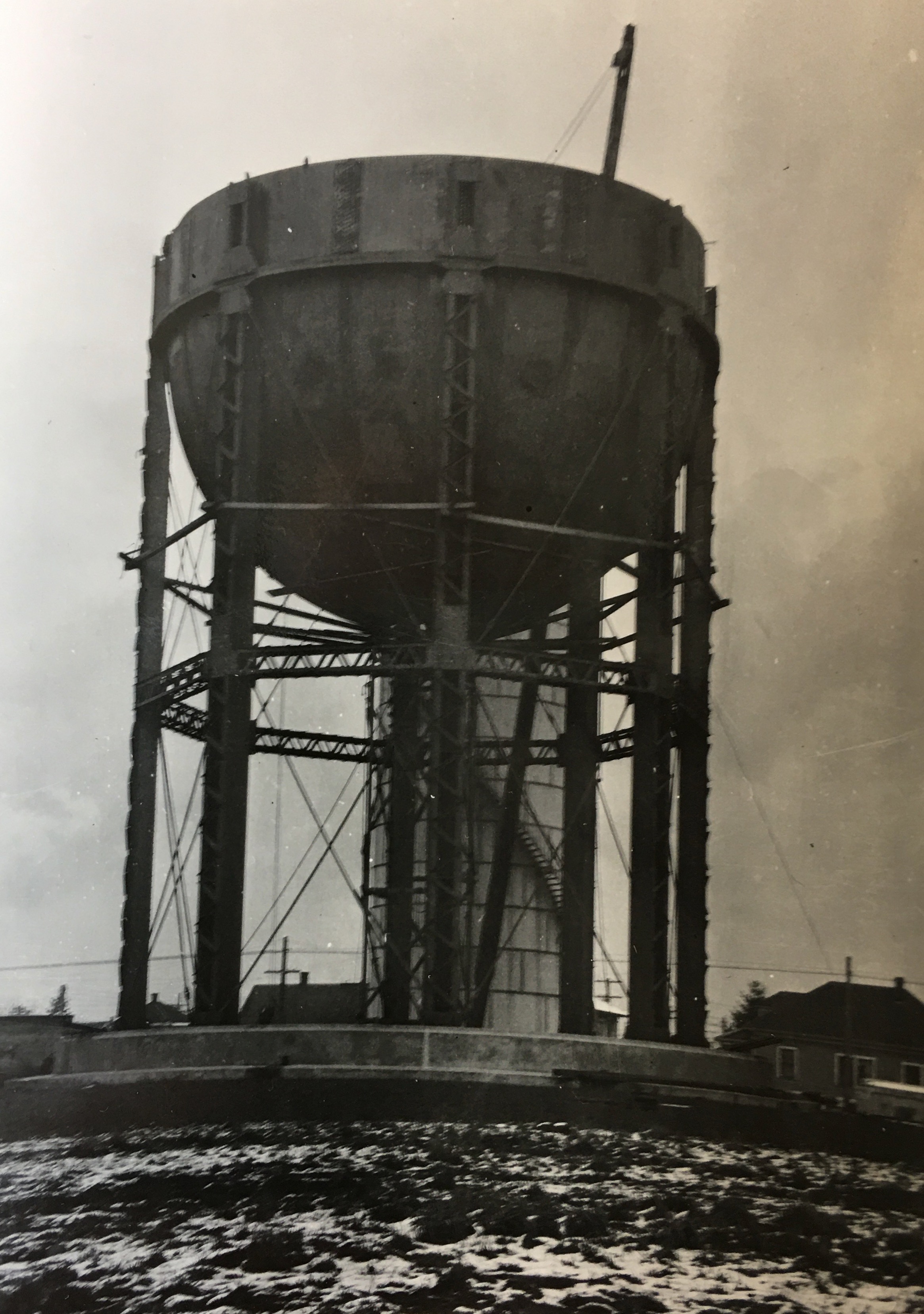
By late 1920 or early 1921 the new tower and tank are taking shape. This view looks north with the standpipe behind and snow on the ground.


In this view looking north in early summer of 1921, workers are in their shirtsleeves and the tank is done.


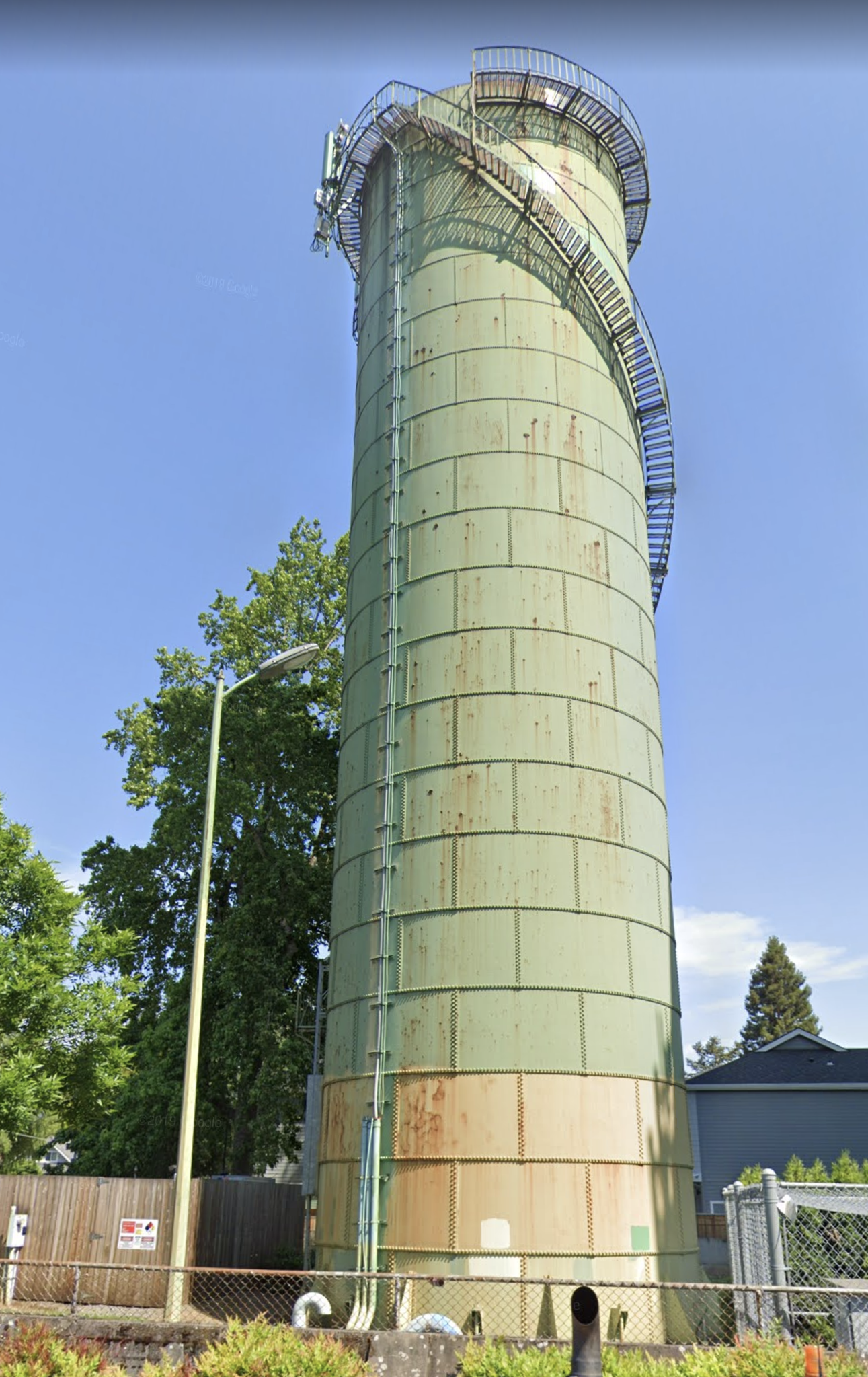
In August 1921 the city paid Portland-based Le Doux and Le Doux Construction $10,477 to dismantle the former Vernon Standpipe (underway in this photo) now that the new tank was in place, and to relocate the pipe to a new venue in St. Johns at the corner of N. Princeton Street and N. Oswego  Avenue, where it stands to this day (below), still in service at more than 120 years old:


Next up: The 1920 tank is eventually dwarfed by the biggest tank in the nation.

Gravel pits dotted the neighborhoods

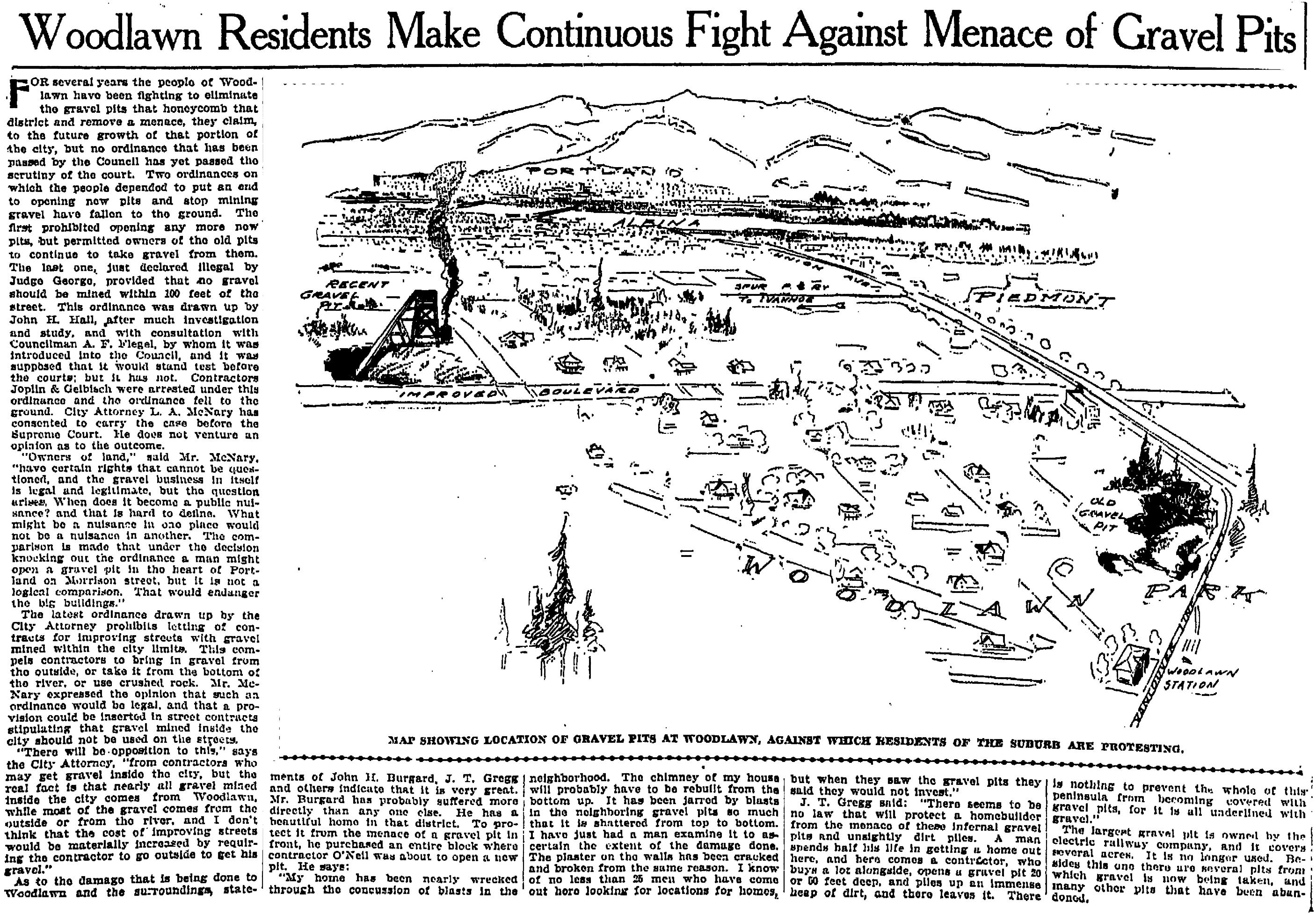
Since we seem to be on the subject of gravel pits and how neighbors feel about them, we thought this article from April 9, 1905 would be topical, and might even make some readers want to go for a walk with this 114-year-old sketch in hand to look for clues. Click into the story and you’ll find an interesting review of the city’s ordinances related to gravel; insight that most gravel mined from within the city limits came from Woodlawn; and what it felt like to live near a pit.

From The Oregonian, April 9, 1905. Click to enlarge.

Because the two primary sources quoted in the article describe impacts to their homes, it’s helpful to know that John H. Burgard lived at 833 NE Ainsworth (he went on to become the influential chair of the Commission on Public Docks); and J.T. Gregg lived a few blocks north at 6547 NE 8th Avenue.

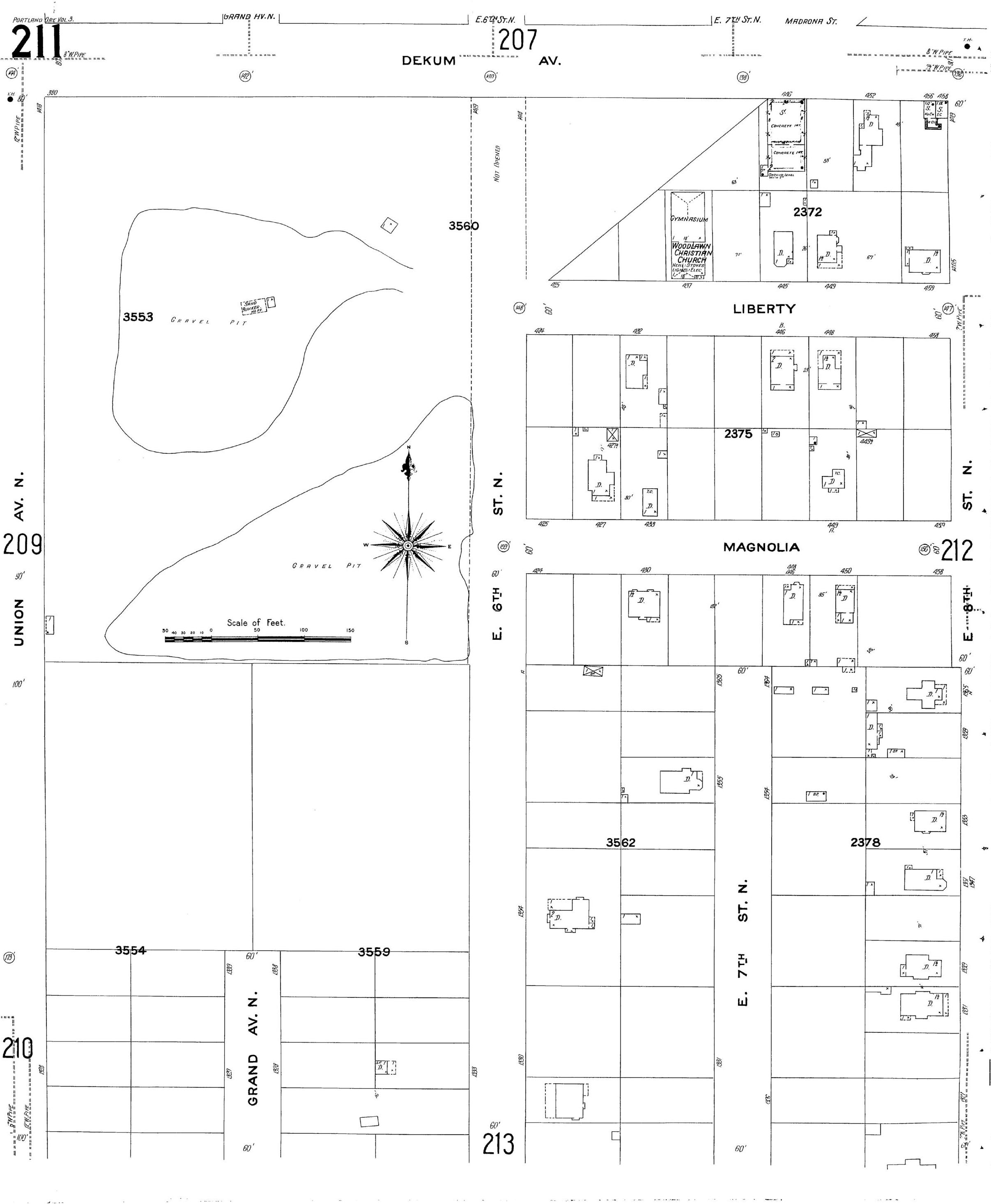
Subsequent news stories reported the big pit—the one labeled “recent gravel pit” in the 1905 sketch and shown next to a conveyor belt and smoke plume (issuing from what looks to us like a steam donkey) on the left side of the sketch—was located between NE Martin Luther King Jr. Boulevard and NE 8th Avenue, south of Dekum and north of Ainsworth.

Here’s a look at the Sanborn Fire Insurance map of the area from 1908-1909. Magnolia on that map is today’s Rosa Parks Way. Another deep gravel pit existed about two blocks south of the big pit, just off this plate.

Sanborn Fire Insurance Map, Plate 211, 1908-1909

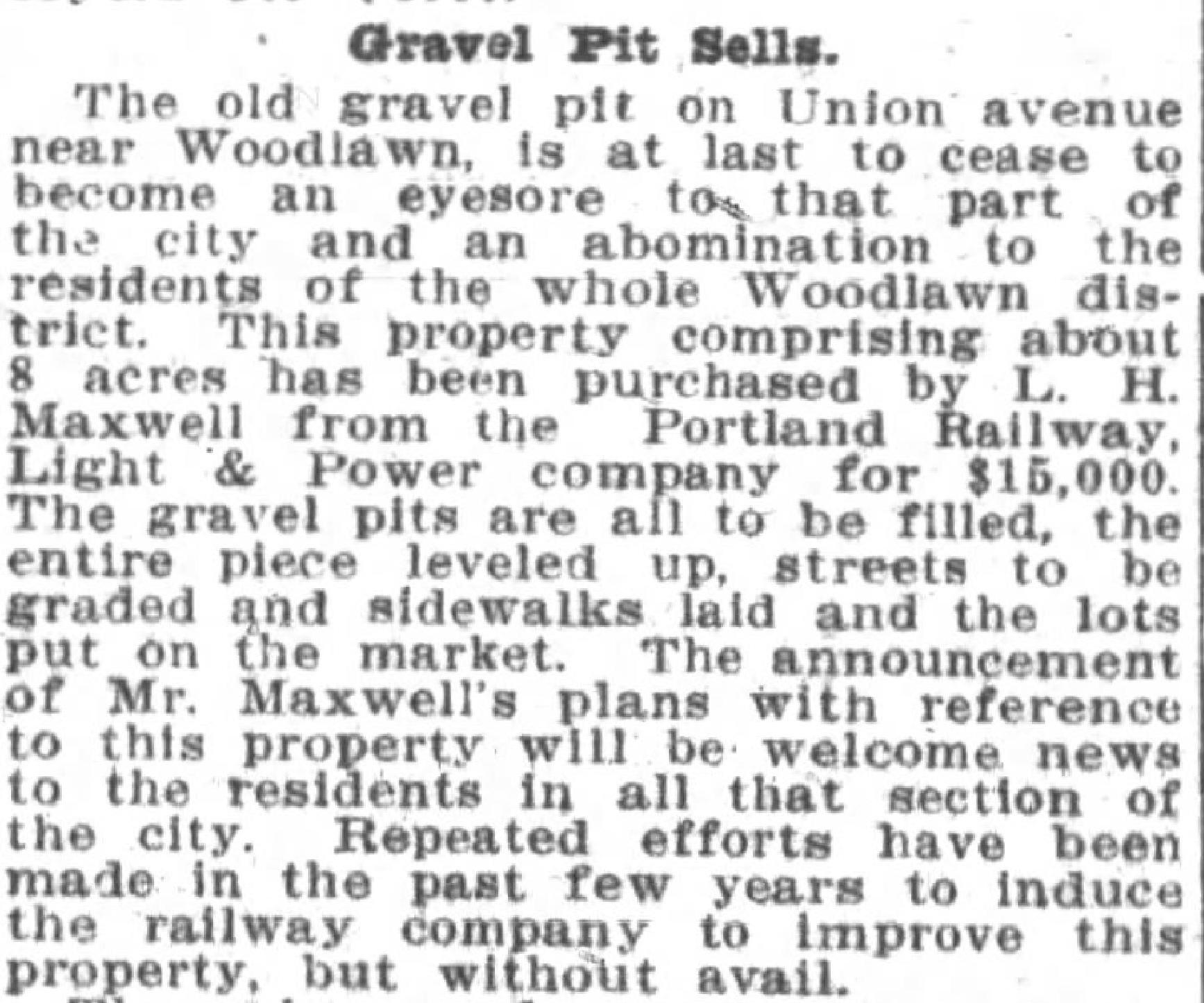
Fortunately for Woodlawn residents, the heated-up real estate market meant the property would be more valuable as a neighborhood than a gravel pit. In 1908, the pit area was sold to real estate developers W.C. North and L.H. Maxwell who proceeded with fill operations. The land was level by 1912.

From The Oregon Journal, January 17, 1909

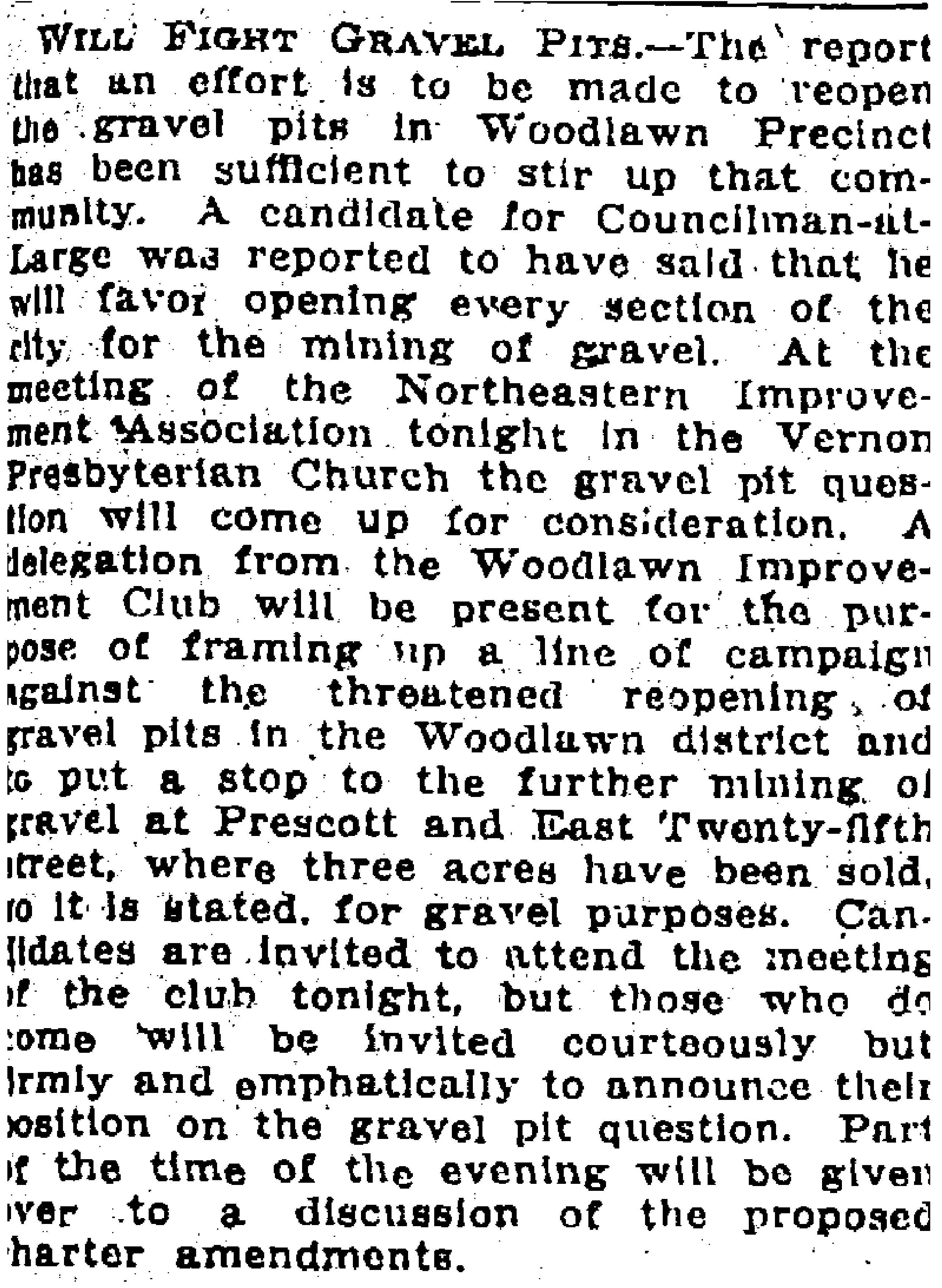
Like their Woodlawn neighbors, Vernon residents were also on the defense when it came to gravel pits. Two years later, they were pressing city council candidates for their views about the troublesome three-acre gravel pit that used to be near the corner of NE 25th and Prescott.

From The Oregonian, April 30, 1907

One message from this new awareness about big holes in the relatively flat neighborhoods we know today is that there used to be a lot more topography out here. Check out the post we did a few years back about the big natural gulches that once marked the east side. Like Alameda’s own Fremont Sanitary Landfill, a lot of these gullies were filled with garbage, construction debris and worse.

Makes you appreciate the lay of the land we know today, and wonder what’s below the surface.

Mothers Against Alberta Pool Halls

During our recent research adventures on Alberta Street, we bumped into some stories about the perceived corrupting influence of pool halls, and the advocacy of local mothers. We were wandering around in newspapers from the 19-teens as we sought insights about Ford’s Pool Hall at NE 17th and Alberta. As it turns out, there were several pool halls along with all the other businesses on Alberta and local mothers were not happy about it.

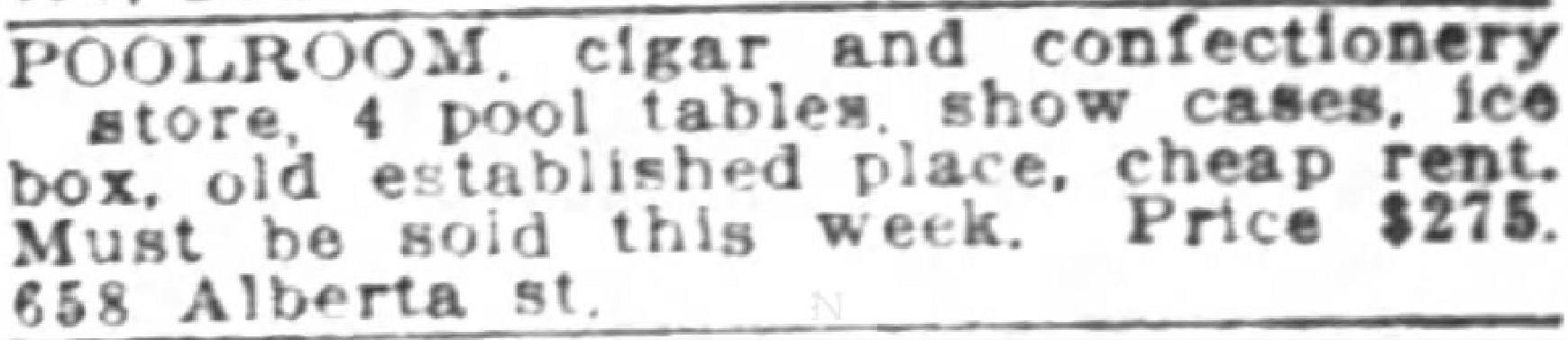
We know the Fords got out of the pool hall business entirely in 1917. Maybe they saw the writing on the wall.

Classified ad from the Oregon Journal, June 28, 1917. George and Sylvia Ford were selling their pool hall business.


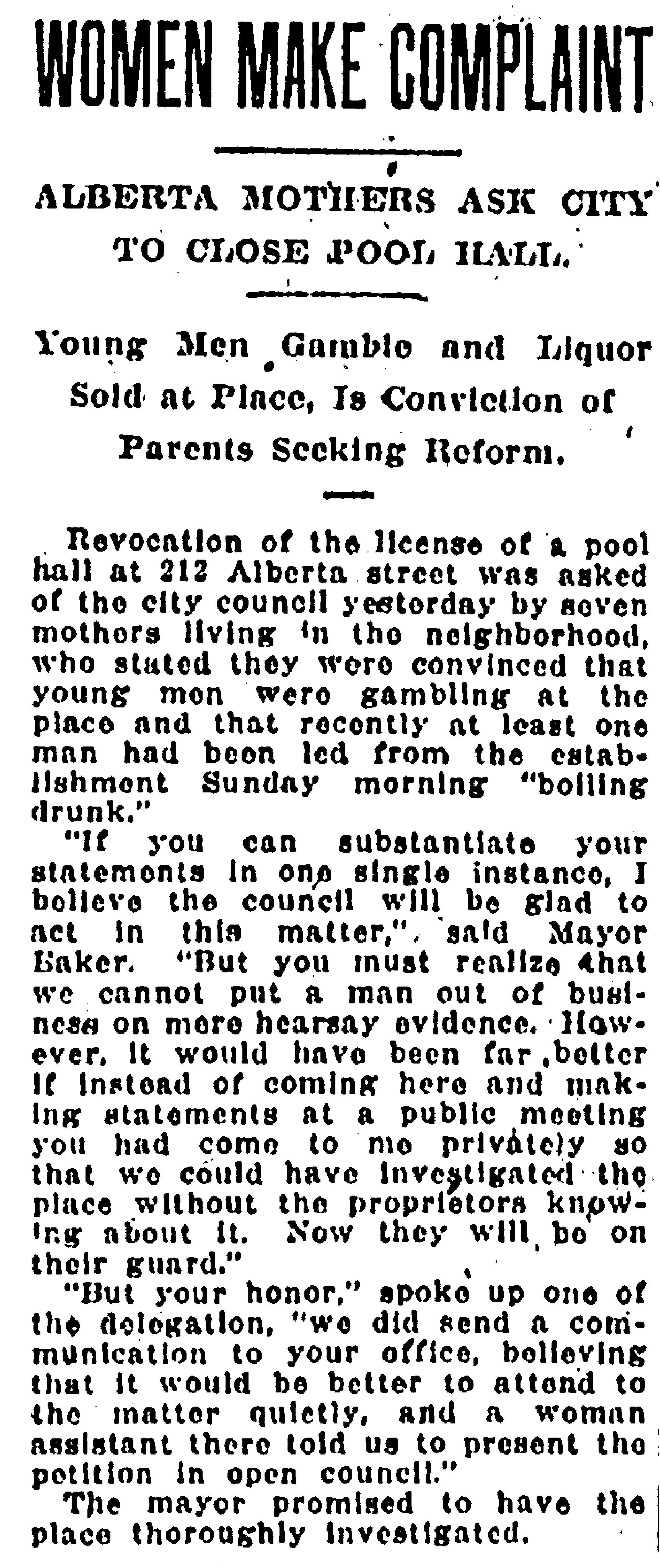
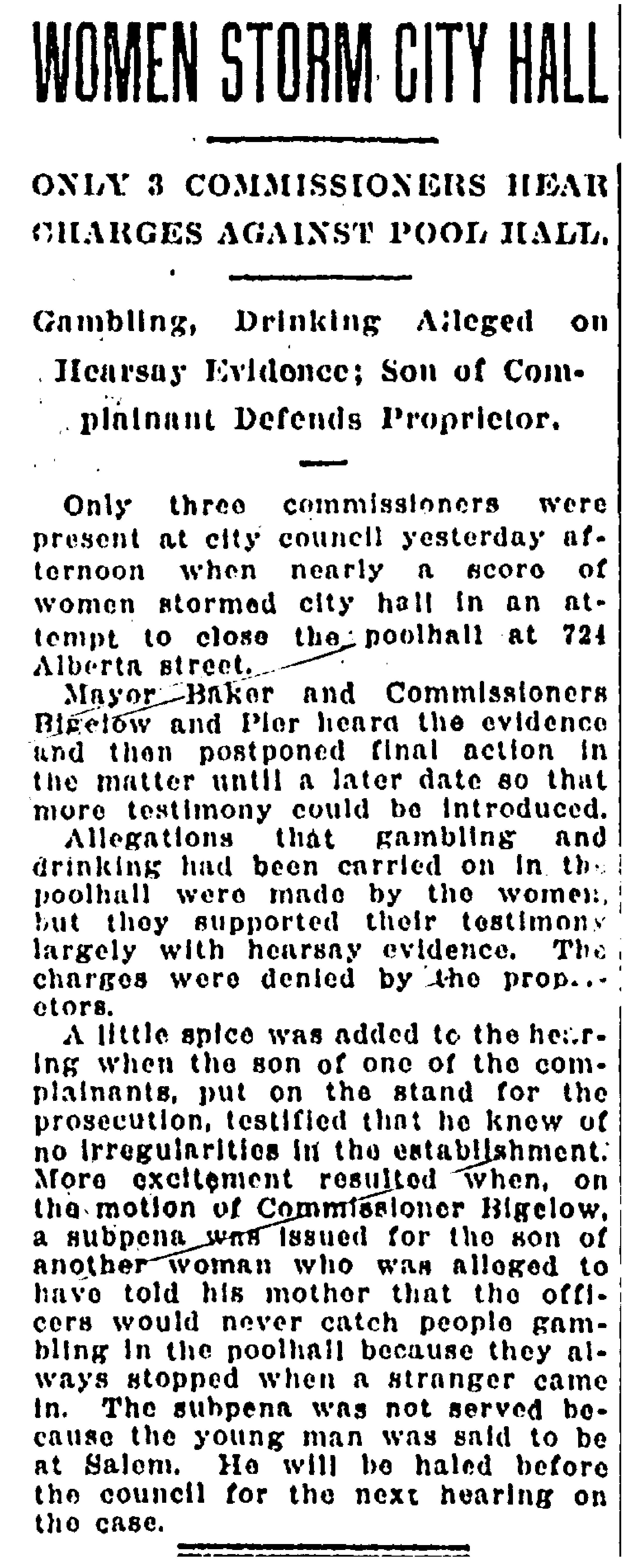
By the early 1920s, mothers of the Alberta area were concerned and brought their protests to City Hall.

From The Oregonian, January 27, 1921. The building at 212 Alberta has been demolished.


From The Oregonian, February 12, 1921. This pool hall was in located at 2038 NE Alberta, the building now occupied by Little Big Burger. Think about that the next time you drop by for a chèvre burger and fries…

Reading these two news stories, it’s hard to know what is most striking, the patronizing nature of the officials toward the obviously concerned mothers making the complaint, the admirable boldness of the women bringing their concerns directly into City Hall, or the notion that spending time in a pool hall would lead to the corruption of youth.


The Disappearance of Vernon Avenue

During our recent explorations of Vernon, we came across a street with a story to tell:

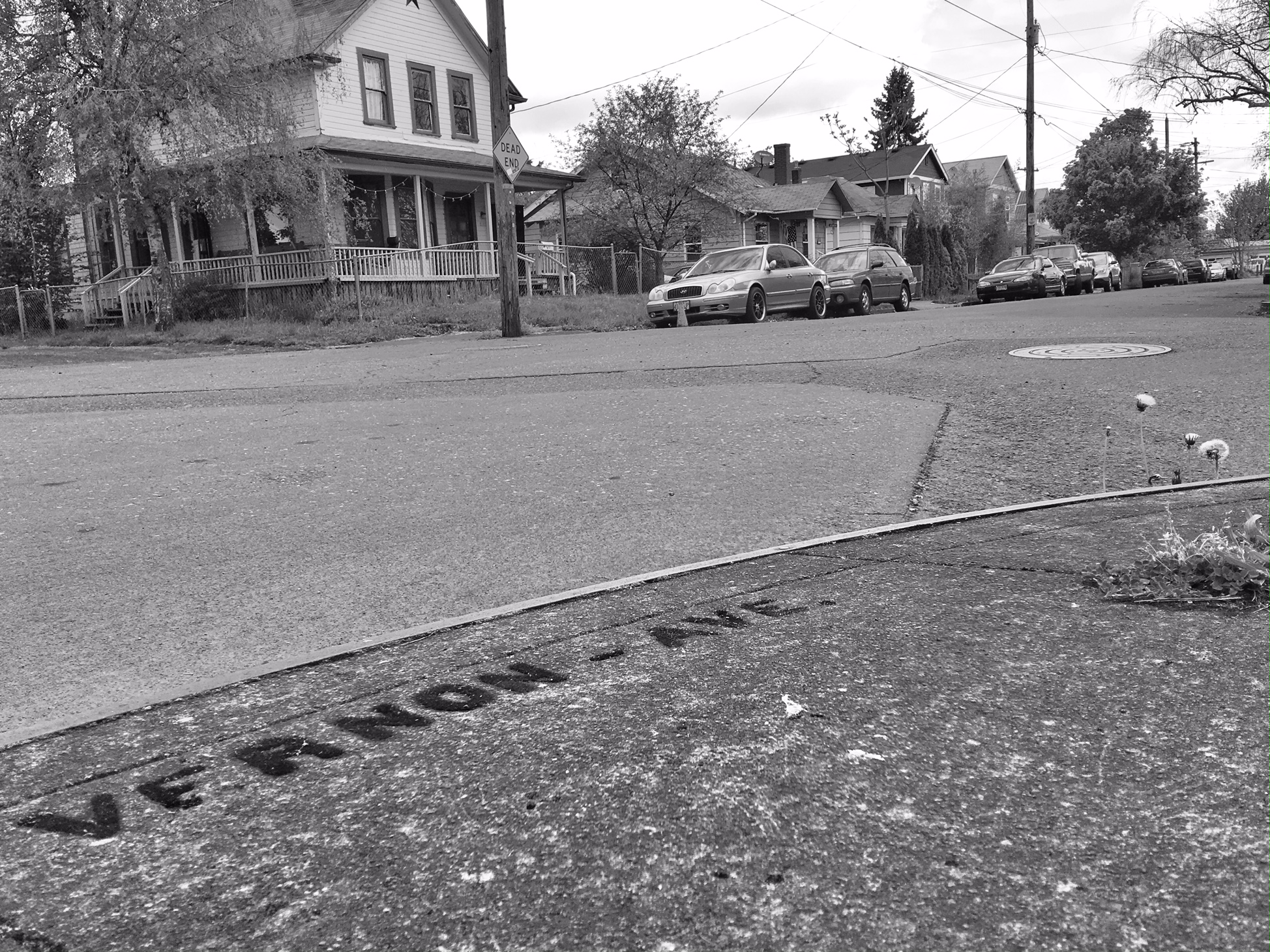
Wait, what? There’s an actual Vernon Avenue? Photographed April 2018, looking northwest at Emerson Street.

We’ve tripped over this place in early editions of The Oregonian—references to builders, families, homes and interesting things happening over on Vernon Avenue—but it’s a ghost that no longer exists in the real world.

Vernon Avenue sounds like a street that you should know where it is, especially since we have a whole neighborhood named Vernon. But it’s just an echo because the actual Vernon Avenue was silenced on September 2, 1931 when City Council passed ordinance 61325 readdressing all of Portland’s streets and calling for multiple street name changes. The six-block Vernon Avenue went extinct and became today’s NE 14th Place, running between Prescott and Killingsworth.

We know the renumbering aspect of the 1931 ordinance was long-overdue. But losing the name of your street, that one really stung.

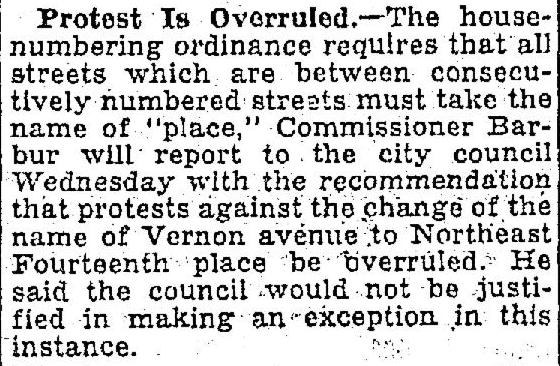
In January 1933, neighbors along Vernon Avenue, angry about the change and still using their original addresses, presented a petition to City Council protesting the switch to 14th Place. Commissioner of Public Works Asbury L. Barbur reviewed the protest, but was not moved:

The Oregonian, February 26, 1933. Several other neighborhood streets were renamed by the ordinance, including Glenn (now NE 32nd Place) and Marguerite (now NE 35th Place).

We haven’t yet come across anything on the record about how neighbors responded. Eventually the passage of time dulled the loss as Vernon Avenue families grew old, grew up and moved on—but it’s worth noting that articles in The Oregonian well into the 1940s referred to addresses on Vernon Avenue when reporting births, marriages, deaths and social occasions.

Vernon Then and Now

While the pace and scale of change can often take your breath away (for good and not so good), it’s surprising how some aspects of our neighborhood landscape are recognizable from a distance of more than 100 years.

We’re preparing a program for Wednesday night, April 18th about Vernon neighborhood history—come on along if you like, 7:00 p.m. at the Leaven Community Center, 5431 NE 20th Avenue—so we’ve been out recently scouting around. Vernon is the neighborhood loosely bounded on the north and south between NE Ainsworth and NE Wygant, and the west and east from NE 11th to NE 21st. Walkabouts for us usually begin with finding a handful of old photos, reference points or things to look for and then sleuthing around the neighborhood looking for the right vantage point. Here’s a couple examples.

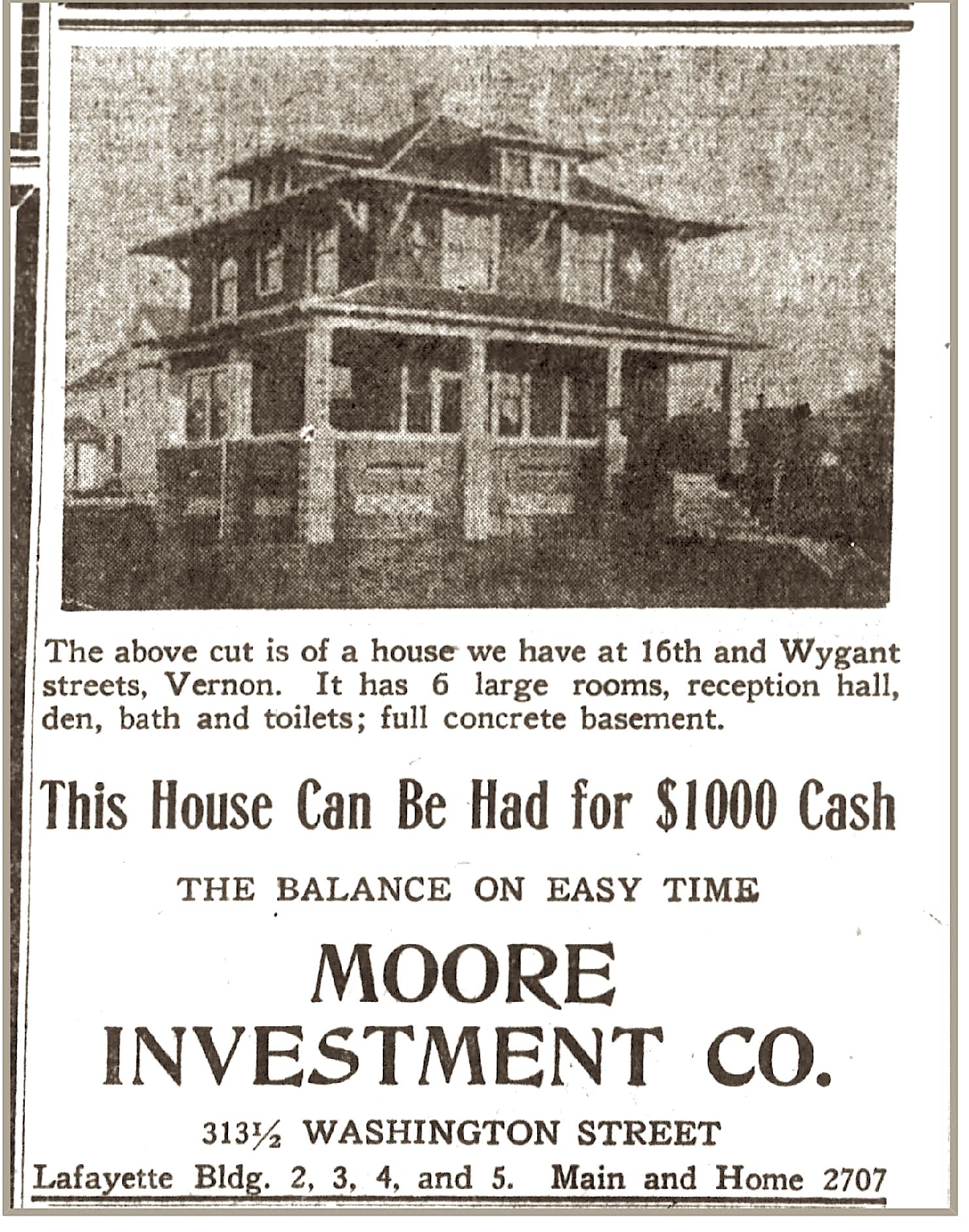
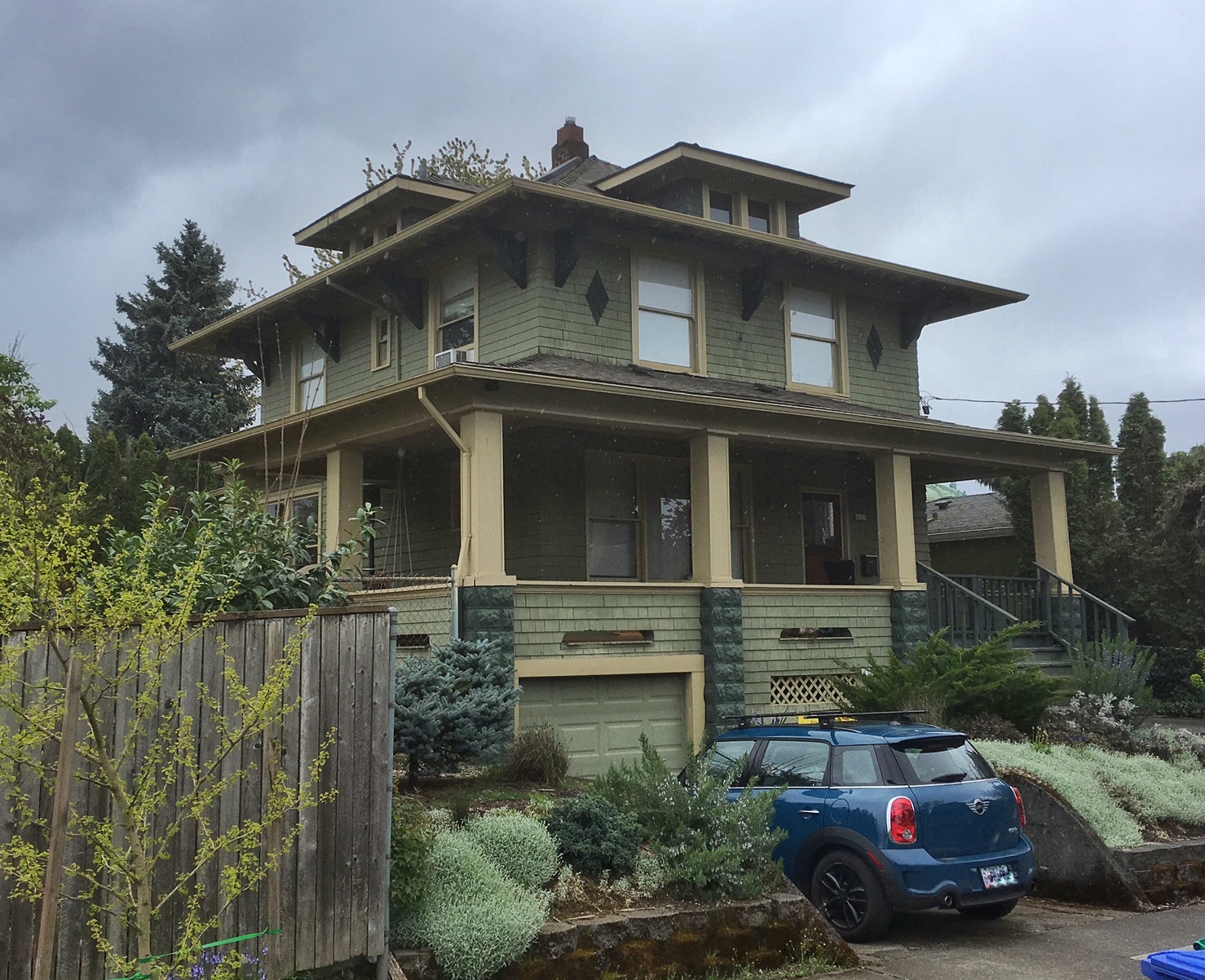
We love this old newspaper advertisement placed in the Oregon Journal on October 25, 1908 by developers of the Vernon addition. Imagine: $1,000. The house was built in 1907 for O.G. Goldberg.

Here’s the Goldberg House today:


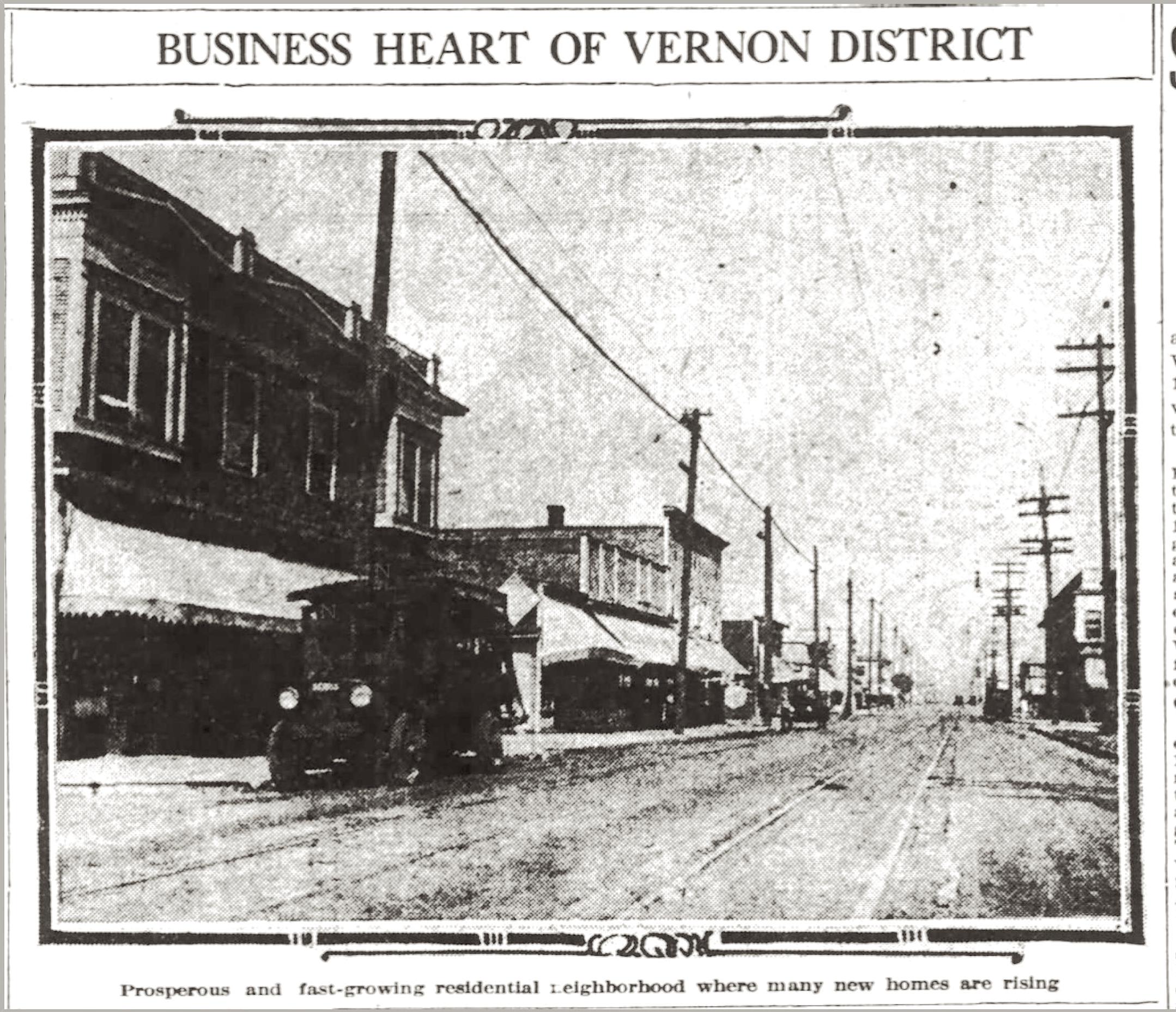
And here’s another great pair, just a few blocks north, this time looking at the heart of the Vernon business district, from the Oregon Journal on October 30, 1920. Check out the streetcar tracks and overhead lines.

And today:

Looking east on Alberta at NE 16th Avenue, April 2018. The distinctive building on the northeast corner (left) was built in 1909 during the rise of the Vernon-Alberta business district.

Some of our favorite stories are from Vernon: the ghost of Old Vernon and its practice houses, the Alberta Streetcar, the mystery of Crane Street, Alberta storefronts, Alberta Park, opposition to (and even arson at) the new local fire station. So many stories to tell, including an upcoming post that shares the intriguing real estate drama about how Vernon almost didn’t become Vernon. Stay tuned.


Long live the ghost of Crane Street

Regular readers will remember our recent post about the mystery of Crane Street, that interesting short and narrow road that disappears weirdly into a fence along the eastern curb line of NE 21st Avenue, and then re-emerges briefly in vestigial pieces a few blocks east on NE 24th. It’s a fascinating story of dueling subdivision plats, activist neighbors and the redrawing of maps.

Recently, we heard from neighbors along the street who knew something interesting must have happened, but weren’t quite sure what. Here’s a note from Joel Schipper on NE 24th:

We were thrilled to see your story on Crane Street — that’s our driveway/curb in the two pictures in the blog.  We’ve seen the writing in the concrete before, and in the four years we’ve lived in this house, we’ve discovered the remaining bit of Crane street over between 19th and 21st.  But we never knew the whole story — so thank you!

As a bit of ‘extra info,’ when we moved in, we found that this driveway shared with our neighbor, was essentially useless in that neither of could drive an SUV, sedan, or truck up it without scraping on the bottom, unless we essentially went up at a 45 degree ‘sideways’ angle.  So the ‘newish’ looking concrete in the picture is our collaborative hiring of a contractor to re-contour the driveway — after how many years?  Since 1924, which would be soon after this portion of Crane Street disappeared?  Both of us then had to rebuild our side walls — ours is pictured, and we hope this Spring to cover it from the bottom up with a climbing ‘native’ plant (Yarrow?), and with a spilling native — Kinickinick is already planted.

One last tidbit … two years ago on “National Night Out” in August, we hosted a block gathering on what was billed as the “Ghost of Crane Street,” a BBQ in the wide driveway.  We had neighbors who had lived on the block nearly 30 years and had never met each other!  And most were unaware of the Crane Street “driveway.”

We think it’s so cool how history has brought these neighbors together like never before, and that the ghost of Crane Street is alive in imaginations.

Right now we’re working on the mystery of Laura Avenue, the street that disappeared from use after Elwood Wiles and Company had already set the name in stone in the grid of Alameda street names. What was all that about? Who was Laura? Who suggested Edgehill?

Inquiring minds want to know.

In praise of alleys

Here’s something you probably have not spent much time thinking about: Northeast Portland alleys.

It’s OK that you haven’t been thinking about them—it’s hard to know exactly where they are, some neighborhoods have them and some don’t. And even where they do exist, they might be hidden behind a wall of blackberry bushes, or garbage cans, or yard debris.

But now it’s time to think about alleys and to go out of your way a bit to appreciate and understand their history, demise and possibility. Along the way, we should also examine the question of why one neighborhood has them and another doesn’t. Mull that over a bit while we explore this topic.

First, an important fact about Portland alleys: virtually all of them are on the eastside.

Downtown Portland, known for its small and walkable 200’ x 200’ blocks, has never had alleys, to the chagrin over time of some business owners and public works officials who have complained that our downtown grid makes deliveries and trash removal too complicated and public. If our city blocks had alleys, they’ve argued, those essential but less desirable functions could take place out of view, giving the front of the business more leeway and prominence.

Here’s a great map that shows the extent and location of Portland’s alleys. Have a good look at it then come back here and we’ll continue our exploration.

There is at least one common denominator in this map’s seemingly random purple grid segments: they exist in neighborhoods platted before 1909. In Portland, as in so many other US cities, alleys were a utilitarian feature designed before the age of automobiles. The barn out back that might have housed a horse or wagon also contained garbage and other chaos that you didn’t want to have out front. But when the car came along—a symbol of convenience, independence and even status—garages began their migration from out back to the front of the house.

After about 1910, land development companies platting Portland’s eastside neighborhoods responded to this shift by dropping alleys and back garages from their plans. Not incidentally, this allowed houses to be a bit larger and to shift back farther from the street allowing for front yards and landscaping, as well as driveways and garages.

Alameda and its neighborhoods immediately to the north are a perfect illustration. Vernon, Elberta (not a typo) and Lester Park—the subdivisions just to the north across Prescott—were platted between 1903 and 1908 and they have alleys and 40′ x 100′ lots. Here in Alameda, platted in 1909 and built starting in 1910, there are no alleys, but 50′ x 100′ lots. North of Prescott, smaller houses crowd the street and yards are small. South of Prescott in Alameda, houses are larger and set back farther. No alleys. (Check out our Maps page and scroll down to find the original plats for Vernon, Elberta, Lester Park and Alameda Park.)

Yes, there are other contributing factors at play: Alameda has the ridge, which breaks the rectangular grid pattern. Plus, Edward Zest Ferguson and his Alameda Land Company wanted Alameda to be an upscale addition of larger homes, as opposed to the more compact homes and lots in subdivisions to the north. Irvington, for instance, platted even earlier than all of us above the ridge, does not have alleys. This was a function of the size and siting of much larger and costly homes on relatively constrained lot sizes. It’s hard to have both large homes and alleys given our compact grid.

The presence or absence of alleys was central to the question of site and building design, real estate value, and marketing potential at the turn of the last century. Throw in the advent of automobiles and you’ve crossed a tipping point away from alleys in the minds of early property developers. Why bother with alleys anymore?

So, there’s our answer to why some eastside neighborhoods have them and some don’t: it’s largely related to timing (pre- and post-1909 as the key date), with the advent of the car looming large, and a few other considerations like targeted market sector and house size. Bottom line is that after 1909, no more new alleys were built on Portland’s eastside.

Here in Northeast Portland you’ll find two types of alleys: the obvious ones that are a long straight laneway right up the middle of the block adjacent to back yards and paralleling the length of the fronted street (typically the numbered street). You’ll find these between Prescott and Alberta, from 24th to 33rd. Another form you’ll find is the tee alley, on either side of Ainsworth between NE 23rd and NE 33rd. This form provides a shorter cross alley (like the top of a letter T) that bisects the long laneway. These are interesting to explore and are in pretty good shape.

Once you start walking our alleys, you begin to see clues to the past and to future potential, and you can see how different neighborhoods have responded to their alleys. While we haven’t walked every Portland alley, we’ve explored a lot of them, and offer these observations as an enticement.

This alley is just off Alberta between NE 29th and NE 30th. Looking a bit like a gallery, the pools of light here illuminate boards that advertise the adjacent T.C. O’Leary’s Irish Pub. It’s an enticing sight.

___

Most of the alleys between Prescott and Alberta from NE 24th to NE 33rd look something like this one: muddy ruts, grass, brush ready to grow over.

___

Here’s one just north of Alberta between NE 27th and NE 28th. The entrance is crowded with garbage cans and recycling bins but adventure up a bit and you see a kind of graffiti gallery.

___

Here’s one that has grown over. Looks like that laurel bush has eaten the garage too.

___

The Piedmont neighborhood has great alleys that run south from Rosa Parks to Killingsworth between MLK and N. Commercial. Lots going on here: powerline corridor, pavement and some interesting ADUs.

___

We came across quite a few alleys that had an entry threshold like this one with the gridded pattern scored into the sidewalk. This signaled the alley opening to passing pedestrians.

___

Some alleys like this one in Portsmouth have become debris dumping zones for neighbors, with piles of clippings, dirt and other debris forming impassable mounds. No more cars up this alley.

___

This Portsmouth alley is so well used and traffic-friendly that residents have built a driveway off the alley that seems like a primary entrance to their house. No need for a front yard here.

In recent years, there has been a resurgence of interest in alleys as public spaces that connect neighbors and neighborhoods. In many ways they are a hidden resource, public spaces in out of the way places. A few years back a consortium of city planners and urban design professionals launched the Portland Alley Project, which led to several alley maintenance and recovery projects. Here’s another great blog by San Francisco urban designer David Winslow with passages from his book Living Alleys: A new view of small streets.

Check these out, look at the map and then go for a walk. Get out there into this ready-made local trail system where you can slow things down and experience a completely different neighborhood than the one you think you know.

A Concordia alley