Old glass negatives allow glimpse of lost time and place in Northeast Portland

Six glass plate negatives from 1908 retrieved from the basement of the von Homeyer house in Northeast Portland tell a story about a setting, home and family life that have become extinct but not forgotten.

The first von Homeyer house in northeast Portland at 850 Going Street (today’s NE 27th and Going), from a glass plate negative. Hans O.S. von Homeyer on the roof with sons Hans W.S., and Irvin Erwin Frederick. At the back steps: Minnie and daughter Gretchen. View looking toward the northwest, about 1908.

The glass plates are some of the thousands of photos unearthed by new owners Michael and Jaylen Schmitt earlier this year as they prepared the house for overhaul and adaptive reuse. This winter and spring, we helped the Schmitts sort, organize and add context to the mountain of photos and documents that had accumulated in the house over the last century.

In May after careful review of each image, we sent more than 30 pounds of old photos “home” to the next generation of family members who had never seen many of these long-passed great aunts, uncles, grandparents and family scenes. Duplicates and some others (including the glass plates) went to an estate sale that helped clear out the house in May. A select few of the photos and documents will remain behind with the house going forward.

But these six are special, because they are so old and fragile, and because after some detective work, we now know what they depict.

The first time we saw them this winter, we knew they might be some of the most interesting images in the entire collection: they showed a young family’s connection with an old house–something always near to our hearts.

The von Homeyers at 850 Going: Erwin and Hans at left; Hans, Minnie and Gretchen on the front porch. Looking southwest about 1908.

They showed wide open spaces around the house, hinting at things to come.
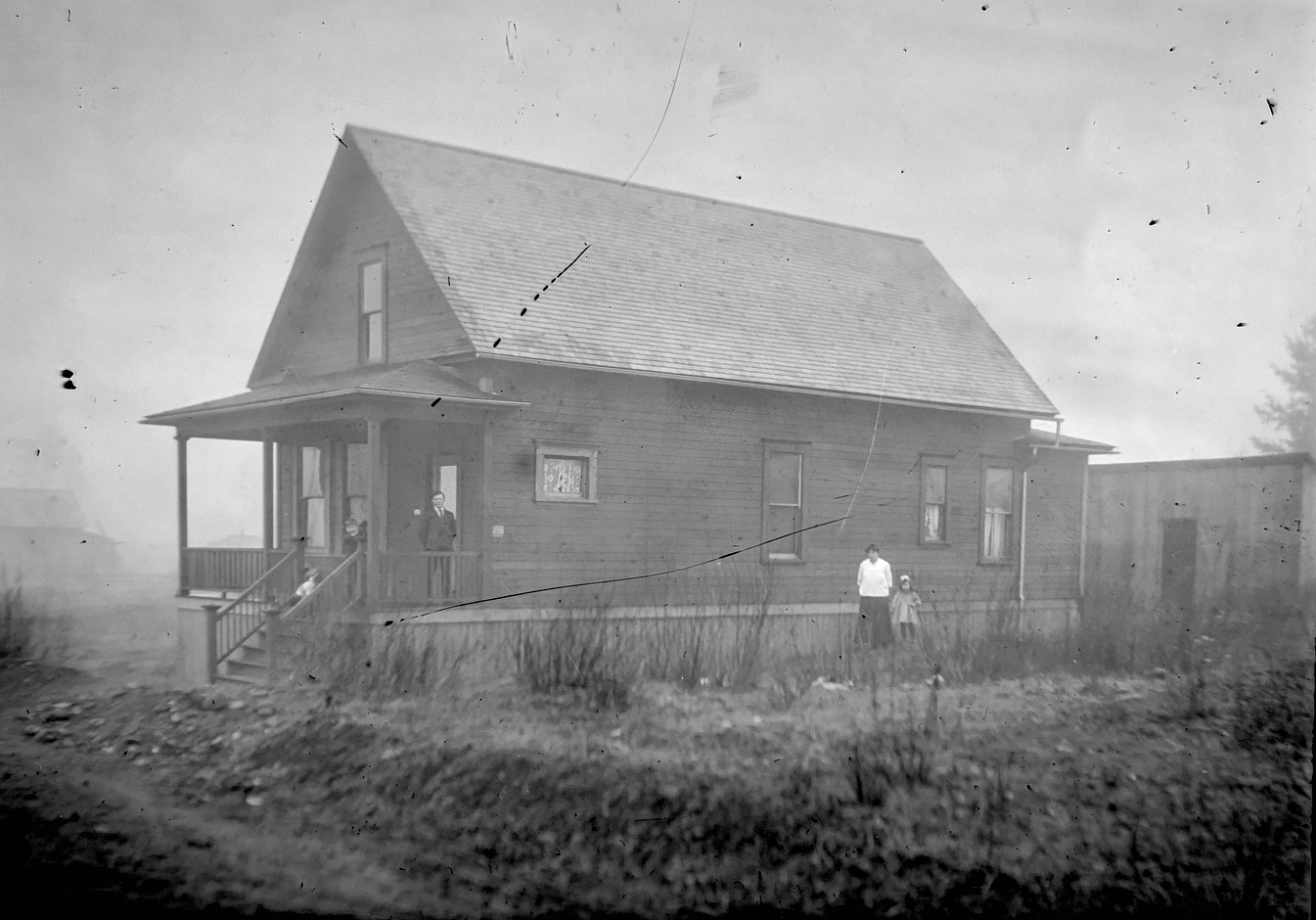
The von Homeyers at 850 Going: Hans, Hans and Erwin on the porch; Minnie and Gretchen at the side. No sidewalks, dirt streets and wide open lots all around. Looking east-southeast about 1908.

They showed the home’s interior, three children in the foreground, columns and windows behind.
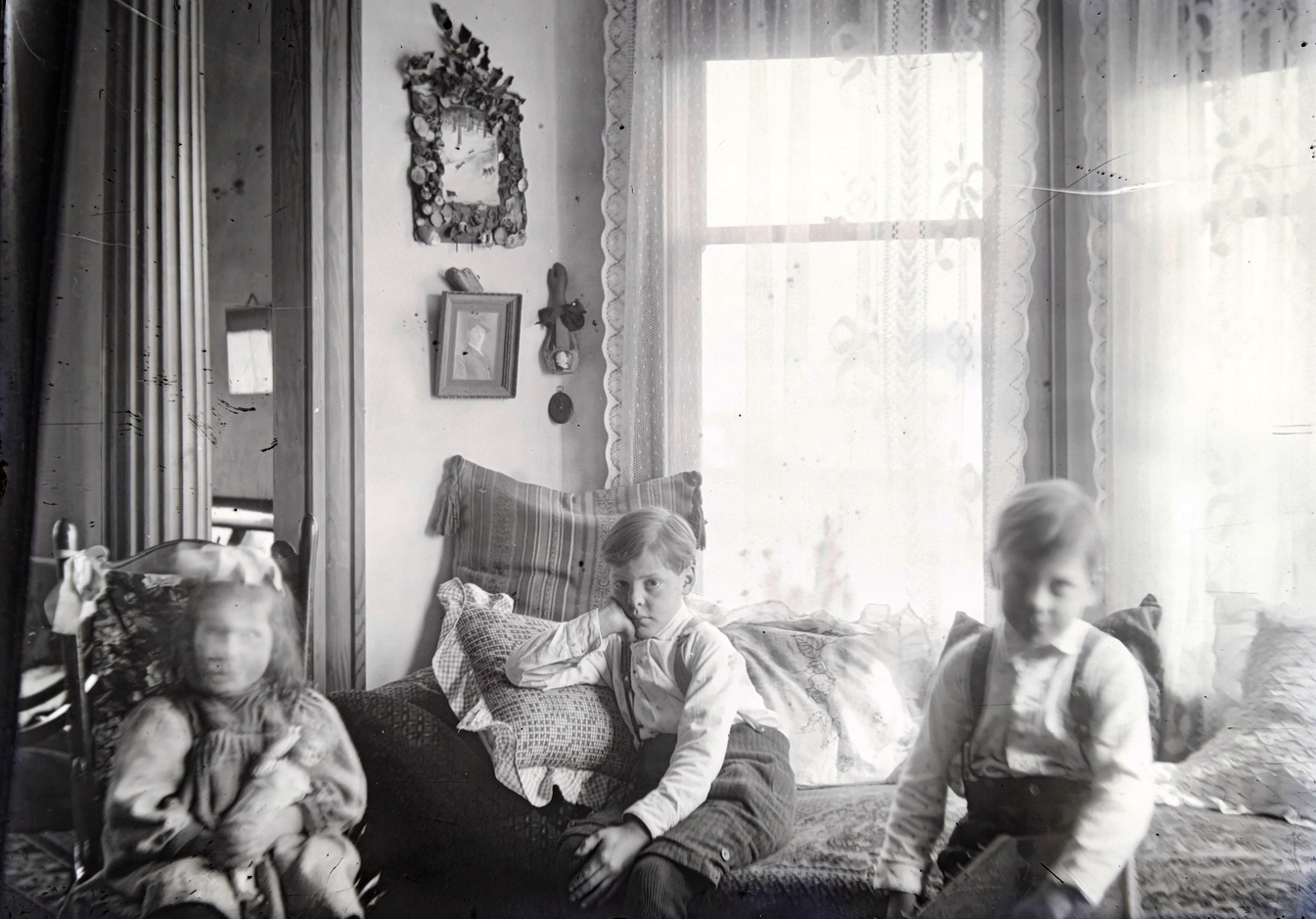
Gretchen, Hans and Erwin at the bay window, 850 Going Street, about 1908.

And they showed a builder at work upstairs. The backlighting from the second floor window makes it difficult to see, but the carpenter’s square, saw and plane behind him, hammer in hand, and the at-work stance of the human subject, come through clearly.
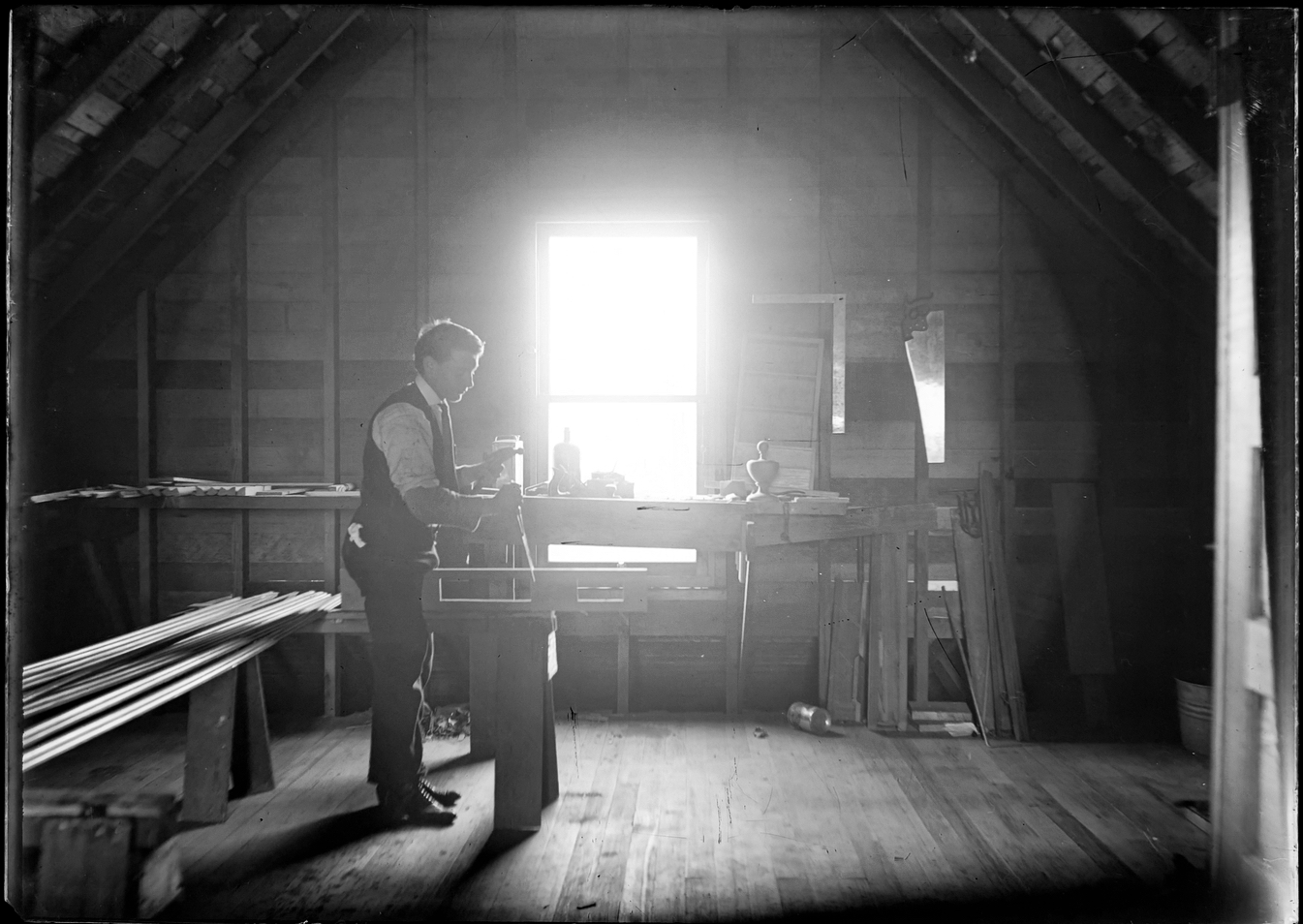
Hans von Homeyer at work, upstairs at 850 Going, about 1908.

As glass plate negatives go, they are a tad hard to read if you just pick them up for a quick look. Thick with emulsion, it takes a lot of light to reveal the negative image. Which might be one of the reasons why they survived the estate sale: people couldn’t tell what they were seeing.

We made prints and stared at them for a long time. Where is this place, we wondered.

Over the winter, as we continued looking at hundreds of family photos and began to recognize particular people and places, and as we researched the von Homeyer family story, a common thread began to tie some pieces together: this house.

First, we found this paper image in one of the old photo albums. It’s a “Real Photo” postcard showing two generations of a family out front of a tidy house.
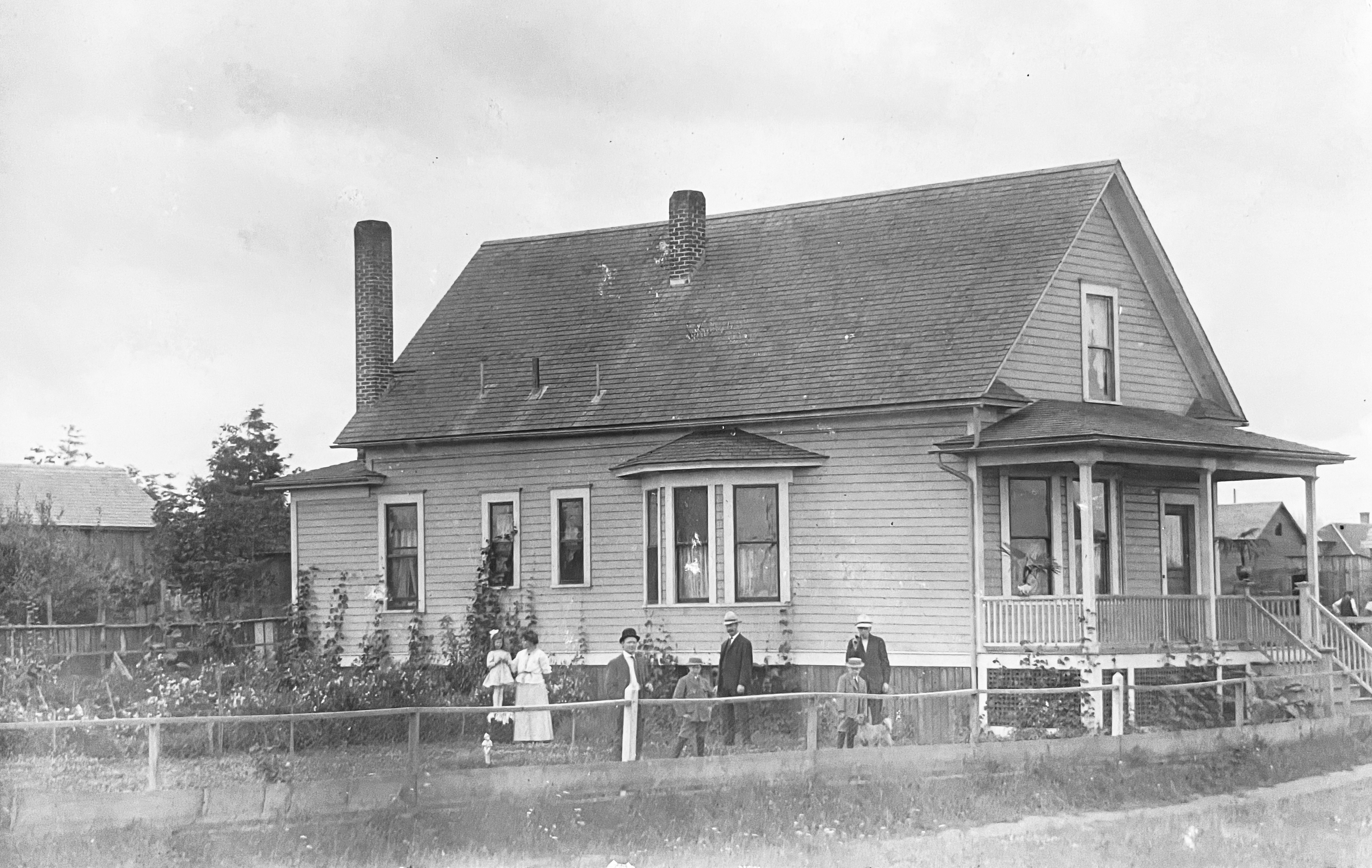
This Real Photo postcard was sent from Hans to brother-in-law Karl Tripp about 1909, looking southwest. Minnie and Gretchen at left; Hans center with Hans and Erwin; two unknown visitors. A few more nearby houses and a new coat of paint.

The glass negatives show a slightly earlier version of the house, before paint, less landscaped, a little rough around the edges, but definitely the same place. By 1909 and the postcard to Karl, the von Homeyer home at 850 Going was looking pretty tidy.

Do-it-yourself cards like this were first offered by Kodak in 1903 and almost immediately blew up in popularity as friends and families exchanged their own photos and brief greetings through the postal mail. An early and s l o w version of sharing photos and a few well chosen words across distance. Something families still like to do today. Here’s more about how Real Photo postcards transformed photography between 1905-1915.

This one was sent by the first Hans O.S. von Homeyer (1871-1942), father of Hans W.S. von Homeyer (1898-1969) who built the house at NE 24th and Mason, grandfather of the brothers Karl and Hans E. von Homeyer (1927-2002) who lived in the Mason Street house all their lives. Hans the elder sent the card to his brother-in-law Karl in Chicago, Minnie’s brother. The message on the back was in German which we can’t read, so we sent a picture of the almost undecipherable longhand script to our friends Christiane and Roland in Germany for quick translation. They wrote back immediately with the 110-plus year-old postcard greeting that made us smile:

Dear Karl, we are all still alive and frisky. How are you? With best greetings from all of us to all of you.”

The card was signed “H. von Homeyer, 850 Going Street, Portland, Ore.” which of course also piqued our interest, knowing that Going Street makes its long east-west transit through today’s King, Vernon, Concordia and Cully neighborhoods. We’ve looked at enough old east-west addresses to know 850 was going to be about 27 blocks east of Martin Luther King Jr. Boulevard and would probably end up in the Elberta Addition.

If you search for that address in pastportland.com (which is one of the very best tools for converting between pre-address change addresses and today) it comes up empty. Plenty of numbers either side, but no 850.

We looked for 850 in the 1909 Sanborn Maps, but this block and several others nearby were still unbuilt brushy vacant lots with dirt roads scratched into the ground. Sanborns were used by fire insurance underwriters to gauge fire risk based on the presence of fire hydrants, distance from fire stations and types of construction materials and heating systems used by various buildings. But out near 27th and Going in 1909, there weren’t any buildings that needed insurance underwriting. So, it wasn’t mapped.

Next we began nosing around The Oregonian and the Oregon Journal, both of which are searchable by word going way back if you have a library card. News stories, letters to the editor from Hans and other mentions began turning up, confirming the von Homeyer’s presence there.

Then we found this buried in the real estate transaction list: Hans and Minnie buying a vacant lot in the Elberta Addition for $350 in late July 1907.
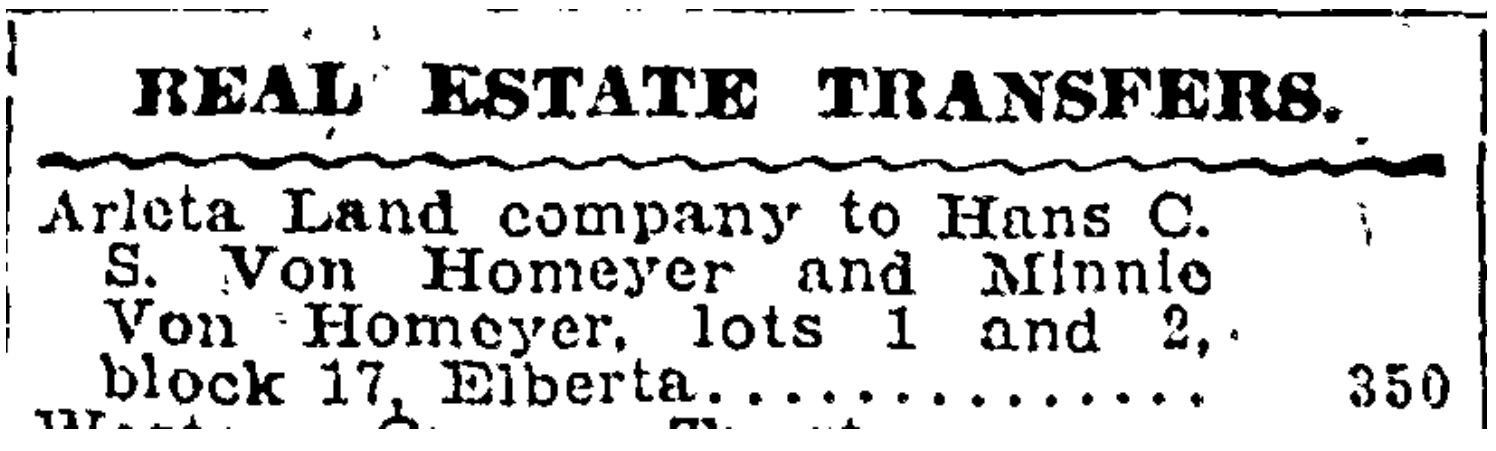
From The Oregonian, July 29, 1907

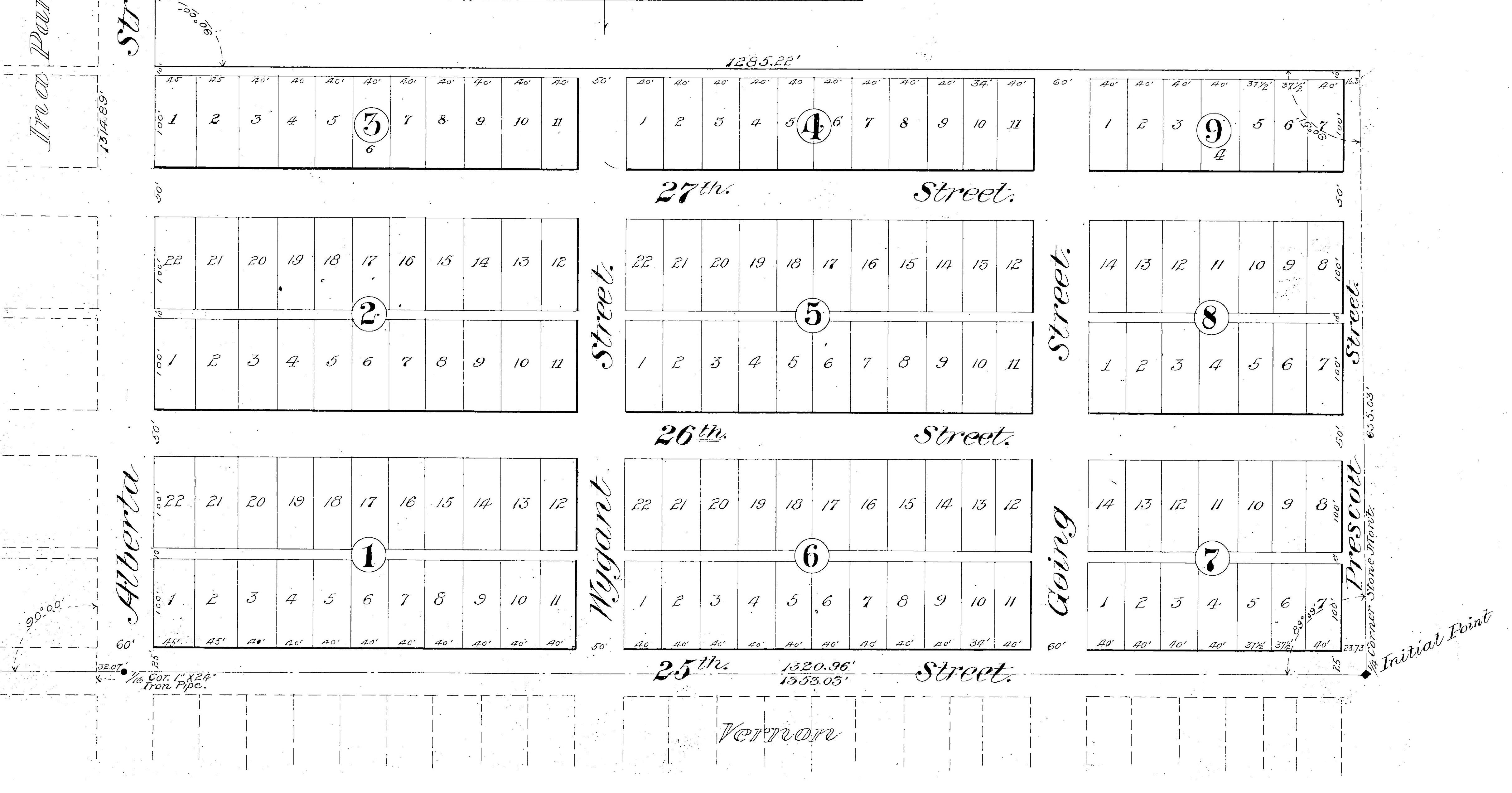
That gave us a lot and block number and a place to look. So we downloaded the Elberta plat from the Multnomah County Surveyor’s office, and began trial-and-error looking on Portlandmaps.com for block and lot details in that vicinity. We quickly found lots 1 & 2 of Block 17 today–the northeast corner of 27th and Going–but the pre-address-change address for that place says 848 and what’s there today doesn’t look anything like the postcard.

We began to note that after 1910, all references to 850 Going stop. Going, going gone. So how come 850 shows up in some news stories and on the postcard, but then disappears? We had a hunch.

The next newspaper story we found made it clear:
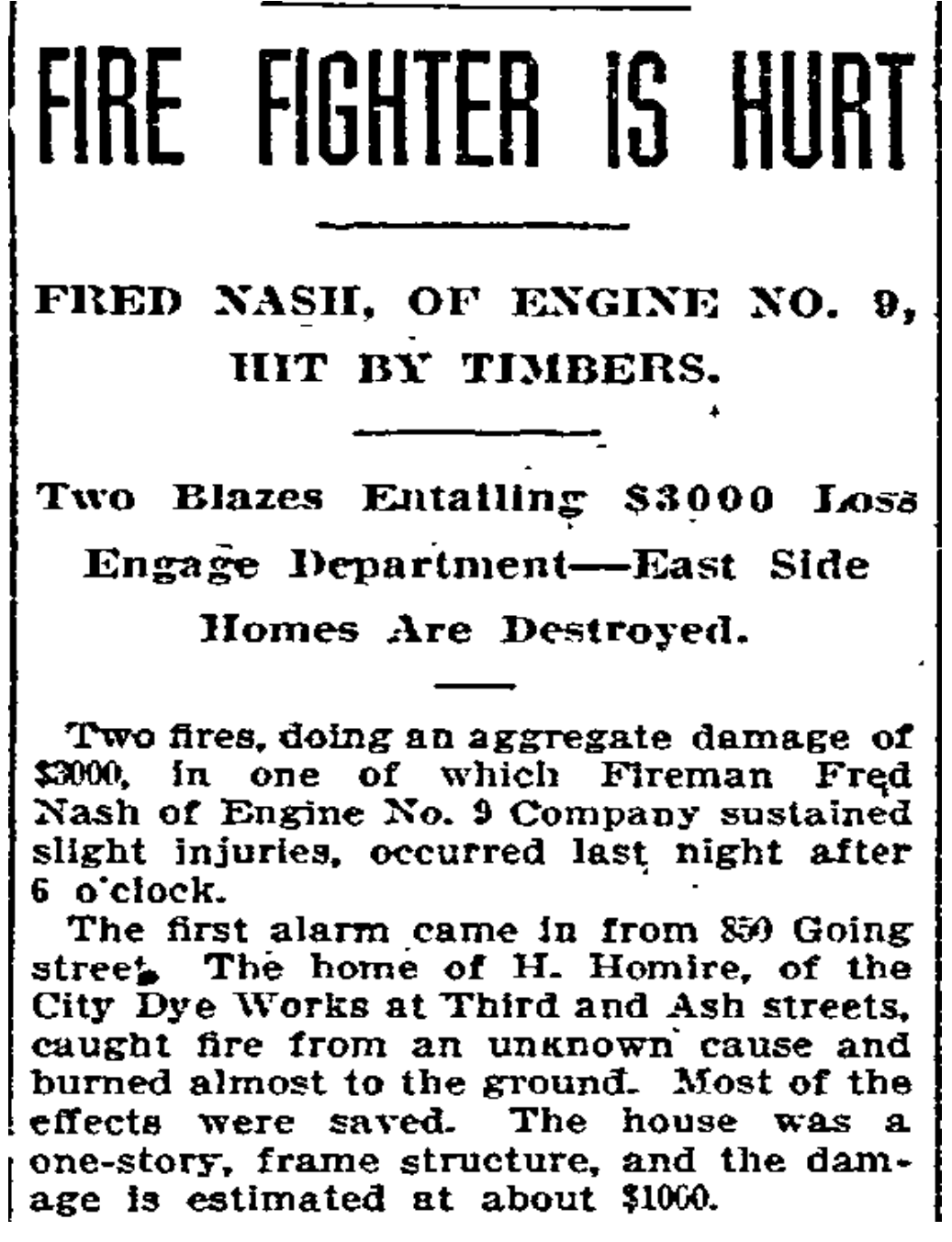
From The Oregonian, September 20, 1909. Creative spelling.

Glancing back and forth between the post card picture and the glass plates, with the fire story in mind, the realization struck: the images on the old glass and the postcard print were showing the same house: the first von Homeyer home, built in 1907 after they arrived in Portland from Chicago. In September 1909, it burned to the ground.

Eerily, Hans von Homeyer foreshadowed what might happen to their new home on Going Street. In a letter to the editor of the Oregon Journal the year before, signed on behalf of area residents, Hans gave voice to frustrations with the city about lack of water pressure in their part of the neighborhood, and worries about the fire safety of the huge wood-frame Vernon School just up the street, where their children attended.
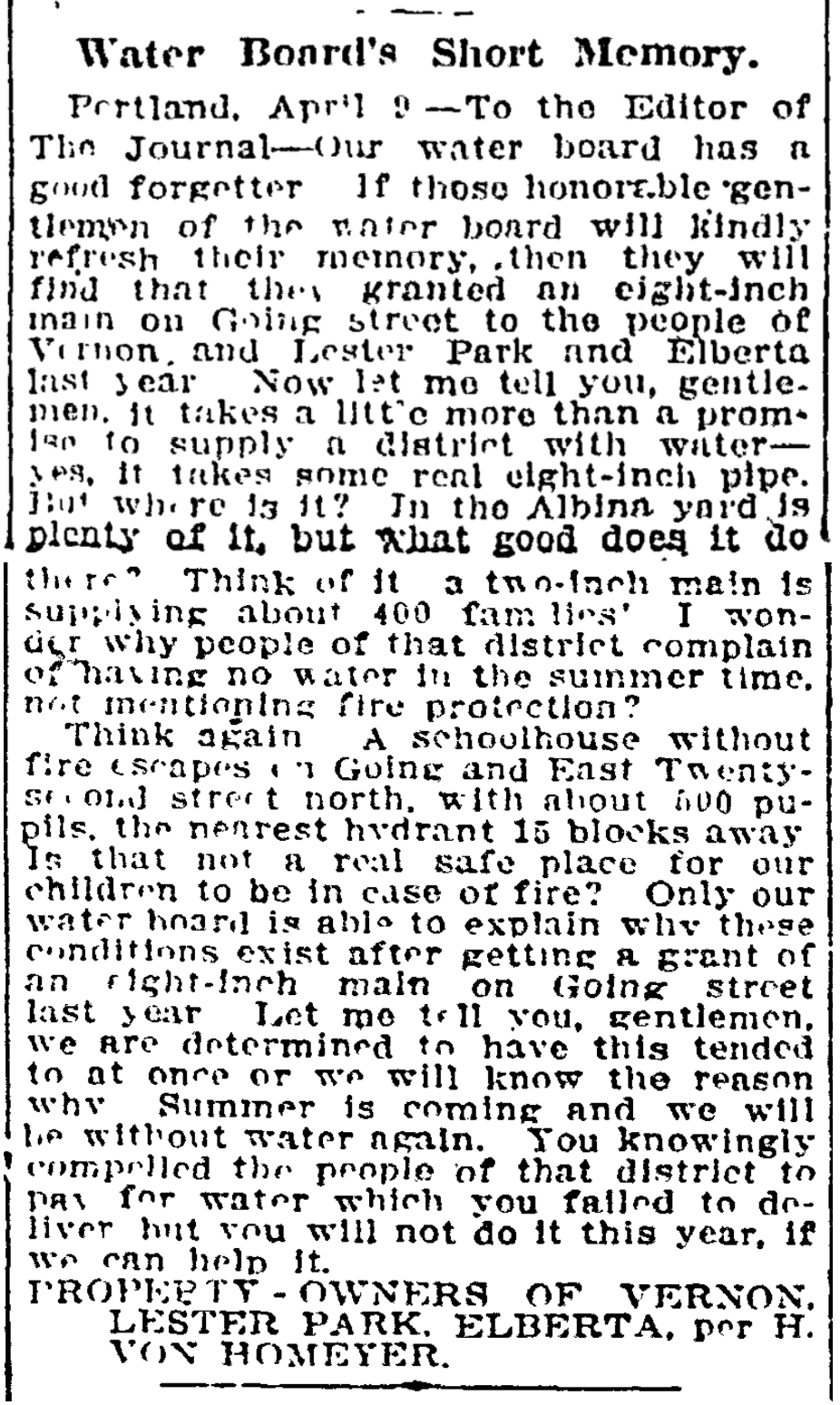
From the Oregon Journal, April 13, 1908

In June 1911, Hans and Minnie sold Going Street and took up residence in a spacious Craftsman-style house on NE San Rafael just east of today’s Martin Luther King Jr. Boulevard. The kids were growing and so was their business. Later, the von Homeyers moved to Vancouver where their story continued.

Have a good look at the 1908 surroundings as you think about the corner of NE 27th and Going today. Just across the street is the former dry goods store. The streets were unpaved gravel, no curbs or sidewalks until 1913. On the property where the von Homeyer house stood, a new home was built: the late Queen Anne Victorian that stands today, known as the Going Queen. Today, that intersection is all concrete streets and sidewalks, topography leveled off, no vacant lots in sight.

Aside from the small miracle of their basic survival all these years is the reality these glass plate negatives somehow made it through the fire or were carried out of the burning house they depict: the news story reported “most of the effects were saved.”

For extra credit, the six glass plates also made it through the estate sale in May. No one was interested in them, so after the sale they made it to the dregs pile that Michael was going to have to deal with one way or another. When we learned this, we very happily rescued them from the dregs. Now they’re in a safe place.

The last of the six glass plates–smaller in size, made a little bit later in a different location–may be the most wonderful, showing youngest sister Marguerita Anna “Gretchen” von Homeyer on a porch, bow in her hair, standing near an ivy-covered column, looking off toward the future. Probably taken in about 1913. She was eight years old.
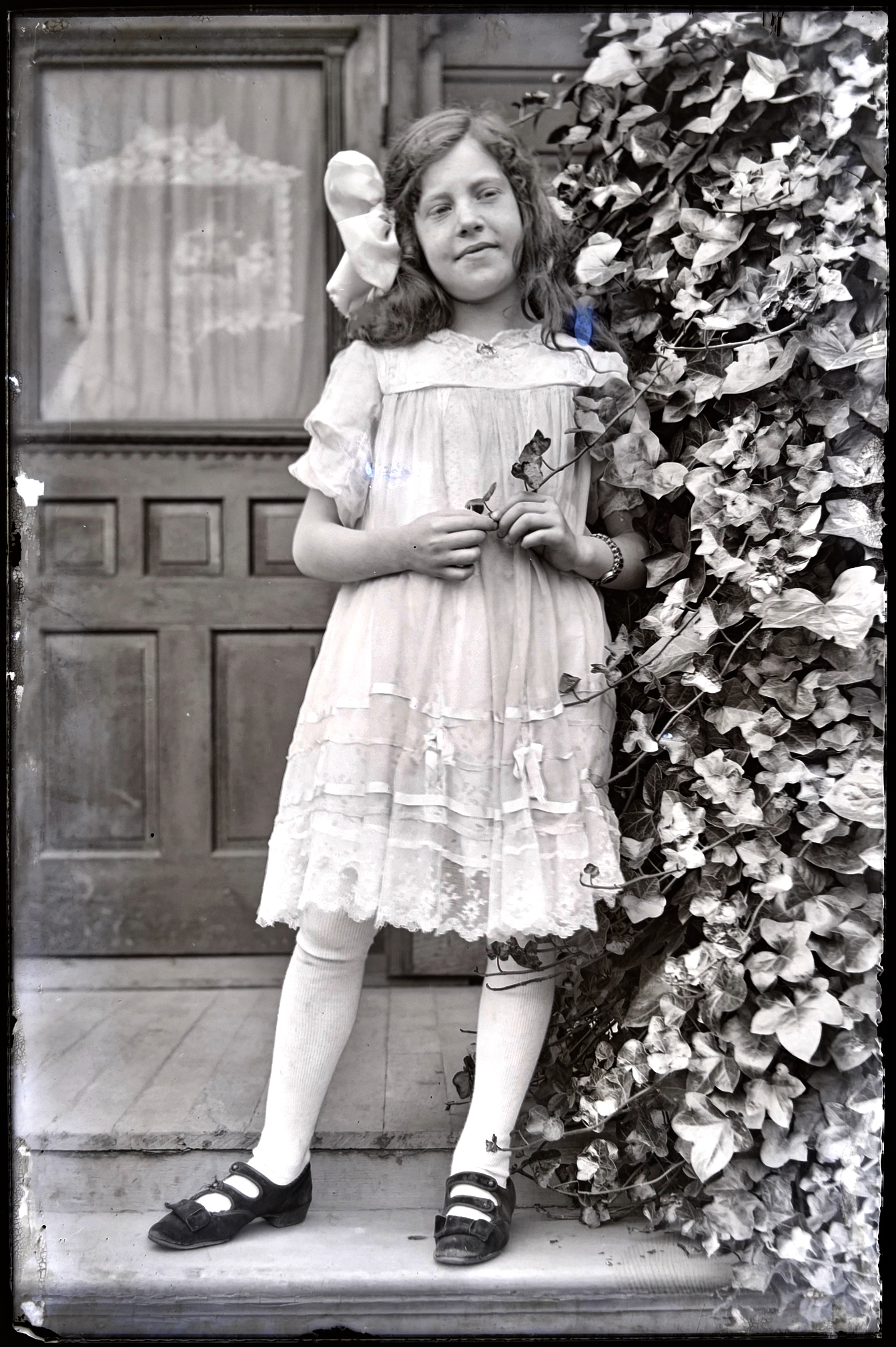
Marguerita Anna “Gretchen” von Homeyer about 1913.

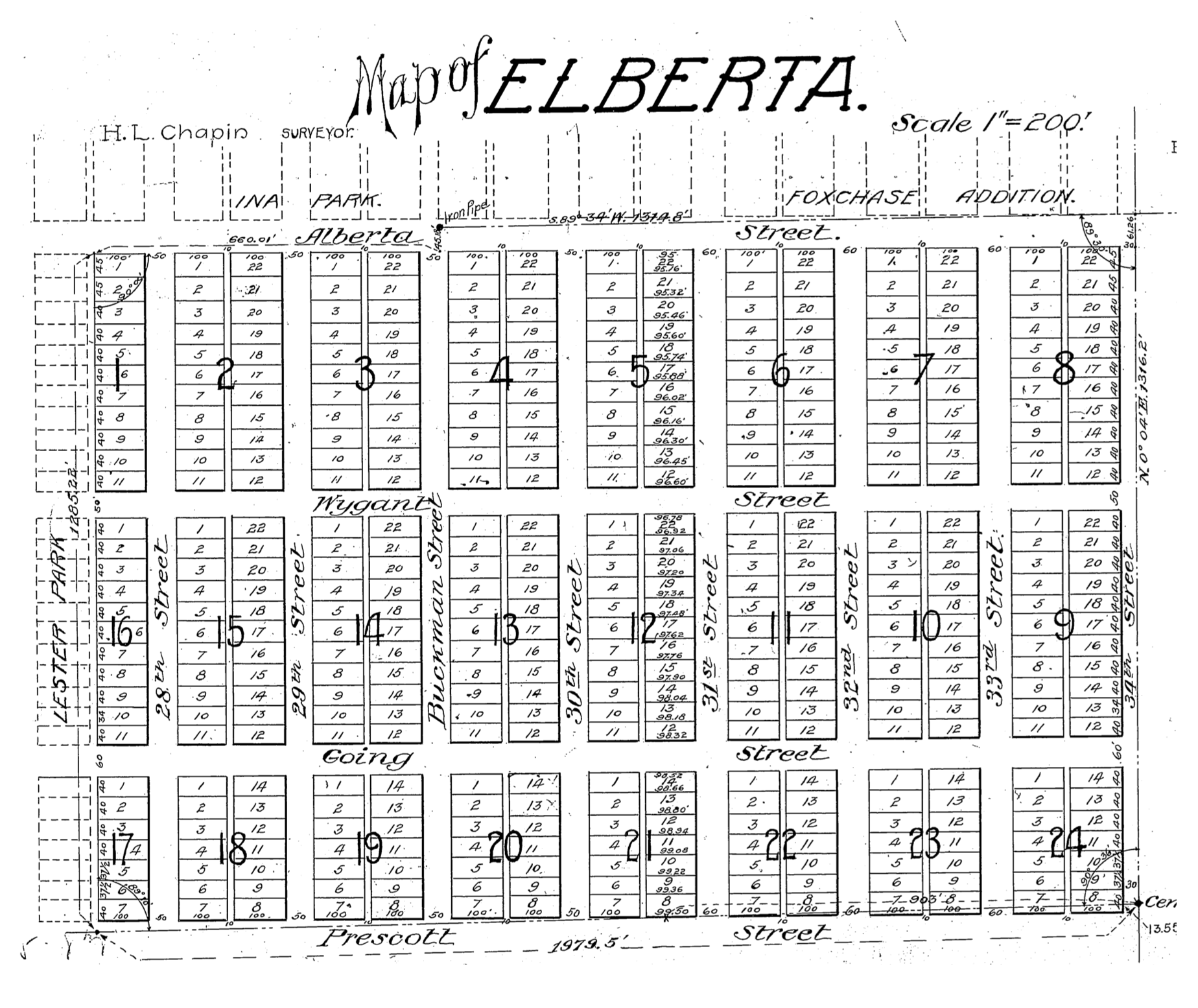
The Elberta Additon – Not a Typo

We’ve been looking into the Elberta Addition this week, a 24-block subdivision platted in August 1906 bounded by Northeast 33rd and 28th on the east and west, and by Northeast Alberta and Prescott on the north and south.

It’s a name that has caused some confusion in the past given its proximity to Alberta Street. Readers will recall that name stems from the fourth daughter of Queen Victoria, Princess Louise Caroline Alberta, an honorific street name bestowed in the 1880s. Not to be confused with Elberta.

Elberta was once the most popular variety of peach, named for the wife of the Georgia peach grower who established the hybrid in the 1800s. It’s rich, tart flavor eventually fell out of favor to sweeter varieties, and what had been tens of thousands of acres of peach orchards all across the country were uprooted. Our peach sources tell us that finding an Elberta peach today can be challenging.

This 50-acre subdivision, part of today’s Concordia neighborhood, was once forests, orchards and fields, part of the Buckman Estate and may well have known its own share of Elberta peaches. But when real estate speculation boomed in Portland after the 1905 Lewis and Clark Exposition, properties like this became valuable for conversion to residential use.

Angeline B. Richardson, sister of Isaac Buckman, owned the property (and many other properties on Portland’s eastside) and when she saw the writing on the wall for the rapidly increasing development value, she platted the fields into 479 lots, each 40 x 100, and began selling them off, with the help of her friends Thomas Benton Potter and H.L. Chapin.

From the Oregon Journal, August 5, 1906

Potter and Chapin were the principals of a much larger real estate syndicate that developed rural properties in Kansas City, San Francisco and even on the Oregon Coast: Potter was the driving force behind the ill-fated Bayocean community west of Tillamook that was eventually washed away by the Pacific Ocean. They also initially sold most of the lots in the adjacent Ina Park, Lester Park and Vernon subdivisions here in Northeast Portland.

About 1906, the Potter & Chapin firm changed its name to the Arleta Land Company (which just to keep things interesting, The Oregonian sometimes confused with the Alameda Land Company), named for Thomas Potter’s youngest daughter Arleta. The firm continued to develop and sell properties across Portland’s eastside, including in the Mt. Scott – Arleta neighborhood which it platted in 1903. The Arleta Land Company kept a fairly low profile, unlike other developers who paid for robust advertising campaigns in local newspapers. Arleta Land Company’s presence was almost entirely focused on classified advertising where business was brisk in 1906-1908 with news of properties being bought and resold, and homes built.
In other research, we’ve come across an interesting photo of the young Elberta Addition, showing the former home of the Hans C.S. and Minnie von Homeyer family, located at the southwest corner of NE 27th and Going. Click into this photo for a good look, it’s a beauty.

Southwest corner of NE 27th and Going, known as 850 Going Street prior to the Great Renumbering. Courtesy von Homeyer Collection

Today a 1910 Victorian-style home known as the “Going Queen” is on that property. But back in 1907, the von Homeyers bought the two lots from the Arleta Land Company for $350 and built this house. Unfortunately for them, fire destroyed their home on July 28, 1907. This rich photo has many stories to tell, and reminds us of the rural nature of the area.

Today, Elberta is a great place for a walk to appreciate residential design and construction from the first decade of the 20th Century. We’ve enjoyed exploring Elberta in this post about its alleys, which are like a built-in trail system for many of us dog-walkers. And in this bit of photo sleuthing.

The Naming of Alberta

We’ve been asked recently about the naming of Alberta Street in north and northeast Portland. The short answer is that it has to do with the British Royal family by way of Canada.

But it’s also a reminder about the development of early Portland.

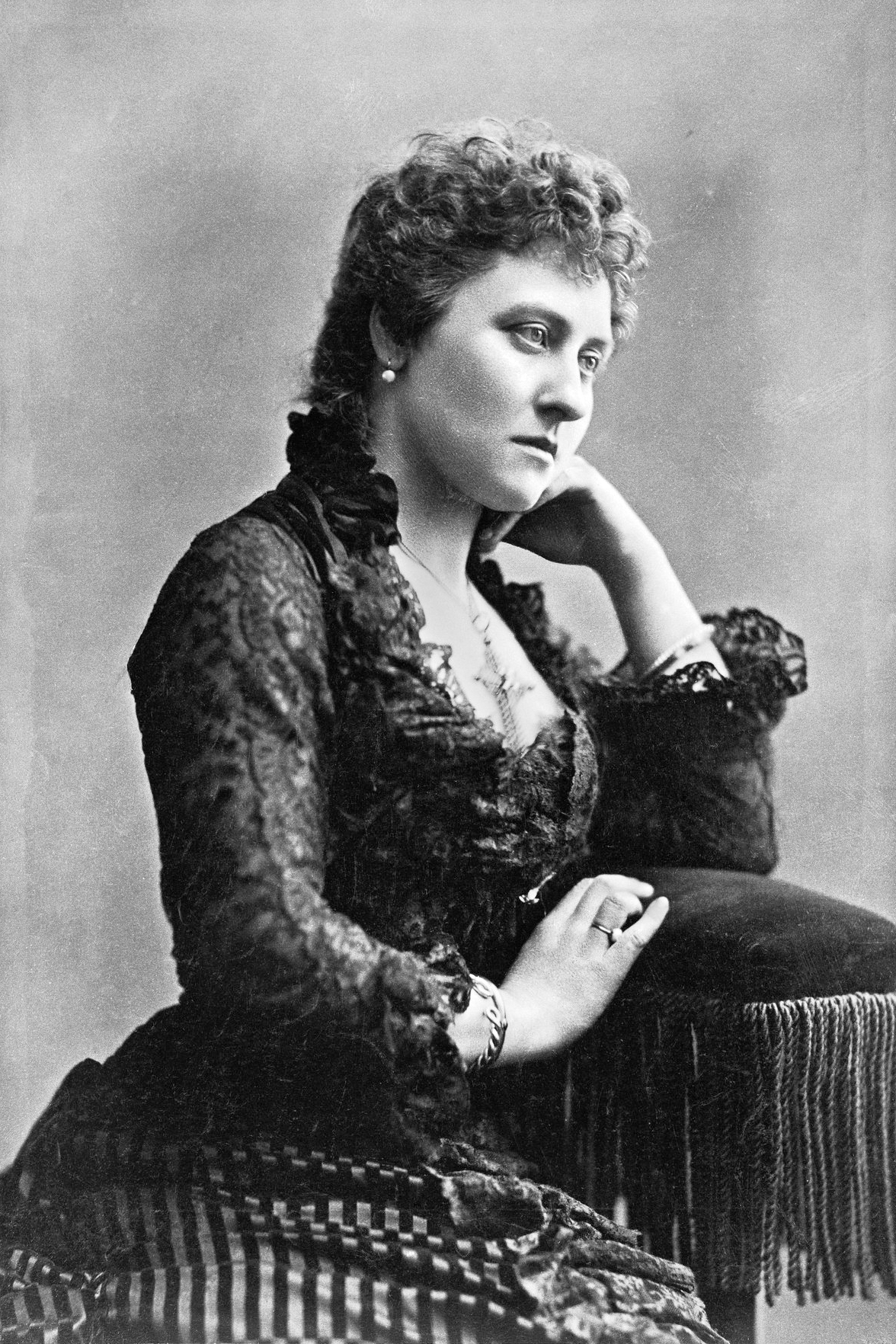
Alberta was named for Princess Louise Caroline Alberta, the fourth daughter of Victoria, Queen of England. Her husband was John Campbell, Marquess of Lorne and Governor General of Canada from 1873-1883. In September 1882, the couple made a swing up the west coast, traveling by ship from San Francisco to her mother’s namesake: Victoria, British Columbia, Canada. Having royals out this way was a very big deal in Canadian and American newspapers of the time.

Princess Louise Caroline Alberta about the time of her visit to the West Coast. Image source: The Royal Collection Trust, object 2903653.

Here’s where the Portland connection comes in.

About that time, our area was booming: the city we think of as Portland today was actually three separate cities, Portland, East Portland and Albina. There were similarities and some connecting common threads, but each had its own street system, addressing system, governance.

Albina, which historian Steve Schreiber reminds us was actually pronounced “al-bean-uh,” was just being platted. For more on Albina, check out Steve’s outstanding history (and his whole website on the legacy of Volga Germans in this area).

One of the developers planning Albina was Portlander Edwin Russell, who had immigrated here from England and was manager of the Bank of British Columbia in Portland. Russell had his own connection to royalty, having descended from the Duke of Bedford.

As Russell planned streets in the new suburb called Albina (and on a plat called Albina Heights), he named one street after himself: Russell; one street after his business partner: Williams; and one street after Princess Louise Caroline Alberta, whose visit to the region was causing a stir, particularly among Queen Victoria’s emigrated loyal subjects. The Princesses’s multiple names were being applied to geographic features all across the western map, including Lake Louise and the Canadian province of Alberta.

Later, as Portland expanded east of today’s Martin Luther King Jr. Boulevard, the street named Alberta expanded east too.

Lead paint sinks Billy Rowe’s wall mural

We’ve heard from the property owner working on restoration of the former Billy Rowe’s Tavern building (recently known as Bernie’s Southern Bistro) at the southeast corner of NE 29th and Alberta.

Unfortunately, the mural on the west wall must go.

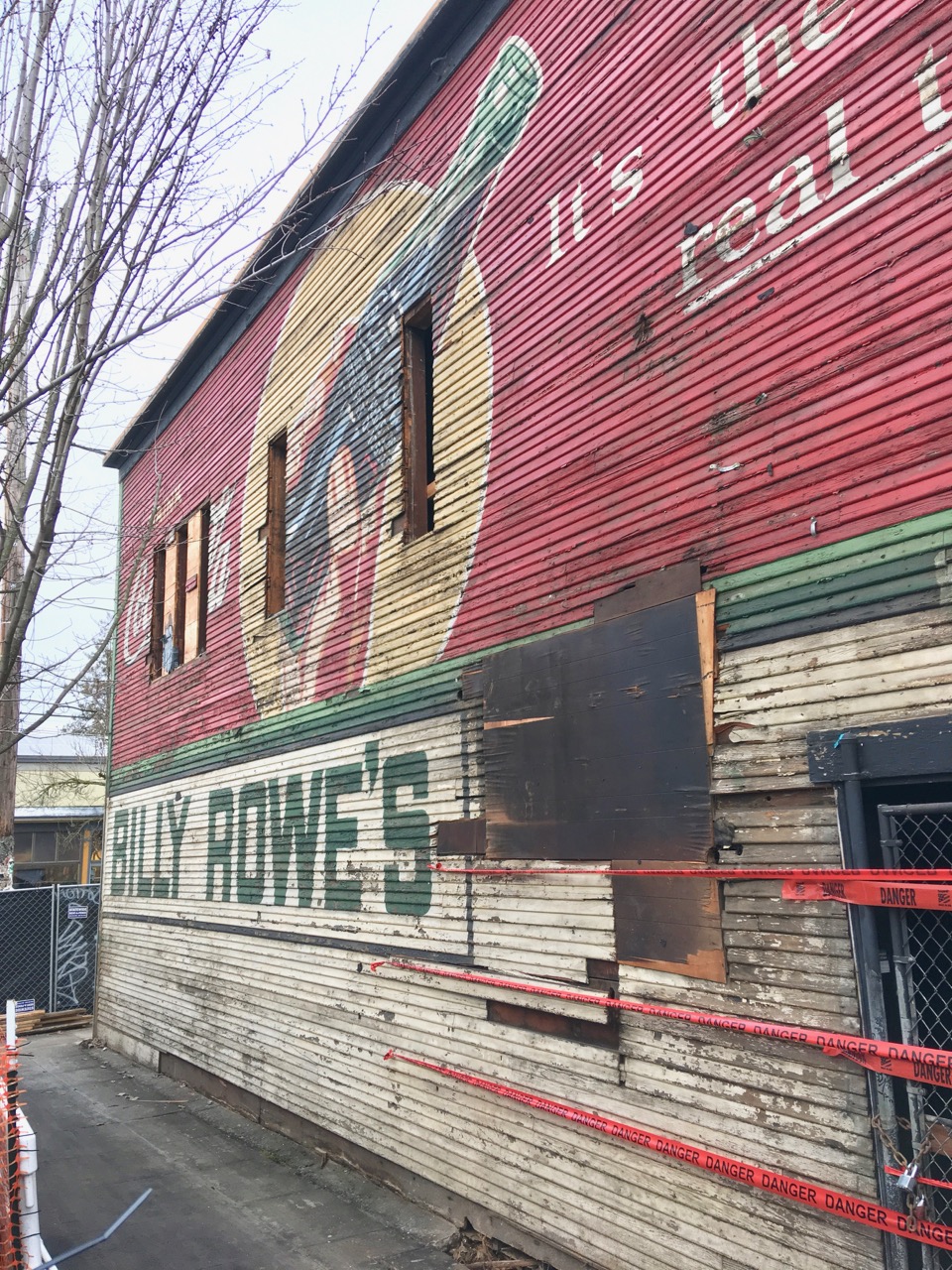
We’ve been watching this week as an amazing wall-size advertisement from the 1940s has resurfaced during restoration, and as we’ve learned more about Billy Rowe.

O’Cardinal Properties—the current building owner—was as amazed with the find as the neighborhood was, and intrigued with the possibility of incorporating the original material of the painted wall into the renovated space. But testing for lead late last week returned results that have ruled that out.

“We love the signs and would like to preserve it,” wrote O’Cardinal’s Property Manager Monica Geller in a weekend e-mail exchange.

“However, last week we got the paint tested for lead and it came back with extreme lead paint ratings that will not allow us to retain the mural as is, even with a strong clear coat intended to contain the lead paint.”

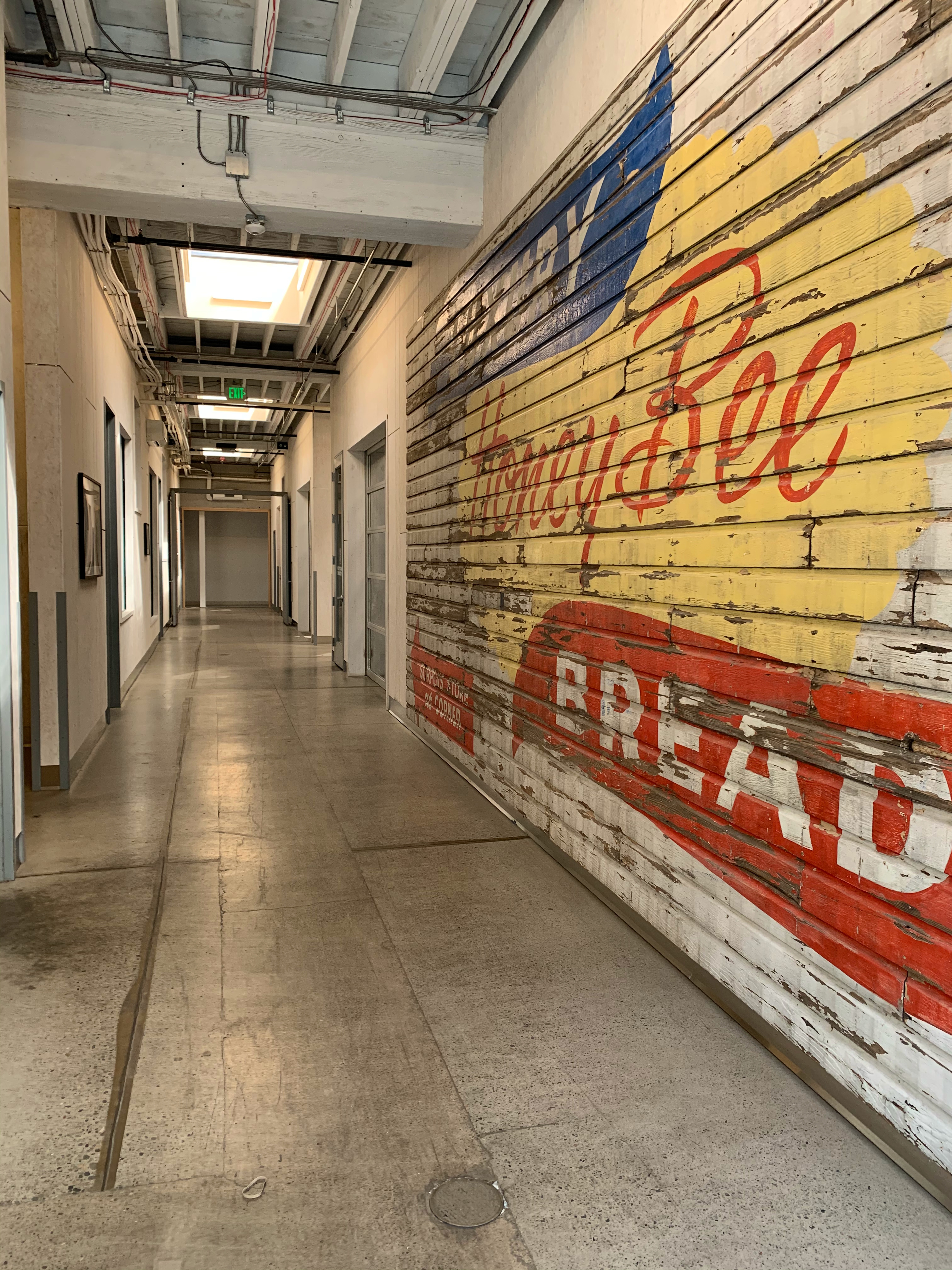
Geller and her colleagues are disappointed, especially given their interest and track record of adaptively re-using and renovating older buildings. In southeast Portland at SE 14th and Stark, O’Cardinal updated the 1929 Luxury Bread Building, carrying forward aspects of its history—including old siding, photos of the old bakery operation and family photos and stories from the former owners. Here’s a photo from inside Luxury Bread showing how O’Cardinal used a former painted mural there:

Repurposed wall siding inside the Luxury Bread Building recently restored by O’Cardinal Properties, 1403 SE Stark. Due to high levels of lead found in the Billy Rowe’s mural, something like this is not possible, according to O’Cardinal.

“We have a plan to take a hi-res photo and reproduce the image to use on the building to retain some of the heritage, “Geller continued.

“I know it is going to be hard for the neighborhood to see the boards come down,” she acknowledged, “but there is no feasible way for us to keep the mural in place, so it will be removed.”

One more for Billy Rowe

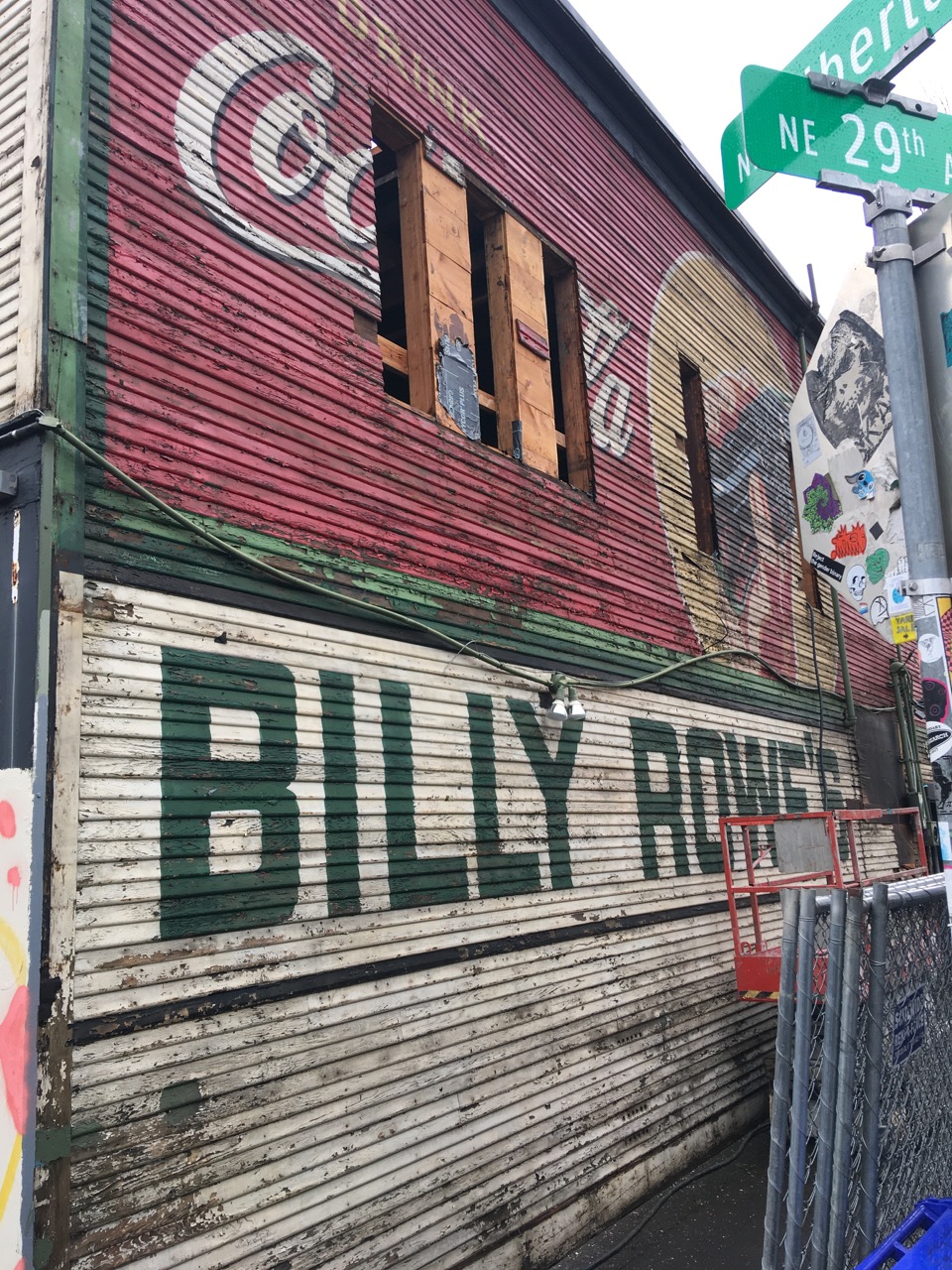
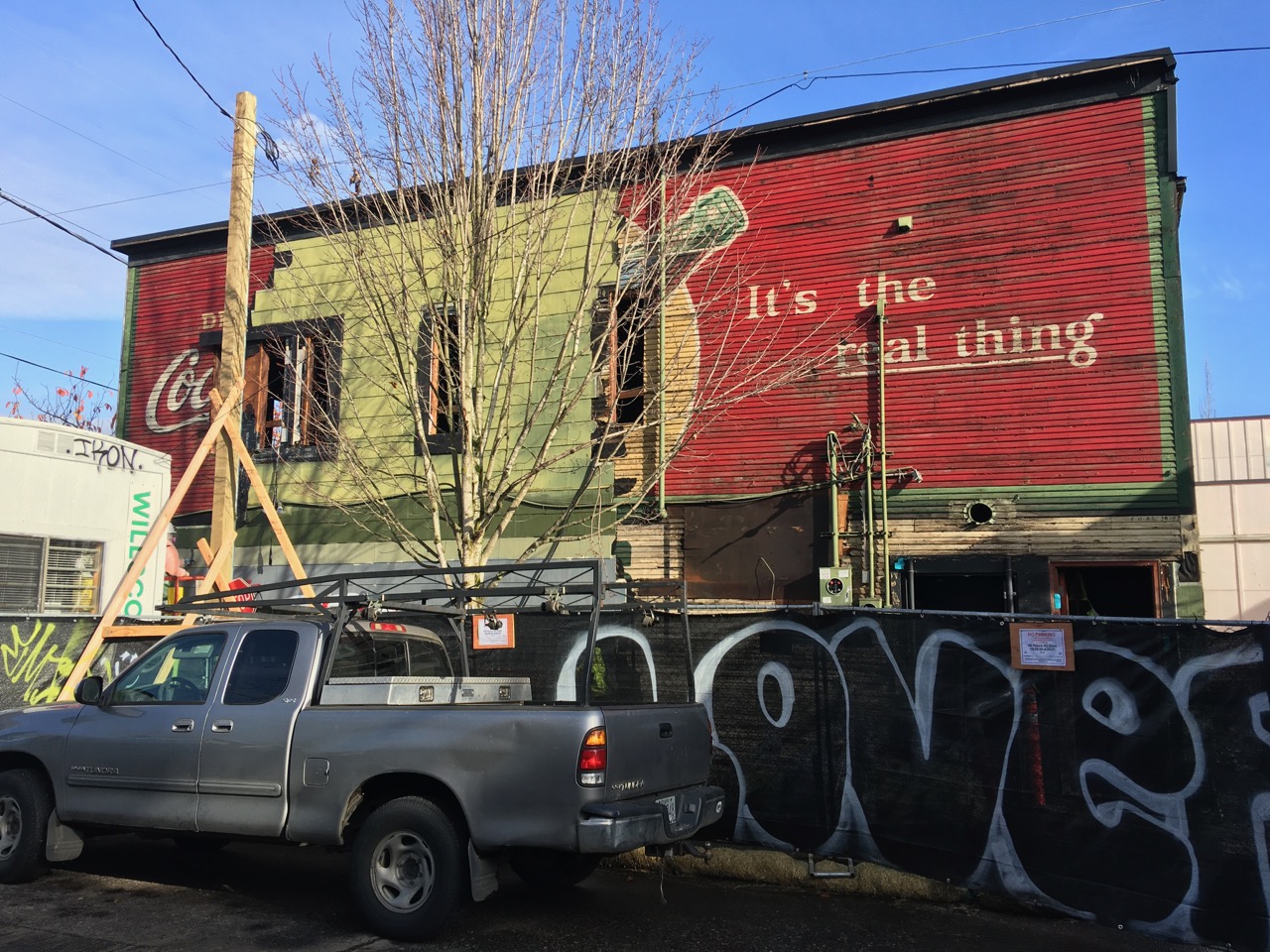
Like a giant postcard from 1946, the western wall of the former Billy Rowe’s Tavern reappeared yesterday at NE 29th and Alberta as workers removed shingle tiles during a major building renovation. When we visited yesterday morning, workers had exposed the vibrant colors of the Coca-Cola ad painted in 1946, but something more had yet to be revealed. Check it out:

The former Billy Rowe’s Tavern, in restoration November 25, 2020.

Naturally, we wondered about Billy.

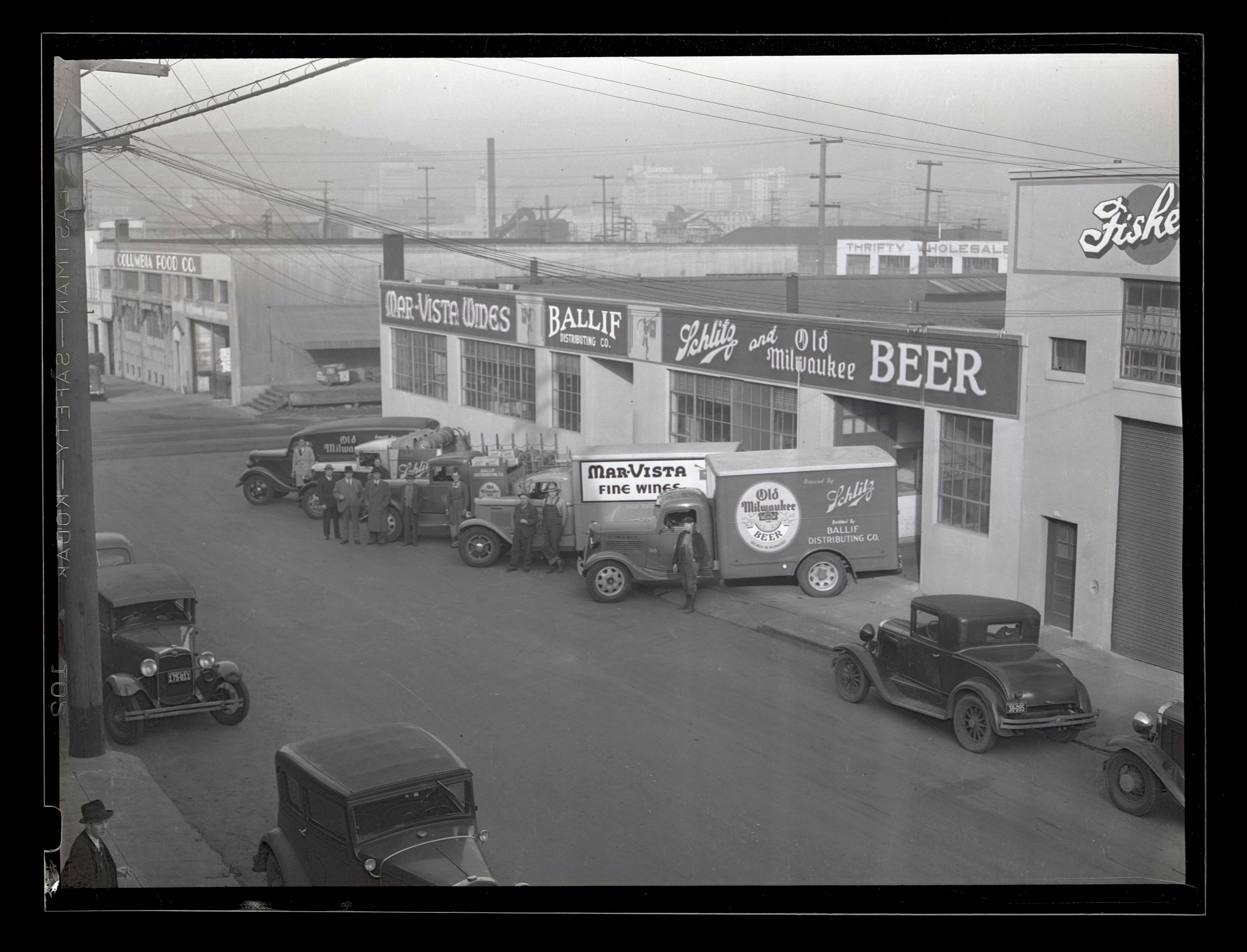
William Chauncey Rowe and wife Doris Isabelle Rowe opened the tavern at 2904 NE Alberta in 1943. Billy was a commissioner in the Boy Scouts, a member of the Portland Elks lodge and an active member in the Church of the Latter Day Saints. Doris was a member of the Elks Auxiliary. Before going into the tavern business, Billy was vice president of Ballif Distributing Company, a beer distributor based in southeast Portland.

Maybe he’s one of the overcoats here in this photo, from the incredible collection of Oregon Journal photos at the Oregon Historical Society. This photo is not specifically dated, but caption information indicates sometime between 1933-1941 (old car aficionados could probably pin that down, guessing late 1930s).

Photo credit: Oregon Journal Negative Collection; Org. Lot 1368; Box 372; 372A1164

After leaving Ballif Distributing, Billy and Doris operated the tavern until their sudden death on the night of January 2, 1951 in a road accident north of Klamath Falls while returning to Portland. Newspaper reports describe a head-on crash in icy conditions. They were survived by two sons, Earl and Calvin.

The tavern appears to have passed out of Rowe family hands after that, but the name stuck (perhaps because it was painted in three-foot letters across the side of the building…the place was a local institution). In 1957, new owner Joseph Hoover was arrested on charges of promoting gambling on the premises and having a horoscope machine that made small payoffs to customers. Later that year, Portland City Council refused to renew Hoover’s tavern license.

Sometime after that–perhaps when the shingles went up on that west wall covering up Billy Rowe’s name–the place transitioned to Duke’s. Any AH readers able to share a story from the Billy Rowe era?

Update: On December 6th, the owners let us know the mural wall will have to come down due to high levels of lead paint. Click here to read more.

Peeling back the layers

We always love to see layers of history being revealed in buildings and places we think we know. Check out this view from today’s walk up Alberta. Here we are at the southeast corner of Alberta and NE 29th, the building that used to house Bernie’s Southern Bistro.

Looking at the west side of the building from NE 29th. Sunshine!

Workers were carefully removing the green shingles, exposing a huge advertisement for the real thing painted directly onto the original shiplap siding.

According to the permit, it looks like the building is getting a complete renovation, with all interior walls, stairs and fixtures on both floors coming out; construction of a new stair, an upgrade to the old storefront and a complete seismic upgrade. Big job.

Built in 1921-1922 by D.L. Duncan, the building housed multiple businesses in its early days: a repair shop, a shoe store, a print shop. In its middle years and most recently it’s been a place to meet for a drink or a meal. From about 1940 until the late 1960s, it was Billy Rowe’s Tavern and then Duke’s Tavern before becoming Bernie’s Bistro.

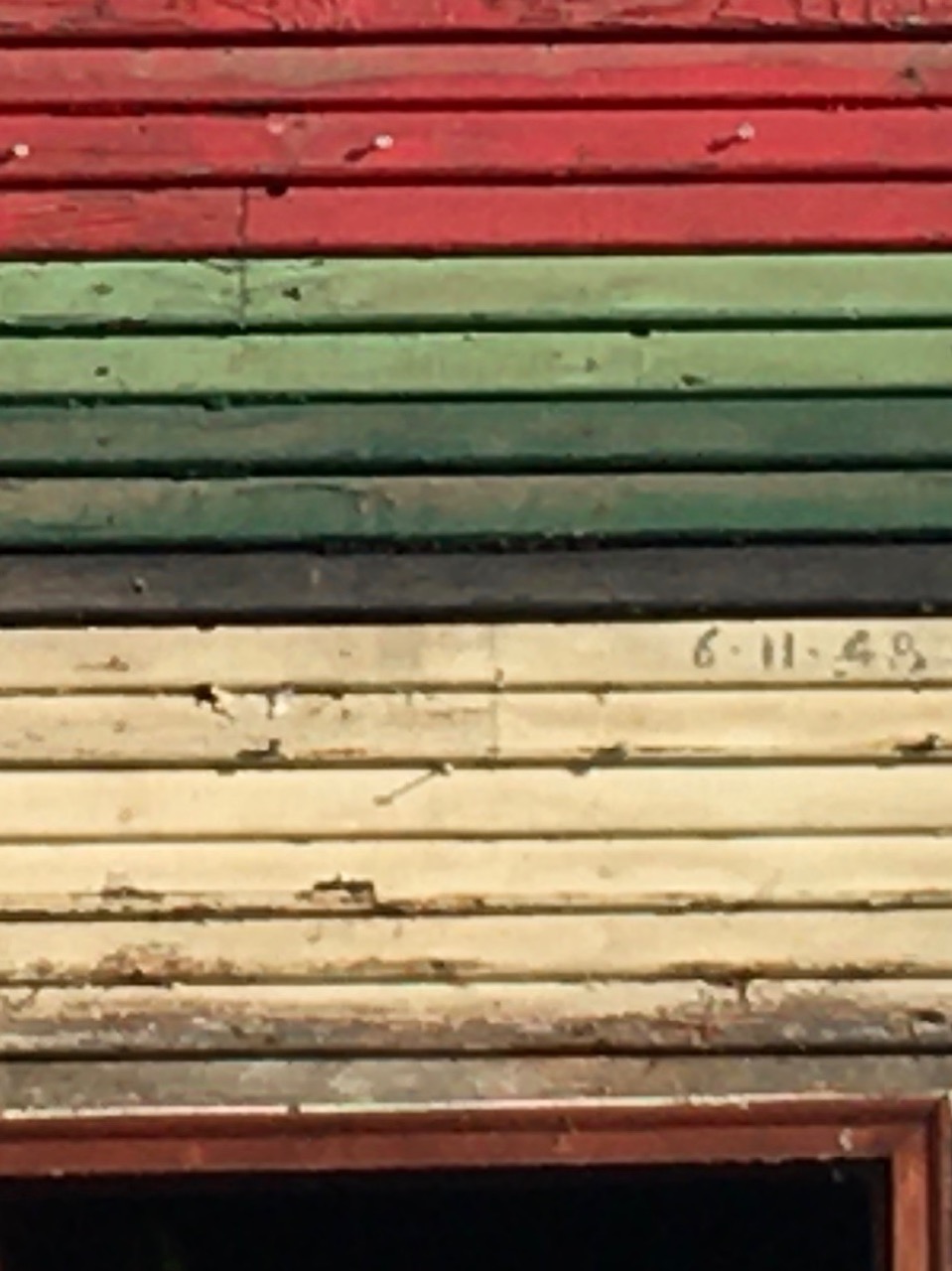
Small lettering just below the real thing suggests this advertisement was from the Billy Rowe’s era. Can you read the lettering? Looks like June 11, 1948. We know a few sign painters and will ask around for insights…there’s more to this story.

Alberta was a busy place in the 1920s-1930s. Research we’ve done shows that in 1930, there were more than 200 businesses on Alberta between MLK and NE 33rd, from pool halls to bakeries to grocery stores.

Here’s a post-script on Billy Rowe with another photo of the building later in the day.

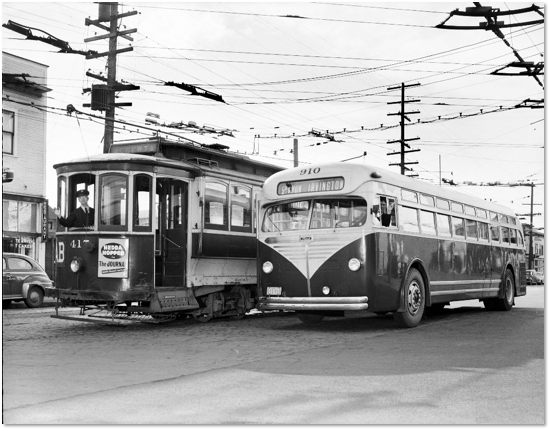
Just for fun–and you’ll be forgiven for being distracted by what’s in the foreground–here’s another view of the same building. Yep, that’s the corner of Billy Rowe’s Tavern there on the left by the streetcar, on February 3, 1948, at NE 29th and Alberta. The photo was published in the Portland Transit Company’s 1947 Annual Report to illustrate the end of an era. The caption: “Walt Baker, trolley skipper since 1911, greets Merritt Lutman, pilot of a new Mack bus.”

Vernon Then and Now

While the pace and scale of change can often take your breath away (for good and not so good), it’s surprising how some aspects of our neighborhood landscape are recognizable from a distance of more than 100 years.

We’re preparing a program for Wednesday night, April 18th about Vernon neighborhood history—come on along if you like, 7:00 p.m. at the Leaven Community Center, 5431 NE 20th Avenue—so we’ve been out recently scouting around. Vernon is the neighborhood loosely bounded on the north and south between NE Ainsworth and NE Wygant, and the west and east from NE 11th to NE 21st. Walkabouts for us usually begin with finding a handful of old photos, reference points or things to look for and then sleuthing around the neighborhood looking for the right vantage point. Here’s a couple examples.

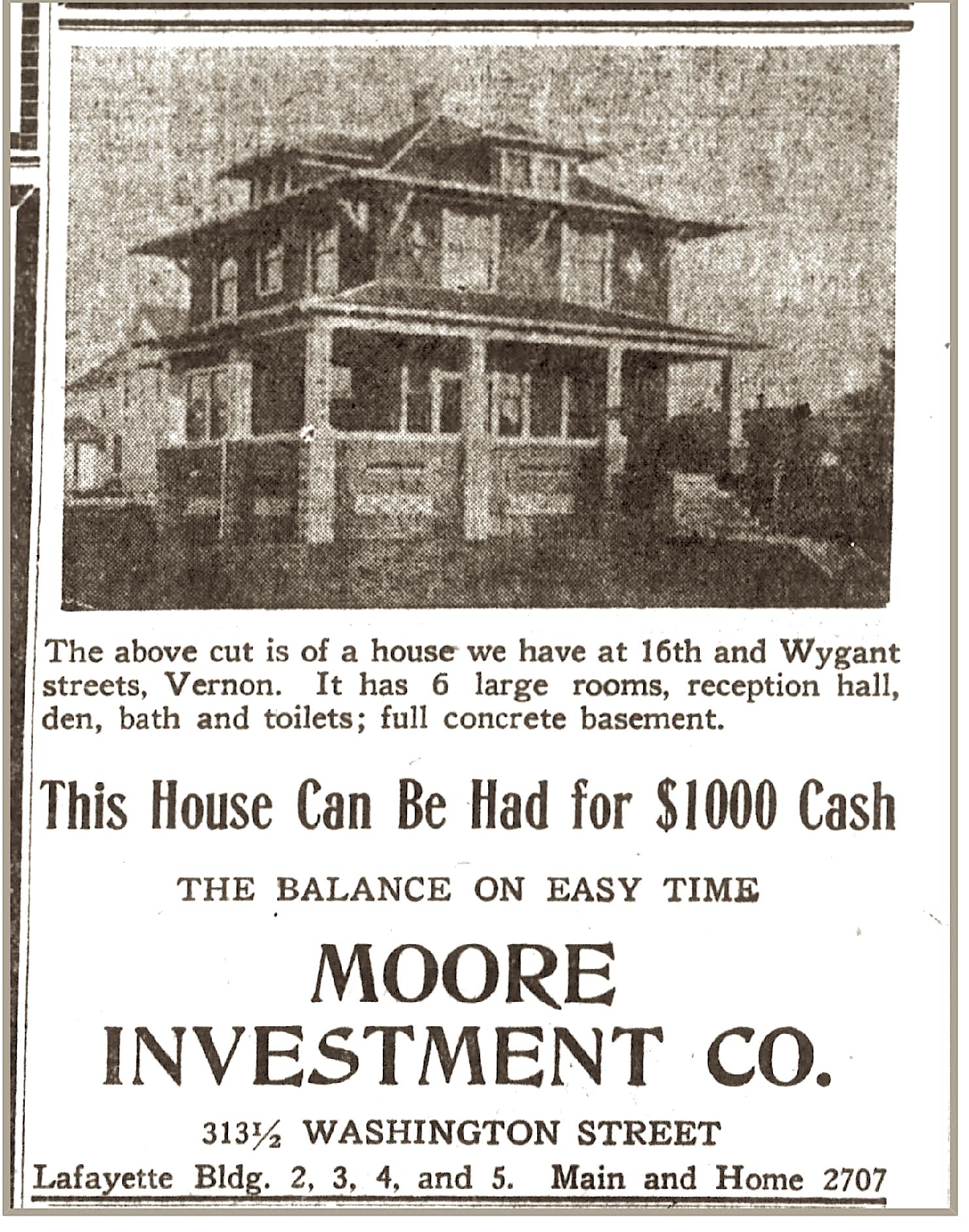
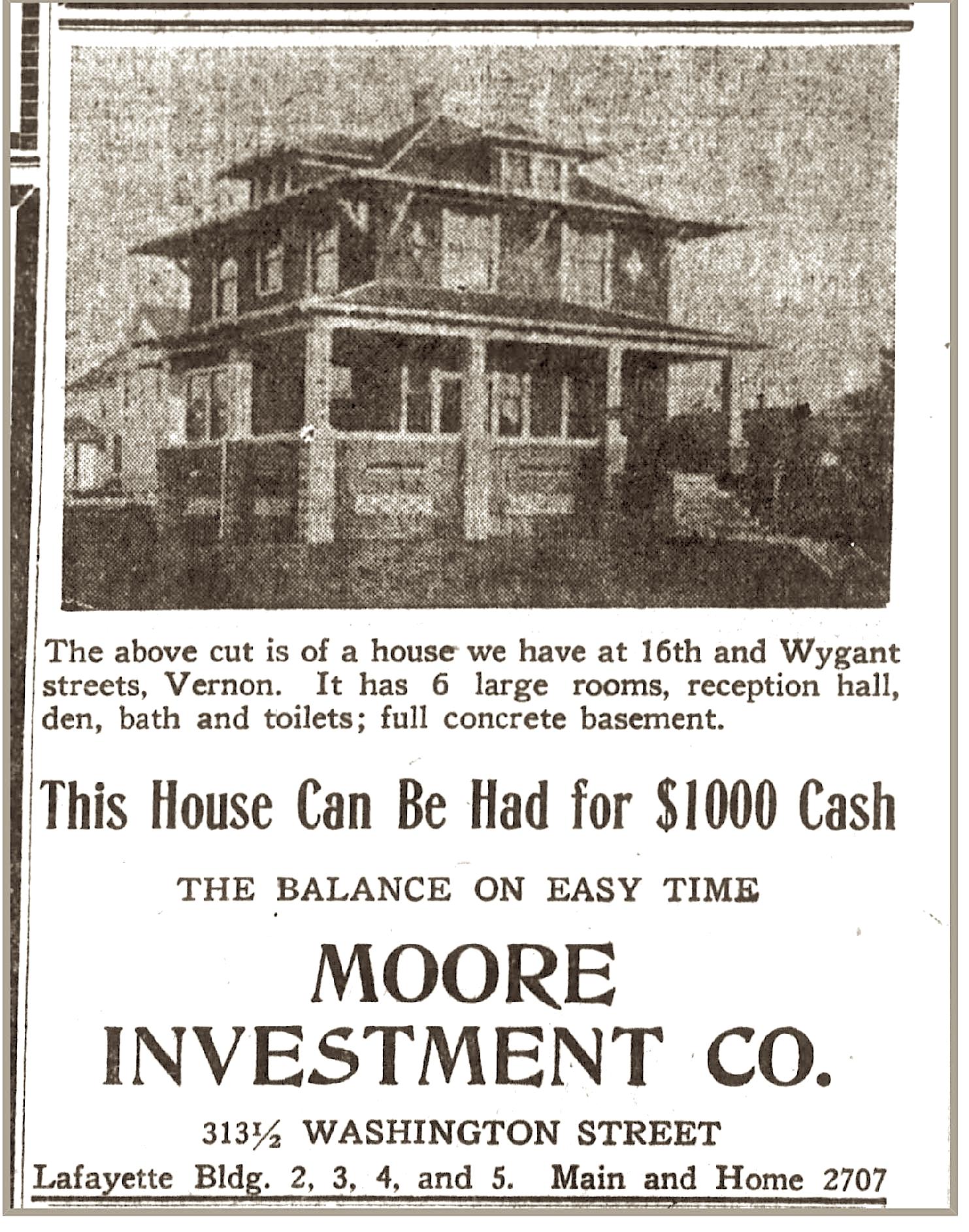
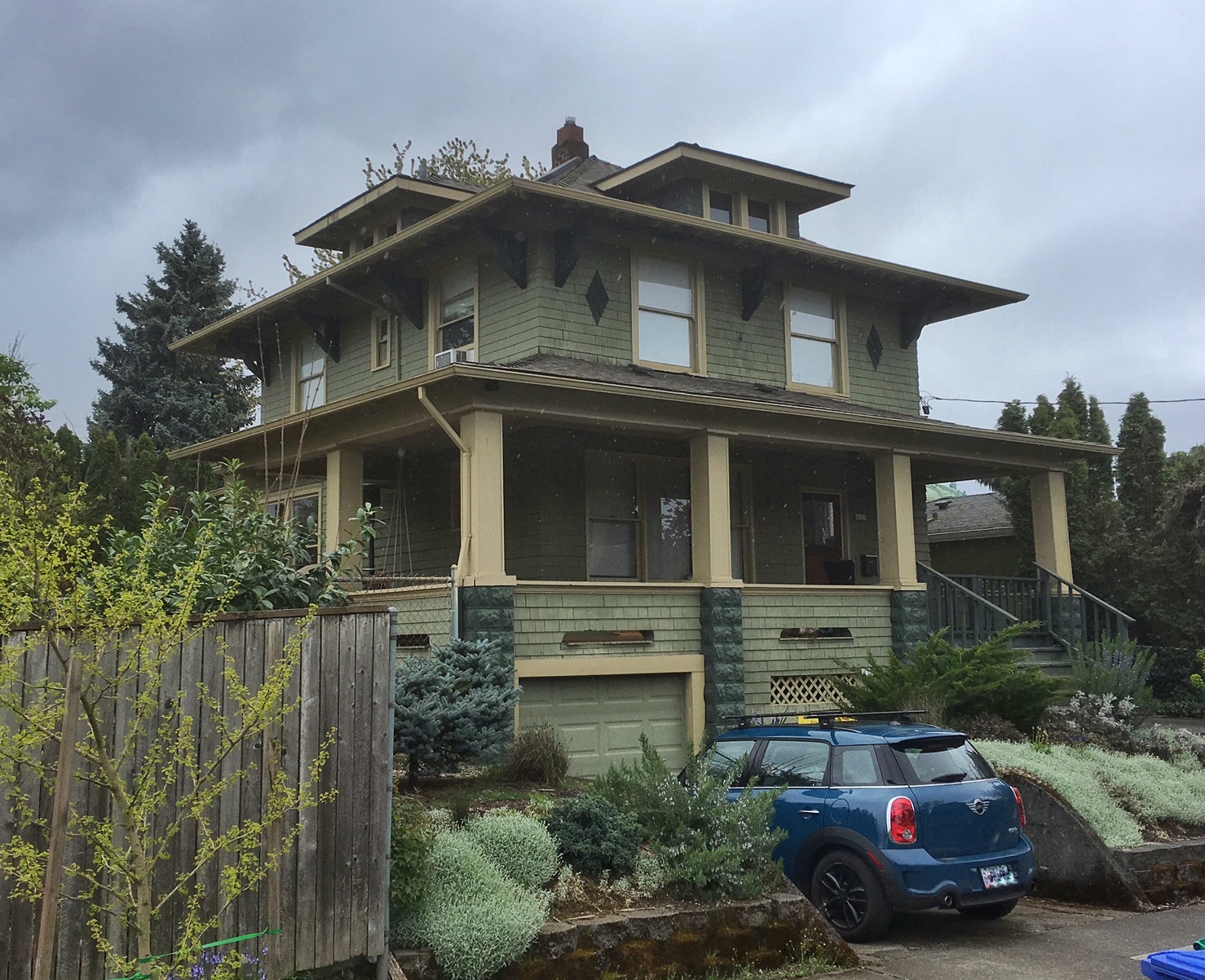
We love this old newspaper advertisement placed in the Oregon Journal on October 25, 1908 by developers of the Vernon addition. Imagine: $1,000. The house was built in 1907 for O.G. Goldberg.

Here’s the Goldberg House today:


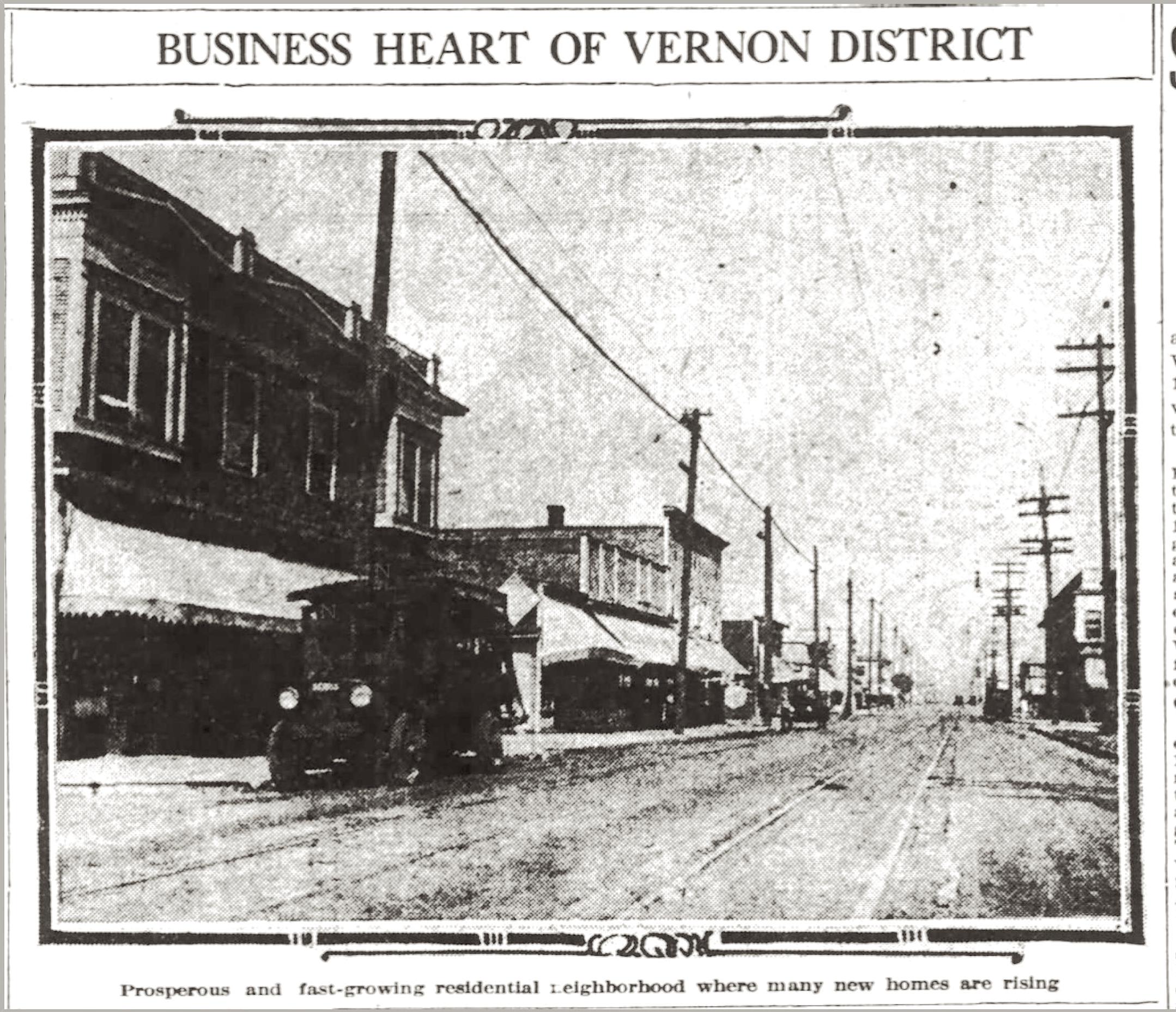
And here’s another great pair, just a few blocks north, this time looking at the heart of the Vernon business district, from the Oregon Journal on October 30, 1920. Check out the streetcar tracks and overhead lines.

And today:

Looking east on Alberta at NE 16th Avenue, April 2018. The distinctive building on the northeast corner (left) was built in 1909 during the rise of the Vernon-Alberta business district.

Some of our favorite stories are from Vernon: the ghost of Old Vernon and its practice houses, the Alberta Streetcar, the mystery of Crane Street, Alberta storefronts, Alberta Park, opposition to (and even arson at) the new local fire station. So many stories to tell, including an upcoming post that shares the intriguing real estate drama about how Vernon almost didn’t become Vernon. Stay tuned.


Alberta Lodge: Rescued and revived

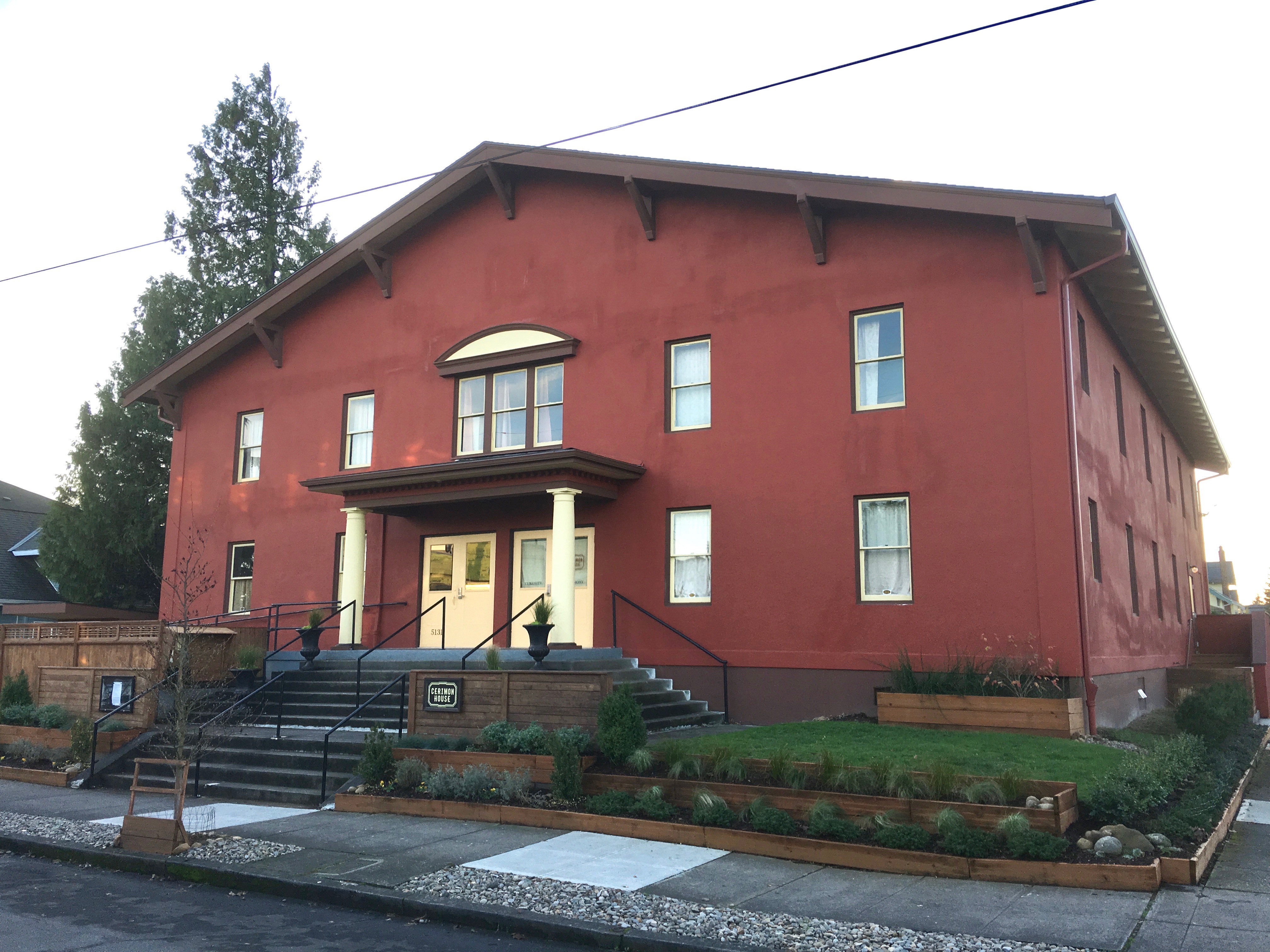
Walking and wondering about history go hand-in-hand, especially here in Northeast Portland. On a recent adventure down Concordia neighborhood alleys, we came across a distinctive building at the corner of NE 23rd and Sumner that made us wonder: what was that? Too big to be a family house; too small and house-shaped to be an apartment building. Maybe you’ve seen this and wondered too. Take a look:

5131 NE 23rd Avenue

When you stand and stare for a moment, many possibilities come to mind: hostel, church, school, chalet, rooming house, theater. Hmm, what could it be?

How about fraternal lodge?

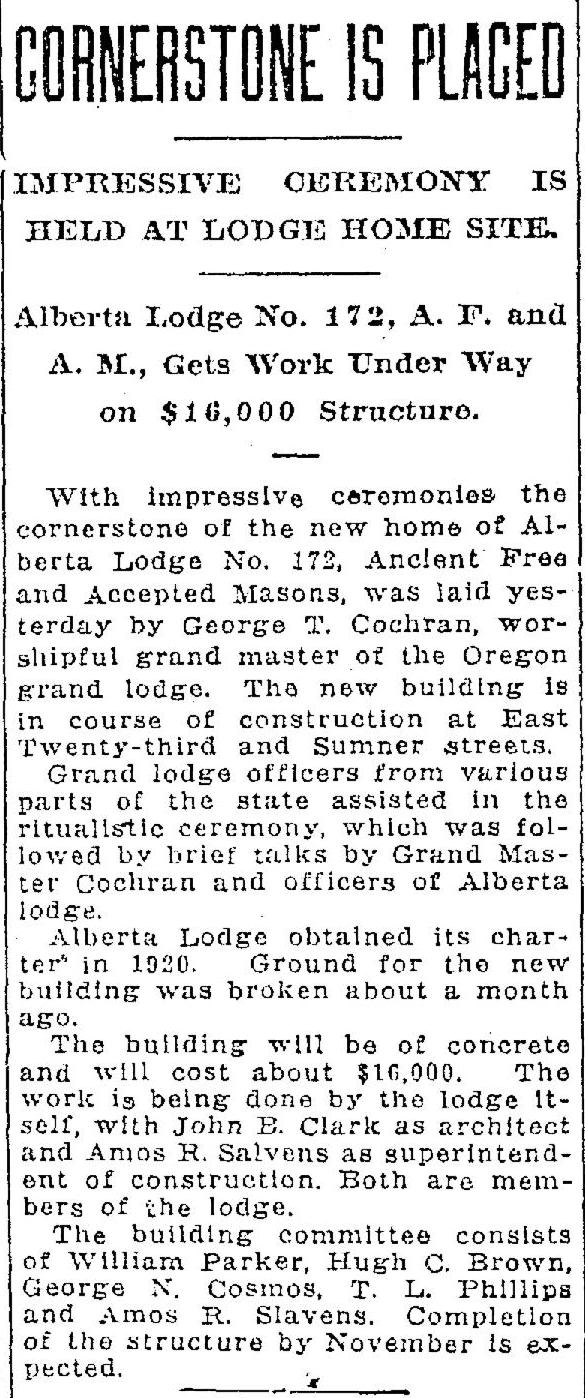
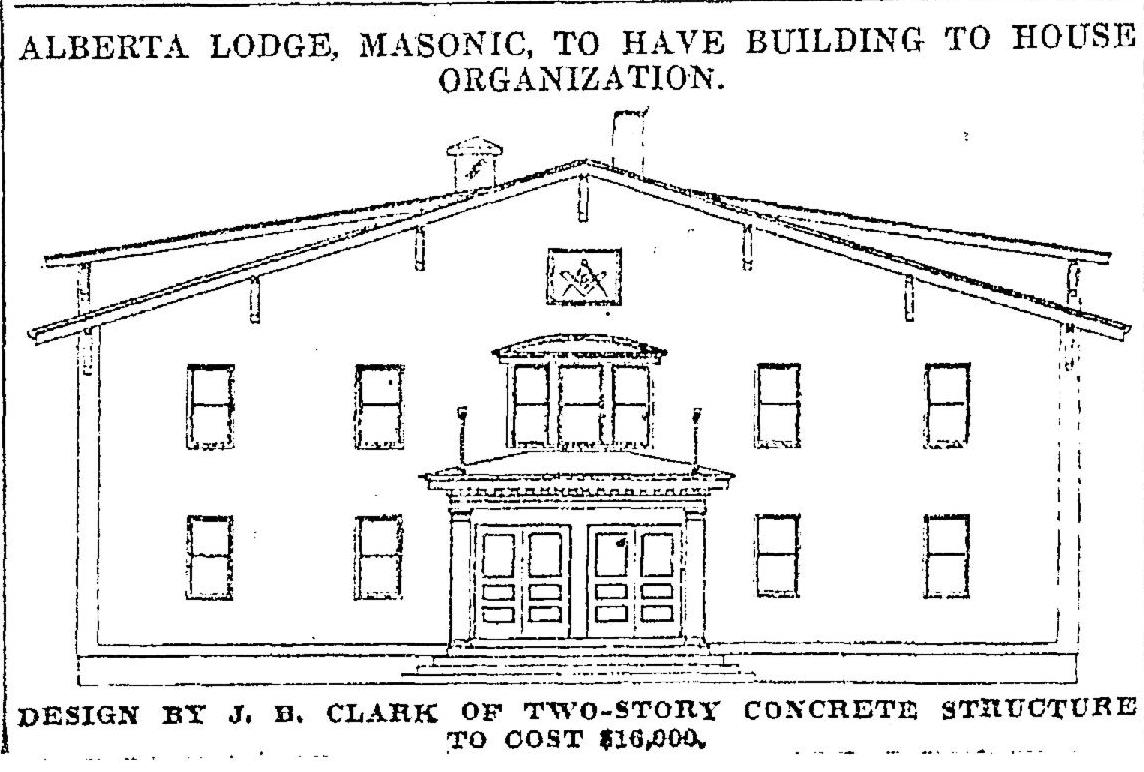
Yes, the two-story, bracket-eaved old beauty was purpose-built in 1923 as the home of the Alberta Lodge Number 172 Ancient Free and Accepted Masons. Here’s the news from July 1923 about the ceremonial placing of the cornerstone, and a construction rendering of the building:

From The Oregonian, July 8, 1923


Those big gable-ended walls at front and back: they’re made out of concrete, formed and poured in place (all four walls are concrete, making moving a window or door no simple task, just ask the current owners). Inside, there were small rooms and chambers for the various aspects of the secret Masonic rites, and a beautiful theater-like gathering space. A kitchen, offices, cloak rooms.

During its heyday, the Alberta Lodge No. 172 had 450 members and was jammed busy on multiple nights each week, often with a ceremony and the many social gatherings that preceded or followed: picnics, breakfasts, dinners, work parties.

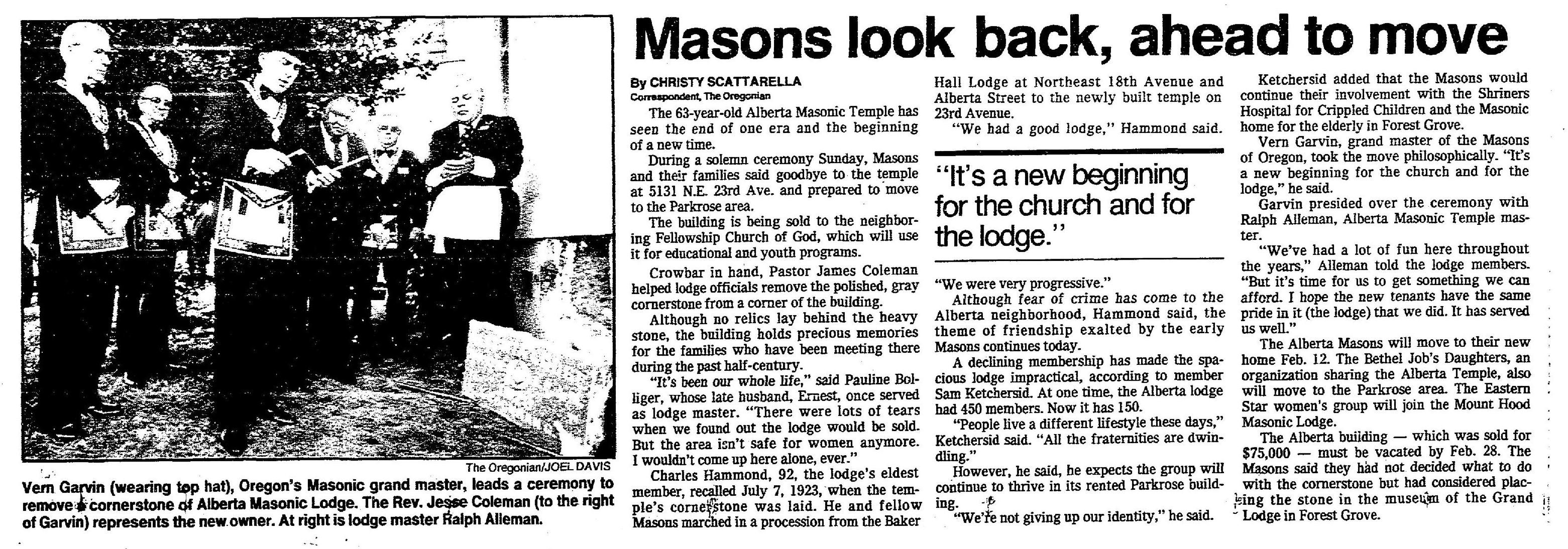
In 1986, with Lodge membership dipping to just 150 members—most of them senior citizens—the Masons decided to sell the building and consolidate several other shrinking lodges under one roof in Parkrose. Masonic elders came to reclaim the ceremonial cornerstone and extinguish its service in one last ceremony. A January 14, 1986 news story in The Oregonian quotes the wife of one former Alberta Lodge leader: “It’s been our whole life.” Another, reflecting on our changing society: “People live a different lifestyle these days. All the fraternities are dwindling.”

Click to enlarge. From The Oregonian, January 14, 1986. 

Following its time as a lodge, the building was the Fellowship Church of God until 2005 when that growing community moved first to the Doubletree Hotel near Lloyd Center then to a new and larger facility on NE 122nd. The space was rented on and off for several years, and served as the home of Heaven Bound Deliverance Center before slipping into receivership and an accumulated ocean of deferred maintenance.

That’s where current owner Randall Stuart and his colleagues found it during their search for just the right building to serve as a convening space for art, theater, music, learning and community.

The 8,000-square-foot concrete building was headed for demolition when Stuart and his team purchased it in 2013 launching a two-year renovation effort that involved restoring virtually every surface and moving part in the place. And then some: new interior walls and spaces, including a major interior stairway; an ADA ramp and exterior access; outdoor spaces and landscaping; a total overhaul of building systems.

Prior to finding the Alberta Lodge, Stuart and his colleagues had formed the foundation that now runs it: Cerimon House is a 501(c)(3) humanities organization dedicated to creating and celebrating community through arts and humanities.

“It’s definitely been a labor of love. Our board is very proud of saving the building and keeping it aligned with a fellowship mission” he says, tipping his hat to the generations of Mason families who have gathered in the space.

Today, the old Alberta lodge building is definitely back to life as gathering space for art, music, readings and lectures—and lots of other interesting events, including weddings, meetings and family gatherings (the space is available to rent). Stuart invites neighbors who want to see inside Cerimon House to book a tour online at the website or take a virtual tour to learn more: www.cerimonhouse.org

“Our old synagogue of blessed memory”

We’ve been exploring the history of a 110-year-old building in the Vernon neighborhood at NE 20th and Going, once home to Congregation Tifereth Israel, an eastside Jewish community, and then to several African American Christian congregations.

We’ve always been interested in transitions between building uses and occupants: what creates them, how they go, how people feel and react, what happens after.

In this case, the transition from Jewish synagogue to African American church brought out the best in the respective religious communities, but was a low-water mark for enlightenment in the neighborhood, which shouldn’t really come as a surprise given Portland’s troubled history of official and unofficial racism.

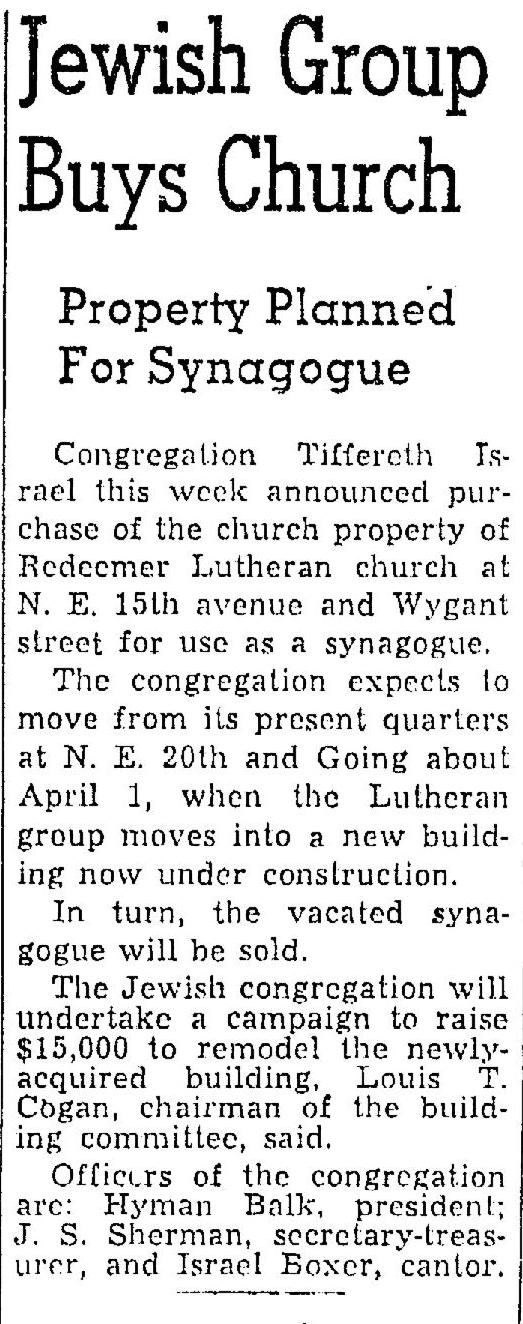
The Tifereth Israel community had its roots in Russia and the Ukraine. Many of its earliest members were immigrants who fled discrimination and violence there at the turn of the last century. As families became established in Portland, and new generations came along, the Tifereth Israel community grew to a point where they needed more space than the 1,000-square-foot Alberta Shul could provide. Congregation leaders—many of whom lived in the surrounding neighborhood—focused on a slightly larger building at NE 15th and Wygant, which was then the Redeemer Lutheran Church, a community that was about to move out and up to provide space for its own growing membership.

In December 1951, Tifereth Israel leaders announced they were going to buy the nearby Redeemer Lutheran building, and sell the Alberta Shul:

The Oregonian, December 29, 1951

___

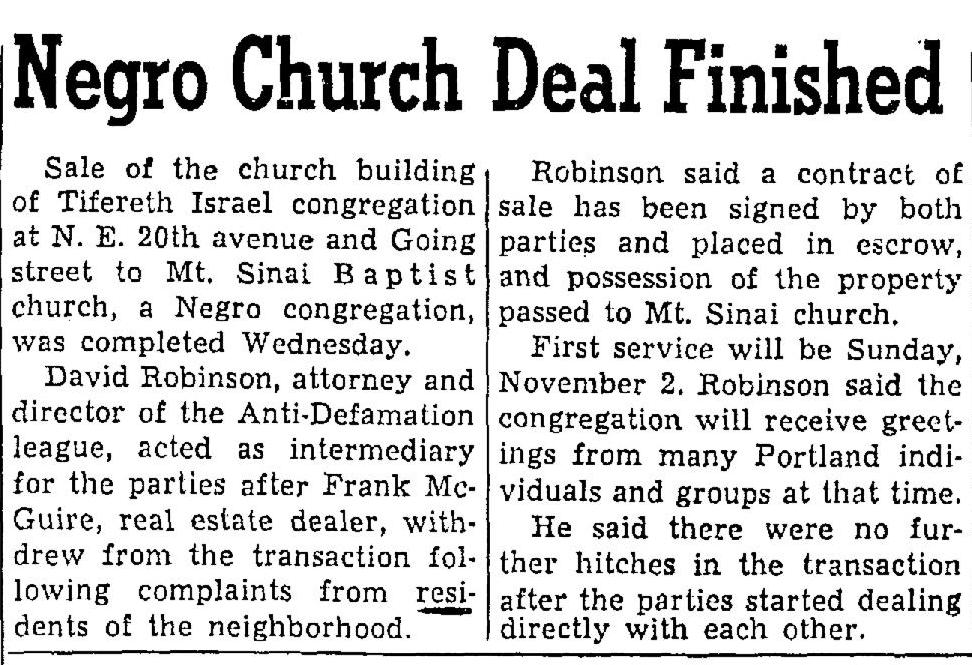
The move to the new venue apparently went fine, with services starting up there in 1952. But things got complicated that fall when the empty Alberta Shul went up for sale. Another growing church community, the Mt. Sinai Community Church, made an offer on the former synagogue, which ignited concern in what was then a mostly white neighborhood.

The realtor handling the sale dropped the deal like a hot rock once the neighbors started to push and as they were quoted in the newspaper with thinly-veiled reasons for opposing the African American church, which had gone out of its way to keep the peace in the neighborhood. Read this next story carefully.


The Oregonian, October 8, 1952

___

Tifereth Israel leaders and others stepped in when the real estate agent stepped out, and the deal went forward.

The Oregonian, October 10, 1952

Lest you think this was just a real estate transaction for an empty building, have a look at the following passage of a letter from Tifereth Israel leaders to real estate agent Frank L. McGuire, which reads as true and important today as it did in the 1950s.

At the time said agreement was entered into, this congregation had no knowledge of the purchasers other than their name and that they were a Christian congregation. Later it developed that the members of Mount Sinai Congregation are Negroes and pressures have been put upon us to back out of the deal for no other reason than that the purchasers, though Christian, are also Negro.

We regard such pressures as being violative of the principles of Americanism, of Judaism, of Christianity and of common decency…Man has no dearer right than the privilege of worshiping God in his own way. To deprive any group of people of the right to meet and to worship merely because God chose to make them a part of the colored majority of mankind is repulsive to Americans who love their country and the great principles of democracy which distinguish our land from the totalitarian states wherein liberty and religion are destroyed.

In welcoming our colored brethren to our old synagogue of blessed memory, we are mindful of the quotation from Hebrew scripture, “Have we not all one Father; hath not One God created us?” We hope that they also will find God within its walls and that He will answer their prayers and ours that He teach us “to love one another.” In the event you refuse to close the sale, we desire to be released from our listing agreement so that we may ourselves consummate the moral agreement we have entered into.


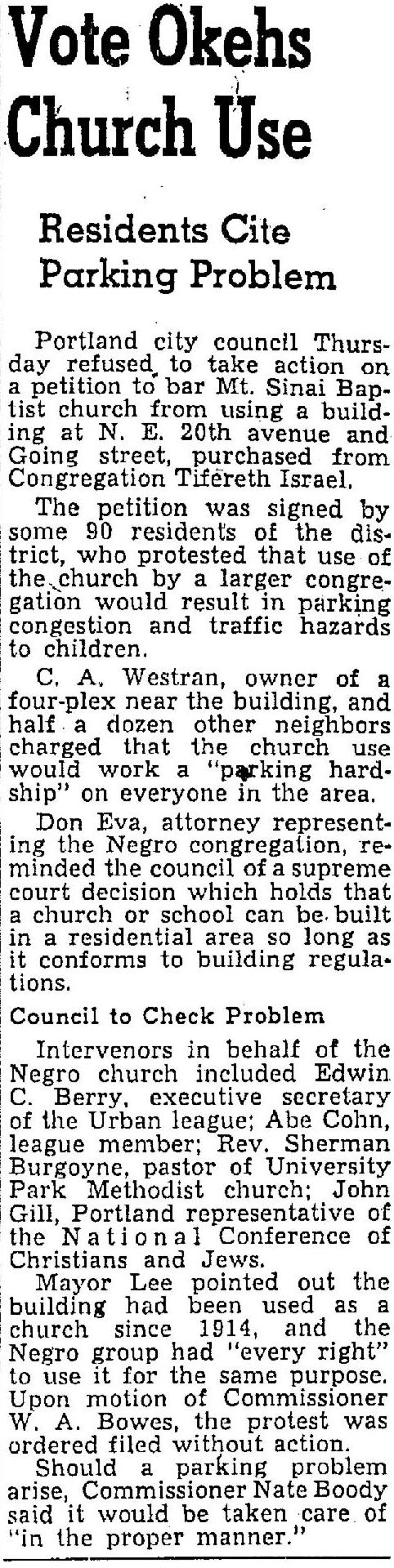
Irate the deal was progressing, neighbors upped the conflict further by taking a petition signed by 90 residents to City Hall. Portland City Council refused to take it up.

The Oregonian, October 24, 1952

Even thought the Alberta Shul transition did go forward, deep currents of racism were affecting Northeast Portland neighborhoods, home mortgage lending practices and individual real estate transactions. The Tifereth Israel letter, written by elders who had survived generations of their own discrimination, encouraged a higher ground.

We’d like to learn more about Mt. Sinai Community Church and to hear from any who have known this building in the past.

Restoring a hallowed neighborhood building: The return of Alberta Shul

Past and present are on course to connect in a humble 110-year old building on the southeast corner of NE 20th and Going in northeast Portland’s Vernon neighborhood.

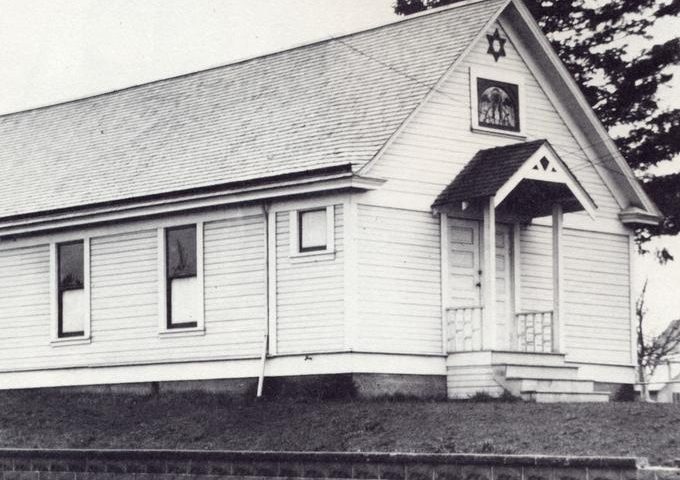
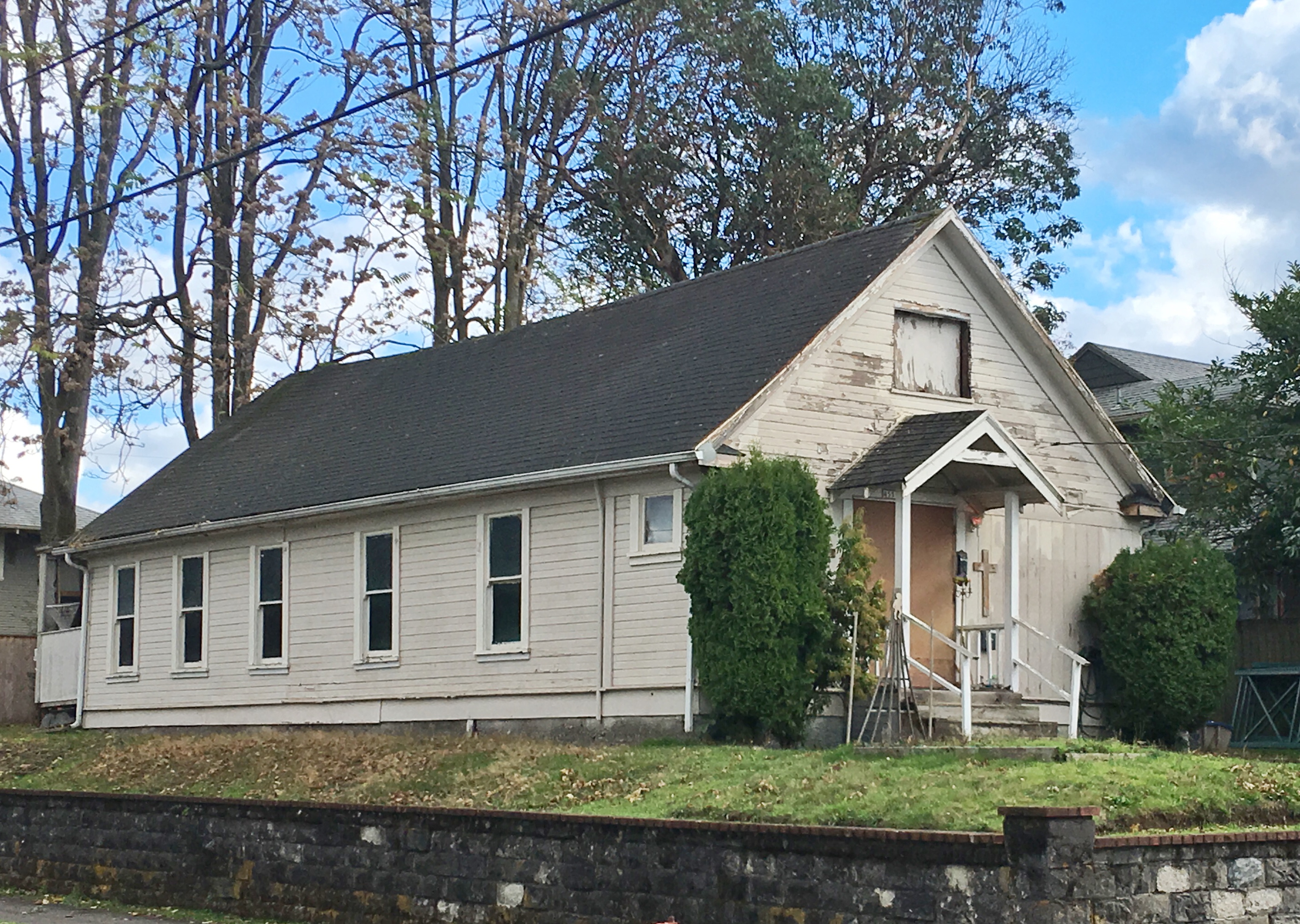
This long, narrow, white clapboard-sided building was built in 1907 and purchased in 1914 by Tifereth Israel, an Orthodox Jewish congregation with roots in Russia and the Ukraine. Later it served as an African American church.

This undated photo shows Tifereth Israel, a synagogue from 1914-1952. The building later became home to several African American church congregations, and most recently an art gallery and studio. A group of Jewish community leaders is now working to purchase and restore the building. Photo courtesy of University of Oregon—Building Oregon Collection.


The building in November 2017. Developers have been eyeing the corner lot for a tear-down. The Alberta Shul Coalition has secured an agreement with the current building owner to purchase and restore the 110-year-old building.

We bet you’ve seen the old building’s patient but somewhat tired grace, just west of the Vernon Practice House (from Old Vernon fame). Clearly not a residence, it presides over the intersection from its corner height.

Originally the center of Jewish life for a small handful of families on Portland’s eastside–many of whom lived within walking distance–the congregation expanded over the years to include up to 100 families. Known during those early years as the Alberta Shul (a Yiddish word meaning a place of study and prayer), the building drew together the eastside Jewish community. By the early 1950s, Tifereth Israel had outgrown the building, so the congregation purchased and moved into the former Redeemer Lutheran Church at NE 15th and Wygant.

From 1952 until the early 1980s, the building was home to several African American congregations, including the Mt. Sinai Community Church. In 1980, when it was sold to its current owner, the building was rented out for various purposes including religious gatherings and then eventually as storage space. In 2010 it became home to Xhurch (its current incarnation) a gathering and workspace for resident artists and musicians.

When the property was placed up for sale in 2016, members of Portland’s Jewish community learned of its availability—and its history—and began to organize an effort to purchase and restore the building. Their purchase proposal was in competition with developers interested in tearing it down and redeveloping the site, but the current owner was intrigued with the restoration project and has since entered into a contract with the coalition for purchase.

Today, the Alberta Shul Coalition is raising funds and support to transform the building back to its earlier role as a place for meeting, learning, community and prayer for the eastside Portland Jewish community. [Editor’s note: that effort from 2018 was not successful].

Eleyna Fugman is one of the founders of the growing coalition. Her vision is for a special, simple gathering place for local Jewish residents to connect through a variety of community-driven programming, as well as a space that northeast neighbors could rent and use for meetings, classes and events.

“The fact that we could work, play and practice in a building that our ancestors built and made into a Jewish home is very important,” says Fugman. “There are many young Jews who are looking for a place to be Jewish, who are yearning for Jewish community in some format.” The coalition’s vision is that Alberta Shul can be a cultural venue for Jewish art, music, learning, and gathering as well as a place for traditional and alternative religious services and prayer.

The coalition is interested in gathering insights about the history of the building and the generations of families who knew it first as a synagogue and then later as a church. During its years as a synagogue, the 1,000-square-foot building drew people from many areas east of the Willamette River, including neighbors who lived just across the street, and some who came from as far away as Oregon City.

As we’ve seen, the Alberta business district exploded about the time this building was built, and Going Street was known for its neighborhood mom-and-pop grocery.

Eleyna Fugman is intrigued with the eastside presence of a vibrant Jewish community during those days, notable since the most established Jewish neighborhoods—and largest synagogues and congregations—were in south and southwest Portland.

Rosters of past Tifereth Israel members—which can be cross-referenced against city directories from earlier years—can help better illuminate the presence and extent of Portland’s eastside Jewish community. Some original records and other items survive from the early days and were saved when Tifereth Israel was absorbed into northwest Portland’s Congregation Shaarie Torah  in the 1980s. Stories and memories are beginning to emerge. The Alberta Shul Coalition has begun to find and meet a handful of former Tifereth Israel members who recall the building and its community.

The current building resident, Xchurch’s Matt Henderson, has been in touch with pastors from the building’s days as an African American church, and has helped connect and open conversations with members of the Alberta Shul Coalition. The coalition is interested in knowing more about the transition from synagogue to church, which was strongly supported by the Jewish community at the time and which created consternation in the then largely white neighborhood (more on that in next week’s post, which will open a window into the subtle and not-so-subtle racism and discrimination of the mid 1950s).

We had a chance to visit the building recently and found some tantalizing clues to its former lives:

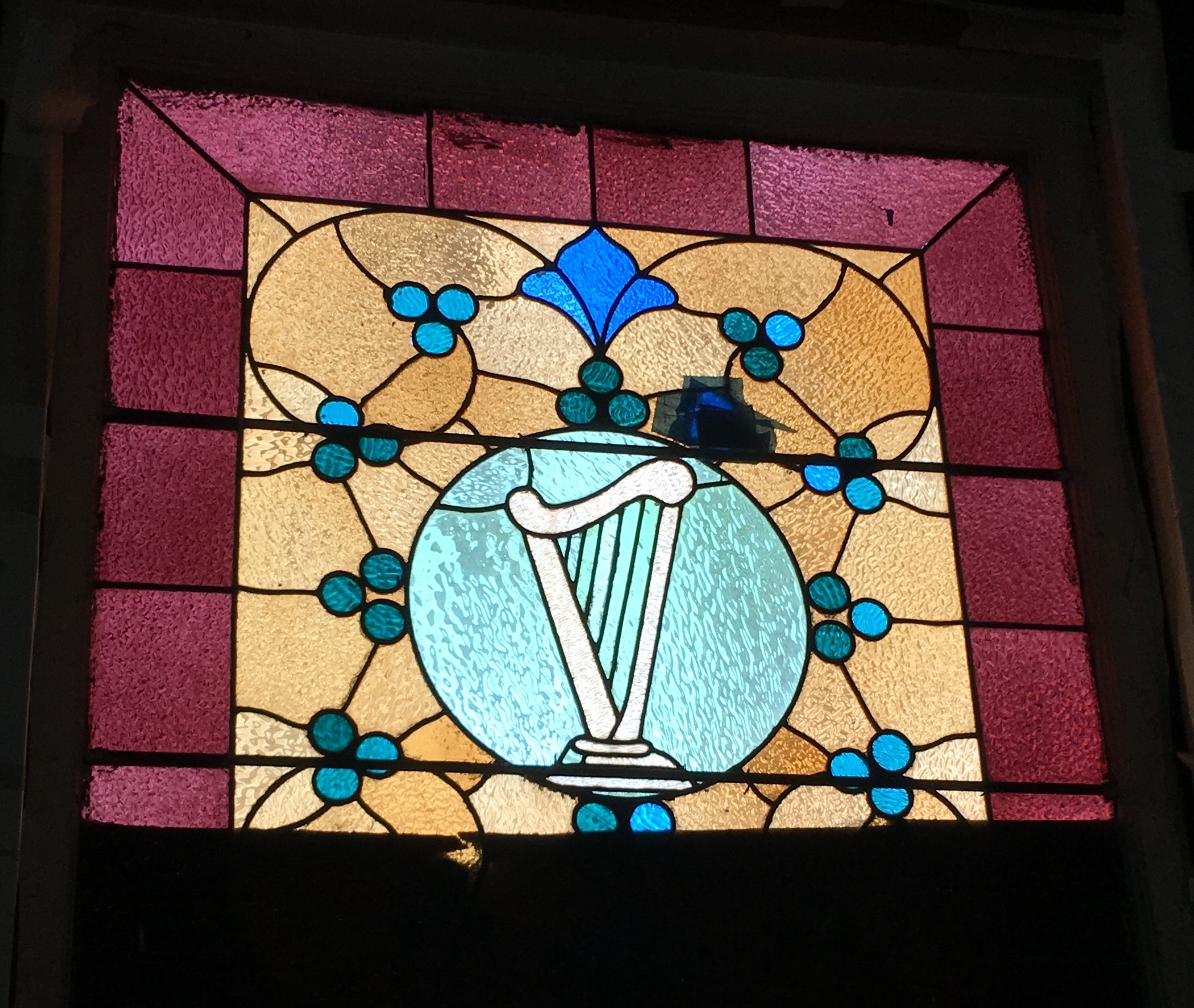
A stained-glass window in the eastern wall. Alert AH reader Robert Stoltz recognizes this as the Harp of David, a metaphor from Jewish tradition for physical and emotional health and healing. We’re working on understanding the un-accounted for seven years between 1907-1914 and how this building started its life, stay tuned for more on this. It’s pre-Great Renumbering street address was 972 East 20th Street North.


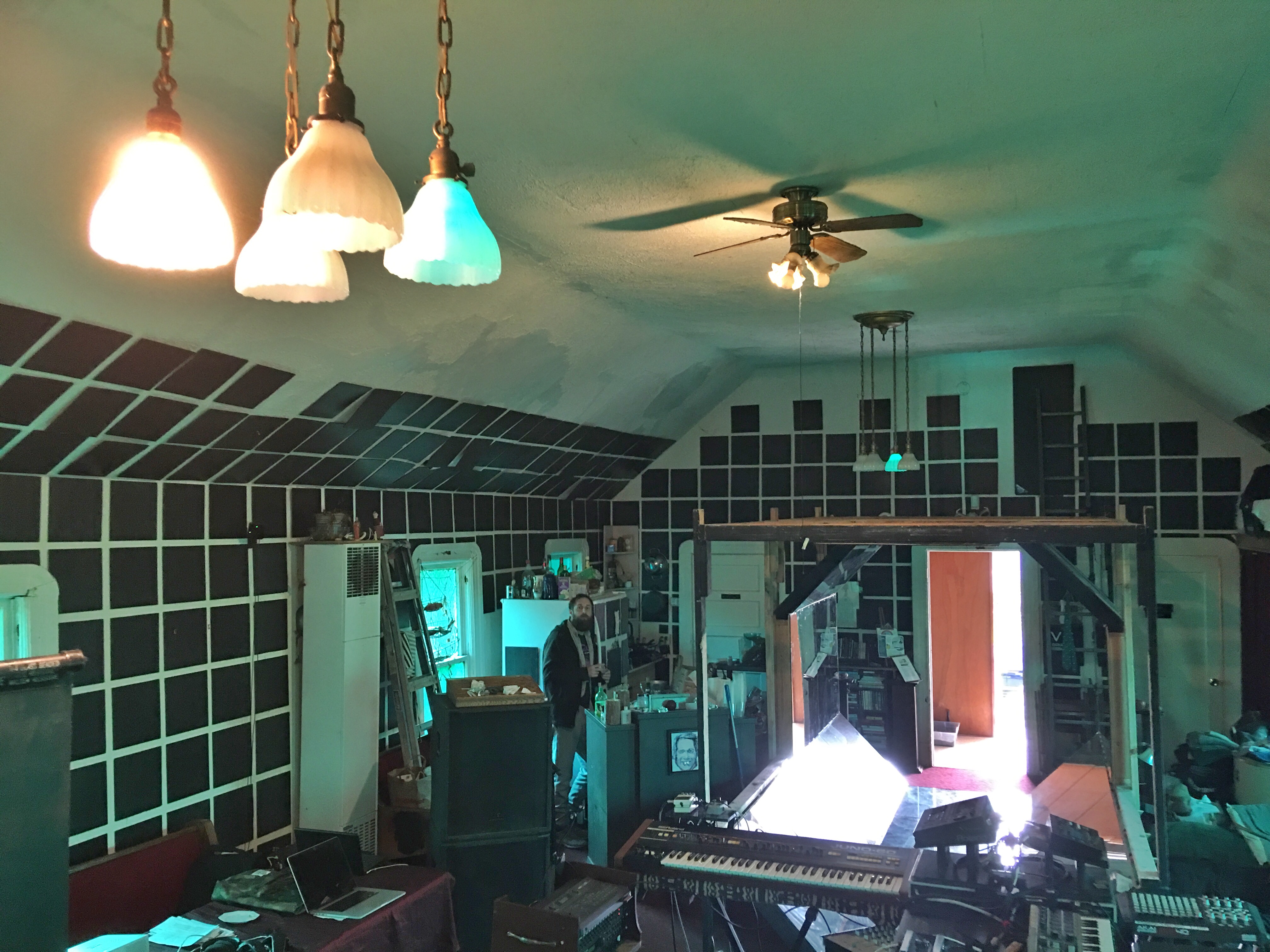
An interior that is alive at the moment with Xhurch art and music. The windows are tinted green producing an interior glow. Check out the original light fixtures with hanging chains and shades (the fan-fixture is relatively new). Not pictured here is a raised platform or bimah that may have also held the altar in later years. Original? Maybe. 


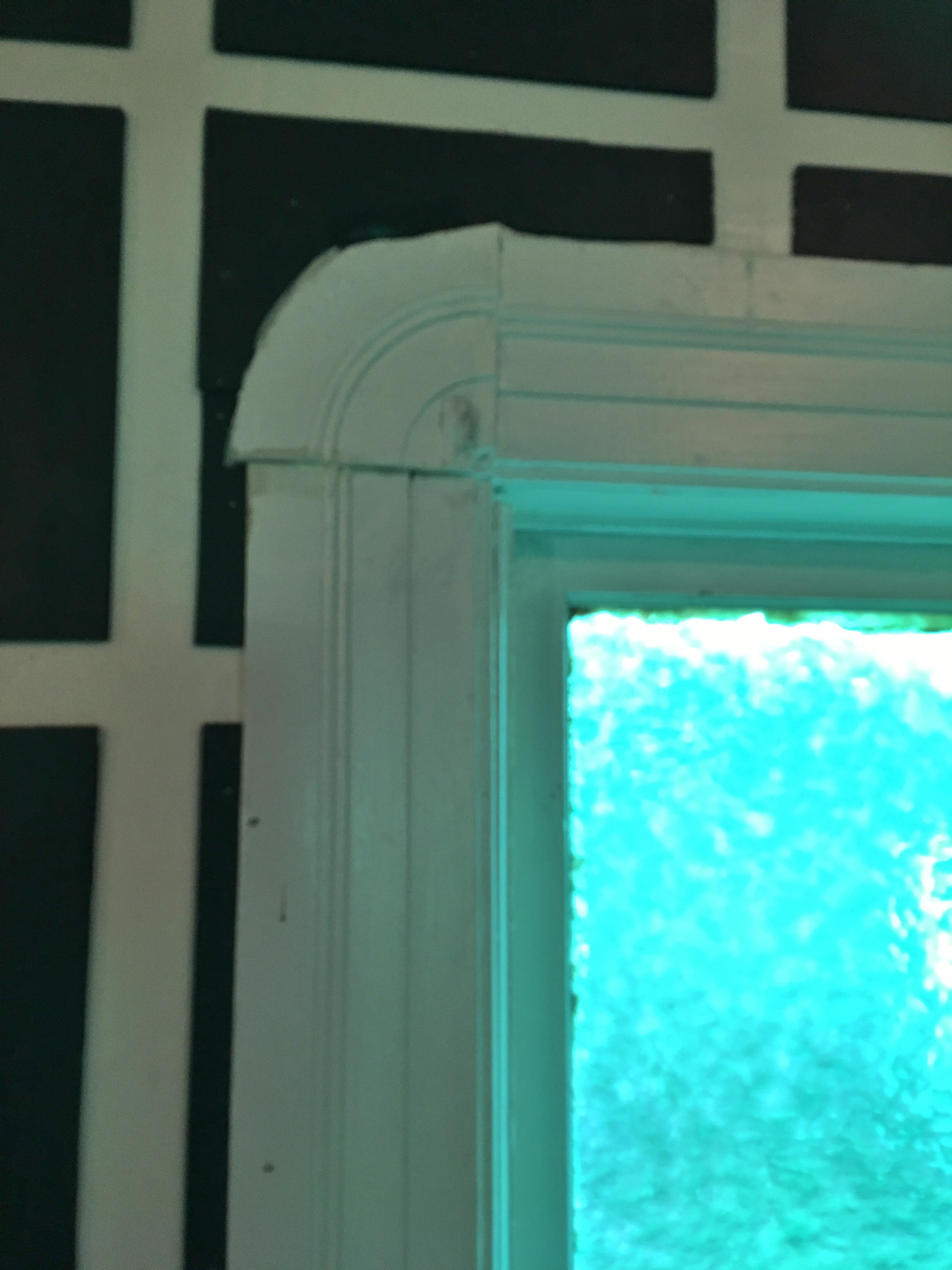
Beautiful and unusual rounded window trim, unlike anything we’ve seen in a building of this era. We’ve had a quick look at several interior photos from the 1950s (hoping to be able to share those here soon) that also show this distinctive woodwork. Could the trim have been original? Five windows in the north wall, five in the south wall—and interior doors—all similarly trimmed out. And all frosty green.


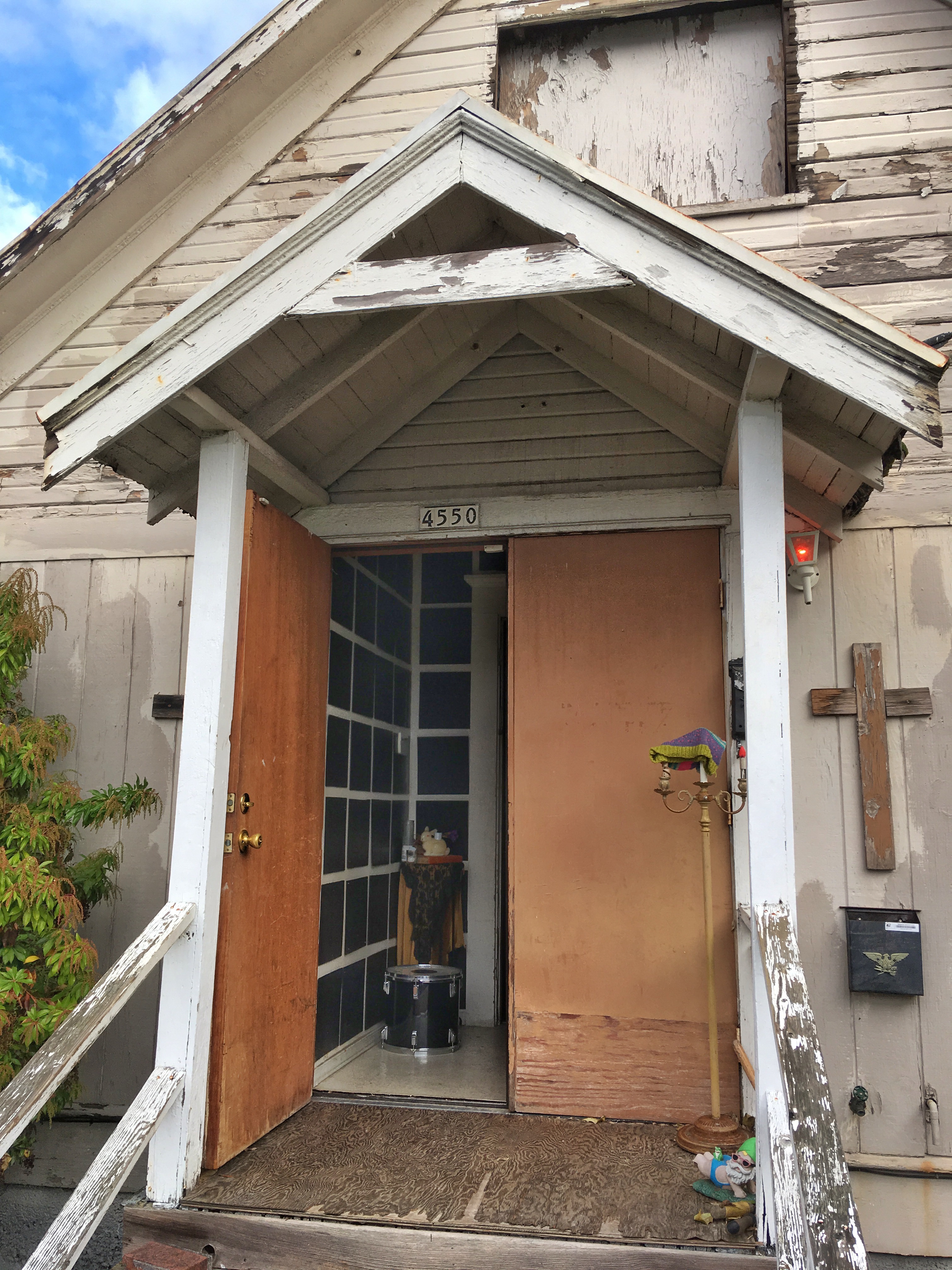
The entry, featuring weathered crucifixes from earlier years, a new grid of tiles from the Xhurch days, and clear indications of the restoration work necessary to upkeep the siding, trim, stairs, fascia boards and soffits, roof and just about everything else. Fortunately the building does not have a basement: no downstairs foundation walls that need to be shored up.

Next up: The transition between synagogue and African American church in the 1950s brought out the best of both religious communities, but the worst of the neighborhood.